
I. Introduction
Gait analysis is the well-ordered study of human walking patterns, focusing on the locomotion of the lower limbs [1]. It involves measuring and analyzing the movements, body mechanics and muscle activity during walking. Variations in gait patterns suggest significant fitness information that might be utilized to evaluate or analyze people with pathological circumstances that impact their gait and the health of their entire biomechanical system [2]. Traditionally, a human observer would analyze a person’s gait. However, this was enhanced with video capture, which allowed for a slower-motion inspection of the film to enable a more precise evaluation of the gait cycle. These days, qualitative analysis is still a widely utilized method. However, this approach is inaccurate, labor-intensive and demands a trained physician. Human gait analysis holds profound implications for rehabilitation strategies [3], stroke survivors [4] and advancements in robotics [5]. Traditionally reliant on intricate marker-based motion capture (MoCap) systems [6], gait analysis is undergoing a transformative shift with the advent of pose estimation models. These cutting-edge models provide a nonintrusive and cost-effective means to precisely determine spatiotemporal gait parameters [7]. These parameters are valuable clinical tools for assessing a wide range of conditions affecting the musculoskeletal and neurological systems [8]. They play a crucial role in clinical assessment, including disease management [9], joint replacements [10], muscle weakness or imbalance [11], pain assessment [12], early detection of dementia [13] and sports medicine [14].
Many applications of cyber-physical systems, including athlete assessment [15], fall detection [16], prediction of potential movement disorders [17], feedback for patients undergoing therapy and a host of additional augmented and virtual reality uses, depend on gait analysis. Because of this, a lot of recent research has concentrated on estimating step length, a crucial component of gait analysis, using wearable sensors [18, 19]. Anderson et al. [20] present a novel ultra-wideband-based foot-mounted sensor system for mobile gait analysis. One Xsens MTI300 inertial measurement unit (IMU) sensor is placed on the subject’s pelvis to determine step length [21]. Abbasi et al. [22] proposed an algorithm that combines IMU, magnetometer and Kinect for step length estimation.
The significance of spatiotemporal gait parameters, including step length, speed and cadence, lies in their ability to unveil intricate details about an individual’s walking patterns. Whether for clinical diagnostics, rehabilitation or sports performance analysis, these metrics are essential for comprehending and evaluating gait patterns. They are widely used because they offer a thorough picture of a person’s gait, which is crucial for identifying anomalies in gait, organizing rehabilitation and assessing the effectiveness of treatment. The present study focuses on determining three important spatiotemporal gait parameters, which include:
Step Length: Shortened step length can signify balance issues or lower limb weakness [23].
Gait Speed: Often used as a general indicator of mobility and functional status [24]. Slow gait speed can indicate underlying health issues or risk of falls [25].
Cadence: Helps in identifying rhythm abnormalities, which can be indicative of neurological or musculoskeletal disorders [26].
As mentioned above, these parameters are useful in assessing human health, especially for the elderly population. Therefore, accurate measurement of these parameters is essential in real-time to support the telemedicine and rehabilitation strategies.
MoCap systems necessitate a considerable investment in specialized hardware and software, which limits their accessibility. They require meticulous setup and calibration within a controlled laboratory environment and are susceptible to errors caused by marker placement sensitivity, skin movement artifacts and occlusion [27]. This artificial environment may not accurately represent natural gait. Additionally, obtaining biomechanical insights is a lengthy process due to the extensive processing time required for intricate data modeling. These factors render MoCap impractical for real-world applications, long-term monitoring or regular clinical use outside of specialized laboratories, and the need to wear multiple markers can be intrusive.
Wearable sensor technologies, such as IMUs, address environmental constraints by providing a portable solution for analyzing gait in real-world settings [28]. However, requiring participants to wear several sensors may lead to discomfort or affect their natural walking patterns, especially for the elderly population [2]. These systems also encounter fundamental accuracy issues, including sensor drift over time, dependence on exact positioning, vulnerability to magnetic interference and challenges in achieving the spatial precision found in lab-based MoCap. Although they eliminate the complicated setup associated with MoCap, analyzing sensor data for biomechanical information still demands considerable computational resources and advanced algorithms, and technical limitations can impact the reliability of intricate measurements.
Researchers now have the chance to use deep learning-based human pose estimation techniques, which can identify the locations of human body joints from a given video or image in 2D or 3D [29], thanks to recent advancements in the field of artificial intelligence (AI). There is insufficient gait data available in the current smartphone applications for self-health monitoring. Human posture key points can be instantly identified on computing devices with limited resources, such as smartphones and Raspberry Pi (RPI) devices [30]. This raises the possibility of using effective measuring techniques for the vision sensor data in the design and development of computationally demanding applications [31] on computing machines with limited resources. The fusion of mobile camera and 5G connectivity is poised to revolutionize chronic disease monitoring and remote care [32]. High-fidelity gait data—including parameters such as stride length, cadence and symmetry—can be instantly uploaded to mobile edge computing (MEC) servers for analysis using advanced machine learning (ML) and AI algorithms. This architecture minimizes on-device power consumption and allows for complex, centralized processing, generating highly accurate and personalized insights for clinicians. The ubiquitous nature of 5G networks facilitates seamless data collection in a patient’s natural environment, overcoming the “white coat effect” where gait patterns might be altered under clinical observation. Consequently, 5G-enabled mobile gait analysis promises to lower healthcare costs, enhances patient autonomy and provides more clinically relevant, habitual data for personalized treatment plans in physical therapy, orthopedics and geriatrics [33].
Despite recent advances in markerless gait analysis, existing studies either lack validation against clinical gold standards or do not address real-time deployment in remote healthcare settings. This work addresses both limitations.
a. Contributions
Accurate assessment of spatiotemporal gait parameters is essential for evaluating mobility and diagnosing gait-related disorders such as slow speed, short step length and rhythmic abnormalities. This study is the continuation of the human gait pattern analysis system (HGPAS) [30] for determining the spatiotemporal gait parameters. The developed system can run on resource-constrained computing devices such as smartphones and RPIs, utilizing built-in vision sensors. It estimates step length, speed and cadence with the help of a pose estimation model called MediaPipe Pose (BlazePose) [34], without attaching any wearable sensors to the body.
The proposed framework employs the MediaPipe Pose (BlazePose) model for full-body human pose estimation. Although the model estimates 33 anatomical landmarks, only the left and right ankle keypoints are utilized for heel-strike detection and gait parameter estimation such as step length, speed and cadence. This selective use of relevant landmarks reduces downstream computational complexity while preserving the accuracy of gait event detection. The system is validated using videos from the MoCap dataset [27], and the estimated gait parameters are compared against the corresponding ground-truth measurements.
Once the poses are captured, this study developed a specialized pipeline featuring step detection algorithms and the extraction of spatiotemporal characteristics such as stride length, cadence and gait speed. This is specifically designed for recognizing gait patterns in real-time, utilizing the 5G architecture (Figure 1). These elements were not present in the original BlazePose or MediaPipe frameworks.
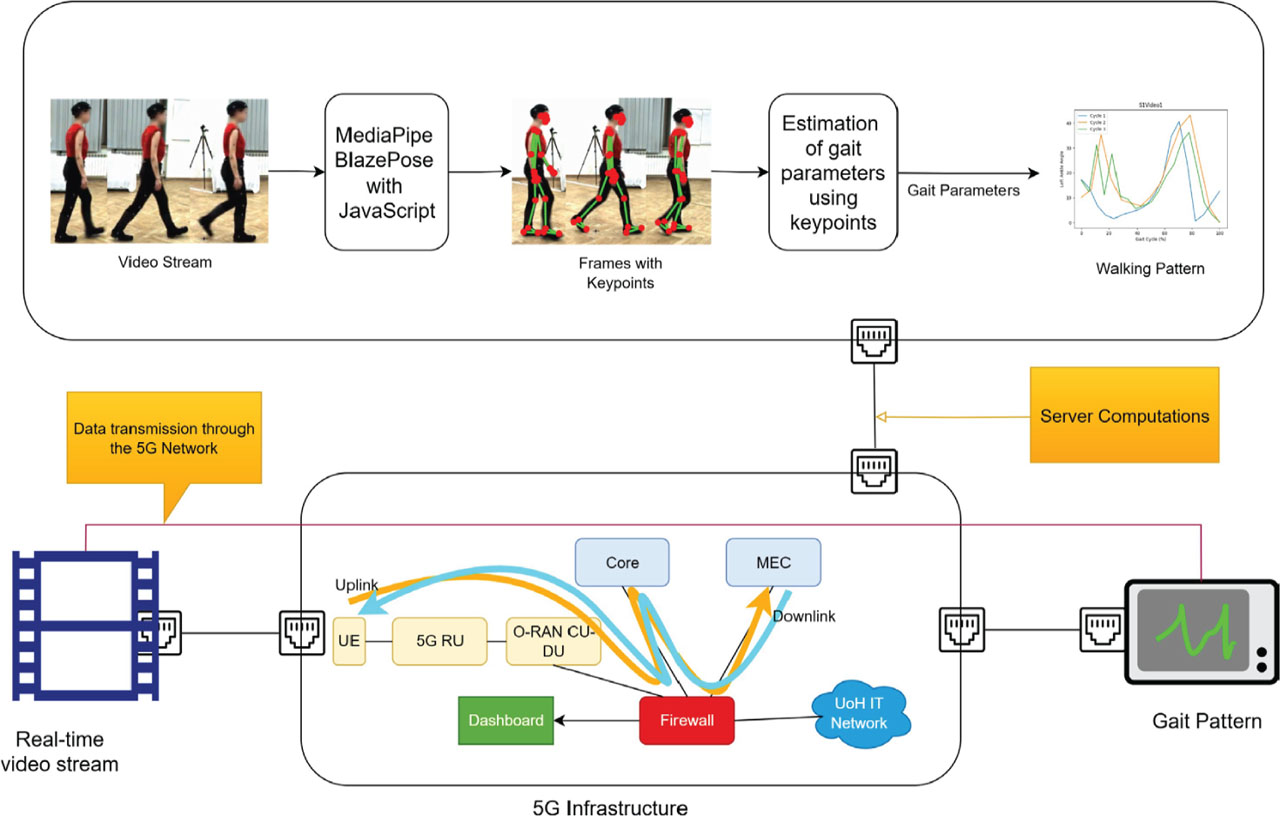
Figure 1:
Processing pipeline of the developed system. UE, user equipment.
Although BlazePose provides robust human pose estimation [34], it does not directly perform gait analysis or clinical parameter extraction. The proposed framework extends BlazePose by introducing an ankle-based gait event detection pipeline, spatial gait parameter estimation, real-time 5G-enabled transmission and validation against motion-capture reference data. The framework enables markerless and wearable-free gait assessment using commodity smartphones, making it suitable for remote telemedicine applications.
The main contributions of this study are as follows:
A non-wearable, smartphone-based gait analysis framework for extracting spatiotemporal gait parameters using 3D pose estimation.
A quantitative validation of the proposed system against a gold-standard MoCap system and real-world hospital data.
A real-time, 5G-enabled architecture supporting remote gait assessment in telemedicine settings.
b. Outline
The rest of this paper is organized as follows. Section II discusses the experimental setup and the estimation of gait parameters. It also discusses the justification of the methodology implemented. Section III presents findings and analysis of gait data from elderly patients in real-time hospital settings. The performance comparison between the HGPAS and the MoCap systems is explained in Section IV. The performance of the HGPAS system on the 5G network infrastructure, including core functions flow and key 5G network performance parameters, is discussed in Section V. The validation of the HGPAS system is summarized in Section VI. Finally, Section VII concludes with a summary of the HGPAS system and the potential future directions of the project.
II. Methodology
a. Experimental setup
The backend, deployed on a 5G MEC server, is implemented using FastAPI and includes a Uvicorn WebSocket server to facilitate low-latency data exchange. Upon receiving the JSON data, Python-based modules conduct computational tasks such as peak detection and gait cycle segmentation, utilizing NumPy and SciPy. After processing, enriched JSON tables are generated and sent back to the frontend for visualization. This setup enables comprehensive real-time gait monitoring and analysis, leveraging the low-latency and high-bandwidth benefits of the 5G MEC infrastructure.
Algorithm 1
Procedure of step detection and estimation of spatiotemporal gait parameters
1: dis = leftAnkle − rightAnkle
2: abs dis = | dis | ◸ Absolute value of dis variable
3: dur ← frame duration (ms)
4: noise level = 1.4826 * median (|abs dis − median (abs dis)|)
5: peaks ← find peaks(abs dis, height ← noise level, distance ← 3)
6: steps ← length(peaks)
7: totalDistance(m) ← sum(value(peaks))
8:
9: ◸ Step Length in meters(m)
10: ◸ Cadence in steps/min
11: ◸ Speed in m/s
The experimental setup features a real-time gait analysis system that combines a browser-based frontend with a 5G multi-access edge computing (MEC) backend. On the frontend, a lightweight web interface is built using HTML5, CSS and JavaScript, which utilizes BlazePose to capture human joint landmarks from live video streams. These landmarks are organized into a table-like JSON array and transmitted to the backend through a WebSocket client.
The proposed framework utilizes the world landmark representation provided by MediaPipe Pose (BlazePose), where the 3D coordinates are expressed in meters with the origin defined at the midpoint of the hips. Therefore, spatial gait parameters such as inter-ankle distance are computed directly from these metric coordinates without requiring explicit camera calibration or pixel-to-metric conversion. Although the world coordinates are estimated by the pose model, they provide a practical means for markerless gait analysis using a single RGB smartphone camera.
b. Noise level estimation
To robustly estimate the noise level in the ankle distance signal (abs dis), this study employs the median absolute deviation (MAD), which is less sensitive to outliers than the standard deviation. The MAD is computed as
where xi denotes the ankle distance measurements. The noise level is then estimated asThe constant 1.4826 is a normalization factor derived from the standard normal distribution, given by
where Φ−1(0.75) ≈ 0.6745 is the 75th percentile of the standard normal distribution. This scaling makes the MAD a statistically consistent estimator of the standard deviation for Gaussian noise while retaining robustness against outliers [35]. Since pose-estimation-based ankle trajectories may contain sporadic errors due to occlusion, missed detections or tracking inaccuracies, the scaled MAD provides a reliable estimate of noise in the abs dis signal.c. Gait parameter extraction
The key points provided by the ML posture estimation model for each video frame are used to detect steps, along with the step length, gait speed and cadence, using Algorithm 1. For every frame in the video, dis is the distance between the left and right ankles in meters and dur is the frame duration in milliseconds. The variable abs dis represents the absolute distance between the left and right ankle.
Initially, method 1 determines the noise level by assessing the distance between the left and right ankle data points. This noise level is then used as a threshold parameter in the find peaks function to identify the peaks in abs dis, which subsequently allows for the detection of the number of steps taken. The distance parameter within the find peaks function guarantees that the recognized peaks are at least three data points apart. This stops the identification of several adjacent local maxima as distinct peaks if they originate from the same event. The estimated gait parameters, such as step length, cadence and speed, are in meters, steps per minute, and meters per second, respectively.
Furthermore, the properties of the normal distribution provide a value of 1.4826, which represents the MAD of the standard normal distribution, where the standard deviation equals 1. The noise level is utilized because it is more resistant to data variability compared to the standard deviation, especially in the presence of outliers or when the data does not conform to a normal distribution.
d. Methodology justification
A vision-based, non-wearable method was implemented to facilitate unobtrusive and cost-efficient gait evaluation without disrupting natural walking patterns, an important aspect for both clinical and home monitoring. A standard smartphone camera was chosen due to its widespread accessibility, portability and adequate temporal resolution for recording human movement, allowing for straightforward deployment in real-life situations.
The BlazePose model was selected for 3D pose estimation because it effectively provides accurate skeletal joint localization from a single RGB input while keeping low computational demands, making it suitable for real-time applications. Clinically significant spatiotemporal gait parameters such as step length, gait speed and cadence were derived as they serve as meaningful indicators of functional mobility and can be reliably extracted from the trajectories of lower-limb joints.
To facilitate remote and real-time clinical usage, the system was integrated into a 5G network architecture, which allows for low-latency data transmission, ideal for telemedicine environments. The approach was validated through a two-stage assessment: a quantitative comparison with a benchmark MoCap system using Bland–Altman analysis and testing in a hospital setting with elderly participants to evaluate practical clinical feasibility.
Although the suggested system is not intended to substitute for gold-standard gait laboratories, it offers a practical and validated option for situations where conventional systems are impractical.
The proposed gait analysis framework operates independently of the communication network and can perform pose estimation and gait parameter extraction locally on the smartphone. In this study, 5G was employed as the communication infrastructure to support real-time remote transmission of gait data in telemedicine scenarios. Unlike Wi-Fi, 5G enables seamless connectivity beyond local networks, facilitating continuous remote monitoring of patients in home or community settings.
III. Real-Time Elderly Healthcare Data
This section outlines the results from an analysis of gait data gathered from elderly patients with known medical conditions in a hospital environment (Figure 2). This heterogeneity is consistent with a cross-sectional study in a hospital setting. The main goal was to quantitatively evaluate and interpret patients’ walking patterns. Each patient was asked to walk at a self-selected, comfortable pace for about 6–7 steps. The patients were in their regular outfits.
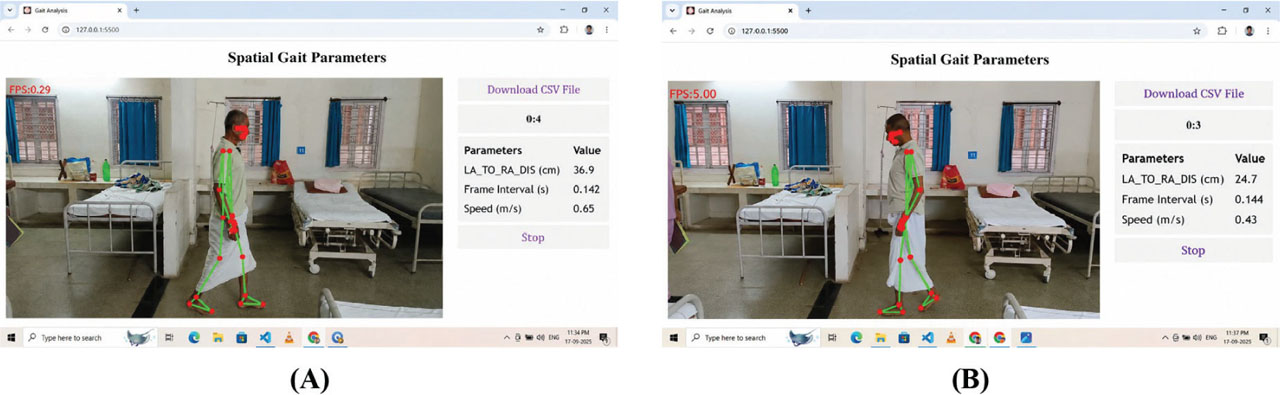
Figure 2:
Real-time elderly patient data collection in a hospital environment, (A) left-to-right. (B) right-to-left walking.
The value displayed as “Frame Interval (s)” represents the elapsed time between consecutive processed frames during real-time gait analysis and should not be interpreted as the duration of an entire gait cycle or analysis window.
a. Elderly subjects
Twenty-six elderly patients’ data were collected and analyzed in a real-time hospital environment. Among them, 14 are female and 12 are male, with a mean age (std) of 56 (±11) years. These patients had specific diagnoses such as bilateral knee pain, acid peptic disease, total knee replacement and cervical spondylosis that can alter their gait.
b. Findings and analysis
This section presents the objective findings from the gait analysis of the patient cohort. The three plots (Figure 3) collectively provide a detailed visual overview of the spatiotemporal gait parameters for the patient cohort, highlighting significant deviations from normal, symmetrical walking patterns. The dashed diagonal line in each plot represents a state of perfect left–right symmetry. The visual representation of these parameters effectively highlights the pronounced left–right asymmetries present in many individuals, providing a crucial objective measure for assessing their functional mobility and informing a personalized approach to their care.
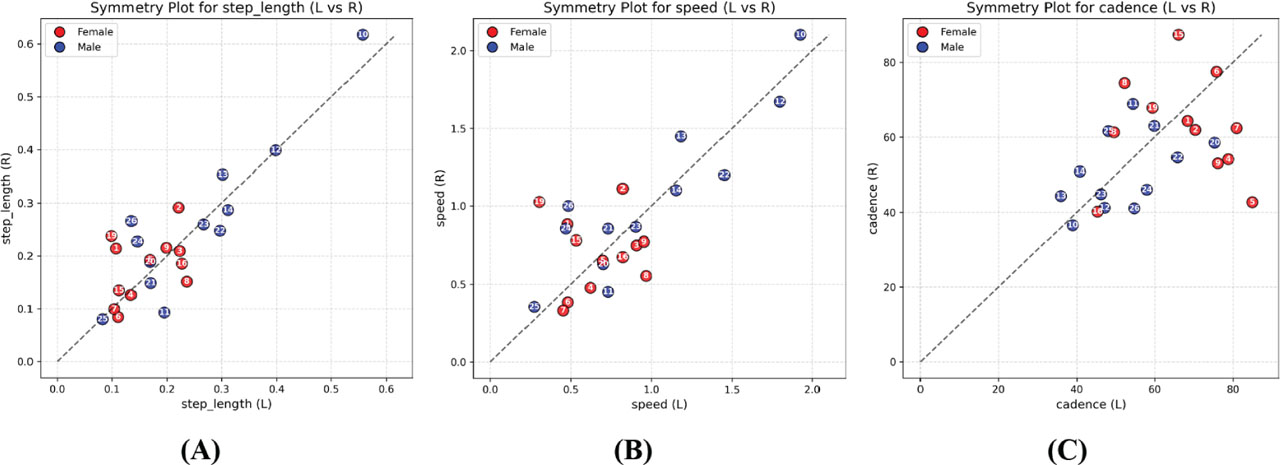
Figure 3:
Symmetry plots for spatiotemporal gait parameters of 26 elderly patients. (A) Symmetry plot for step length (Left vs Right); (B) Symmetry plot for speed (Left vs Right); (C) Symmetry plot for Cadence (Left vs Right).
The findings from this analysis confirm that the elderly patients, each with a diagnosed condition, exhibit distinct and measurable gait abnormalities. The value of this quantitative analysis lies in its ability to translate these biomechanical findings into actionable clinical insights for a heterogeneous patient population. By adopting the HGPAS system, the hospital can design and implement personalized treatment plans that directly address the specific deficits identified in each patient’s gait pattern, moving beyond a one-size-fits-all approach to physical therapy.
IV. The Benchmark MoCap Dataset
This dataset consists of videos featuring 30 healthy participants (20 males and 10 females) [27]. The video recordings feature obscured faces to protect the identities of the participants. It also comprises walking patterns of the subjects captured using 10 MoCap cameras and 4 video cameras. The respective synchronized 3-D MoCap files are given for all the videos. We operated the vision-sensor system using right-to-left and left-to-right walking patterns.
The average values of the spatiotemporal gait parameters for each subject were calculated using both the developed vision-based system and the MoCap system by processing the videos from the dataset. Compared to the MoCap dataset, these values align with the developed system except for some of the subjects, which are far from the predicted values. In the case of step length and speed, two values are out of LoA; for cadence, three values are out of LoA, as shown in Figure 4. The data points in dark blue represent the repetition of values for two or more subjects. The Bland–Altman biases for step length, speed and cadence are −0.036 m, −0.003 m/s and −2.0 steps/min, respectively, with 95% confidence intervals. Also, for limits of agreement (green lines), 95% of differences lie within these bounds. The comparison metric MAPE between the HGPAS and MoCap for step length, speed and cadence is 7.44%, 9.17%, and 3.25%, respectively. The Bland–Altman biases for each gait parameter, when compared with the MoCap system, are close to zero. This suggests that the two methods (developed HGPAS and MoCap) provide very similar results. Additionally, the percentage error (MAPE) is lower when compared with the MoCap system. This indicates the effectiveness of the developed HGPAS non-wearable vision system as an alternate solution for gait assessment.
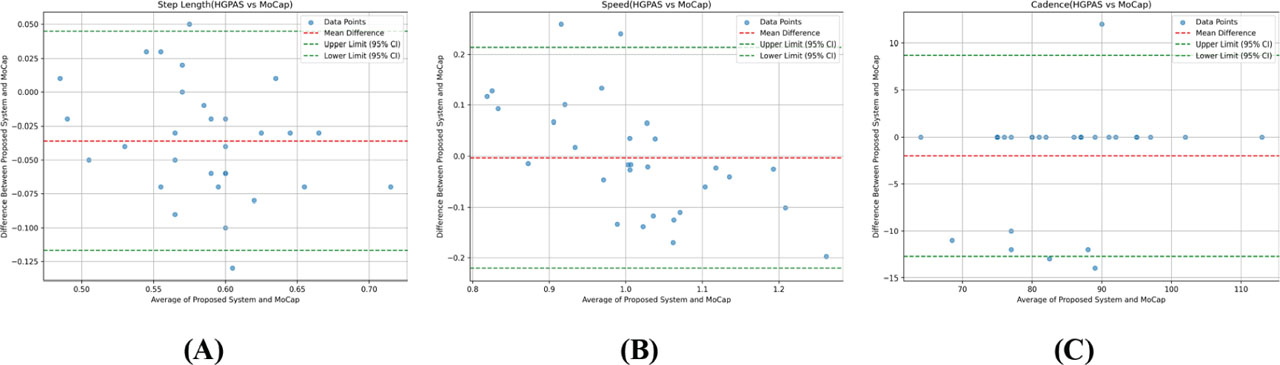
Figure 4:
Bland–Altman plots comparing the proposed gait parameter estimation method with reference measurements [27]. The figures illustrate the agreement between the two methods along with the mean bias and 95% limits of agreement. (A) Step Length (HGPAS vs MoCap); (B) Speed (HGPAS vs MoCap); (C) Cadence (HGPAS vs MoCap). HGPAS, human gait pattern analysis system; MoCap, motion capture.
V. Performance of HGPAS on 5G Network Architecture
This investigation forms the foundation of the present study, which explores the potential of 5G-enabled mobile gait analysis to enhance real-time biomechanical monitoring. This infrastructure enables biomechanical monitoring, supporting various applications in healthcare, sports performance, rehabilitation and eldercare. Utilizing the advantages of 5G’s ultra-low latency, high bandwidth and edge computing features, the platform will allow users to conduct precise remote gait evaluations with just their smartphones or tablets.
Figure 5 presents an illustration of the HGPAS that has been implemented on a 5G MEC server. A drop-down menu that provides options for obtaining walking directions is available. Upon choosing the walking direction, the user may proceed to click the start button to gather the gait data. The device is positioned in landscape orientation to provide an expanded perspective of the video feed. Upon finishing the walk, various biomechanical gait characteristics such as step length, speed and cadence are assessed in real-time.
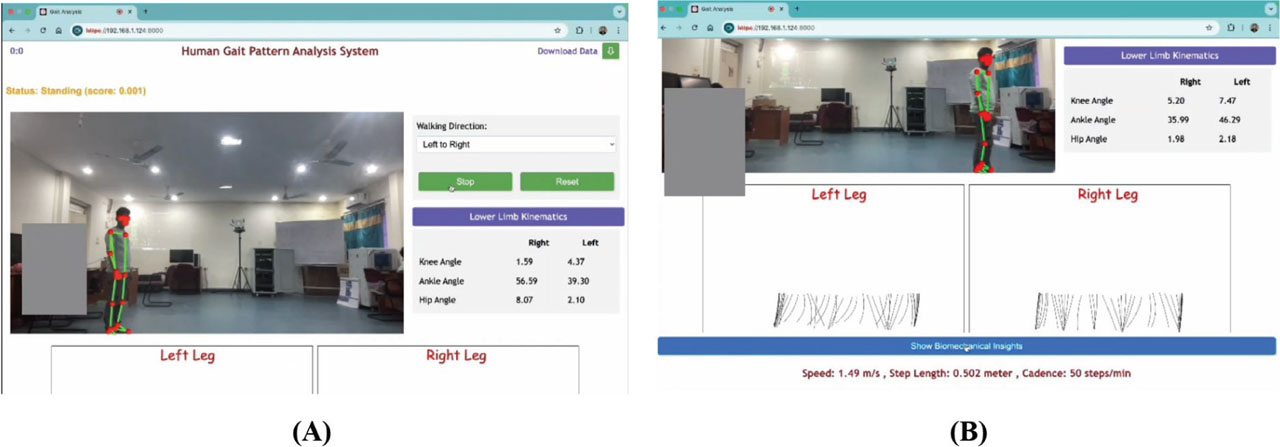
Figure 5:
Deployed HGPAS on 5G-MEC server: Real-time execution (A) Before clicking the start button (B) after clicking the stop button. HGPAS: human gait pattern analysis system.
The test was conducted while the person walked in real-time in the 5G network lab. The respective Wireshark trace (Figure 6) verifies the effective 5G standalone initial access procedure, which functionally separates mobility management from session management. The flow illustrates the separate roles of the core functions.
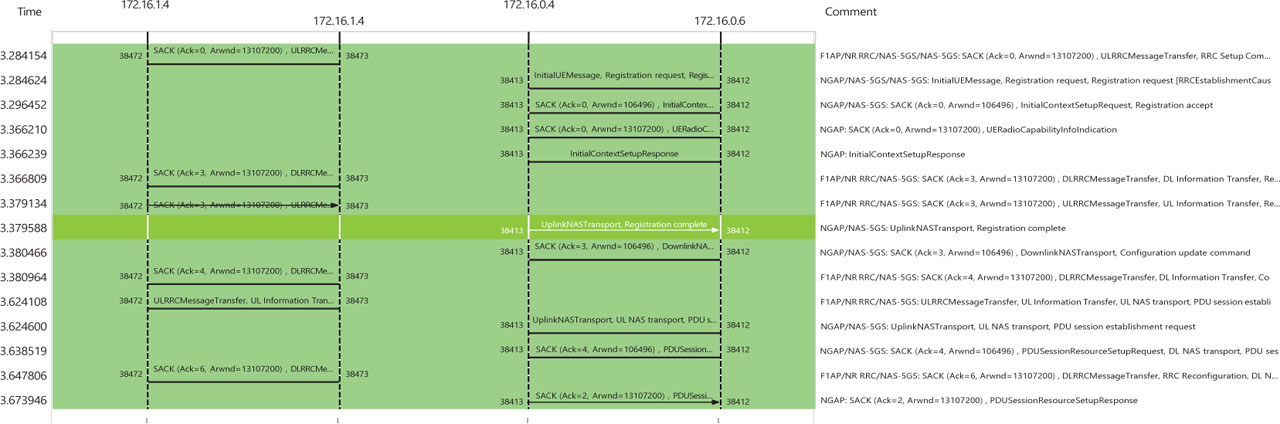
Figure 6:
Flow graph: Network messages from a UE connecting to a 5G (NR) network. UE, user equipment.
The leftmost column, 172.16.1.4, indicates the gNB’s control plane endpoint that connects to the core network. This address serves as the signaling intermediary for the user equipment (UE), forwarding the UE’s NAS messages to the access and mobility management (AMF) and allowing the transmission of NGAP messages from the AMF during context establishment. This node is essential for transmitting the initial Registration Request and the following NAS PDU Session Establishment Request from the device to the core.
The AMF (172.16.0.4) begins the procedure by managing the UE’s Registration Request and subsequent 5G mobility management signaling. This phase sets up a secure, authenticated control-plane connection for the UE. Following successful registration, the process advances to 5G session management. The SMF (172.16.0.6) obtains the NAS PDU Session Establishment Request and performs the essential task of network-assigned addressing. It verifies the request, establishes the user plane through PFCP signaling (not shown in the simplified three-node flow) and allocates the dedicated data IP address, 10.101.0.50, which is communicated to the UE through the PDU Session Establishment Accept message, thus facilitating end-to-end data connectivity.
a. Key 5G network performance parameters
The analysis of 5G network traffic for UE 10.101.0.50 reveals encouraging performance metrics that highlight the system’s operational capabilities in a practical setting. An average RTT of 32.05 ms indicates quick communication, which is suitable for data-intensive applications, while ensuring stable end-to-end connections. The average jitter of 58.27 ms demonstrates the network’s capacity to manage fluctuating traffic scenarios, which is crucial for adaptive systems such as mobile gait analysis. Although the average throughput of 0.165 Mbps implies a light data load during capture, it confirms that the 5G link effectively allows continuous, uninterrupted transmission. The packet loss rate of 27.34%, which is higher than optimal, provides important insights into areas that need improvement and underscores the network’s ability to sustain active sessions despite varying conditions.
Although a packet loss rate of 27.34% was observed during real-time 5G transmission, the impact on gait event detection was mitigated by the temporal characteristics of the ankle-distance signal. The proposed peak detection algorithm operates on smoothed trajectories, where gait events are represented by persistent local maxima and minima across multiple frames. Consequently, occasional missing packets do not necessarily eliminate critical gait events, as adjacent observations preserve the underlying motion pattern.
To reduce the effect of noise and localization uncertainty, temporal smoothing is applied, along with confidence-based keypoint selection, ensuring stable and reliable gait parameter estimation.
wheredenotes the smoothed joint position at time t.
represents the estimated joint position at previous time steps.
N is the window size (number of frames used for smoothing).
This formulation averages joint positions over a temporal window, thereby reducing random fluctuations and improving the stability of the estimated gait parameters.
VI. Validation of the HGPAS (Proposed System)
The established system was verified and validated using videos of 56 subjects (30 from the MoCap dataset and 26 from the hospital patients’ dataset). We operated the vision-sensor system using right-to-left and left-to-right walking patterns. The vision-sensor system successfully implemented the proposed methodology, using videos of subjects walking from the chosen datasets. To evaluate the performance of the developed system in relation to the gold standard approach (MoCap), this study uses the Bland–Altman plot and MAPE. For the hospital dataset, the analysis confirms that elderly patients, each with a diagnosed condition, exhibit distinct and measurable gait abnormalities. In the case of LTE, it provides inferences in 71.43 ms, while using a 5G network, it provides inferences in 32.05 ms. This shows quicker communication of the HGPAS system on the 5G network compared to the LTE network.
VII. Conclusion
Spatiotemporal gait parameters can help determine various problems with the lower extremities. Much work has been done using sensors on the subject’s body and a complex laboratory setup. This study focuses on the development of a markerless system for gait analysis in outdoor and indoor assessments. The HGPAS system is validated with the MoCap system with an overall accuracy of 91%. It was also validated with real-time elderly patients’ data with their known medical conditions in a hospital environment. This indicates that patients suffering from specific medical conditions display specific abnormal gait characteristics, such as decreased walking speed, shortened step length and increased asymmetry.
The Bland–Altman bias, when compared with the MoCap system, is close to zero, suggesting that the two methods provide very similar results, implying a developed system (HGPAS) as an alternate solution for gait analysis. Also, the system’s average percentage error, compared with MoCap, is 6.6, indicating the effectiveness of the non-wearable vision system over the MoCap system. The effectiveness of our method will rely on the specific clinical question being addressed. The system is already deployed and tested on the 5G Network architecture. The performance metrics of the network indicate that the 5G infrastructure is functioning efficiently, laying a strong foundation for further performance enhancements and advanced real-time applications. In the future, the system can be integrated with the hospital settings as it is an apt use case to run on 5G mobile technology with acceptable quality of service parameters.
The present study focuses on the technical development and validation of a smartphone-based markerless gait analysis framework. Although clinicians were consulted regarding the clinical relevance and potential rehabilitation applications of the proposed system, clinician-based interpretation of gait abnormalities was beyond the scope of the current study. Future work will involve collecting data from patients with different categories of gait abnormalities and incorporating clinician-guided evaluation to establish clinical validity and support real-time gait abnormality classification.
Acknowledgment
This work is supported by the SPARC project “IoT-based Sensor Analytics to Enhance the Quality of Life for the Elderly population” under the sanctioned Grant No. SPARC/2019-2020/P2354/SL. The research was approved by the Institutional Ethics Committee (IEC), University of Hyderabad, with IEC No. UH/IEC/2022/237.