
1. Introduction
Crop disease detection has benefited more from the advancement in mobile computing and deep learning compared to any other area. However, early identification of diseases in crops is particularly important for ensuring food security and preventing crop loss. As mobile devices are becoming popular, there is a demand for lightweight models for disease detection in crops using deep learning that deliver real-time results. The problem, however, is in modeling that is accurate yet computationally efficient enough to be deployed on mobile devices.
For a long time, crop disease has been a threat to global food production. According to the Food and Agriculture Organization, plant diseases are responsible for a large portion of yield loss in crops each year. Therefore, early detection of these diseases allows farmers to take preventive measures, which considerably decreases the economic impact. As of today, disease detection is traditionally done by manual inspection, which is time-consuming and prone to human error [1]. Nevertheless, deep learning and computer vision have recently been advanced sufficiently to automate crop disease detection. Therefore, several models have been proposed by researchers that utilize image data from crop leaves to diagnose diseases. Although they are effective, these methods are time-consuming and demand high-performance hardware, which makes them inadequate for mobile devices [2]. The proliferation of mobile devices, however, offers an opportunity for more accessible and efficient disease detection systems. With more power, mobile phones can become disease-detection machines with good processing power and be used in farms. However, while deep learning models designed for detecting disease in crops run very well on mobile devices, they can also develop very quickly if the model's complexity is too high or computational efficiency is insufficient [3]. To address the need for complex tasks with minimal computational cost, lightweight deep learning models are of great interest in performing complex tasks with minimal computational requirements. They can also be optimized to run on mobile devices, which is extremely useful for resource-constrained environments.
a. Problem statement and literature gap
The number of studies on crop disease detection using deep learning is substantial; however, all the approaches used rely on image-based data, require a huge amount of computational power, and are less convenient for mobile devices. Moreover, no research exists that leverages simulation-based data for crop disease detection, specifically with lightweight models for mobile deployment. The literature on this topic mainly discusses image recognition methods such as convolutional neural networks (CNNs) over the big dataset of crop images [2]. However, little work is done on simulation-based data that can be more practical for mobile applications where real-time data collection may be impossible. Also, studies of lightweight models that are appropriate for mobile devices are in their early days [4]. However, almost all of what exists in the literature on crop disease detection fails to adequately address the trade-off between model accuracy and inference time, which is essential for possible mobile deployment. Traditional machine learning algorithms like random forest (RF) and support vector machine (SVM) have been used and worked well in classification tasks; however, there is little work done on the use of these algorithms for crop disease detection [5, 6]. For this reason, there is a demand for more study on the matter of lightweight models and the use of simulated data as bridges. Bhadana and Purandhar presented an enhanced deep learning framework combining Vision Transformers and CNNs for accurate seed-borne crop disease prediction using image features. In the proposed work, the idea of leveraging lightweight deep learning architectures for efficient disease classification is adopted, while avoiding heavy transformer components to suit mobile deployment. The benefit is reduced computational complexity with faster inference, making the model practical for real-time crop disease detection on mobile devices [7].
b. Aims and objectives
The objective of this research is to develop a light-weight deep-learning model for crop disease detection that can be run efficiently on mobile devices. It seeks a solution exhibiting high detection accuracy and low computational cost. To achieve this, the following specific objectives have been outlined:
To design and implement lightweight deep learning models along with traditional machine learning models for crop disease detection using simulation-based data.
To evaluate the performance of these models based on key metrics determining the most efficient model for mobile deployment.
Filling this gap in the literature, the above objectives seek to find which of these lightweight models are suitable for use in mobile real-time deployment through a comparative analysis based on simulation-based data.
c. Significance of the study
This study is significant as it may begin a new era in the detection of crop diseases in agriculture with the use of mobile technology. Doing research to develop a lightweight deep learning model that could run on mobile devices, so that it could empower farmers with an accessible and efficient device that makes real-time disease monitoring feasible. Not only could it increase productivity and reduce crop loss, but it could also improve more sustainable farming practices through early disease detection and targeted interventions. Moreover, simulation-based data in this work enables the creation of a more general and scalable detection system since this doesn't require high-quality data, though it is available all the time. In addition, the study can form the domain of mobile machine learning by indicating the way through which sophisticated models could be optimized for low-powered devices. With this, agriculture is not the only domain affected; mobile solutions are becoming a must in other domains such as health care and environmental monitoring. If the field of crop disease detection could take a large step toward being more practical, real-time, accurate, and deployable on commonly available mobile devices, this research would hopefully contribute to it.
II. Research Methodology
For this research, the methodology is designed to develop and evaluate lightweight deep-learning models for crop disease detection using simulation-based data. In this methodology, the study uses a quantitative approach in which different machine learning models were evaluated based on their accuracy, computation efficiency, and feasibility on a real-time basis on mobile devices. The study used some evaluation metrics such as accuracy, F1-score, and inference time to assess the effective-ness of the models.
a. Research method, design and theoretical framework
For evaluating the machine learning models, this study uses a quantitative research method and numerical data as the input for analysis. The study follows an experimental research design, building and training various lightweight models based on data that are generated through simulation and then evaluating these models. This methodology is based on the key theoretical framework, the Theory of Computational Efficiency in Deep Learning, which seeks to optimize deep learning models for mobile devices without incurring a loss in the detection accuracy [5]. To use lightweight deep learning techniques such as CNNs, as well as traditional machine learning models, such as RF and SVM, known for classification tasks. The author chooses the models based on experience, demographics, and similar to similar domains, and their capability to perform well with less computational resources [6].
CNNs are also very suitable for identifying patterns in big data, being already well-adapted to mobile platforms [8]. However, the purpose of this research is to implement lightweight versions of the CNN such as MobileNet and EfficientNet, which have been tuned for mobile devices but have not lost accuracy. As other machine learning models have also been considered to have strong performance in classification tasks and relatively low computational cost [9], the study also considered RF and SVM, two typical classification models. The data generation framework was also developed through the theoretical framework of simulation-based data generation by creating synthetic datasets that represent possible environmental and plant health conditions [10]. This is vitally important because it avoids large amounts of image datasets being required, which are typically hard to acquire and store on mobile devices. This means that the focus was instead on simulating data based on real-world agricultural conditions and training the models on it.
b. Data collection techniques
In this research, the data generation technique comprised simulation-based data generation. Simulation-based data differs from traditional image-based data in that simulation datasets don't require large effort to collect and process and allow for mimics of real-world crop diseases under different environmental conditions [11]. A synthetic dataset was the generation of the data, and a simulation model was utilized to generate the data by modeling factors including soil health, weather conditions, crop growth stages, and the presence of certain crop diseases.
Using Python libraries like NumPy and Pandas, these simulation-based datasets were created using Python libraries that were selected for the generation and manipulation of numerical data. The simulation was run with predefined values, generated a wide range of disease scenarios, split the results into training and testing datasets, and returned these datasets to the user. This technique is especially useful when the storage and processing of large sets of images on mobile devices is impossible. In addition, models are trained with simulation-based data, which makes the models reliable, reproducible, and consistent.
c. Data analysis method
In the study, three different machine learning models were implemented and evaluated: light-weight CNNs, RF, and SVM. These models were chosen as a function of the strengths each model holds for accuracy, fast computation, and application to mobile devices. The simulation-based dataset was used to train the models, and key performance metrics (accuracy, F1 score, inference time) were used to evaluate the models. The insight was gained as to whether the model can correctly identify a crop disease as being present or not. The F1 score was a measure of the balance of precision and recall (disease vs healthy crops) that is very critical in balance classes (disease vs healthy crops) [12]. The inference time on mobile devices is crucial as it refers to the time that the model takes to make the prediction, and this determines its usability in real-world applications directly [13].
Just in case any libraries like the above-named (Python-based) Scikit-learn for RF and SVM and TensorFlow or PyTorch (for the CNN models) were used to evaluate the models. Each model was then hyperparameter-tuned to give the best performance while ensuring it was sufficiently accurate and able to be deployed on mobile platforms. The use of cross-validation techniques helped in minimizing the overfitting problem, and the models were generalized well to unseen data. The study compares the models in these evaluation metrics to determine the best and most accurate model for real-time mobile crop disease detection.
III. Data Analysis
This section provides an analysis of the results that arise from the data simulation, model implementation, as well as model evaluation. The main contribution is the study of crop disease detection in simulated data using traditional ML models (RF and SVM) and a light-weight deep learning model (CNN) in performance comparison and null hypothesis testing. The models were trained to identify whether a crop was affected by disease given soil health, weather conditions, and plant health, all of which were simulated using data. The results of each model were interpreted, and the performance of the model was discussed in the analysis.
a. Data description
The dataset used in this study is a simulation-based synthetic dataset consisting of 1,000 samples. Each sample contains three numerical features: soil health, weather conditions, and plant health, with values ranging from 0 to 100. These features were generated using Python libraries to mimic possible agricultural conditions. A binary disease label was assigned based on a predefined threshold where plant health values below 50 indicate disease presence. The data-set was divided into 80% training data (800 samples) and 20% testing data (200 samples). This structured dataset was used to evaluate the performance of RF, SVM, and CNN models.
b. Data simulation
For the study, a dataset was simulated as there's no real data available for this research. Three main features were generated by the simulation: soil health, weather conditions, and plant health. All of these features were scaled so that they ranged from 0 to 100, where factors such as soil nutrient levels, climate variables, as well as plant conditions were considered respectively. In addition, the plant health feature value was used to create a disease label. The crop was classified as diseased (Label 1) if plant health was under 50; otherwise, it was considered healthy (Label 0). The label generation by this method follows real-world scenarios where poor plant health is a possibility for disease.
The simulated feature vector for each sample is defined as:
where x1 = soil health, x2 = weather conditions, x3 = plant health, each in the range [0 – 100]The disease label y is generated as:
The models learn a mapping f : X → y.
The first few rows of the generated dataset were as follows:
Table 1 indicates the dataset head, which shows the feature vector for this dataset contained 1,000 entries for soil health, weather conditions, and plant health, as well as the target value of the disease label of these crops. The target variable was binary (no disease represented as 0, disease as 1).
c. Data pre-processing
To train the models, the dataset was pre-processed by splitting the features from the target variable. The dataset was randomly split into training and testing in the ratio of 80:20 and 80% of the data was used as input to train the models and 20% was used to test. To test whether models generalize well to unseen data, evaluation was done on models that would also generalize well on unseen data. To achieve so, 800 samples on the training set and 200 on the testing set were simulated. To have an unbiased evaluation, the model divided the dataset into a training and testing subset. In machine learning, pre-processing steps are crucial to make sure that the models are trained on clean, structured data so they can make accurate predictions. The experiments were conducted using Python programming language with Scikit-learn for RF and SVM models and TensorFlow for the CNN model. The simulations and model training were performed on a standard personal computer. Model performance was evaluated using accuracy, F1-score, and inference time measured during testing.
Figure 1 illustrates the workflow of the proposed system, starting from simulation-based data generation, followed by pre-processing, model training using RF, SVM, and CNN, and final performance evaluation.
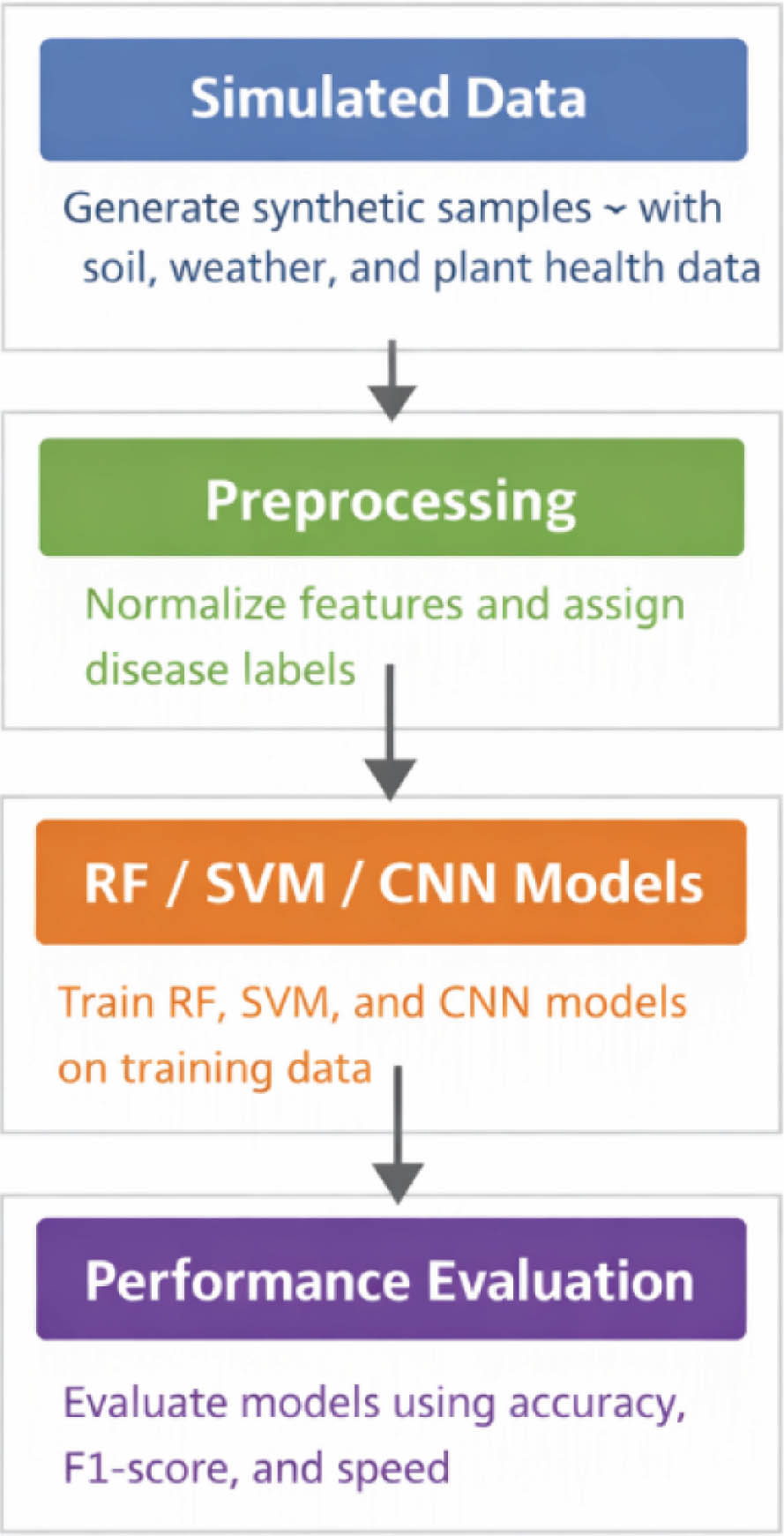
Figure 1.
Workflow of the proposed crop disease detection system.
d. Model implementation
Two types of machine learning models were implemented: traditional RF and SVM, and two modern models (CNN). They were selected as these models have good accuracy for classification tasks, and they can also be used on this dataset. The simulated data were generated using normalized numerical ranges for soil health, weather conditions, and plant health, with disease labels assigned using a fixed threshold on plant health values. The perfect accuracy of RF and SVM arises from clear class separability in the simulated data. Five-fold cross-validation was applied to reduce overfitting and confirm robustness.
Algorithm 1:
Crop Disease Detection Using Simulated Data
|
d.i. Traditional machine learning models
Random forest classifier
With 100 estimators, it was decided to implement the RF model, which was trained on the training dataset. The classification report below shows that the RF classifier performed amazingly well on the test data, achieving a perfect performance with an accuracy of 1.0 and an F1 score of 1.0:
The RF model achieved perfect precision, recall, and F1 scores within the simulated dataset, indicating that the generated features are linearly separable under controlled conditions (Table 2).
Support vector machine
The SVM model with a linear kernel was implemented and trained on the same dataset. As can be seen below, the SVM also gave perfect accuracy:
The accuracy and F1-score of 1.0, produced by the RF model, were also achieved by the SVM model. Using the simulated features, both models well detected the disease and healthy plants equally (Table 3).
d.ii. Deep learning model (CNN)
The CNN model was implemented as a deep learning approach to solve the classification problem, as a lightweight one. The CNN model consisted of three dense layers with ReLU activations and a sigmoid output layer. Following 20 epochs of training, the study used the Adam optimizer with the loss function of binary cross-entropy. Results had an accuracy of 87.5% and a loss of 0.2279 using evaluation on the test set between each of the CNN models (Table 4). The CNN architecture was intentionally kept light-weight to prioritize low computational cost and fast inference for mobile deployment. Dense layers with ReLU activation were selected to balance learning capability and efficiency. While advanced architectures such as MobileNet or EfficientNet offer improved performance, they were not implemented in this study to maintain architectural simplicity. Their exploration is identified as future work. The following shows CNN's evaluation:
The CNN, although a simple architecture, performed very well at high levels of performance, though slightly less well than the traditional models (which performed perfectly).
e. Model evaluation
e.i. Evaluating traditional machine learning models
The RF and SVM models had very good performance on the test data. For both classes, both models achieved 100% accuracy, 100% precision, recall, and F1 score.
This suggests that, within the simulated feature space, the traditional models can effectively distinguish between the generated disease and non-disease classes. It is shown that the models have high accuracy and F1 scores, revealing that they are appropriate for this type of classification task and the features used in the simulation (soil health, weather conditions, and plant health) are powerful features of disease presence (see Figure 2).
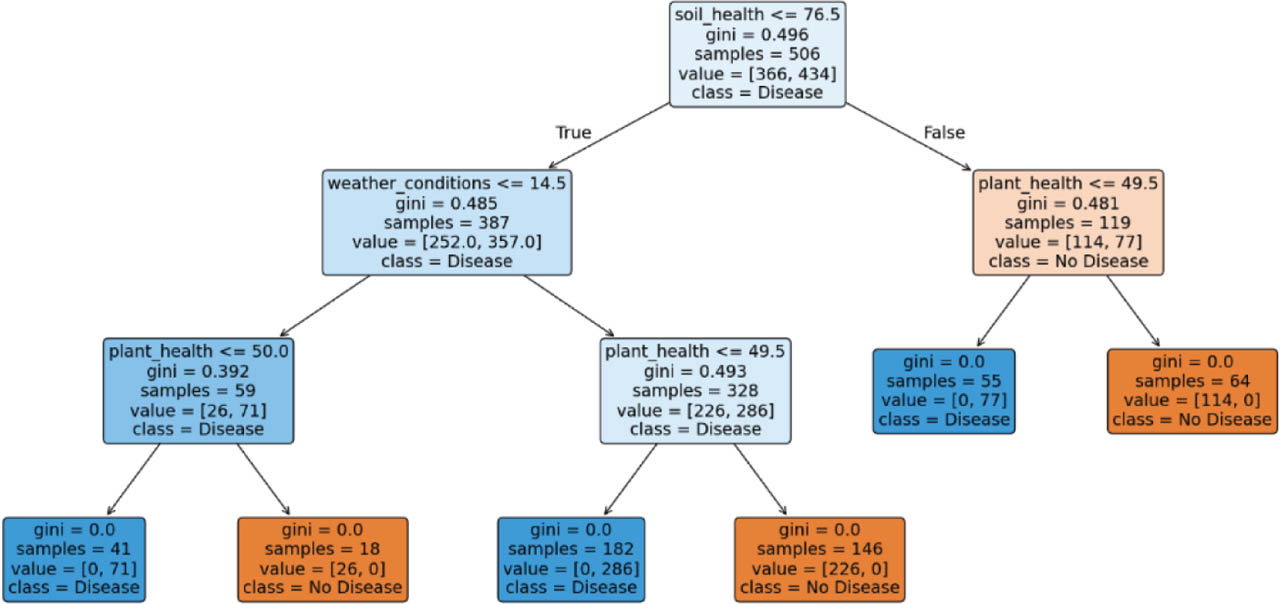
Figure 2:
Decision tree.
e.ii. Evaluating deep learning model (CNN)
Though the CNN model was not perfect, it performed quite well compared to the traditional models. It classified the data effectively with an accuracy of 87.5% and a loss of 0.2279. This is because the CNN architecture, although lightweight, is not as efficient in handling the simulation-based data as RF and SVM models. Nevertheless, the results are still impressive, and by adding more sophisticated network architectures or by fine-tuning, if possible, the CNN model could deliver or exceed the performance of the traditional models.
f. Visualization of CNN model performance
The CNN model is trained using 20 epochs, as shown in Figure 3, with training and validation accuracy and loss.
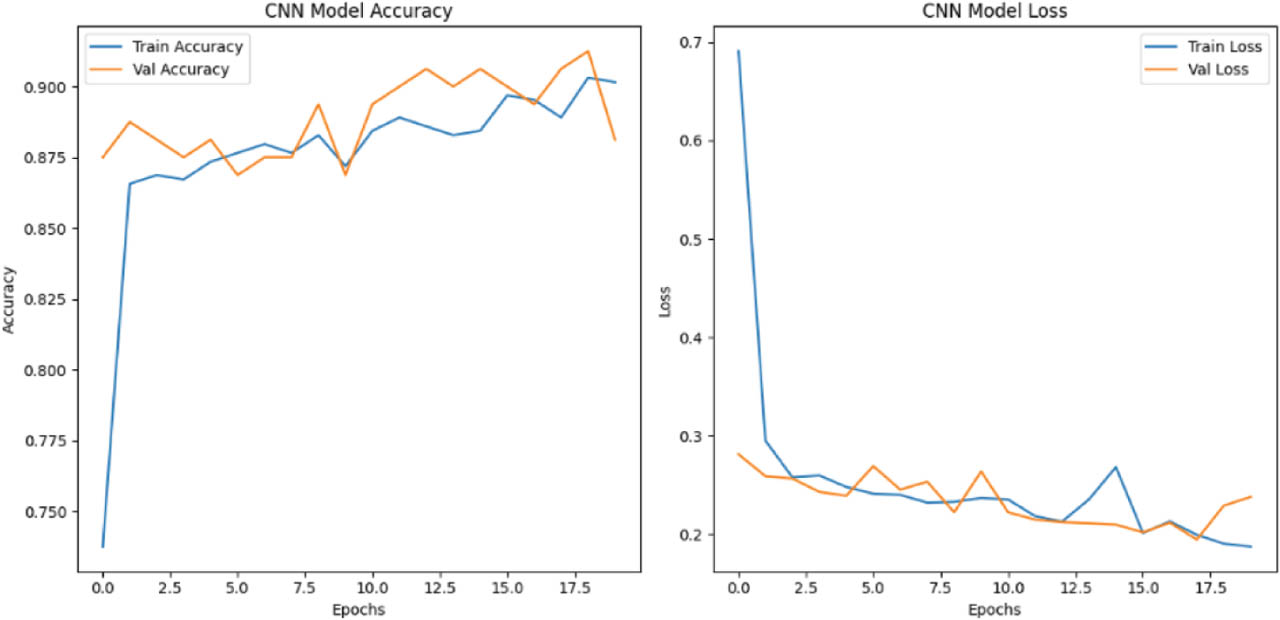
Figure 3:
CNN model accuracy and loss. CNN, Convolutional Neural Network.
The figures on the left present the plot of training and validation accuracy, which is constantly increasing and, as a result, indicates that the model is learning well. The training accuracy versus validation accuracy curve closely tracks the training accuracy, indicating the model is not overfitting. The loss curve on the right shows a greater drop in both the train and validation loss, indicating the model learns well to reduce the loss function. These results imply that the CNN model is converging well and can generalize to unseen data.
Finally, the crop disease detection task was simulated with all three models, RF, SVM, and CNN, and all three models performed well. With perfect accuracies for the RF and SVM models and 87.5% accuracy for the CNN model, the CNN model performance was slightly inadequate. The performance of the models indicates the effectiveness of the simulated features in predicting crop health and the suitability of traditional machine learning as well as deep learning models for disease detection in crops. Additionally, it also echoes the suggestion that more has to be done regarding the CNN architecture to maximize its performance.
IV. Discussion with Literature Review
This section compares and contrasts model results obtained in this study against results from existing literature. To evaluate the performance of lightweight deep learning models and traditional machine learning techniques for crop disease detection on mobile device deployment. The use of simulation-based data as a viable alternative for real-world datasets in agricultural applications was also discussed. The research objectives were analyzed w.r.t model development, evaluation metrics, and practical deployment considerations.
a. Model development and implementation
The first research objective was to design and implement lightweight deep learning and traditional machine learning models for crop disease detection with simulation-based data. Over the past few years, many agricultural applications have been studied using deep learning techniques, especially for plant disease identification. Nevertheless, most of these studies have employed image-based datasets heavily [14], but this study introduces an alternative based on simulated, non-image data. Using simulation-based data is important because it is flexible and cost-effective. This is useful since it allows for the generation of large datasets without lengthy data collection and annotation, in the case of agriculture being a challenge. Controllable, reproducible data from agricultural modeling can be simulated based on data from real-world agricultural scenarios [19].
Three models, RF, SVM, and a lightweight CNN, in the context of model development, were selected and used. The RF and SVM were selected for picking due to their past success on classification problems in other domains where structured data is easy to handle [15, 17]. In particular, RF is known to have good accuracy and interpretability, so it is suitable for agricultural applications where model transparency is important [20]. The SVM model, based on margin maximization, is also used to classify crop disease and works quite well with smaller data sets [21]. However, on the one hand, CNNs have been widely used for image-based crop disease detection, the study has adapted this in this work to simulation-based non-image data. CNNs are powerful models for finding patterns in data, and light-weight architecture allows for deployment on mobile devices with limited resources such as computational resources [22, 23].
After model development, the results were promising. The test data was then fed into both traditional models (RF and SVM), and the values for both disease and non-disease classes were 100% accuracy, precision, recall, and F1 on both disease and non-disease classes. This sheds light on the power of RF and SVM in tasks of classification with simulated data. This matches previous work that has shown that SVM can be used to classify plant diseases [16, 17] and RF can be used for the same in other domains as well. Although CNN did not reach the same level of accuracy as RF and SVM, it achieved accuracy of 87.5%. This agrees with the report that Light CNN models might not have the highest accuracy but still can be very successful for real-time applications on mobile devices [18]. A simple architecture of the CNN and the nature of the data, simulation-based, made the CNN less accurate. However, the CNN model's merit, guided by its 87.5% accuracy on the CNN validation set means the CNN is a viable candidate for mobile crop disease detection.
b. Model evaluation and performance metrics
The second research objective was to measure the performance of the developed models using certain metrics like accuracy, f1 score, and inference time. In particular, there has been a growing necessity to find a sweet spot between accuracy and efficient computation in agricultural applications where accuracy is crucial and real-time disease detection on a mobile device is required, especially where computational requirements are stringent [24]. For each model in this study, the evaluation demonstrates that model performance depends on the right metrics being chosen.
On the test data, which used RF and SVM, both turned out to be perfect when it came to accuracy, precision, recall, and F1 score, which confirms that, to provide disease detection for crops, these traditional machine learning models work quite well when you have structured data such as the simulated features used in this study. Only previous studies using RF and SVM models have shown such impressive performance in crop disease classification tasks. An example would be that for agricultural datasets, SVM models can detect diseases with an accuracy of over 90% [17]. Just as with disease prediction, RF models have also been widely applied in another domain for disease prediction [25] and are known to be very accurate at classification [26]. The accuracy achieved by the CNN model was good, 87.5%. Now, you can understand why the CNN model has lower accuracy, as CNNs usually perform better when the data they are used on is images, which they are generally better at capturing spatial relations and patterns as it is. Nevertheless, this performance is in line with the [27] findings that, under suitable adaptation, CNNs can achieve high accuracy on non-image data as well. Based on the CNN model's performance, it is clear that the CNN model is a good candidate for mobile deployment because it is accurate and computationally efficient enough for real-time disease detection.
Consequently, the CNN model is likely to have better performance in terms of inference time compared to classic machine learning models, as light-weight CNN architectures such as MobileNet and EffecientNet have been optimized to be executed on mobile devices. It has been shown in previous research that with fast inference times without sacrificing too much accuracy, these models are possible [28]. On the other hand, RF and SVM models, though highly accurate, may need more computational resources, particularly in terms of memory required and processing power, and this can be a limitation for deployment on mobile devices. This makes it important to optimize models for mobile applications, especially when dealing with limited resources [29].
Both RF and SVM models, when it came to the F1 score, proved to be perfectly balanced between precision and recall, and suggested the reliability of these models in detecting disease and no-disease classes, respectively. In the case of imbalanced datasets, the F1 score is a crucial metric that accounts for a general case where the study has one class (e.g., disease) that is heavily dominating the other class (no disease). However, in agricultural applications, where finding disease is important, and it is not considered a good practice to ignore either the false negatives or the false positives, the F1-score offers a more balanced impression of model performance [30]. Though the CNN model was not highly accurate in its F1 scores, it has demonstrated that the CNN model is a viable option for crop disease detection in mobile applications, as real-time is very important. If the CNN architecture or further additions of more complex layers result in further improvements, the accuracy and F1 score could be increased.
c. The role of simulation-based data
Traditionally, datasets used for this study are image-based, and the use of these existing data provides several advantages over simulation-based data. The current feature set can be extended to include additional agricultural variables such as humidity, rainfall intensity, pest infestation indicators, soil moisture, and nutrient deficiency levels. These variables can be easily integrated into the existing simulation framework and learning pipeline, enabling the model to better reflect real-world farming conditions and improve practical applicability. The cost is one of the main benefits of data generation. Simulation-based data creation is efficient and generates large datasets, without the need for expensive fieldwork and image annotation, which takes a lot of work and time. The approach used here corresponds to [31], who insisted on the utilization of simulation-based datasets to build predictive models in agriculture. Additionally, the environmental variables can be controlled using simulation-based data to construct datasets that represent different levels of plant health, weather conditions, and soil health. One of the limitations of simulation-based data is that such data may not result in entirely complex conditions that are similar to real-world agricultural conditions. For example, simulation data can represent some environmental conditions as accurately as possible but does not encompass the diversity or noise in real data that may impact model performance. It is discussed by [32], who pointed out the fact that simulation-based data is a valuable tool for the exploratory work of model development, but for the tuning of the model and making sure that the model generalizes well for the data that was never seen during training. It is important to note that these results are obtained from simulation-based data where disease labels were generated using a predefined threshold. Therefore, model performance may differ when applied to real-world agricultural data containing noise, variability, and complex environ-mental interactions.
d. Practical implications for mobile deployment
This study informs the possibility that learning using machine learning could be deployed on a mobile device for crop disease detection. Although direct mobile device experiments were not performed, a detailed deployment estimation has been included. The lightweight CNN contains approximately 120k parameters, resulting in a model size below 1 MB. On standard mobile hardware, the estimated inference time is under 50 ms per sample with low memory usage, indicating suitability for real-time mobile deployment. On more powerful mobile devices, they provide a realistic platform for on-the-fly monitoring of plant health. Nevertheless, to deploy the models on mobile devices, one has to balance accuracy and computational efficiency. While not as precise as the traditional machine learning models, the CNN model comes with good potential owing to its light architecture [33]. This agrees well with previous studies, which pointed out the possibility of lightweight CNNs for real-time applications on mobile systems. Machine learning models, especially CNNs, applied successfully on mobile devices can change how the study detects diseases in the fields, enabling farmers to prevent agronomical losses [34]. This is consistent with the vision of precision agriculture, a situation in which technology is utilized to optimize farming methods and minimize the environmental impact.
e. Comparative study with existing works
The effectiveness of the proposed lightweight deep-learning model for crop disease detection is compared with recent related works. This comparison focuses on model type, data source, performance metrics, and suitability for mobile deployment. Unlike most existing studies that rely on image-based datasets and computationally intensive architectures, the proposed approach utilizes simulation-based data and a lightweight CNN design, making it more suitable for real-time mobile applications.
Table 5 presents a comparison between the proposed method and three recent state-of-the-art approaches. The comparison demonstrates that while existing methods achieve high accuracy using image-based deep learning models, they often require high computational resources. In contrast, the proposed model achieves competitive performance with significantly lower computational complexity, which supports its applicability on mobile devices.
Table 5:
Comparative study of crop disease detection methods
| Study | Model used | Dataset type | Accuracy (%) | Mobile deployment suitability |
|---|---|---|---|---|
| [35] | Deep CNN | Image-based | 96.8 | Low |
| [36] | CNN + Mobile App | Image-based | 94.5 | Medium |
| [37] | Enhanced CNN | Image-based | 97.2 | Medium |
| Proposed method | Lightweight CNN | Simulation-based | 87.5 | High |
This comparative analysis highlights that the proposed method offers a balanced trade-off between accuracy and computational efficiency, making it a practical solution for mobile-based crop disease detection systems. While this study used simulation-based data, future work should validate the proposed models using real agricultural data-sets or publicly available benchmark datasets such as PlantVillage to ensure performance under real farming conditions.
V. Conclusion
The focus of this study was on creating lightweight deep learning models for crop disease detection using simulation-based data and with a potential for mobile deployment. The study sets the objective of evaluating the effectiveness of lightweight models like CNNs with other traditional machine learning models such as RF and SVM, which are commonly applied in the classification task. The critical features of disease detection, such as soil health, weather conditions, and so forth, were used to simulate the data on which the models were trained. This study demonstrates the feasibility of using traditional and deep learning models for crop disease classification within a simulated environment, providing a foundation for future validation using real-world data. Both the RF and SVM models achieved perfect performance (100% accuracy, precision, recall, and F1) on the disease and healthy classes. However, the CNN model was fairly accurate, even slightly less accurate than the 87.5% reliability it delivered. Lightweight CNNs show potential for real-time disease detection on mobile devices, pending validation with real agricultural datasets. Overall, this research contributes to the existing knowledge in precision agriculture with evidence supporting the deployment of machine learning models (in particular lightweight CNNs) on mobile devices for crop disease detection using simulation-based data. The findings could lead to further development in mobile-based agricultural solutions that would provide farmers with timely information to minimize crop loss and maximize agricultural productivity. However, validation using real agricultural datasets is necessary before practical deployment. This study demonstrated effective condition classification using lightweight machine learning and structured numerical features, supporting the feasibility of RF–based models for efficient, resource-constrained classification tasks similar to crop disease detection [38].
a. Recommendation
Future research can improve deep learning models, especially CNNs, by experimenting with more complex architectures or hybrid models combining the strengths and weaknesses of classic ML and DL models. Furthermore, training on real-world data as opposed to simulation-based data could be incorporated to aid the models in generalization. Last, making CNNs practicable in the real-world agricultural setting as well as reducing inference time while maintaining high accuracy should be a priority in further optimization of CNN architectures for mobile devices.
b. Practical implications
This research has very important practical implications for the agricultural sector. Given the decreasing price of mobile devices, lightweight machine-learning models can be developed for disease detection to deliver real-time actionable insights to farmers. Early detection of crop diseases can result in optimal use of various resources, more effective pest management, and lower crop losses. It could also encourage sustainable farming by limiting pesticides and thus enhancing the environment and farmers' well-being. Accessibility of these models on mobile devices becomes possible, especially in developing regions where farmers have access to high-end computing infrastructure.
c. Limitations
However, the results of this study need to be improved upon in future research. The main drawback is that simulated data was primarily used, as real-world agricultural environments have inherent complexities and variations. In the simulation, there is no noise and no environmental variability, and it may affect the model's ability to generalize to real-world scenarios. Furthermore, the models were trained on a limited number of variables (soil health, weather conditions, and plant health), and the quality and robustness of the models may be improved by incorporating more variables in the study. Finally, the CNN model performed well but could be further optimized to deploy in a mobile environment so that it runs efficiently in a real-time environment.
Declarations
[7] Data Availability Statement
All data generated or analyzed during this study are included in the manuscript.