
Table 1:
Review summary of work on AD by different researchers
| Author and Reference | Dataset used | Model | Significant contribution | Limitations |
|---|---|---|---|---|
| Kishore and Goel [22] | FDG-PET images (ADNI dataset) | Deep neural network with transfer learning | Significant generalization ability | Attributes are limited to a single tomography tool |
| Diogo et al. [23] | ADNI and OASIS | Several ML Classifiers | Generalization ability | MCI patients limited to a single dataset |
| Ortiz et al. [25] | ADNI dataset | Deep belief networks | Determination of discriminative ROIs | Dimensionality problem with SVM |
| Sarraf and Tofighi [26] | ADNI dataset | CNN + LeNet-5 Network | Higher performance compared to SVM | Computational Complexity |
| Islam and Zhang [27] | OASIS dataset | Ensemble of deep CNN | Beneficial in scarce datasets | Limited to the AD dataset |
| Pan et al. [30] | F-FDG-PET images (ADNI) | Multi-view separable pyramid network | Strong generalization ability | Satisfactory performance for pMCI vs sMCI |
| Shi et al. [31] | Resting state f-MRI data (ADNI) | SVM | Potential value for the AD pathogenesis mechanism | Limited functional connectivities between voxels |
| Bae et al. [32] | SNUBH and ADNI | CNN | Generalization ability | Satisfactory AUC values for intra and inter-dataset samples |
| Helaly et al. [33] | ADNI dataset | CNN and VGG19 with transfer learning | Low time and computational complexity | Satisfactory performance |
| Battineni et al. [34] | OASIS dataset | Multimodal ML | Prediction of dementia in older adults | Limited to single omic features |
| Kavitha et al. [35] | OASIS dataset | ML models | Insight into different machine-learning models | Satisfactory performance with minimum features |
| Seifallahi et al. [36] | Self-generated using Kinect V.2 camera (time up and go) | SVM | Low-cost and convenient AD assessment mechanism | Lacks confirmation of clinical diagnosis |
| Al Shehri [37] | AD dataset from Kaggle | DenseNet-169 and ResNet-50 | Higher accuracy using DenseNet-169 | No validation using cross-dataset samples |
| Khandekar et al. [38] | OASIS dataset | ML models | Voting classifier obtained 96% accuracy | Satisfactory performance using minimum features |
| Gargi Pant Shukla et al. [40] | ADNI dataset | CNN, RF, and XGBoost | About 97% accuracy using the CNN | Satisfactory performance |
| Agarwal et al. [41] | AD dataset from Kaggle | CNN | Insight into different pretrained models | Satisfactory performance |
| El-Assy et al. [42] | ADNI dataset | CNN | Eliminate the need for handcrafted features | Limited to a few data modalities |
| Sorour et al. [43] | AD dataset from Kaggle | Multimodal deep learning | 99.92% accuracy with CNN + LSTM | Performance is limited to binary classification |
| Castellano et al. [44] | PET and T1-weighted MRI from OASIS-3 dataset | Fusion model using CNN | Identification of key brain regions associated with AD | Computational complexity, and loss of temporal resolution caused by averaging PET frames |
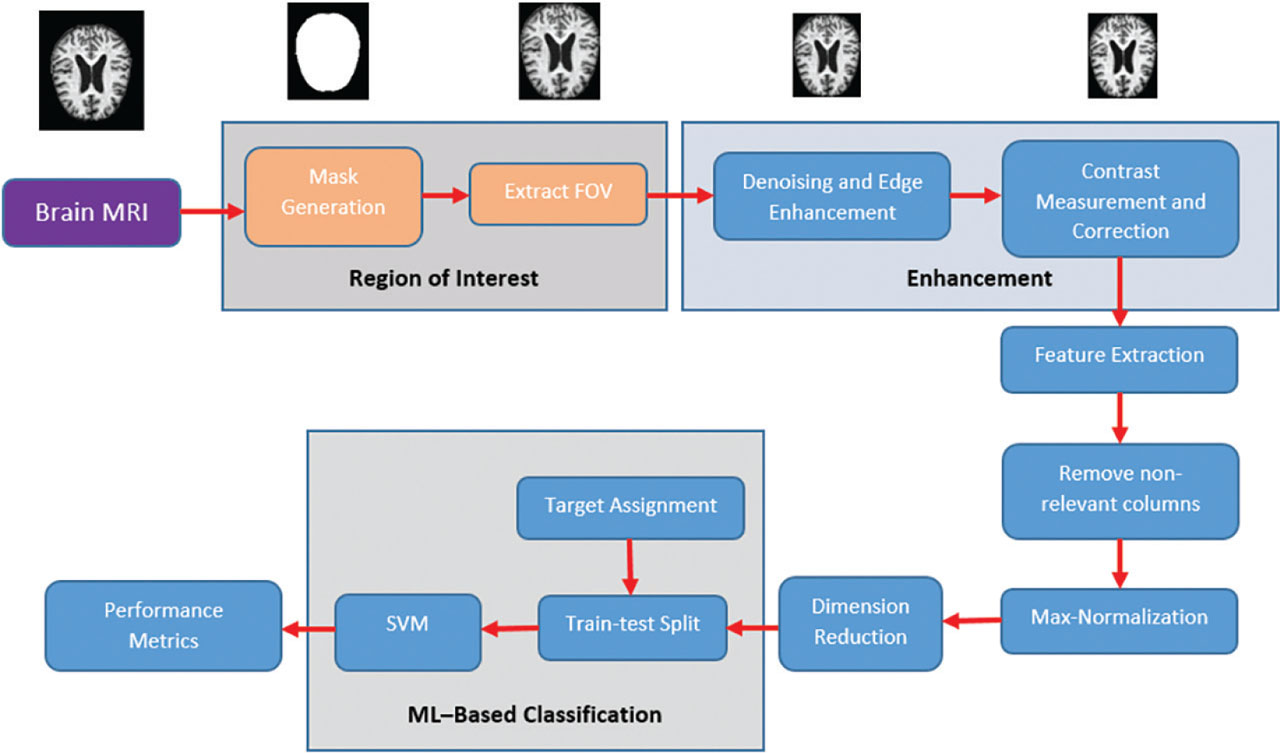
Figure 1:
The proposed CF-ML AD detection framework. AD, Alzheimer’s disease; CF-ML, conventional feature and machine learning; FOV, field-of-view; MRI, magnetic resonance imaging; SVM, support vector machines.
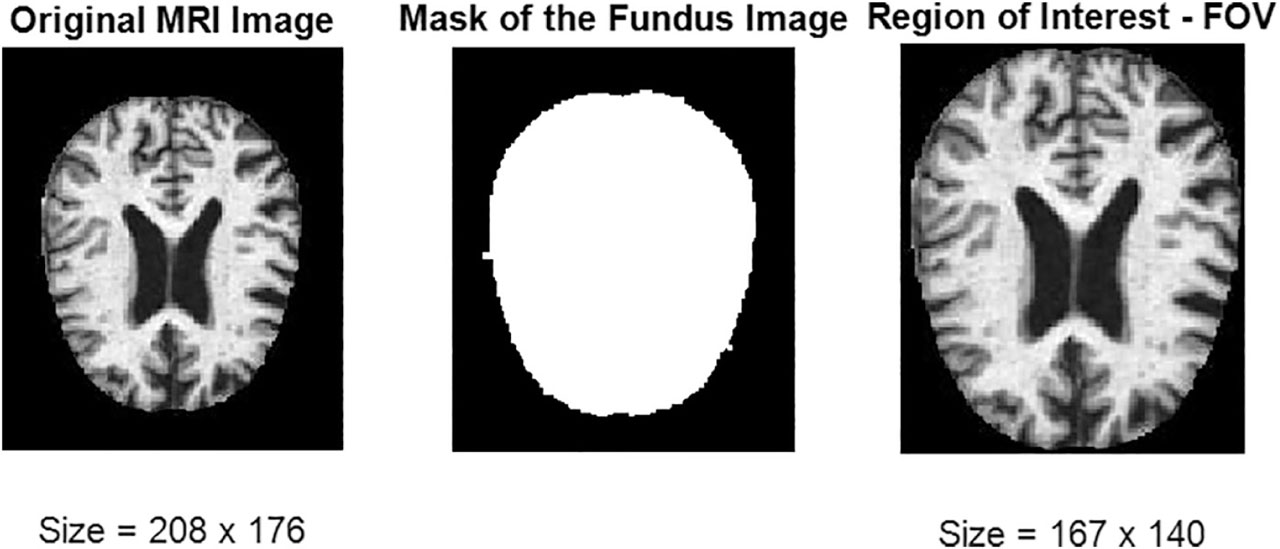
Figure 2:
The preprocessing phase. Original brain MRI image, the extracted FOV, and the region of interest. FOV, field-of-view; MRI, magnetic resonance imaging.
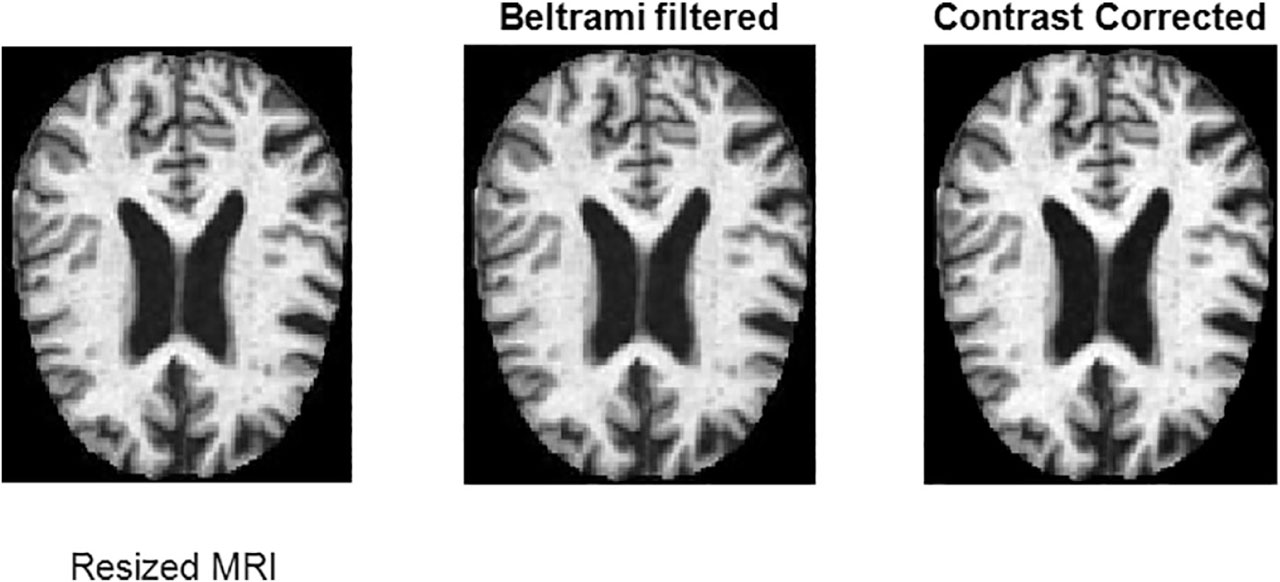
Figure 3:
The effect of denoising using Beltrami filter and enhancement using contrast measurement followed by correction. MRI, magnetic resonance imaging.
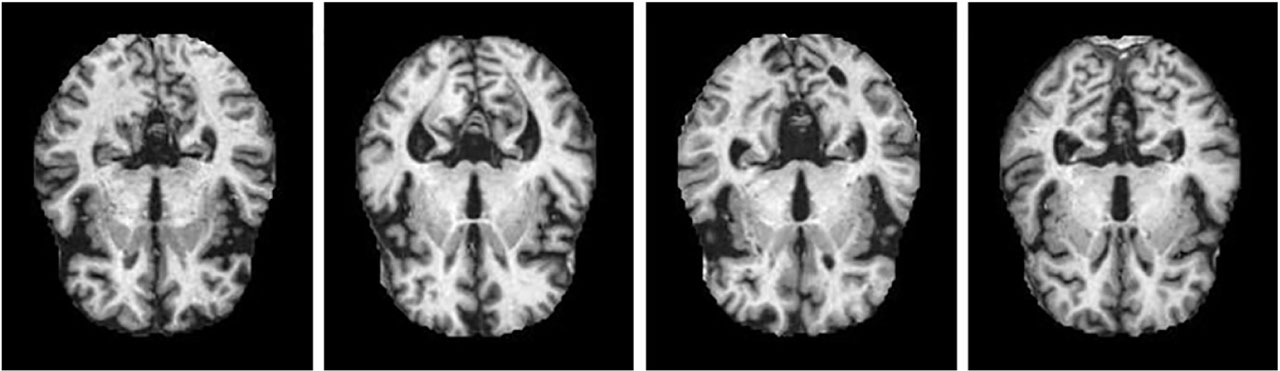
Figure 4:
Dataset samples from MD, ModD, ND, and VMD classes. MD, mild; ModD, moderate dementia; ND, non-dementia; VMD, very mild.
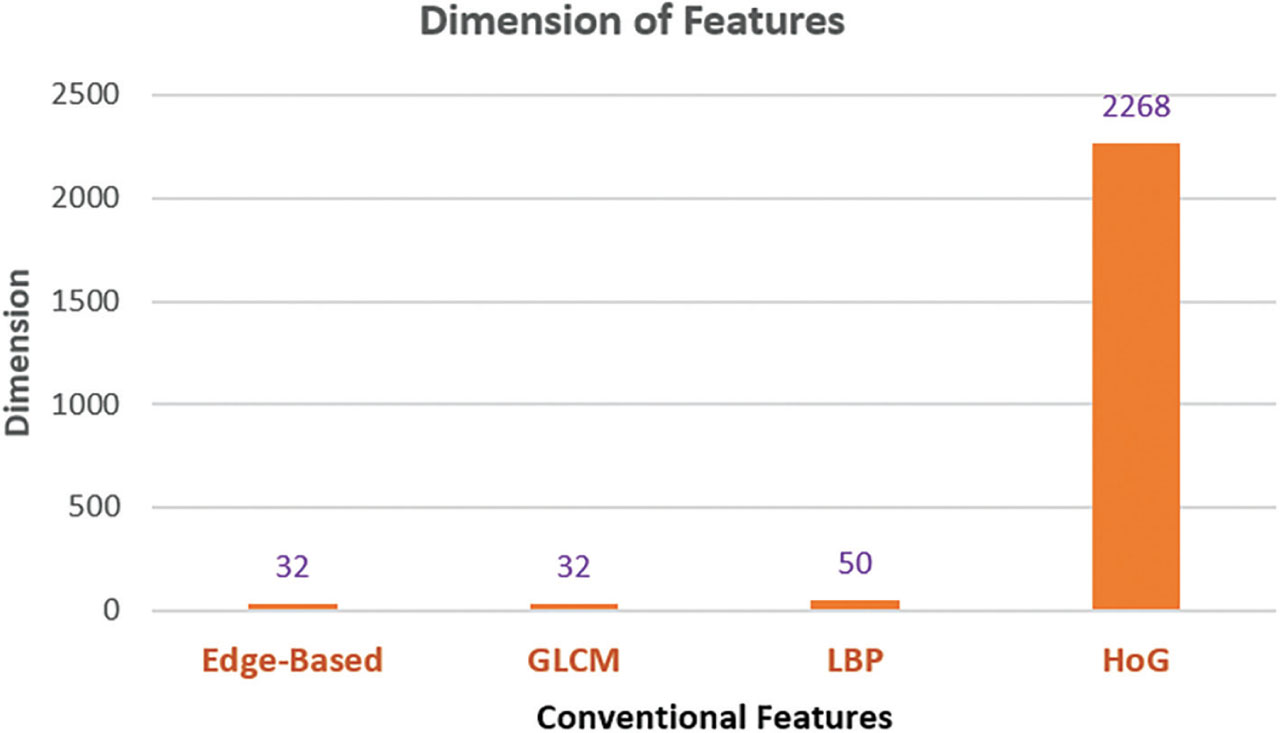
Figure 5:
Conventional features and their dimension. HoG, histogram of oriented gradient; LBP, linear binary pattern.
Table 2:
Kaggle dataset description
| Category | Training set | Test set | Total |
|---|---|---|---|
| MD | 717 | 179 | 896 |
| ModD | 52 | 12 | 64 |
| VMD | 1,792 | 448 | 2,240 |
| ND | 2,560 | 640 | 3,200 |
Table 3:
Kaggle dataset for binary classification
| Category | New class | Total samples |
|---|---|---|
| MD | Demented | 3,200 |
| ModD | ||
| VMD | ||
| ND | Non-demented | 3,200 |
Table 4:
Accuracies over the train and test samples concerning the number of PCA components
| Number of PCA components | Accuracy over the training set (%) | Mean accuracy (20 iterations) over the test set (%) |
|---|---|---|
| 10 | 99.55 | 93.30 |
| 15 | 100 | 98.82 |
| 20 | 100 | 99.29 |
| 25 | 100 | 99.76 |
Table 5:
Dataset categories and their numeric labels for multiclass configuration
| Category | Labels |
| MD | 1 |
| ModD | 2 |
| VMD | 3 |
| ND | 0 |
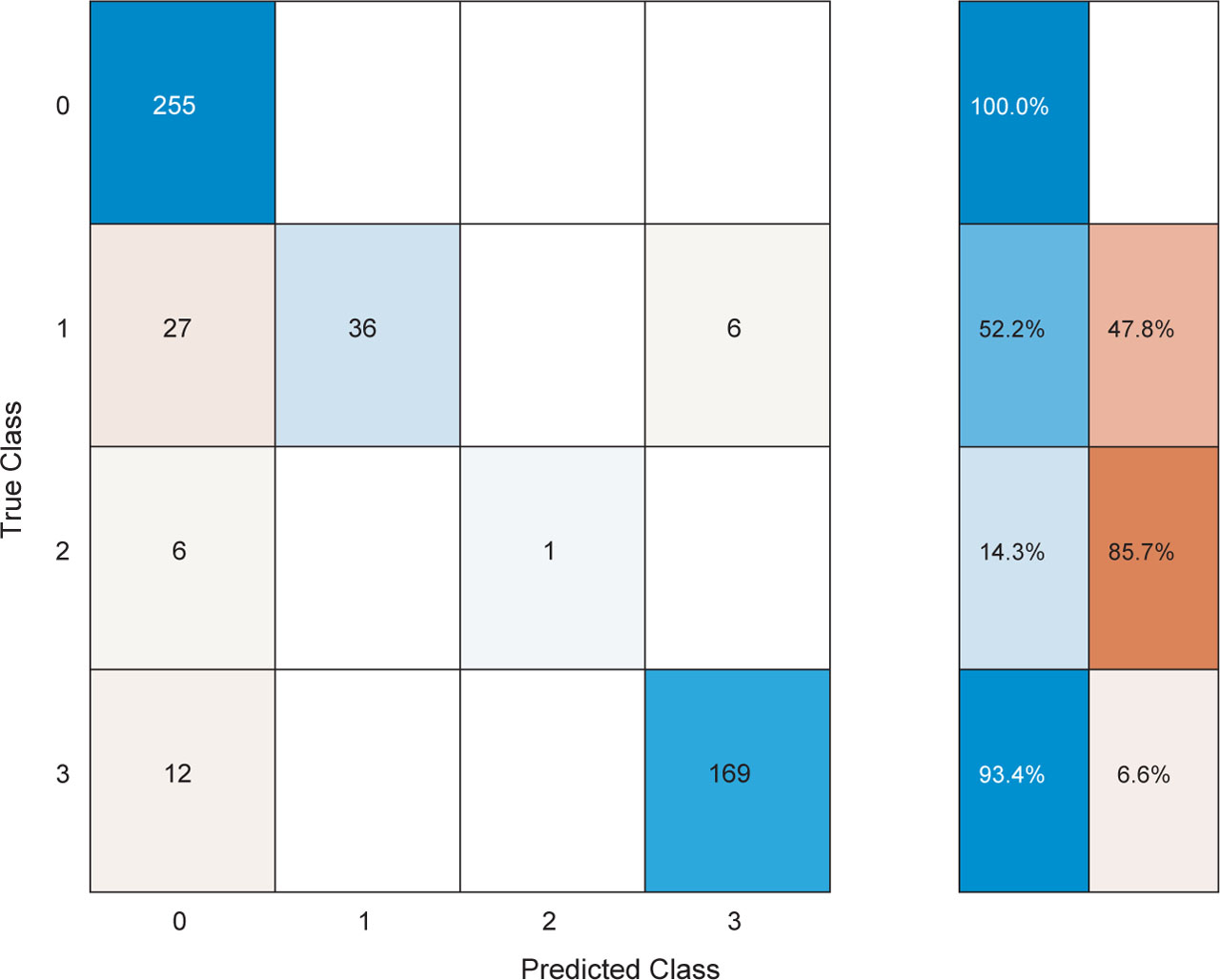
Figure 6:
CF for multiclass configuration. CF, conventional feature.
Table 6:
Accuracies over the train and test samples concerning the number of PCA components
| Number of PCA components | Accuracy over the training set (%) | Accuracy over the test set (%) |
|---|---|---|
| 10 | 99.22 | 88.75 |
| 11 | 99.64 | 88.75 |
| 12 | 99.91 | 90.78 |
| 13 | 99.97 | 98.82 |
Table 7:
Comparison of baseline model with proposed
| Model | Accuracy (%) | Precision (%) | Recall (%) | F1-score (%) |
|---|---|---|---|---|
| LR | 85.73 | 84.96 | 83.42 | 84.18 |
| NB | 83.20 | 81.27 | 79.88 | 80.56 |
| DT | 87.66 | 86.12 | 85.73 | 85.91 |
| KNN | 88.24 | 87.03 | 86.52 | 86.77 |
| RF | 89.72 | 88.94 | 88.11 | 88.52 |
| Proposed CF-ML Model | 98.82 | 97.94 | 97.61 | 97.77 |
Table 8:
Performance of the suggested CF-ML AD detection model versus different recent competing models (binary class configuration)
| Reference | Year | Dataset | Classifier model | Accuracy (%) |
|---|---|---|---|---|
| Sun et al. [51] | 2022 | OASIS | CNN | 99.68 |
| Tuvshinjargal and Hwang [52] | 2022 | Kaggle | Pretrained models | 77.40 |
| Sethuraman et al. [53] | 2023 | ADNI | Pretrained models | 96.61 |
| Balaji et al. [54] | 2023 | Kaggle | CNN-LSTM | 98.50 |
| El-Latif et al. [55] | 2023 | Kaggle | Lightweight CNN | 99.22 |
| Shojaei et al. [56] | 2023 | ADNI | 3D-CNN | 96.60 |
| Salehi et al. [57] | 2023 | Kaggle | LSTM | 98.62 |
| Sorour et al. [58] | 2024 | Kaggle | CNN-LSTM | 99.92 |
| Sener et al. [59] | 2024 | ADNI | Pretrained models | 99.58 |
| Zhang and Wang [60] | 2024 | ADNI | Pretrained models | 98.87 |
| Proposed CF-ML Model | 2024 | Kaggle | SVM | 99.76 |
Table 9:
Performance of the suggested CF-ML AD detection model versus different recent competing models (multiclass configuration)
| Reference | Year | Dataset | Classifier model | Accuracy (%) |
|---|---|---|---|---|
| Wang et al. [61] | 2016 | Kaggle | ML | 93.05 |
| Beheshti et al. [62] | 2017 | Kaggle | FR-GA-ML | 84.17 |
| Altaf et al. [63] | 2017 | Kaggle | Pretrained network | 92.48 |
| Srivastava et al. [64] | 2021 | Kaggle | VGG-16 | 96.20 |
| ResNet-18 | 87.50 | |||
| AlexNet | 91.40 | |||
| Inception v1 | 88.60 | |||
| Custom CNN | 96.20 | |||
| Nagarathna and Kusuma [65] | 2022 | Kaggle | CNN | 83.53 |
| HCNN | 95.52 | |||
| Sharma et al. [66] | 2022 | Kaggle | Hybrid DenseNet121 | 89.89 |
| Hybrid DenseNet201 | 91.75 | |||
| Saleh et al. [67] | 2023 | Kaggle | Pretrained network | 96.05 |
| Balasundram et al. [68] | 2023 | Kaggle | CNN | 94.10 |
| Tripathy et al. [69] | 2024 | Kaggle | CNN | 96.25 |
| Raj et al. [70] | 2025 | Kaggle | Hybrid DL | 97.88 |
| Proposed CF-ML Model | 2025 | Kaggle | CF-ML | 98.82 |