




Table 1:
Summary regarding the review of literature on smart buildings
| Authors | Year | Usage of methodology | Main findings/viewpoints | Limitations |
|---|---|---|---|---|
| Rodríguez Gracia et al. [20] | Apr 2023 | AI techniques in sustainable buildings | Explores how AI can enhance the sustainability of buildings through a comprehensive review of the existing literature. Utilized bibliometric analysis to identify key trends. | Relies on bibliometric data, which may not capture the practical, real-world effectiveness of AI solutions. |
| Khan et al. [21] | Dec 2022 | Critical event library for building fire safety | Developed a framework for firefighting in buildings based on significant fire events. The framework aims to predict future incidents using a database of past events. | Based on historical data, which may not account for new building materials and designs or evolving safety standards. |
| Liu et al. [22] | Jan 2023 | Data-driven smart photovoltaic systems in buildings | Summarized literature on data-driven approaches with integrated photovoltaic systems, covering data collection, analysis, prediction, and optimization. | The focus on data-driven methods does not address the practical implementation and cost considerations for large-scale use. |
| Xia et al. [23] | Sep 2022 | GIS and BIM integration for smart cities | Reviewed data integration methods for combining GIS and BIM technologies in urban planning, emphasizing sustainable city design through digital twins. | The study is largely conceptual and does not provide practical case studies on the implementation of these technologies. |
| Pinto et al. [24] | Feb 2022 | Transfer learning in smart building applications | Reviewed the use of transfer learning and deep learning in smart building technologies, categorizing existing research into four major application areas. | Primarily focuses on theoretical applications without a detailed discussion on the challenges of real-world deployment. |
| Dwivedi et al. [25] | Apr 2022 | IoMT in healthcare buildings | Investigated the use of IoT in healthcare buildings, discussing potential benefits and challenges in creating smart healthcare environments. | Limited discussion on data security and privacy concerns associated with IoT in healthcare settings. |
| Huseien and Shah [26] | Jan 2022 | 5G technology for smart energy management | Discussed the potential of 5G technology to support energy management in smart buildings, with a focus on Singapore’s governmental support for this technology. | Focused on the Singapore context, which may not be applicable to other regions with different regulatory environments. |
| Aguilar et al. [27] | Nov 2021 | AI for energy management in buildings | Reviewed AI applications for self-managing energy systems in buildings, categorizing studies by task areas of monitoring and decision-making. | Limited to AI technologies; does not address the challenges of integrating these systems with existing infrastructure. |
| Malagnino et al. [28] | Aug 2021 | IoT and BIM for sustainable building environments | Explored how building information modeling and the IoT can improve building sustainability, analyzing literature from 2015 to 2020. | Focused on older literature, potentially missing recent advancements and ongoing research in this rapidly evolving field. |
| Stopps et al. [29] | Jan 2021 | Occupant-centric HVAC controls in residential buildings | Reviewed the research on smart HVAC systems that focus on occupant comfort, comparing experimental studies with existing commercial technologies. | Emphasizes research gaps without fully exploring how these systems can be effectively integrated into current homes. |
| Dakheel et al. [30] | Oct 2020 | Smart building features and performance indicators | Reviewed the technologies and KPIs that define intelligent building features and discussed the challenges of retrofitting existing buildings. | The review is general; it lacks specific case studies or quantitative assessments of different smart building technologies. |
| Dong et al. [31] | Sep 2019 | Smart building sensing systems | Reviewed how indoor environmental sensors impact energy efficiency and comfort, covering aspects regarding visual comfort and indoor air quality in the building. | The focus on sensors overlooks the challenges related to maintenance, data accuracy, and system integration. |
| Jia et al. [32] | May 2019 | IoT adoption in smart buildings | Reviewed key projects and research on the changing and fixing of IoT technologies for smart buildings, also highlighting improvements in sites of academia and industry. | Lacks an evaluation for long-term sustainability and scalability of these IoT solutions in several different building types. |
| Our proposed work | Oct 2024 | Adoption of IoT technologies, the formal model language of TLA+, specification with formal methods in smart courtroom building | ||
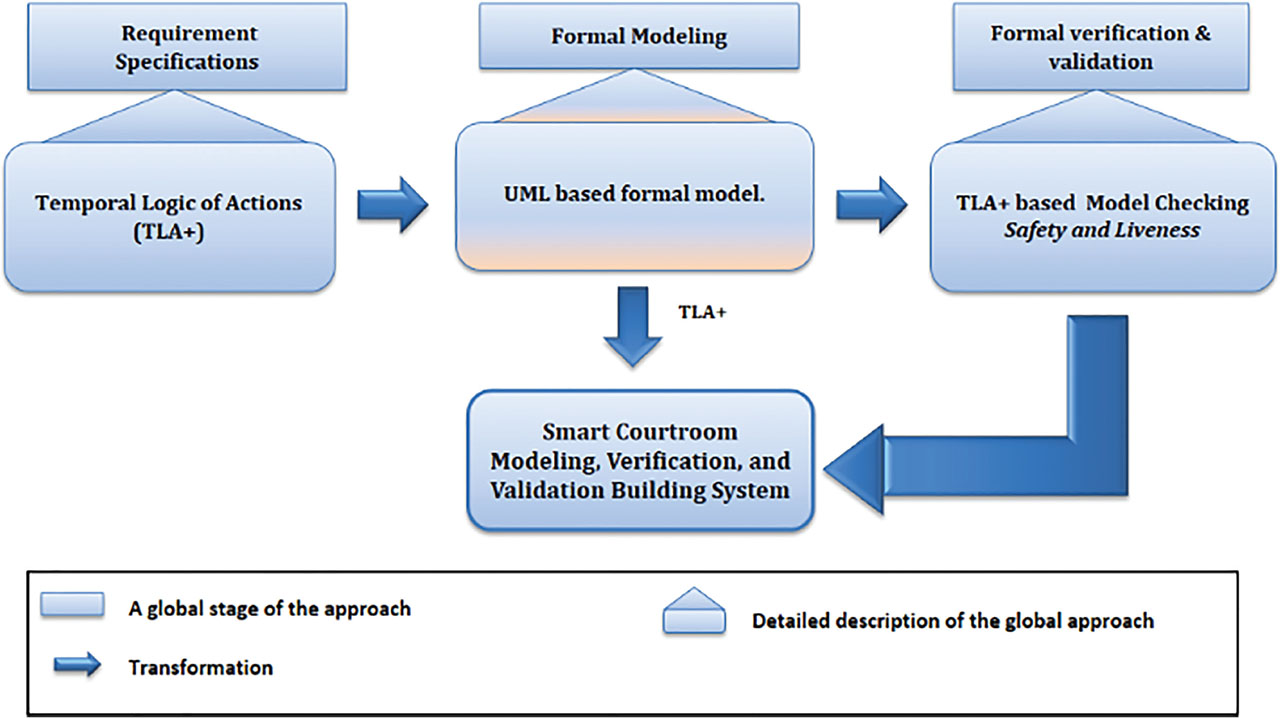
Figure 1:
Proposed approach.
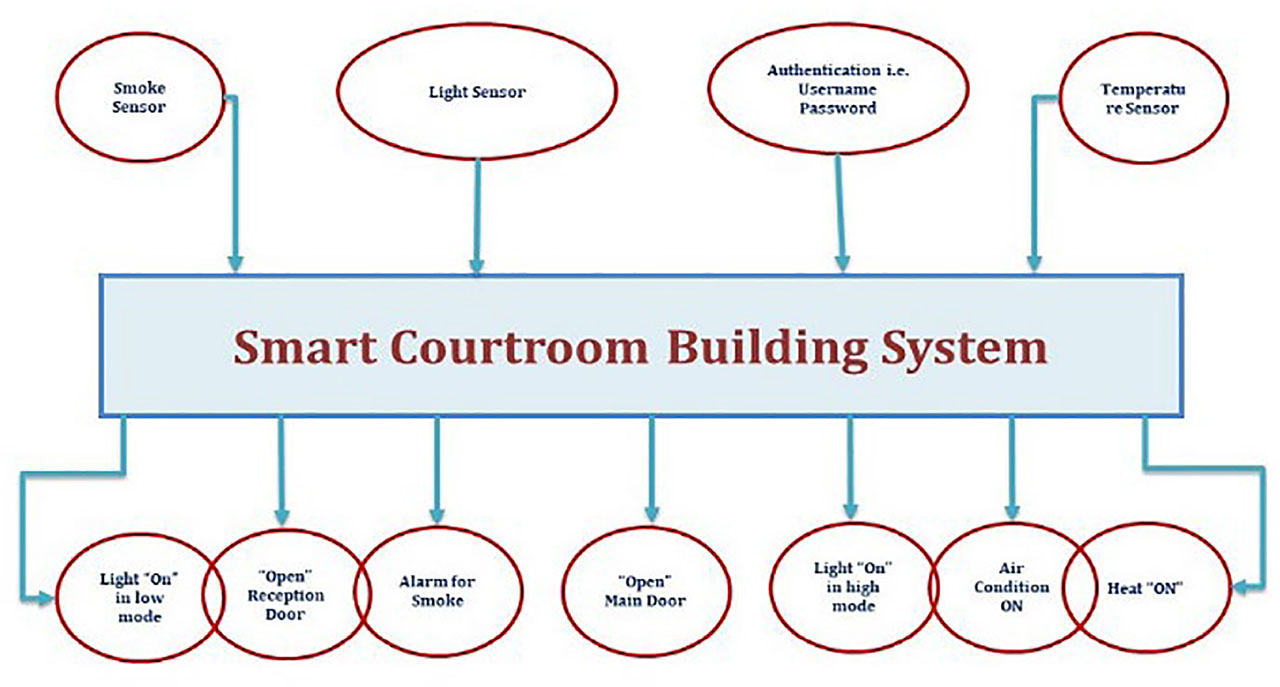
Figure 2:
Inputs/outputs of SMCBS. SMCBS, smart courtroom building system.
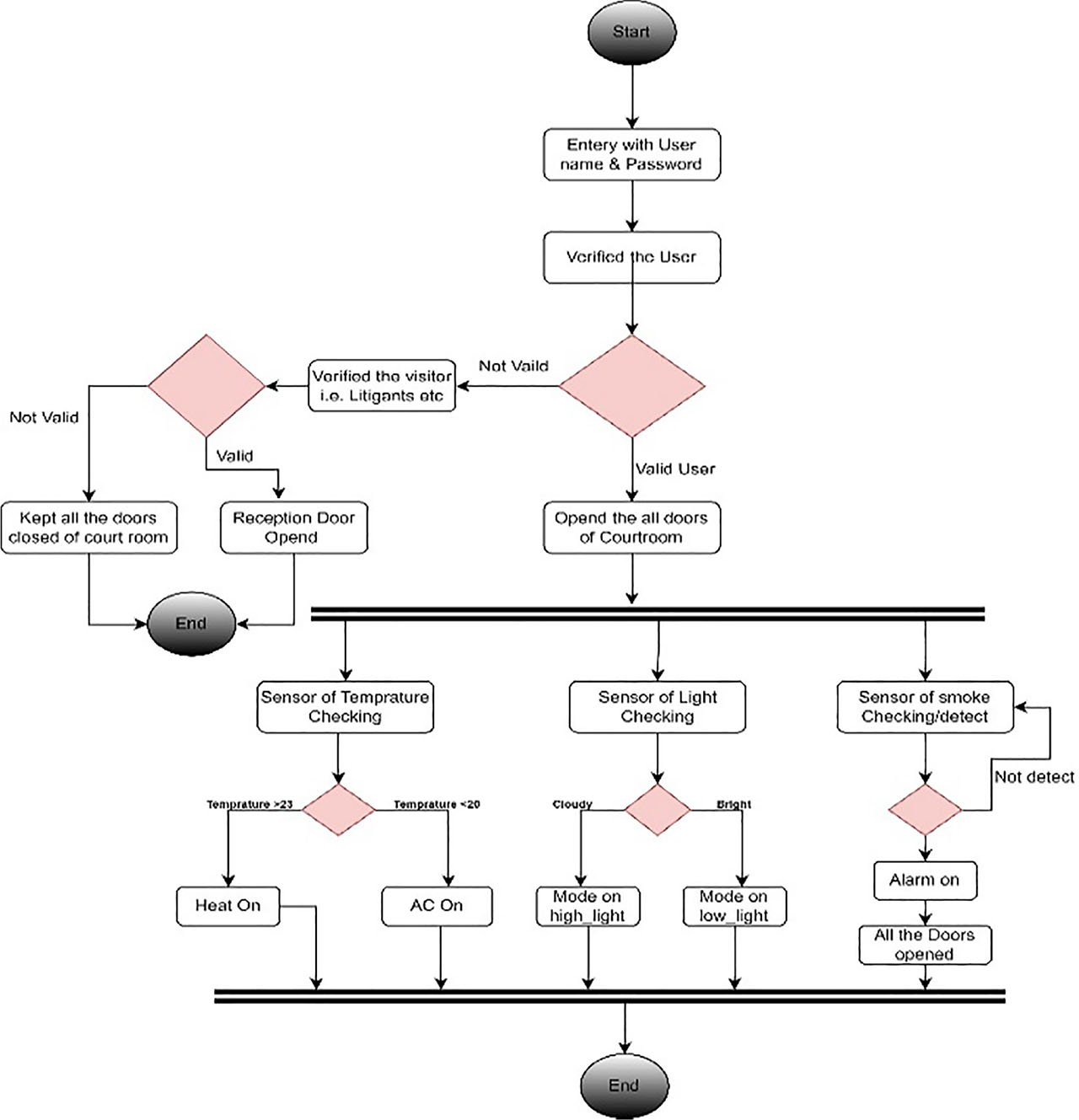
Figure 3:
Smart courtroom activity diagram.
Table 2:
Information of specification in TLA+
| Type name | Value |
|---|---|
| Total number of variables | 21 |
| Extends library variables | 04 |
| Total number of initializations | 21 |
| Total number of off events | 06 |
| Total number of on events | 06 |
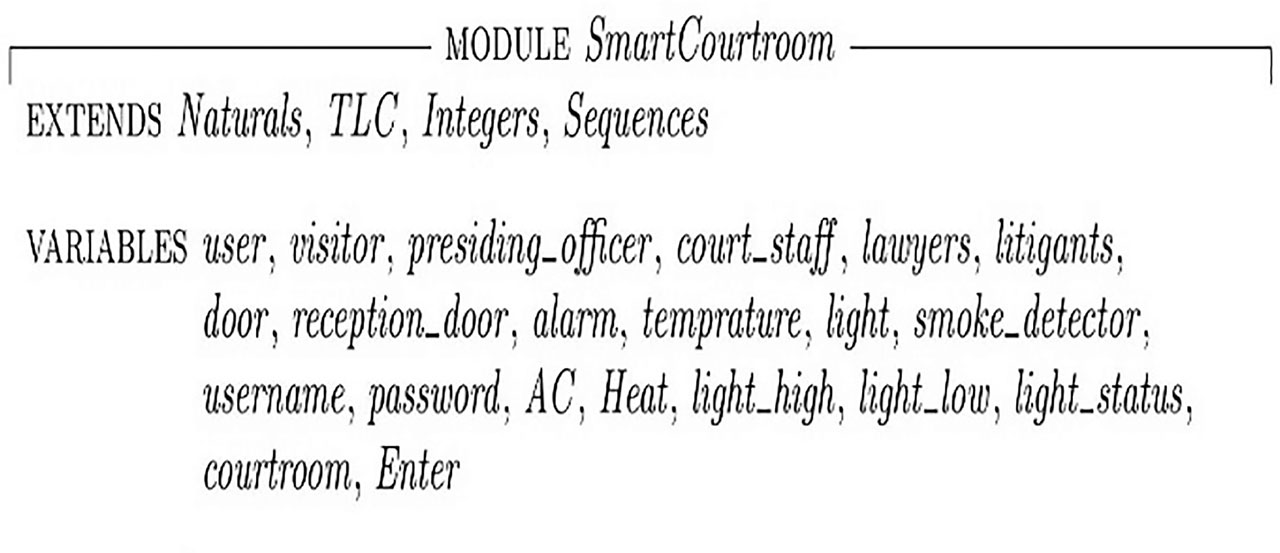
Figure 4:
Variable declaration in the smart courtroom module.
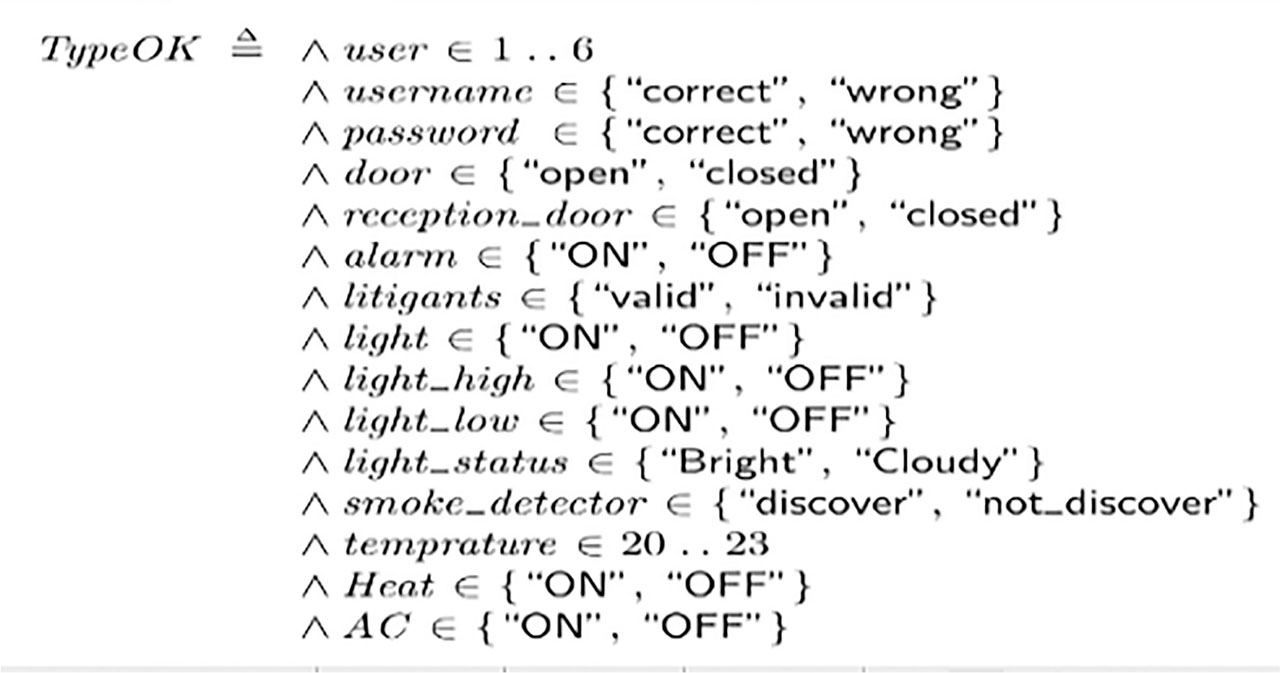
Figure 5:
Smart courtroom TypeOk.
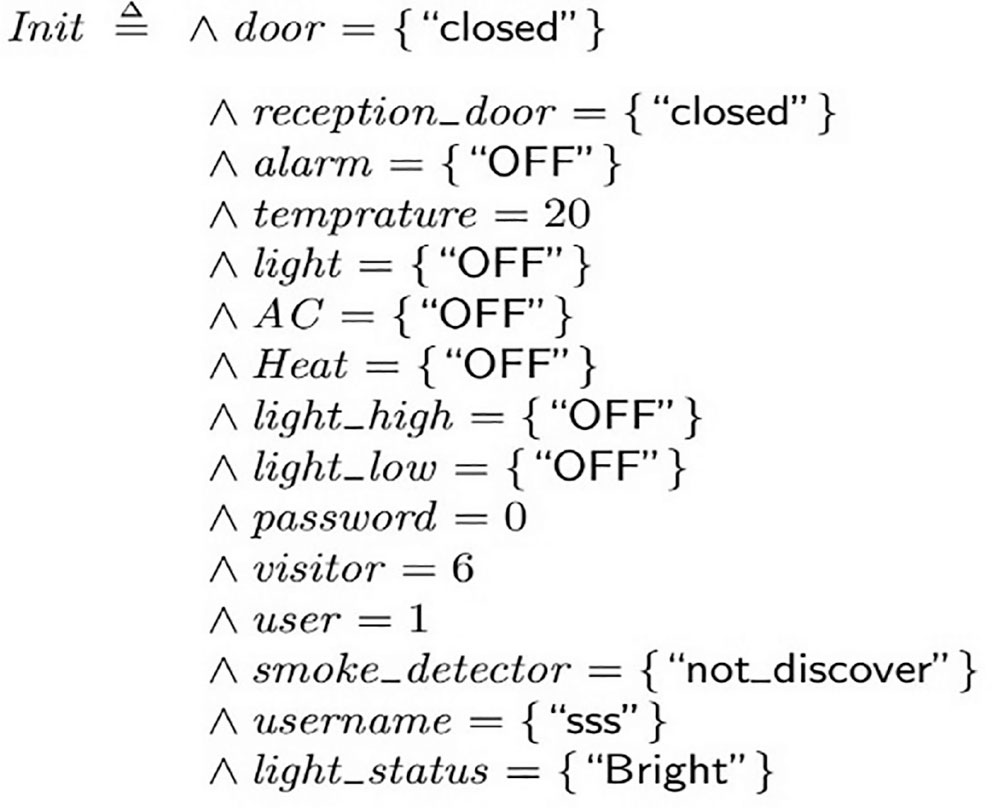
Figure 6:
Init function of the smart courtroom building system. SMCBS, smart courtroom building system.
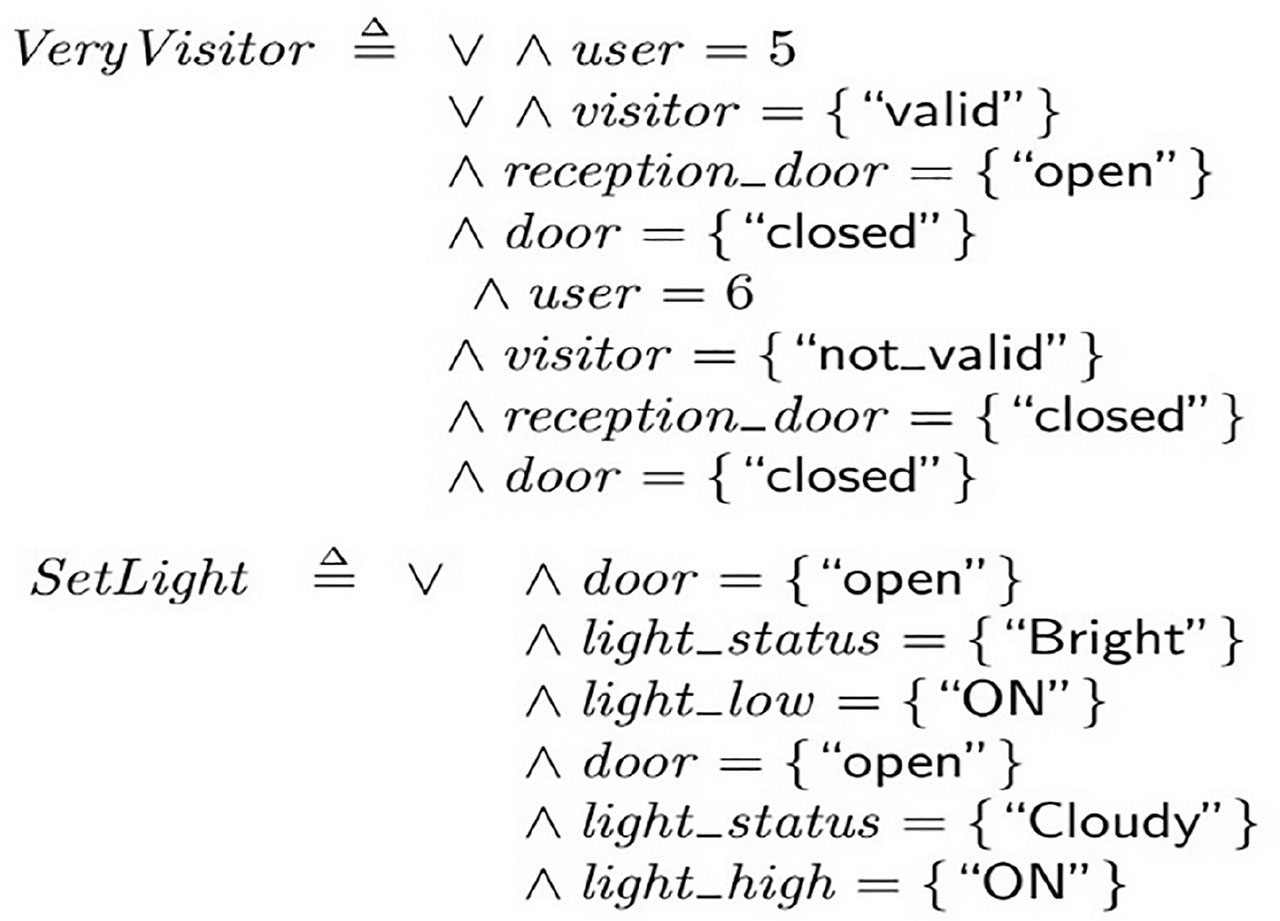
Figure 7:
Verification of visitors/litigants and SetLight functions.
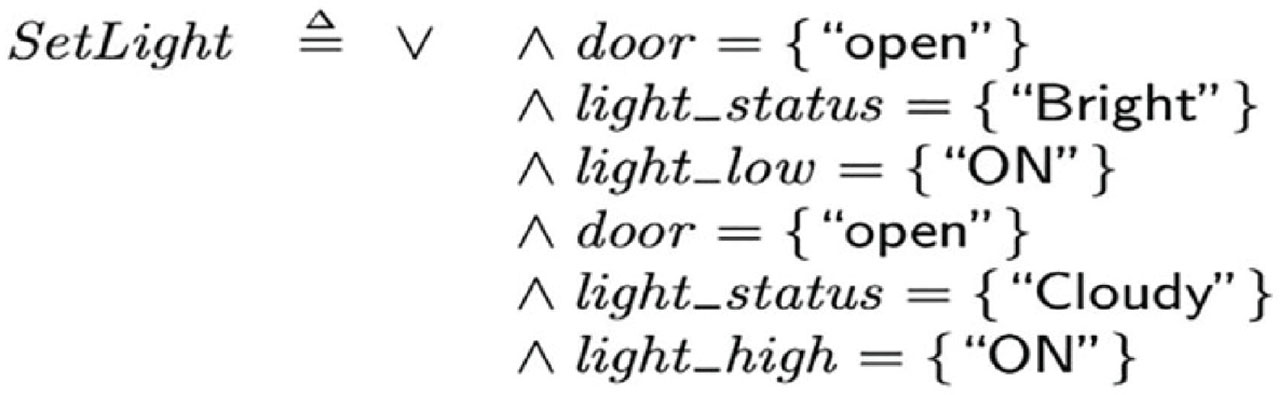
Figure 8:
SetLight function of SMCBS.
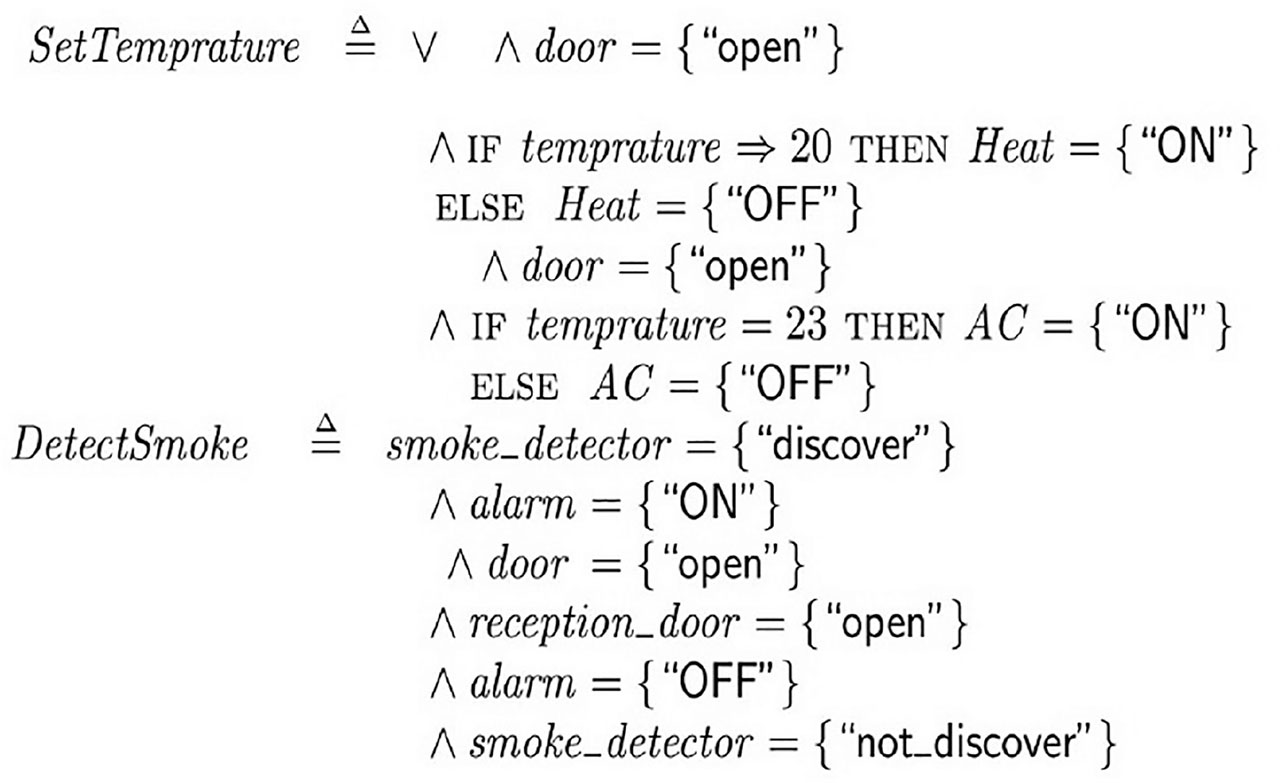
Figure 9:
SetTemperature and DetectSmoke functions in SMCBS.
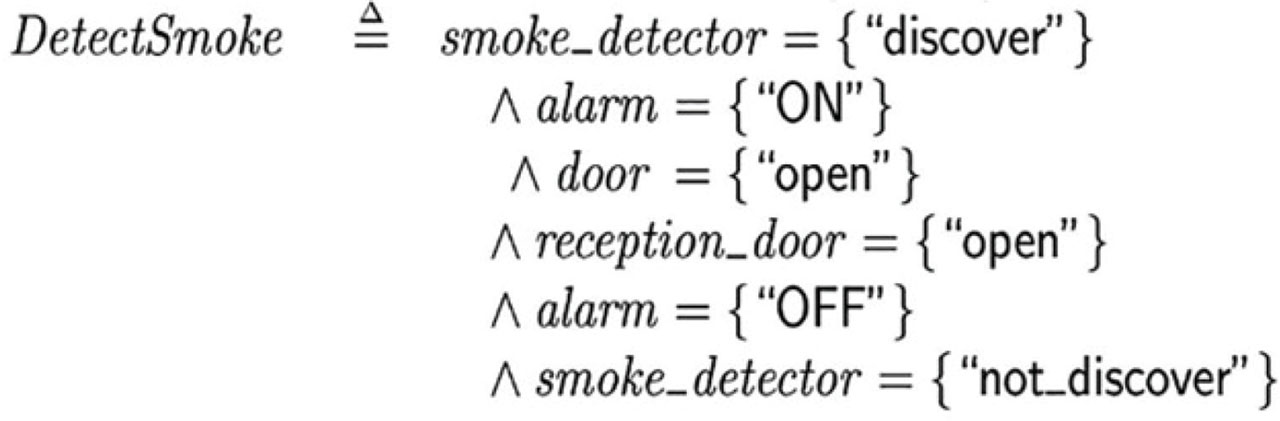
Figure 10:
DetectSmoke functions in SMCBS.
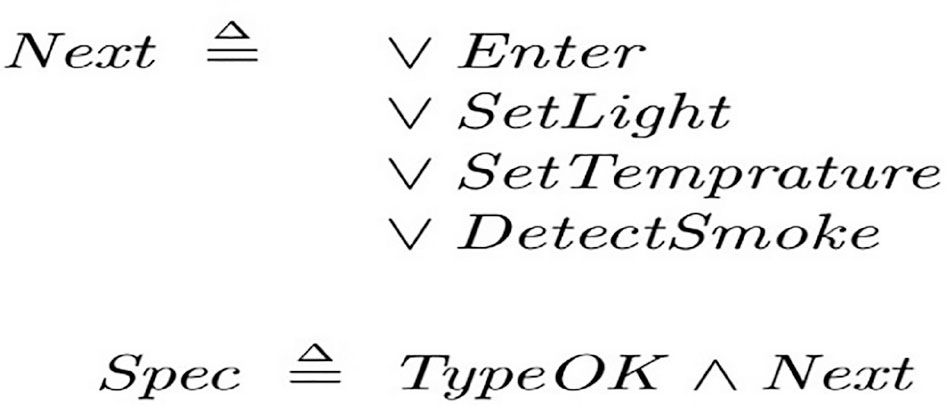
Figure 11:
Next and spec functions in SMCBS.
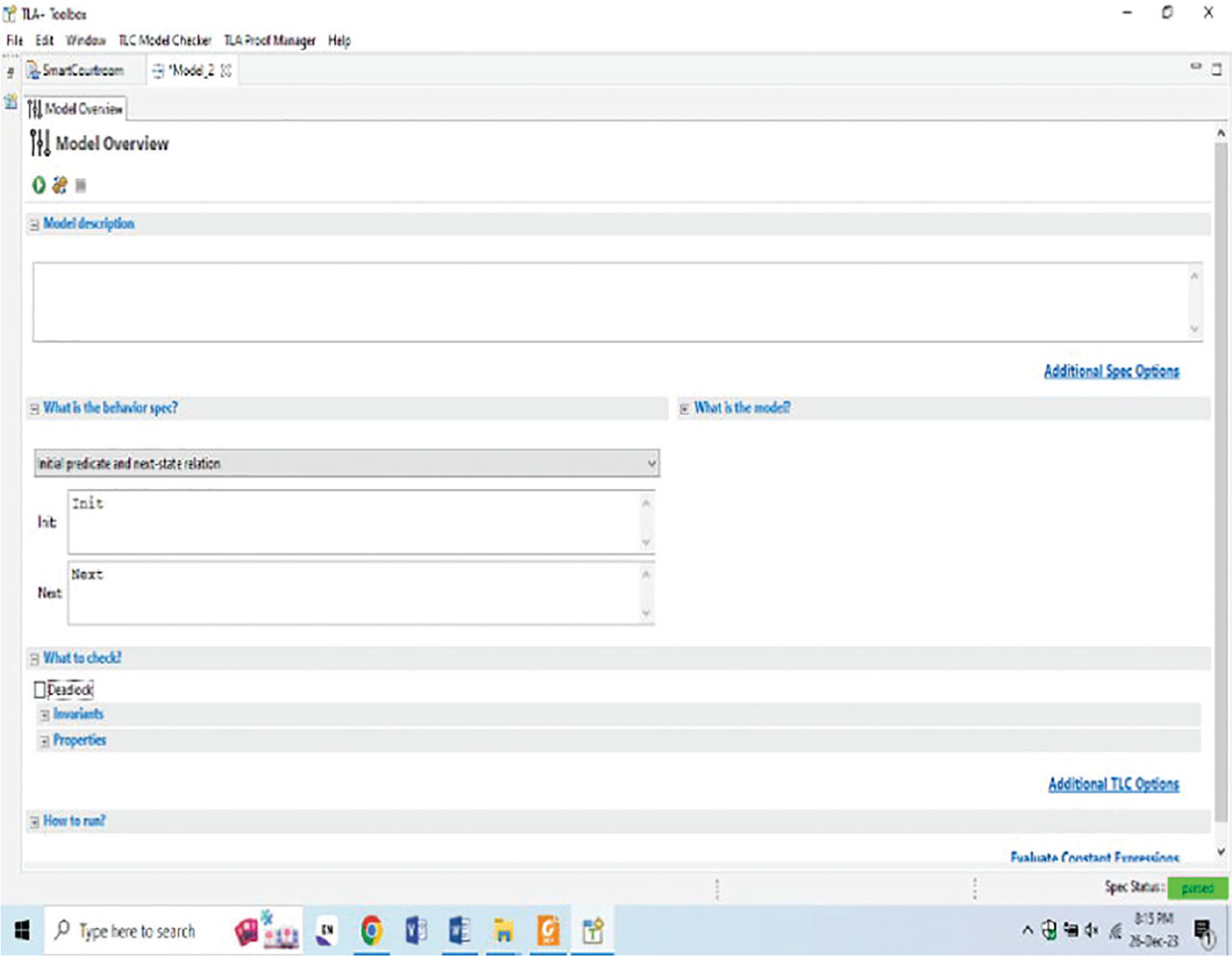
Figure 12:
Parsed model of TLA+ specification.
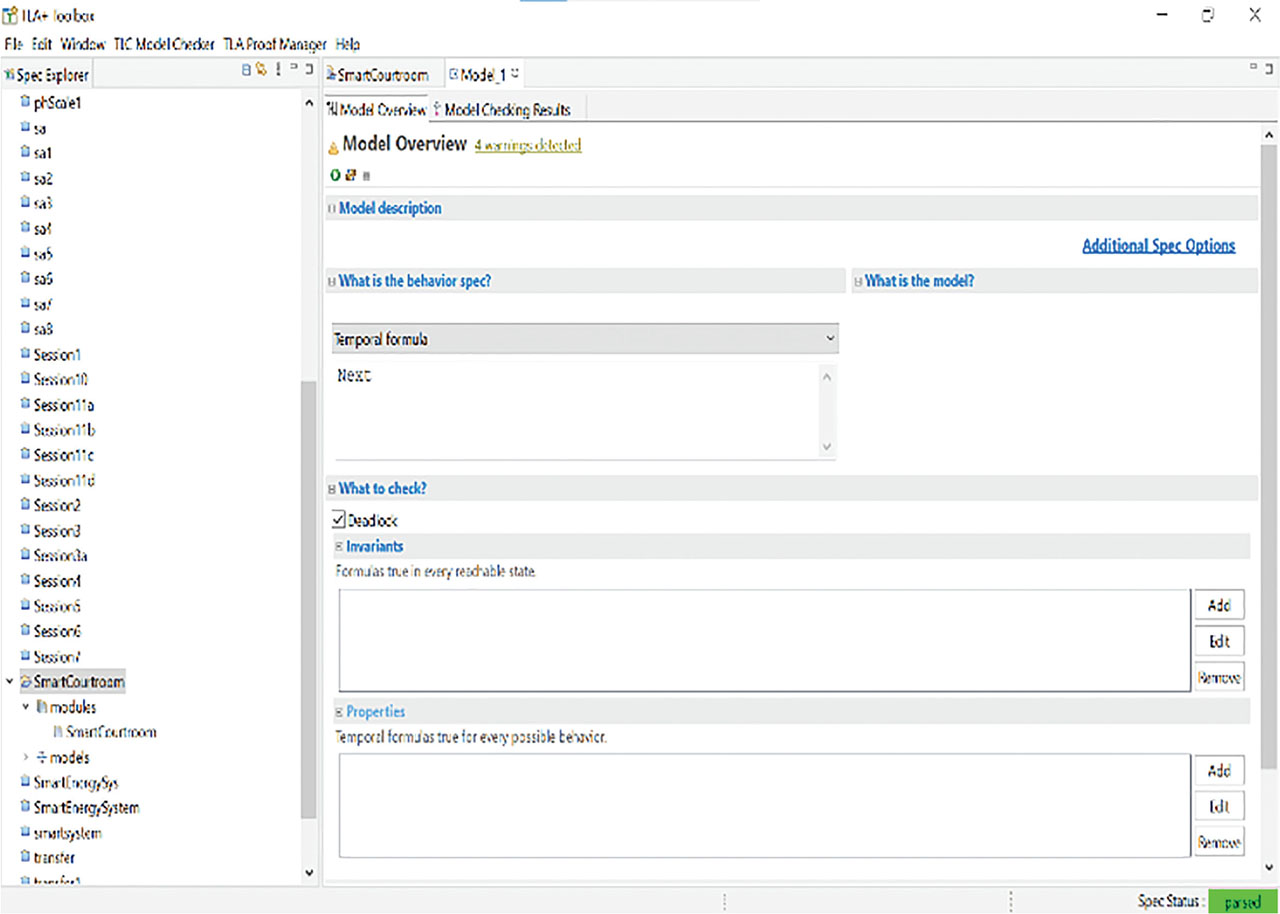
Figure 13:
Parameter setting in model overview.