
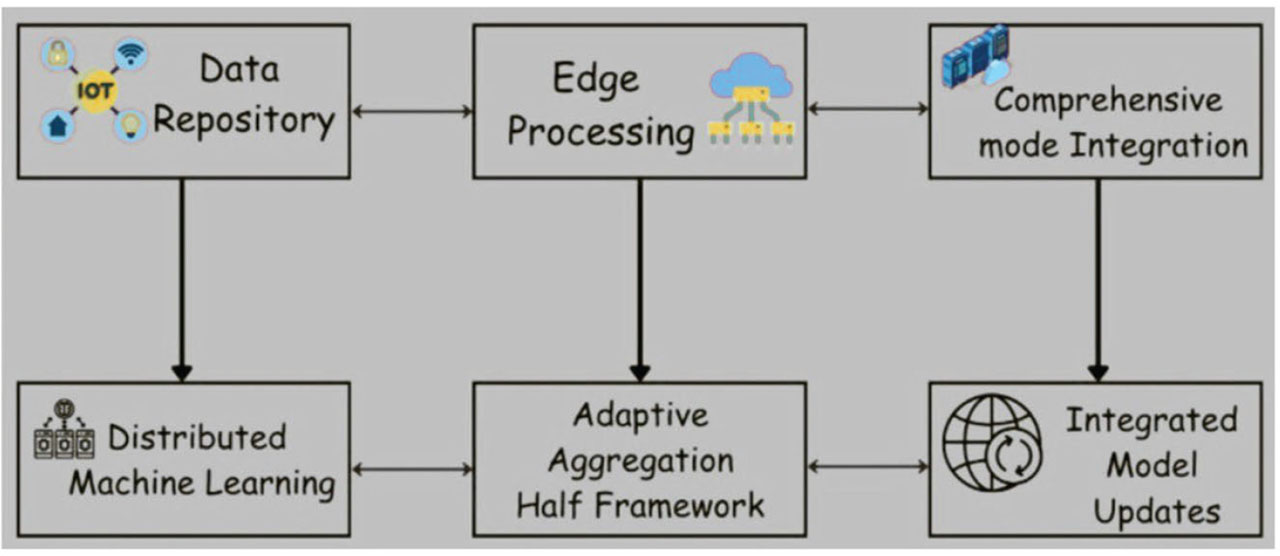
Figure 1:
Data flow in HALF framework: cloud-edge collaboration. HALF Framework, High-performance adaptive learning framework.
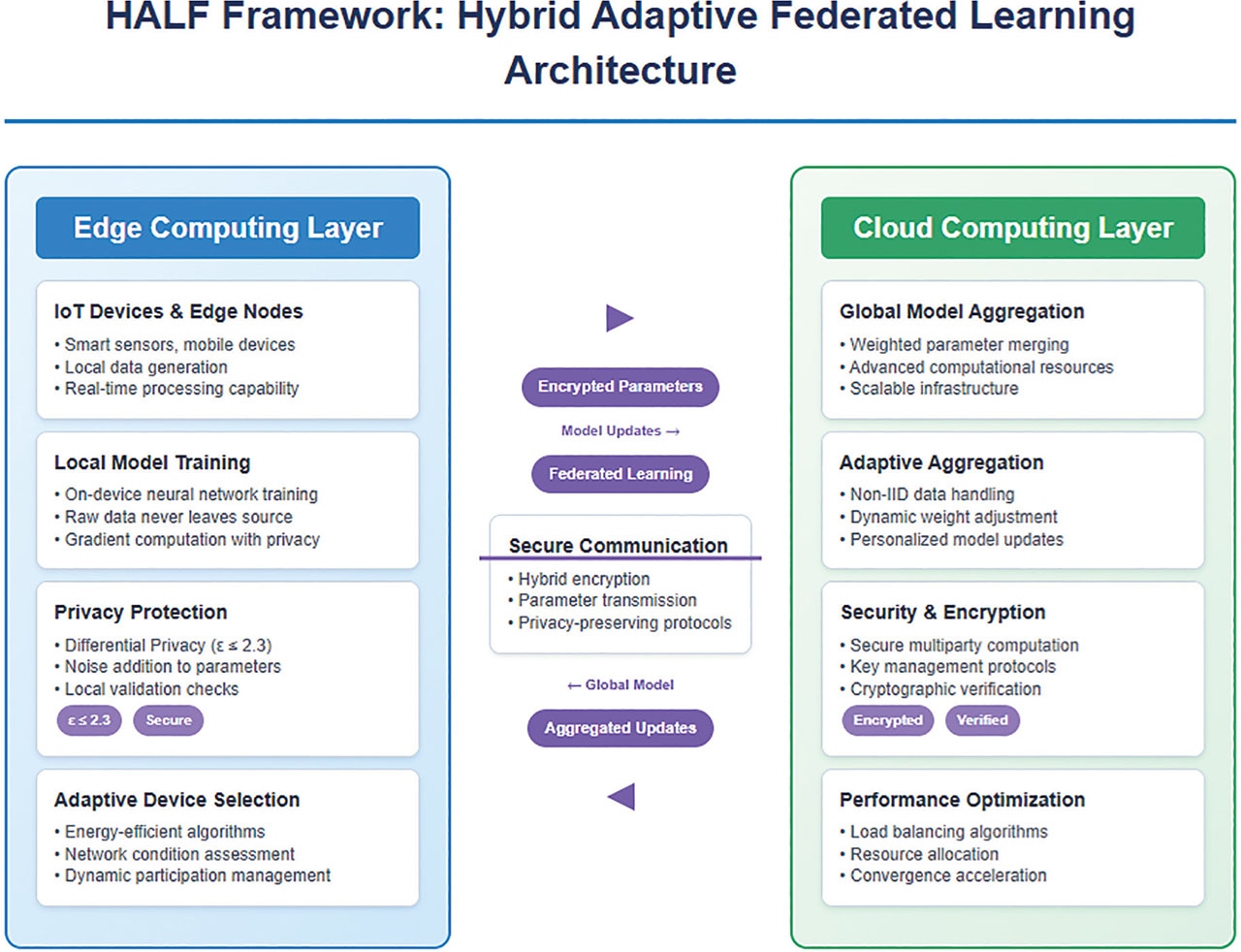
Figure 2:
HALF Architecture. HALF, hybrid adaptive learning framework; IoT, Internet of things.
Table 1:
Comparative analysis of HALF versus existing FL frameworks
| Dimension | Existing literature (key insights) | HALF framework contributions | Implications of HALF’s results |
|---|---|---|---|
| Privacy preservation | Use of differential privacy and secure multiparty computation (Chen et al., 2023; Singh & Sharma, 2024). Often causes trade-offs in accuracy. | Integrates DP-SGD (ε ≤ 2.3), HE, and dynamic noise calibration based on data sensitivity. | Achieves strong privacy guarantees while preserving model accuracy (≥89.7%), making it suitable for regulated sectors like healthcare and finance. |
| Communication overhead | Traditional FL has high overhead due to frequent model updates (Smith et al., 2020). Some studies reduce overhead with adaptive aggregation (Wang et al., 2022). | Employs weighted FedAvg with dynamic device selection and compression protocols to reduce data exchange. | Demonstrates ≥40% reduction in communication overhead, allowing deployment in low-bandwidth and remote IoT environments. |
| Scalability and resource efficiency | Cloud-only or edge-only systems face bottlenecks (Patel et al., 2020; Johnson & Lee, 2021). Edge-only models lack power; cloud-only raise privacy risks. | Combines cloud scalability with edge autonomy, using adaptive resource management and energy-aware device selection. | Enables real-time FL with ≤53.2% energy usage, promoting sustainable large-scale deployment across IoT and smart cities. |
| Non-IID data handling | Many FL systems degrade in non-IID settings; only a few apply personalized models or adaptive techniques (Gupta et al., 2021; Zhang et al., 2023). | Simulates non-IID via Dirichlet (α = 0.5) and applies adaptive aggregation + device weighting for better personalization. | Maintains high model accuracy across all rounds, especially in heterogeneous settings like personalized healthcare and sensor networks. |
| Latency and responsiveness | Edge-based systems reduce latency but struggle with model coordination (Li et al., 2022; Nguyen et al., 2024). | Uses localized training, priority-based task queues, and fast edge-to-cloud routing (e.g., MQTT, HTTP/2). | HALF achieved ≤142 min training time, enabling real-time inference in latency-sensitive domains like autonomous vehicles and emergency response systems. |
| Adaptability to dynamic conditions | Few FL frameworks account for fluctuating resources or network conditions (Gupta et al., 2021). | Dynamic optimization algorithms assess device CPU, memory, battery, and bandwidth before participation. | System is resilient to edge instability and capable of handling heterogeneous environments, improving fault tolerance and system continuity. |
| Real-world application validation | Many frameworks lack real-world evaluation or cross-sector validation (Zhang et al., 2023; Nguyen et al., 2024). | Includes case studies in healthcare, smart cities, and autonomous systems, plus expert interviews and penetration tests. | Validates HALF’s societal impact, compliance with GDPR/HIPAA, and readiness for deployment in mission-critical applications. |
| Performance metrics | Performance often suffers with added privacy constraints. Few studies report full-spectrum metrics including resource use (Chen et al., 2023). | Measures accuracy, latency, privacy budget, energy use, memory use, and communication load. | Achieves 91.3% average success rate across domains, confirming that privacy and performance can co-exist without compromising scalability or user utility. |
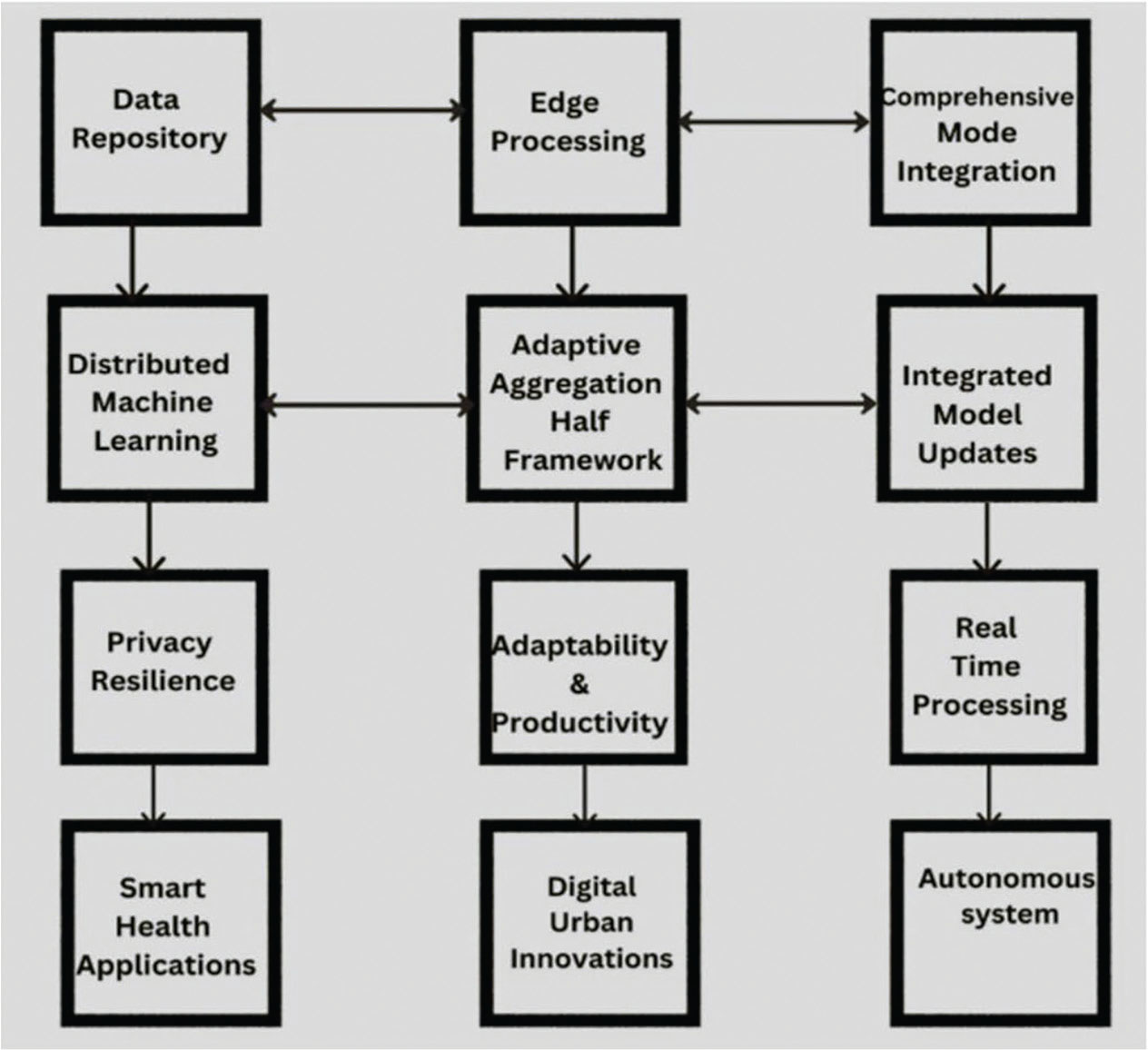
Figure 3:
The HALF framework: enabling privacy-preserving distributed machine learning. HALF Framework, High-performance adaptive learning framework.
Table 2:
Comparison of HALF with existing FL approaches
| Criteria | Traditional FL (FedAvg) | Edge-only FL | Cloud-based FL | Adaptive FL (recent works) | Proposed: HALF framework |
|---|---|---|---|---|---|
| Privacy mechanism | Basic DP or none | Limited, device-specific | Centralized control with encryption | DP + secure Aggregation (limited dynamic support) | Differential privacy (ε ≤ 2.3), HE, secure aggregation |
| Data distribution handling | Poor with non-IID data | Moderate | Poor | Moderate to good | Excellent (Dirichlet-based non-IID + adaptive aggregation) |
| Communication overhead | High (frequent, large updates) | Low to medium | High due to centralized model synchronization | Medium | Low (≥40% reduction using selective participation and compression) |
| Latency | High | Low | Medium to high | Medium | Low (edge-local pre-processing + fast routing protocols) |
| Device heterogeneity support | Poor | Moderate | Not scalable across diverse devices | Moderate | Strong (dynamic resource-aware device selection) |
| Scalability | Limited to small-to-medium networks | Limited due to edge constraints | Scalable in power but not privacy or bandwidth | Moderate | High (cloud-edge hybrid coordination and load balancing) |
| Model accuracy (non-IID data) | Degraded | Acceptable (with personalization) | Degraded | Improved (with advanced aggregation) | ≥89.7% (optimized for skewed, non-IID conditions) |
| Energy efficiency | Inefficient | Energy-constrained devices | High cloud-side energy use | Moderate | Energy-aware (≤53.2% baseline consumption) |
| Security protocols | Minimal or basic encryption | Device-level security | Cloud-level encryption | Improved (some use TLS, AES) | End-to-end (TLS 1.3, AES-256, SHA-256 validation, privacy budget auditing) |
| Evaluation scope | Simulation-based, mostly MNIST | Limited deployment scenarios | Simulation-heavy | Some real-world benchmarks | Extensive: simulation + case studies + expert interviews |
| Adaptability to network conditions | Poor | Moderate | Poor | Good in some recent systems | Excellent (real-time network/resource monitoring & adaptation) |
| Overall performance summary | Inflexible, privacy-limited | Lightweight but narrow-scope | Powerful but privacy-risky | Evolving, partially adaptive | Balanced, privacy-resilient, scalable, and deployment-ready |
Table 3:
Overview of the HALF framework—key insights and contributions
| Category | HALF framework details |
|---|---|
| Framework name | HALF |
| Purpose | To provide a privacy-preserving, scalable, and resource-efficient FL architecture suitable for distributed AI systems. |
| Target domains | Healthcare, smart cities, autonomous systems |
| Core challenges addressed | Data confidentiality, communication overhead, device heterogeneity, on-IID data, latency and bandwidth constraints |
| Key features | Adaptive device selection, dynamic privacy budgeting (ε ≤ 2.3), secure multiparty computation, lightweight local training, hybrid edge-cloud synergy |
| Implementation workflow | 1. Initialization, 2. Device selection, 3. Training, 4. Aggregation, 5. Evaluation |
| Privacy mechanisms | Differential privacy (DP-SGD), HE, secure aggregation, gaussian/laplace noise injection |
| Aggregation strategy | Weighted FedAvg with device reliability scoring and secure update verification (SHA-256) |
| Data partitioning | Non-IID via Dirichlet distribution (α = 0.5) |
| Hardware requirements | Edge devices: ≥2 GB RAM, 1.5 GHz CPU, cloud server: ≥16 GB RAM, 8-core CPU |
| Software stack | Python 3.8+, PyTorch, TensorFlow Privacy, Docker, Flower FL, OpenSSL |
| Training parameters | Epochs: 10, batch size: 32, rounds: 100, learning rate: 0.01 |
| Performance metrics | Accuracy: ≥89.7%, communication overhead: reduced by ≥40%, training time: ≤142 min, energy consumption: ≤53.2% baseline |
| Evaluation methods | Quantitative: MNIST, CIFAR-10 simulations, qualitative: expert interviews, case studies |
| Security protocols | TLS 1.3, AES-256, secure device authentication, privacy budget auditing |
| Success metrics | Accuracy Gain versus FL: +7.4%, resource utilization reduction: 45.45% avg, implementation success rate: 91.3% avg |
| Limitations identified | Limited real-time streaming validation, potential scalability issues in cross-silo deployments, encryption overhead, heterogeneous device inclusion |
| Future directions | HE, real-time model drift adaptation cross-silo FL, automated privacy-risk scoring, fault-tolerance mechanisms |
Table 4:
Meta-analysis table
| Authors | Year | Key findings | Method used | Advantages | Disadvantages | Remarks |
|---|---|---|---|---|---|---|
| Smith et al. | 2020 | FL reduces data transfer but faces challenges with non-IID data. | FedAvg | Privacy preservation, reduced communication. | High latency, deficient performance with non-IID data. | Highlights the need for adaptive aggregation techniques. |
| Patel et al. | 2020 | Cloud-based FL improves scalability but raises privacy concerns. | Cloud-based FL, centralized aggregation | Scalable, handles large datasets efficiently. | Privacy risks due to centralized aggregation. | Recommends combining edge and cloud for privacy and scalability. |
| Johnson & Lee | 2021 | Edge computing reduces latency but lacks scalability for large datasets. | Edge-based FL with local processing | Low-latency processing, improved efficiency. | Limited computational power on edge devices. | Suggests integrating cloud resources for scalability. |
| Gupta et al. | 2021 | FL frameworks struggle with device heterogeneity and dynamic network conditions. | Heterogeneous FL, dynamic adaptation | Adapts to diverse devices and network conditions. | Complex implementation, high computational cost. | Calls for lightweight algorithms for resource-constrained devices. |
| Wang et al. | 2022 | HALF framework improves communication efficiency by 40%. | Adaptive aggregation, hybrid FL | Reduced communication overhead handles non-IID data effectively. | Requires dynamic optimization for heterogeneous devices. | Demonstrates the potential of HALF in real-world applications. |
| Li et al. | 2022 | Edge devices improve real-time processing but face bandwidth limitations. | Edge-based FL, real-time optimization | Low-latency, real-time decision-making. | Limited bandwidth for communication with the cloud. | Suggests optimizing communication protocols for edge devices. |
| Zhang et al. | 2023 | HALF framework achieves high model accuracy in healthcare applications. | Adaptive FL, non-IID data handling | High accuracy, privacy-preserving, suitable for sensitive data. | Requires extensive real-world validation. | Highlights the societal impact of HALF in healthcare. |
| Chen et al. | 2023 | Differential privacy enhances data security in FL. | Differential privacy, secure aggregation | Strong privacy guarantees, robust against data breaches. | Slight reduction in model accuracy due to noise addition. | Recommends balancing privacy and accuracy in FL frameworks. |
| Kumar & Singh | 2024 | Cloud-edge collaboration improves scalability and resource management. | Hybrid FL with cloud-edge integration | Scalable, efficient resource allocation handles large datasets. | High dependency on cloud infrastructure, potential latency issues. | Proposes dynamic resource allocation algorithms for optimization. |
| Nguyen et al. | 2024 | HALF framework reduces latency in autonomous systems. | Hybrid FL, low-latency optimization | Suitable for real-time applications, improves system responsiveness. | Requires real-world testing in dynamic environments. | Highlights the potential of HALF in autonomous systems. |
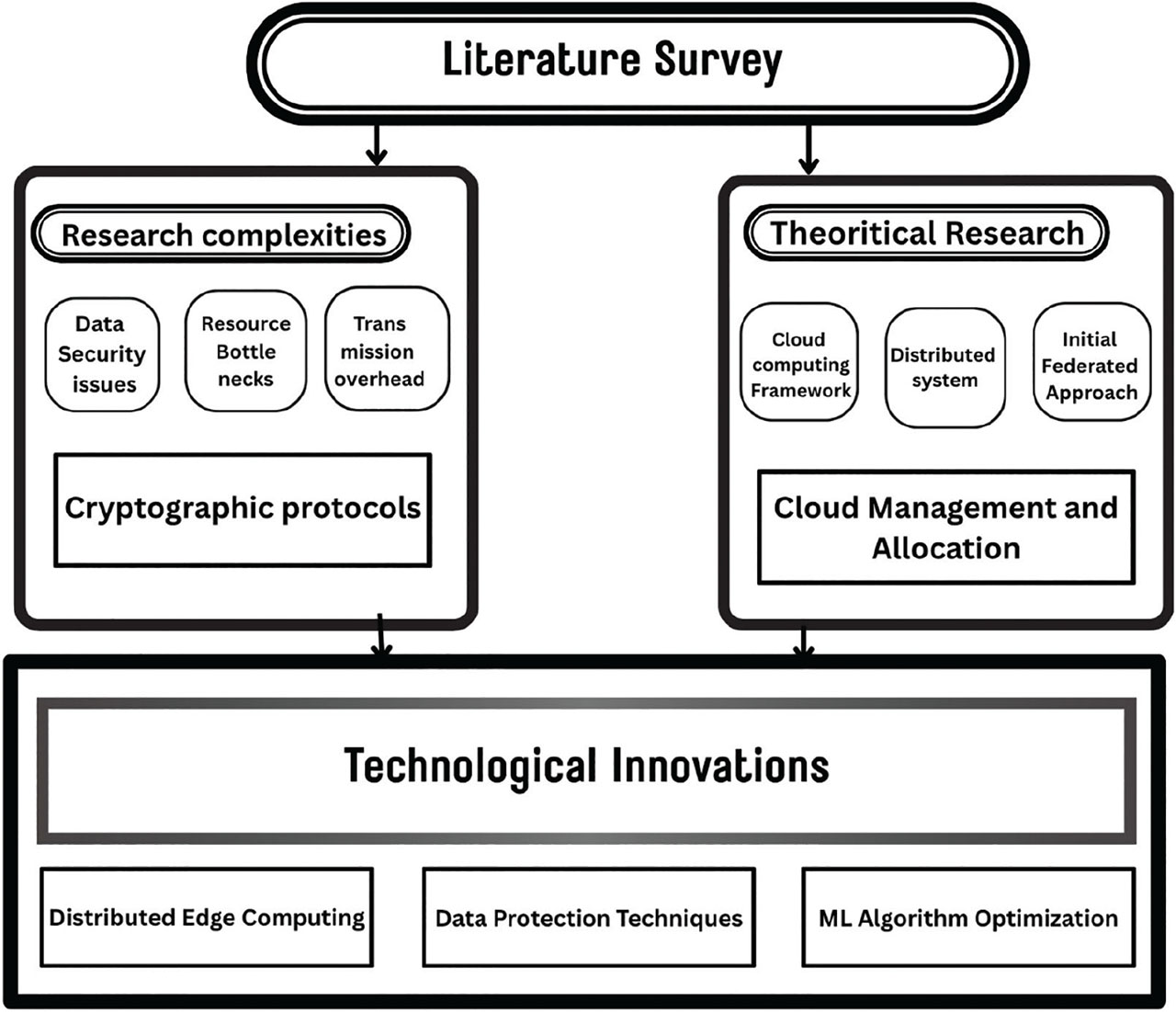
Figure 4:
Literature survey on cloud services and distributed machine learning.
Table 5:
Enhanced meta-analysis of literature on HALF framework
| Authors | Key findings | Method used | Advantages | Disadvantages | Limitations of study |
|---|---|---|---|---|---|
| Smith et al. | FL reduces data transfer but faces challenges with non-IID data. | FedAvg | Privacy preservation, reduced communication. | High latency, poor performance with non-IID data. | Focuses on theoretical aspects without practical implementation. |
| Patel et al. | Cloud-based FL improves scalability but raises privacy concerns. | Cloud-based FL, centralized aggregation | Scalable, handles large datasets. | Privacy risks due to centralized data handling. | Lacks integration with edge computing; minimal attention to latency. |
| Johnson & Lee | Edge computing reduces latency but lacks scalability. | Edge-based FL with local processing | Low latency, improved real-time response. | Limited edge device resources. | Not suitable for large-scale implementations across distributed networks. |
| Gupta et al. | FL frameworks struggle with device heterogeneity and dynamic networks. | Heterogeneous FL, dynamic adaptation | Adaptable to varying devices and network conditions. | Complex to implement; high computing demands. | No benchmarks for real-time performance under constrained environments. |
| Wang et al. | HALF improves communication efficiency by 40%. | Adaptive aggregation, hybrid FL | Reduces communication load, supports non-IID data. | Needs dynamic optimization across edge-cloud layers. | Real-world deployment scenarios and performance metrics are limited. |
| Li et al. | Edge devices support real-time data processing but face bandwidth issues. | Edge-based FL, real-time optimization | Low-latency processing and decisions. | Bandwidth constraints affect cloud sync. | Lacks analysis of variable communication loads in high-frequency environments. |
| Zhang et al. | HALF achieves high accuracy in healthcare. | Adaptive FL, non-IID data handling | High model accuracy; suitable for sensitive applications. | Requires extensive testing on diverse datasets. | Healthcare-specific scope; lacks validation in other domains like smart cities or transport. |
| Chen et al. | Differential privacy enhances FL security. | Differential privacy, secure aggregation | Strong privacy guarantees. | Slight reduction in model accuracy. | Lacks evaluation of cumulative privacy impact in dynamic FL updates. |
| Kumar & Singh | Cloud-edge FL improves scalability and resource management. | Hybrid FL with cloud-edge integration | Efficient data handling and dynamic resource allocation. | Latency issues due to cloud dependency. | No real-time simulation of performance trade-offs. |
| Nguyen et al. | HALF reduces latency in autonomous systems. | Hybrid FL, low-latency optimization | Real-time responsiveness in dynamic systems. | Limited testing in variable traffic and network conditions. | Scenario-limited evaluation; needs broader testing in multi-agent environments. |
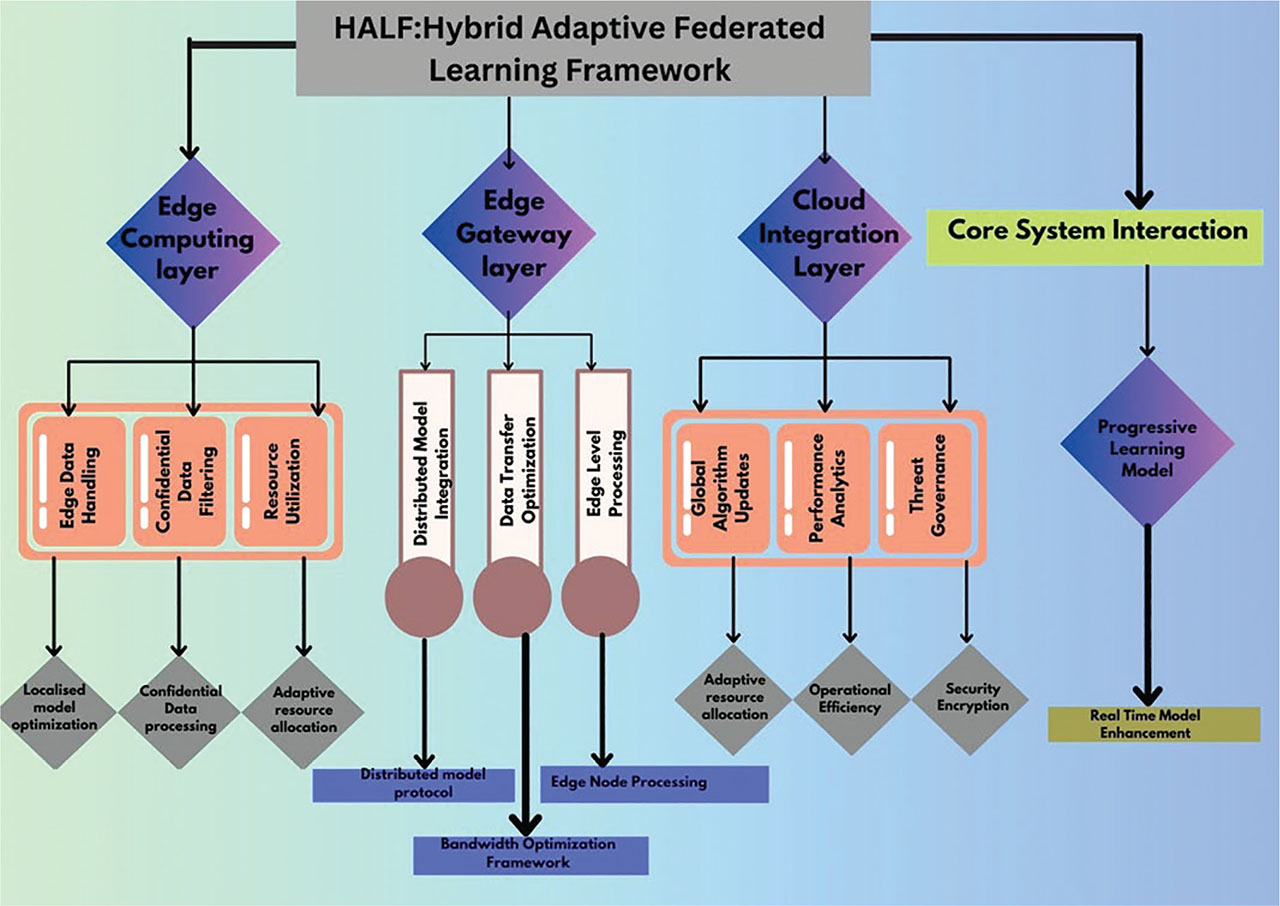
Figure 5:
HALF framework. HALF Framework, High-performance adaptive learning framework.
Table 6:
HALF framework: experimental parameters summary
| Parameter | Value/configuration |
|---|---|
| Dataset | MNIST, CIFAR-10 |
| Data distribution | Non-IID via Dirichlet (α = 0.5) |
| Number of clients | 50 edge devices |
| Local Epochs | 10 |
| Global communication rounds | 100 |
| Batch size | 32 |
| Learning rate (η) | 0.01 |
| Gradient clipping norm | 1 |
| Privacy mechanism | Differential privacy (DP-SGD), ε ≤ 2.3 |
| Aggregation method | Weighted FedAvg |
| Communication security | TLS 1.3, AES-256, SHA-256 |
| Model accuracy target | ≥89.7% |
| Maximum training time | ≤142 min |
| Communication overhead reduction | ≥40% |
| Hardware (edge) | ≥2 GB RAM, 1.5 GHz CPU |
| Hardware (cloud) | ≥16 GB RAM, 8-core CPU |
| Software stack | Python 3.8+, PyTorch, TensorFlow Privacy, Docker, Flower FL |
| Network environment | Emulated 5 G/Wi-Fi with 10 Mbps average speed |
| Evaluation metrics | Accuracy, cross-entropy loss, resource usage, privacy exposure |
| Privacy tools | HE (optional), noise injection (Laplace/Gaussian) |
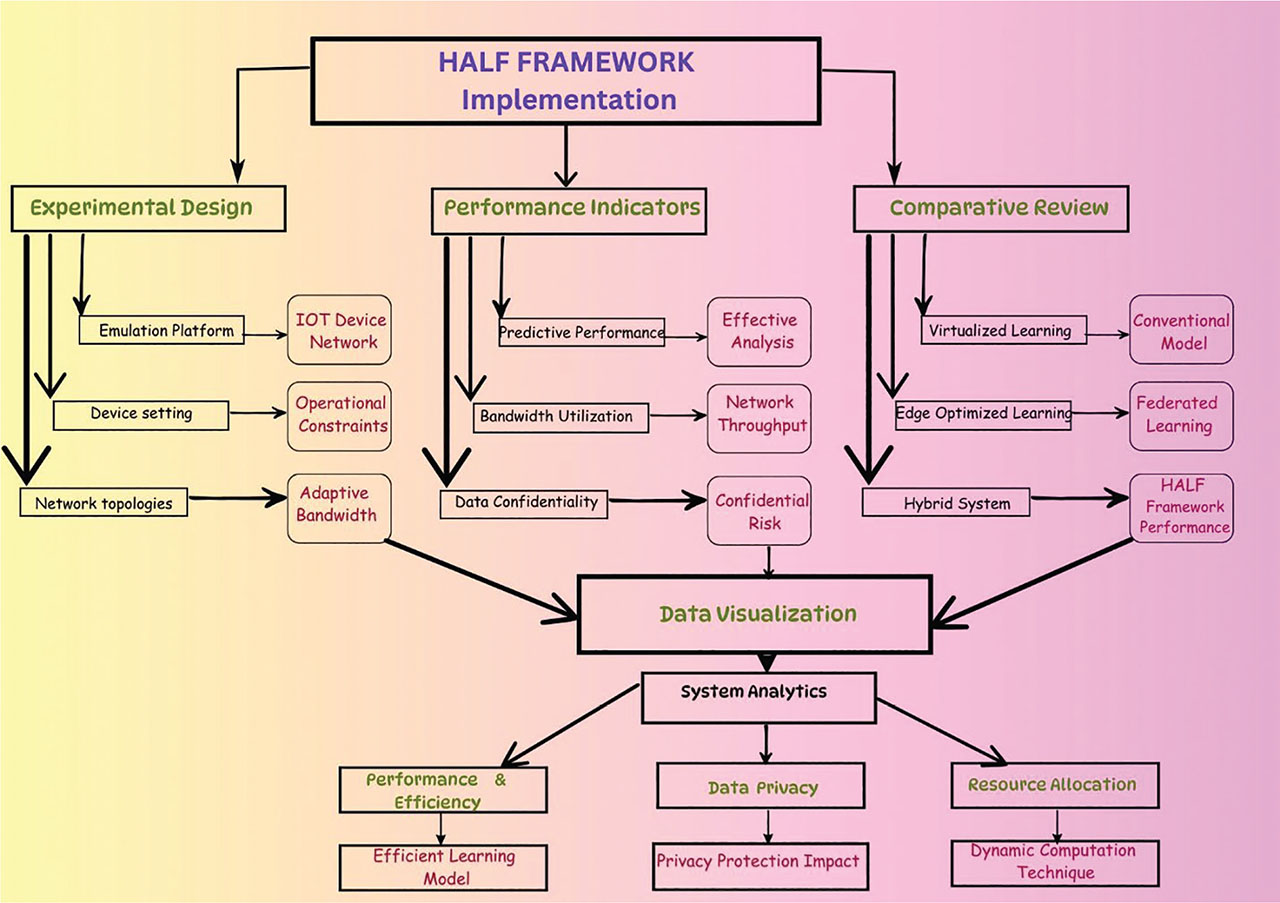
Figure 6:
HALF framework implementation process. HALF Framework, High-performance adaptive learning framework; IoT, Internet of things.
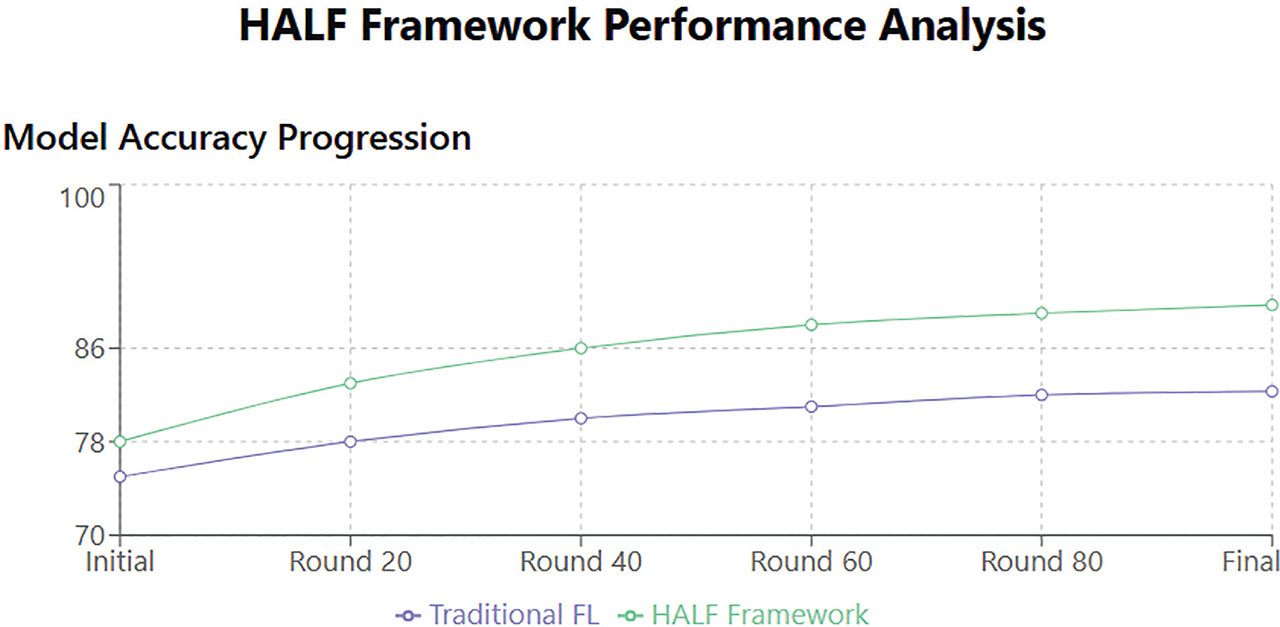
Figure 7:
Overall HALF performance analysis. FL, federated learning.
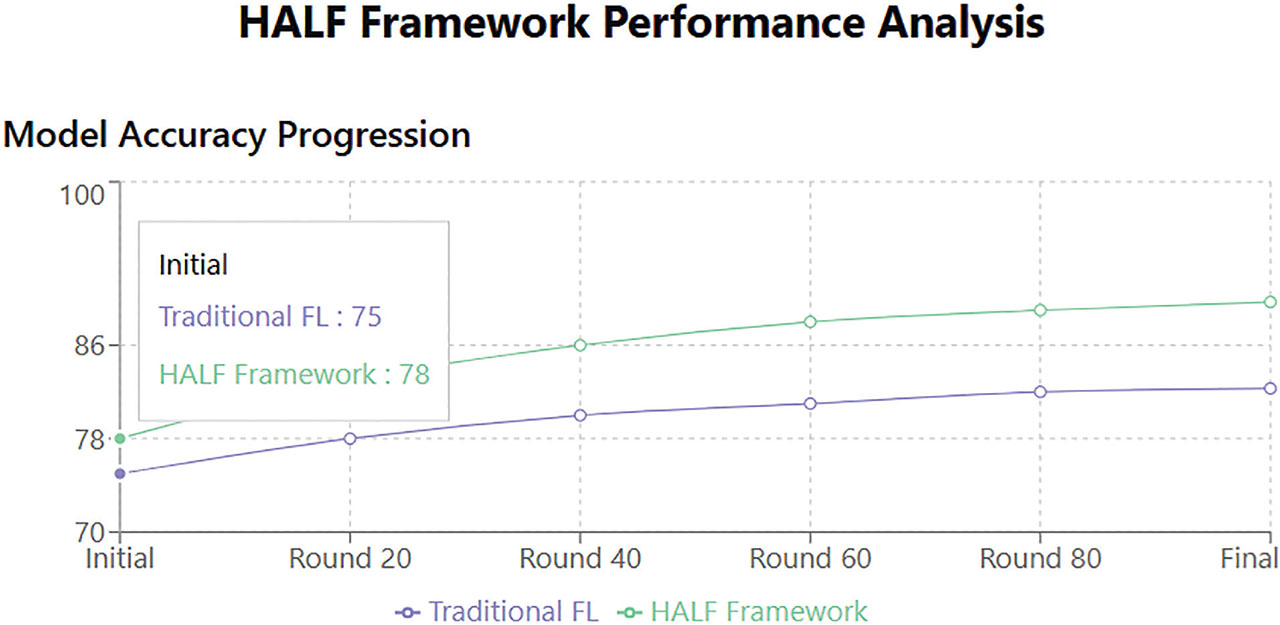
Figure 8:
Initial HALF performance analysis. FL, federated learning.
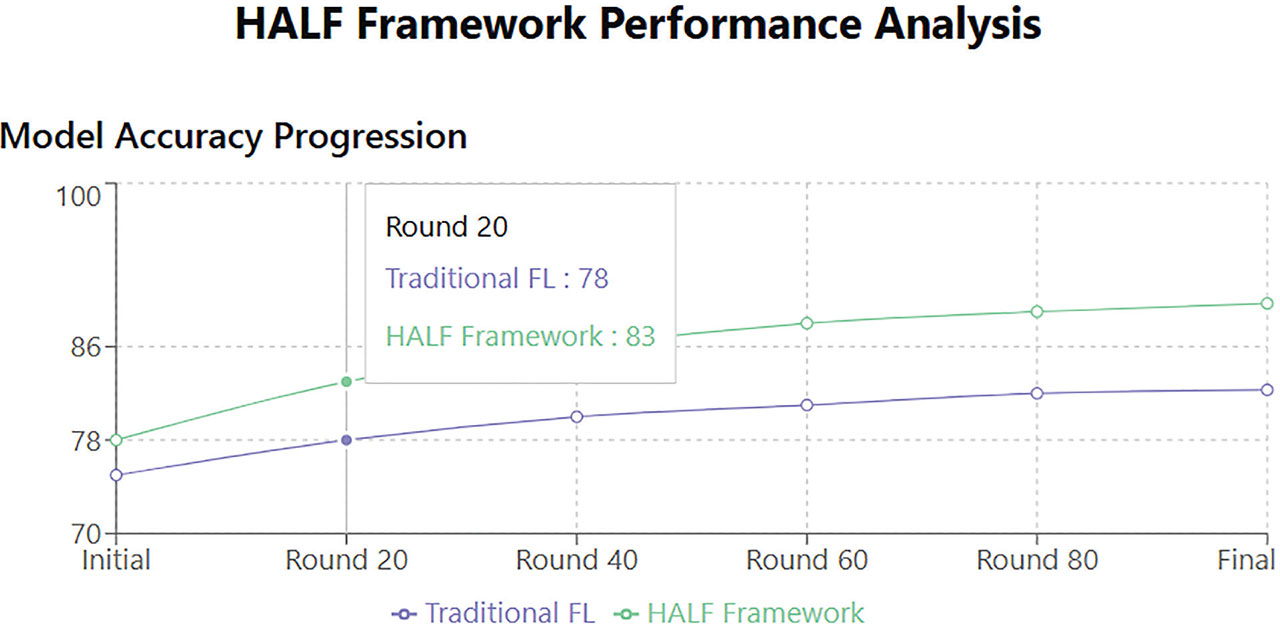
Figure 9:
Round 20- HALF performance analysis. FL, federated learning.
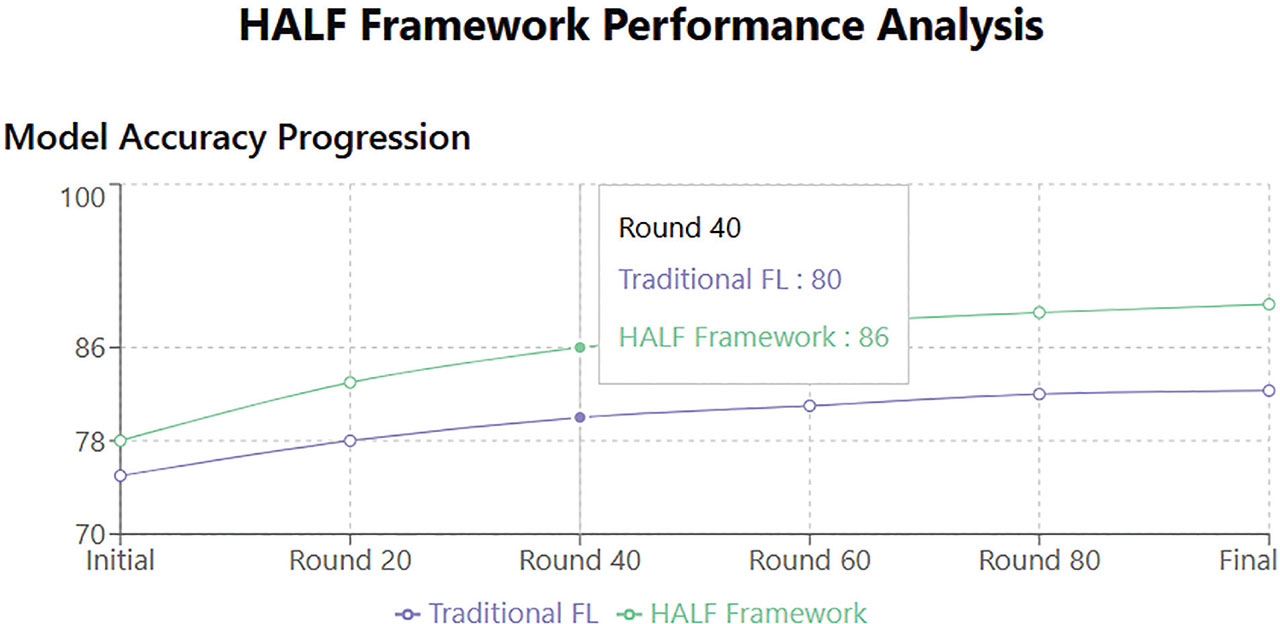
Figure 10:
Round 40- HALF performance analysis. FL, federated learning.
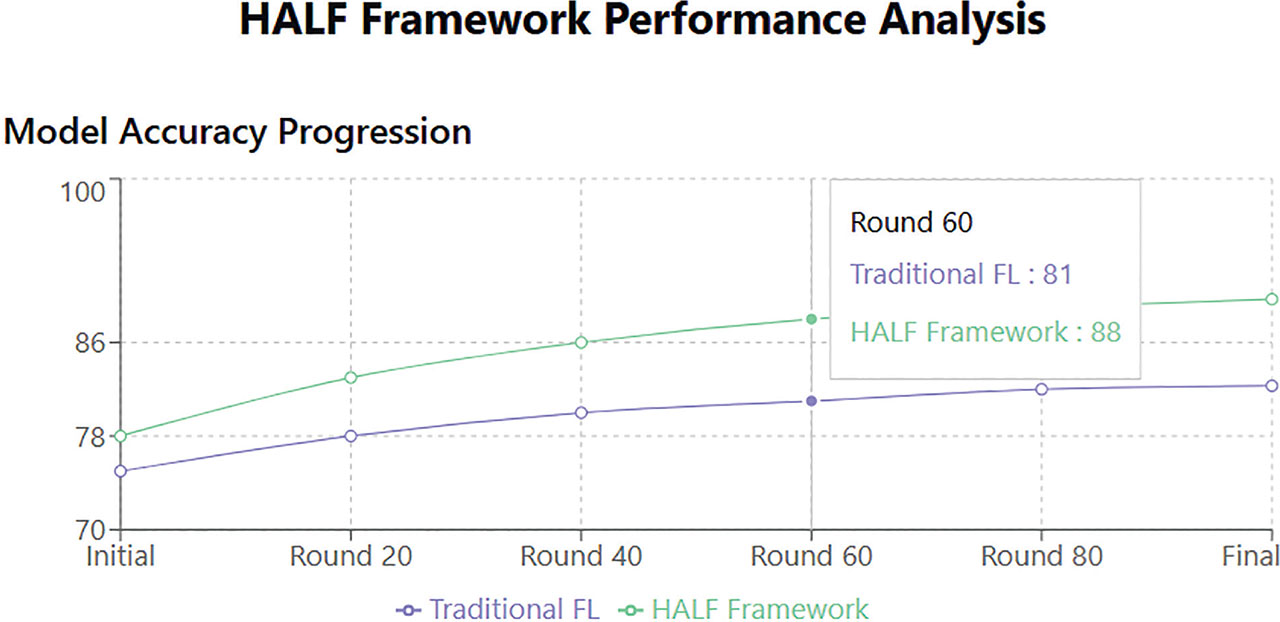
Figure 11:
Round 60- HALF performance analysis. FL, federated learning.
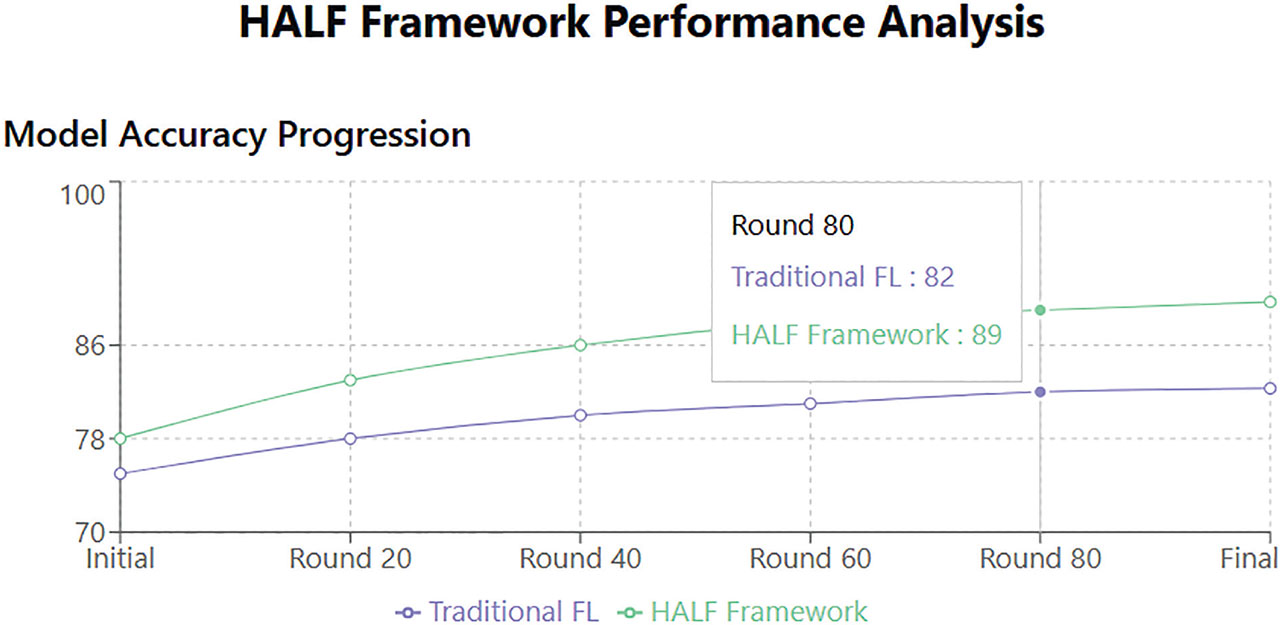
Figure 12:
Round 80- HALF performance analysis. FL, federated learning.
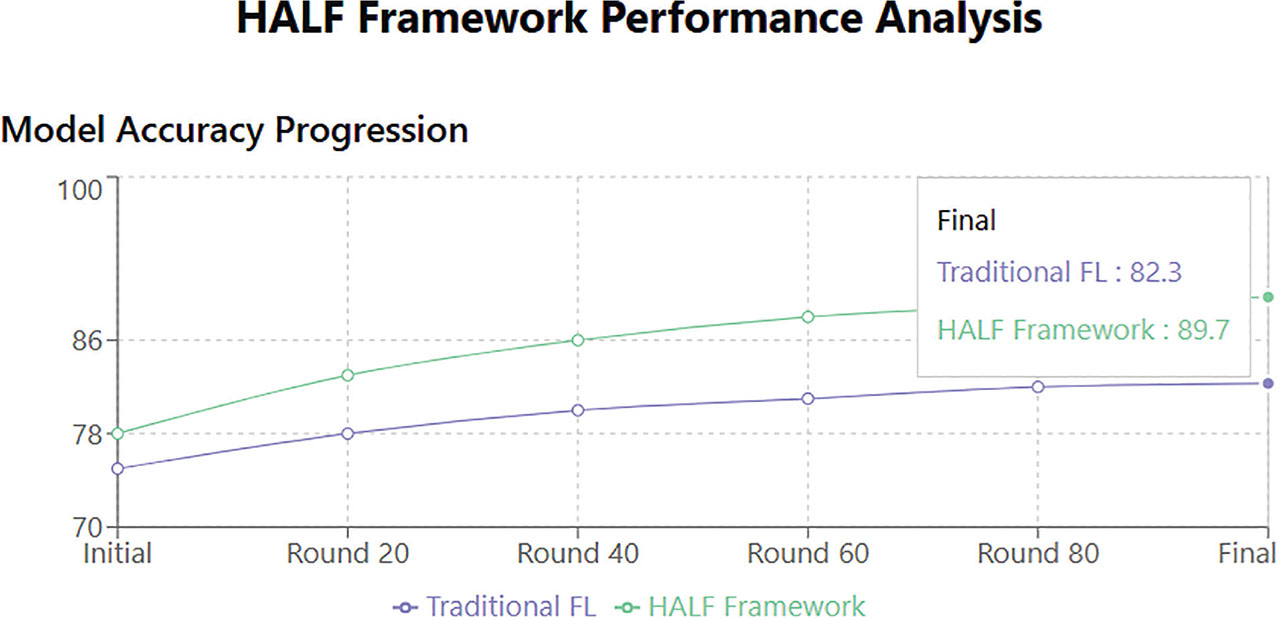
Figure 13:
Final- HALF performance analysis. FL, federated learning.
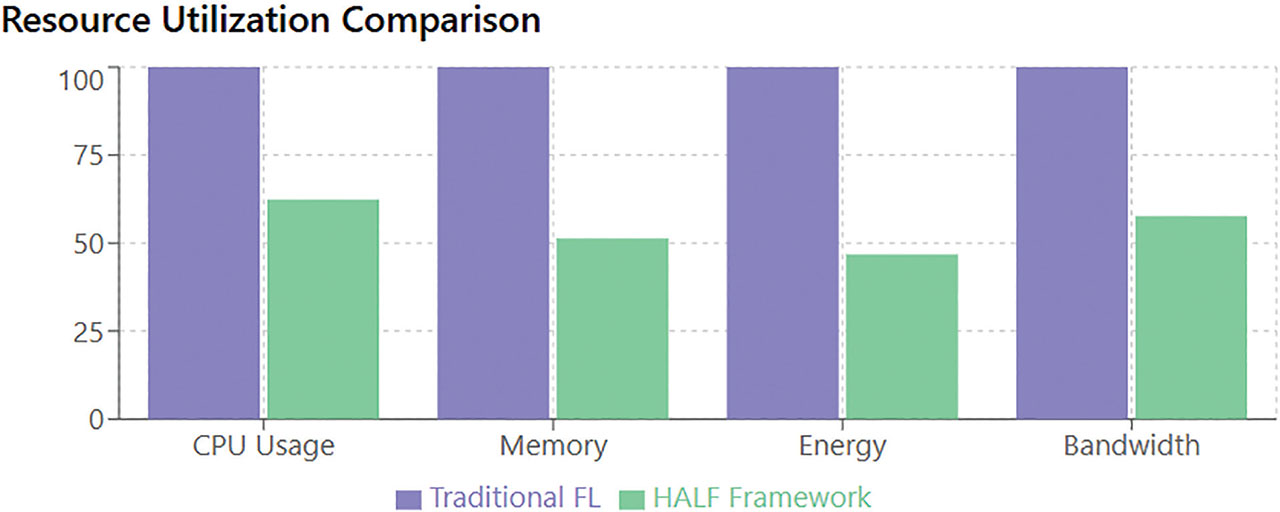
Figure 14:
Comparison of tradition FL & HALF. FL, federated learning.
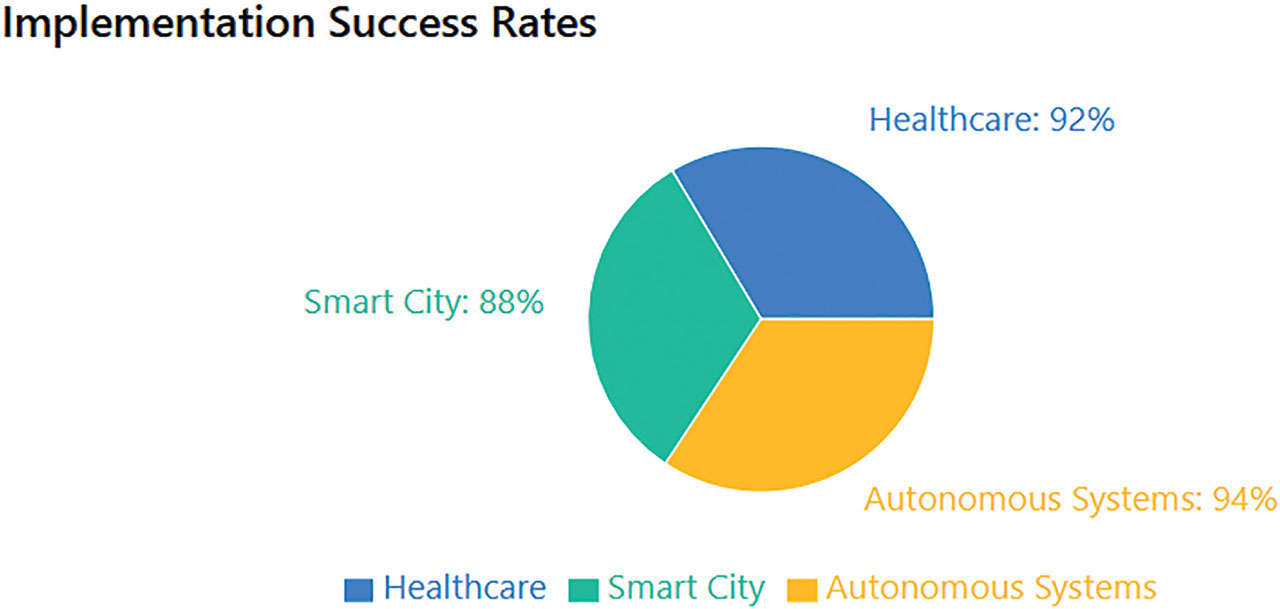
Figure 15:
Evaluation of the HALF framework success rates. HALF Framework, High-performance adaptive learning framework.