
Table 1
Data collection process.
| Step | PATENTSCOPE advanced search | Number of patents |
|---|---|---|
| 1 | FP:( “alkaline electrolysis” OR “alkaline fuel” OR “ammonia cracking” OR “anion exchange membrane” OR “automotive fuel cell” OR “aviation fuel cell” OR “carbon capture utilization” OR “ccus” OR “coal gasification” OR “fuel and electrolysis cell” OR “fuel cell truck” OR “fuel cell vehicle” OR “hydrogen carrier” OR “hydrogen distribution” OR “hydrogen fuel” OR “hydrogen gas turbine” OR “hydrogen generation” OR “hydrogen internal combustion engine” OR “hydrogen liquefiers” OR “hydrogen production” OR “hydrogen refueling station” OR “hydrogen storage” OR “hydrogen tank” OR “hydrogen transformation” OR “hydrogen use” OR “hydrogen vessel” OR “hydrogen-based fuel” OR “oil reforming” OR “proton exchange membrane” OR “shipping fuel cell” OR “soec” OR “solid oxide electrolyzer cell” OR “steam reforming” OR “synthetic fuel” OR “synthetic methane” OR “water electrolysis” OR “water electrolyzer” ) | 98,099 |
| 2 | AND PA:( “asahi” OR “electric power development” OR “eneos” OR “hitachi” OR “honda” OR “iwatani” OR “j-power” OR “k line” OR “kawasaki” OR “marubeni” OR “matsushita” OR “mitsubishi” OR “nippon oil and energy” OR “nissan” OR “panasonic” OR “sanyo” OR “shell japan” OR “sumitomo” OR “tokyo gas” OR “toshiba” OR “toyota” ) | 10,789 |
| 3 | AND DP:[1960 TO 2019] | 9,437 |
| 4 | AND DP:[2020 TO 2024] | 1,352 |
Source: Own interpretation based on PATENTSCOPE (WIPO, 2024b).
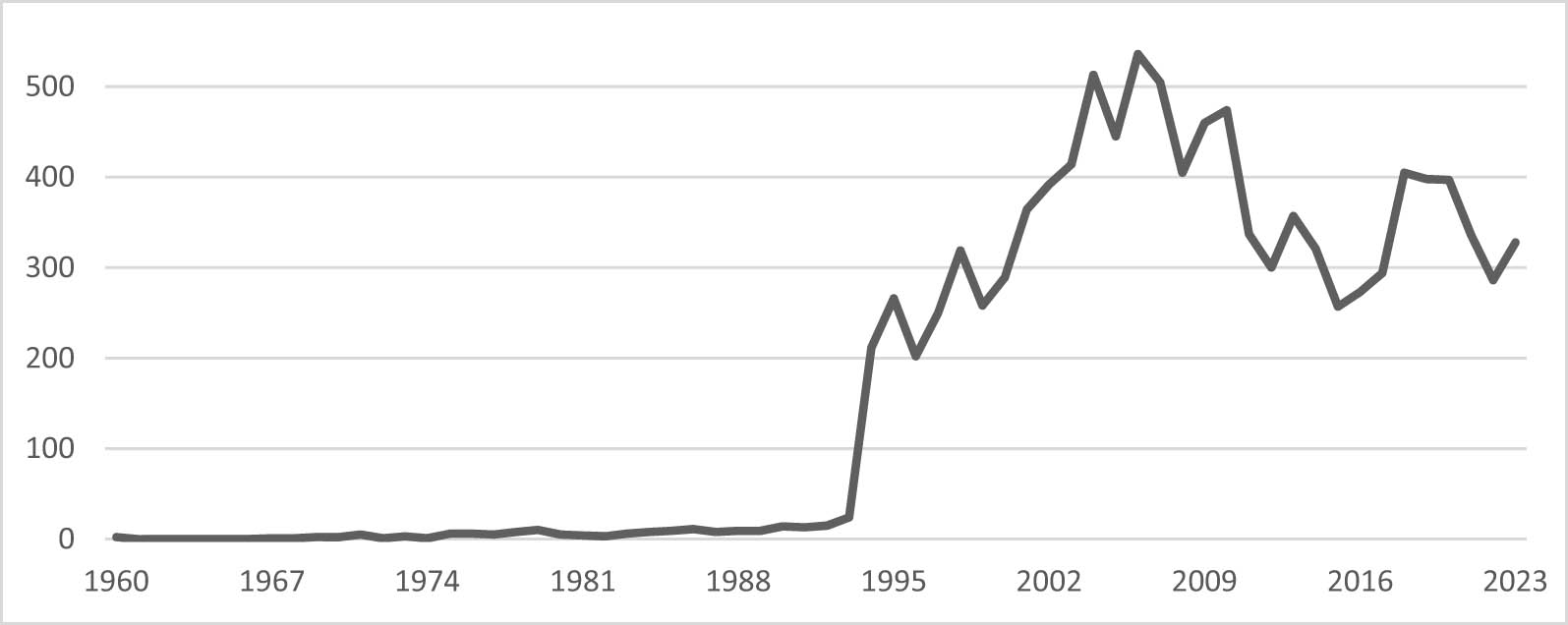
Graph 1
Annual number of new patents, 1960–2023 (publication date).
Source: Own interpretation based on PATENTSCOPE (WIPO, 2024b).
Table 2
Prominent patent offices and patent applicants.
| Rank | Patent office | Number of patents | Rank | Patent applicant | Number of patents |
|---|---|---|---|---|---|
| 1 | Japan | 6,753 | 1 | Honda Motor Co Ltd | 1,355 |
| 2 | United States of America | 1,354 | 2 | Toyota Motor Co | 1,145 |
| 3 | PCT | 797 | 3 | Toyota Jidosha Kabushiki Kaisha | 624 |
| 4 | European Patent Office | 679 | 4 | SANYO ELECTRIC CO LTD | 619 |
| 5 | China | 643 | 5 | Matsushita Electric Ind Co Ltd | 575 |
| 6 | Canada | 150 | 6 | Panasonic Co | 477 |
| 7 | Republic of Korea | 110 | 7 | Nissan Motor Co Ltd | 476 |
| 8 | Australia | 97 | 8 | Mitsubishi Heavy Ind Ltd | 469 |
| 9 | India | 59 | 9 | Toshiba Co | 362 |
| 10 | United Kingdom | 38 | 10 | Hitachi Ltd | 342 |
| 11 | Germany | 21 | 11 | Tokyo Gas Co Ltd | 241 |
| 12 | Denmark | 19 | 12 | Panasonic Ip Management Co | 234 |
| 13 | Spain | 10 | 13 | Toyota Motor Co Ltd | 197 |
| 14 | Malaysia | 10 | 14 | Panasonic Intellectual Property Management Co Ltd | 190 |
| 15 | South Africa | 9 | 15 | Toshiba Battery Co Ltd | 181 |
| 16 | France | 8 | 16 | Matsushita Electric Industrial Co Ltd | 145 |
| 17 | Indonesia | 6 | 17 | Toyota Central Res and Dev Lab Inc | 139 |
| 18 | Singapore | 6 | 18 | Toyota Industries Co | 136 |
| 19 | Mexico | 5 | 19 | Mitsubishi Heavy Industries Ltd | 135 |
| 20 | Philippines | 5 | 20 | Hitachi Maxell Ltd | 130 |
Source: Own interpretation based on PATENTSCOPE (WIPO, 2024b).
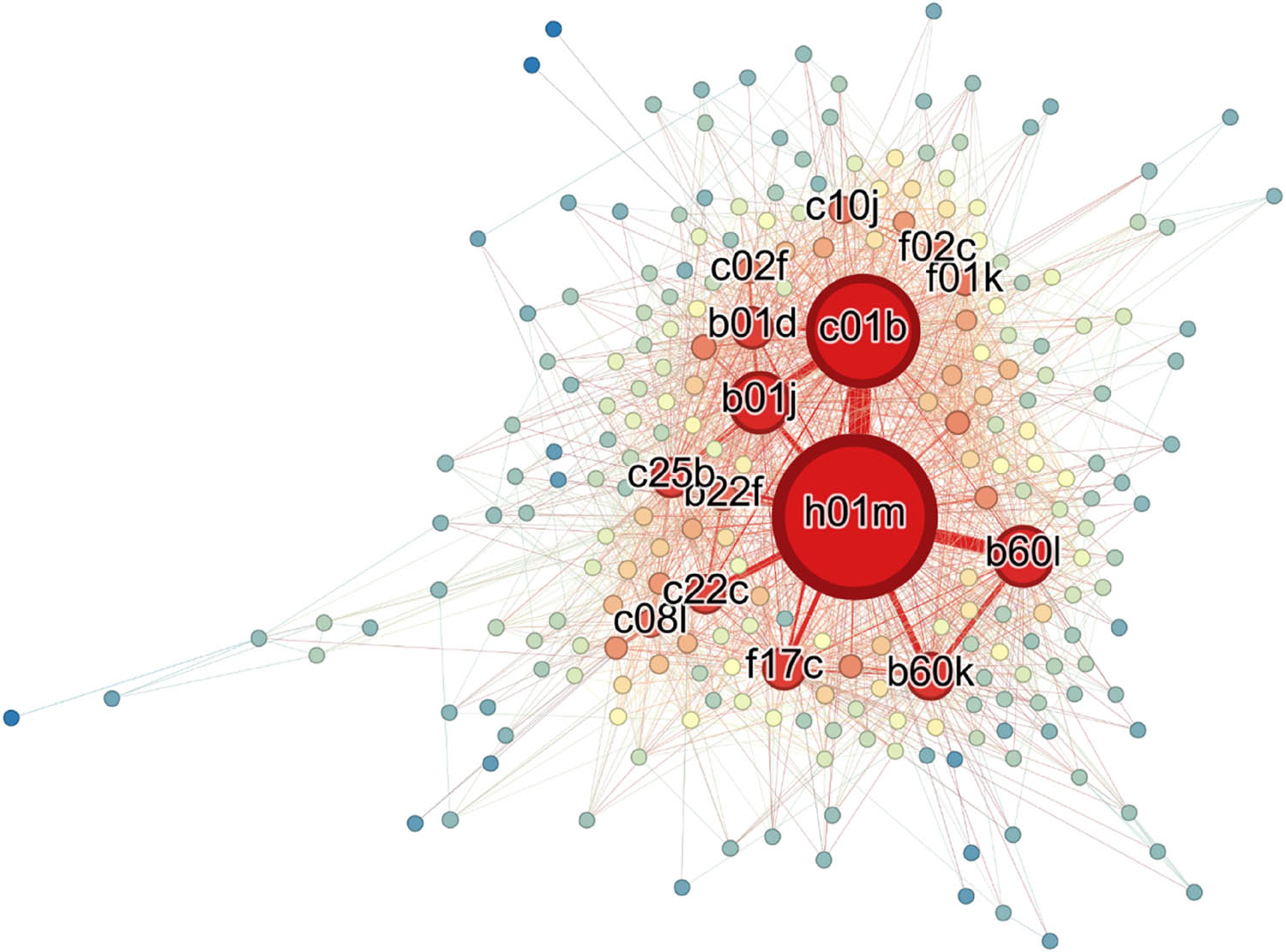
Graph 2
IPC code co-occurrence network (size and colour: weighted degree).
Source: Own interpretation based on PATENTSCOPE (WIPO, 2024b).
Table 3
Prominent IPC codes (subclass level).
| IPC code | Title | Degree | Weighted degree | Number of patents |
|---|---|---|---|---|
| H01M | Processes or means, e.g., batteries, for the direct conversion of chemical energy into electrical energy | 169 | 6,766 | 5,907 |
| C01B | Non-metallic elements; compounds thereof | 145 | 4,434 | 3,005 |
| B60L | Propulsion of electrically-propelled vehicles (…) | 79 | 2,121 | 1,276 |
| C25B | Electrolytic or electrophoretic processes for the production of compounds or non- metals; apparatus therefor | 107 | 1,142 | 1,239 |
| B01J | Chemical or physical processes, e.g. catalysis or colloid chemistry; their relevant apparatus | 98 | 2,139 | 1,035 |
| F17C | Vessels for containing or storing compressed, liquefied, or solidified gases (…) | 92 | 1,257 | 784 |
| B60K | Arrangement or mounting of propulsion units or of transmissions in vehicles (…) | 67 | 1,500 | 745 |
| C22C | Alloys | 37 | 1,091 | 725 |
| B01D | Separation | 95 | 1,217 | 600 |
| C10J | Production of gases containing carbon monoxide and hydrogen from solid carbonaceous materials (…) | 50 | 545 | 364 |
| C08L | Compositions of macromolecular compounds | 47 | 584 | 332 |
| B22F | Working metallic powder; manufacture of articles from metallic powder (…) | 26 | 600 | 320 |
| C02F | Treatment of water, waste water, sewage, or sludge | 58 | 441 | 257 |
| F02C | Gas-turbine plants; air intakes for jet-propulsion plants; controlling fuel supply in air-breathing jet-propulsion plants | 50 | 509 | 232 |
| H02J | Circuit arrangements or systems for supplying or distributing electric power; systems for storing electric energy | 39 | 329 | 218 |
| C07C | Acyclic or carbocyclic compounds | 43 | 410 | 201 |
| F01K | Steam engine plants; steam accumulators; engine plants not otherwise provided for; engines using special working fluids or cycles | 49 | 480 | 187 |
| F02M | Supplying combustion engines in general with combustible mixtures or constituents thereof | 44 | 375 | 171 |
| B62D | Motor vehicles; trailers | 22 | 363 | 156 |
| C08K | Use of inorganic or non-macromolecular organic substances as compounding ingredients | 33 | 309 | 136 |
Table 4
Prominent connections between IPC codes.
| Source IPC code | Target IPC code | Number of patents | Source IPC code | Target IPC code | Number of patents | Source IPC code | Target IPC code | Number of patents |
|---|---|---|---|---|---|---|---|---|
| C01B | H01M | 1,675 | B22F | H01M | 248 | F01K | F02C | 130 |
| B60L | H01M | 1,093 | C01B | C25B | 229 | C10J | F02C | 116 |
| B01J | C01B | 735 | C01B | F17C | 226 | C01B | C22C | 108 |
| C22C | H01M | 555 | B01D | B01J | 188 | B01J | C25B | 100 |
| B60K | H01M | 530 | B22F | C22C | 183 | B60K | F17C | 96 |
| B60K | B60L | 405 | B60K | B62D | 142 | B62D | H01M | 91 |
| B01J | H01M | 367 | H01M | H02J | 141 | C10J | F01K | 79 |
| F17C | H01M | 367 | B01D | C02F | 137 | C01B | F02M | 77 |
| C25B | H01M | 275 | C08K | C08L | 132 | B60L | B62D | 70 |
| B01D | C01B | 251 | B01D | H01M | 130 | C08J | C08L | 69 |
Source: Own interpretation based on PATENTSCOPE (WIPO, 2024b).
Table 5
Examples of hydrogen technology-related projects in Japan.
| Company | Project/partners | Key hydrogen technology |
|---|---|---|
| Kawasaki Heavy Industries | HySTRA; HESC | Developed the Suiso Frontier, the world’s first liquefied-hydrogen carrier (2019), and a liquefied-hydrogen receiving terminal (2020). Supplied a hydrogen power plant for Seibu Oil’s Yamaguchi Refinery, operational since August 2021. |
| Nippon Hydrogen Energy (Kawasaki Heavy Industries subsidiary) | NEDO hydrogen supply-chain commercialization project with ENEOS and Iwatani | Development of large-scale liquefied-hydrogen supply-chain infrastructure, including carriers, liquefiers, and storage tanks. |
| Electric Power Development Co. (J-POWER) | Japan–Australia HESC demonstration project | Coal-gasification and lignite-derived hydrogen production. A demonstration plant near an Australian lignite mine began producing hydrogen in February 2021. |
| Chiyoda Corporation | AHEAD consortium with Mitsubishi Corporation, Mitsui & Co., and Nippon Yusen Kabushiki Kaisha | SPERA Hydrogen®, an organic chemical hydride technology for hydrogen storage and transport. |
| Iwatani Corporation | HySTRA, HESC, and Fukushima Hydrogen Energy Research Field (FH2R) | Liquefied-hydrogen production and commercial hydrogen-refuelling stations. |
| Toshiba Energy Systems & Solutions | FH2R with NEDO, Tohoku Electric Power, and Iwatani | Renewable-powered, 10 MW-class hydrogen production system, among the world’s largest at the time of commissioning. |
| Woven Planet Holdings | Woven City project backed by Toyota, ENEOS, and Akio Toyoda | Hydrogen infrastructure for Woven City, including electrolysers at refuelling stations and stationary fuel-cell generators. |
Source: Compiled from company reports and industry publications.
Table 6
SWOT analysis of Japan’s hydrogen economy, including findings from patent analysis.
| Japan | |
|---|---|
| Strengths | Weaknesses |
|
|
| Opportunities | Threats |
|
|
Source: Authors’ own elaboration.