
1. Introduction
Hydrogen has become a prominent yet contested technology in the global transition to carbon neutrality. Governments increasingly regard it not only as a means of reducing emissions but also as a tool for strengthening energy security, industrial competitiveness, and technological leadership. Japan has been at the forefront of this transition (Behling et al., 2015). In 2017, it became the first country to adopt a comprehensive national hydrogen strategy, outlining a long-term vision of a “hydrogen society” in which hydrogen occupies a central role in the energy system and wider economy.
Japan’s commitment to hydrogen reflects both strategic ambitions and structural challenges. Although the country is a global leader in hydrogen innovation (IEA, 2021a), its energy system remains heavily dependent on fossil fuels. In 2022, fossil fuels accounted for 87% of primary energy supply, nearly 90% of which was imported (IEA, 2024). This dependence has intensified energy security concerns and strengthened the case for alternative energy sources. Against this backdrop, hydrogen is expected to support Japan’s goal of carbon neutrality by 2050 while enhancing economic resilience and competitiveness (Furnaro & Trencher, 2026).
Although existing studies examine Japan’s hydrogen policies, deployment challenges, and energy implications, less attention has been paid to the structure of hydrogen innovation itself, particularly the technological domains, organizational actors, and knowledge networks underpinning Japan’s leadership. This study asks: What technological domains and actors dominate Japanese hydrogen patenting? Answering this question shows that Japan’s hydrogen innovation system is not undergoing a generalized green-hydrogen transition but rather a state-supported reconfiguration of incumbent automotive, electrochemical, materials, and heavy-industrial capabilities around fuel-cell-centred technological complementarities. The remainder of this article is organized as follows. First, the research background is outlined, followed by an empirical analysis based on patent data and a review of key hydrogen initiatives and challenges. The findings are then discussed, and the article concludes by summarizing the main drivers of Japan’s hydrogen technology development and highlighting its emerging strategic priorities.
2. Research background
2.1. Toward a hydrogen-based economy in Japan
The transition to a hydrogen-based economy is a complex, policy-driven process involving multiple stakeholders across different levels of the socioeconomic system. Japan represents a particularly instructive case, having pursued hydrogen development through a sustained combination of industrial, energy, and innovation policies for more than four decades.
Japan’s hydrogen policy originated in the 1970s oil shocks, which exposed its dependence on imported energy. The Sunshine Project (1974) supported alternative energy technologies, including hydrogen production, storage, and transport, while the Moonlight Project (1978–1993) focused on energy efficiency (Atomica, 2005; Okutsu & Shibata, 2020). With funding exceeding ¥ 5171 billion and representing one of the most ambitious state-led energy initiatives in the country’s history (Ohta & Abe, 1985), these initiatives were consolidated into the New Sunshine Program in 1993, which included WE-NET’s vision of a global hydrogen supply system (Chiba et al., 1998; Hikima et al., 2020).
These programs established the technological foundations of Japan’s contemporary hydrogen strategy. Between 1993 and 2016, the New Energy and Industrial Technology Development Organization (NEDO), a leading national research and development agency in Japan, invested more than ¥200 billion in hydrogen-related technologies, contributing to the accumulation of domestic technological capabilities (Hikima et al., 2020). The 2017 Basic Hydrogen Strategy then elevated hydrogen from a research and development (R&D) priority to a central element of energy policy, combining deployment and cost-reduction targets with substantial public funding from the Ministry of Economy, Trade and Industry (METI), and the Ministry of the Environment (MOE).
The revised 2023 strategy further positioned hydrogen as an instrument of decarbonization, energy security, industrial competitiveness, and growth. It set a 2050 demand target of 20 million tonnes, cost targets of ¥30/Nm³ by 2030 and ¥20/Nm³ by 2050, and a definition of low-carbon hydrogen (Matsuno, 2025; METI, 2023). Support has since expanded through the ¥7 trillion hydrogen-related technologies and infrastructure over the coming decade under the Green Transformation (GX) programme and the 2024 Hydrogen Society Promotion Act, which introduced a 15-year, ¥3 trillion contract-for-difference scheme administered by the Japan Organisation for Metals and Energy Security (JOGMEC) (Odawara et al., 2024; OECD, 2024). Additional incentives for industrial demand, hydrogen hubs, and fuel cell electric vehicles (FCEVs) reinforce the strategy’s industrial policy orientation.
Nevertheless, the outcomes of the hydrogen strategy remain contested. Although Japan has established a leading position in hydrogen innovation, the deployment of hydrogen technologies has progressed more slowly than anticipated (IEA, 2025). Critics argue that policy support has focused excessively on fuel-cell vehicles, hydrogen refuelling infrastructure, and fossil-fuel-based hydrogen, potentially diverting resources from renewable energy and green hydrogen while reinforcing carbon-intensive pathways (Ohno et al., 2022). Regulatory challenges associated with international hydrogen supply chains further complicate implementation (Jeje et al., 2024; Zhang & Yang, 2022).
2.2. The geopolitical and competitive dimensions of hydrogen technologies
Hydrogen-related debates increasingly reach beyond the domain of energy and industrial policy to questions of geopolitical competition and technological leadership. It is Van Graaf (2020) and not Graaf (2020). argue that the emergence of a hydrogen economy could reshape the development trajectories of fossil-fuel-exporting countries, generate new patterns of trade dependency, and intensify competition over strategic technologies. Similarly, Eicke and De Blasio (2022) identify China and the United States as the principal contenders in the emerging hydrogen economy, owing to their technological capabilities, market size, and industrial scale. Although Europe and Japan continue to serve as important centres of hydrogen innovation, the global competitive landscape is becoming more dynamic, as firms from South Korea and China rapidly expand their presence in key segments such as fuel cells, electrolysers, and related applications (IEA, 2023).
In this context, Japan’s hydrogen strategy can be interpreted as a response to growing uncertainty in the international political economy (Furnaro & Trencher, 2026). Rather than pursuing technological self-sufficiency, the strategy seeks to reinforce domestic technological capabilities while preserving strategic international interdependencies. This positioning aligns with the concept of technological sovereignty (Edler et al., 2023), which emphasizes maintaining critical capabilities and resilience amid geopolitical disruption. In the Japanese case, however, these goals are not entirely novel; instead, they reflect a longer-standing tradition of developmental techno-nationalism (Luo & Van Assche, 2023), characterized by active state support for strategic industries alongside continued integration into global markets and production networks. Accordingly, innovation activity is best understood as embedded in institutional systems of coordination that shape how firms access knowledge, manage uncertainty, mobilize resources, and pursue technological change (Furnaro & Trencher, 2026; Kucharski & Unesaki, 2018; Kwon & Motohashi, 2017).
Japan’s innovation system is characterized by close government-industry collaboration, trust-based interfirm relations, long-term employment, innovation-oriented policies, and strong internationalization (Johnson, 1982; Okimoto, 1989). Its manufacturing-intensive structure relies heavily on applied and incremental engineering innovation (Kwon & Motohashi, 2017), supported by comparatively high levels of R&D investment. Japan spent 3.44% of GDP on R&D in 2023, including 2.72% by the business sector, well above the EU’s business-sector share of 1.49% in 2024 (Eurostat, 2026). These characteristics suggest that technological change in Japan tends to proceed gradually through reconfiguration rather than abrupt transformation. At the same time, this incremental process remains oriented at the system level toward the preservation of technological leadership and economic competitiveness.
2.3. Patents as indicators of innovation and technological change
Patents are widely used to measure innovation and technological change. Quantitative patent analysis can identify technological trajectories, market leaders, key markets, and the firms and institutions investing in specific technologies (Baumann et al., 2021; Chanchetti et al., 2016). Because patenting is closely linked to R&D, patent data also indicate innovative capacity, technological specialization, and competitive positioning, helping policymakers assess performance and support emerging technologies (Mueller et al., 2015). Although patents do not capture all inventions, they remain a key indicator of technological development, innovation strategies, and competitive dynamics.
3. Methodology and data
The World Intellectual Property Organization’s (WIPO) International Patent Classification (IPC) system is widely used in patent research due to its systematic, language-independent structure. IPC codes are hierarchical: subclasses such as H01M contain main groups (e.g., H01M 8/00), which are further divided into subgroups (e.g., H01M 8/22), with lower levels providing greater technological detail (WIPO, 2023). This study analyzes patents at the subclass level, consistent with prior research on technology co-occurrence and technological main paths (Boyack & Klavans, 2008; Filippin, 2021; Gwak & Sohn, 2018; Hu & Xu, 2022; Lee, 2020; Lee & Sohn, 2017; Tang et al., 2020).
IPC code co-occurrence networks, or co-classification maps, capture relationships between technologies (Engelsman & Van Raan, 1994; Tomeczek, 2025). They are undirected graphs in which nodes represent IPC subclasses and weighted edges indicate their co-occurrence in patents. We retain only IPC subclasses appearing in at least two patents and belonging to the network’s largest connected component, thereby emphasizing core technological developments and reducing statistical noise. The network is constructed and analyzed in Gephi (Bastian et al., 2009) and VOSviewer (van Eck & Waltman, 2010), with IPC codes formatted as author keywords for the latter.
Table 1 summarizes the data collection process. Step 1 identifies relevant patents using literature-derived search terms, yielding 98,099 records. Step 2 restricts the sample to patents filed by selected Japanese firms, resulting in 10,789 patents. Because of export limits, the data are downloaded in two batches through Steps 3 and 4 and then combined into the final dataset of 10,789 patents.
Table 1
Data collection process.
| Step | PATENTSCOPE advanced search | Number of patents |
|---|---|---|
| 1 | FP:( “alkaline electrolysis” OR “alkaline fuel” OR “ammonia cracking” OR “anion exchange membrane” OR “automotive fuel cell” OR “aviation fuel cell” OR “carbon capture utilization” OR “ccus” OR “coal gasification” OR “fuel and electrolysis cell” OR “fuel cell truck” OR “fuel cell vehicle” OR “hydrogen carrier” OR “hydrogen distribution” OR “hydrogen fuel” OR “hydrogen gas turbine” OR “hydrogen generation” OR “hydrogen internal combustion engine” OR “hydrogen liquefiers” OR “hydrogen production” OR “hydrogen refueling station” OR “hydrogen storage” OR “hydrogen tank” OR “hydrogen transformation” OR “hydrogen use” OR “hydrogen vessel” OR “hydrogen-based fuel” OR “oil reforming” OR “proton exchange membrane” OR “shipping fuel cell” OR “soec” OR “solid oxide electrolyzer cell” OR “steam reforming” OR “synthetic fuel” OR “synthetic methane” OR “water electrolysis” OR “water electrolyzer” ) | 98,099 |
| 2 | AND PA:( “asahi” OR “electric power development” OR “eneos” OR “hitachi” OR “honda” OR “iwatani” OR “j-power” OR “k line” OR “kawasaki” OR “marubeni” OR “matsushita” OR “mitsubishi” OR “nippon oil and energy” OR “nissan” OR “panasonic” OR “sanyo” OR “shell japan” OR “sumitomo” OR “tokyo gas” OR “toshiba” OR “toyota” ) | 10,789 |
| 3 | AND DP:[1960 TO 2019] | 9,437 |
| 4 | AND DP:[2020 TO 2024] | 1,352 |
Source: Own interpretation based on PATENTSCOPE (WIPO, 2024b).
4. Results
4.1. Network analysis
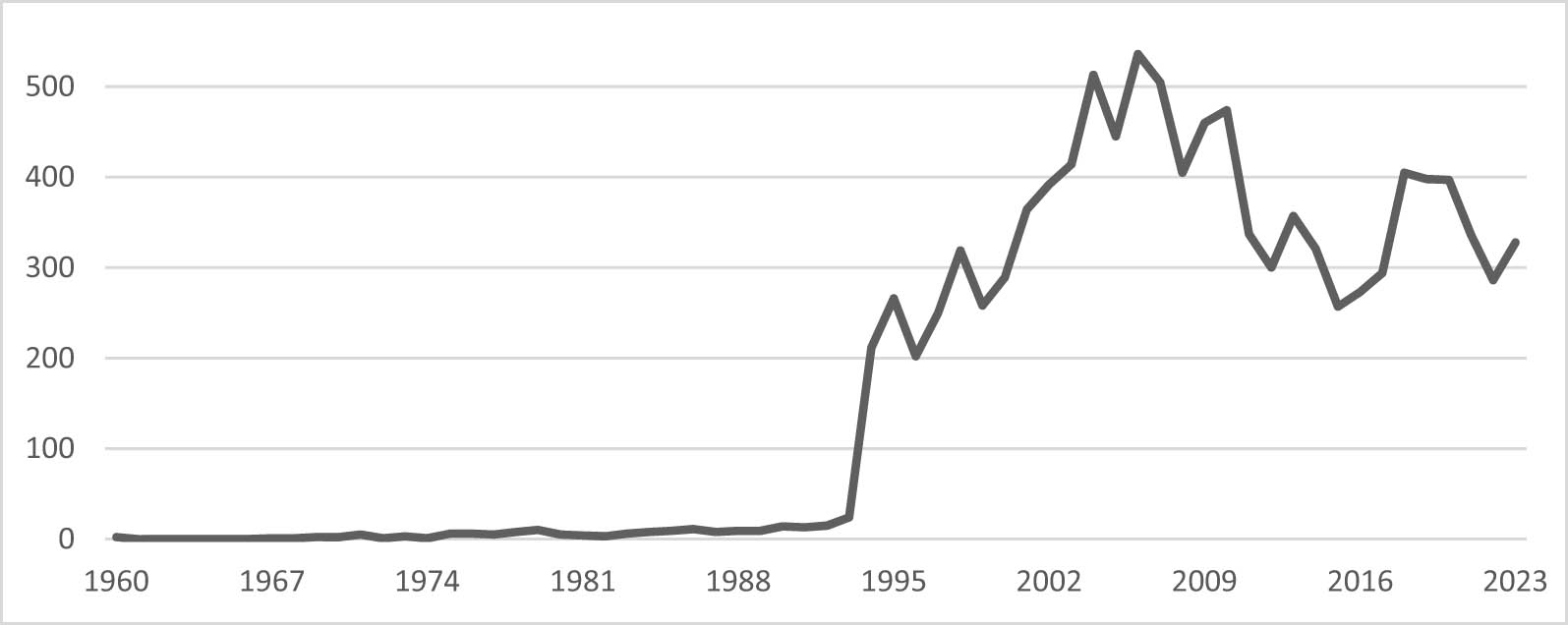
Graph 1 shows annual patent publications. The earliest patent identified was published in the United Kingdom on June 9, 1960. Before 1994, all patents by Japanese firms available in PATENTSCOPE were published outside Japan. Coverage expanded with the inclusion of the Japan Patent Office in 1994, when publications rose to 212. The annual total peaked at 536 in 2006 and subsequently declined to 328 in 2023. The year 2024 is excluded because only five patents had been published by January 9, 2024.
Graph 1
Annual number of new patents, 1960–2023 (publication date).
Source: Own interpretation based on PATENTSCOPE (WIPO, 2024b).
Table 2 shows where leading Japanese firms filed hydrogen-related patents. Japan accounted for 6,753 applications, or 63% of the dataset, followed by the United States (1,354), PCT applications through WIPO (797), the European Patent Office (679), and China (643). Other major jurisdictions included Canada (150), South Korea (110), Australia (97), India (59), and the United Kingdom (38). Overall, overseas filings were concentrated in large markets, particularly the United States, Europe, and China.
Table 2
Prominent patent offices and patent applicants.
| Rank | Patent office | Number of patents | Rank | Patent applicant | Number of patents |
|---|---|---|---|---|---|
| 1 | Japan | 6,753 | 1 | Honda Motor Co Ltd | 1,355 |
| 2 | United States of America | 1,354 | 2 | Toyota Motor Co | 1,145 |
| 3 | PCT | 797 | 3 | Toyota Jidosha Kabushiki Kaisha | 624 |
| 4 | European Patent Office | 679 | 4 | SANYO ELECTRIC CO LTD | 619 |
| 5 | China | 643 | 5 | Matsushita Electric Ind Co Ltd | 575 |
| 6 | Canada | 150 | 6 | Panasonic Co | 477 |
| 7 | Republic of Korea | 110 | 7 | Nissan Motor Co Ltd | 476 |
| 8 | Australia | 97 | 8 | Mitsubishi Heavy Ind Ltd | 469 |
| 9 | India | 59 | 9 | Toshiba Co | 362 |
| 10 | United Kingdom | 38 | 10 | Hitachi Ltd | 342 |
| 11 | Germany | 21 | 11 | Tokyo Gas Co Ltd | 241 |
| 12 | Denmark | 19 | 12 | Panasonic Ip Management Co | 234 |
| 13 | Spain | 10 | 13 | Toyota Motor Co Ltd | 197 |
| 14 | Malaysia | 10 | 14 | Panasonic Intellectual Property Management Co Ltd | 190 |
| 15 | South Africa | 9 | 15 | Toshiba Battery Co Ltd | 181 |
| 16 | France | 8 | 16 | Matsushita Electric Industrial Co Ltd | 145 |
| 17 | Indonesia | 6 | 17 | Toyota Central Res and Dev Lab Inc | 139 |
| 18 | Singapore | 6 | 18 | Toyota Industries Co | 136 |
| 19 | Mexico | 5 | 19 | Mitsubishi Heavy Industries Ltd | 135 |
| 20 | Philippines | 5 | 20 | Hitachi Maxell Ltd | 130 |
Source: Own interpretation based on PATENTSCOPE (WIPO, 2024b).
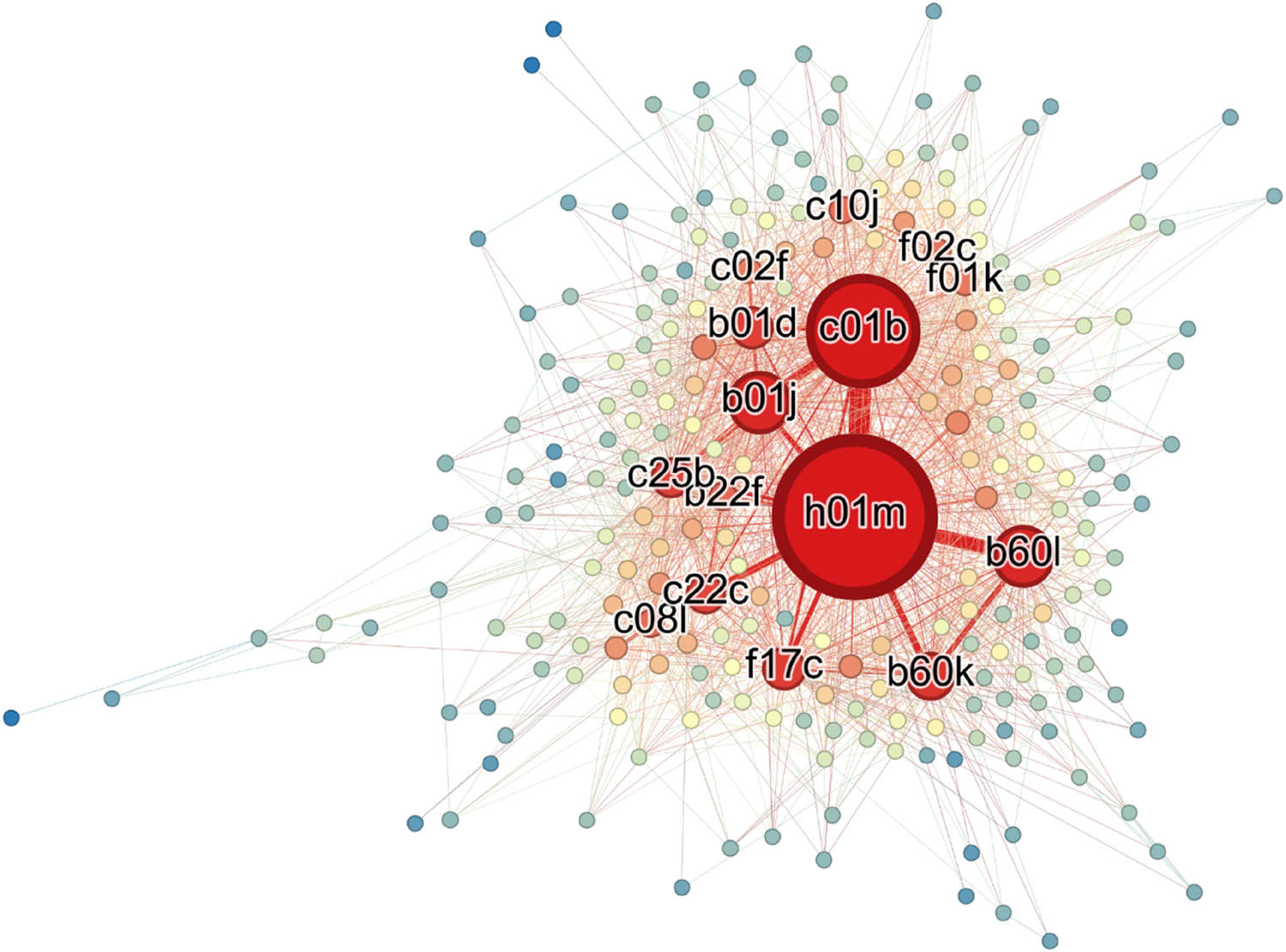
The final IPC co-occurrence network comprises 237 nodes and 1,921 edges, with a diameter of 5, density of 0.069, average degree of 16, and average weighted degree of 151. Graph 2 visualizes the network, while Tables 3 and 4 report statistics for prominent IPC codes and their strongest connections, respectively.
Graph 2
IPC code co-occurrence network (size and colour: weighted degree).
Source: Own interpretation based on PATENTSCOPE (WIPO, 2024b).
Table 3
Prominent IPC codes (subclass level).
| IPC code | Title | Degree | Weighted degree | Number of patents |
|---|---|---|---|---|
| H01M | Processes or means, e.g., batteries, for the direct conversion of chemical energy into electrical energy | 169 | 6,766 | 5,907 |
| C01B | Non-metallic elements; compounds thereof | 145 | 4,434 | 3,005 |
| B60L | Propulsion of electrically-propelled vehicles (…) | 79 | 2,121 | 1,276 |
| C25B | Electrolytic or electrophoretic processes for the production of compounds or non- metals; apparatus therefor | 107 | 1,142 | 1,239 |
| B01J | Chemical or physical processes, e.g. catalysis or colloid chemistry; their relevant apparatus | 98 | 2,139 | 1,035 |
| F17C | Vessels for containing or storing compressed, liquefied, or solidified gases (…) | 92 | 1,257 | 784 |
| B60K | Arrangement or mounting of propulsion units or of transmissions in vehicles (…) | 67 | 1,500 | 745 |
| C22C | Alloys | 37 | 1,091 | 725 |
| B01D | Separation | 95 | 1,217 | 600 |
| C10J | Production of gases containing carbon monoxide and hydrogen from solid carbonaceous materials (…) | 50 | 545 | 364 |
| C08L | Compositions of macromolecular compounds | 47 | 584 | 332 |
| B22F | Working metallic powder; manufacture of articles from metallic powder (…) | 26 | 600 | 320 |
| C02F | Treatment of water, waste water, sewage, or sludge | 58 | 441 | 257 |
| F02C | Gas-turbine plants; air intakes for jet-propulsion plants; controlling fuel supply in air-breathing jet-propulsion plants | 50 | 509 | 232 |
| H02J | Circuit arrangements or systems for supplying or distributing electric power; systems for storing electric energy | 39 | 329 | 218 |
| C07C | Acyclic or carbocyclic compounds | 43 | 410 | 201 |
| F01K | Steam engine plants; steam accumulators; engine plants not otherwise provided for; engines using special working fluids or cycles | 49 | 480 | 187 |
| F02M | Supplying combustion engines in general with combustible mixtures or constituents thereof | 44 | 375 | 171 |
| B62D | Motor vehicles; trailers | 22 | 363 | 156 |
| C08K | Use of inorganic or non-macromolecular organic substances as compounding ingredients | 33 | 309 | 136 |
Table 4
Prominent connections between IPC codes.
| Source IPC code | Target IPC code | Number of patents | Source IPC code | Target IPC code | Number of patents | Source IPC code | Target IPC code | Number of patents |
|---|---|---|---|---|---|---|---|---|
| C01B | H01M | 1,675 | B22F | H01M | 248 | F01K | F02C | 130 |
| B60L | H01M | 1,093 | C01B | C25B | 229 | C10J | F02C | 116 |
| B01J | C01B | 735 | C01B | F17C | 226 | C01B | C22C | 108 |
| C22C | H01M | 555 | B01D | B01J | 188 | B01J | C25B | 100 |
| B60K | H01M | 530 | B22F | C22C | 183 | B60K | F17C | 96 |
| B60K | B60L | 405 | B60K | B62D | 142 | B62D | H01M | 91 |
| B01J | H01M | 367 | H01M | H02J | 141 | C10J | F01K | 79 |
| F17C | H01M | 367 | B01D | C02F | 137 | C01B | F02M | 77 |
| C25B | H01M | 275 | C08K | C08L | 132 | B60L | B62D | 70 |
| B01D | C01B | 251 | B01D | H01M | 130 | C08J | C08L | 69 |
Source: Own interpretation based on PATENTSCOPE (WIPO, 2024b).
H01M is the most common IPC subclass, appearing in 5,907 patents (54.8%), followed by C01B (3,005; 27.9%), B60L (1,276; 11.8%), C25B (1,239; 11.5%), and B01J (1,035; 9.6%). These subclasses also dominate the strongest co-occurrence links. The most frequent pairings are H01M–C01B (1,675 patents), H01M–B60L (1,093), C01B–B01J (735), H01M–C22C (555), H01M–B60K (530), and B60L–B60K (405).
An IPC code’s degree indicates the number of subclasses to which it is connected, while its weighted degree captures the total strength of those connections. Although more frequent codes generally have higher connectivity, notable differences emerge. B60L and C25B appear in a similar number of patents, yet B60L has fewer connections (degree 79 versus 107) but a much higher weighted degree (2,121 versus 1,142). Thus, B60L co-occurs with fewer subclasses, but its connections are substantially stronger. Similarly, B60K and C22C occur with comparable frequency, but B60K has a higher weighted degree (1,500 versus 1,091).
Network connections between IPC codes represent technological bridges through which new formalized knowledge emerges. Their significance depends on both co-occurrence frequency and interdisciplinarity: links within the same IPC class, such as B60K–B60L, differ from cross-class links, such as H01M–B60L. Rapidly strengthening bridges may signal emerging technological fields or opportunities for future collaboration. As technologies evolve, new IPC codes may also be introduced to improve classification.
4.2. Japan’s hydrogen technology development: major initiatives and challenges
One of the key initiatives in Japan’s hydrogen strategy is the CO₂-free Hydrogen Energy Supply-chain Technology Research Association (HySTRA). HySTRA aims to establish an international hydrogen supply chain encompassing hydrogen production, transportation, storage, and utilization. One of its flagship achievements is the construction of the world’s first liquefied hydrogen carrier, Suiso Frontier, by Kawasaki Heavy Industries (Table 5). The vessel plays a critical role in the Japan-Australia Hydrogen Energy Supply Chain (HESC) pilot project. In 2022, Suiso Frontier completed the world’s first maritime transportation test of liquefied hydrogen, carrying hydrogen produced in Australia from lignite to Japan. This demonstration highlighted the feasibility of large-scale international hydrogen transport and the potential for cost-competitive hydrogen imports (Saito, 2022). Another major initiative is the Advanced Hydrogen Energy Chain Association for Technology Development (AHEAD), a consortium supported by NEDO to develop alternative hydrogen transport technologies. Its Global Hydrogen Supply Chain Demonstration Project transports hydrogen from Brunei to Japan using Chiyoda Corporation’s Organic Chemical Hydride Method, supporting Japan’s goal of establishing large-scale hydrogen power generation by 2030 (AHEAD, 2017).
Table 5
Examples of hydrogen technology-related projects in Japan.
| Company | Project/partners | Key hydrogen technology |
|---|---|---|
| Kawasaki Heavy Industries | HySTRA; HESC | Developed the Suiso Frontier, the world’s first liquefied-hydrogen carrier (2019), and a liquefied-hydrogen receiving terminal (2020). Supplied a hydrogen power plant for Seibu Oil’s Yamaguchi Refinery, operational since August 2021. |
| Nippon Hydrogen Energy (Kawasaki Heavy Industries subsidiary) | NEDO hydrogen supply-chain commercialization project with ENEOS and Iwatani | Development of large-scale liquefied-hydrogen supply-chain infrastructure, including carriers, liquefiers, and storage tanks. |
| Electric Power Development Co. (J-POWER) | Japan–Australia HESC demonstration project | Coal-gasification and lignite-derived hydrogen production. A demonstration plant near an Australian lignite mine began producing hydrogen in February 2021. |
| Chiyoda Corporation | AHEAD consortium with Mitsubishi Corporation, Mitsui & Co., and Nippon Yusen Kabushiki Kaisha | SPERA Hydrogen®, an organic chemical hydride technology for hydrogen storage and transport. |
| Iwatani Corporation | HySTRA, HESC, and Fukushima Hydrogen Energy Research Field (FH2R) | Liquefied-hydrogen production and commercial hydrogen-refuelling stations. |
| Toshiba Energy Systems & Solutions | FH2R with NEDO, Tohoku Electric Power, and Iwatani | Renewable-powered, 10 MW-class hydrogen production system, among the world’s largest at the time of commissioning. |
| Woven Planet Holdings | Woven City project backed by Toyota, ENEOS, and Akio Toyoda | Hydrogen infrastructure for Woven City, including electrolysers at refuelling stations and stationary fuel-cell generators. |
Source: Compiled from company reports and industry publications.
Hydrogen infrastructure has also been a major policy priority. To accelerate the deployment of hydrogen refuelling stations for fuel-cell vehicles, public and private stakeholders established Japan Hydrogen Mobility (JHyM) in 2018. Supported by government subsidies, JHyM plays a central role in expanding hydrogen infrastructure and implementing Japan’s hydrogen strategy (Toyota, 2018). Japan has also invested heavily in hydrogen production technologies. Since 2020, the Fukushima Hydrogen Energy Research Field (FH2R) has served as one of the world’s largest hydrogen production facilities, using solar-powered electrolysis to demonstrate the integration of renewable energy with hydrogen production and distribution systems (Takahashi, 2020).
Beyond government-supported projects, industry-led initiatives also contribute to Japan’s hydrogen ambitions. Established in 2020, the Japan Hydrogen Association (JH2A) promotes international cooperation, supply-chain development, and policy coordination to strengthen Japan’s position in the emerging hydrogen economy (Toyota, 2020). Similarly, Toyota’s Woven City serves as a large-scale demonstration site for hydrogen-powered urban infrastructure and advanced energy-management systems (Noguchi, 2021).
Despite these investments, Japan’s hydrogen strategy faces significant economic and technological challenges. One notable feature of the Japanese approach is its emphasis on low-carbon hydrogen, including blue hydrogen,2 rather than exclusively focusing on green hydrogen produced from renewable energy (Dzienis, 2022). This preference reflects both economic and structural considerations. First, fossil-fuel-derived hydrogen and coal–ammonia co-firing have attracted particular interest because they can utilize existing transportation and storage infrastructure (Jeje et al., 2024), which may help reduce costs. Second, this strategy supports incumbent industrial actors, including firms such as Iwatani Corporation and Kawasaki Heavy Industries, which have made substantial investments in hydrogen transport and processing technologies.
The economics of green hydrogen remain particularly challenging. Production costs are highly dependent on access to low-cost renewable electricity and remain substantially higher than those of hydrogen produced from fossil fuels. Hydrogen produced from fossil fuels with carbon capture and storage (CCS) typically costs between $1.20 and $2.60 per kilogram, compared to $3.20–$7.70 per kilogram for renewable hydrogen (HESC 2026). Consequently, countries with abundant renewable resources are likely to become major hydrogen exporters. In contrast, resource-constrained economies such as Japan, South Korea, and many European countries are expected to become net importers. Emerging hydrogen partnerships, including Australia–Japan and Morocco–Germany, illustrate this evolving international division of labour in the hydrogen economy (PwC website).
These constraints help explain Japan’s pragmatic approach to hydrogen development. Given its limited renewable energy potential and dependence on imported energy, Japan views hydrogen as both a decarbonization tool and an instrument of energy security and industrial policy. Since large-scale green hydrogen deployment requires substantial investments in renewable generation, electrolysers, storage, and import facilities (Jeje et al., 2024), Japan currently prioritizes low-carbon hydrogen and ammonia while treating green hydrogen as a longer-term objective (Matsuno, 2025). The analysis of strengths, weaknesses, opportunities, and threats of Japan’s hydrogen economy is presented in Table 6.
Table 6
SWOT analysis of Japan’s hydrogen economy, including findings from patent analysis.
| Japan | |
|---|---|
| Strengths | Weaknesses |
|
|
| Opportunities | Threats |
|
|
Source: Authors’ own elaboration.
On the demand side, Japanese hydrogen consumption remains concentrated in traditional industrial sectors. Refineries account for approximately 39% of hydrogen demand, followed by power generation, steel production, and ammonia and methanol manufacturing (Fortune Business Insights, 2026). Accordingly, government policy focuses not only on supporting technological innovation and supply-chain development but also on creating stable demand through hydrogen-based power generation, industrial applications, and transportation. In the latter domain, Honda and Toyota take the lead. Recently, however, high vehicle and infrastructure costs, low usage, and limited profitability have driven refuelling station closures, while reduced FCEV subsidies (amid stronger electric vehicle support) further widen the competitiveness gap (Okinaga et al., 2026). As a result, the future of FCEVs depends heavily on whether a viable hydrogen ecosystem can be developed to support broader adoption.
In conclusion, Japan has pursued one of the world’s most comprehensive hydrogen strategies, integrating state support, industrial coordination, business cooperation, and large-scale demonstration projects. However, its long-term success will depend on reducing production costs, securing reliable imports, expanding domestic demand, deploying infrastructure, and overcoming the technological and economic barriers that continue to constrain the commercialization of green hydrogen (Takahashi, 2020).
5. Discussion and conclusion
This article examined Japan’s hydrogen-related innovation activity using patent network analysis to identify the technological domains, firms, and knowledge connections underpinning the country’s hydrogen strategy. The findings confirm that Japan has built a broad and mature hydrogen innovation ecosystem, but one that remains strongly concentrated around specific technological fields and industrial actors.
The patent network shows that fuel-cell technologies occupy the core of Japan’s hydrogen innovation system. The dominance of H01M, together with its strong co-occurrence with C01B, B60L, B60K, C25B, B01J, and F17C, indicates that Japanese firms have developed dense technological linkages between fuel cells, hydrogen production, vehicle propulsion, electrolysis, catalysis, and storage. This confirms that Japan’s hydrogen trajectory has been shaped not only by energy and industrial policy goals but also by the strategic interests of automotive, chemical, and heavy-industry firms. The central role of Honda, Toyota, Panasonic, Nissan, Mitsubishi Heavy Industries, Toshiba, and Hitachi suggests that hydrogen innovation in Japan is embedded in established industrial capabilities rather than emerging from a completely new technological base.
These results also highlight the importance of state coordination. Japan’s hydrogen strategy has evolved through successive public programmes, including the Sunshine Project, New Sunshine Program, Basic Hydrogen Strategy, GX initiatives, and large-scale demonstration projects such as HySTRA, HESC, AHEAD, JHyM, and FH2R. These initiatives have supported both supply-side innovation and demand-side market formation. In this sense, Japan’s approach can be understood as an ecosystem strategy: the state does not merely fund R&D but also helps coordinate infrastructure, standards, demonstration projects, international supply chains, and industrial demand. The patent evidence confirms that Japan’s hydrogen strategy is less a radical industrial rupture than a reconfiguration of established strengths in automotive engineering, electrochemistry, materials, storage, catalysis, and heavy industrial systems into a platform for future green competitiveness.
Nevertheless, this reconfiguration is characterized by several structural tensions. The country’s established capabilities in fuel-cell and mobility technologies risk reinforcing path dependence around FCEVs, even as global hydrogen strategies increasingly prioritize industrial decarbonization and green hydrogen production (see Table 6). Accordingly, Ohno et al. (2022) argue that the broad vision of a “hydrogen society” should be replaced with a more targeted strategy focused on green hydrogen applications in hard-to-abate sectors. Moreover, Japan’s emphasis on low-carbon hydrogen, ammonia co-firing, and international supply chains, while reflecting domestic resource constraints, may slow the transition to renewable hydrogen and ultimately undermine long-term competitiveness. At the same time, reliance on imported hydrogen and the high cost of domestic green hydrogen create new technological and geopolitical vulnerabilities.
The study has several limitations. Patent data do not capture all forms of innovation, and the analysis focuses on selected Japanese firms rather than the full universe of hydrogen-related actors. Moreover, IPC co-occurrence networks reveal technological proximity but not the commercial success or environmental performance of specific technologies. Future research could therefore compare Japan’s patent network with those of Germany, South Korea, China, the United States, or the European Union.
Acknowledgements
We thank the anonymous reviewers for their valuable insights and constructive comments, which helped improve the manuscript’s quality and clarity.
Funding information
Authors state no funding involved.
Author contributions
Anna Maria Dzienis: Conceptualization, methodology, investigation, writing – original draft, writing – review and editing, supervision, project administration; Artur F. Tomeczek: Methodology, formal analysis, Investigation, data curation, writing – original draft, writing – review and editing, visualization.
Conflict of interest statement
Authors state no conflict of interest.
Data availability
Data available upon request.