
1. Introduction
Political events significantly influence financial markets, affecting asset prices, market volatility, and investor behaviour. Studies exploring the link between political uncertainty and financial market outcomes indicate that fear of political instability has a significant negative impact on stock market returns and the volatility of financial assets (Wagner et al., 2018; Czech et al., 2023). For instance, market reactions to the Brexit referendum showed that equity, commodity, government bond, and currency markets reacted quickly to political news. Changes in the probability of Brexit (just before the referendum) were quickly reflected in equity prices, often within a minute (Gu & Hibbert, 2021; Wielechowski & Czech, 2016). Moreover, financial markets often react negatively to political events, such as elections and legislative changes, due to the uncertainty they introduce (Mei & Guo, 2004).
Political events might significantly change investor sentiment (Maurya et al., 2026; Nasraoui et al., 2024). For example, uncertainty about approaching political events may make investors more risk averse. This behaviour often decreases prices across various financial markets. Trading activity varies even with the type of election and the demographic profile of investors. Colón e Armas et al. (2021) revealed that younger, employed U.S. investors are more active during Republican victories. However, this evidence is weaker for Democratic victories. Political uncertainty generally increases market friction, negatively affecting institutional behaviour and the entire economy (Dai & Zhang, 2019). Institutional investors try to reduce their holdings during periods of political uncertainty, including presidential elections. This reduction ranges from 0.8 to 2.3% during presidential election years (Francis et al., 2021). Additionally, political uncertainty leads to herding behaviour among institutional investors, particularly when the U.S. president is unpopular (Gavriilidis et al., 2024). There is evidence that investor concerns grow in the run-up to election day, leading to increased market volatility. In contrast, during post-election periods, a temporary decline in implied volatility is often observed (Shaikh, 2019). Notably, the victory of populist candidates often leads to higher short-term market volatility. However, the impact of populism on financial markets varies depending on specific policies and country context, but it is generally associated with uncertainty and volatility (Hartwell, 2022).
In this article, we focus on elections as political events and their impact on stock market prices. Previous studies mostly concentrate on analysing the effect of elections, not on mean rates of return, but rather on price volatility in the financial market. The uncertainty surrounding election outcomes substantially impacts market volatility. The predictability of electoral outcomes also affects financial volatility, thereby increasing it (Carnahan & Saiegh, 2021). It is well established that the conditional variance of stock market returns increases when there is greater uncertainty about the outcome of an approaching election (Bowes, 2017; Smales, 2014, 2015). Historical data from various countries, including Australia, South Korea, and other The Organisation for Economic Co-operation and Development (OECD) countries, show that national elections induce higher stock market volatility. Factors such as narrow margins of victory, changes in political orientation, and the inability to form a majority government are strictly related to the level of the election shock (Białkowski et al., 2008; Smales, 2016; Chiu et al., 2005). Moreover, the probability of an opposing party candidate winning positively correlates with implied market volatility (Mnasri & Essaddam, 2021). An interesting aspect is that the anticipation of a Democratic victory in the U.S. has been associated with decreased market volatility (Leblang & Mukherjee, 2004). Li and Born (2006) observe that during presidential elections with no decisive frontrunner, stock market volatility rises, accompanied by higher mean stock market returns. Moreover, Gil-Alana et al. (2020) found that during the second presidential term, the S&P 500 stock market is less efficient and exhibits greater volatility persistence.
In this study, we analyse the impact of the U.S. presidential elections on the stock market. The U.S. presidential election consistently draws global attention due to its evident impact on both the domestic and global economies (Ahmed et al., 2025). Previous studies prove that the U.S. presidential elections affect stock markets internationally, e.g. the Taiwanese stock market is sensitive to the U.S.-China-Taiwan relationship during U.S. elections (Hung, 2013). Similarly, the 2000 U.S. presidential election delay negatively affected the Canadian and Mexican stock markets, indicating close integration of these economies with the U.S. financial market (Nippani & Arize, 2005).
Our analysis deals with three U.S. presidential elections, the ones in which Donald Trump was a candidate, not because of the expected electoral outcomes, but due to the distinctive nature of uncertainty associated with his political involvement. Donald Trump is widely regarded as an unconventional and polarising political figure, whose leadership style, business background, and unpredictable policy positions have historically increased market sensitivity (Lewis et al., 2018; McAdams, 2017; Mollan & Geesin, 2020). His political presence has been associated with heightened market uncertainty and unexpected policy shifts, often referred to as the “Trump Doctrine” or simply “Trumpism,” i.e. a collection of statements and policy orientations developed since his 2015 presidential bid (Pham et al., 2018). In the literature, there exists the term Trump effect, which refers to the observed impact of Donald Trump’s political actions, rhetoric, and electoral involvement on financial markets, investor sentiment, and economic expectations. In empirical finance, it is commonly associated with increased market volatility and shifts in asset prices, driven by Donald Trump’s unpredictable decision-making. Cosma et al. (2025), for example, explicitly referred to the Trump effect when analysing the performance of green stocks during the latest U.S. presidential election, while De Area Leão Pereira et al. (2018) used the term in the context of broader international volatility responses. While election-related uncertainty is a well-established phenomenon in the literature, our analysis focuses on candidate-specific uncertainty, particularly associated with politically unconventional and polarising figures. Therefore, the term Trump effect is used in a descriptive sense, referring to an observed empirical pattern rather than implying a strictly causal relationship.
Numerous studies demonstrate that Trump’s candidacy and policy outlooks have led to observable sectoral and international effects. For example, the U.S. stock market was visibly affected by the 2016 U.S. presidential election, with significant responsiveness observed when Trump obtained the Republican nomination. Before that election, the U.S. stock market experienced fluctuations based on polling data and election outcomes. The life insurance sector has been negatively impacted by Trump’s policy intentions (Pham et al., 2018). Conversely, pharmaceutical companies, which underperformed before the election, experienced significant price increases just before the election results, indicating market anticipation (Blau et al., 2019). Companies linked to presidential candidates experienced increased abnormal returns during the 2016 election period (Child et al., 2021). Moreover, at the international level, the 2016 U.S. presidential election had varied effects on different markets. Trump’s win negatively impacted, among others, financial markets in China and Brazil due to his neo-mercantilist policies, while the Russian market reacted positively due to expectations of eased sanctions (Bouoiyour & Selmi, 2018). In the period leading up to the 2024 U.S. presidential election, sectoral responses were heterogeneous. These dynamics were particularly evident in energy, industrials, and financials, which recorded substantial gains, largely attributable to anticipated deregulation and shifts in economic policy (Ahmed et al., 2025; Cosma et al., 2025; Ferriani et al., 2025).
One additional aspect is that Donald Trump’s tweets mentioning publicly traded companies often led to immediate changes in stock prices, increased trading volume, and volatility (Ge et al., 2019; Machus et al., 2022). Positive tweets generally resulted in positive abnormal returns, while negative tweets triggered negative effects on given stocks (Ajjoub et al., 2021). Nevertheless, these effects were typically short-lived as stock prices often reverted to their previous levels within days (Born et al., 2017). Recent literature further suggests that Trump’s electoral involvement has had a distinctive effect on market volatility, especially in comparison to other political candidates. De Area Leão Pereira et al. (2018) revealed this by showing that search intensity for “Donald Trump” in Google Trends was positively correlated with market volatility across several countries, including Mexico, Japan, Australia, and Brazil. Cosma et al. (2025) similarly found that firms with strong environmental credentials experienced disproportionately negative returns during Trump’s campaigns, consistent with anticipated changes in regulatory and climate policy.
Our study contributes to the existing literature on the sensitivity of financial markets to political events by offering a focused analysis of U.S. presidential elections. In detail, we adapt the event study framework to analyse the impact of the 2016, 2020, and 2024 U.S. presidential elections (involving Donald Trump) on S&P 500 returns and volatility. We recognise that political events can generally influence financial markets; however, by analysing U.S. presidential election periods, we assume that not every such event necessarily leads to changes in market volatility. In our view, it is the specific uncertainty associated with individual candidates, particularly the unpredictability regarding their potential decisions, that is more likely to trigger increased volatility. Methodologically, the existing literature lacks studies that perform comprehensive robustness checks of results in this context. In our research, beyond comparing elections involving Donald Trump with previous election cycles (2004, 2008, 2012), we also conduct a placebo test for structurally analogous non-election periods. Thus, our study provides evidence that the observed increase in volatility is indeed associated with the Trump effect. Our findings offer insights for investors and policymakers, indicating the existence of stock market uncertainty during politically sensitive events. It should be emphasised that the objective of this study is not to generalise the findings to all U.S. presidential elections, but rather to document a consistent empirical pattern observed in a limited number of election cycles involving a specific candidate.
The outline of the study is as follows. Section 2 presents the study’s objective, along with a description of the data and methods employed. Section 3 provides the empirical results and discussion, while the final section offers our conclusions.
2. Materials and methods
This study applies the event study methodology to investigate and assess the impact of election periods on stock prices in the United States, specifically focusing on the 2016, 2020, and 2024 presidential elections, during which Donald Trump was a candidate. In detail, we aim to analyse the influence of these elections on both the returns and volatility of the S&P 500 index. The objective is to assess whether presidential elections contribute to statistically significant changes in returns and volatility.
We define a 10-day election event period for each U.S. presidential election, comprising 5 trading days before and 5 trading days after the election day, referred to as the “election event period” and compare it with a control period of the same length preceding the election event period, i.e. “pre-election event period”. We use short election event periods to better isolate the effects of specific political events and limit the impact of other macroeconomic factors that could influence stock prices.
We assume that the mean and volatility of the rates of return differ significantly between these examined sub-periods. Sub-periods for each election (2016, 2020, and 2024) are defined separately. The choice of the S&P 500 index was motivated by its role as a benchmark for the U.S. equity market. The daily data for the S&P 500 index were obtained from LSEG Workspace (formerly Refinitiv Datastream) and cover the period from 2016 to 2024. Table 1 provides the specific timeframes for each analysed event period.
Table 1
U.S. presidential elections and analysed event periods (2016, 2020, and 2024).
| U.S. presidential elections | Election date | Pre-election event period | Election event period |
|---|---|---|---|
| 2016 | 08.11.2016 | 19.10.2016–01.11.2016 | 02.11.2016–15.11.2016 |
| 2020 | 03.11.2020 | 14.10.2020–27.10.2020 | 28.10.2020–10.11.2020 |
| 2024 | 05.11.2020 | 16.10.2024–29.10.2024 | 30.10.2024–12.11.2024 |
Source: Own calculation based on data from LSEG Workspace.
In the analysis, we use the logarithmic daily rates of return of the S&P 500 index, calculated as follows:
where represents the logarithmic rate of return, and and are the closing prices of the S&P 500 on day and the previous trading day (t − 1), respectively.To examine the impact of U.S. presidential elections on S&P 500 index returns and volatility, we first test the hypothesis regarding the equality of variances. This step is motivated by the findings presented in the literature review, which indicate that political events, including presidential elections, tend to influence market volatility more strongly than mean rates of return. Thus, we apply a two-sided F-test to verify whether the variance of returns during the pre-election event period and the election event period differs significantly.
The statistical hypotheses for the two-sided F-test are as follows:
: The variances of returns during the pre-election event period and the election event period are equal .
: The variances of returns during the pre-election event period and the election event period are significantly different .
The F-test statistic is given by
where and are the sample variances of returns in the two sub-periods.If the results of the two-sided F-test confirm a statistically significant difference in variances, we conduct an additional one-sided F-test to verify whether the variance of return in the election event period is statistically significantly higher than in the pre-election period. This is in line with findings in the literature suggesting that market volatility tends to increase during election periods.
The statistical hypotheses for the one-sided F-test are as follows:
: The variances of returns during the pre-election event period and the election event period are equal .
: The variances of returns during the pre-election event period and the election event period are significantly different .
Next we assess the hypothesis concerning the equality of mean daily rates of return between the pre-election and election event periods. The statistical hypotheses are formulated as follows:
: The mean daily rates of return during the pre-election event period and election event period are equal .
: The mean daily rates of return during the pre-election event period and election event period are significantly different .
The choice of the appropriate version of the t-test depends on the outcome of the F-test. If the F-test does not reject the null hypothesis of equal variances, we apply the standard two-sample Student’s t-test, assuming homoscedasticity to examine differences in mean rates of return. The test statistic is defined as
where and are the sample mean rates of return in the pre-election and election event periods, respectively, and are the number of observations in each sub-period, and represents the pooled standard deviation, calculated aswhere and are sample variances in the respective periods, and degrees of freedom are given byIf the F-test rejects the null hypothesis and indicates unequal variances, we apply the Welch’s t-test for independent samples with unequal variances, which is more robust to heteroscedasticity. The formula for Welch’s t-test remains structurally similar
But the degrees of freedom are adjusted using the Welch–Satterthwaite approximation.
T-tests and F-tests assume that returns in both sub-periods are normally distributed. The Shapiro–Wilk normality test is used to check this assumption. All statistical analyses are conducted with a significance level of .
The hypotheses for mean and variance are tested separately for the three elections, i.e. 2016, 2020, and 2024 periods. The interpretation of the statistical results allows us to determine whether the mean and volatility of daily rates of return of the S&P 500 index differed significantly during the election event periods compared to the pre-election event periods.
In order to perform a robustness check of our results, we conducted an additional comparative analysis using data from earlier U.S. presidential elections, specifically 2004, 2008, and 2012, when Donald Trump was not a candidate. We assume that the influence of U.S. presidential elections on stock market volatility is not automatically present in every election, but instead is related to specific individuals who participate, such as Donald Trump, who was a candidate in the 2016, 2020, and 2024 elections. This allows us to assess whether similar effects occurred in other election cycles, helping to confirm whether the observed changes in volatility are indeed connected to Donald Trump’s candidacy or are a more general feature of U.S. presidential elections. Table 2 provides the specific timeframes for each of the analysed U.S. election windows in 2004, 2008, and 2012.
Table 2
U.S. presidential elections and analysed event periods (2004, 2008, and 2012).
| U.S. presidential elections | Election date | Pre-election event period | Election event period |
|---|---|---|---|
| 2004 | 02.11.2004 | 13.10.2004–26.10.2004 | 27.10.2004–09.11.2004 |
| 2008 | 04.11.2008 | 15.10.2008–28.10.2008 | 29.10.2008–11.11.2008 |
| 2012 | 06.11.2012 | 17.10.2012–30.10.2012 | 31.10.2012–13.11.2012 |
Source: Own calculation based on data from LSEG Workspace.
Furthermore, to validate the robustness of our findings, we conduct a placebo test by applying the same event-study procedure to analogous periods in non-election years. The dates were selected to closely match the timing structure of the actual election periods, ensuring comparability. In the United States, presidential elections are held every 4 years on the first Tuesday following the first Monday in November. The placebo test was applied to non-election years that are chronologically close to actual election years: specifically, 2015 (pre-election), 2017 (post-election), 2019 (pre-election), 2021 (post-election), and 2023 (pre-election). If significant election-like effects were observed in these non-election years, it would raise doubts regarding the statistical validity of our results and suggest that the identified market responses might not be related to the election events themselves. The objective is to verify whether similar increases in volatility occur in years without presidential elections. This additional step helps ensure the robustness of the findings and supports the argument that any detected effect in election years is indeed attributable to the presidential election cycle, rather than to random market fluctuations or temporal anomalies. Table 3 details the analysed placebo periods.
Table 3
Placebo test periods in non-election years.
| Year | Placebo event date | Placebo pre-event period | Placebo event period |
|---|---|---|---|
| 2015 | 03.11.2015 | 14.10.2015–27.10.2015 | 14.10.2015–27.10.2015 |
| 2017 | 07.11.2017 | 18.10.2017–31.10.2017 | 18.10.2017–31.10.2017 |
| 2019 | 05.11.2019 | 16.10.2019–29.10.2019 | 16.10.2019–29.10.2019 |
| 2021 | 02.11.2021 | 13.10.2021–26.10.2021 | 13.10.2021–26.10.2021 |
| 2023 | 07.11.2023 | 18.10.2023–31.10.2023 | 18.10.2023–31.10.2023 |
Source: Own calculation based on data from LSEG Workspace.
3. Results and discussion
Our study seeks to examine how election periods influence the U.S. stock market, with a particular emphasis on the 2016, 2020, and 2024 presidential elections, in all of which Donald Trump was a candidate.
Figure 1 illustrates the behaviour of the S&P 500 index value (blue line, left axis) and daily rates of return (orange line, right axis) over a 20-day period surrounding the 2016, 2020, and 2024 U.S. presidential elections. Each subfigure (a–c) represents a different election year, depicting two distinct time frames: the pre-election event period, covering the 10 trading days preceding the election event period, and the election event period, covering 5 trading days before and 5 trading days after the election date. The green vertical line marks the election date (8.11.2016 in (a); 3.11. 2020 in (b); and 5.11. 2024 in (c)), while the black vertical line indicates the beginning of the election event period (2.11.2016 in (a); 28.10.2020 in (b); and 30.10.2024 in (c)). Across all analysed U.S. presidential election periods, we observe a visible increase in market volatility around the election date. Figure 1 suggests that U.S. presidential elections lead to increased market uncertainty, particularly in the days surrounding the analysed political events.
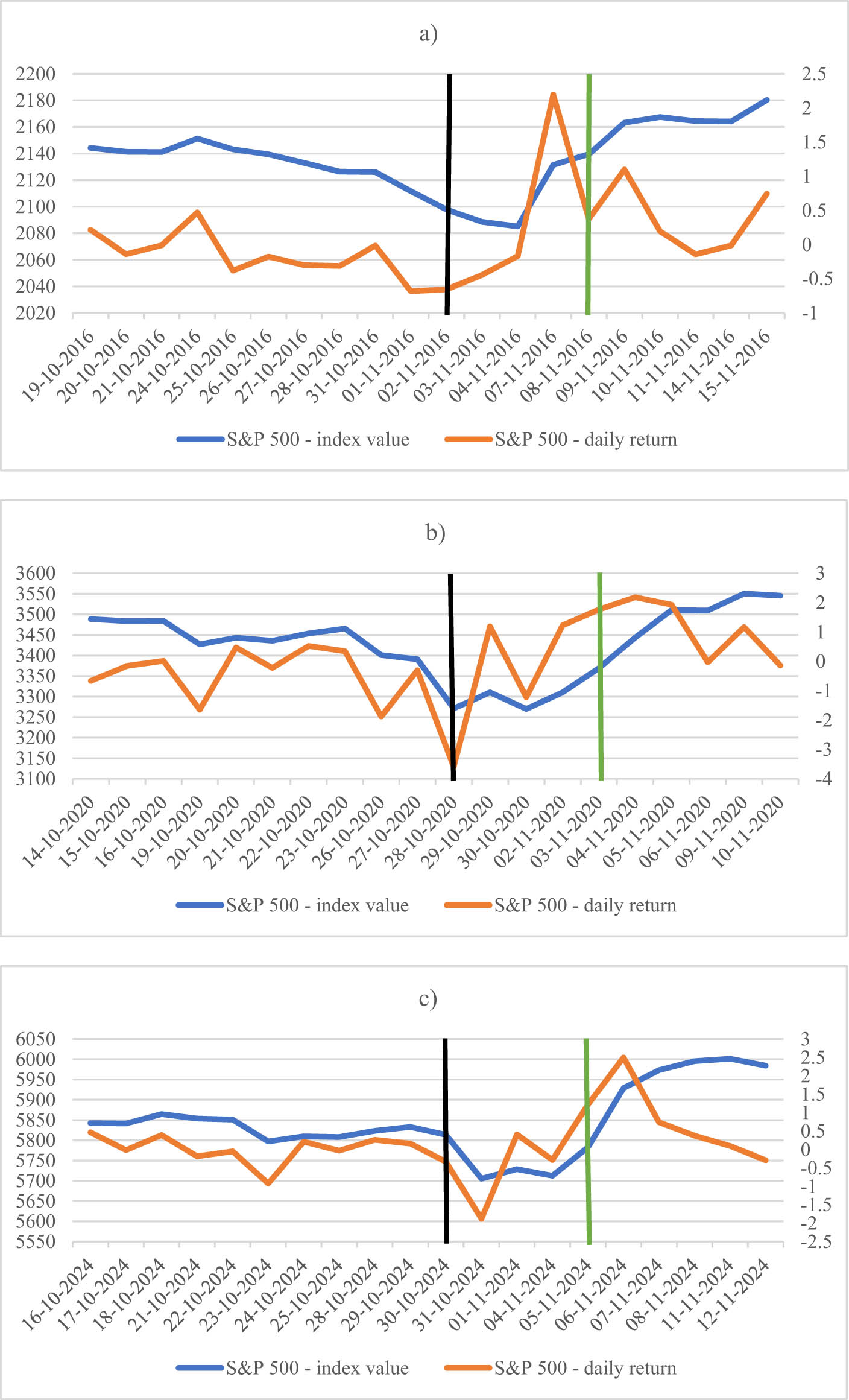
Figure 1
Market reactions to U.S. presidential elections: S&P 500 index value and daily rates of return: (a) 2016, (b) 2020, and (c) 2024. Notes: The green vertical line denotes the election day, and the black vertical line indicates the start of the election event period.
Source: Own elaboration and calculation based on data from LSEG Workspace.
Table 4 presents descriptive statistics for the pre-election event periods and election event periods across the U.S. Presidential elections in 2016, 2020, and 2024. We calculate mean returns, standard deviation, variance, and the range (minimum and maximum) of returns for the S&P 500 index during these periods.
Table 4
Descriptive statistics of the S&P 500 during the analysed U.S. presidential election periods.
| U.S. presidential election | Descriptive statistics | Pre-election event period | Election event period |
|---|---|---|---|
| 2016 | Mean value | −0.13 | 0.32 |
| Standard deviation | 0.32 | 0.85 | |
| Variance | 0.10 | 0.71 | |
| Minimum | −0.68 | −0.65 | |
| Maximum | 0.47 | 2.20 | |
| 2020 | Mean value | −0.35 | 0.45 |
| Standard deviation | 0.83 | 1.77 | |
| Variance | 0.69 | 3.14 | |
| Minimum | −1.88 | −3.59 | |
| Maximum | 0.52 | 2.18 | |
| 2024 | Mean value | 0.03 | 0.26 |
| Standard deviation | 0.39 | 1.14 | |
| Variance | 0.16 | 1.30 | |
| Minimum | −0.92 | −1.88 | |
| Maximum | 0.47 | 2.50 |
Source: Own calculation based on data from LSEG Workspace.
Data in Table 4 show that during the 2016 U.S. presidential election event period, the mean return of the S&P 500 index rose from −0.13 to 0.32, indicating a positive market reaction. Volatility increased, with the variance rising from 0.10 to 0.71. The maximum return surged from 0.47 to 2.20, also reflecting stronger fluctuations. In 2020, we observe the analogous trend, with the variance rising from 0.69 to 3.14. The minimum return dropped to −3.59, and the maximum climbed to 2.18. For the 2024 election, the mean rate of return increased from 0.03 to 0.26, similar to the above-mentioned election periods. Volatility increased, with the variance growing from 0.16 to 1.30. The return range also expanded.
In the next part of the analysis, we examine whether the changes in returns and volatility during the election periods are statistically significant. As a first step, we apply a two-sided F-test to test the hypothesis of equal variances. This is because, as presented in the literature review, volatility is generally more likely to change significantly during election periods, whereas changes in mean rates of return are less consistent. Moreover, the results of the F-test (Table 5) help determine which t-test to use when testing the hypothesis of equal mean rates of return.
Table 5
Two-sided F-test results.
| U.S. presidential election | F-statistic | p-value |
|---|---|---|
| 2016 | 0.15 | 0.009 |
| 2020 | 0.22 | 0.034 |
| 2024 | 0.12 | 0.004 |
Source: Own calculation based on data from LSEG Workspace.
We test the hypothesis that the variances of returns in the two examined periods (pre-election and election event periods) are equal, against the alternative that they differ (Table 5). For the 2016 U.S. presidential election, the F-statistic is 0.15 with a p-value of 0.009, for the 2000 U.S. presidential election, the F-statistic is 0.22 with a p-value of 0.034, and for the 2024 U.S. presidential election, the F-statistic is 0.12 with a p-value of 0.004. This implies that, at the 0.05 significance level, we reject the null hypothesis. This finding suggests that the variances of returns in the pre-election and election event periods for the analysed U.S. elections differ significantly. The results indicate that election events are associated with significant differences in market volatility across all three U.S. presidential elections (Table 5).
The results in Table 5 confirm that the variance during the election event periods differs statistically from that observed during the pre-election event periods. Additionally, the descriptive statistics indicate that variance tends to be higher during the election periods. Therefore, we additionally apply a one-sided F-test to verify whether the variance during the election event periods is statistically significantly higher than during the pre-election periods (Table 6).
Table 6
One-sided F-test results.
| U.S. presidential election | F-statistic | p-value |
|---|---|---|
| 2016 | 0.15 | 0.004 |
| 2020 | 0.22 | 0.017 |
| 2024 | 0.12 | 0.002 |
Source: Own calculation based on data from LSEG Workspace.
The results presented in Table 6 confirm that the variance during the election event periods is statistically significantly higher compared to the pre-election periods. For all analysed elections (i.e. 2016, 2020, and 2024), the results are significant at the 0.05 significance level.
In a further step, we test the hypothesis of equality of means of returns. Since the F-test results (Table 5) indicated that the variance in the election period differs significantly from the pre-election period, it is necessary to use the t-test with Welch’s correction (Table 7).
Table 7
Welch two-sample T-test results.
| US presidential election | t-statistic | p-value |
|---|---|---|
| 2016 | −1.58 | 0.142 |
| 2020 | −1.29 | 0.220 |
| 2024 | −0.59 | 0.567 |
Source: Own calculation based on data from LSEG Workspace.
Table 7 presents the Welch two-sample T-test results for the hypothesis that the mean returns in the analysed sub-periods (pre-election event period and election event period) are equal vs the alternative hypothesis that they differ significantly. The results reveal that, for all three analysed U.S. presidential election periods, the p-value is greater than the 0.05 significance level. Thus, we cannot reject the null hypothesis, indicating that there is no statistically significant difference in mean returns between the pre-election and election event periods. This suggests that the observed changes in mean returns are not statistically significant.
The results presented above (Table 6) indicate a statistically significant increase in volatility during the election event periods compared to the pre-election event periods for the 2016, 2020, and 2024 U.S. presidential elections, all of which involved Donald Trump as a candidate. To verify whether this increase in volatility is specifically associated with these elections or reflects a broader relationship between U.S. presidential elections and stock market volatility, we conducted an additional robustness check. Specifically, we applied the F-test to the 2004, 2008, and 2012 election periods, when Donald Trump was not a candidate, in order to test the statistical hypothesis that the variances of returns during the pre-election event period and the election event period are significantly different. Table 8 presents the F-test results for the 2004, 2008, and 2012 election windows.
Table 8
Two-sided F-test results (2004, 2008, and 2012).
| U.S. presidential election | F-statistic | p-value |
|---|---|---|
| 2004 | 1.6808 | 0.451 |
| 2008 | 3.2147 | 0.097 |
| 2012 | 0.4684 | 0.274 |
Source: Own calculation based on data from LSEG Workspace.
The results of the additional comparative analysis for the 2004, 2008, and 2012 election windows indicate that the p-value is greater than the 0.05 significance level for each of these periods. We did not observe any statistically significant differences in the variance of returns between the analysed periods. This indicates that market volatility in these cases did not change significantly as a result of the election events, which challenges the hypothesis of a universal impact of presidential elections on capital market behaviour (Table 8). Based on these findings, it can be concluded that not every U.S. presidential election leads to changes in stock market volatility. The analysis suggests that statistically significant differences in the volatility of S&P 500 returns, specifically, an increase in volatility, occurred only during the elections in which Donald Trump was a candidate. This may serve as empirical evidence supporting the existence of the so-called Trump effect in the U.S. stock market.
Additionally, in order to ensure the robustness of our results, we apply a placebo test based on the same methodology to non-election years that are chronologically close to actual election years: specifically, 2015 (pre-election for 2016), 2017 (post-election for 2016), 2019 (pre-election for 2020), 2021 (post-election for 2020), and 2023 (pre-election for 2024). Due to the unavailability of data, we are unable to conduct the analysis for the post-election year following 2024, i.e. 2025. If statistically significant changes in the variance of returns were observed in these non-election years, it would raise concerns about the statistical validity of our findings and suggest that the identified market responses might not be related to the election events themselves.
With the robustness of our results, we verify the hypothesis that the variances of returns in the two examined periods (placebo pre-event period and placebo event period) are equal, versus the alternative hypothesis that these variances differ, we apply the F-test (Table 9). For all analysed years, i.e. 2015, 2017, 2019, 2021, and 2023, the p-value is greater than the significance level of 0.05. Thus, we cannot reject the null hypothesis that the variances in two analysed sub-periods (placebo event period vs placebo pre-event period) are equal. This additional step ensured the robustness of the findings and supports the study’s results, which indicate that the higher volatility of returns during election-event periods in election years is attributable to the presidential election cycle rather than to random market fluctuations or temporal anomalies.
Table 9
Placebo test: two-sided F-test results.
| Placebo period | F-statistic | p-value |
|---|---|---|
| 2015 | 1.45 | 0.586 |
| 2017 | 3.80 | 0.060 |
| 2019 | 1.10 | 0.885 |
| 2021 | 1.25 | 0.747 |
| 2023 | 1.15 | 0.834 |
Source: Own calculation based on data from LSEG Data & Analytics.
Our findings are in line with previous studies analysing the relationship between political uncertainty and financial markets. Li and Born (2006) observed that stock market volatility tends to rise in elections without a decisive frontrunner, often accompanied by an increase in mean rates of return. Similarly, Carnahan and Saiegh (2021) found that unpredictable and decisive elections generate the highest volatility, whereas predictable yet indecisive elections also contribute to post-electoral fluctuations. Moreover, our findings further support Bowes (2017) and Smales (2014, 2015), who demonstrated that stock market conditional variance increases when uncertainty surrounding election outcomes is high. The results from the 2016, 2020, and 2024 U.S. elections support the idea that financial markets react strongly to uncertainty surrounding elections. During these times, volatility is a key indicator of risk perception and investor sentiment.
From a policy perspective, our findings indicate that financial markets tend to exhibit increased volatility during presidential elections involving unpredictable candidates such as Donald Trump. This observation highlights the importance of clear and consistent communication from policymakers and regulatory institutions during election periods. It might imply that enhanced transparency around economic policy intentions during politically charged periods could contribute to greater market stability and improved investor confidence.
4. Conclusion
This study aims to investigate and assess the impact of election periods on stock prices in the United States, focusing on the 2016, 2020, and 2024 presidential elections, in which Donald Trump was a candidate. Specifically, we analyse how these elections influenced both the mean rates of return and volatility of the S&P 500 index. We define the election event period as the 5 trading days before and 5 trading days after the election and compare it with a control period of the same length preceding the event period. Our hypothesis suggests that the mean and volatility of rates of return differ significantly between these sub-periods. To assess the impact of U.S. presidential elections on S&P 500 returns and volatility, we apply the t-test and the F-test, respectively.
The analysis reveals notable findings across the 2016, 2020, and 2024 elections. Descriptive statistics indicate that both the mean and variance of returns were visibly higher during the election event periods compared to the pre-election event periods. The results of the F-tests indicate significant differences in return variances across elections, indicating that the volatility of returns during the election event period is significantly higher than during the pre-election event period. However, the t-tests show no statistically significant differences in mean rates of return. The results imply that although mean returns may not differ significantly across periods, the market experienced increased volatility during election events, reflecting heightened uncertainty and market reactions to the electoral process. The findings highlight the existence of a relationship between political events and stock market behaviour. To check the robustness of our results, we analysed the 2004, 2008, and 2012 U.S. presidential elections, when Donald Trump was not a candidate. In these cases, the p-values were above 0.05, indicating no statistically significant changes in market volatility. This suggests that increased volatility is not a universal feature of U.S. presidential elections but is specific to those in which Donald Trump was a candidate, supporting the existence of the so-called Trump effect.
Additionally, we apply a placebo test using the same methodology in non-election years that are chronologically close to actual election years. Based on the F-test, we fail to reject the null hypothesis that the variances in the two analysed sub-periods (placebo event period vs placebo pre-event period) are equal. These results support our study and indicate that the higher volatility of returns during election-event periods in election years is attributable to the presidential election cycle rather than to random market fluctuations or temporal anomalies.
This study contributes to the literature on financial markets and political events by investigating the impact of the 2016, 2020, and 2024 U.S. presidential elections on S&P 500 returns and volatility, with particular emphasis on cycles involving Donald Trump as a candidate. Our analysis of earlier election periods when Trump was not a candidate shows no statistically significant increase in market volatility, indicating that such changes are not a general feature of all U.S. presidential elections. Furthermore, the inclusion of placebo tests for structurally analogous non-election periods confirms that the observed increases in volatility are not attributable to random market fluctuations or to the electoral calendar itself. Taken together, these findings demonstrate that the rise in volatility is specifically associated with elections involving Donald Trump, supporting the existence of the so-called Trump effect rather than a universal election effect. These results offer practical insights for investors, who should account for increased risk during such periods, and for policymakers, who must consider the impact of candidate-specific uncertainty on market stability. While the analysis focuses on elections involving Donald Trump, the findings may be interpreted more broadly as an example of how uncertainty related to politically unconventional or unpredictable candidates may affect financial markets.
A key limitation of this study is that the analysis is restricted to the U.S. stock market and does not consider the impact of global economic conditions or political events outside the U.S. on stock returns. Another limitation is the reliance on historical data, which may not fully capture real-time market reactions, as investor sentiment and market conditions can shift rapidly. Finally, the study does not extensively control other influential factors, such as economic indicators or major geopolitical events during the election periods, which could affect the results.
Future research could extend the analysis over a longer period by including earlier U.S. presidential elections to provide a broader perspective on the long-term relationship between political events and stock market behaviour. Additionally, future studies could explore the effects of other major political events on stock market performance. Comparative research across different countries could also be conducted to examine how political events impact financial markets worldwide.
Funding information
Authors state no funding involved.
Author contributions
Michał Wielechowski: conceptualisation; literature review; methodology; research design; formal statistical analysis; visualisation; data interpretation; writing, review & editing; supervision; coordination of the study. Katarzyna Czech: conceptualisation; literature review; methodology; research design; formal statistical analysis; visualisation; data interpretation; writing, review & editing; supervision; coordination of the study. Arkadiusz Weremczuk: support in literature review; visualisation; review & editing. Mariusz Próchniak: consultation on methodology; review & editing; supervision.
Conflict of interest statement
Authors state no conflict of interest.