
1. Introduction
Climate change along with energy and waste disposal crises translated into a global economic crisis and triggered an ongoing discussion among economists and scientists about the search for a new development path. The linear “take-make-consume-dispose” economy model has driven exponential natural resources consumption, consumerism, and extensive waste generation (Stuart et al., 2020; Lučić and Uzelac, 2023). European Union (EU) countries generate 2.2 billion tons of waste annually with 27% of it being municipal waste, primarily from households. In 2020, the average European generated 178 kg of packaging waste, including 35 kg of plastic packaging and 73 kg of paper and cardboard packaging, of which only about 40% was recycled (Cieśla and Schmidt, 2023). An alternative approach to linear model of economy is circular economy (CE) model directly aligned with the Sustainable Development Goals (Cecchin, 2021; Roleders et al., 2022; Heras-Saizarbitoria et al., 2023). The core CE concept can be expressed as “reduce-reuse-recycle” (3R) principle, which aims to minimize waste and resource consumption by promoting more sustainable production and consumption patterns (Korhonen et al., 2018; Kirchherr et al., 2022). From the packaging perspective, the 3R concept represents a shift towards a new management approach. The most desirable production model either eliminates the need for packaging or uses the reusable one. This approach emphasizes packaging that can be reused multiple times, fully recycled after use, and the recycled materials can be used for new production.
Given the above principles, sustainable packaging becomes an increasingly important focus in research, production, and management. Current research primarily focuses on enhancing the sustainability of packaging through innovative technologies and eco-design tools (Ren et al., 2022; Martins and Marto, 2023). However, consumer behaviour and attitudes towards sustainable packaging also become important research topics (Boz et al., 2020; Morashti et al., 2022). Consumer sustainable choices in the cosmetics market were predominantly explored within specific country or regional contexts (including Croatia, Hungary, Italy, Pakistan, and Poland) and indicated that the main determinants of sustainable choices for cosmetic products are price, environmental awareness, personal norms, sex, and education as the socio-demographic traits of consumers. However, the primary drivers and barriers influencing consumers’ sustainable choices vary across different countries, underscoring the importance of macro-environmental factors in shaping sustainable consumer behaviour.
The aim of this study is to evaluate the level of ecological awareness among consumers in the Polish cosmetics market and to identify the determinants of their sustainable purchasing choices. The analysis of the purchasing behaviour of consumers in cosmetics market is conducted with a focus on the product packaging as findings show (European Union, 2009; Brdulak and Szafranowicz, 2022) in the cosmetic category that the size of both external and direct packaging often does not match the product contents. Additionally, the multi-layer packaging is still commonly used as a marketing tool contributing to the problem of excessive packaging (Plastic Pollution Coalition, 2022; Rocca et al., 2022; Lindsay, 2024). The study is based on the two-stage research process in which both qualitative and quantitative data were collected.
2. Literature review
The literature review on sustainability in the cosmetics industry demonstrates good exploration and general understanding of the topic. Sustainability attracted growing interest from consumers, producers, organizations, and academics across various disciplines. In addition to the general exploration of sustainability’s role in the cosmetics industry value chain (Bom et al., 2019; Cinelli et al., 2019; Cosmetics Europe, 2019; Rocca et al., 2022; Suphasomboon and Vassanadumrongdee, 2023), special attention has been given to sustainable packaging of cosmetic products (Drobac, 2020; Wandosell et al., 2021; Martins, Marto, 2023). The perspective of cosmetics consumers has also gained a significant interest of researchers (Sharma et al., 2023). However, research on the determinants of consumers’ behaviour remains fragmented. Most studies have primarily focused on product sustainability itself and has examined the topic in various geographic contexts, including Hungary (Amberg and Fogarassy, 2019), Croatia (Matič and Puh, 2016), Italy (Bellomo, 2020), Malaysia (Jaini et al., 2020; Quoquab et al., 2020), Poland (Ratajczak et al., 2023), Indonesia (Widiantari and Rachmawati, 2023), Pakistan (Shah et al., 2024), and others (Rocca et al., 2022).
In general, the studies showed that the main determinants of the consumers sustainable choices in the cosmetics market is product quality but growing importance is gained by consumers health and environmental awareness (Amberg and Fogarassy, 2019; Jaini et al., 2020; Quoquab et al., 2020; Ratajczak et al., 2023; Testa et al., 2023; Widiantari and Rachmawati, 2023; Shah et al., 2024). Among the socio-demographic factors, the key determinants include sex (Matič and Puh, 2016; Quoquab et al., 2020; Testa et al., 2023) and education level (Amberg and Fogarassy, 2019; Jaini et al., 2020; Quoquab et al., 2020; Testa et al., 2023). The research results vary depending on the country of analysis which proves that the culture and social norms are also influential drivers of consumers green choices in the cosmetics market (Zhang and Dong, 2020). The literature review confirms that the topic of consumers’ sustainable decisions in the cosmetics market is important, explored in different perspectives but still needs investigation. In particular, there is lack of comprehensive and up to date research on the determinants of consumers’ sustainable purchasing behaviour regarding sustainability of product packaging. This survey aims to address the above gap.
3. Research questions (RQs) and hypotheses
This study aims to fill in the identified research gap by evaluating the level of ecological awareness among cosmetics consumers. It seeks to identify the drivers, barriers, and socio-demographic determinants influencing sustainable choices in the cosmetics market. Additionally, it investigates consumer perceptions of sustainable packaging for cosmetic products. In particular, the study seeks to answer the following RQs:
RQ1: What are the consumers’ motivations and barriers when choosing cosmetic products with environmentally friendly packaging?
RQ2: What does ecological packaging mean for the cosmetic products’ consumer?
RQ3: Are purchasing choices in the cosmetics industry determined by sex, age, education of the consumer, or number of persons in the household?
The below hypotheses have been proposed for the RQs:
H1: There is a relationship between drivers and barriers of consumers’ sustainable choices in a cosmetics market and the price of a product.
H2: Consumers have insufficient knowledge regarding ecological packaging.
H3: There is a relationship between consumer’s preference for purchasing cosmetic products in sustainable packaging and their sex, age, level of education, and number of persons in consumer’s household.
The selected socio-demographic characteristics were primarily based on the results of the literature review, where sex, age, and education are commonly used variables in the research on sustainable consumers choices, including those in the cosmetics market. Additionally, the influence of number of persons in the household in consumers’ sustainable decisions has been explored. Referencing existing studies allows for the broad research scope by enabling comparison of data from Polish market with findings from other geographical regions and for further analysis of the responsible choices through the lens of cultural differences. In the study, data from 2022 research were analysed using both qualitative and quantitative methods to answer the RQs and test the proposed hypotheses.
4. Methodology
The research process consisted of two stages aimed at different goals and adopting the different types of research. The research (computer-assisted web interviewing [CAWI], focus group [FG]) was conducted in Polish, and the results were translated into English for publication purpose. The first step of the research was the qualitative one aimed at diagnosis of the level of consumers’ ecological awareness and their buying behaviour. The qualitative data were collected during the 120 min FG interviews conducted in June 2022 with 10 people aged from 20 to 60, among them persons with children, single persons, and people in relationships without children where each of the partners works professionally. Interviews were conducted to explore opinions of the consumers on the packaging of purchased products and to identify their preferences concerning cosmetics packaging. Additionally, the study aimed to define what ecological product packaging means to the respondents and to determine their attitudes towards ecology and ecological products. Moreover, the consumers’ motivations and barriers when choosing cosmetic products packaged in an environmentally friendly manner were investigated. The focus study was used as a foundation to draft a questionnaire for the quantitative survey – the second stage of the research process. The quantitative primary data were collected using the survey distributed to respondents (random sampling) with the CAWI method. The questionnaire consisted of three groups of questions: questions demonstrating purchasing habits concerning specific personal hygiene products; questions dealing with the type and function of cosmetics packaging (direct, external), and questions concerning ecologically aware cosmetics purchasing decisions. The quantitative survey was rounded out by a batch of questions concerning ecological beliefs and manner of expressing ecological attitudes. In particular, the CAWI survey data analysis included the cluster analysis aimed at testing the proposed H3 and answering the RQ3. The cluster analysis helped to create homogeneous groups (clusters) of respondents according to their approach towards packaging of products as it relates to being environmentally conscious. Next the created clusters were described using the characteristics of the respondents in each group to develop profiles that correspond to specific behaviours and approaches to environmentally friendly packaging. The analysis of the combined results of FG and CAWI research was used to test the other proposed hypotheses (H1 and H2) and to answer RQ1 and RQ2.
5. Findings
Participants in the FG interviews pointed out that the main factors in choosing cosmetic products are quality and convenient packaging. Still the cosmetics’ quality is the most important as the product is in direct contact with consumers’ body and has influence on their health. Consumers do not like wasting the product, so the packaging that allows for complete use is the most required feature. Also, participants in the FG interviews noticed that the packaging of the products bought is often too big, multi-layer, and of mix-material. However, if they like the contents, the mentioned unecological features of the packaging are mostly accepted and have no influence on their buying decisions.
Respondents are aware of the raising amount of waste produced by their household: “I see how much garbage is taken out now and how much were taken out when I was a teenager and lived with my parents. The frequency is much higher.” They admitted that the factors motivating them to consider ecology in their lives are mostly ecological education at school and home, legal regulations enforcing specific behaviours (such as waste segregation), and increased concern for future generations. Other factors mentioned in the survey include environmentally engaged surroundings (parents, friends, and acquaintances) and media discussions about environmental threats. The more ecologically aware consumers confirmed that they implement environmentally friendly solutions through the appropriate selection and use of cosmetics: “Personally, I do pay attention to the size of the packaging so that it is as large as possible and lasts as long as possible. It’s better to buy one larger package of a product than several smaller ones”; “Previously, I bought 3-in-1 shampoo so as not to multiply the packaging. Now, I try to always have shampoo and conditioner in a bar, but still I’m not get used to it. I buy it for ecological reasons.” As of the perfect cosmetics packaging, the respondent agreed that: “The perfect packaging is no packaging at all. Or it is good if it can be used for something else later on. Recycling is the last resort.” As per their further opinion, the packaging is often too small: “I wish the packaging were bigger. We would pollute the environment less and I wouldn’t have to go to the store so often. Moreover, often there is foil first, then a cardboard box and a box with cream inside. This produces a lot of garbage.” The respondents also emphasized the mix-material packaging or lack of relevant recycling instructions on the packaging which causes recycling problems: “It happens that there are packages that you don’t know which bin to put. I think there should be information about this on the packaging.” However, many of these behaviours have a double motivation – convenience or economy plus ecology. According to the respondents, the perfect cosmetics packaging should combine functionality and convenience. If it also meets sustainability requirements, that feature is just an extra advantage for the consumer (Table 1).
Table 1
Perfect packaging in the opinion of respondents of the FG.
| Functional considerations | Ecological considerations |
|---|---|
| No permanent fusion of different materials (such as plastic embedded in glass) |
|
|
|
|
|
|
|
|
|
|
| Common denominator |
|---|
|
|
|
|
|
Source: own elaboration.
The FG interviews helped also to determine the barriers of consumer’s ecological choices in the cosmetics market. The frequently indicated ones are:
– Limited market offers of cosmetic products packaged in an environmentally friendly manner: “Living in a village, it’s hard to get something like this. Shops selling bulk products are becoming fashionable in cities. But I have to organize myself to get there, plus time, fuel costs and higher prices in such a store compared to a supermarket. There is better choice and more shops in cities”; “We buy in the packaging available in the neighbouring shops. You can only look at the ingredients, and that’s all. We don’t have much choice.”
– Higher prices of the ecologically packed products, lack of willingness to bear additional costs and sometimes, even expectation of financial reward for choosing ecological solutions.
– Consumers’ habits and convenience: “If it’s a product I like, I stick with it. But I won’t buy a new product packed in unnecessary foil layers,” “If it were a product I knew, only in eco-friendly packaging, I would use it. With the new product it is not so easy. I don’t like reading ingredients’ info.”
– Living trends: “I don’t pay attention to it [packaging] due to the lack of time. I used to pay attention to this, but after the pandemic the eco-related topic seems to have faded away.”
– Perceived limited effectiveness of individual actions and little harmfulness of their absence: “For me, the packaging is not that important. I don’t buy the cream once a week, but once every few months.”
– Limited willingness to make sacrifices and diffused responsibility: “the others don’t do it, why me?”
The FG interviews were followed by CAWI survey. It gave deeper insight into the consumers purchasing behaviour in particular, the place of purchase, the packaging of the bought cosmetics, and the drivers and barriers of choosing the cosmetic products in environmentally friendly packaging. Among the survey respondents, 43% buy cosmetics in discount stores, 24% in supermarkets or hypermarkets, and 24% choose the brick-and-mortar (Rossmann, Douglas, or Sephora). When it comes to the bought cosmetic products, plastic still dominates in direct packaging (66%) and products are often packed in additional outer layers (over 50%). Although the opinion that additional packaging is unnecessary, a neutral or even positive attitude towards them dominates. More than half (54%) of the respondents admitted that aesthetic and nice outer packaging motivates them to purchase, while 68% of the respondents confirmed that the outer packaging is important while the cosmetic is bought as a gift.
The survey results showed the type of packaging still has little impact on purchasing decisions. Moreover, 37% of the respondents admitted that packaging has no influence at all. In the opinion of over half of the respondents, the functionality of the packaging overrides ecology (51%), while the economic reasons matter for 35% of the survey participants who confirmed that they buy products in bigger package if possible. This behaviour most of all gives savings but at the same time reduces the amount of waste generated. Consumers also emphasized that product quality has a strong impact on their purchasing decisions. According to 66% of the respondents, the quality of the contents is the main feature that matters in their purchasing decisions. Ecological packaging is not the leading driver; however, the sustainability issue is present in determinants of their purchasing decisions. 37% survey participants admitted that they buy cosmetics in glass packaging more often, 27% avoid buying cosmetics in plastic packaging. Moreover, 39% of the respondents are willing to buy products without direct packaging, while 29% of the respondents declared it happened, they resigned from the cosmetic products’ purchase due to its negative environmental impact.
The results of the FG interviews and CAWI survey confirmed the price of the ecologically packed product matters while buying the category products. The higher price of the sustainable packed products was emphasized as one of the main barriers of sustainable choices of cosmetics consumers. On the other hand, the respondents expressed their expectation of paying less for the environmentally friendly products thus being rewarded for their sustainable choices. Also, the data on the place of purchase showed that most of the respondents buy cosmetics in discounts, hypermarkets, and supermarkets which proves the financial motives of their choices and the search for lower priced products. This may correspond to the self-assessment of the respondents’ household financial status, with 23% declaring a poverty or modest living level, and 59% indicating an average standard of living. Therefore, the first research hypothesis (H1) assuming the relationship between the drivers and barriers of cosmetics consumers’ sustainable choices with the price of the product has been confirmed. Additionally, in opinion of the respondents, the ecological packaging of cosmetics is the glass or cardboard one or no packaging at all; however, they mostly lack knowledge on other environmentally friendly solutions. CAWI survey also proved that the role of symbols on packaging in sustainable choices is rather moderate. About half of the respondents (54%) correctly recognized the symbol indicating that the packaging is made of plastic, this percentage dropped to 31% for the recycling symbol and 26% for the symbol indicating reusable packaging. Only a bit more than one-third (37%) of the respondents admitted to noticing the symbol indicating the possibility of reusing the packaging (this share was lower among men and those with primary education). The above results of research revealed insufficient level of consumers’ knowledge regarding the meaning of certain symbols on the cosmetic products packaging and hence the lack of knowledge to determine if the packaging is or is not a sustainable one. Therefore, the second research hypothesis (H2) assuming that consumers lack sufficient knowledge about what ecological packaging is has been confirmed.
The data collected with the online survey were also used to conduct the cluster analysis in order to determine the socio-demographic factors related to sustainable choices of cosmetics consumers. The CAWI survey was addressed to both men and women (percentage of both was 50%) and resulted in 1,006 correctly filled out questionnaires (n = 1,006) (Table 2). Research population (N = 32,003,422 – the state as of 04.27.2023) consisted of adults (persons 15 years and above) living in Poland (GUS, 2023). Given the sample size (n = 1,006) and a 95% level of confidence, the estimation error equals 3.09%.
Table 2
Structure of CAWI participants by sex, age, and education.
| Sex | Age in years | Education | ||||||
|---|---|---|---|---|---|---|---|---|
| 18–24 | 25–34 | 35–44 | 45–54 | 55–65 | Primary and secondary vocational | Secondary | Higher | |
| Female | 69% | 58% | 50% | 42% | 42% | 55% | 46% | 50% |
| Male | 31% | 42% | 50% | 58% | 58% | 45% | 54% | 50% |
| Other | 0% | 0% | 0% | 0% | 0% | 0% | 0% | 0% |
| Total (N = 1,006) | 109 | 232 | 232 | 221 | 212 | 375 | 371 | 260 |
Source: own elaboration.
Women were prevalent among younger study participants (18–24 and 25–34 years). In the older age groups (45–54 and 55–65 years), men accounted for almost 60% of the total. The percentage of male and female respondents with higher education was almost comparable. Among the respondents with secondary education, 54% were men, while among those with primary or secondary vocational education, women accounted for more than half.
To create groups of customers, who are alike in terms of their answers with a group (internal homogeneity) but differ between groups (external heterogeneity), a clustering (grouping) analysis has been used. Clustering variables (Table 3) consist of questions asking responders to assess the degree of impact (Q1) or fit/accordingness with (Q2–Q7) between a given statement and their purchasing behaviour. Answers were measured on an ordinal, 5-point Likert scale. Selected variables were checked according to the pre-estimation checklist presented by Sarstedt and Mooi (2014). And so (1) all statistically significant Pearson (to assess cross-linearity) and Spearman (given the original scale) correlation coefficients were below the 0.9 threshold (with maxima of r Pearson = 0.465 and r Spearman = 0.461) and (2) the number of observations 1,006 is more than the suggested minimum of 2 m , where m stands for the number of clustering variables (27 = 128).
Table 3
Clustering variables.
| Q1. Rate the degree of impact that the following issue related to the external packaging has on your cosmetics purchasing decision – Packaging designated for recycling |
| Q2. Rate the degree of fit between the following statement and your cosmetics purchasing behaviour – I am able to pay more for cosmetics in ecological packaging. |
| Q3. Rate the degree of fit between the following statement and your cosmetics purchasing behaviour – If I had the ability, I would purchase cosmetics without packaging (soap, shampoo in bricks, or cosmetics distributed to my own packaging). |
| Q4. Rate the degree of fit between the following statement and your cosmetics purchasing behaviour – I purchase cosmetics in larger packaging and distribute them to multi-use containers. |
| Q5. Rate the degree of fit between the following statement and your cosmetics purchasing behaviour – I avoid products in plastic packaging. |
| Q6. Rate the degree of fit between the following statement and your cosmetics purchasing behaviour – I avoid products in multilayer packaging. |
| Q7. Rate how strongly you agree with the following statement – We need (as soon as possible) a massive introduction of new types of packaging that will not have a negative impact on the environment. |
Source: own elaboration.
Since there was no preestablished number of clusters, first, hierarchical clustering method (with Ward clustering method and Squared Euclidean centroid distance measure) was used to explore possible numbers of clusters and to create initial cluster centroids. These served as input into the k-means clustering technique applied next. Comparison of initial and final centroids to test the stability of a series of possible clustering solutions was suggested. This approach is described by Sarstedt and Mooi (2014) and used by, e.g. Witek-Hajduk and Napiórkowski (2017). The 3-cluster solution (as compared to a 4- and 5-cluster solutions) suggested by the dendrogram (Figure 1) produced well-defined clusters: one with relatively high centroids and 322 observations, one with relatively low values of centroids and 142 observations and an in-between one with 542 observations.
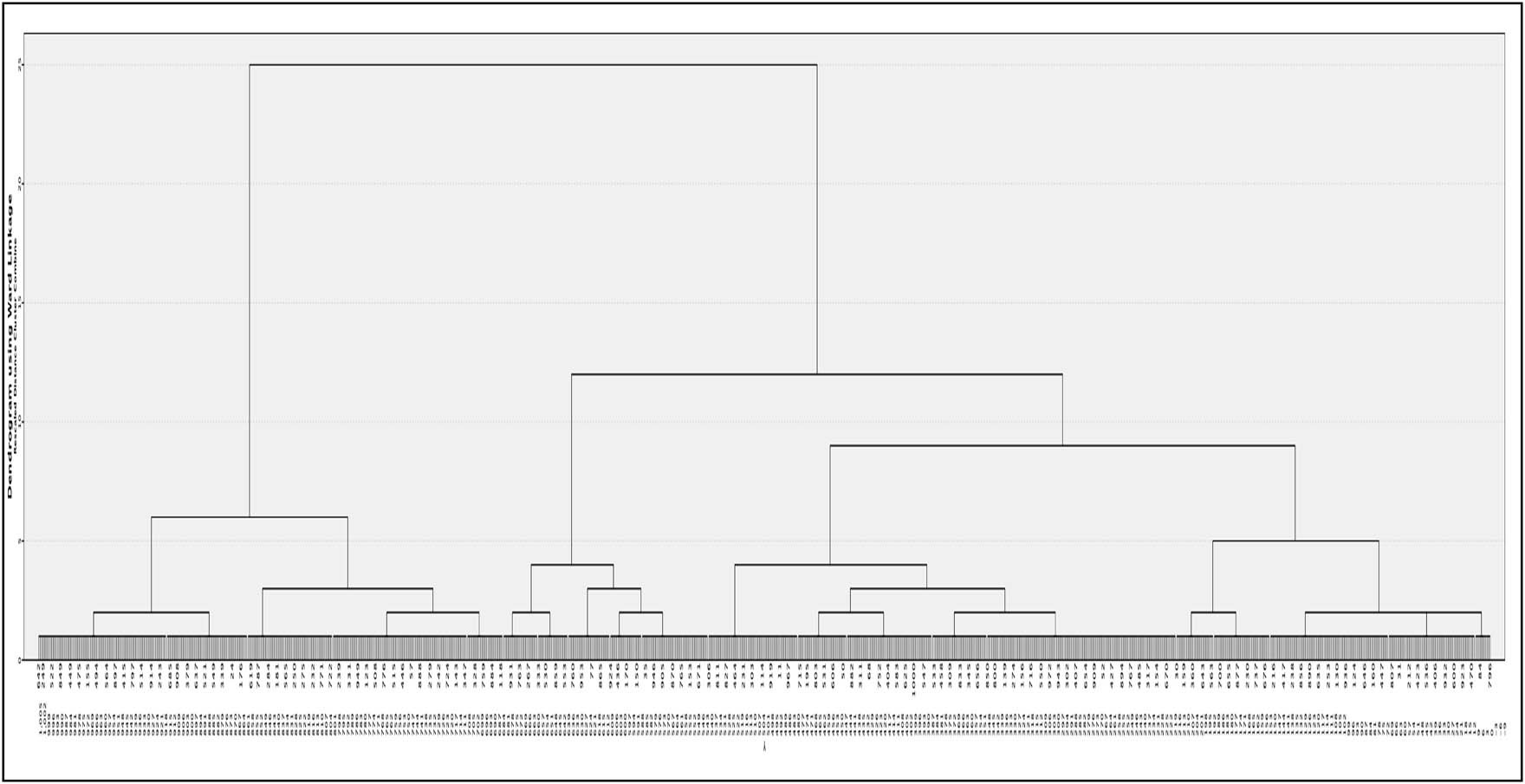
Figure 1
Dendrogram form of the hierarchical clustering method.
Source: own elaboration.
A series of one-way ANOVA tests (supplemented with Welch Robust Tests for Equality of Means due to lack of homogeneity of variance) confirmed (sig. < 0.001) that there is a statistically significant difference in initial centroids between clusters. Furthermore, Games–Howell post hoc tests showed that this is true for each clustering variable individually between all clusters (with sig. < 0.001 for all except for Q7 between clusters 1 and 3 where sig. = 0.029). In other words, created clusters are statistically different between each other in terms of studied characteristics; hence, this solution is a solid base to move forward on. The following k-means cluster analysis yielded similarly divided three clusters: cluster 2 with high final centroids and 305 observations, cluster 3 with low centroids and 192 observations and an in-between cluster 1 with 509 observations. Accompanying ANOVA analysis confirmed (sig. < 0.001) the existence of statistically significant differences in centroid values between established clusters. Difference between cluster assignments across these two methods equalled 23.10%. This is arguably more than the suggested 20%, but the difference of 3.1 pp. should not impact the solution’s stability. The 3-cluster solution also proved to have the lowest maximum (in absolute terms) difference between initial and final cluster centres (0.38; Table 4); hence, it is possible to say that there is a small probability that the overall within-cluster variation could be reduced by another assignment of responders to different clusters.
Table 4
Absolute difference in cluster centres between initial and final cluster centres form the hierarchical and k-means clustering techniques accordingly.
| Cluster | Initial cluster centres | Final cluster centres | Difference in cluster centres | ||||||
|---|---|---|---|---|---|---|---|---|---|
| 1 | 2 | 3 | 1 | 2 | 3 | 1 | 2 | 3 | |
| Q1 | 3.25 | 4.03 | 1.7 | 3.23 | 4.31 | 1.77 | 0.02 | −0.28 | −0.07 |
| Q2 | 2.58 | 3.89 | 1.45 | 2.71 | 3.84 | 1.6 | −0.13 | 0.05 | −0.15 |
| Q3 | 2.94 | 3.79 | 2.09 | 2.86 | 4.17 | 1.99 | 0.08 | −0.38 | 0.1 |
| Q4 | 2.69 | 3.9 | 1.7 | 2.9 | 3.7 | 1.81 | −0.21 | 0.2 | −0.11 |
| Q5 | 2.79 | 3.65 | 1.51 | 2.78 | 3.82 | 1.67 | 0.01 | −0.17 | −0.16 |
| Q6 | 3.05 | 3.73 | 1.97 | 3.01 | 3.92 | 2.14 | 0.04 | −0.19 | −0.17 |
| Q7 | 3.53 | 3.98 | 3.18 | 3.45 | 4.33 | 2.98 | 0.08 | −0.35 | 0.2 |
Source: own elaboration.
Obtained solution created three clusters (Table 5). First cluster, with high cluster centres, consist of 305 members, who care about product packaging from the ecological perspective the most. Second cluster, with medium cluster centres, consists of 509 observations and consists of adult (35–44 years old) males with three persons in a household. Third and last cluster (192 observations), with low cluster centres consists of older (45−54 years old) males with two persons in a household.
Table 5
Final cluster centres from the k-means clustering method and their descriptors.
| n | 305 | 509 | 192 |
|---|---|---|---|
| Q1. Rate the degree of impact that the following issue related to the external packaging has on your cosmetics purchasing decision – Packaging designated for recycling | 4.31 | 3.23 | 1.77 |
| Q2. Rate the degree of fit between the following statement and your cosmetics purchasing behaviour – I am able to pay more for cosmetics in ecological packaging. | 3.84 | 2.71 | 1.6 |
| Q3. Rate the degree of fit between the following statement and your cosmetics purchasing behaviour – If I had the ability, I would purchase cosmetics without packaging (soap, shampoo in bricks, or cosmetics distributed to my own packaging). | 4.17 | 2.86 | 1.99 |
| Q4. Rate the degree of fit between the following statement and your cosmetics purchasing behaviour – I purchase cosmetics in larger packaging and distribute them to multi-use containers. | 3.7 | 2.9 | 1.81 |
| Q5. Rate the degree of fit between the following statement and your cosmetics purchasing behaviour – I avoid products in plastic packaging. | 3.82 | 2.78 | 1.67 |
| Q6. Rate the degree of fit between the following statement and your cosmetics purchasing behaviour – I avoid products in multilayer packaging. | 3.92 | 3.01 | 2.14 |
| Q7. Rate how strongly you agree with the following statement – We need (as soon as possible) a massive introduction of new types of packaging that will not have a negative impact on the environment. | 4.33 | 3.45 | 2.98 |
| Descriptors (modes) | |||
| Sex | Female | Male | Male |
| Age | 25−34 | 35−44 | 45−54 |
| Education level | Sec.* | Sec. | Sec. |
| Persons in a household | 2 | 3 | 2 |
*Sec. – secondary.
Source: own elaboration.
Secondary ANOVA analysis revealed that there is no statistically significant difference between three groups in terms of age (p-value = 0.815) and education (p-value = 0.229); hence, it is unlikely that these factors impact groups’ approach to ecological packaging. At the same time, there is a statistically significant difference between clusters in terms of sex (p-value = 0.006) and number of persons in a household (p-value = 0.046).1 Interestingly, the need for new pro-ecological packaging is the most important issue for members of all three clusters (scores per Table 4: 4.33, 3.45, and 2.98). The most pro-ecological cluster (n = 305) puts high emphasis on packaging being designed for recycling (score: 4.31, which is near the bottom of importance for the least pro-ecological group – score: 1.77) and the ability to purchase cosmetics (e.g. soap, shampoo) without packaging (score: 4.17). Members of this group are least interested in purchasing cosmetics in larger packaging, so that it can be distributed to multi-use containers (score: 3.7). The medium cluster (n = 509) also places emphasis on packaging designed for recycling (second most important factor, score: 3.23), followed by avoidance of products in multilayer packaging (score: 3.01). This group (same as the least pro-ecological cluster, n = 192) is unable to pay more for cosmetics in ecological packaging (scores accordingly: 2.71 and 1.6). This is surprising given their emphasis on new pro-environment packaging. Therefore, it can be said that both the medium and the least pro-ecological groups do want packaging that will not have a negative impact on the environment, but they are unable to pay more for such solutions. The least pro-environment in terms of packaging cluster (like the medium one) also places importance on avoiding products in multilayer packaging (score: 2.14).
Therefore, the third research hypothesis (H3) claiming that there is a relationship between consumer’s preference for purchasing cosmetic products in sustainable packaging and consumers sex, age, level of education, and number of persons in consumer’s household has been partially confirmed as identified clusters do not differ in terms of age and level of education.
6. Conclusion
This article contributes to the ongoing discourse on sustainability in cosmetics market by examining the determinants of consumers’ ecological purchasing choices. The research focused on assessing consumers ecological awareness and identifying the determinants of consumers ecological choices from the perspective of cosmetic products packaging and its sustainability. The study revealed the growing level of ecological awareness of consumers. Respondents have already recognized the need to introduce new cosmetics packages with reduced negative impact on environment. They also declared their willingness to stop buying products whose packaging has a harmful effect on the environment. However, this environmentally friendly standpoint is not constantly supported by the consumers’ willingness to pay more for pro ecological solutions. Instead, they rather expect a form of compensation for ecological choices such as reduced prices for sustainable products. The relatively higher price of products with environmentally friendly packaging was identified as one of the key barriers to ecological purchasing choices in the cosmetics market. The importance of price in making consumers choices is also evidenced by the tendency to purchase cosmetic products in discounts, hypermarkets, and supermarkets. In addition, consumers often seek larger packaging sizes proving strong economic and financial motivations in their buying behaviour. These findings support H1 and provide an answer to RQ1 about drivers and barriers of choosing the products packed in environmentally friendly manner. In addition to price, other major barriers include the limited market offers of cosmetic products in ecological packaging, consumers habits, and life trends. The price as a barrier factor in ecological choices confirms the earlier findings (Ratajczak et al, 2023; Testa et al., 2023), but contradicts the research results in Pakistan (Shah et al, 2024), where consumers accept the higher prices of ecological products and do not perceive it as demotivating in their ecological behaviour.
Among drivers of ecologically packed cosmetics’ choices, the main one is the rising ecological and health awareness, which is in line with the findings of the earlier cited research conducted in Croatia, Hungary, or Italy, and concerns about future generations. What also motivates consumers to incorporate ecological considerations into their decisions is education at school and at home, as well as regulations that encourage or require environmentally responsible behaviour. The research proved that the growing amount of information available in the public sphere matters; however, this message is not yet fully clear as demonstrated by consumer statements. This led to another finding of the research, which is the consumers’ insufficient level of knowledge about the features of ecological packaging. Therefore, H2 has been confirmed. This lack of systematized knowledge and unified regulations may also undermine consumers trust in companies’ declaration of their products being environmentally friendly, particularly in the case of cosmetics produced outside EU. This insufficient knowledge proved the need for social campaigns that clearly define the criteria for ecological packaging, and the information on packaging has not been standardized, which constitutes the field for further awareness rising action. There is apparently a considerable need to develop and systematize knowledge about what ecological packaging is, as well as to dispel existing myths (such as glass is the most eco-friendly material, packaging from recycled materials is not aesthetic, and moreover it cannot come in contact with the product). Therefore, in awareness-raising activities, it is worth focusing not only on proving that care for the environment is important but also showing in detail what criteria must be met for a packaging to be considered eco-friendly. The gradually applied EU’s regulations shall help to solve the above problems but still the legislative movements should be supported with adequate social campaigns. Considering RQ2, according to the respondents, the ecological cosmetic packaging is “no packaging at all,” the one of glass or cardboard (no mixed materials) with the size fitting the contents. The research proved that the product’s packaging functionality and convenience still prevails in consumers’ choices; however, in their opinion, it is worth searching the market for products that combine economic and functional aspects with ecology.
The further research results analysis considered the consumers individual traits such as sex, age, and education level. Additionally, the relationship of number of persons in a household was analysed. The cluster analysis revealed that there are three groups of consumers on the Polish cosmetics market in terms of their attitude towards ecological packaging. Moreover, statistically, the clusters do not differ in terms of age and education level. What differentiates them is sex and number of persons in a household. The latter one relates to the household budget which also supports the financial motivations of consumer choices (H1). The cluster analysis finding showed the partial support of H3 and give answer to RQ3 proving that among the considered consumers, only socio-demographic factors such as sex and number of persons in the household are statistically related to their choices of cosmetic products in environmentally friendly manner. The consumer sex as a determining factor was confirmed in the already cited research in European and Asian countries, which may prove that this factor is independent of cultural differences.
7. Implications
In the context of growing eco-friendly attitudes and awareness, the results of the study may form an important part of activities undertaken by enterprises with respect to their business strategies and models. The consumers’ willingness to reject purchase of cosmetics in non-ecological packaging is an important sign for manufacturers that consumers’ preferences change and shall be a trigger to switch to more sustainable packaging. The consumers also admit that the ecological aspects of the packaging may be the point in choosing new products. This conclusion shall be considered by cosmetics producers while introducing new products or extending the portfolio of already existing lines of cosmetics. The research results may help manufacturers and policymakers to understand drivers and barriers of consumers’ green choices which constitutes an important input to the process of proper crafting of marketing strategies by the companies and proper tailoring of the governmental activities aimed at raising the eco-awareness of the consumers. The proved lack of systematized knowledge on what the ecological product and packaging is constitutes a clear message to governments and calls for organized activities leveraging the ecological awareness of the society. Finally, this research adds to the academic literature on consumer behaviour and sustainable products, providing a basis for further studies.
8. Limitations and future research directions
The study enabled an analysis of eco-friendly consumer attitudes within the Polish cosmetics market. Considering the different results of similar research in other countries, it is reasonable to investigate the issue from the cross-cultural perspective to indicate the universal or culture-related determinants of ecological choices of the consumers. Additionally, the cross-cultural comparisons of consumers’ behaviour could offer valuable insight into the discussion. The study is based on consumers’ declarations, not their actual choices which is also a limitation of the presented analysis. The research focused on the packaging of the cosmetic products; however, the cosmetics products in general have not been analysed, providing the basis for further research on certain types of cosmetics where determinants may differ. Finally, this study employed a cross-sectional survey design for data collection. Future research could utilize a longitudinal design to more effectively capture changes in consumers’ behaviour over time.
Funding information
The authors received no financial support for the research, authorship, and/or publication of this article.
Author contributions
Małgorzata Szafranowicz – 33%; Halina Brdulak – 34%; Tomasz Napiórkowski – 33%
Conflict of interest statement
The authors declared no potential conflicts of interest with respect to the research, authorship, and/or publication of this article.