
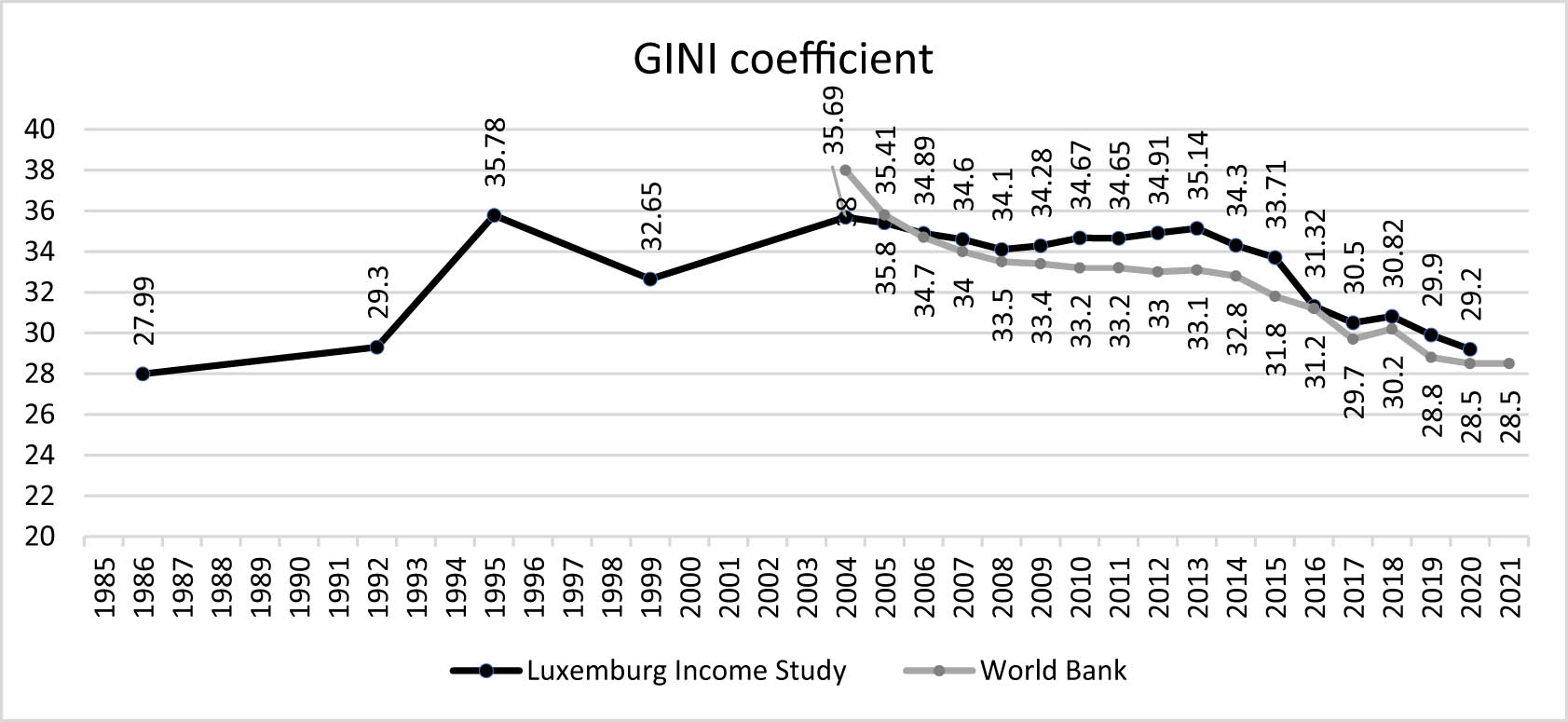
Figure 1
Gini coefficient for Poland during 1986–2021.
Source: WIID – the World Income Inequality Database, Luxembourg Income Study database, World Bank Database.
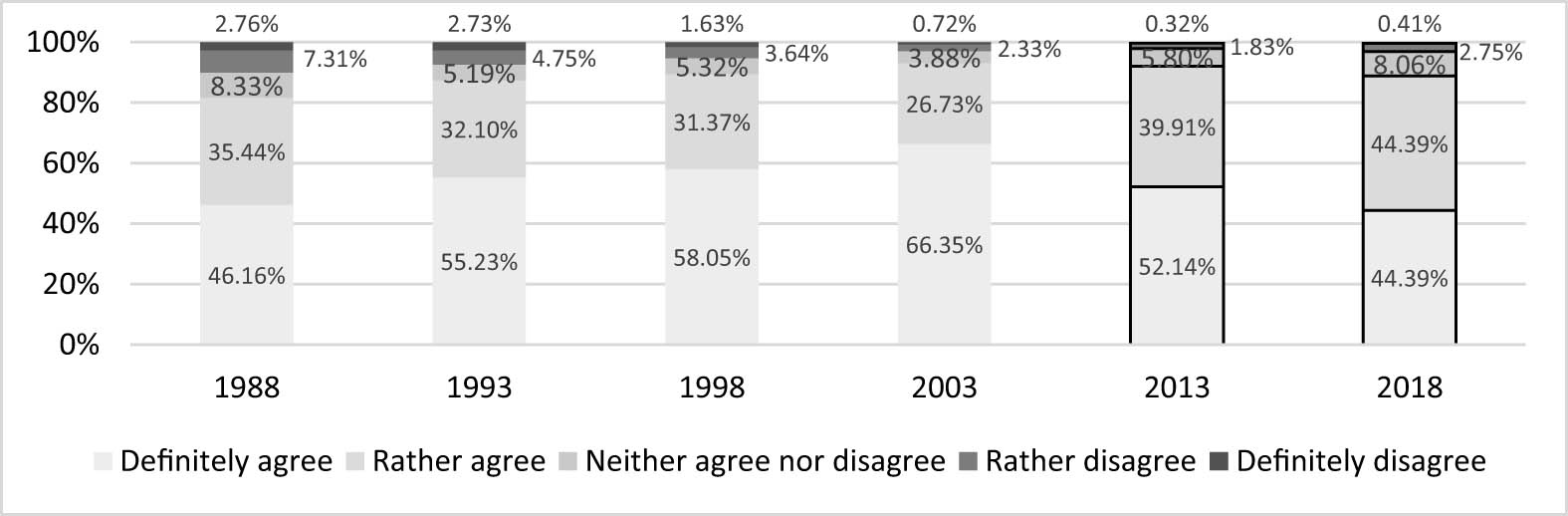
Figure 2
Differences in income in Poland are too large. Data for 1998–2018. Note: 1988–2003 – Polish Panel Survey [“Dane i dokumentacja – Polskie Badanie Panelowe POLPAN”], 2015–2018 – GUS survey (GUS, 2018).
Source: Polish Panel Survey - POLPAN; GUS.
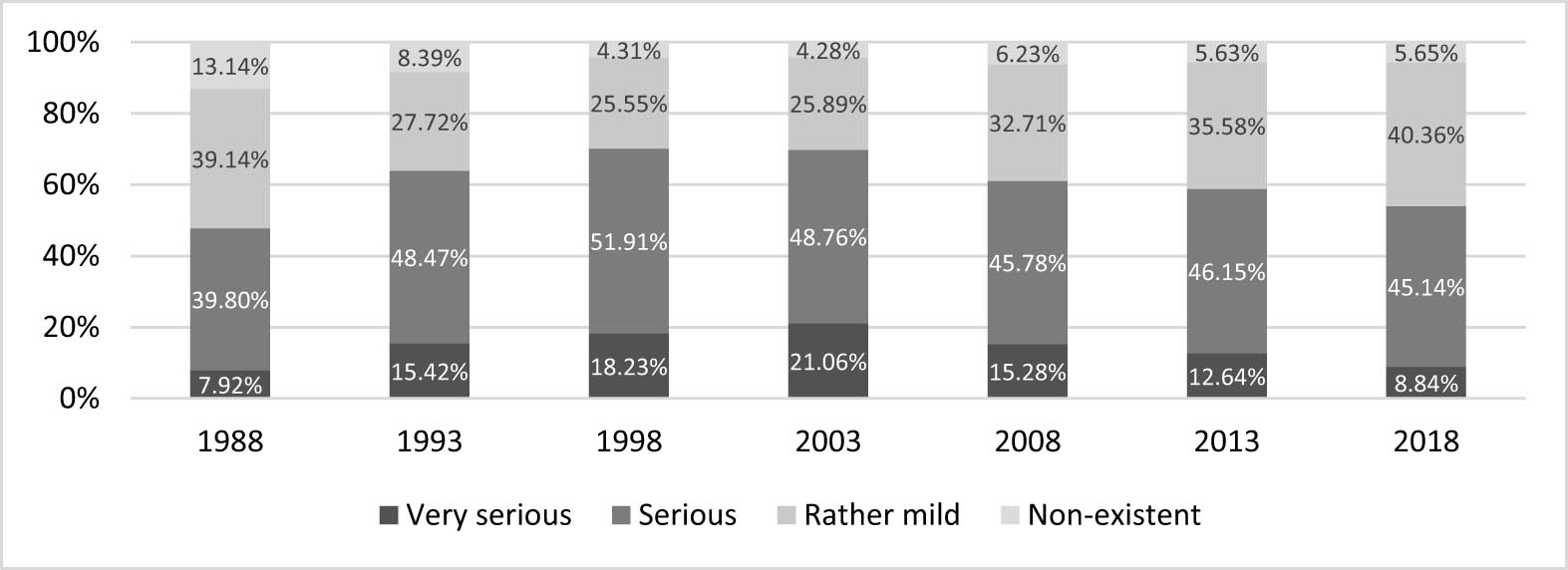
Figure 3
How serious are conflicts between rich and poor?.
Source: Polish Panel Survey – POLPAN.
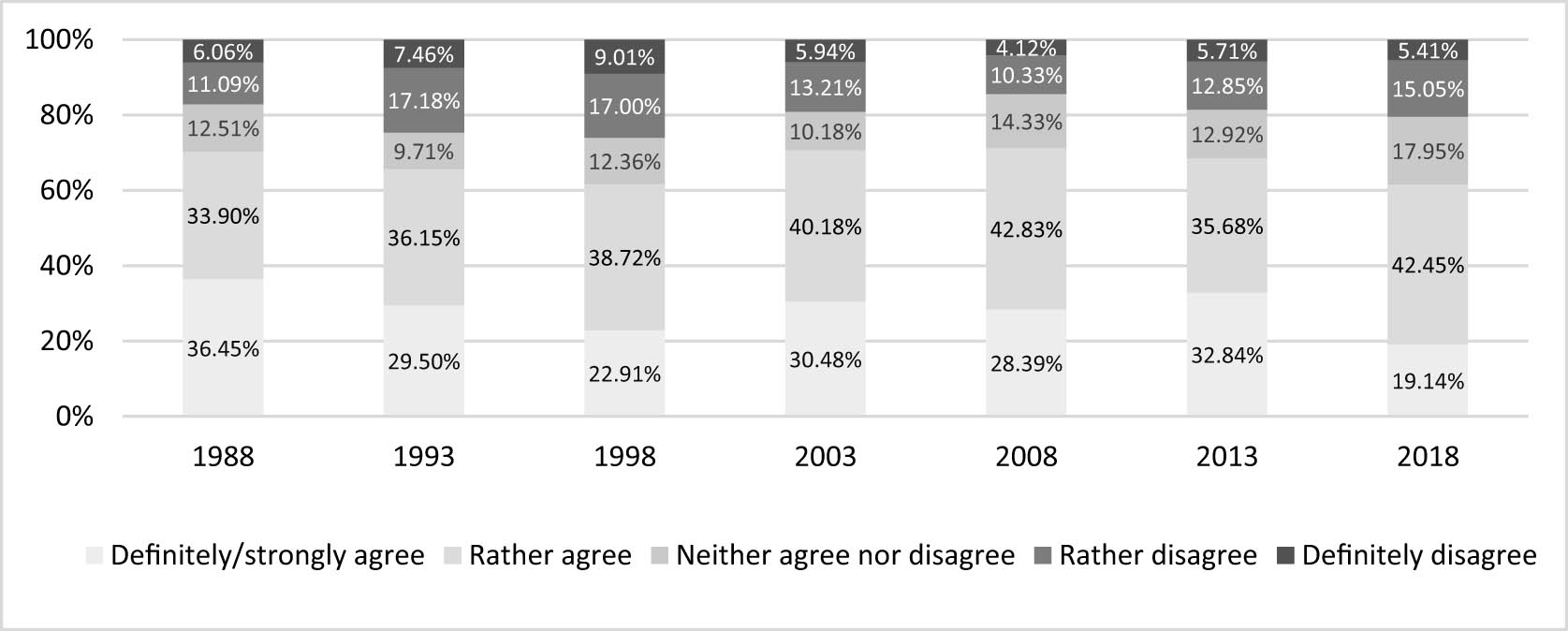
Figure 4
State should decrease inequality.
Source: Polish Panel Survey – POLPAN.
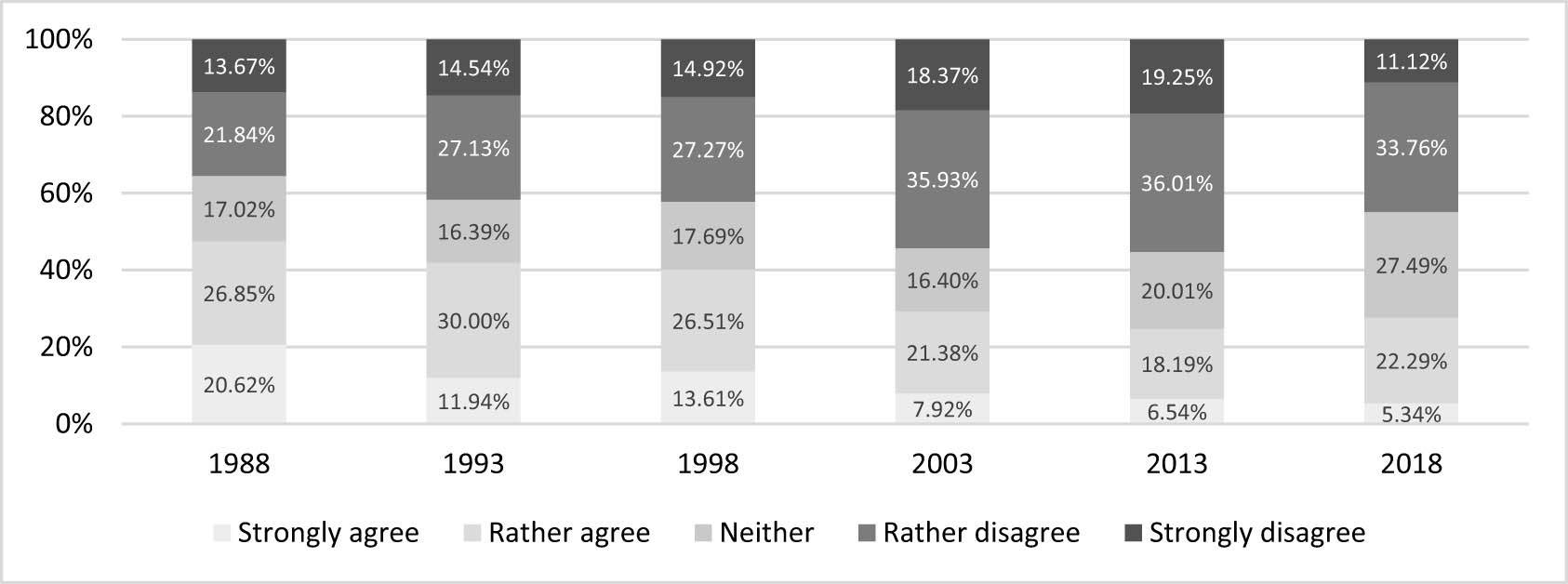
Figure 5
Is large income difference necessary for prosperity?.
Source: Polish Panel Survey – POLPAN.
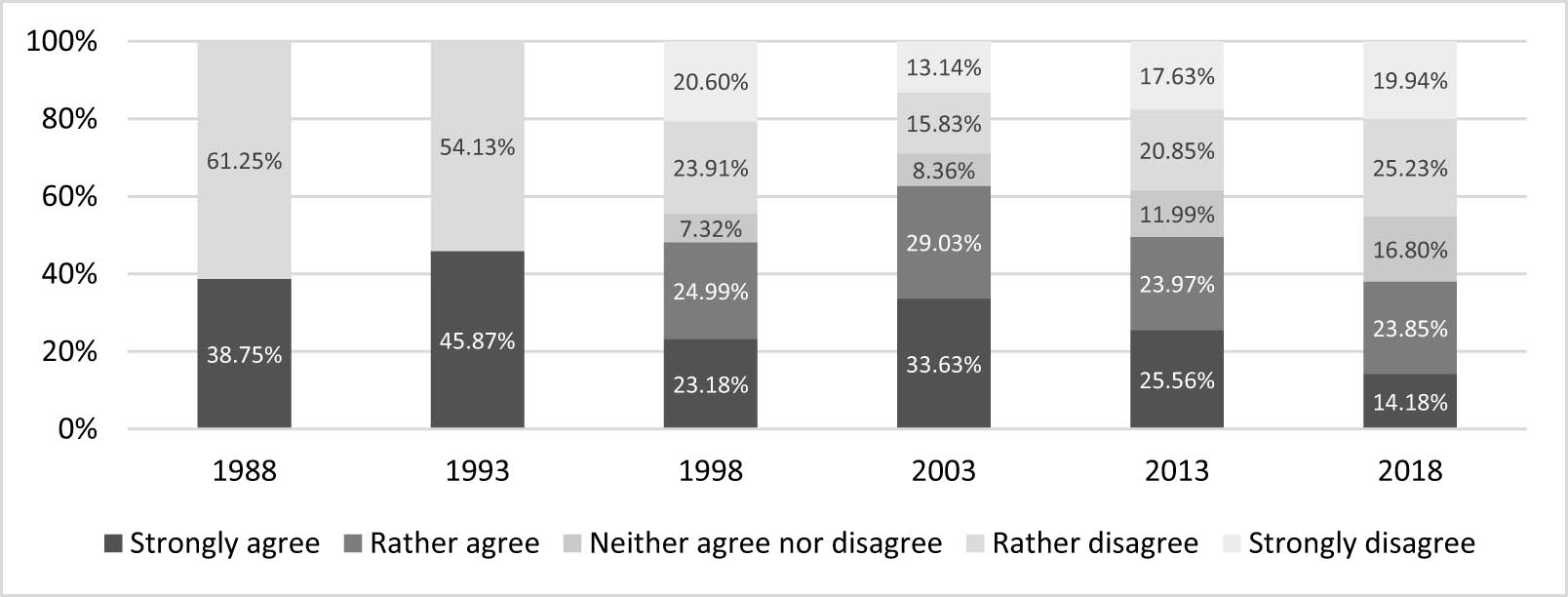
Figure 6
Distributions of respondent’s answers to the question: “Do you agree with the statement that the upper income limit should be set?”
Source: Polish Panel Survey – POLPAN.
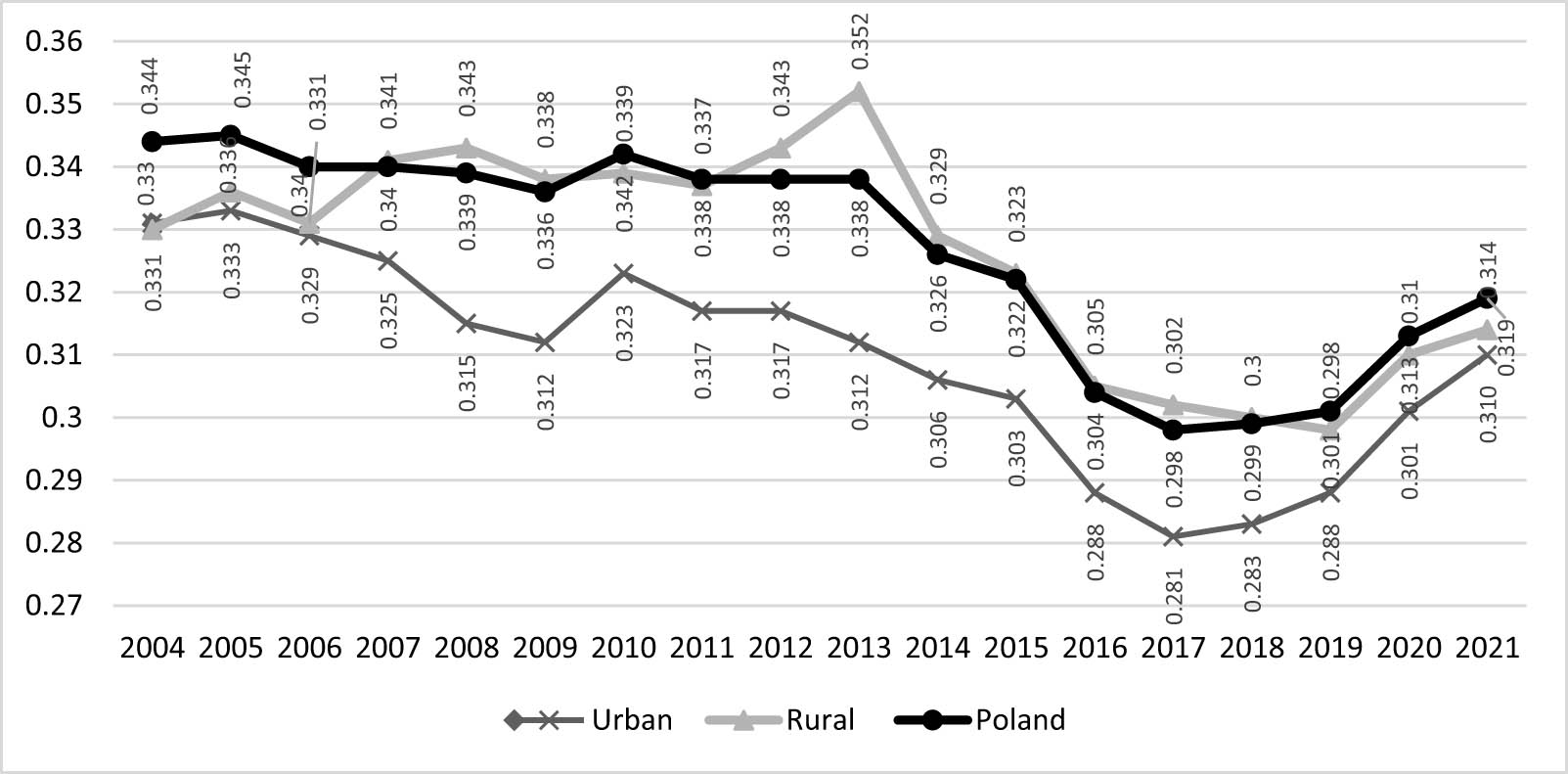
Figure 7
Income inequalities in households per capita measured by Gini coefficient in Poland by type of area during 2004–2021.
Source: The situation of households in 2021 in light of the results of the household budget survey. GUS, Warsaw 2021.
Table 1
Average monthly disposable income per capita (in PLN) by category of locality in Poland in 2006 and 2019.
| Average monthly disposable income per capita (in PLN) | Changes during 2006–2019 (in %) | ||
|---|---|---|---|
| 2006 | 2019 | ||
| Total | 834.68 | 1819.14 | 217.94% |
| Urban total | 943.90 | 1991.08 | 210.94% |
| Urban less than 20,000 | 770.02 | 1745.91 | 226.74% |
| Urban 20,000–100,000 | 845.16 | 1836.36 | 217.28% |
| Urban 100,000–200,000 | 863.17 | 1912.26 | 221.54% |
| Urban 200,000–500,000 | 1026.84 | 2089.25 | 203.46% |
| Urban 500,000 and more | 1276.05 | 2480.88 | 194.42% |
| Rural | 659.29 | 1551.17 | 235.28% |
Source: PHBS, Household Budgets for 2006 and 2019, Central Statistical Office. Warsaw 2007 and 2020.
Source: own computation, data from: POLPAN.
Table 2
Size of the locality as a grouping variable – K–W test for variables related to attitudes to inequality.
| Asymptotic significance, test K–W | Income differences are too large (p-value, K–W test) | Conflicts between rich and poor (p-value, K–W test) | State should decrease inequality (p-value, K–W test) | Income differences are necessary (p-value, K–W test) | The legal limit on the highest monthly income (p-value, K–W test) |
|---|---|---|---|---|---|
| 1988 | 0.968 | 0.663 | 0.861 | 0.929 | <0.001 |
| 1993 | 0.006 | 0.167 | 0.027 | 0.932 | <0.001 |
| 1998 | <0.001 | 0.971 | <0.001 | <0.001 | <0.001 |
| 2003 | 0.15 | 0.025 | <0.001 | 0.019 | <0.001 |
| 2008 | n/a | 0.615 | <0.001 | n/a | n/a |
| 2013 | n/a | <0.001 | 0.001 | 0.334 | 0.02 |
| 2018 | n/a | 0.001 | 0.005 | 0.094 | <0.001 |
Note: Kruskal–Wallis test, Grouping variable: SIZE OF LOCALITY. n/a - not available.
Source: own computation, data from POLPAN.
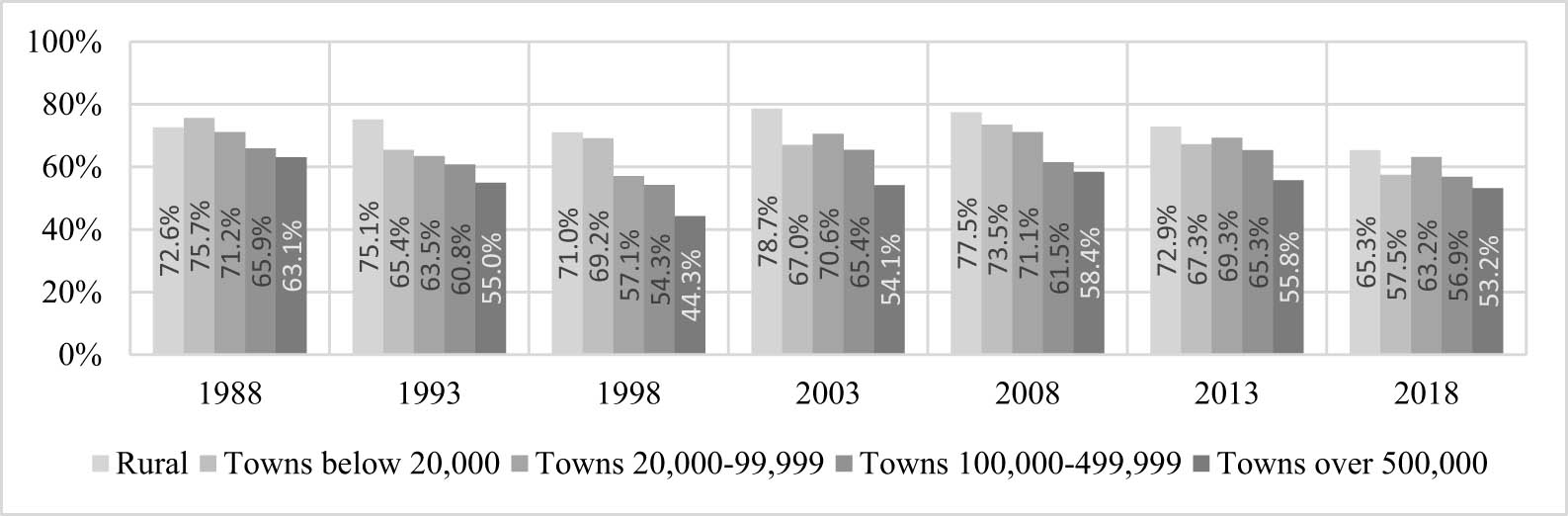
Figure 8
State should decrease income inequalities: Agree and strongly agree – by size locality during 1988–2018.
Source: POLPAN.
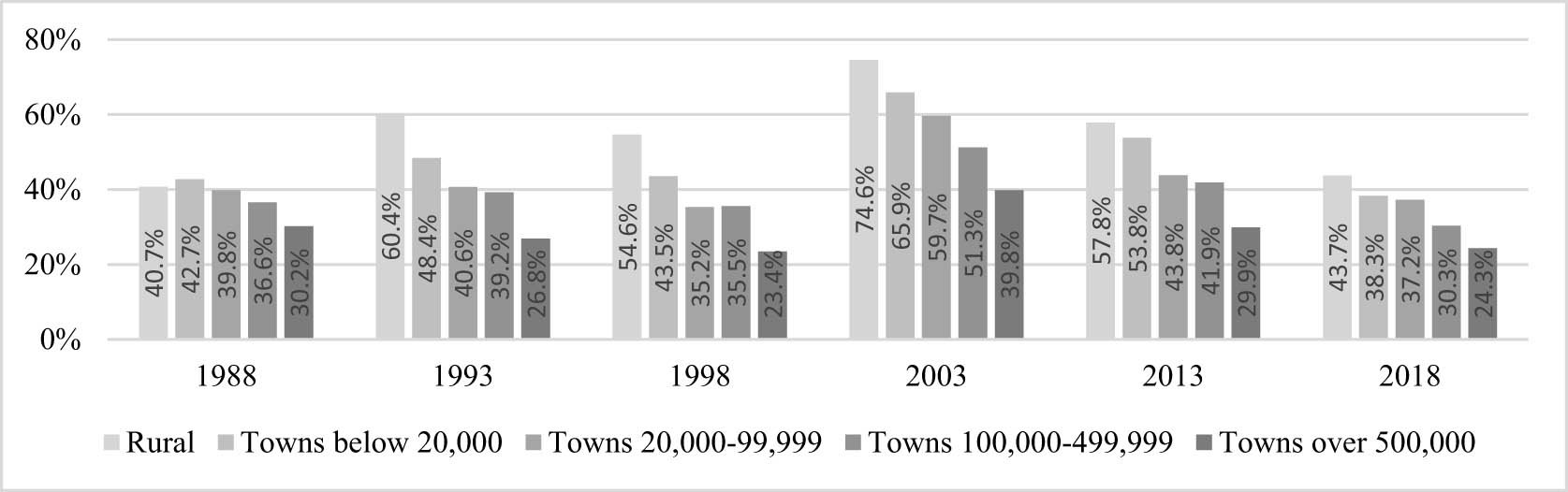
Figure 9
There should be a set upper-income limit: agree and strongly agree – by the size of locality during 1988–2018.
Source: POLPAN.
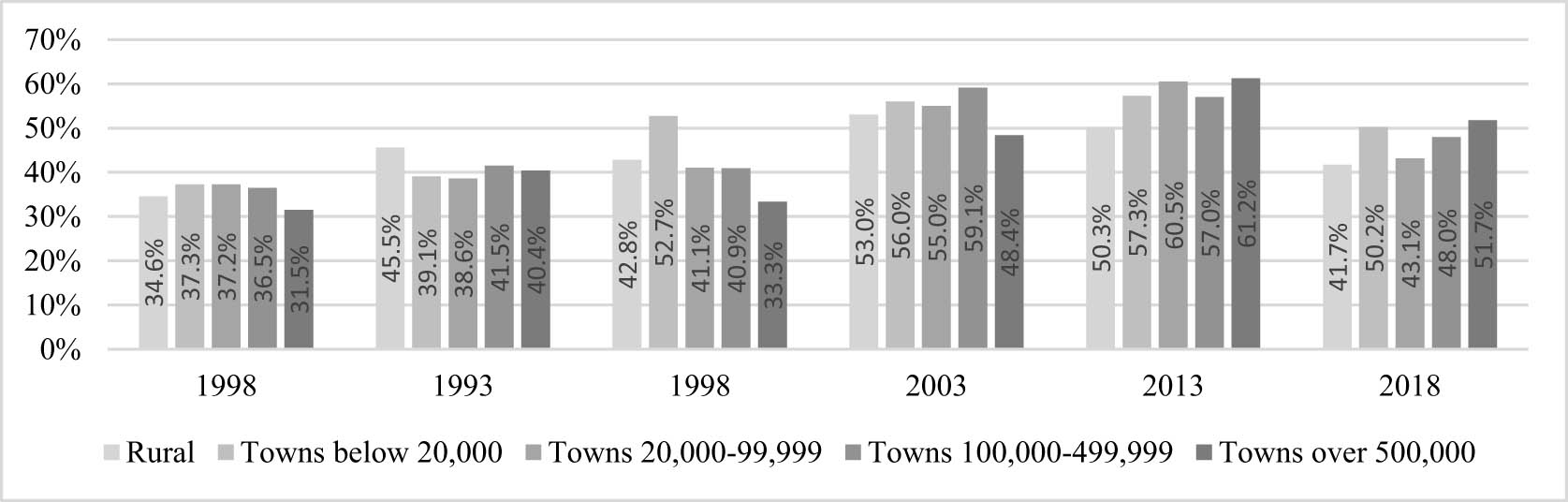
Figure 10
Large income inequalities are necessary for prosperity: disagree and strongly disagree – by the size of locality during 1988–2018.
Source: POLPAN.
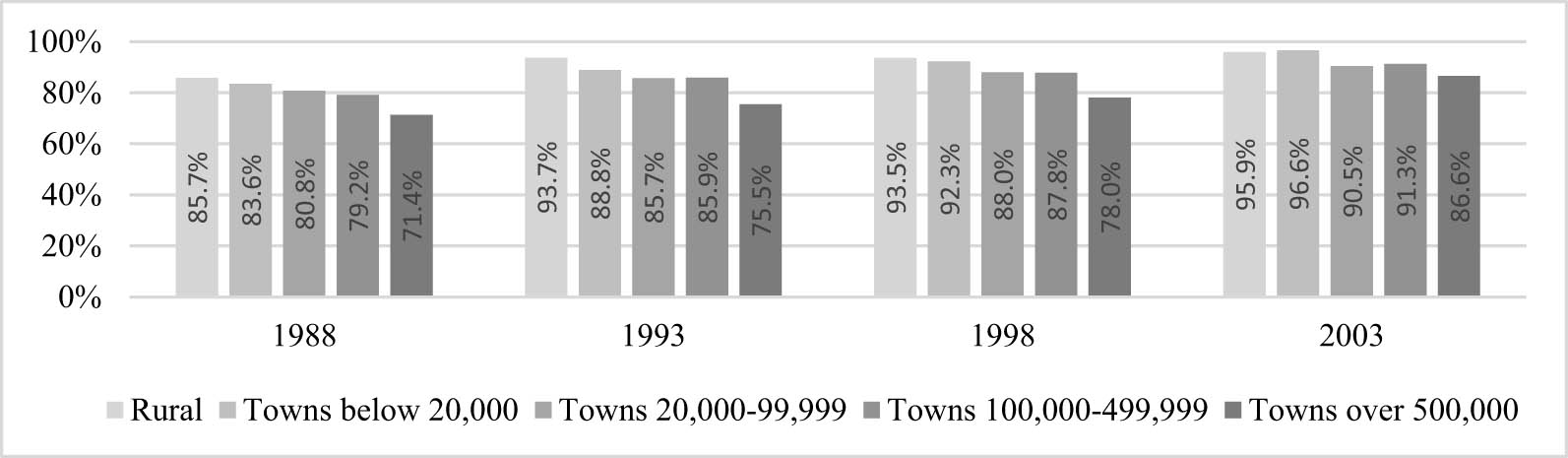
Figure 11
Income inequalities are too large: agree and strongly agree – by the size of locality during 1988–2003.
Source: POLPAN.
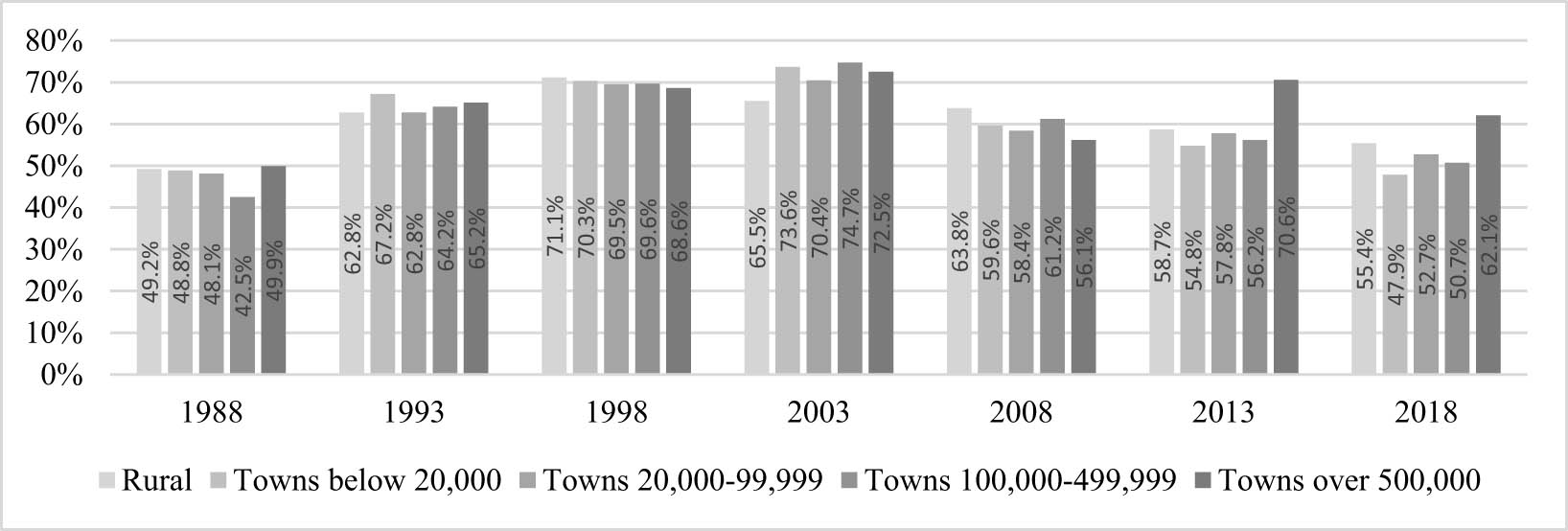
Figure 12
Conflicts between the rich and poor are serious or very serious – by the size of location during 1988–2018.
Source: POLPAN.