
1. Introduction
At the beginning of 2020, the world faced a huge threat of public health. The increasing number of reported infections and deaths due to an unknown disease has caused uncertainty in every area of life. The World Health Organization on March 11, 2020, declared the novel coronavirus (COVID-19) outbreak a global pandemic. The global crisis initiated by the COVID-19 pandemic triggered unparalleled economic upheavals (Teitler Regev & Tavor, 2024) and the global uncertainty it caused produced an apparent panic in stock markets (Bilgili et al., 2023). When analyzing the behavior of most indices in different countries in the initial phase of COVID-19, one can observe rapid declines that have not been observed in stock markets for a long time. Fluctuations in one stock market might adversely influence back on others due to the breadth and depth of interdependence among contemporary economies (Karamti & Belhassine, 2022). Thus, it is worth detecting the effect of factors related to the pandemic on the stock market in more depth. This is particularly important for stock market participants who make decisions regarding the choice of assets for their investment portfolio or traded companies.
The aim of this study is to examine the relation between the number of COVID-19 infections, COVID-19-related deaths, first-dose vaccinations, second-dose vaccinations, booster vaccinations, and the WIG20 stock market index during different waves of infections. Analogous comparative analysis is conducted for Hungary, the United Kingdom, and the Czech Republic. To model the dynamic conditional correlations between the selected stock markets and the US stock market, the Autoregressive Moving Average-Asymmetric Dynamic Conditional Correlation (ADCC)-Generalized Autoregressive Conditional Heteroskedasticity (GARCH) models are utilized. To investigate the time-frequency connectedness between the COVID-19 pandemic and the stock markets, the wavelet coherence approach is used.
To perform empirical investigations, we used daily data for the following stock indices: the WIG20 index (Poland), the BUX index (Hungary), the FTSE 250 index (the United Kingdom), the PX index (the Czech Republic), and the S&P500 index (the United States). Poland is the main country of interest, while other countries were introduced to provide a broader context, in order to formulate potential more general conclusions. Two European countries, similar to Poland in term of location, for which such analyses have not yet been conducted, were selected. The United Kingdom was introduced in order to relate the obtained results to the correlations detected for a country outside the European Union. The choice of the US stock exchange was motivated by the fact that it affects European markets. We collected daily data for selected indices from January 2, 2019 to April 4, 2022. Further, we assembled another dataset on daily cumulative cases of infection, deaths, first-dose COVID-19 vaccinations, second-dose COVID-19 vaccinations and booster COVID-19 vaccinations. Here the data were collected starting from March 3, 2020, the date is associated with the appearance of the first case of infection with an unknown virus. The data concerning the pandemic were taken from the Our World in Data website.
Based on the Dynamic Conditional Correlation (DCC) modeling we test the hypothesis that there is a significant long-term relationship among stock markets during the pandemic. Using the wavelet coherence method, we verify the hypothesis that a greater effect of the number of COVID-19 infections and deaths on stock market realized in the initial phase of the pandemic. In addition, we verify the hypothesis that the appearance of COVID-19 vaccinations had a greater effect on the stock market than the number of COVID-19 infections and deaths.
This study is part of the emerging literature which examines the effect of COVID-19 on financial outcomes. The literature in this area is constantly evolving. Previous studies have looked at a shorter duration of COVID-19, most often the first 6 months or a year were analyzed. However, this study covers a period of 2 years of the pandemic, which gives a broader view of the differences between the waves of infection.
The remainder of this study is organized as follows. Section 2 reviews related literature and develops hypotheses. Section 3 describes the methodology. Section 4 presents the data and empirical results, and Section 5 gives the conclusion.
2. Literature and hypothesis
A new stream of research exploring the effects of the COVID-19 pandemic on the financial markets is nowadays observed in the literature. Stock markets have proven to be sensitive to the risks posed by the pandemic. In many countries, an increase in infection rates and fatalities was correlated with greater stock market declines. Teitler Regev and Tavor (2024) emphasized the complexities of the COVID-19 pandemic’s impact on stock markets and highlighted the importance of tailored strategies and policies for different countries.
By employing a wavelet methodology, Bilgili et al. (2023) indicated that for most stock markets in emerging Latin American countries, COVID-19 cases negatively affected the stock markets during certain sub-sample periods. Karamti and Belhassine (2022) used the wavelet method to determine co-movements of selected assets with the COVID-19 pandemic across the following financial stock markets: Japan, China, the United States, France, Germany, and the United Kingdom. Based on the wavelet power spectra, they found that the indices exhibited very high volatilities during the first wave of the pandemic. The authors also stated that fear in the US market spread to all other markets at longer investment horizons.
Applying ARIMA models, Chowdhury (2022) observed that during the first wave of COVID-19, the confirmed cases and the fiscal measure had a significant effect on the US stock returns. In contrast, during the second wave, the vaccination initiative and the abnormal hike of confirmed cases were crucial.
Yousfi et al. (2021) made the comparative assessment of the impacts of the first and second waves of the COVID-19 pandemic for the US stock market. They investigated the DCC and the asymmetric impacts of shocks on the correlation between the US and Chinese stock markets before and during the COVID-19. Based on GARCH, DCC, and ADCC modeling, they supported the volatility spillovers, so called contagion effects, between the two stock markets, especially during the rapid spread phase of COVID-19 in the US. It appeared that the shocks to both the markets have asymmetric effects on the correlation between them. Employing the wavelet coherence approach, Rehman et al. (2021) found that both the number of confirmed COVID-19 cases and the number of deaths exhibit strong coherence with the G7 equity markets, except for Canada and Japan where only a weak relationship was detected.
Brueckner and Vespignani (2021) estimated a vector autoregression model to characterize the dynamic relationship between COVID-19 infections in Australia and the performance of the Australian stock market. Analyzing the impulse response functions, the authors stated that COVID-19 infections in Australia have a significant positive effect on the performance of the stock market. Hoshikawa and Yoshimi (2021), using a VAR model, found that an exogenous positive shock on the number of daily new infections increases volatility in the South Korean stock market. In contrast, a rise in the number of daily new deaths caused by COVID-19 does not have a clear effect on stock market volatility. Given that the number of new deaths increases several days post a surge in the number of new cases, this result implies that investors react when they observe a rise in new cases and that by the time of observing an increase in new deaths, they have already made their adjustments. Similarly foreign investors’ stock holdings negatively react to new infections but not new deaths.
Li et al. (2021) found that the total volatility connectedness among G20 stock markets increased significantly during the COVID-19 crisis; moreover, the volatility connectedness display dynamic evolution characteristics during different periods of the COVID-19 pandemic. Besides, it was concluded that the developed markets are the main spillover transmitters while the emerging markets are the main spillover receivers. Based on spatial econometrics methods, they suggested that stock markets react more strongly to the COVID-19 confirmed cases and cured cases than the death cases.
Rouatbi et al. (2021) examined whether vaccination programs can revert the adverse effects of the COVID-19 pandemic on stock market volatility around the world. Based on data from 66 countries from January 1, 2020 to April 30, 2021, the authors provided evidence that COVID-19 vaccination assists in stabilizing the global equity markets. This effect was found to be stronger within developed markets than in emerging ones.
Hashmi et al. (2021) focused on the effect of the COVID-19 pandemic on stock prices in seven emerging countries, namely, Brazil, Russia, India, China, Turkey, Mexico, and Indonesia. The authors concluded that stock prices are integrated with COVID-19 cases. Using quantile-on-quantile regression, they found a weak positive relation at the upper quantiles of stock prices, and a strong negative effect at the lower quantiles of stock prices.
It is widely acknowledged that other factors also affect market uncertainty, which is subsequently reflected in stock market investment decisions, leading to stock price volatility. As a result, econometric models presented in the literature have often been extended to include additional exogenous variables, such as the price of a barrel of crude oil (Gunay, 2020), the price of gold (Mensi et al., 2022), the Volatility index (VIX), the Economy Policy Uncertainty (EPU) index, and the Global Economic Policy Uncertainty (GEPU) index) (Thai Hung, 2024).
It is of great significance to analyze the impact of COVID-19 on global stock markets. Previous studies have revealed that spillovers frequently occur in the economic system. Based on the literature, an empirical study was designed. Based on the DCC modeling, we test the hypothesis that there is a significant long-term relationship among Polish and US stock markets during the pandemic. Using the wavelet coherence method, we verify the hypothesis that a greater effect of the number of COVID-19 infections and deaths on stock market realized in the initial phase of the pandemic. In addition, we verify the hypothesis that the appearance of COVID-19 vaccinations had a greater effect on the stock market than the number of COVID-19 infections and deaths.
3. Methodology
3.1. DCC modeling
DCC models are estimated in two steps.
Let be an vector of the asset returns and ARMA(1,1) a process in the mean equation for .
The equation for residuals is as follows: , where is the conditional covariance matrix of and is an identical and independently distributed vector of random errors.
In the first step, GARCH parameters are estimated and then the DCCs in the second step. Proposed by Engle (2002) the dynamic correlation model, comparing to Bollerslev’s (1990) constant condition correlation, differs only in allowing to be time varying: . is the conditional covariance matrix, n × n, and is the conditional correlation matrix. is a diagonal matrix with time-varying standard deviations on the diagonal.
Parameters of matrix from the GARCH(1,1) are as follows:
is a symmetric positive definite matrix:
is the unconditional correlation matrix of the standardized residuals . Parameters and are associated with the smoothing process. The DCC model means return to equilibrium if sum of and is less than 1 and positive. The correlation is estimated as follows: .
3.2. ADCC modeling
Second model that was applied is the ADDC model as the DCC model fails to capture asymmetry effects. The formula for is given by the following equation:
where = 1, if < 0 and 0 in other cases.Finally, the in the ADCC model is as follows:
where , , and are parameter matrices of size , is a vector of standardized errors. and are the unconditional matrices of and .3.3. Wavelet coherence method
In the second stage of the analysis, the wavelet coherence method was used. It provides insightful information on dynamic market behavior over time. Wavelet coherence is based on the frequency of a given phenomenon, which allows to capture long-run and short-run market linkages. The wavelet analysis involves a transform from a one-dimensional time series (or frequency spectrum) to a diffuse two-dimensional time-frequency image.
To be a wavelet, function must have zero mean and be localized in both time and frequency space (Farge, 1992)
where is responsible for the variance stabilizing normalization, is the time parameter, τ refers to the location, and represents the scale.In the next step, the continuous wavelet transformation is applied. This transformation represents one analysis tool for extracting local-frequency information from a signal
We utilize the wavelet coherence technique, a method characterized by localization in both time and frequency domains, which in turn allows to measure the strength of association between two time-series over sample period across different time frequencies. We define the cross-wavelet between the two series x(t) and y(t) as follows:
To capture the co-movement between the two series, we define the wavelet coherence as
where is the smoothing operator and .The coefficient reflects the degree of correlation between the examined series. Values closer to 1 indicate the presence of strong (weak) correlation between the two time series and values closer to 0 indicate the presence of weak correlation between the two time series.
This study focuses on the analysis of graphs showing the estimated wavelet with arrows plotted, which indicate the correlations between the studied series A black outline indicates the significance of relations at the 5% significance level. Warm colors indicate areas with a strong relationship, while cold colors indicate the occurrence of weak dependence. On the wavelet coherence plots, the red colors represent strong co-movement, whereas the blue colors correspond to weak co-movement. The direction of the arrows is the direction of the relation. Arrows pointing to the right mean that two series are in phase or moving in a similar way. If arrows point to the left, then two series are negatively correlated. Furthermore, the phase difference shows the lead/lag relationship between two series. Arrows pointing to the right and up suggest that first variable is leading and the two variables are positively correlated. If arrows are pointing to the right and down, then the second variable is leading. On the other hand, arrows pointing to the left and up signify that the first series is lagging and the correlation is negative, while arrows facing the left and down indicate that the first series is leading but with a negative correlation.
4. Results
4.1. Data
To perform empirical investigations, we used daily data from Poland WIG20 index, which measures the stock performance of 20 companies with the largest capitalization traded on the Warsaw Stock Exchange and daily data from the US S&P500 index, which measures the stock performance of the 500 large companies traded on the New York Stock Exchange. The choice of the US stock exchange was motivated by the fact that it affects European markets. For comparative purposes, an analysis was also performed for the FTSE 250 (United Kingdom), BUX (Hungary), and PX index (Czech Republic). The selection of such countries provides a broad comparison of the relationship between European stock markets and the US market, and also analyzes the impact of the pandemic on several markets. Great Britain was selected for the study as the stock market with the largest capitalization in Europe and, additionally, a country outside the European Union. However, Poland, Hungary, and the Czech Republic are countries with much lower capitalization than the United Kingdom, and they all belong to the European Union. This gives some diversity in the analyzed countries, which may influence the result. We collected daily data from January 2, 2019 to April 4, 2022. Further, we assembled another dataset on daily cumulative cases of infection, deaths, first-dose COVID-19 vaccinations, second-dose COVID-19 vaccinations and booster COVID-19 vaccinations. Here the data were collected starting from March 3, 2020, the date is associated with the appearance of the first case of infection by an unknown virus. WIG20 index and S&P500 index data were taken from the Stooq website, whereas the data concerning the pandemic were taken from the Our World in Data website.
For the purpose of capturing the behavior of the stock market along with the progress of the pandemic, the dataset was divided into sub-samples: I wave 04.03.2020 – 31.07.2020, II wave 01.09.2020 – 01.02.2021, III wave 01.02.2021 – 30.06.2021, and IV wave 15.10.2021 – 04.04.2022.
Based on Figure 1, it can be seen that with the beginning of the pandemic, both the US and Polish stock markets experienced a significant decline. However, after a few days, both increased. The graphs also show declines in the index values related to the rapid increase in infections in given waves. On this basis, the above-described subsets were distinguished. The decreases with every next wave of infections were smaller than with the first wave. This could be due to investors getting used to the situation. The graphical analysis indicates a strong link between the pandemic situation and the situation on the stock market, as with the increase in infections, the decrease in index values is observed.
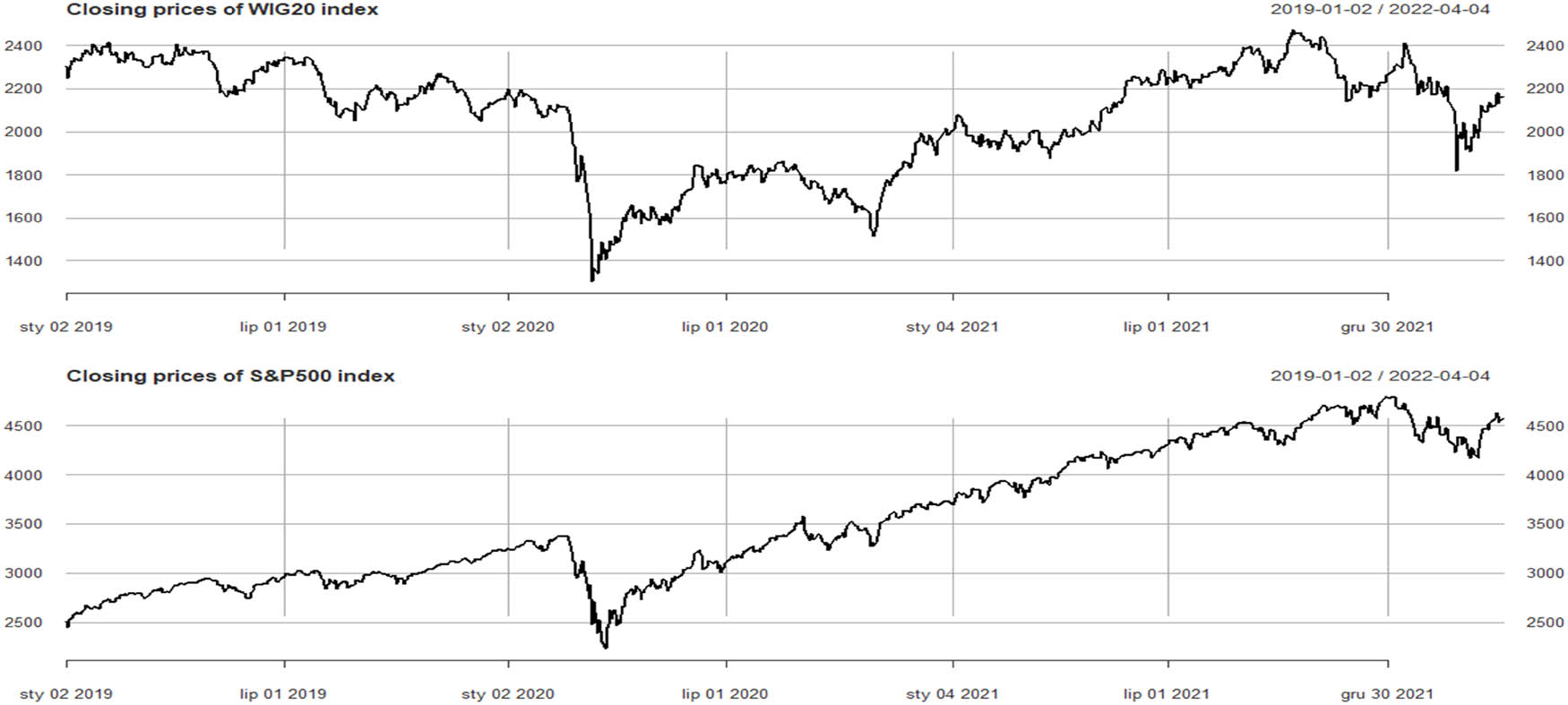
Figure 1
Closing prices of WIG20 index and S&P500 index.
Source: own elaboration.
The values were then transformed into logarithmic rate of returns multiplied by 100. Table 1 presents descriptive statistics concerning the WIG20 and S&P500 returns. Significantly higher volatility reflected by higher value of variance and standard deviation during the COVID-19 period was observed for both indices. The WIG20 and S&P500 exhibit positive returns during the COVID-19 period, which highlights the capacity of these stock markets to perform during crisis period.
Table 1
Summary descriptive statistics for WIG20 and S&P500 returns and the number of COVID-19 cases and deaths.
| Full sample | Pre-pandemic time | Pandemic time | ||||||
|---|---|---|---|---|---|---|---|---|
| WIG20 | S&P500 | WIG20 | S&P500 | WIG20 | S&P500 | Infections | Deaths | |
| Number of observations | 796 | 796 | 283 | 283 | 513 | 513 | 513 | 513 |
| Minimum | −14.2456 | −12.7652 | −4.5152 | −4.5168 | −14.2456 | −12.7652 | 0.0000 | 0.0000 |
| Maximum | 8.0995 | 8.9683 | 4.4347 | 4.5011 | 8.0995 | 8.9683 | 160.9438 | 69.3147 |
| 1st quantile | −0.7063 | −0.4318 | −0.6069 | −0.2892 | −0.8302 | −0.5321 | 0.2094 | 0.1568 |
| 3rd quantile | 0.7217 | 0.7311 | 0.5814 | 0.6222 | 0.8423 | 0.8220 | 1.7954 | 1.3506 |
| Mean | −0.0067 | 0.0758 | −0.0658 | 0.0639 | 0.0259 | 0.0824 | 3.0414 | 2.2721 |
| Median | −0.0190 | 0.1333 | −0.0677 | 0.1047 | 0.0198 | 0.1495 | 0.7954 | 0.6659 |
| Variance | 2.5689 | 2.0350 | 1.2348 | 0.8743 | 3.3057 | 2.6781 | 122.3133 | 48.0013 |
| Standard deviation | 1.6028 | 1.4265 | 1.1112 | 0.9351 | 1.8182 | 1.6365 | 11.0595 | 6.9283 |
| Skewness | −1.2600 | −1.0222 | −0.3107 | −0.7433 | −1.3338 | −0.9822 | 9.5662 | 6.8743 |
| Kurtosis | 13.0328 | 17.1735 | 2.8987 | 5.1682 | 11.6569 | 14.6068 | 111.4018 | 54.6338 |
Source: own elaboration.
When analyzing summary statistics of variables for all four waves of infections, the highest decline in the WIG20 index was observed during the first and fourth waves. But it should also be noted that negative average return on Warsaw stock during the fourth wave can be linked more to the beginning of the war in Ukraine than to COVID-19 pandemic. Thus, we conclude that the highest effect on stock market was observed at the beginning, during the first wave. With the subsequent waves, the shock was lower as investors got used to the situation prevailing on the market.
4.2. DCC model results
We estimated several versions of DCC and ADCC models for WIG20 and S&P500 indices. A constant term was included in the mean equation. The ARMA(1,1) term was then added to some of them, modification concerning the error term distribution was considered (normal distribution vs Student’s t-distribution, and GARCH and EGARCH for modeling volatility were proposed. For the purpose of comparison, we extended the analysis to include Hungary, the United Kingdom, and the Czech Republic. These are countries similar to Poland, due to their location in Europe and economic cooperation.
Information criteria were used in the model selection process: the Akaike criterion, Bayesian criterion, Shibata criterion, and the Hannan−Quinn criterion. Models with the Student’s t-distribution turned out to be better. Finally, ARMA(1,1)-DCC-GARCH(1,1) and ARMA(1,1)-ADCC-GARCH(1,1) were chosen for Poland and Hungary and DCC-GARCH(1,1) and ADCC-GARCH(1,1) appeared to be the best for United Kingdom and Czech Republic.
Table 2 reports the results of modeling the DCC and ADCC process between the stock markets of the analyzed countries and the US stock market (S&P500).
Table 2
DCC and ADCC modeling results for the analyzed countries.
| Poland | Hungary | UK | Czech Republic | Poland | Hungary | UK | Czech Republic | |
|---|---|---|---|---|---|---|---|---|
| ARMA(1,1)-DCC-GARCH(1,1) | DCC-GARCH(1,1) | ARMA(1,1)-ADCC-GARCH(1,1) | ADCC-GARCH(1,1) | |||||
| 0.0110 | 0.0623* | 0.0701*** | 0.084*** | 0.0110 | 0.0623* | 0.0701*** | 0.0840*** | |
| (0.0374) | (0.0361) | (0.0279) | (0.0242) | (0.0376) | (0.0360) | (0.0279) | (0.0242) | |
| 0.3929*** | −0.8023* | 0.3929*** | −0.8023* | |||||
| (0.1240) | (0.4848) | (0.1241) | (0.4850) | |||||
| −0.4476*** | 0.8348* | −0.4476*** | 0.8348* | |||||
| (0.1205) | (0.4457) | (0.1204) | (04459) | |||||
| 0.0761** | 0.0926** | 0.0523*** | 0.0532*** | 0.0761* | 0.0926** | 0.0523*** | 0.0532*** | |
| (0.0401) | (0.0470) | (0.0202) | (0.0199) | (0.0401) | (0.0470) | (0.0202) | (0.0199) | |
| 0.0974*** | 0.1486*** | 0.1495*** | 0.1977*** | 0.0974*** | 0.1486*** | 0.1495*** | 0.1977*** | |
| (0.0380) | (0.0425) | (0.0448) | (0.0504) | (0.0380) | (0.0425) | (0.0445) | (0.0503) | |
| 0.8726*** | 0.7944*** | 0.8124*** | 0.7579*** | 0.8726*** | 0.7944*** | 0.8124*** | 0.7580*** | |
| (0.0477) | (0.0653) | (0.0485) | (0.0555) | (0.0477) | (0.0652) | (0.0483) | (0.0556) | |
| 4.4122*** | 6.7275*** | 5.4617*** | 5.1220*** | 4.4122*** | 6.7275*** | 5.4617*** | 5.1220*** | |
| (0.5929) | (1.5729) | (0.8774) | (0.8574) | (0.6118) | (1.5808) | (0.8878) | (0.8627) | |
| 0.1419** | 0.1419** | 0.1434*** | 0.1434*** | 0.1419** | 0.1419** | 0.1434*** | 0.1434*** | |
| (0.0598) | (0.0599) | (0.0251) | (0.0251) | (0.0598) | (0.0600) | (0.0250) | (0.0251) | |
| 0.8719** | 0.8719** | 0.8719** | 0.8719** | |||||
| (0.3624) | (0.3627) | (0.3622) | (0.3630) | |||||
| −0.9276*** | −0.9276*** | −0.9276*** | −0.9276*** | |||||
| (0.2795) | (0.2797) | (0.2794) | (0.2800) | |||||
| 0.0518*** | 0.0518*** | 0.0545*** | 0.0545*** | 0.0518*** | 0.0518*** | 0.0545*** | 0.0545*** | |
| (0.0159) | (0.0160) | (0.0165) | (0.0165) | (0.0159) | (0.0159) | (0.0164) | (0.0165) | |
| 0.2403*** | 0.2403*** | 0.2428*** | 0.2428*** | 0.2403*** | 0.2403*** | 0.2428*** | 0.2428*** | |
| (0.0522) | (0.0522) | (0.0520) | (0.0519) | (0.0516) | (0.0517) | (0.0512) | (0.0517) | |
| 0.7416*** | 0.7416*** | 0.7354*** | 0.7354*** | 0.7416*** | 0.7416*** | 0.7354*** | 0.7354*** | |
| (0.0434) | (0.0433) | (0.0438) | (0.0438) | (0.0431) | (0.0432) | (0.0436) | (0.0437) | |
| 5.6651*** | 5.6651*** | 6.0295*** | 6.0295*** | 5.6651*** | 5.6651*** | 6.0295*** | 6.0295*** | |
| (1.0134) | (1.0318) | (1.0559) | (1.0471) | (1.0155) | (1.0334) | (1.0563) | (1.0473) | |
| 0.0057 | 0.0118** | 0.0030 | 0.0136** | 0.0057 | 0.0099 | 0.0011 | 0.0131** | |
| (0.0054) | (0.0055) | (0.0058) | (0.0067) | (0.0071) | (0.0063) | (0.0150) | (0.0069) | |
| 0.9751*** | 0.9760*** | 0.98*** | 0.9750*** | 0.9751*** | 0.9739*** | 0.9708*** | 0.9746*** | |
| (0.0113) | (0.0095) | (0.0266) | (0.0146) | (0.0459) | (0.0124) | (0.0422) | (0.0152) | |
| — | 0.0000 | 0.0043 | 0.0027 | 0.0011 | ||||
| (0.0181) | (0.0087) | (0.0159) | (0.0069) | |||||
| 5.7024*** | 6.2533*** | 5.9472*** | 5.6219*** | 5.7024*** | 6.3229*** | 5.9864*** | 5.6353*** | |
| (0.6054) | (0.7427) | (0.0595) | (0.5705) | (0.6664) | (0.7838) | (0.6372) | (0.5802) | |
| Models with exogenous variables | ||||||||
| 0.0162 | 0.0217*** | 0.0000 | 0.0245*** | 0.0255*** | 0.0217*** | 0.0395*** | 0.0447*** | |
| (0.1287) | (0.0030) | (0.0000) | (0.0017) | (0.0074) | (0.0035) | (0.0131) | (0.0056) | |
| 0.9409*** | 0.9248*** | 0.8833*** | 0.9147*** | 0.9036*** | 0.9248*** | 0.9131*** | 0.9491*** | |
| (0.1477) | (0.0126) | (0.0875) | (0.0209) | (0.0410) | (0.0149) | (0.0149) | (0.0310) | |
| 0.0000 | 0.0000 | 0.0068** | 0.0070*** | |||||
| (0.0032) | (0.0024) | (0.0033) | (0.0022) | |||||
Notes: Standard errors are in parentheses; ***p < 0.01, **p < 0.05, *p < 0.1.
Source: own elaboration.
Assuming a 10% significance level, all coefficients –except for μ for WIG20 – are significant. Based on these estimates, short-term persistence and long-term persistence can be analyzed. The short-term persistence () is statistically significant for both variables under all the models. The estimated coefficient on long-term persistence () is statistically significant for each country and S&P500 series, thus indicating the importance of long-term persistence. In addition, in both models, DCC and ADCC, sum of the coefficients for short-term persistence () and long-term persistence for each country index and S&P500 is less than 1, and in each case, exceeded , which indicates that long-term volatility is more intense compared to short-term volatility. The statistical significance of short-term persistence and long-term persistence provides evidence of volatility clustering.
At the end of Table 2, the DCC coefficients are presented. The positive and significant coefficients of indicate that there exists a long-term relationship between the variables (Yousfi et al., 2021). The sum of the coefficients of and is also less than 1, thus ensuring the return to equilibrium of DCCs and model stability. Moreover, after adding exogenous variables, the DCC coefficient a turned out to be statistically significant for all countries in the case of the ADCC model. In the model without exogenous variables, it was significant only for the Czech Republic. This indicates that correlations between variables are also influenced by current (short-term) information. However, the impact of coefficient b is greater for all countries analyzed because its estimates are much higher than those for coefficient a.
Following Bilgili et al. (2023) results, that dynamics of stock exchange markets can be explained by some other parameters, we tested the robustness of our results by adding exogenous variables. We thus used a DCC model that allows us to measure the effect of exogenous variables on time-varying correlations (Horra et al., 2024). Based on the literature, we proposed an extension of DCC model with the following additional exogenous variables: the price of a barrel of crude oil (Gunay, 2020), the price of gold (Mensi et al., 2022), the VIX, the EPU index, and the GEPU index (Thai Hung, 2024). The VIX is a popular measure of stock market expectations regarding volatility, which is based on options on the S&P 500 index. The EPU and GEPU indices are indicators that measure the level of economic uncertainty, based on the analysis of articles, expert statements, and available reports. This extended analysis confirmed the conclusions formulated above.
Based on Figure 2 presenting the DCC for WIG20 index and S&P500 index, we can see the rapid increase in coefficients in March 2020, so just at the beginning of COVID-19 pandemic in Poland. This means that the two stock markets are strongly linked at the beginning of the pandemic. Over time, the strength of the relation began to decline, until around 2021, the correlation fell below the pre-COVID-19 value.
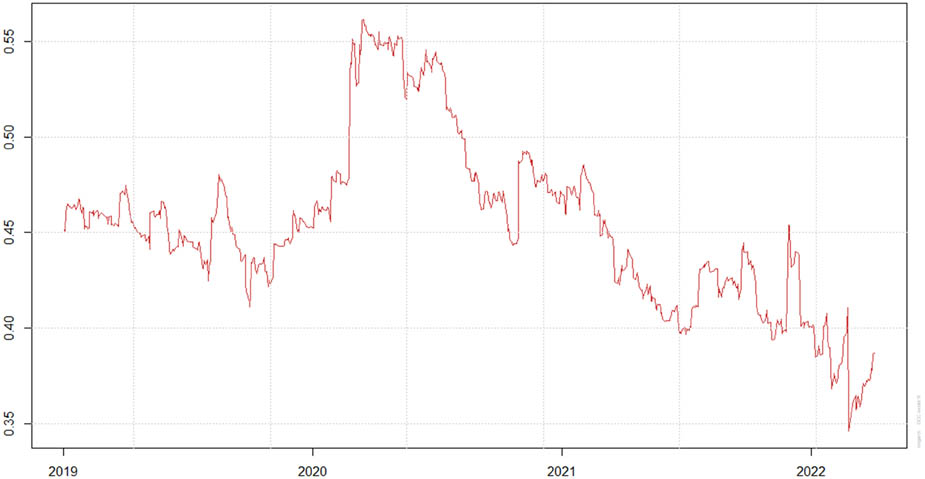
Figure 2
DCC for WIG20 index and S&P500 index.
Source: own elaboration.
In the next step, we focused on the dynamic correlations between WIG20 index and daily cases of infection and deaths caused by COVID-19 in Poland for four waves of infections. Further, the effect of the vaccination program on Polish stock market was also checked. The first-dose COVID-19 vaccinations, second-dose COVID-19 vaccinations, and booster COVID-19 vaccinations were investigated. The modeling process was based on ARMA(1,1)-DCC-GARCH(1,1) model with Student’s t-distribution. For comparative purposes, an analogous analysis was carried out for Hungary, the United Kingdom, and the Czech Republic.
Results reported in Table 3 indicate that the strongest relation between WIG20 index and cases of infections was observed during the first wave of pandemic in Poland, as only for this period, both coefficients, a and b, are statistically significant. For the second wave, only b coefficient occurred to be statistically significant and close to unity which indicates long-term persistence. In contrast, for next waves, the DCC parameters were found to be insignificant. When analyzing the results for WIG20 and deaths caused by COVID-19, it can be noted that a coefficient is not significant for all waves and b parameter is insignificant for the third wave.
Table 3
DCC modeling results for analyzed indices, infections, and deaths for four waves.
| Poland | Hungary | United Kingdom | Czech Republic | Poland | Hungary | United Kingdom | Czech Republic | |
|---|---|---|---|---|---|---|---|---|
| Stock indices - Infections | Stock indices - Deaths | |||||||
| First wave | ||||||||
| a | 0.2883*** | 0.0000 | 0.1931* | 0.3208*** | 0.1227* | 0.0000 | 0.0265 | 0.0000 |
| b | 0.6608*** | 0.8675 | 0.5398* | 0.2555 | 0.7186 | 0.9326*** | 0.8553*** | 0.9374 |
| Stock indices - Infections with exogenous variables | Stock indices - Deaths with exogenous variables | |||||||
| a | 0.0344 | 0.0053 | 0.1190 | 0.0379** | 0.0291 | 0.0308*** | 0.0000 | 0.0236* |
| b | 0.8913 | 0.9137*** | 0.5361 | 0.8369*** | 0.8894 | 0.8691*** | 0.9007*** | 0.9130*** |
| Second wave | ||||||||
| a | 0.0000 | 0.0000 | 0.0000 | 0.0261 | 0.0000 | 0.0000 | 0.0000 | 0.0578 |
| b | 0.9029*** | 0.8995*** | 0.8765*** | 0.9251*** | 0.8882*** | 0.9119*** | 0.8794*** | 0.7223*** |
| Stock indices - Infections with exogenous variables | Stock indices - Deaths with exogenous variables | |||||||
| a | 0.0013 | 0.0032 | 0.0000 | 0.0098 | 0.0045 | 0.0084 | 0.0049 | 0.0053 |
| b | 0.8836 | 0.8948 | 0.9152 | 0.9902*** | 0.8653*** | 0.7635 | 0.8748 | 0.9947*** |
| Third wave | ||||||||
| a | 0.1661 | 0.0000 | 0.0000 | 0.0000 | 0.2706 | 0.0000 | 0.0678 | 0.0000 |
| b | 0.0000 | 0.9318 | 0.8974*** | 0.9418*** | 0.0000 | 0.9223*** | 0.5131** | 0.9686*** |
| Stock indices - Infections with exogenous variables | Stock indices - Deaths with exogenous variables | |||||||
| a | 0.0000 | 0.0119 | 0.0000 | 0.0295 | 0.0000 | 0.0181 | 0.0000 | 0.0169 |
| b | 0.9253 | 0.8182*** | 0.8966*** | 0.6465 | 0.9332 | 0.7975 | 0.9018*** | 0.8403** |
| Fourth wave | ||||||||
| a | 0.7573 | 0.0185 | 0.0000 | 0.0000 | 0.0000 | 0.0210 | 0.0000 | 0.0000 |
| b | 0.0000 | 0.8969** | 0.8849*** | 0.9406 | 0.9106*** | 0.9635*** | 0.9103*** | 0.9493*** |
| Stock indices - Infections with exogenous variables | Stock indices - Deaths with exogenous variables | |||||||
| a | 0.0262** | 0.0281*** | 0.0000 | 0.0242* | 0.0262** | 0.0208 | 0.0000 | 0.0215 |
| b | 0.8451*** | 0.8936*** | 0.9137*** | 0.8858*** | 0.8451*** | 0.8923*** | 0.9049*** | 0.8594*** |
Source: own elaboration.
Summing up, the obtained results indicate that a higher correlation occurred in the case of the number of infections and WIG20 than in the case of the number of deaths and WIG20. This could be due to the fact that the increase in the number of deaths is naturally related to the increase in the number of infections and occurs a few weeks after it. For this reason, investors reacted more strongly when information about the increase in infections appeared. Not significant results for the third and fourth waves may be related to lower investors’ uncertainty due to a certain familiarity of functioning during the pandemic. In addition, from 2021, vaccines were present and mass vaccinations started, which also gave hope for a possible end to the pandemic.
The results most similar to those in Poland were obtained for the United Kingdom. In this case, a strong relationship was also observed between the number of infections and the FTSE250 index during the first wave. However, during subsequent waves, only the b coefficient was statistically significant. The results for Hungary were somewhat surprising, as during the first wave, both DCC coefficients were insignificant for the number of infections. This suggests that the number of infections had no impact on the BUX index at that time. This changed in the second wave as the b coefficient became statistically significant. At this stage, it should be emphasized that the conclusions change when controlling for additional exogenous variables, and the patterns are different for the countries studied, which is worth further detailed analysis.
4.2.1. DCC model results – vaccination program
The COVID-19 pandemic has exerted a noteworthy impact on stock market. We test whether vaccination programs can revert these adverse effects? Invention of a vaccine and the start of mass vaccination can be expected to be associated with the loss of uncertainty among investors.
In Poland, the first COVID-19 vaccination with the first dose took place on 27.12.2020, with the second dose on 20.01.2021 and booster vaccination on 06.10.2021. To find the relation between COVID-19 vaccinations and WIG20 index, three ARMA(1,1)-DCC-GARCH(1,1) models were estimated. The subsamples were determined by the dates of the first vaccination of subsequent doses.
The results are reported in Table 4. We confirm linkages among WIG20 and vaccination programs. The strongest relation was found for WIG20 and the second-dose COVID-19 vaccinations. In this case, both parameters, a and b, are significant at the 5% significance level, and their sum is below unity, which indicates the return of DCC to equilibrium. In addition, parameter b was found to be significant in the case of vaccination of each dose, and the value of the estimate was relatively high, which means long-term persistence of the links between the WIG20 index and vaccination variables.
Table 4
DCC modeling results for WIG20, the first-dose COVID-19 vaccinations, second-dose COVID-19 vaccinations, and booster COVID-19 vaccinations.
| WIG20 – the first-dose COVID-19 vaccinations | WIG20 – the second-dose COVID-19 vaccinations | WIG20 – booster COVID-19 vaccinations | ||||
|---|---|---|---|---|---|---|
| Estimates | P-value | Estimates | P-value | Estimates | P-value | |
| a | 0.0162 | 0.1913 | 0.0542 | 0.0231 | 0.0523 | 0.4289 |
| b | 0.9640 | 0.0000 | 0.8994 | 0.0000 | 0.6308 | 0.0012 |
Source: own elaboration.
The above conclusions should be confronted with the results regarding the relation of the WIG20 index with the number of COVID-19 infections and deaths during the third and fourth wave of infections. Increases in infections in these waves coincided with the dates with the appearance of vaccinations. This may explain the lack of significance of the DCC parameters during the third and fourth waves. During these periods, vaccinations had a greater effect on the stock market than infections.
4.3. Wavelet coherence analysis
In order to extend the research, wavelet coherence analysis was performed. Correlations between the WIG20 index and variables related to pandemics and vaccinations were examined. The analysis was conducted both on the full sample and for four waves of infections.
The graphs show the estimated wavelets and behavior of the studied pairs of series. On the wavelet coherence plots, the warm colors represent strong co-movement, whereas the cold colors correspond to weak co-movement. Significance at the 5% level is marked with black outlines. There are also arrows on the graphs representing the phase (lead/lag) relations between two series. A right arrow indicates that time series are in phase, i.e., moving in the same direction (positive correlation). The left arrow suggests that the series are in antiphase, and so move in opposite directions (negative correlation). There are also right-down and left-up arrows, which means that the second variable leads the first, while the right-up or left-down arrows show that the first variable leads the second. On the other hand, arrows pointing up or down suggest that the variable leads or lags, respectively.
Figure 3 presents the wavelet coherence analysis results. In case of full sample, many significant areas indicating a strong relationship, in particular around the end of 2020 and the beginning of 2021, and then at the end of 2021, can be found. These periods are related to the intensification of COVID-19 infection waves. Figures for both COVID-19 infections – WIG20 index relation and COVID-19 deaths – WIG20 index relation seem to be similar. A slight shift in areas with a strong correlation to a later period in case of COVID-19 deaths – WIG20 index relation can be noticed, which may be associated with a delay in increase in deaths relative to increase in infections. In both cases, at the end of 2020, the arrows are pointing to the right and up, which indicates a positive correlation with WIG20 and signifies that the first series (the number of infections/deaths) is leading. It changes in the case of the number of infections around March 2021, a positive correlation with WIG20 remains, but the first variable is lagging now. This change may be related to the decrease in infections during this period.
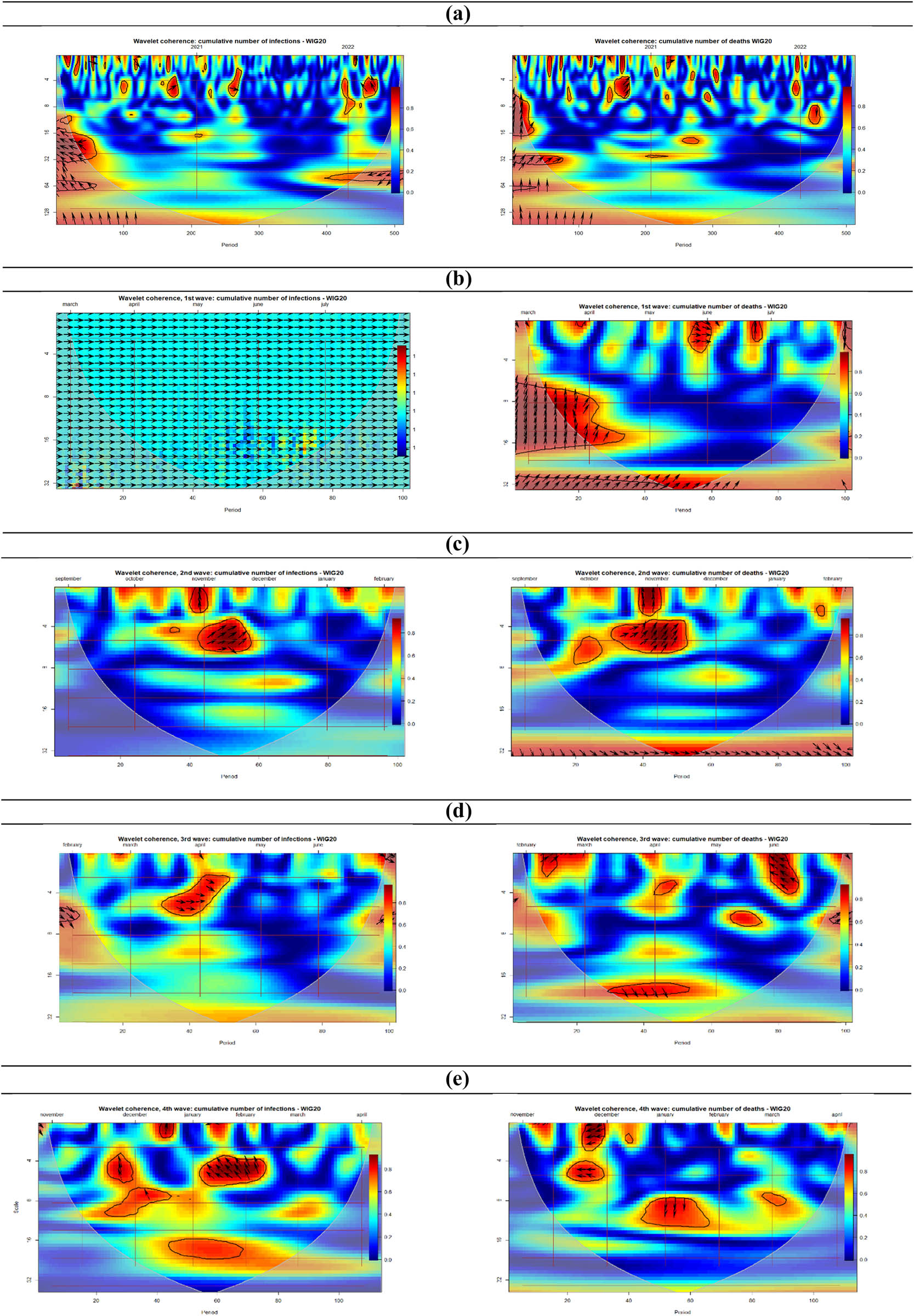
Figure 3
Wavelet coherence analysis. (a) The full sample. (b) The first wave. (c) The second wave. (d) The third wave. (e) The fourth wave.
Source: own elaboration.
In case of the first wave, the areas indicating the strong significant relation in the case of the number of infections and WIG20 index are not detected. Although throughout the period, the variables were weakly positively correlated, as indicated by arrows pointing to the right. The situation is different for the number of deaths. At the beginning and during the first wave, there are areas with a strong relation with the WIG20 index. The positive correlation was observed and the first variable was leading. The results of the wavelet coherence for the second wave are similar for number of infections and number of deaths. Attention is drawn to one area of significant relation. In both cases, number of infections – WIG20 index relation and number of deaths – WIG20 index relation, arrows are pointing to the right and up. It indicates that the first series is leading with a positive correlation. The wavelet coherence results for the third wave highlight some change. For number of infections, the arrows are now pointing right and down, meaning that the correlation with WIG20 index is positive but the first variable is now lagging. In the case of the number of deaths, similar conclusion can be drawn for April, while around June, the correlation with WIG20 that is found is negative. For the fourth wave, the negative correlation between pandemic variables and WIG20 index was confirmed here. In case of number of infections, the second variable was leading.
In summary, the strongest relations between pandemic variables and WIG20 index occurred during the first and second waves, the correlation was positive and the first variable was leading. However, the behavior of variables during the third and fourth waves was slightly different, because the correlation was mostly negative and the second variable was leading.
4.3.1. Wavelet coherence analysis – vaccination program
In the last stage, a wavelet coherence analysis was carried out for the WIG20 index and given vaccination doses. As can be seen on the graphs (Figure 4), areas with a strong relationship emerged throughout the duration of the vaccination program. The correlation between the variables changed over time as there are arrows indicating both, positive and negative relations. However, it is worth emphasizing that most of the time, there was a negative correlation between WIG20 and vaccinations. In the meantime, there were also changes in the leading of the variables.
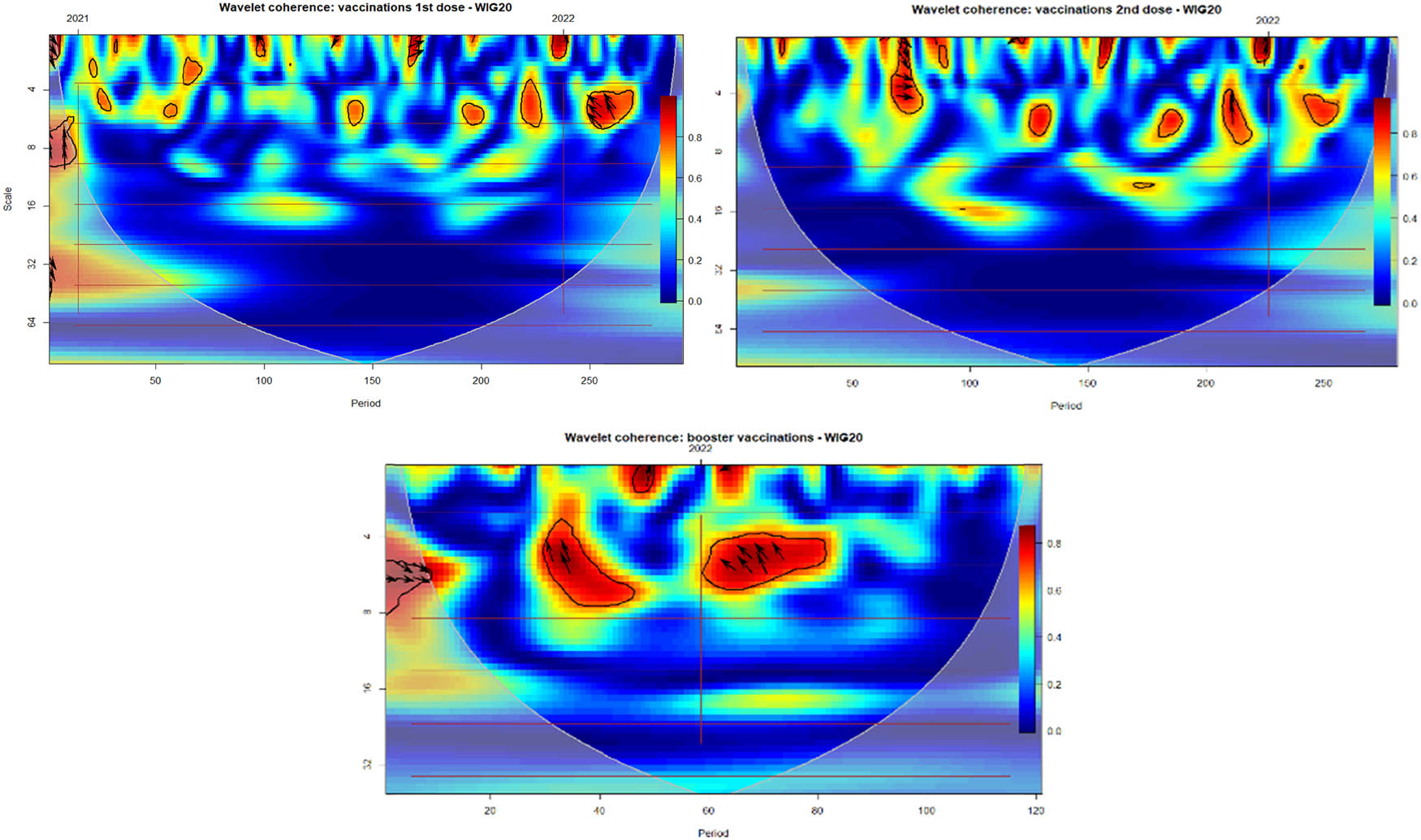
Figure 4
Wavelet coherence analysis for vaccinations.
Source: own elaboration.
The analysis in every aspect confirms the conclusions of the study of dynamic correlations. The pandemic has had a huge effect on the stock market in Poland. Presented figures might be compared to those given by Karamti and Belhassine (2022) for the Nikkei225 (Japan), SSE (China), CAC40 (France), DAX (Germany), and FTSE (United Kingdom). For each country, some differences can be detected.
5. Conclusion
Our study confirmed the existence of contagion effects between the COVID-19 pandemic and the behavior of the stock market in Poland. First of all, in the initial phase of the pandemic, the number of infections and deaths due to COVID-19 had a greater effect on the WIG20 index than in later periods. With the start of coronavirus vaccinations, it was observed that they had a greater effect on the stock market in Poland than the number of COVID-19 infections and deaths. Our analysis indicated a strong relation between the WIG20 index and the S&P500 index. The short-term persistence occurred to be statistically significant for WIG20 and S&P500 series as well as the long-term persistence. In addition, long-term volatility was found to be more intense comparing to short-term volatility. Based on DCC coefficients we indicated that there exists a significant long-term relationship among Polish and US stock markets. The strongest relation between the number of infections and the number of deaths due to COVID-19 on the WIG20 index was observed during the first and second wave of infections. This is related to a huge shock and greater uncertainty at the beginning.
In addition, a strong relationship was detected between vaccinations and the stock market in Poland. This may also explain the fact that the third and fourth waves of infections had a smaller effect on quotations. With the start of the vaccination program, there was hope for the end of pandemic.
Analysis using the wavelet coherence method pointed to the lagged effect of the number of deaths on the WIG20 index, compared to the number of infections due to COVID-19. This is in line with Hoshikawa and Yoshimi (2021) findings. Given that the number of new deaths increases several days post a surge in the number of new cases, this result implies that investors react when they observe a rise in new cases and that by the time of observing an increase in new deaths, they have already made their adjustments.
Similar conclusions concerning the relationship between the stock markets of United States and the other analyzed countries, namely, Great Britain, Hungary, and the Czech Republic, were drawn. The analysis indicated a strong correlation between the FTSE250, BUX, and PX indices and the S&P 500 index, both in the short and long term. However, as with the WIG20 index, long-term volatility was found to be stronger (more pronounced) than short-term volatility.
Similar results to those observed in Poland were found in the analysis of the impact of the number of Covid-19 infections and death rates on the FTSE250 index. Both the number of infections and deaths showed a strong correlation with the United Kingdom stock market during all four waves. However, unlike in Poland, this relationship did not weaken during the third and fourth waves. Slightly different results were obtained for Hungary, as during the first wave, both DCC coefficients were insignificant for the number of infections. This changed in the second wave, as the coefficient for the long-term relationship between variables turned out to be significant. It is also important to note that during the first wave, a correlation was found between the BUX index and the number of deaths, suggesting that investors in Hungary may have been more influenced by death-related information than by infection rates. Regarding the PX index, there was a short-term relationship with the number of infections during the first wave, but for the subsequent waves, this relationship became long-term.
Our findings enrich COVID-19 contagion effects research and give insights to financial market investors and risk managers seeking to manage their portfolios in times of pandemic. By presenting results for additional countries, we show that market specifics matter and not all conclusions can be generalized.
Funding information
Authors state no funding involved.
Author contributions
The Authors confirm their contribution to the paper as follows: study conception and design: Aneta Dzik-Walczak, Anna Gaweł; literature review: Aneta Dzik-Walczak, Anna Gaweł; data collection: Anna Gaweł; methodology: Aneta Dzik-Walczak, Anna Gaweł; models estimation: Anna Gaweł; analysis and interpretation of results: Aneta Dzik-Walczak, Anna Gaweł; and discussion and conclusion: Aneta Dzik-Walczak, Anna Gaweł.
Conflict of interest statement
Authors state no conflict of interest.