
Table 1
Characteristics of the shops analyzed.
| Shop | Country of origin | Year of creation | First shop in Poland | Type of sale | Assortment | Average shop area | Area of activity |
|---|---|---|---|---|---|---|---|
| Biedronka | Poland | 1995 | 1995 | Supermarket | Foodstuffs, industrial goods | Approx. 650 m2 | Poland |
| Lidl | Germany | 1930 | 2002 | Supermarket | Foodstuffs, industrial goods | Approx. 1,200 m2 | Europe |
| Kaufland | Germany | 1968 | 2001 | Hypermarket | Foodstuffs, industrial goods, everyday products | Approx. 2,600 m2 | Europe |
| Carrefour | France | 1959 | 1997 | Hypermarket, supermarket | Foodstuffs, industrial products, daily consumer goods, household appliances, consumer electronics | Hypermarket: 2,000–12,000 m2, supermarket: up to 2,000 m2 | Europe, Asia, South America |
| Auchan | France | 1961 | 1996 | Hypermarket, supermarket | Foodstuffs, industrial products, daily consumer goods, household appliances, consumer electronics | Hypermarket: over 10,000 m2, supermarket: 100–2,000 m2 | Europe, Asia |
| Rossmann | Germany | 1972 | 1993 | Industry | Cosmetics, household chemicals | Approx. 350 m2 | Europe |
| Hebe | Poland | 2011 | 2011 | Industry | Cosmetics, household chemicals | Approx. 250 m2 | Poland |
| Decathlon | France | 1976 | 2001 | Branch trading house | Sports clothing and accessories, supplements, sports equipment and supplies | Approx. 6,000 m2 | world |
| Żabka | Poland | 1998 | 1998 | Convenience store | Groceries, daily necessities | 60–150 m2 | Poland |
Source: Compiled by the authors.
Table 2
Metrics of respondents to the survey.
| Gender | Women – 74% | Men – 26% | ||
| Age | Below 18 years – 8% | 18–35 years – 70% | 35–50 years – 18% | Above 50 years – 4% |
| Education | Basic – 7% | Professional – 3% | Medium – 47% | Higher – 43% |
| Place of residence | Village – 33% | City of up to 150,000 inhabitants – 37% | City of 150,000–500,000 inhabitants – 14% | City of over 500,000 inhabitants – 16% |
Source: Compiled by the authors.
Table 3
Reasons for choosing different types of checkout.
| Reasons for choosing a traditional cash register | Reasons for choosing self-service checkout |
|---|---|
|
|
Source: Compiled by the authors.
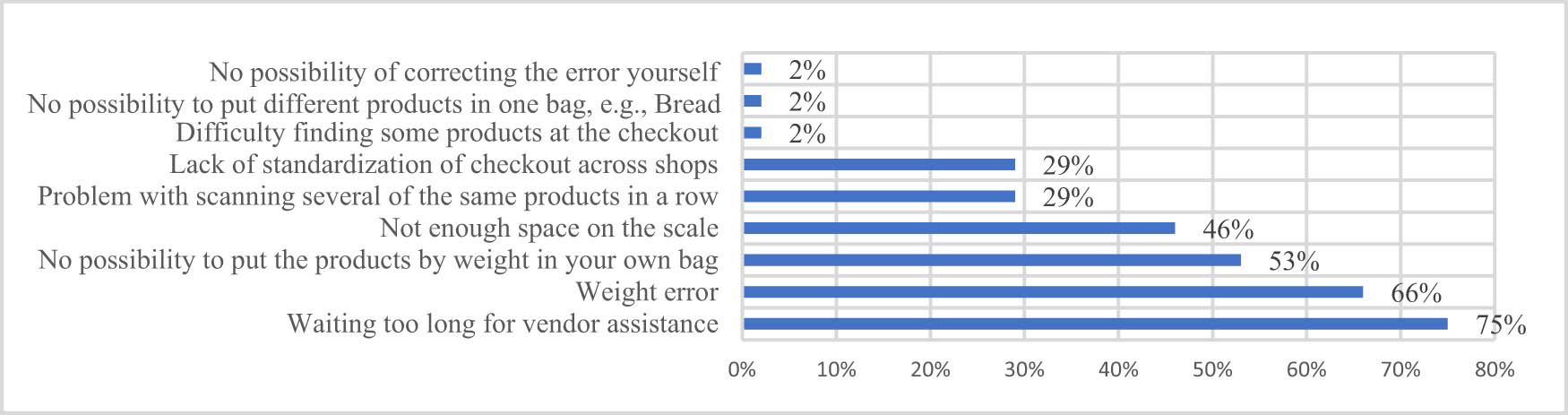
Figure 1
Problems arising in the use of self-service checkouts.
Source: Compiled by the authors.
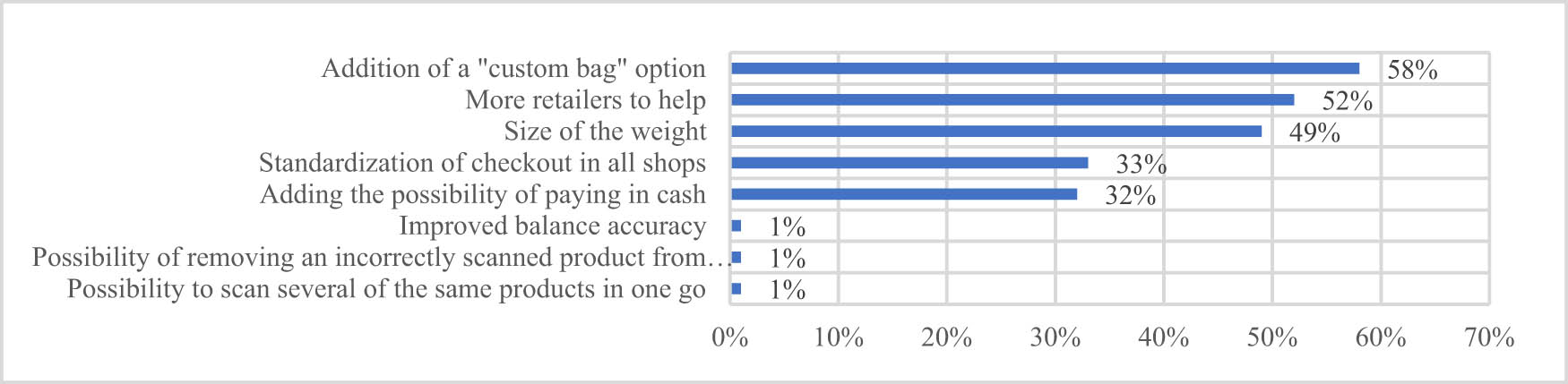
Figure 2
Changes consumers would make to self-service checkouts.
Source: Compiled by the authors.

Figure 3
Reasons why customers choose self-service checkout.
Source: Compiled by the authors.
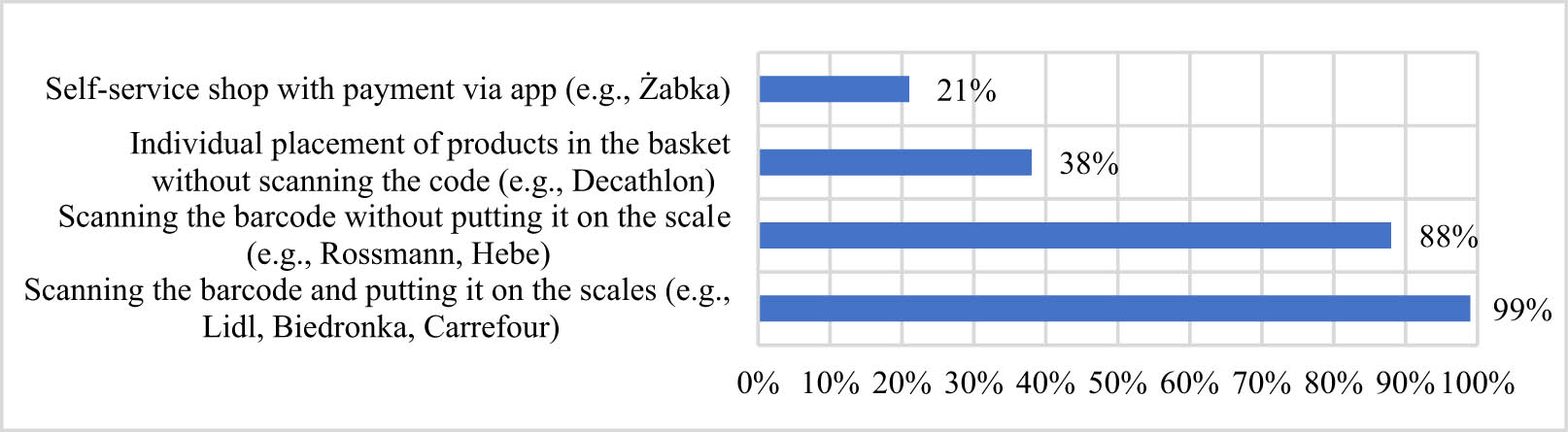
Figure 4
Types of cash registers used by respondents.
Source: Compiled by the authors.
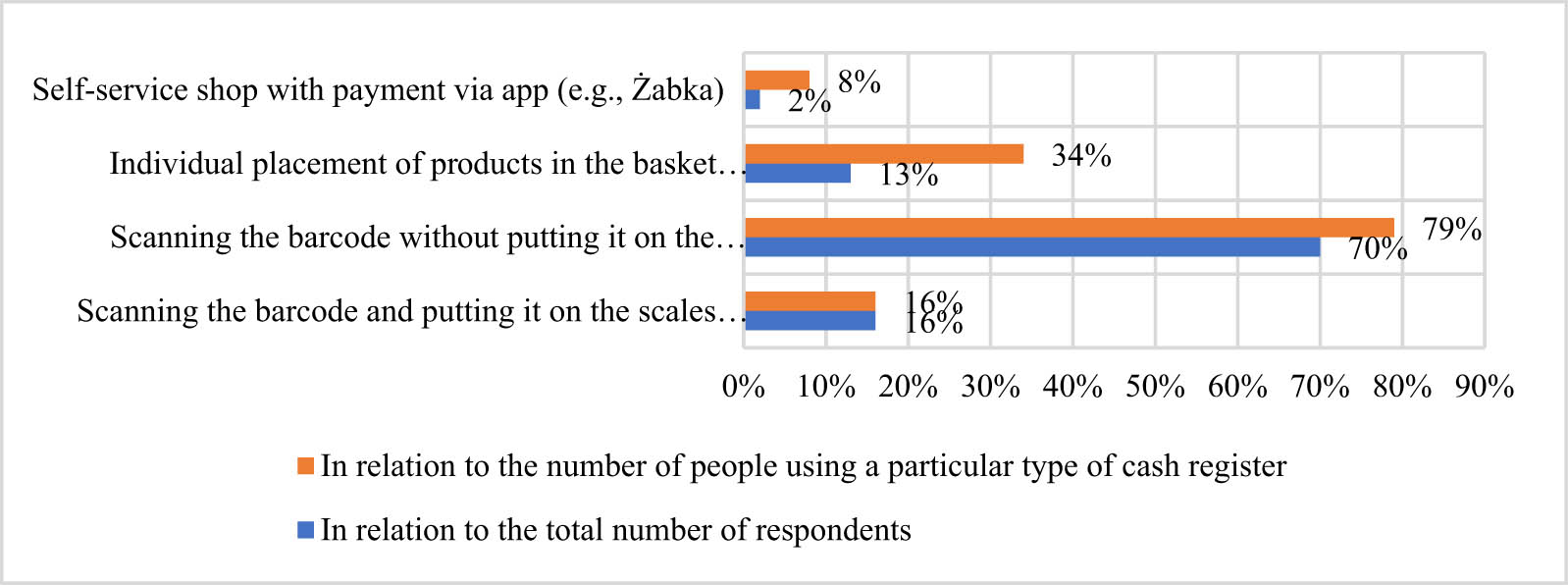
Figure 5
Comparison of the choice of the best type of self-service in relation to all survey participants and to the number of people using the type of checkout.
Source: Compiled by the authors.
Table 4
Respondents’ ratings of the ease of use of the checkout types and the average rating of the ease of use of each checkout type.
| Checkout type | Rating (%) | Average rating | ||||
|---|---|---|---|---|---|---|
| 1 | 2 | 3 | 4 | 5 | ||
| Scanning the barcode and putting it on the scales (e.g., Lidl, Biedronka, Carrefour) | 4 | 9 | 23 | 37 | 27 | 3.74 |
| Scanning the barcode without putting it on the scale (e.g., Rossmann, Hebe) | 4 | 1 | 10 | 20 | 65 | 4.40 |
| Individual placement of products in the basket without scanning the code (e.g., Decathlon) | 8 | 1 | 24 | 21 | 46 | 3.96 |
| Self-service shop with payment via app (Żappka) | 14 | 11 | 24 | 24 | 27 | 3.38 |
Source: Compiled by the authors.
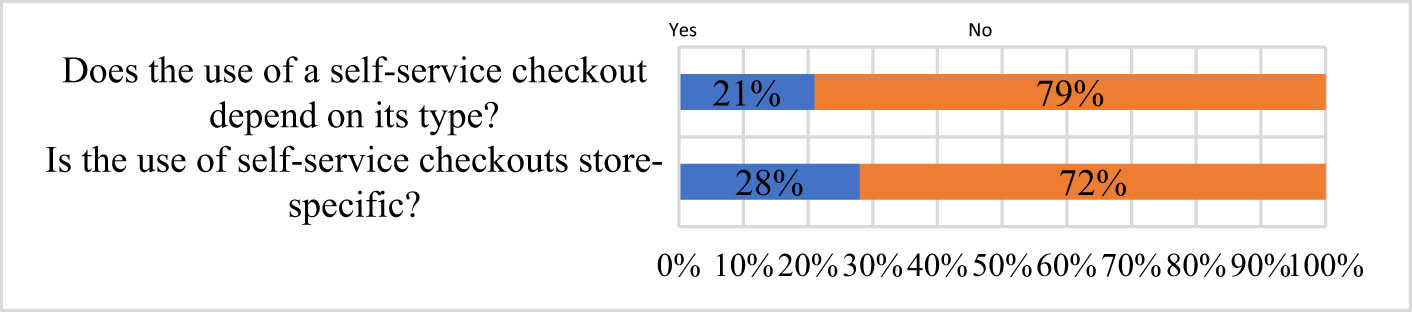
Figure 6
Choice of self-service option depending on checkout type and shop.
Source: Compiled by the authors.
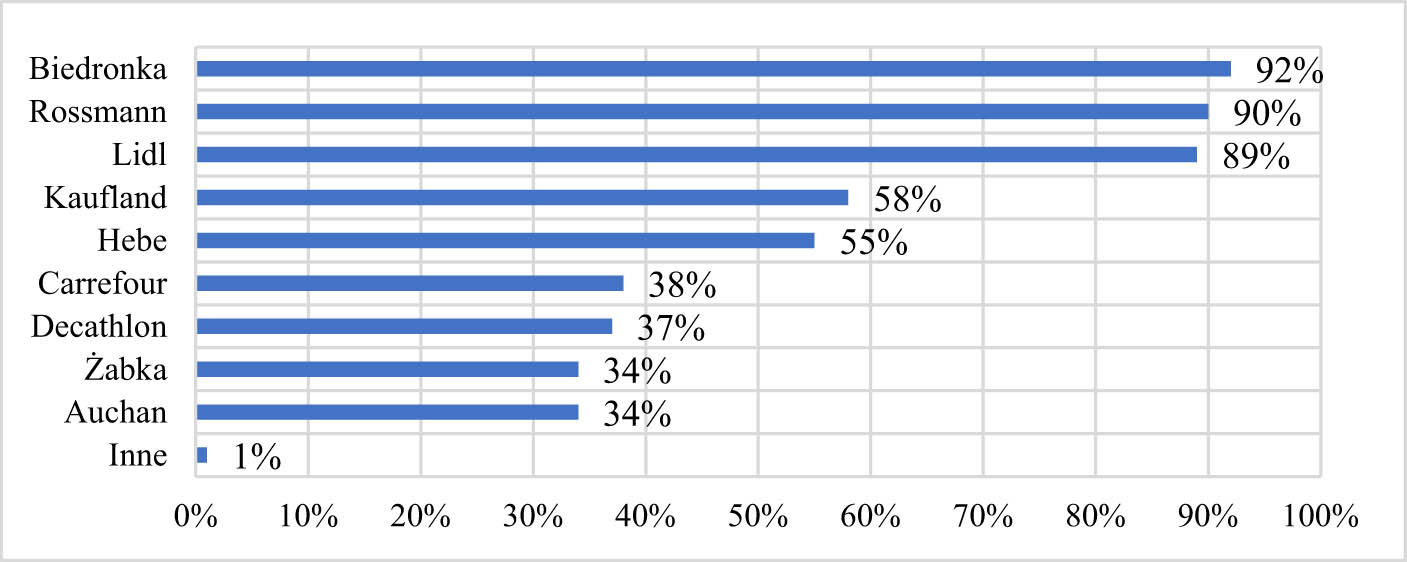
Figure 7
Shops where respondents use self-service checkouts.
Source: Compiled by the authors.
Table 5
Comparison of selected self-service checkout functions in selected shops.
| Shop | Biedronka | Lidl | Kaufland | Carrefour | Auchan | Rossmann | Hebe | Decathlon | Żabka |
|---|---|---|---|---|---|---|---|---|---|
| Cash payment option | − | − | + | − | + | − | − | − | − |
| Built-in checkweigher | + | + | + | + | + | − | − | − | − |
| Weighing products on scales at the checkout | + | + | − | − | − | ND | ND | ND | ND |
| Possibility of using your own bag | + | + | − | + | + | ND | ND | ND | ND |
| Scanning a receipt on exit | − | + | + | − | − | − | − | − | ND |
| Need to click START before scanning the first product | − | − | + | − | − | − | + | + | ND |
| Dedicated member of staff to assist in case of problems | − | +/− | + | + | + | − | − | − | − |
ND – Not applicable.
Source: Compiled by the authors.
Table 6
Summary of the survey and analysis of the results regarding the performance evaluation of the cash registers.
| Questions | Responses of respondents | |||
|---|---|---|---|---|
| Frequency of use of self-service checkouts | Always | Often | Rarely | Never |
| 24% | 56% | 16% | 4% | |
| The most common problems encountered when using self-service checkouts | Too long waiting time for vendor assistance; weight error; no possibility to put products in their own bag; insufficient space on the scales | |||
| Changes that customers would make | Addition of a “custom bag” option; more retailers to assist; increase in weight; possibility to pay in cash; standardized checkout in all shops | |||
| Reasons for choosing self-service checkout | Small queue; small purchases; no interaction with shop staff | |||
| Average rating for comfort at self-service checkouts (scale of 1–5) | 4.06 | |||
| Most commonly used cash registers | Scanning a bar code and putting it on the scales; barcode scanning without placing on scales | |||
| Best type of cash register according to consumers | Scanning the barcode without putting it on the scale | |||
| Average rating for ease of use (scale of 1–5) | Scanning the bar code and putting it on the scale | 3.74 | ||
| Scanning the barcode without putting it on the scale | 4.40 | |||
| Single item placement in the shopping basket without scanning the code | 3.96 | |||
| Self-service shop with payment via app (Żappka) | 3.38 | |||
| The most popular self-service shops used by consumers | Biedronka; Rossmann; Lidl | |||
Source: Compiled by the authors.
Table 7
Advantages and disadvantages of the different types of self-service checkouts.
| Checkout type | Advantages | Disadvantages |
|---|---|---|
| Scanning the barcode and putting it on the scales (e.g., Lidl, Biedronka, Carrefour) |
|
|
| Scanning the barcode without putting it on the scale (e.g., Rossmann, Hebe) |
|
|
| Individual placement of products in the basket without scanning the code (e.g., Decathlon) |
|
|
| Self-service shop with payment via app (Żappka) |
|
|
| From a business perspective |
|
|
Source: Compiled by the authors.