
1. Introduction
Customer service is a fundamental part of sales. Though it has evolved significantly over time, it has always been present (Bańka et al., 2022; Brzóska, 2017; Rahimi & Kozak, 2017). Nearly everyone interacts with customer service daily, whether shopping in-store or online (Russ-Eft, 2004; Sałach-Dróżdż, 2024). In the past, companies focused mainly on smooth transactions and simple return processes. Today, expectations are much higher (Czernek-Marszałek et al., 2024; Ostoj, 2024; Ozuem et al., 2016). Customers now demand fast, personalized service, a sense of connection with brands, and proactive solutions (Midor, 2019; Próchniak, 2018; Sałaciński et al., 2023). Businesses are responding by modernizing operations to better attract and retain customers. This article explores modern customer service methods in retail.
It fills a notable research gap concerning the Polish retail market, where local consumer preferences and technological conditions have been underexplored. While studies exist globally, they often overlook Poland’s unique context.
The study focuses on several key elements. First, it details Polish consumer behaviors and expectations regarding modern technologies, acknowledging cultural and structural differences in retail. Second, it analyzes the effectiveness and popularity of self-service tools and the challenges they pose. Third, it presents survey data from Polish consumers, offering direct insight for businesses considering such investments. Fourth, it compares self-service and traditional checkout efficiency.
Addressing this gap contributes to understanding how modern technologies can be applied effectively in Poland and provides practical guidance for retail businesses. It also lays groundwork for future comparative international studies.
The study includes the topic’s background, literature review, methodology, analysis, discussion, and conclusion. It introduces key concepts, summarizes current theories, and outlines the research process and findings. A final list of sources is included, ensuring academic transparency. The structure supports a clear, logical flow from theory to practical insights.
2. Analysis of latest research where the solution of the problem was initiated
The retail market has undergone dynamic changes in recent years (Białek, 2023; Próchniak, 2014). Customer preferences are evolving – large weekly shopping trips are being replaced by more frequent, smaller, and faster purchases. According to a DS Smith study, one in three people abandons purchases due to long queues, and 46% choose not to return to such stores (Pierzchała, 2023). The COVID-19 pandemic reduced foot traffic in physical stores (Masłowski et al., 2022; Osika, 2023), prompting retailers to implement solutions that improve shopping convenience (Własny Biznes, 2023). Increasingly, stores – including local ones – are investing in modern tools that enhance operations and increase profits (Melović et al., 2015).
Modern retail technologies are increasingly based on artificial intelligence (AI) (Khrais & Alghamdi, 2021). AI analyzes customer data and offers personalized recommendations (Kim & Aggarwal, 2016; Masłowski, 2020), using information from various sources – such as weather forecasts, purchase history, and trends – to optimize sales strategies (Dudin et al., 2022), potentially boosting sales by up to 5% (Własny Biznes, 2023).
In practice, AI supports tools such as digital signage – smart displays showing ads adjusted to sales performance (Lui & Piccoli, 2016). However, the most widespread technology is the self-checkout system, allowing customers to scan and pay for items themselves, usually with cashless payment (Kenett et al., 2011). These systems reduce queues, lower operational costs, and improve efficiency (Ridwan, 2022).
Entrepreneurs are increasingly implementing such technologies, recognizing their long-term benefits – greater efficiency, cost savings, and more precise marketing through data analysis (Cahyani et al., 2021). In the near future, customer service may no longer involve cashiers, queues, or cash payments (Białek, 2023) – a scenario that seems increasingly likely given the fast pace of technological advancement.
3. Methodology
The aim of the article is to analyze modern customer service methods implemented in selected stores. The conducted research aims to assess how these modern methods are performing in the chosen stores. Do customers willingly use them? Are they profitable for the stores? Should changes be introduced to make the use of modern customer service methods easier and more enjoyable for both customers and businesses? Will the number of modern solutions increase, or will stores refrain from such investments? The authors will analyze selected modern customer service methods available on the market and attempt to find answers to the posed questions.
The subject of the analysis conducted in this study was selected stores that utilize modern customer service methods in the form of self-checkout registers and self-service applications. These include the following retail chains: Biedronka, Lidl, Kaufland, Carrefour, Auchan, Rossmann, Hebe, Decathlon, and Żabka (Table 1).
Table 1
Characteristics of the shops analyzed.
| Shop | Country of origin | Year of creation | First shop in Poland | Type of sale | Assortment | Average shop area | Area of activity |
|---|---|---|---|---|---|---|---|
| Biedronka | Poland | 1995 | 1995 | Supermarket | Foodstuffs, industrial goods | Approx. 650 m2 | Poland |
| Lidl | Germany | 1930 | 2002 | Supermarket | Foodstuffs, industrial goods | Approx. 1,200 m2 | Europe |
| Kaufland | Germany | 1968 | 2001 | Hypermarket | Foodstuffs, industrial goods, everyday products | Approx. 2,600 m2 | Europe |
| Carrefour | France | 1959 | 1997 | Hypermarket, supermarket | Foodstuffs, industrial products, daily consumer goods, household appliances, consumer electronics | Hypermarket: 2,000–12,000 m2, supermarket: up to 2,000 m2 | Europe, Asia, South America |
| Auchan | France | 1961 | 1996 | Hypermarket, supermarket | Foodstuffs, industrial products, daily consumer goods, household appliances, consumer electronics | Hypermarket: over 10,000 m2, supermarket: 100–2,000 m2 | Europe, Asia |
| Rossmann | Germany | 1972 | 1993 | Industry | Cosmetics, household chemicals | Approx. 350 m2 | Europe |
| Hebe | Poland | 2011 | 2011 | Industry | Cosmetics, household chemicals | Approx. 250 m2 | Poland |
| Decathlon | France | 1976 | 2001 | Branch trading house | Sports clothing and accessories, supplements, sports equipment and supplies | Approx. 6,000 m2 | world |
| Żabka | Poland | 1998 | 1998 | Convenience store | Groceries, daily necessities | 60–150 m2 | Poland |
Source: Compiled by the authors.
The survey was conducted between January 2022 and December 2023 and focused on evaluating modern customer service methods in physical stores. The target group included Polish residents. A total of 1,310 individuals participated, with a maximum margin of error of approximately 3%, assuming a 95% confidence level and a fraction size of 0.5 (used due to the unknown characteristic of the studied population).
The research was carried out electronically via a Google Forms questionnaire and centered on self-service checkouts. The survey contained 24 questions – 22 closed and 2 open-ended – divided into 7 sections. The first section (3 questions) assessed respondents’ views on the usefulness of self-service checkouts and their usage frequency. The second section (3 questions) addressed those who do not use self-checkouts, asking for reasons and what might encourage them to do so.
Sections 3–5 (1 question each) were directed at users of self-checkouts and explored their service preference (traditional vs self-service). Based on their answers, participants were guided to Section 4 or 5, each containing an open-ended question about their service preference rationale.
Section 6 targeted respondents who use self-checkouts rarely, often, or always. It included 11 questions covering motivations for using self-checkouts, types used, store preferences, encountered problems, suggested improvements, and overall comfort.
This structure allowed for a comprehensive assessment of attitudes and experiences related to self-service technologies.
4. Discussion
Table 2 presents a demographic breakdown of the participants in the survey. The majority of respondents are females, individuals aged 35 or younger, with at least a secondary education, residing in rural areas or small to medium-sized towns.
Table 2
Metrics of respondents to the survey.
| Gender | Women – 74% | Men – 26% | ||
| Age | Below 18 years – 8% | 18–35 years – 70% | 35–50 years – 18% | Above 50 years – 4% |
| Education | Basic – 7% | Professional – 3% | Medium – 47% | Higher – 43% |
| Place of residence | Village – 33% | City of up to 150,000 inhabitants – 37% | City of 150,000–500,000 inhabitants – 14% | City of over 500,000 inhabitants – 16% |
Source: Compiled by the authors.
92% of respondents considered the introduction of self-checkout registers a good solution, 5% held the opposite view, and 3% had no opinion. 82% believe that such registers should be available in all stores. 80% had used self-checkouts at least twice, and 25% stated they always choose this option when available.
Those who do not use self-checkouts most often pointed to numerous problems during operation and long wait times for staff assistance. 60% said they would not change their opinion even if these issues were resolved – they would only use self-checkouts if traditional lanes were unavailable. Discounts, mobile app points, the option to pay in cash, fewer errors, and the absence of pressure or unpleasant sounds could encourage them to switch.
Among respondents using both service forms, 63% preferred self-checkouts, 17% preferred traditional registers, and 20% had no preference (Table 3).
Table 3
Reasons for choosing different types of checkout.
| Reasons for choosing a traditional cash register | Reasons for choosing self-service checkout |
|---|---|
|
|
Source: Compiled by the authors.
As it can be seen, opinions among the respondents are divided. However, it is certain that self-checkout registers, while offering advantages, also come with several drawbacks. By far, the most significant problem is the extended wait time for assistance from store staff (Figure 1). Other issues include errors in weight measurement, the inability to use one’s own bag, and insufficient space on the weighing scale.
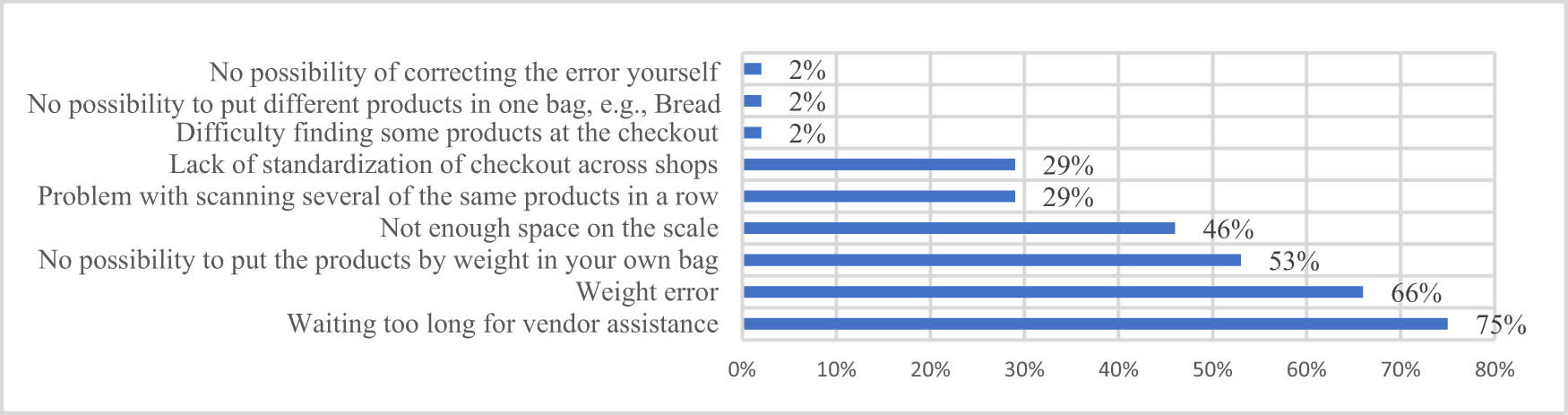
Figure 1
Problems arising in the use of self-service checkouts.
Source: Compiled by the authors.
Respondents propose several changes, primarily the addition of an “own bag” option. They also suggest having more staff available to assist customers, increasing the size of the weighing scale, standardizing the checkout process in all stores, and enabling cash payment (Figure 2).
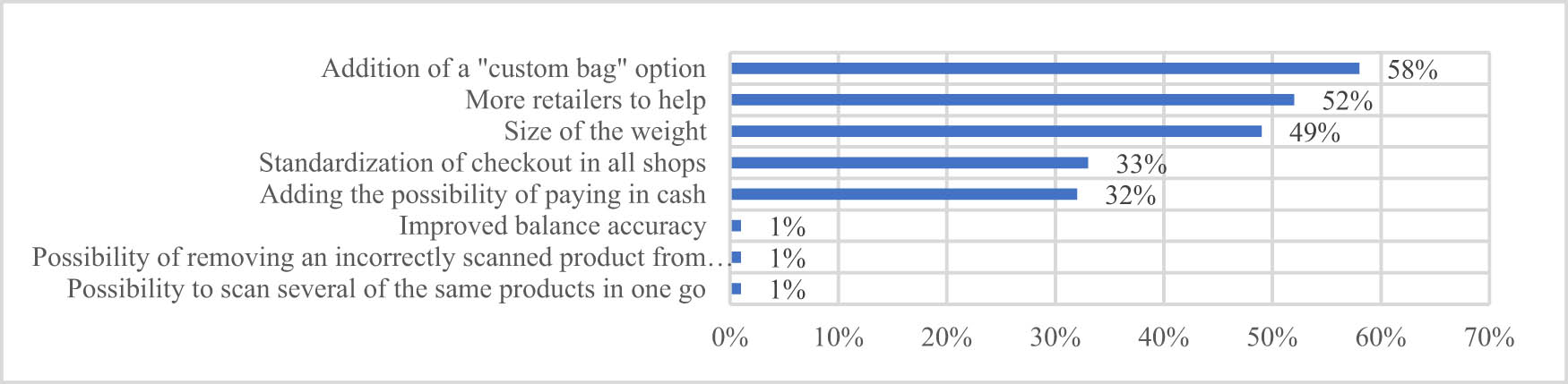
Figure 2
Changes consumers would make to self-service checkouts.
Source: Compiled by the authors.
It is evident that time savings are of paramount importance to shoppers. Often, the decision to use self-checkout is driven by the small quantity of items being purchased. Nearly one-third of respondents choose self-checkout registers because they do not need to interact with store employees. Some individuals also consider whether there is an employee ready to provide assistance at the self-checkout lanes. 8% of people use self-checkout registers out of habit, suggesting that it has become their preferred method, and they habitually use this type of register first (Figure 3).

Figure 3
Reasons why customers choose self-service checkout.
Source: Compiled by the authors.
The majority of the surveyed individuals are satisfied with the convenience of self-checkout registers. Based on the responses provided, the calculated average rating is 4.06 out of 5.
Respondents were asked about the types of self-checkout registers they use. The most popular type of register is the one used in grocery stores with an integrated weight control function. As many as 99% of the surveyed individuals have used this type of device. The second, slightly less popular type is the register without a weight function, which only scans the barcode of the product. It was used by 88% of respondents. Registers that do not require scanning and use RFID technology were used by 38% of individuals. The least popular is the Żabka self-checkout store, with only 21% of respondents having used this method (Figure 4).
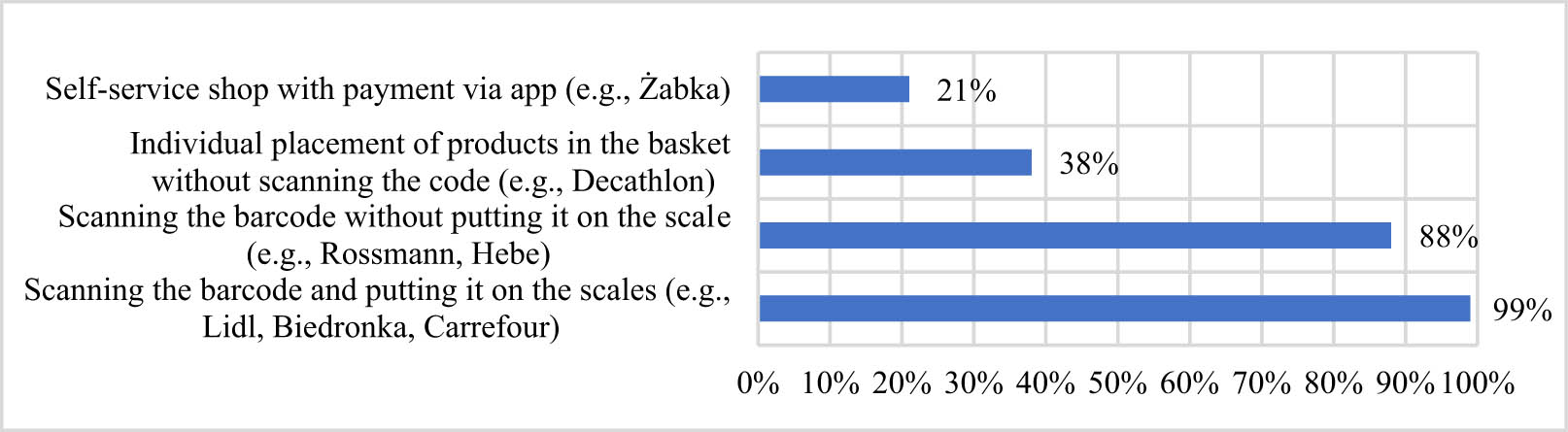
Figure 4
Types of cash registers used by respondents.
Source: Compiled by the authors.
Respondents were asked which type of self-checkout they consider the best. The orange color represents the portion of respondents who consider a particular type of self-checkout as the best (Figure 5). In this comparison, self-checkout without an integrated weight control function is the clear winner, with 70% of respondents selecting this option. Self-checkout with an integrated weight control function came in second place. According to 13% of individuals, the best type is the one using RFID technology. Only 2% of respondents consider the Żabka self-checkout store as the best choice. Since the highest number of people used a particular type of self-checkout, it is also the type most people consider the best. To provide a comprehensive view of the assessment, Figure 5 includes a second range in yellow. This range shows the percentage of respondents who have used a particular type of self-checkout and consider it the best. In this case, the responses are distributed differently. Self-checkout without an integrated weight control function is still considered the best type, but self-checkout using RFID technology comes in second place, with 34% of individuals who have used this technology considering it the best. Only 16% of respondents who have used self-checkout with an integrated weight control function consider it the best choice. In contrast, 8% of those familiar with the Żabka self-checkout store believe it is the best type of self-checkout.
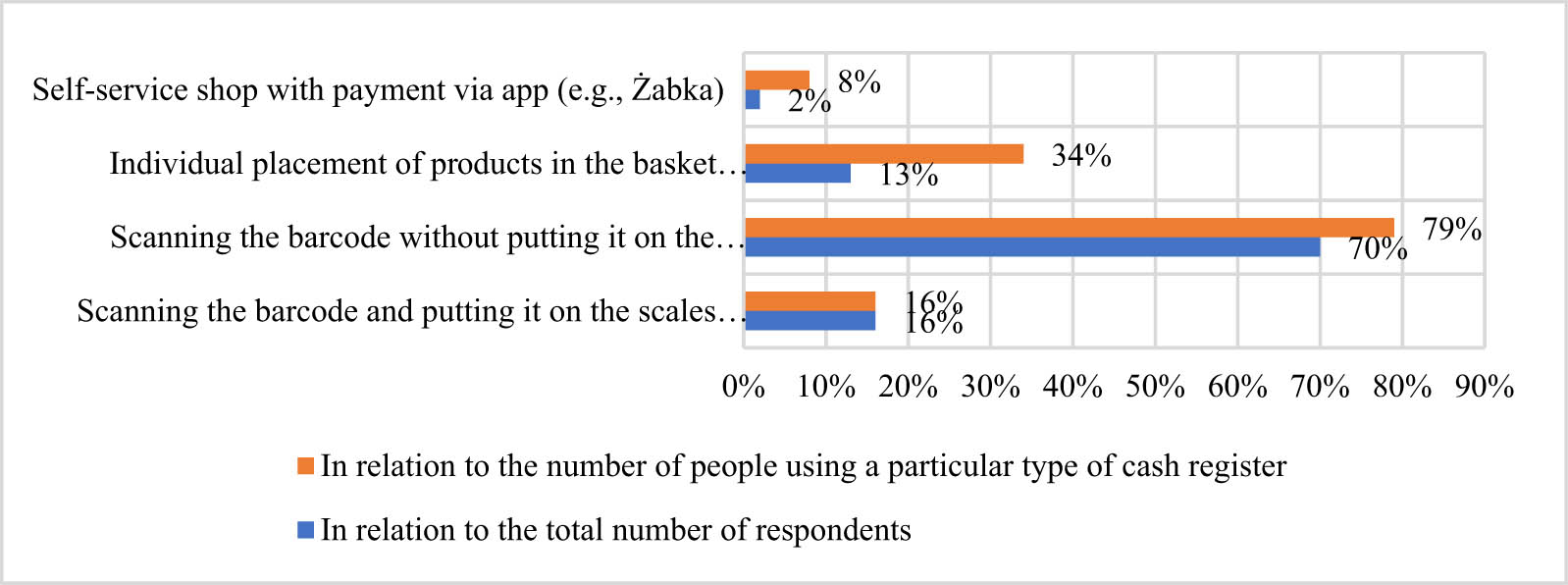
Figure 5
Comparison of the choice of the best type of self-service in relation to all survey participants and to the number of people using the type of checkout.
Source: Compiled by the authors.
Respondents similarly evaluated the ease of use of different types of self-checkout. The self-checkout without placing items on the scale is considered the easiest to use by the respondents. In the second place is self-checkout using RFID technology, followed by self-checkout where products need to be placed on the scale, and finally, the Żabka self-checkout store. These data confirm the earlier analysis regarding which type of self-checkout is considered the best by the respondents (Table 4).
Table 4
Respondents’ ratings of the ease of use of the checkout types and the average rating of the ease of use of each checkout type.
| Checkout type | Rating (%) | Average rating | ||||
|---|---|---|---|---|---|---|
| 1 | 2 | 3 | 4 | 5 | ||
| Scanning the barcode and putting it on the scales (e.g., Lidl, Biedronka, Carrefour) | 4 | 9 | 23 | 37 | 27 | 3.74 |
| Scanning the barcode without putting it on the scale (e.g., Rossmann, Hebe) | 4 | 1 | 10 | 20 | 65 | 4.40 |
| Individual placement of products in the basket without scanning the code (e.g., Decathlon) | 8 | 1 | 24 | 21 | 46 | 3.96 |
| Self-service shop with payment via app (Żappka) | 14 | 11 | 24 | 24 | 27 | 3.38 |
Source: Compiled by the authors.
For the vast majority of respondents, the type of self-checkout and the store where they shop do not matter. However, more respondents do consider the store where they shop to be a factor compared to the type of self-checkout (Figure 6).
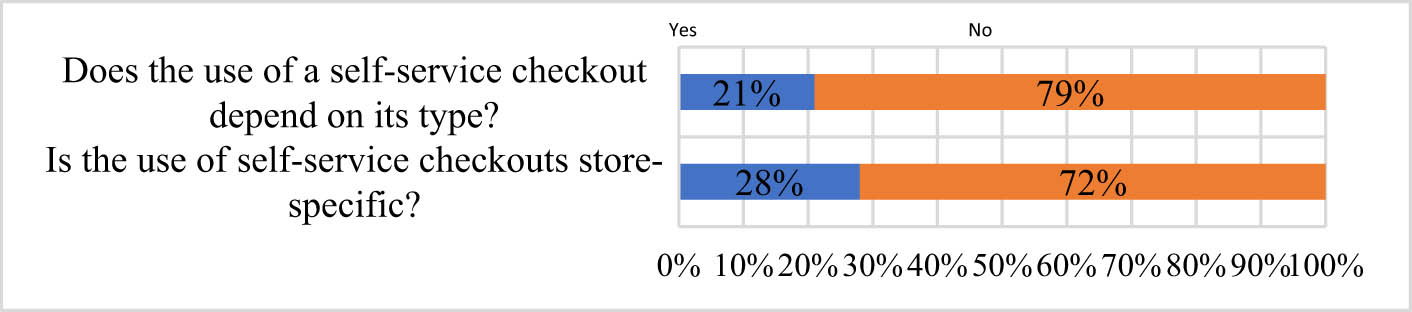
Figure 6
Choice of self-service option depending on checkout type and shop.
Source: Compiled by the authors.
The most popular stores where respondents use self-checkout registers are Biedronka, Rossmann, and Lidl. Biedronka and Lidl are the most popular grocery store chains in the country, and Rossmann is the most common drugstore, which explains the significant preference for these chains. Figure 7 shows how many respondents have used self-checkout registers in each store. Only 1% of individuals stated that they have used self-checkout registers in a store other than those mentioned, confirming that the mentioned stores are the most popular ones with self-checkout registers.
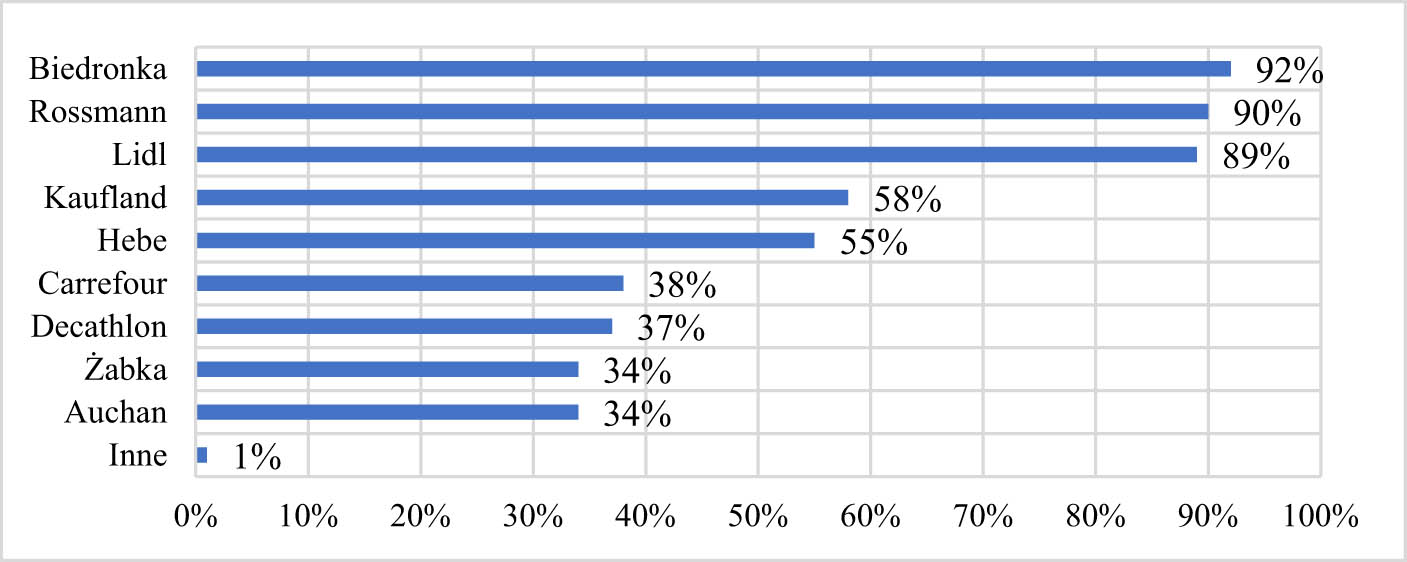
Figure 7
Shops where respondents use self-service checkouts.
Source: Compiled by the authors.
Self-checkout registers in different stores have some differences, even if they operate on the same principles. Table 5 lists various features that can be found in some stores, indicating whether a particular feature is present in each store or not.
Table 5
Comparison of selected self-service checkout functions in selected shops.
| Shop | Biedronka | Lidl | Kaufland | Carrefour | Auchan | Rossmann | Hebe | Decathlon | Żabka |
|---|---|---|---|---|---|---|---|---|---|
| Cash payment option | − | − | + | − | + | − | − | − | − |
| Built-in checkweigher | + | + | + | + | + | − | − | − | − |
| Weighing products on scales at the checkout | + | + | − | − | − | ND | ND | ND | ND |
| Possibility of using your own bag | + | + | − | + | + | ND | ND | ND | ND |
| Scanning a receipt on exit | − | + | + | − | − | − | − | − | ND |
| Need to click START before scanning the first product | − | − | + | − | − | − | + | + | ND |
| Dedicated member of staff to assist in case of problems | − | +/− | + | + | + | − | − | − | − |
ND – Not applicable.
Source: Compiled by the authors.
5. Evaluation of current customer service methods
Currently, consumers prefer smaller but more frequent shopping trips, making self-checkout lanes a convenient option. They also appreciate shorter wait times and minimal interaction with staff. The survey identified key drawbacks of self-checkouts and areas for improvement.
The results show that most Poles use self-checkout lanes, which are generally well-received. The average comfort rating was 4.06 out of 5. Respondents favored checkouts where barcodes are scanned without using a weight scale, as most problems – such as errors requiring staff assistance and the need to transfer items twice – are linked to weight scales. Stores lacking the option to weigh personal bags further contribute to inconvenience. Checkouts without weight scales avoid these issues and are rated highest for ease of use. Barcode-based self-checkouts are the most popular among consumers (Table 6).
Table 6
Summary of the survey and analysis of the results regarding the performance evaluation of the cash registers.
| Questions | Responses of respondents | |||
|---|---|---|---|---|
| Frequency of use of self-service checkouts | Always | Often | Rarely | Never |
| 24% | 56% | 16% | 4% | |
| The most common problems encountered when using self-service checkouts | Too long waiting time for vendor assistance; weight error; no possibility to put products in their own bag; insufficient space on the scales | |||
| Changes that customers would make | Addition of a “custom bag” option; more retailers to assist; increase in weight; possibility to pay in cash; standardized checkout in all shops | |||
| Reasons for choosing self-service checkout | Small queue; small purchases; no interaction with shop staff | |||
| Average rating for comfort at self-service checkouts (scale of 1–5) | 4.06 | |||
| Most commonly used cash registers | Scanning a bar code and putting it on the scales; barcode scanning without placing on scales | |||
| Best type of cash register according to consumers | Scanning the barcode without putting it on the scale | |||
| Average rating for ease of use (scale of 1–5) | Scanning the bar code and putting it on the scale | 3.74 | ||
| Scanning the barcode without putting it on the scale | 4.40 | |||
| Single item placement in the shopping basket without scanning the code | 3.96 | |||
| Self-service shop with payment via app (Żappka) | 3.38 | |||
| The most popular self-service shops used by consumers | Biedronka; Rossmann; Lidl | |||
Source: Compiled by the authors.
Measuring the time it takes to checkout five products in different stores showed that self-checkout lanes work similarly, and the time customers spend using these lanes is comparable across the stores surveyed. The only standout in this regard is Żabka store, more precisely the Żappka app. However, self-checkout stores are, for the time being, relatively rare. Only 20% of respondents have ever used this method. It is certainly not an ideal solution and would not work well in larger stores.
Table 7 presents the advantages and disadvantages of various types of checkouts, based on survey results and personal observations. In checkouts with a control scale (e.g., in grocery stores), an advantage is the ability to detect incorrectly scanned products. However, in practice, the scale often causes errors requiring staff assistance, which significantly extends the checkout time. In checkouts (e.g., in drugstores) that rely only on barcode scanning without a scale, the main benefit is the low error rate, but the lack of control increases the risk of theft. A common issue is also the inability for customers to remove mistakenly scanned items themselves.
Table 7
Advantages and disadvantages of the different types of self-service checkouts.
| Checkout type | Advantages | Disadvantages |
|---|---|---|
| Scanning the barcode and putting it on the scales (e.g., Lidl, Biedronka, Carrefour) |
|
|
| Scanning the barcode without putting it on the scale (e.g., Rossmann, Hebe) |
|
|
| Individual placement of products in the basket without scanning the code (e.g., Decathlon) |
|
|
| Self-service shop with payment via app (Żappka) |
|
|
| From a business perspective |
|
|
Source: Compiled by the authors.
In Decathlon stores, the checkout system does not require scanning, and the RFID system prevents duplication or fraud. The downside is the need for a costly and dedicated system. In Żabka self-checkout stores, customers enter by scanning a QR code, take products, and leave – making the process extremely fast. However, the store must be equipped with advanced camera systems, and usage requires a dedicated app.
For entrepreneurs, self-checkout systems offer significant savings – fewer employees are needed, store space is used more efficiently (more checkouts in less space), service is faster, and language options improve accessibility. The main disadvantages are the high investment costs (€100,000–€500,000) and the risk of fraud (e.g., scanning cheaper products). Although one employee is needed to supervise the area, they can support multiple checkouts simultaneously, making it more efficient than traditional lanes.
In conclusion, customers generally enjoy self-checkouts despite their flaws. These technologies are relatively new and constantly improving, offering retailers many opportunities to enhance customer service and boost sales while reducing long-term costs.
6. Propositions for improvements of self-checkout lanes
The article outlines key improvements to boost the efficiency and convenience of self-service checkouts. The main suggestions include:
“Own bag” option – to avoid transferring items after scanning and speed up checkout.
More support staff – to reduce wait times for assistance during issues.
Larger control scales – to better accommodate bigger or multiple items.
Process standardization – to reduce confusion caused by differing systems across stores.
Cash payment option – to cater to customers who prefer paying with cash.
More accurate scales – to minimize weight-related errors and reduce staff intervention.
Batch scanning – to allow quicker processing of identical items.
Removing incorrect scans – to let users fix mistakes without waiting for staff.
These changes would improve customer satisfaction, streamline service, and support broader adoption of self-service solutions.
7. Conclusion
Modern customer service methods are increasingly used in stores, with businesses implementing various solutions of varying effectiveness. This article aimed to analyze such methods in selected stores, assess their performance, and suggest improvements to enhance usability and efficiency. A customer survey identified both strengths and weaknesses of self-service checkouts, which were generally rated positively. The study confirms their popularity and benefits for businesses, though further improvements are needed. New innovations are expected to boost service efficiency.
Limitations include a sample limited to Polish residents, reducing generalizability; use of mostly closed-ended questions, possibly omitting key insights; and data that may become outdated due to rapid technological progress. Respondents’ subjective opinions may also affect objectivity.
The study contributes to customer service theory by offering insights into the effects of modern technologies, supporting better implementation strategies, and guiding business decisions. Future research should explore other regions, long-term effects of technology use, and emerging solutions like AI, virtual reality, and blockchain. The impact of the COVID-19 pandemic on shopping behavior and technology adoption also warrants further study.
Funding information
Authors state no funding involved.
Author contributions
Dariusz Masłowski – 50%; Mariusz Salwin – 10%; Sandra Pallus-Fudali – 20%; Magdalena Hryniewicka – 10%; Michał Pałęga – 10%.
Conflict of interest statement
Authors state no conflict of interest.