
1. Introduction
Connections, both geospatially and in terms of strong relationships, are crucial for innovation and business success. As a result, a growing number of studies have focused on clusters, which were defined by Porter, 1998 as the “geographic concentration of interconnected companies, specialized suppliers, service providers, firms in related industries, and associated institutions (e.g. universities, standards agencies, and trade association) in particular fields that compete but also co-operate.”
One of the major challenges in cluster research is the inherent ambiguity that is linked with the concept of clusters. Clusters are described in the literature as organic phenomena that emerge from chance events and flourish in localized economies in a path-dependent manner. Nevertheless, policymakers and practitioners in certain nations tend to view clusters as organized systems. Therefore, it is essential to establish a clear differentiation between clusters and cluster initiatives. A “cluster initiative” is a term used to describe organized efforts to enhance the competitiveness of clusters in a particular geographical region. These projects usually require the active involvement of cluster enterprises, government bodies, and research units (Sölvell et al., 2003). A cluster initiative is managed by a cluster organization, which is a legal entity that represents the members of a particular cluster. The organization’s main role is to enhance collaboration and networking among cluster members by offering business support services to encourage joint activities (Lis & Kowalski, 2022).
Traditionally, the concept of clustering was used in order to explain the business success of industrial regions as it was highlighted that clusters give competitive advantages to co-located firms due to the external economies of scale (Krugman, 1991), easier access to resources, and proximity to specialized suppliers and customers (Porter, 2008). In recent years, the focus on clustering has shifted more toward innovation (Kowalski et al., 2022). This transition reflects a broader understanding that the proximity of companies, academic institutions, and other organizations fosters a collaborative environment where ideas can easily be shared and developed. Clusters are now seen as ecosystems that support the entire innovation process, from idea generation to commercialization. This ecosystem includes various actors forming the Triple Helix model introduced by (Etzkowitz & Leydesdorff, 1995), i.e., industry, university, and government, which collectively enhance the region’s capacity for innovation.
The objective of this study is to evaluate the impact of clusters on innovation performance of companies as investigated through the prism of companies forming cluster initiatives. Our data come from cluster benchmarking in Poland, a survey carried out for the Polish Agency for Enterprise Development in 2022–2023 on the sample of 41 selected formalized cluster initiatives in Poland, and 642 of their member firms.
This work is organized as follows. First, we provide an overview of the literature. From this, we provide the concept of clusters. Later, we develop our key research hypotheses. Next we present the data sources, operationalization of the variables, and methods, followed by the empirical results. Conclusions with key findings, novelty and contribution, managerial and policy implications as well as limitations make up the final section.
2. Literature review
The literature on clusters and innovation has advanced considerably, integrating theoretical viewpoints from economic geography, industrial organization, and innovation studies. Porter’s seminal work (1998) elucidated the competitive benefits of clusters, emphasizing that geographical closeness enhances both collaboration and rivalry, hence promoting innovation. Krugman (1991) established the notion of growing returns and spatial agglomeration, illustrating how external economies of scale enhance regional innovation potential. The Triple Helix model introduced by Etzkowitz and Leydesdorff (1995) further elucidates the relationships of academics, business, and government in influencing cluster innovation. This model highlights the systemic characteristics of innovation, whereby institutional frameworks and knowledge transfers are essential factors influencing regional competitiveness.
The importance of clusters for an economy’s capacity for innovation is connected to the finding that innovation, particularly in high-tech industries, tends to be geographically concentrated, particularly in urban regions. According to Audretsch and Feldman (1996), clusters stimulate innovativeness since they foster knowledge exchange among firms, individuals, rivals, and knowledge institutions. They demonstrated that knowledge spillovers are spatially concentrated, resulting in elevated innovation rates in cluster-based enterprises relative to isolated firms. More recent empirical research, such as the study by Delgado et al. (2016), affirm that enterprises inside clusters have enhanced innovation performance owing to their integration in dense collaborative networks. Capello and Lenzi (2013) further examined the significance of social capital in information transmission within clusters, asserting that trust-based connections and informal contacts improve the efficiency of knowledge transfer. Giuliani and Bell (2005) emphasize that a firm’s absorptive capacity, which is its ability to perceive, integrate, and use external information, is vital in influencing the efficacy of knowledge spillovers within clusters.
Contemporary innovation operations are structured based on the open innovation paradigm, which emphasizes the significance of external sources of innovation (Chesbrough, 2003). This approach involves seeking external sources of business growth outside one’s own company, such as identifying and integrating ideas that align with existing research and development initiatives, and establishing collaborative alliances (such as clusters) with other entities. Within this framework, clusters have emerged as especially favorable settings for open innovation, promoting interactive learning processes, resource sharing, and collaborative R&D projects (Radziwon, 2024). Additionally, clusters operate as ecosystems that facilitate enterprises’ engagement in both inward and outward open innovation endeavors. Inbound open innovation transpires when corporations get external knowledge from universities, technology parks, and other organizations, while outbound open innovation entails the externalization of information via patents, spin-offs, and joint ventures (Radziwon & Bogers, 2019). Radziwon (2024) emphasizes that the efficacy of open innovation in clusters depends on elements like institutional backing, governance structures, and the existence of intermediaries that promote cooperation. This corresponds with the findings that cluster governance and the engagement of public and private stakeholders substantially affect the innovation results of member businesses (Delgado et al., 2016).
The cost of knowledge transfer is often a function of geographic time distance (Siegel et al., 2003), so innovative clusters may act as the source of localized knowledge externalities. Hence, clustered enterprises are often seen as more inventive than isolated firms (Bittencourt et al., 2023). Collaboration within the industrial cluster increases the opportunities for firms to establish connections with one another. By engaging in direct interpersonal contact, people may efficiently and systematically tackle challenges, hence facilitating the exchange of information (Xu et al., 2023). Cooperating firms may search broadly and access different types of resources and capabilities possessed by the partners either by having many partners that possess unique resources or a few partners with diverse resource profiles (Gnyawali & Srivastava, 2013). This may be analyzed through the prism of the resource-based view (RBV) of the firm applied to territories as proposed by Hervás-Oliver and Albors-Garrigós (2007), who stated that clusters have a unique set of resources and capabilities and a certain performance level. Moreover, the dynamic capabilities framework, which enhances the RBV by emphasizing a firm’s capacity to integrate, develop, and reorganize internal and external competencies to respond to swiftly changing surroundings, has been used in clusters. Kero and Bogale (2023) performed a comprehensive study emphasizing the relationship between RBV and dynamic capacities. Clusters provide access to essential resources and augment enterprises’ dynamic capacities, allowing them to innovate and adapt proficiently to environmental changes.
Clusters facilitate knowledge spillovers, which are crucial for innovation. When firms are located near each other, they can easily share and acquire new knowledge, leading to increased innovation performance. According to Delgado et al. (2016), firms located within clusters experience higher innovation rates due to the dense networks of knowledge-sharing and collaboration that clusters provide. Additionally, Franco et al. (2024) found that the clustering process in a specific location facilitates the exchange of knowledge and innovation among member firms, thereby enabling the establishment of an inter-organizational network within the cluster. Particularly, it was determined that cluster members are driven to persist within the network to further enhance knowledge, especially its dissemination and transfer. This indicates that clusters, regarded as an intelligent aggregation of firms within the same industry, significantly enhance innovation, establishing a causal relationship between the inputs and outputs generated by each firm.
While clusters provide a collaborative environment, Akpinar and Mermercioglu (2014) argue that not all clusters exhibit the same level of knowledge potential. They propose a benchmarking approach that assesses regional competitiveness based on factors such as educational infrastructure, access to R&D, and institutional cooperation. Their findings indicate that clusters in different countries perform differently depending on how well they integrate knowledge-sharing mechanisms into their ecosystems. This does not imply, however, that each entity inside a cluster is more innovative than those external to the clusters (Kuczewska et al., 2019).
In rapidly evolving environments, such linkages may become complex and even chaotic, sometimes leading to conflicts and tensions among cluster members with varying interests and degrees of power (Chakrabarty, 2020). More dominant cluster members may use coercive power, exploiting it and leading to the unfavorable consequence of an exit strategy for several lesser enterprises. Based on this observation, Akpinar (2024) contends that the application of coercive power in inter-organizational relationships may hinder the establishment of sustainable cooperation within a cluster, which is fundamental to the cluster’s performance, as evidenced by metrics such as the number of innovations or newly established businesses.
When exploring the relationship between cluster membership and innovation performance, particularly through participation in innovation and R&D projects, Iritié (2021) found that being part of an innovation cluster can enhance private R&D investments, leading to improved innovation performance. The research underscores the significance of collaborative settings in promoting effective R&D endeavors. A research by Canet-Giner et al. (2022) showed that companies within a cluster organization might promote the establishment of practical, training-oriented programs focused on technical elements while also enhancing various skills and competencies. The authors affirm that clusters may affect organizations’ behavior and promote knowledge-sharing procedures, which are essential for innovation performance. Additionally, a research conducted by Žižka et al. (2018) evaluated the impact of cluster organizations on the innovation performance of member firms across both conventional and emerging sectors. The study revealed that the pro-innovation services offered by the cluster, including information sharing and collaborative activities, significantly enhance the innovation performance of member enterprises. Therefore, for further testing of these relationships in the reality of the Polish economy leads to the formulation of the following hypotheses:
Cluster membership positively influences innovation performance of companies (H0) due to participation in the implementation of an innovation and/or R&D project in a cluster (H1), participation in cluster-initiated joint forms of professional competence improvement (H2), increased amount of R&D expenditure as a result of participating in the cluster (H3), and using pro-innovation services provided in the cluster by or through the cluster (H4).
Nevertheless, not all clusters may be considered innovative, and inventive clusters may not always prioritize high technology (McCormick, 2007). While clusters significantly contribute to innovation, they also present challenges such as the risk of lock-in, where firms may become overly specialized and slow to adapt to new technologies or market conditions. Moreover, the benefits of clusters are not universally experienced, as peripheral firms may not experience the same levels of knowledge spillover as those at the core. This provides the rationale to test what is the impact of cluster initiatives in Poland on the innovation performance of its member companies.
3. Data and research methods
Our data come from cluster benchmarking in Poland, a survey carried out for the Polish Agency for Enterprise Development in 2022–2023 on the sample of 41 selected clusters in Poland, and 642 of their member firms (PARP, 2023). As a dependent variable, we generate an index called “Innovation,” which measures innovation performance and is composed of the following variables:
The number of innovations introduced by member companies due to participation in the cluster,
Increased technological sophistication reported by member companies due to participation in the cluster,
Product innovation (service or product that is new or significantly improved) introduced by member companies in the last 2 years due to its participation in the cluster,
Business process innovations introduced by member companies in the last 2 years due to its participation in the cluster.
Explanatory variables are related to the participation in cluster activities and use of pro-innovation services:
Participation of member companies in the implementation of an innovation and/or R&D project in a cluster (with the participation of a coordinator and a minimum of two members or with a minimum three cluster members without a coordinator) in the last 2 years,
Participation in cluster-initiated joint forms of professional competence improvement (such as trainings, workshops, courses) in the last 2 years,
Increased amount of R&D expenditure as a result of participating in the cluster,
The use of one of the following pro-innovation services provided in the cluster by or through the cluster in the last 2 years: technology trends monitoring, technology audit, commercialization plans, industrial protection consulting, specialized training, digital transformation and application of Industry 4.0 technologies.
A list of the variables used here for each group are presented in Appendix and Table 1.
Table 1
Counts of innovation index component variables.
| Value | 0 | 1 |
|---|---|---|
| Q_INNOV | 290 | 214 |
| TECH_SOPH | 279 | 225 |
| PROD_INNOV | 299 | 205 |
| BUS_INNOV | 332 | 172 |
Source: Author’s contribution.
3.1. Research methods
Our analysis involves statistical techniques to evaluate the relationship between the explanatory variables (participation in cluster activities and use of pro-innovation services) and the dependent variable (innovation performance). The aim of this study is to determine whether and to what extent participation in cluster initiatives enhances the innovation capabilities of member firms. We have one key variable of interest, as well as a number of explanatory variables. Many of these variables involve multivariate groups of related survey questions.
In order to reduce the dimensionality of our data, we combine each group of variables into single indices using both traditional principal component analysis (PCA) and logistic principal component analysis (LPCA). The first method is a well-known approach (Rencher, 2002) that creates linear combinations of groups of continuous variables that contain as large a proportion as possible of their original variables. There can be as many of these principal components – all of which are uncorrelated with one another – as there are variables in a group, but only those with calculated eigenvalues greater than one are generally used. Oftentimes only the first principal component, which contains the largest proportion of the total variance, meets this criterion; this then forms the index that is used in in the subsequent empirical analysis. The LPCA method of Landgraf and Lee (2020) represents a similar process, but is used for discrete variables that take values of zero or one and is conducted using the LPCA package in R.
We create three indices in our study. The first – the dependent variable of interest – is called “Innovation.” It is made up of four subcomponents, all of which address whether survey respondents had introduced new processes to their production process or had experienced a technological improvement due to their participation in the cluster.
There are two indices used as independent variables as well. Of these, “Performance” is made up of five components, which describe improvements in various areas that are brought on by participation in the cluster. The other index, “Services,” captures six types of pro-innovation service that respondents provide in their cluster.
After examining the statistical properties of these indices, we then enter them into our regression model. We conduct an ordinary least squares (OLS) regression of the following model, which includes measures of cluster innovation, performance improvement, and competence improvement, as well as dummies for industry group, size category, and whether the firm is part of a National Key Cluster:
These variables are described further below. We include dummies for specific firm characteristics. These include reported industry groups (such as scientific/academic, government, or business support), size category (an ordered variable with four ranges), and whether the firm is located in a National Key Cluster. If any main variables turn out to be insignificant, we omit them in a second specification to see whether the performance of the model or the significance level of the remaining variables improves.
The variables are linked to the control variables as follows: CLUSTER_INNOV corresponds to H1, while COMP_IMPROV is tied to H2. RD_EXPEND is directly connected to H3; and SERV_USE most closely fits H4 most closely.
In addition to using Innovation as the dependent variable, we also estimate two additional specifications that include individual subcomponents in the model. They are Q_INNOV (“Has your organization’s performance improved in the following areas [Number of innovations introduced] due to participation in the cluster,” and TECH_SOPH (“Has your organization’s performance improved in the following areas- [Increased technological sophistication] due to participation in the cluster.” Since both of these are binary, we use a Probit model, which is a method that is very similar to logistic regression. Here we can see which variables contribute to a value of 1 in the dependent variable vs 0 value. Using these models, we are able to test whether cluster membership, as well as related activities, have an impact on innovation.
4. Research results
Our PCA results are presented in Table 2. We see in Panel A that all of the groups’ eigenvalues for their first principal components are greater than one, which indicates that this component is a valid index for each. In Panel B, we provide the factor loadings (in absolute value). We see that in the innovation index, which is used as the dependent variable in our regression analysis, the Quantity of innovation (number of innovations produced), as well as technological sophistication, has the highest loadings. For the other two indices, coordination and training have the highest loadings, respectively. The relative loadings are roughly similar between traditional and logistic PCA methods, and the proportion of the total group variance captured by each first principal component is relatively high.
Table 2
PCA.
| A. Eigenvalues (PCA) | ||||||
|---|---|---|---|---|---|---|
| 1 | 2 | 3 | 4 | 5 | 6 | |
| INNOVATION | 2.620 | 0.685 | 0.415 | 0.280 | ||
| PERF_IMPRPV | 3.297 | 0.650 | 0.616 | 0.270 | 0.167 | |
| SERV_USE | 3.829 | 0.675 | 0.542 | 0.373 | 0.335 | 0.246 |
| B. Factor loadings (absolute values) | ||||||||
|---|---|---|---|---|---|---|---|---|
| INNOVATION | PCA | LPCA | PERF_IMPROV | PCA | LPCA | SERV_USE | PCA | LPCA |
| Q_INNOV | 0.535 | 0.580 | SCI_COOP | 0.364 | 0.293 | TECH_MON | 0.430 | 0.459 |
| TECH_SOPH | 0.541 | 0.614 | RES_INF_RES | 0.480 | 0.499 | TECH_AUD | 0.430 | 0.365 |
| PROD_INNOV | 0.490 | 0.437 | RES_INF_NEEDS | 0.463 | 0.467 | COMM_PLANS | 0.428 | 0.364 |
| BUS_INNOV | 0.426 | 0.310 | COORD_INNOV | 0.472 | 0.510 | IND_CONS | 0.336 | 0.284 |
| COORD_DIG | 0.446 | 0.433 | TRAINING | 0.393 | 0.501 | |||
| DIG_TRANS | 0.424 | 0.436 | ||||||
| C. Proportion of variance by First PC (LPCA) | |
|---|---|
| Prop. | |
| INNOVATION | 0.616 |
| PERF_IMPROV | 0.646 |
| SERV_USE | 0.544 |
Source: Author’s contribution.
Figure 1 shows the distribution of values for each index; all appear to be non-normally distributed. INNOVATION, for example, has large proportions of high and low values. SERV_USE is left-skewed. As a result, we use robust standard errors in our OLS model.
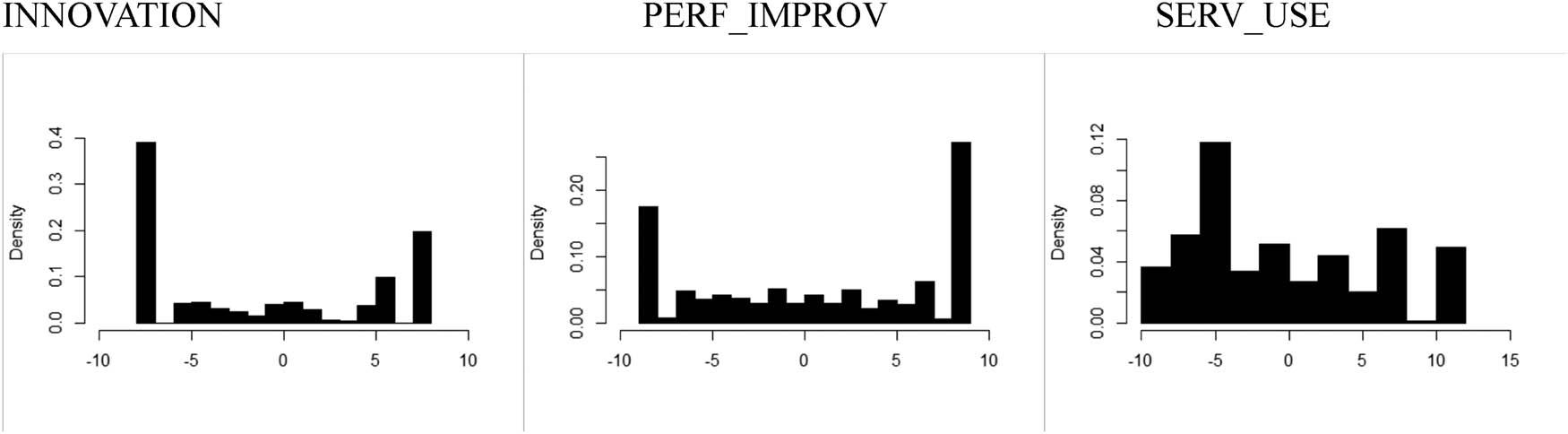
Figure 1
Distributions of principal component indices.
Source: Author’s contribution.
The results for this regression are provided in Table 3. Almost all variables, with the exception of Performance Improvement, have significantly positive coefficients. This result confirms our hypothesis that our chosen drivers – particularly performance – indeed lead to increased innovation within a cluster. Performance, in this context, refers to improvements driven by cluster membership, such as enhanced cooperation with scientific entities, better alignment of research infrastructure with company needs, and more effective activities of cluster coordinators in promoting innovation and digitization efforts. The data indicate that participation in cluster-related activities, such as joint training programs and pro-innovation services, significantly boosts innovation performance, thus highlighting the critical role of these elements in fostering a collaborative and innovative environment within clusters.
Table 3
Regression results.
| Method | OLS | OLS | Probit | Probit | Probit | Probit |
|---|---|---|---|---|---|---|
| Dependent variable | INNOVATION | INNOVATION | Q_INNOV | Q_INNOV | TECH_SOPH | TECH_SOPH |
| (Intercept) | −4.039 (0.000) | −4.150 (0.000) | −0.856 (0.000) | −0.908 (0.000) | −0.856 (0.001) | −0.842 (0.000) |
| PERF_IMPROV | 0.403 (0.000) | 0.404 (0.000) | 0.088 (0.000) | 0.088 (0.000) | 0.125 (0.000) | 0.124 (0.000) |
| SERV_USE | 0.073 (0.091) | 0.069 (0.018) | 0.03 (0.106) | 0.027 (0.033) | 0.014 (0.467) | 0.019 (0.154) |
| COMP_IMPROV | 6.034 (0.000) | 6.040 (0.000) | 1.425 (0.000) | 1.425 (0.000) | 1.367 (0.000) | 1.360 (0.000) |
| RD_EXPEND | −0.281 (0.513) | −0.114 (0.541) | −0.130 (0.514) | |||
| CLUSTER_INNOV | 0.190 (0.689) | 0.047 (0.814) | 0.238 (0.255) | |||
| NKC | −0.528 (0.134) | −0.532 (0.129) | −0.051 (0.732) | −0.054 (0.716) | −0.230 (0.141) | −0.241 (0.122) |
| OTHER | 2.920 (0.003) | 2.926 (0.003) | 0.913 (0.04) | 0.895 (0.044) | 0.969 (0.043) | 0.968 (0.044) |
| IOB | 3.327 (0.080) | 3.283 (0.084) | 1.422 (0.045) | 1.393 (0.048) | 0.497 (0.578) | 0.450 (0.607) |
| NAUKOWA | 1.220 (0.094) | 1.156 (0.107) | 0.412 (0.174) | 0.381 (0.204) | 0.420 (0.192) | 0.378 (0.233) |
| SAMORZAD | 0.547 (0.619) | 0.517 (0.638) | 0.44 (0.353) | 0.416 (0.381) | −0.756 (0.309) | −0.837 (0.264) |
| SIZEGROUP | 0.296 (0.096) | 0.295 (0.097) | 0.035 (0.645) | 0.035 (0.649) | 0.130 (0.103) | 0.126 (0.112) |
| Adj. R 2 or Pseudo R 2 | 0.653 | 0.653 | 0.398 | 0.398 | 0.475 | 0.472 |
| N | 493 | 493 | 493 | 493 | 493 | 493 |
P = values in parentheses. Robust Standard errors used for OLS estimation.
Source: Author’s contribution.
Table 3 provides our regression results, for two specifications of each of three dependent variables. There is a general consistency overall, although the model that uses our constructed “innovation” index has a better fit, measured by adjusted R-squared, as well as more significant determinants. Of the two constructed indices that are used as explanatory variables, PERF_IMPROV has a positive and highly significant effect on innovation in all specifications. The positive impact of SERV_USE, which is driven by TECH_SOPH, is most prevalent when two insignificant variables are dropped in the models. Based on these findings, we can conclude that hypotheses H1 and H4 are therefore supported.
Of the other key explanatory variables, CLUSTER_INNOV and RD_EXPEND do not have significant effects on innovation, and are dropped in the second specification. Only COMP_IMPROV has a positive effect. Therefore, we conclude that hypotheses H2 and H3 are not met.
The coefficients on the dummy variables indicate that membership in a National Key Cluster has no effect on innovation, when controlling for other firm characteristics. Firm size has a very weak effect, which is only significant at 10%, but which indicates that larger firms are more innovative. Only being classified as a business-supporting firm or as “other” has a significantly positive effect on innovation among these firms. These findings are worthy of further research in a future study. Using a Probit model with single index components as the independent variable confirms our general results. The only difference is when TECH_SOPH is used, and CLUSTER_INNOV is not significant.
Overall, we can say that the study demonstrates that clusters act as catalysts for innovation by enhancing the technological sophistication of member companies, facilitating the introduction of new products and business processes, and supporting participation in R&D projects. These factors contribute to the overall improvement of firms’ innovation capabilities, thereby validating that clusters are effective ecosystems for fostering innovation.
5. Discussion
The findings of this study underscore the significant positive impact that cluster membership has on the innovation performance of companies. Clusters facilitate a collaborative environment where firms can engage in knowledge sharing, thereby accelerating the innovation process. The data from the Polish Agency for Enterprise Development survey reveal that companies within clusters are more likely to introduce new products and processes, increase their technological sophistication, and participate in R&D projects compared to their non-clustered counterparts. This aligns with the theoretical framework proposed by Porter (1998), who emphasized that geographical proximity of interconnected firms, institutions, and industries plays a crucial role in competitive advantage and innovation. Similarly, Audretsch and Feldman (1996) demonstrated that innovation, particularly in knowledge-intensive sectors, is often geographically concentrated in clusters, further validating the role of such ecosystems in enhancing innovation capacity.
The study identifies several mechanisms through which clusters enhance innovation performance. The first mechanism is related to knowledge spillovers as clusters facilitate the exchange of knowledge and ideas among member firms, academic institutions, and other stakeholders. This exchange is critical for innovation, as it allows firms to leverage external knowledge and expertise. Knowledge spillovers occur when firms in close proximity to one another exchange information, ideas, and technological insights, thereby improving their collective innovation capacity. This finding is supported by the work of Delgado et al. (2016), who highlighted that firms in strong clusters tend to achieve higher levels of innovation output due to dense networks of collaboration and knowledge-sharing. In our study, the regression analysis indicates that variables related to knowledge transfer, such as participation in joint R&D projects and professional development initiatives, are positively correlated with innovation outcomes. This finding echoes the research results of Xu et al. (2022), who emphasize the role of knowledge spillovers within clusters, arguing that these spillovers contribute to the transformation and optimization of industrial structures.
The second mechanism influencing innovation is access to specialized resources, including human capital, advanced technologies, and financial support. Firms in clusters often have privileged access to these resources, which gives them a competitive edge over isolated firms. The importance of resource access in clusters is well-documented in the literature. For example, (Krugman, 1991) noted that the spatial concentration of industries leads to external economies of scale, whereby firms benefit from reduced transaction costs, better access to inputs, and increased efficiency. Similarly, (Gnyawali & Srivastava, 2013) emphasized that firms in clusters can tap into diverse capabilities and resources, particularly through collaborative partnerships with other firms.
The empirical results of our study also allow to identify the third mechanism driving innovation, i.e., collaborative projects. Participation in joint R&D projects, facilitated by cluster organizations, helps firms develop new capabilities and accelerate the innovation process. Xu et al. (2023) highlighted the importance of inter-firm cooperation in industrial clusters for new product development, noting that collaboration allows firms to overcome technical challenges and bring innovations to market more quickly. Our findings suggest that firms actively participating in cluster-initiated R&D projects report higher levels of innovation, supporting the argument that clusters act as catalysts for collective learning and innovation.
The fourth identified mechanism influencing innovation are pro-innovation services as clusters often provide a range of pro-innovation services, such as technology audits, commercialization plans, and digital transformation support. These services are instrumental in enhancing the technological sophistication of firms, as evidenced by the positive correlation between the use of pro-innovation services and innovation performance in our study. This finding is consistent with previous research by Lis & Kowalski, 2022, who highlighted the role of cluster organizations in promoting non-technological innovations through business support services.
However, while clusters significantly contribute to innovation, they are not without challenges. One notable challenge is the risk of lock-in, where firms become overly specialized and resistant to new technologies or market changes. Our study partially corroborates this by noting that not all cluster firms benefit equally from knowledge spillovers or innovation opportunities. Firms located on the periphery of clusters or those with limited collaboration opportunities may experience lower innovation outcomes than core firms with more robust connections. Additionally, clusters do not universally prioritize high-technology innovation. While some clusters, particularly those in technology-intensive industries, are hubs of cutting-edge innovation, others may focus on more traditional industrial activities, which can limit their overall innovation output.
6. Conclusion
While clusters significantly contribute to innovation, they also present challenges such as the risk of lock-in, where firms may become overly specialized and slow to adapt to new technologies or market conditions. Moreover, the benefits of clusters are not universally experienced, as peripheral firms may not experience the same levels of knowledge spillover as those at the core. Furthermore, not all clusters prioritize high-technology innovations. As noted by McCormick, 2007, some clusters may focus on other aspects of industrialization, which can impact the overall innovation output.
Despite the positive findings, the discussion also highlights several challenges and limitations associated with clusters as they differ in their prioritization of innovation, with some focusing more on incremental improvements rather than high-technology or groundbreaking innovations. Not all clusters are focused on fostering cutting-edge technologies; some may prioritize other industrial processes or traditional sectors, which can limit the cluster’s overall innovation output (McCormick, 2007). This variation can affect the long-term competitiveness of firms within the cluster, especially in industries where rapid technological advancement is key. Our study observed that clusters with a stronger focus on high-technology sectors showed greater innovation improvements than those in more traditional industries. Furthermore, small and medium-sized enterprises (SMEs) may face challenges in fully participating in cluster activities due to resource constraints. While larger firms may have the capacity to engage in joint R&D projects and make use of pro-innovation services, SMEs often struggle with the high costs associated with these activities. Kowalski et al. (2022) highlight that smaller firms often require additional support mechanisms to fully benefit from cluster initiatives, such as tailored financial assistance or specialized training programs. This limitation was evident in the study, where smaller firms were less likely to report significant improvements in innovation performance compared to larger, well-established firms.
Effective coordination within clusters is essential for maximizing the benefits of collaboration and resource sharing. However, the study noted that in some cases, the activities of cluster coordinators were not perceived as effective by all members, particularly in areas such as promoting innovation or facilitating digital transformation. Sölvell et al. (2003) emphasize that the success of a cluster depends heavily on the quality of its management and the ability to coordinate joint efforts effectively. When cluster organizations are not proactive in fostering collaboration or addressing the needs of their members, the potential for innovation may be diminished.
While clusters undeniably offer significant advantages for fostering innovation, addressing these challenges is critical for ensuring that clusters can continue to thrive and support innovation across diverse industries and firm sizes. The findings of this study have several important implications for policymakers and managers. From the policy perspective, cluster initiatives need to be supported to enhance regional innovation capacity. This support can include funding for joint R&D projects, professional development programs, and pro-innovation services. To mitigate the risk of lock-in, clusters should encourage diversity in their member base and promote collaborations that bring in new perspectives and technologies. Cluster policies should be inclusive so efforts should be made to ensure that peripheral firms also benefit from cluster initiatives. This can be achieved through targeted support and inclusion strategies. There is also a need for continuous monitoring as regular benchmarking and evaluation of cluster initiatives can help in identifying areas for improvement and ensuring that clusters continue to meet their innovation goals.
The study points out several key directions for future research, which could further deepen the understanding of how clusters influence innovation performance and address the limitations encountered in this study. One area for future research is the longitudinal study of clusters to better understand their evolution over time. While this study provides valuable insights into the current impact of clusters on innovation, examining how clusters develop, adapt, and potentially decline over extended periods would offer a more nuanced view of their life cycles. Moreover, while much of the literature and empirical evidence focuses on clusters in high-tech industries, there is still a need to explore the impact of clusters in more traditional or emerging sectors. Furthermore, taking into account that peripheral firms often do not benefit as much as core firms within clusters, future studies could investigate mechanisms for ensuring that smaller or less-central firms can better access the resources, knowledge spillovers, and collaborative opportunities offered by clusters. This would also involve examining policies or cluster management strategies that promote inclusivity and diversity within cluster ecosystems.
In conclusion, the study reaffirms the critical role of clusters in fostering innovation among companies. By providing a conducive environment for knowledge sharing, resource access, and collaborative projects, clusters significantly enhance the innovation performance of their member firms. However, to fully realize the benefits of clusters, it is important to address the challenges of lock-in, uneven benefits, and varied innovation priorities.
Acknowledgements
This work was supported by the National Science Center, Poland, under Grant No. 2022/47/B/HS4/01255 “Clusters and cluster policy models in the world economy.”
Author contributions
Conceptualisation, AMK and SWH; methodology, AMK and SWH; formal analysis, AMK and SWH; data curation, AMK and SWH; calculations, SWH; writing – original draft preparation, review and editing, AMK and SWH; project administration, AMK. All authors have read and agreed to the published version of the manuscript.
Conflict of interest statement
Authors state no conflict of interest.
Appendices
Appendix
Table A1
Survey variables used in this study
| DV: INNOVATION | Question |
|---|---|
| Q_INNOV | Has your organization’s performance improved in the following areas – [Number of innovations introduced] due to participation in the cluster |
| TECH_SOPH | Has your organization’s performance improved in the following areas – [Increased technological sophistication] due to participation in the cluster |
| PROD_INN | Has your organization introduced product innovation or business process innovation in the last 2 years - (multiple answers possible) [Product innovation (service or product that is new or significantly improved)] due to its participation in the cluster |
| BUS_INN | Has your organization introduced product innovations or business process innovations in the last 2 years due to its participation in the cluster - (multiple answers possible) [Business process innovations] |
| Group: PERF_IMPROV question | |
| SCI_COOP | Through participation in the cluster, has your organization established and/or intensified cooperation with scientific entities (in the last 2 years) |
| RES_INF_RES | How do you assess the availability of resources in the cluster from the point of view of your organization – [Research Infrastructure] |
| RES_INF_NEEDS | How would you rate the degree to which the research and production infrastructure in the cluster is aligned with the needs of your organization [Research Infrastructure] |
| COORD_INNOV | How would you rate the activities of the cluster coordinator in the following areas (in the last 2 years) – [Innovation activity (e.g., pro-innovation services, innovation development)] |
| COORD_DIG | How do you evaluate the activities of the cluster coordinator in the following areas (in the last 2 years) - [Activities for digitization of the cluster/implementation of Industry 4.0 technologies] |
| Group: SERV_USE question | |
| Has your organization used the following pro-innovation services provided in the cluster by or through the cluster in the last 2 years | |
| TECH_MON | Technology Trends Monitoring |
| TECH_AUD | Technology audit |
| COMM_PLANS | Commercialization plans |
| IND_CONS | Industrial protection consulting |
| TRAINING | Specialized training |
| DIG_TRANS | Digital transformation and application of Industry 4.0 technologies |
| Other explanatory variables and dummies | |
| CLUSTER_INNOV | Has your organization participated in the implementation of an innovation and/or R&D project in a cluster (with the participation of a coordinator and min. two members or with min. three cluster members without a coordinator) in the last 2 years |
| COMP_IMPROV | Have the employees of your organization participated in cluster-initiated joint forms of professional competence improvement (such as trainings, workshops, courses) in the last 2 years |
| RD_EXPEND | Has your organization’s performance improved in the following areas - [Amount of R&D expenditure] as a result of participating in the cluster |
| NKC | = 1 if Member of a National Key Cluster |
| SIZEGROUP | 1 = Microenterprise (0–9 employees); 2 = Small enterprise (10–49 employees); 3 = Medium enterprise (50–249 employees); 4 = Large enterprise (250 or more employees). |
| IOB | = 1 if categorized as a Business environment institution |
| NAUKOWA | = 1 if categorized as a Scientific unit/university |
| SAMORZAD | = 1 if categorized as a Local government unit |
| OTHER | = 1 if categorized as “Other” or not listed |
Source: Author’s contribution.
Table A2
Clusters’ characteristics.
| Cluster | NKC | Most_Common_Type | Region – voivodship |
|---|---|---|---|
| LODZistics - Logistics Business Network of Central Poland | No | Scientific unit/University | Lodzkie |
| Metal Processing Cluster | No | Small enterprise | Podlaskie |
| Subcarpathian Flavors Cluster | No | Small enterprise | Subcarpathian |
| East Automotive Alliance | No | Large enterprise | Subcarpathian |
| Carpathian Tourist Cluster | No | Microenterprise | Subcarpathian |
| Cluster “Polish Automotive Group” | Yes | Large enterprise | Subcarpathian |
| Food Cluster of Southern Wielkopolska Association | No | Microenterprise | Greater Poland |
| Polish Cluster of Composite Technologies | Yes | Microenterprise | Lesser Poland |
| Polish Construction Cluster | No | Microenterprise | Podlaskie |
| Waste Management and Recycling Cluster | Yes | Microenterprise | Masovian |
| Mazovia Cluster ICT | Yes | Microenterprise | Masovian |
| Bydgoszcz Industrial Cluster Tool Valley | Yes | Small enterprise | Kuyavian-Pomeranian |
| Lublin Medicine | No | Microenterprise | Lubelskie |
| MedSilesia - The Silesian Network of Medical Devices | Yes | Small enterprise | Silesian |
| Silesia Automotive and Advanced Manufacturing | Yes | Medium enterprise | Silesian |
| NUTRIBIOMED Cluster | Yes | Microenterprise | Lower Silesia |
| Lower Silesian Educational Cluster | No | Local government unit | Lower Silesia |
| ITCorner | No | Small enterprise | Lower Silesia |
| Radom Metal Cluster | No | Medium enterprise | Masovian |
| Cluster for Photonics and Fiber Optics | No | Microenterprise | Lubelskie |
| The Easter Metalworking Cluster | Yes | Medium enterprise | Lubelskie |
| Lubuski Metal Cluster | No | Medium enterprise | Lubuskie |
| Lower Silesian Automotive Cluster | No | Medium enterprise | Lower Silesia |
| North-South Logistics and Transport Cluster | Yes | Microenterprise | Pomeranian |
| Polish Nature Cluster | No | Microenterprise | Masovian |
| Lodz ICT Cluster | No | Large enterprise | Lodzkie |
| Association West Pomeranian Chemical Cluster “Green Chemistry” | Yes | Medium enterprise | West Pomeranian |
| Silesian Aviation Cluster | Yes | Microenterprise | Silesian |
| Interizon ICT Cluster | Yes | Small enterprise | Pomeranian |
| Cluster of Information Technologies in Building Industry | No | Microenterprise | Lesser Poland |
| Digital Creative Cluster | No | Small enterprise | Masovian |
| Bydgoszcz IT Cluster | Yes | Microenterprise | Kuyavian-Pomeranian |
| Wielkopolska ICT Cluster | No | Microenterprise | Greater Poland |
| Lublin Enterprise Cluster | No | Microenterprise | Lubelskie |
| The Cluster of Tourist Brands of Eastern Poland | No | Small enterprise | Podlaskie |
| Construction Cluster INNOWATOR | No | Microenterprise | Holly Cross |
| West Pomeranian ICT Cluster | No | Small enterprise | West Pomeranian |
| Sustainable Infrastructure Cluster | Yes | Small enterprise | Lesser Poland |
| Cluster of Innovative Manufacturing Technologies (CINNOMATECH) | No | Microenterprise | Lower Silesia |
| Lublin Eco-Energy Cluster | No | Microenterprise | Lubelskie |
| Kuyavian Agro Cluster | No | Small enterprise | Kuyavian-Pomeranian |
Note: HHI – Hirschman Indices of Industry Concentration in Firm. NKC – National Key Clusters. Large enterprise (≥250 employees), Medium enterprise (50–249 employees), Small enterprise (10–49 employees), Microenterprise (0–9 employees).
Source: Author’s contribution.
Table A3
Clusters’ firms’ characteristics by region.
| Region – voivodship | # Clusters w/Seat | Most_Common_Type | % of total | # Firms |
|---|---|---|---|---|
| Masovian | 5 | Large enterprise | 51.1 | 90 |
| Lubelskie | 5 | Local government unit | 41.0 | 83 |
| Silesian | 3 | Small enterprise | 27.4 | 73 |
| Lower Silesian | 5 | Small enterprise | 25.7 | 70 |
| Subcarpathian | 4 | Small enterprise | 29.5 | 44 |
| Lesser Poland | 3 | Small enterprise | 34.9 | 43 |
| Podlaskie | 3 | Small enterprise | 42.9 | 42 |
| Lodzkie | 2 | Microenterprise | 21.9 | 32 |
| Kuyavian-Pomeranian | 3 | Microenterprise | 34.4 | 32 |
| Greater Poland | 2 | Microenterprise | 36.7 | 30 |
| Pomeranian | 2 | Microenterprise | 33.3 | 27 |
| Lubuskie | 1 | Microenterprise | 27.3 | 22 |
| West Pomeranian | 2 | Microenterprise | 33.3 | 21 |
| Warmińsko-Mazurskie | 0 | Microenterprise | 40.0 | 15 |
| Holy Cross | 1 | Medium enterprise | 44.4 | 9 |
| Opolskie | 0 | Medium enterprise | 33.3 | 6 |
Note: Large enterprise (≥250 employees), Medium enterprise (50–249 employees), Small enterprise (10–49 employees), Microenterprise (0–9 employees).
Source: Author’s contribution.
Table A4
Types of cluster members distribution (N = 641).
| Type | N | % |
|---|---|---|
| Local government unit | 19 | 3.0 |
| Scientific unit/university | 47 | 7.3 |
| Microenterprise (0–9 employees) | 209 | 32.6 |
| Small enterprise (10–49 employees) | 156 | 24.3 |
| Medium enterprise (50–249 employees) | 119 | 18.6 |
| Large enterprise (250 or more employees) | 63 | 9.8 |
| Other | 17 | 2.7 |
| Business environment institution | 6 | 0.9 |
| None | 6 | 0.9 |
Source: Author’s contribution.