
1. Introduction
Corporate social responsibility (CSR) initiatives are currently scrutinized regarding their economic benefits for companies (García-Sánchez & García-Sánchez, 2020). Questions are raised about whether these initiatives enhance value (e.g., Ferrell et al., 2016) or lack real environmental or social implications (García-Sánchez & García-Sánchez, 2020). The impact of CSR on firm value has been extensively researched, e.g., Carroll and Shabana (2010) refer to the potential benefits that companies gain from CSR as the “business case for CSR.” Researchers assume that engaging in CSR activities supports the local community and serves the company’s long-term self-interest (Carroll & Shabana, 2010). This also responds to Friedman’s (1970) argument that business should focus solely on long-term profits. Proving that companies benefit financially from CSR would counter Friedman’s claims. The debate regarding corporate responsibility to shareholders versus stakeholders has persisted for over 50 years, notably during the 2008–2009 financial crisis (Lins et al., 2017) and the current COVID-19 crisis.
Crises have challenged numerous CSR assumptions, concepts, and practices, as well as their impact on company performance (e.g., Albuquerque et al., 2020). During the COVID-19 pandemic, corporations have reaffirmed their commitment to stakeholder interests to maintain shareholder value (Bae et al., 2021). Companies across many industries faced supply chain disruptions, necessitating production cuts and cost increases. Consumer purchasing behavior also shifted, leading to a surge in online shopping demand (Donthu & Gustafsson, 2020).
Various motives drive companies to engage in CSR (Manuel & Herron, 2020). Broccardo et al. (2019) identified key CSR drivers, including firm size, firm age, community commitment, and managers’ values and educational backgrounds. Managers’ attitudes toward CSR significantly influence corporate CSR activities (e.g., Wójcik, 2018). Zhuang et al. (2020) argue that entrepreneurial orientation (EO), defined by innovativeness, proactiveness, and risk-taking, encourages more socially responsible practices and benefits society. In addition, Karaibrahimoğlu (2010) posited that financial crises can spur societal responsiveness as a business strategy. During the COVID-19 pandemic, companies increased their CSR activities due to utilitarian and deontological motivations, addressing the needs of stakeholders (Manuel & Herron, 2020). CSR activities build social capital, enhancing stakeholder cooperation, trust, and reducing the need for formal contracts (Lins et al., 2017). Stakeholder attention is crucial for CSR initiatives to generate financial benefits (Madsen & Rodgers, 2015).
Understanding the relationship between CSR and company performance during the COVID-19 pandemic can help businesses plan future CSR programs. He and Harris (2020) suggest that the pandemic will accelerate postpandemic CSR growth as companies recognize the necessity of balancing profitability with stakeholder engagement for long-term survival. Rawhouser et al. (2019) emphasize the importance of quantitative methods in evaluating CSR challenges, which can be achieved by integrating industry focus.
To address the research gap, the objective of this study is to answer the following research questions:
1) How managers’ perceptions of CSR, EO, and the impact of the COVID-19 pandemic on business conditions affect CSR activities undertaken by companies?
2) How CSR activities affect companies’ performance during COVID-19 pandemic?
To address these questions, a survey was conducted with 241 medium and large companies in Poland from the fashion, cosmetics, and consumer electronics industries. Partial least squares structural equation modeling (PLS-SEM) was used to analyze the results and verify the research hypotheses.
This article is structured as follows: it begins with a critical literature review of CSR drivers, CSR initiatives, and the relationship between CSR and company performance. The subsequent sections present the conceptual model, research methods, and findings. This article concludes with a brief discussion of the results, limitations, and suggestions for future research.
2. Literature review
2.1. CSR drivers
CSR drivers can be categorized into external and internal factors. External drivers include obtaining legitimacy (institutional theory, legitimacy theory), securing stakeholder support (stakeholder theory), and ensuring resource flow (resource dependence theory). Internal drivers involve developing valuable nonmarket resources (resource-based view) and satisfying managerial needs (agency theory) (Frynas & Yamahaki, 2016).
Aguilera et al. (2007) propose a CSR model that suggests that companies engage in CSR activities at the organizational level based on a hierarchy of motivations. According to Aguilera et al. (2007), the primary motivator for undertaking CSR activities is the self-interested or instrumental motivation to achieve benefits that promote firm survival. A secondary motivator for CSR is the potential benefit to relationships with stakeholders, which can positively impact financial performance. The third motivator is deontological, driven by the moral imperative to do what is right. These motivations can operate simultaneously, with some being more salient than others at different times, and a single action can satisfy multiple motivations (Manuel & Herron, 2020). A similar approach is taken by Gond et al. (2017), who in their model of psychological microfoundations of CSR, divide CSR drivers into 1) instrumental (e.g., ego-based motives, self-serving concerns), 2) relational (e.g., need for belongingness, relationship-based concerns), 3) moral (e.g., need for meaningfulness, care-based concerns), and 4) other individual drivers (e.g., sociodemographics, personality traits).
At the individual level, researchers agree that managers’ attitudes toward CSR are a significant factor influencing the activities undertaken by enterprises in this field (e.g., Wójcik, 2018). Motivations for CSR can range from self-centeredness to managerial altruism (García-Sánchez & García-Sánchez, 2020). Mi et al. (2018) posited that beliefs and values are the fundamental reasons that drive an entrepreneur’s sustainable corporate strategy. The ethical attitude of managers strengthens the relationship between a company’s commitment to CSR and its performance (Kim & Statman, 2012). Employees are more willing to engage in developing and implementing practices that have a positive impact if they feel encouraged by management (Belak & Rozman, 2012). Javed et al. (2016), and Wang et al. (2016) indicate the need for further research on the motives for implementing CSR activities by top management, particularly identifying whether these motives are driven by profit, company values, or involvement in broader social issues.
Managers’ attitudes toward CSR were examined, among others, by Quazi and O’Brien (2000), who developed a two-dimensional CSR model to measure the level of corporate involvement in CSR activities and tested it empirically on companies based in Sydney and Bangladesh. Quazi and O’Brien (2000) analyze CSR motives considering two dimensions: 1) the perception of CSR in a narrow or broad sense, and 2) the perception of the costs and benefits associated with CSR. The narrow approach to social responsibility focuses on delivering goods and services and maximizing short-term profits within the framework of applicable norms and legal regulations. A broad approach to CSR occurs when a company addresses broader societal needs, such as environmental protection, resource conservation, and the development of local communities. Viewing social responsibility through the lens of costs happens when CSR is seen solely as an expenditure. Conversely, recognizing long-term benefits that exceed costs reflects understanding CSR from a profit perspective (Quazi & O’Brien, 2000). In addition, evidence suggests that during crises and periods of uncertainty, senior leadership plays a crucial role in adopting CSR activities. As He and Harris (2020) claim, the COVID-19 pandemic provides a valuable context to examine how institutional factors and leadership influence firms’ CSR and ethical conduct.
Thus, the following hypotheses were formulated:
H1: The more managers perceive CSR as a cost, the less intense their companies’ CSR activities.
H2: The more managers perceive CSR as a benefit, the more intense their companies’ CSR activities.
Recently, EO has become increasingly important for organizational engagement in CSR practices. Miller (1983, p. 771) argues that EO refers to an entrepreneurial firm that “engages in product-market innovation, undertakes somewhat risky ventures, and is first to come up with ‘proactive’ innovations, beating competitors to the punch.” The EO of a CEO reflects their consistent focus on entrepreneurship and can shape organizational behavior and outcomes (Keil et al., 2017). Zhang et al. (2021) argue that a CEO’s EO, characterized by their willingness to implement innovative, proactive, and risky behaviors, plays a significant role in the company’s choice of CSR activities. These authors show that the CEO EO significantly leads to greater engagement in CSR activities beyond just corporate philanthropy (Zhang et al., 2021). The role of a company’s EO in enhancing CSR performance has been studied by several researchers, including Zhuang et al. (2020). They argue that a firm’s innovativeness, proactiveness, and risk-taking can lead to more socially responsible practices and generate benefits for society (Zhuang et al., 2020). Researchers agree that future studies should explore the connections between EO and CSR activities (e.g., Dai et al., 2015).
Thus, the third hypothesis was formulated:
H3: The stronger a company’s EO, the more intense its CSR activities.
The COVID-19 crisis has altered the way companies pursue their economic, social, and environmental objectives, emphasizing the role they must play in society. This shift means that companies were driven by both profit and obligation when deciding whether to engage in CSR. García-Sánchez and García-Sánchez (2020) argue that balancing profit with the common good is a more sustainable strategy for long-term survival. He and Harris (2020) state that, on one hand, crises may discourage companies from investing in CSR due to the need to focus on core operations for short-term survival. On the other hand, historical crises (e.g., the oil crisis in the 1970s) have sometimes facilitated the development of CSR. An increasing body of research examines the impact of COVID-19 on various industries and the role companies should play in the post-COVID era (García-Sánchez & García-Sánchez, 2020). Qiu et al. (2021) suggest that it is worth investigating whether investing in CSR to consolidate corporate financial performance during crises is a wise strategy. The heightened attention and the demand for CSR following the market crash caused by the COVID-19 pandemic provide a unique opportunity to test the notion that CSR protects company value during periods of crisis (Bae et al., 2021).
Thus, the fourth hypothesis was formulated:
H4: The greater the impact of the COVID-19 pandemic on business conditions, the more intense the company’s CSR activities.
2.2. CSR initiatives
Business organizations have chosen different types of CSR for their own purposes (Wu & Kong, 2021). CSR activities can range from business practices that reduce harm to the environment and people, to engaging in philanthropy and supporting employee volunteerism in socially desirable causes (Manuel & Herron, 2020). Chowdhury et al. (2019), borrowing from the concept of sustainable development and the triple bottom line model of Elkington (1999), indicate three interrelated aspects of CSR: economic, social, and environmental. Through CSR activities targeted at multiple stakeholders, an organization can reconcile economic and social goals while caring for the interests of both the company and society (Wu & Kong, 2021). Organizations may vary considerably in their response to social issues, but their social performance is mainly determined by how they deal with stakeholder relationships and issues. Each CSR activity is guided by different principles and concerns a different group of stakeholders, but they should be complementary to each other. Literature presents various classifications of CSR activities, but all of them have a common core and are often categorized into four areas: 1) natural environment, 2) marketplace, 3) workplace, and 4) society (e.g., Carrero & Valor, 2012). The literature also emphasizes the particular importance of CSR activities within the supply chain (e.g., Chu, 2019; Klosa & Kisperska-Moroń, 2017; McGoldrick & Freestone, 2008).
Businesses have seen an increased demand for CSR activities in response to the pandemic (Manuel & Herron, 2020). COVID-19 poses challenges to firms and organizations and puts companies to the test regarding their commitment to ethical business conduct and CSR. As He and Harris (2020, p. 177) argue, financial strains caused by the pandemic could “significantly push firms to pursue short-term gains, sometimes even through fraud and misconduct, and reduce long-term CSR investment, probably due to lack of slack resources and mounting pressure for survival.” Manuel and Herron (2020) state that the COVID-19 pandemic’s impact on health and the economy fits into the disaster category. These researchers state that corporate philanthropy, as a subset of CSR, was growing during most of the major recent natural disasters. The stock market and affected employees responded positively to announcements of corporate philanthropy in a disaster, which might mean that the market valued these CSR investments (Manuel & Herron, 2020).
Moreover, during the COVID-19 pandemic, the safety and well-being of customers are particularly essential elements of CSR (Wen et al., 2020) and can bring additional benefits by increasing customer loyalty (Qiu et al., 2021). CSR initiatives helped corporations discover business opportunities by being committed to social issues, such as COVID-19 (Wu & Kong, 2021). As indicated by previous studies, communities, customers, and employees are the most vulnerable to pandemics (e.g., Hao et al., 2020; He & Harris, 2020; Qiu et al., 2021). Crane and Matten (2021) identify four key areas where CSR research has been challenged by COVID-19: stakeholders, societal risk, supply chain responsibility, and the political economy of CSR. García-Sánchez and García-Sánchez (2020) identify three areas of responsibility during the COVID-19 crisis: 1) protecting the interests of shareholders and investors, 2) promoting the well-being of society in general and vulnerable groups in particular, and 3) combining altruistic activities with commercial interests. Their results show that large Spanish companies are not only highly oriented toward the legitimacy and protection of the interests of shareholders and investors but also demonstrate a strong altruistic commitment to society, playing an important role in the economic and social recovery of Spain from the COVID-19 crisis (García-Sánchez & García-Sánchez, 2020).
2.3. CSR impact on company performance
The link between CSR initiatives and firm performance is complex because of its multifaceted nature. In recent years, the term “business case for CSR” has appeared in the scientific literature on CSR (e.g., Carroll & Shabana, 2010). This refers to a set of arguments describing the potential benefits that companies gain if they invest in CSR. The basic question answered by a business case for CSR is: “What do companies and organizations gain and how do they benefit from their involvement in CSR?” (Carroll & Shabana, 2010, p. 86). Kong et al. (2020) state that future researchers should focus on solving these challenges.
The variety of CSR indicators makes measuring CSR initiatives difficult in relation to financial performance (Crane et al., 2019). Even though CSR activities involve investment to improve social well-being with or without direct benefit to corporate financial performance (Qiu et al., 2021), researchers point to the trend of a closer connection between CSR and the financial goals of the organization. CSR activities, while generating costs in the short term, are usually aimed at improving and sustaining long-term corporate financial performance (Feng et al., 2018). Vogel (2005) believes that a thorough examination of the relationship between CSR initiatives and financial performance is a feature of the “new world of CSR,” where the essence of CSR starts to be “doing good to do well” and emphasizing the relationship between CSR and the financial success of a company.
An attempt to establish a business case for CSR strives to prove a positive relationship between the efficiency of CSR activities and the company’s financial results (Carroll & Shabana, 2010, p. 93). Researchers are still seeking answers to the question of whether enterprises can achieve better financial results by carrying out their core business activities while fulfilling their obligations to society (e.g., Zaborek, 2014). Companies undertaking and publicizing CSR activities achieve higher valuations if CSR activities and the company’s reputation are consistent. Appropriate CSR activities that satisfy different stakeholders may benefit corporate image (Franco et al., 2020) and contribute to favorable assessments in capital markets (Madsen & Rodgers, 2015). Chen (2019) states that a positive corporate image through corporate donations can improve employee morale and increase productivity, thereby reducing production and operating costs and enhancing company performance. Li et al. (2016) found that the lack of employee protection rights reduces commitment to work and proactive customer service. Qiu et al. (2021) state that CSR in relation to clients has a significant and immediate impact on the company’s financial results, which in turn may positively affect the return on capital during a crisis. Lins et al. (2017) indicate that companies with a high level of CSR achieve a surplus of returns on equity during financial crises due to high profitability, margin, sales growth, and employee productivity compared to companies with a low level of CSR.
The COVID-19 pandemic affected industries in different ways. Bae et al. (2021) indicate that in times of crisis, better stock price performance is to be expected from companies active in CSR if their actions are perceived as realistically meeting the increased stakeholder demand for CSR caused by the pandemic. The authors examined the impact of CSR across industries and found that it does not have a significant impact on performance during crisis or recovery periods in most industries, with the exception of consumer durables, chemicals and related products, business equipment, healthcare and medical equipment, and drugs (Bae et al., 2021). Qiu et al. (2021) state that involvement in CSR during a crisis can draw enormous public attention to companies that hope to improve their image and influence investor decisions, but whether companies should invest in CSR during difficult times remains controversial. Lee et al. (2013) claim that during a crisis, operations-related CSR (e.g., employee and environmental relations) increases the firm value. Mao et al. (2020) state that CSR activities can improve employees’ psychological capital in terms of self-efficacy, hope, resilience, and optimism during the COVID-19 pandemic.
Based on the aforementioned details, the fifth hypothesis was formulated:
H5: The more intense a company’s CSR activities, the better its financial and nonfinancial performance.
3. Research concept and method
Addressing the research gap identified through the literature review, this empirical study aims to determine the relationship between selected factors driving CSR activities and the intensity of these CSR activities undertaken by medium and large companies in the fashion, cosmetics, and consumer electronics industries operating in Poland. In addition, the study examines the impact of these activities on both financial and nonfinancial performance.
In the empirical study, the following factors were identified as drivers of CSR activities: (1) managers’ perception of CSR in terms of costs, (2) managers’ perception of CSR in terms of benefits, (3) EO, and (4) the impact of the COVID-19 pandemic on business conditions. The areas of CSR activities included in the research are as follows: (1) relations with employees, (2) natural environment, (3) relations with society, (4) relations in the supply chain, and (5) relations with costumers. Data on financial and nonfinancial results were collected based on the respondents’ assessment of changes in these companies’ results in 2021 compared to the end of 2019 (before the pandemic).
Company performance was analyzed using the following indicators: 1) financial (net profit, operating margin, revenue on sales – ROS, sales value), 2) nonfinancial (market share in terms of value, number of customers who make purchases on a regular basis, customer loss rate, number of new clients, awareness of the key brand among customers, company/key brand image, perceived quality of company brands/products), 3) income.
The conceptual model of the relationship between the variables included in the study is presented in Figure 1.
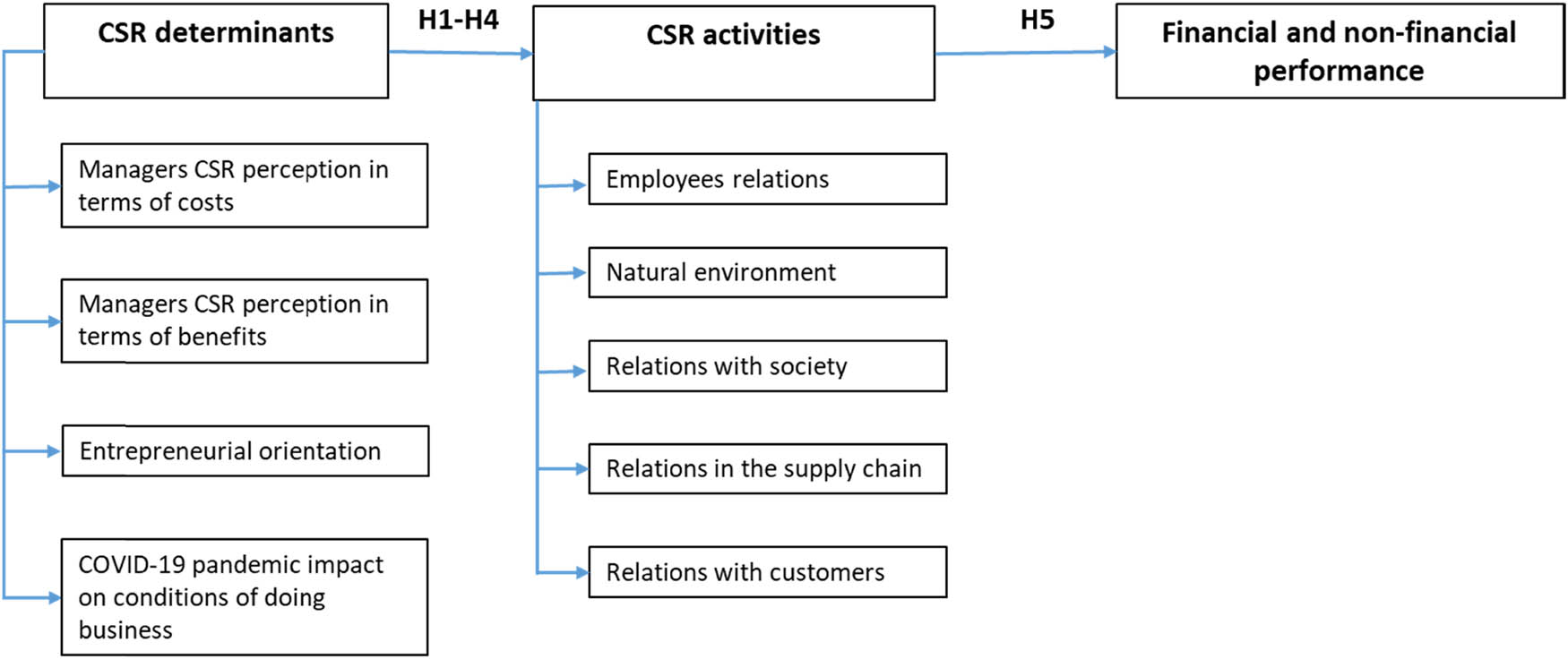
Figure 1
Conceptual model of the relationship between the variables included in the study.
Source: Own elaboration.
To answer the research questions and verify the research hypotheses, quantitative research was conducted using computer-assisted web interviews and computer-assisted telephone interviews. The study was carried out on a nationwide sample of 241 companies based in Poland that met the following criteria: medium-sized companies (i.e., with 50–249 employees) and large companies (i.e., with more than 250 employees) from the fashion, cosmetics, and consumer electronics industries operating in the B2C market and being manufacturers or trade intermediaries. Among the surveyed companies, the distribution was as follows: cosmetics industry – 89 companies (36.9%), consumer electronics industry – 78 companies (32.4%), and fashion industry – 74 companies (30.7%). This distribution indicates that similar number of companies represented all three industries included in the study. The respondents to the survey were owners of the surveyed companies and senior managers responsible for marketing, including CSR. The questionnaire consisted of closed questions with a 7-point Likert scale (statements about CSR drivers and CSR activities) and closed questions with a 5-point Likert scale (statements about companies’ performance). The study was conducted in July–August 2021 and was preceded by a pilot study on 10 companies.
For data analysis, the PLS-SEM method was used, employing the Smart PLS 3 software. This method is gaining importance in research, particularly for exploratory or theory development purposes (Hair et al., 2017). PLS-SEM allows for the extraction of latent variables and the estimation of the regression coefficients of the relationships between variables. To estimate the distribution of estimation errors and determine the statistical significance of the regression paths, PLS-SEM utilizes the bootstrapping procedure (Hair et al., 2014).
4. Structural model analysis
Based on the literature, four drivers and five dimensions of CSR activities were introduced to the structural model using the PLS-SEM method. The model consists of three main conceptual components:
1) Drivers of CSR activities, which consist of four exogenous reflective constructs – items adapted from Eggers et al. (2013), Quazi and O’Brien (2000), and own elaboration:
managers’ perception of CSR in terms of costs (CSRCT),
managers’ perception of CSR in terms of benefits (CSRBE),
EO,
impact of the COVID-19 pandemic on the business conditions (COP)
2) CSR activities, which consist of five dimensions (endogenous reflective constructs) – items adapted from Javed et al. (2016), Jiang and Wen (2020), Rettab et al. (2009), Schramm-Klein et al. (2015), Witek-Hajduk and Zaborek (2016), and own elaboration:
employee relations (CSREM),
natural environment (CSREN),
relations with society (CSRSO),
relations in the supply chain (CSRSU),
relations with costumers (CSRCO).
3) Surveyed companies performance, which consists of three endogenous formative constructs:
nonfinancial results (PNFI),
financial results (PFI),
income (PIN).
Variables concerning companies’ financial and nonfinancial results have been aggregated for the purposes of the model, creating the dependent variables: indices of financial and nonfinancial results.
Reflective constructs assume that the cause is the construct itself, and its manifestations are observable variables (as strongly correlated indicators). In the case of formative constructs, measurable variables form a construct for which pointers are the cause, so these constructs are indices for which a change in the value of the index translates into a change in the value of the construct. Figure 2 shows the structural model of the relationship between CSR drivers, CSR activities, and the results of the surveyed companies. To facilitate the interpretation of path coefficients, the diagram has been simplified by omitting measurable variables (i.e., indices of hidden variables).
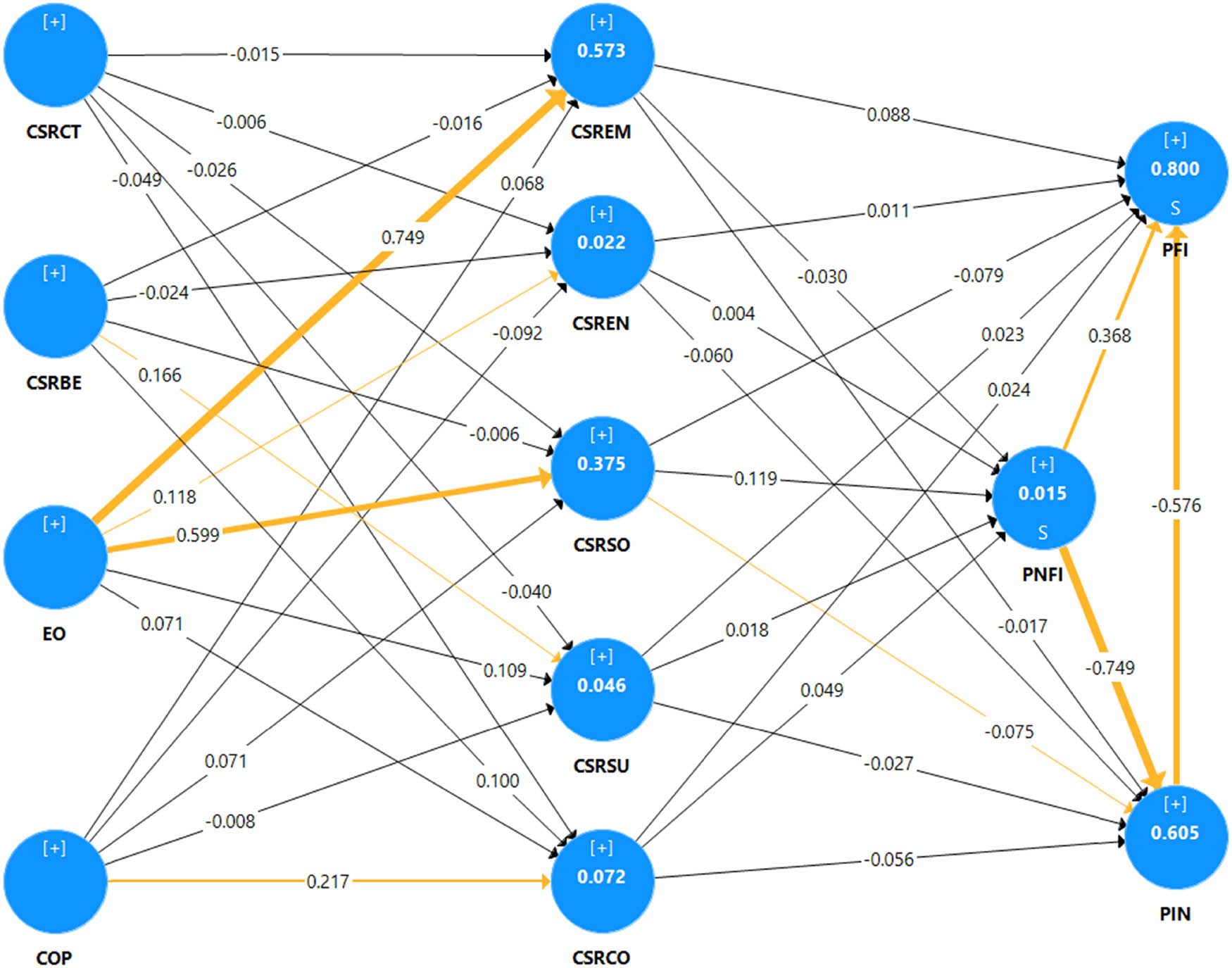
Figure 2
Structural model of relations between constructs. Explanations: Circles represent hidden variables, and the values given inside indicate the coefficients of determination R 2. Arrows (regression paths) between hidden variables indicate their cause–effect relationships resulting from theoretical assumptions (yellow color indicates statistically significant relationships), and the values indicated in the arrows represent path coefficients (i.e., standardized regression coefficients).
Source: Own elaboration with the use of SmartPLS software.
The sample size for the structural model estimated in PLS-SEM meets the requirement of the so-called “10 times rule,” i.e., the number of observations should be greater than ten times the largest number of paths leading to one of the variables hidden in the model (Hair et al., 2014). The evaluation of the model began with the determination of the parameters of the measurement (external) part. For this purpose, factor loadings were determined, and indicators with very low loadings (below 0.4) have been removed (Hair et al., 2011). Another model quality criterion is composite reliability and average variance extracted (AVE). In the presented model, all constructs present the AVE value greater than the required minimum level of 50% (Hair et al., 2014). This means that all reflective constructs of the model present a high level of convergent validity. The model meets the discriminant validity criterion as well. To assess this quality criterion the heterotrait–monotrait ratio of correlations (HTMT) was used as recommended by Henseler et al. (2015).
The next step in the analysis was to test the research hypotheses, i.e., the analysis of the structural (internal) model. The estimation of the structural model started with checking the collinearity (Hair et al., 2014). All constructs of the presented structural model present the variance inflation factor below 5.00 (Hair et al., 2014), which indicates the lack of collinearity between the constructs. The most frequently used measure to assess the structural model is the coefficient of determination (R 2), calculated for each endogenous construct (Hair et al., 2011). The values of R 2 for endogenous variables in the structural model are presented in Figure 2. Based on the estimated path coefficients and their statistical significance, it was determined whether the research hypotheses of the conceptual model are empirically confirmed (Table 1).
Table 1
Path coefficients and significance of relations between constructs (N = 241).
| Hypothesis | Path coefficients | Original sample | P values |
|---|---|---|---|
| H1 – not confirmed | |||
| H2 – partially confirmed | CSRBE → CSRSU | 0.166 | 0.032 |
| H3 – partially confirmed | EO → CSREM | 0.749 | 0.000 |
| EO → CSREN | 0.118 | 0.095 | |
| EO → CSRSO | 0.599 | 0.000 | |
| H4 – partially confirmed | COP → CSRCO | 0.217 | 0.006 |
| H5 – not confirmed |
Source: Own elaboration with the use of SmartPLS software.
5. Research results
The results of the structural model indicate that the “managers’ CSR perception in terms of costs (CSRCT)” does not have a statistically significant relationship with CSR activities. Therefore, hypothesis H1, which proposed that “The more managers perceive CSR as a cost, the less intense their companies’ CSR activities,” cannot be confirmed for any of the analyzed CSR dimensions. However, the “managers’ CSR perception in terms of benefits (CSRBE)” positively correlates with CSR activities related to “relations in the supply chain (CSRSU).” No statistically significant relationship was found for other CSR dimensions. In summary, hypothesis H2, stating that “The more managers perceive CSR as a benefit, the more intense their companies’ CSR activities,” is confirmed for activities related to supply chain relations.
“EO” shows a statistically significant positive relationship with three CSR dimensions: “relations with employees (CSREM),” “relations with society (CSRSO),” and “natural environment (CSREN).” The relationships with employees and society are strong, while the relationship with the natural environment is relatively weak. Thus, hypothesis H3, which posits that “The stronger a company’s entrepreneurial orientation, the more intense its CSR activities,” is confirmed for relations with employees, society, and the natural environment.
The impact of the COVID-19 pandemic on business conditions (COP) is positively related to “relations with customers (CSRCO),” while other CSR activities show no statistically significant relationship. Therefore, hypothesis H4, “The greater the impact of the COVID-19 pandemic on business conditions, the more intense the company’s CSR activities,” is confirmed only for customer relations.
Regarding the hypothesis on the relationship between CSR activities and the financial and non-financial performance of the surveyed companies, only one CSR activity, “relations with society (CSRSO),” shows a statistically significant relationship with “income (PIN).” However, this relationship is very weak and negative. As a result, hypothesis H5, which proposed that “The more intense a company’s CSR activities, the better its financial and non-financial performance,” is not confirmed.
6. Conclusions
The impact of COVID-19 has motivated companies to rethink their core competencies, seek new opportunities, and redefine sustainable business models more intensely and urgently (Bai et al., 2021). The pandemic has led to a surge in CSR initiatives, particularly in philanthropic activities and volunteering to support society. Many entrepreneurs demonstrated solidarity with society by addressing the most pressing issues caused by the pandemic (e.g., García-Sánchez & García-Sánchez, 2020).
This study contributes to the literature on the business case for CSR, particularly in relation to CSR drivers, CSR dimensions, and their impact on company performance. The survey, conducted on a sample of 241 medium and large companies in Poland from the fashion, cosmetics, and consumer electronics industries, indicates that the strongest factor driving CSR activities is EO. This factor has a positive impact on employee relations, societal relations, and environmental protection initiatives. These results align with the previous studies that show EO is becoming increasingly important for companies’ engagement in CSR practices (e.g., Zhuang et al., 2020). In addition, the research addresses calls for more studies connecting EO and CSR (e.g., Dai et al., 2015; Hajmohammad & Vachon, 2016).
During the COVID-19 pandemic, companies across various industries faced supply chain disruptions, leading to reduced production and increased costs. The findings of this research show that managers who perceive CSR in terms of benefits tend to initiate CSR activities in the supply chain. Leaders who recognize the long-term benefits of CSR are more likely to build honest and responsible relationships with business partners throughout the supply chain. The research also highlights a positive relationship between the impact of the COVID-19 pandemic on business conditions and CSR activities focused on customer relations. This suggests that the greater the impact of the pandemic on a company’s day-to-day operations, the more intensive its CSR activities around customer relations become. This is likely because companies redirected their resources to the areas most affected by the pandemic. As previous studies have shown, communities, customers, and employees were among the most vulnerable groups during the COVID-19 crisis (e.g., Hao et al., 2020; He & Harris, 2020; Qiu et al., 2021).
Regarding the relationship between CSR activities and company performance, the study found no significant connection between CSR initiatives and either financial or nonfinancial performance. These findings are consistent with the conclusions of Bae et al. (2021), who noted that CSR does not significantly impact performance during crises in most industries. Furthermore, Wu and Kong (2021) acknowledged the challenges in examining the relationship between CSR initiatives and firm performance.
This study does have some limitations. One is the focus on three industries: fashion, cosmetics, and consumer electronics. Future research could compare results across these industries or include other sectors, such as FMCG. Another limitation is that the study is confined to one market – Poland. A comparative study across different foreign markets could provide valuable insights. In addition, future research could explore a broader range of CSR drivers.
Funding information
This research was financed from the subsidy of the Polish Ministry of Science and Higher Education.
Author contributions
The author was solely responsible for the conceptualization, study design, literature review, data analysis, interpretation of results, and preparation of the manuscript. Data collection was conducted by an external research agency. The author approved the final version of the manuscript.
Conflict of interest statement
Author states no conflict of interest.