
1. Introduction
The fundamental prerogative of investors who invest capital in joint stock companies is the right to profit participation. It consists in receiving a certain amount of money from the company’s net profit generated or previously accumulated reserve capital [Piątkowska, 2019]. Investors look favorably on this form of remuneration for the capital they provide [Bräuer et al., 2022]. In the long investment horizon, it is the regularly paid dividends that form the basis for the formation of the intrinsic value of shares, which usually differs from the listed market price [Mikołajewicz, 2010]. Thanks to this difference, investors are able to assess whether it is worth investing money in a particular company, and if it is already in the portfolio, whether it is reasonable to keep it. One of the dividend entities are State Treasury companies, which, due to their high propensity for regular payments [Mitek and Perepeczo, 2012; Kowerski, 2014], can be an attractive investment alternative.
Various methods of price forecasting are used in the literature and in investment practice. One of the most popular is technical analysis, which involves forecasting the prices of financial instruments on the basis of data visible on price charts [Hańczyk, 2021; Pawlik, 2023]. The tools of technical analysis allow not only to determine a good time to start a trade, but can also provide a signal for the completion of a transaction [Murphy, 1999]. Among them, oscillators such as the relative strength index (RSI-ang) are popular indicators [Cohen and Cabiri, 2015, Furková and Surmanová, 2011].
The purpose of this study is to measure the value relevance of transaction signals (buy/sell) by the RSI in the case of State Treasury companies listed on the Warsaw Stock Exchange (WSE). State Treasury companies are considered to be those that willingly share profits with shareholders and whose dividend yields are higher than average [Denis and Osobov, 2008; Kowerski, 2011]. Investing in such entities can therefore increase the profitability of the investment, as the investor, on one hand, can gain from the positive difference between the selling and buying price, and on the other hand, receives additional income in the form of dividends.
In this paper, the volatility will be verified using event study. The so-called abnormal returns (AR) method allows measuring changes in the market valuation of securities in response to various types of information coming into the financial market [Perepeczo, 2010; Barber and Lyon, 2015; Kujawa and Ostrowska, 2016]. In the paper, this information will be the buy/sell trading signals generated by the RSI. The goal is to help achieve the two main hypotheses of the study, which are as follows:
H1: The buy stock trading signals generated by the RSI result in statistically significant positive AR.
H2: The sell stock trading signals generated by the RSI result in statistically significant negative AR.
These, in turn, support that RSI generates value-relevant signals, which are valuable investment tools and can be used to earn money on the stock exchanges.
This paper refers to economic theories such as technical analysis and the efficient markets hypothesis. According to the first theory, all factors affecting the price are included in it, and sudden events are immediately discounted. According to this assumption, technical analysis indicators that use only price (such as RSI) can be successfully used in the prices forecasting. In this context, oscillators, which include the RSI indicator, allow the identification of turning points in trends [Murphy, 1999]. The second economic theory, which has been used in the paper, is based on the efficiency of capital markets. According to the most frequently used definition by Fama [1965], it assumes that the market fully reflects available information. Event study allows one to assess the effectiveness of investments and the impact of individual events on market valuations. In order to use the event study method, it is necessary to assume the efficiency of markets, which leads to the conclusion that if a given event is important, it should be immediately reflected in the price of the instrument [Lisicki, 2018].
The paper is divided into several parts. The first presents the dividend policy of State Treasury companies listed on global stock exchanges. In the second part, attention is focused on the description of the RSI whose generated trading signals (buy/sell) will be the subject of verification in the empirical part. The next part indicates the basics of the application of event study – a method that allows to determine the magnitude of the reaction of investors to incoming information on the market. In this paper, these will be the readings of the RSI that come to investors, which can form the basis for decisions to buy (sell) securities. The last section includes a description of the research results obtained and their summary.
The research procedure put forward by the authors is an original proposal for verifying the significance of the trading signals generated by the RSI for the market valuation of issuers listed on stock exchanges, which has not been previously considered by financial market researchers. The research undertaken can provide a basis for further scientific inquiry into the significance of the impact of technical analysis indicators on the actual market valuation of public companies.
2. RSI as a potential determinant of investment strategies in dividend stocks using the example of State Treasury companies
Dividends, that is, a part of a company’s profit paid to shareholders, provide an additional source of income for investors [Mikołajewicz, 2010]. The decision to pay and the amount of dividends are referred to as the dividend policy. It should take into account the economic situation and development plans of the company. This is a key decision from the point of view of company management [Kuciński, 2012]. A specific group of companies are State Treasury companies (state owned enterprises (SOEs)). The dividend policy of this type of company is an important area of research and previous studies have mainly focused on assessing the propensity of SOEs to pay dividends. Most authors have attempted to answer the following questions: Do SOEs have a higher propensity to share their profits than private companies, and how are their dividend rates shaped [Kowerski, 2014]?
The issue of dividend policy of SOEs has been addressed by many authors. Some have focused their interest on single markets like Szilagyi and Renneboog [2007], who analyzed only data from their home country companies. Others like Thanh and Heaney [2007] conducted cross-sectional studies of companies from different countries. In recent years, there has been a trend toward analyzing the dividend policies of companies from Asian countries. Xi et al. [2011] conducted a study of the impact of state ownership on the dividend policy of Chinese companies and Pham et al. [2018] analyzed data from the Taiwanese and Vietnamese markets. Research involving the analysis of factors affecting the level of dividends for Bangladeshi companies, on the other hand, was conducted by Basri [2019] and Hasan et al. [2023].
The issue of dividend payments by SOEs was also addressed by Polish authors. Adamczyk [2013] in his research addressed the aspect of the difference in the level of dividends between draft resolutions proposed by the board of directors and resolutions of the general meeting of shareholders for SOEs. Jabłoński and Kuczowic [2017], on the other hand, conducted research involving a search for the determinants of the dividend payment rate for the largest Polish SOEs included in the WIG index.
Based on the abovementioned literature works cited, it can be concluded that the capital structure of companies affects their dividend policy. As a rule, SOEs are characterized by a higher propensity to pay dividends than private companies [Mitek and Perepeczo, 2012; Kowerski, 2014]. At the same time, the dividend rate in SOEs is relatively higher than in fully private companies. This type of relationship is found in both developed and developing markets and is a general trend rather than a specific feature of a particular geographic area [Truong and Heaney, 2007]. Therefore, it can be concluded that SOEs can be attractive from the point of view of an investor, especially a long-term investor, since they generate extra income in the form of dividends in addition to the profit resulting from the positive difference between the sale and purchase prices.
Investing in companies that pay regular and high dividends can increase the profitability of stock investments. However, it should be borne in mind that in most cases the investor’s primary source of income is the positive difference between the selling price and the buying price of these securities. Thus, the fundamental problem seems to be the search for an accurate method of predicting stock prices. One well-known method of predicting prices is technical analysis, which is based on the assumption that price discounts everything [Murphy, 1999].
One of the tools of technical analysis for accurate price forecasting are indicators that allow precise timing of the opening and closing of trades. Among the most popular technical analysis indicators is the RSI, first presented by Wilder [1978].
The RSI in its construction compares upward and downward movements for closing prices over a given period. Its value is calculated based on the average value of the increase in closing prices from the period under review and the average value of the decrease in closing prices from the same period. The indicator takes values from 0 to 100. Values >70 (conservative variant 80) indicate an overbought market, generating a signal to close a long position or open a short position [Kannan et al., 2010]. The opposite signal, in turn, is generated when the value of the RSI is below the level of 30 (conservative variant 20), which is in turn referred to as the oversold level [Gumparthi, 2017]. The method of calculating the RSI is presented in Eq. (1):
where:a – average value of increase in closing prices from the analyzed period,
b – average value of decrease in closing prices from the analyzed period.
The level of accuracy of signals generated by the RSI in the Indian stock market in the short and long terms was studied by Gumparthi [2017]. The study was conducted using data for 20 companies from January 2011 to December 2013. The analysis used the 14-period and 56-period RSI, as well as fundamental ratios such as EPS (earnings per share) and P/E (price to earnings). The results of the study indicate that the RSI is an effective investment tool, and the signals it generates can be successfully used in the construction of a stock portfolio. At the same time, the best results come from using the RSI in conjunction with fundamental indicators. The possibility of using the RSI in the Indian stock market was also the subject of a study by Sundareswaran and Sathish [2022]. The study was conducted from March 1, 2020 to February 28, 2021 on a sample of 10 companies using statistical methods. A 14-period RSI was applied, and levels of 30 and 70 were used as trading signals. The results obtained by the authors indicate that in the Indian market, the RSI allows generating accurate buy and sell signals for stocks, helps identify overbought and oversold levels, and that the best results can be obtained by using it in combination with other technical indicators such as moving averages – confirming the results obtained by Gumparthi [2017] with his research team.
Tanoe [2019] in his research presented the forecasting possibilities provided by the use of the RSI, moving average and Deep Q-Learning reinforcement learning in forecasting the price of the US company Apple, based on data from 2018 to 2019. With regard to the RSI, the study consisted of comparing its value with that of the stock price. The results obtained by the author indicate that the values of the index allowed to accurately predict the lows and peaks on the price chart. When the price peaked on the chart, then the indicator was in the overbought zone, when the price was at the bottom, the indicator value, in turn, indicated oversold.
On the other hand, an extensive study of the accuracy of signals generated by RSI and moving average convergence divergence (MACD) indicators in Asian markets was conducted by Sami et al. [2022]. The study was based on data for 26 companies from stock exchanges in Japan, India, Hong Kong, Bangladesh, Indonesia, Malaysia, and Thailand. The research period was not explicitly defined in the paper, it was only noted that the study was focused on forecasting the direction of stock price movement in the short term. The analysis was conducted using statistical methods and tests of forecast accuracy. The results indicate that both the MACD and RSI indicators allow accurate forecasting of the direction of stock price movement, with the observation that in the case of less liquid companies the signals may have lower precision.
Based on the research so far, it is worth noting that the RSI can be a useful investment tool, becoming a source of accurate buy and sell signals in global stock markets in both the short and long terms. The accuracy of this method can be increased by using other technical indicators or fundamental indicators as additional confirmation of signals. At the same time, the RSI can also allow identification and estimation of potential volatility by determining oversold and overbought zones.
3. Event study-methodology that verifies the level of investor response to incoming financial market information
The trading signals generated by the RSI indicator can give rise to a “reaction” of investors expressed in buying (selling) securities. This, in turn, can cause changes in the market valuation manifested in the occurrence of statistically significant AR.
A milestone for the development of event study methodology was the work of two research teams published at a very close time. The first was on the impact of a report containing information on the financial performance of listed companies on their market valuation conducted by Ball and Brown [1968]. The second publication introducing the event study methodology to global research was implemented by the research team of Fama et al. [1969]. Studying a broad event period of split information, they attempted to verify the pursuit of stock prices as a result of new information.
Event study recognizes the impact of upcoming to the financial market information on the market valuation of the companies listed on the world stock exchanges. In order to conduct a successful event study, it is necessary to follow a few steps. Researchers vary in the approach to event study methodology, and as a result, different numbers of stages have been identified in the literature [McWilliams and Siegel, 1997; Gurgul, 2012]. These steps can be organized into an algorithm with six mandatory stages [Kurek, 2020]:
Identifying the event, which will be examined;
Selection of the research sample (group of companies);
Indicating the time when information about selected event has been released (event window);
Placing the estimation window and choosing the method of calculation of the expected return(s);
Calculation of the abnormal return(s), which reflect(s) the extraordinary behavior of the investors;
Statistical verification of obtained results with the use of parametric and non-parametric tests.
Proposing an event whose impact on the market valuation of listed issuers will be studied is indicated as a necessary start to conducting an event study. In this paper, such an event will be the achievement of the RSI’s cut-off values, which are taken to be (according to the conservative variant) values of 20, which for investors is an indication of extreme market oversold (a buy signal), and 80, which in turn indicates extreme market overbought (a sell signal).
The next event study steps involve indicating the location and length of the estimation and event windows. In the first of these (using the selected model), the expected return(s) will be estimated. Estimating the expected return(s) is intended to determine the development of the prices of securities of public companies that would have taken place if the announcement of the event had not been made public. The event window, in turn, examines the impact of the event on the market valuation of securities of listed companies [McWilliams and Siegel, 1997]. It can cover only the day of occurrence of the event under study, several consecutive trading sessions, or even a period of a year [Polak, 2018].
The most important part of the presented methodology is calculation of the abnormal return(s). They represent the difference between the actual realized return of the stock i on day t of the event window, and the expected return calculated using one of the models. The formula for calculating AR is presented in Eq. 2 [Perepeczo, 2010]:
where:ARit – abnormal return on the asset i in period t,
Rit – realized return on the asset i in period t,
E (Rit) – expected return on the asset i in period t.
The abnormal return calculated in this way can take a positive, negative, or zero value. The sign of the abnormal return allows you to indicate how the analyzed event will affect the market valuation of the issuer’s shares. In the vast majority of cases1, when the obtained abnormal return is positive, then it can be said that the studied event positively affects the market valuation of the studied entity by increasing its value. In the opposite case, when the result records a negative value, it means that the event has been negatively evaluated by investors. The market value of the issuer will then decrease [Lisicki, 2021].
4. Research procedure
In order to study the issuers’ market valuation when the RSI generates trading signals, eight SOEs listed on the WSE’s main market with the largest capitalization at the end of the adopted research period (September 29, 2023) were selected. These included: PZU, ENEA, JSW, KGHM, PGE, PKN, PKO BP, and TPE [Stockwatch, 2023]. The choice of this group of entities was justified by the existence of a higher-than-average level of dividends paid to shareholders during the period under review. At the same time, companies with the largest capitalization, on one hand, are more resistant to negative market volatility due to stable fundamentals, and on the other hand, their shares are more liquid than smaller companies, so making purchase and sale transactions immediately after the signal occurs is not problematic [Chordia et al., 2005].
The study was conducted using data from July 6, 2011 to September 29, 2023. The beginning of the research period is also the first day on which all the analyzed companies were listed on the WSE. The end date of the research period, on the other hand, is the last day of the month preceding the start of the analyses. The study used daily closing prices downloaded from the www.stooq.pl [2023] website. The study used the most commonly used 14-day RSI in a conservative variant that takes into account as extreme levels the values of 20 and 80 [Gumparthi, 2017], the exceeding of which, according to the assumptions of the construction of this indicator, is supposed to generate buy or sell signals for individual securities, respectively. The values of the 14-day RSI indicator were initially calculated based on quotations from periods 1–14. In subsequent steps, the oldest values were discarded and the newest values were taken into account, that is, rates from periods 2–15 were used, then from periods 3–16, RSI was chosen to generate signals because it is one of the most popular oscillators used in technical analysis. The signals generated by this indicator are widely used in making investment decisions, so they may be potentially important from the point of view of event analysis [Kannan et al., 2010].
The study consisted of two parts, in which different stages can be distinguished. The purpose of the first part was to calculate the value of the RSI for chosen companies and to notate buy and sell signals. The second part, in turn, consisted of assessing the changes in the market valuation by applying event study. Figure 1 presents a flowchart with the detailed presentation of the adopted research procedure.
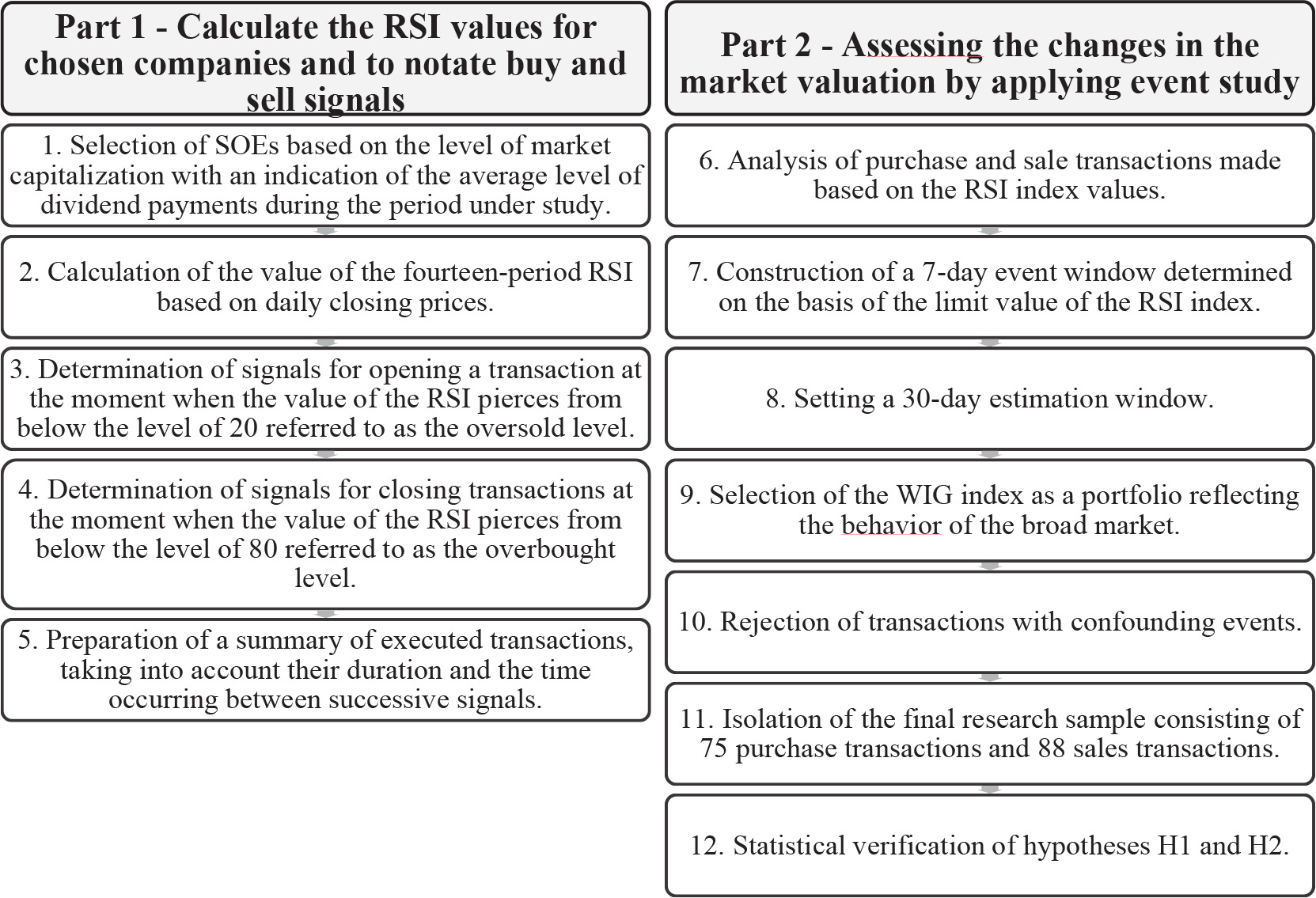
Figure 1.
Flowchart of the research procedure.
Source: Own elaboration.
In the first part of the study, the following steps were taken; the first five steps form Part 1 “Calculate the RSI values for chosen companies and to notate buy and sell signals.”
Next, an event study methodology was carried out for all qualified events in the research sample (step 6), which were the purchase and sale transactions of shares of the above-mentioned SOEs executed on the basis of the RSI index cut-off values.
According to the presented before event study methodology, a 7-day event window was constructed for each of the cases of buy/sell transactions in shares of the studied issuers determined on the basis of the borderline value of the RSI index (step 7). The day t0 was taken as the day on which the RSI generated a trading signal. Based on assumptions found in previous studies applying event study [Bhagat and Romano, 2002; Polak, 2018], it was decided to include in the event window also the 3 days preceding the day of generation of the trading signal (t−3, t−2,t−1) and the 3 days immediately following it (t+1,t+2,t+3). The estimation window (step 8) in which the expected returns was calculated was set at 30 days (t−35 to t−6). The model used for its calculation was the market model [Sudarsanam, 2003], which is based on linking the returns on securities with a certain factor common to all securities. It is also one of the most popular models used when analyzing events affecting a company, as is the case in this study [Kurek, 2017]. When calculating expected returns using market models, it is necessary to select a portfolio of securities that reflects the behavior of the broad market. For the WSE, the only suitable candidate seems to be the WIG index (step 9).
Importantly, for the second part of the study, only those trades were considered for which there were no confounding events during the studied 7-day event window (t−3 to t+3) or on adjacent days (step 10). The most popular events confounding the impact of the RSI index cut-off values include news about the company’s dividend policy, mergers and acquisitions, signing/termination of contracts, changes in management boards, impairment of assets, delisting, and block trades [Krivin et al., 2003; Kurek, 2017; Lisicki, 2021]. This is extremely important from the point of view of event study methodology, since the occurrence of an event other than the event under study in the event window (or estimation window) can distort the assessment of its impact on the volatility of the market valuation of the issuers under study [Gurgul, 2012].
In the case of several dozen cases included in the research sample using the electronic information processing system (ESPI), the occurrence of other events relating to the analyzed companies was noticed in the constructed event windows (and/or estimation windows) [Infostrefa.com, 2024]. Therefore, in order to isolate the information content of the RSI indicator transaction signals, it was decided to remove them from the research sample. Therefore, it was also necessary to reject from the research sample transactions (concluded on the basis of reaching RSI cut-off values) that occurred too close to each other. They could have “overlapped” each other, causing distortions in attempts to estimate the significance of the market valuation of the surveyed issuers caused by the RSI’s trading signals. Finally, 75 buy transactions (out of 101 that occurred during the study period) and 88 sell transactions (out of also 101) that took place on the days when the RSI generated the aforementioned trading signals were qualified for the final research sample (step 11). On the basis of these transactions, verification was undertaken of the paper’s main hypotheses H1 and H2 (step 12). The obtained AR were subjected to statistical verification using conventional cross-sectional t-test, which instead of the standard deviation of AR calculated only from the event window, the standard deviation of average abnormal returns (AAR) from all days of the estimation and event window is used [Sorrescu, 2017].
5. Market valuation of public companies in response to trading signals of the RSI – research results
Based on the research procedure presented, eight companies with State Treasury participation listed on the WSE [2023] were selected for analysis. The State Treasury has a shareholding ranging from 29.43% (in the case of PKO BP) to 60.86% (in the case of PGE) of the surveyed enterprises. Each of the surveyed companies has paid dividends at least three times during the period of its presence on the Polish stock market, which ranged from 12 years in the case of JSW to 24 years in the case of PKN. However, it is worth noting that for three-quarters of the companies, dividends were paid for at least half of the years they were listed [WSE, 2023]. To confirm that the surveyed companies are dividend-paying, the average annual dividend rates for the broad WIG index were compared with the average annual dividend rates of the surveyed companies. These are presented in Figure 2.
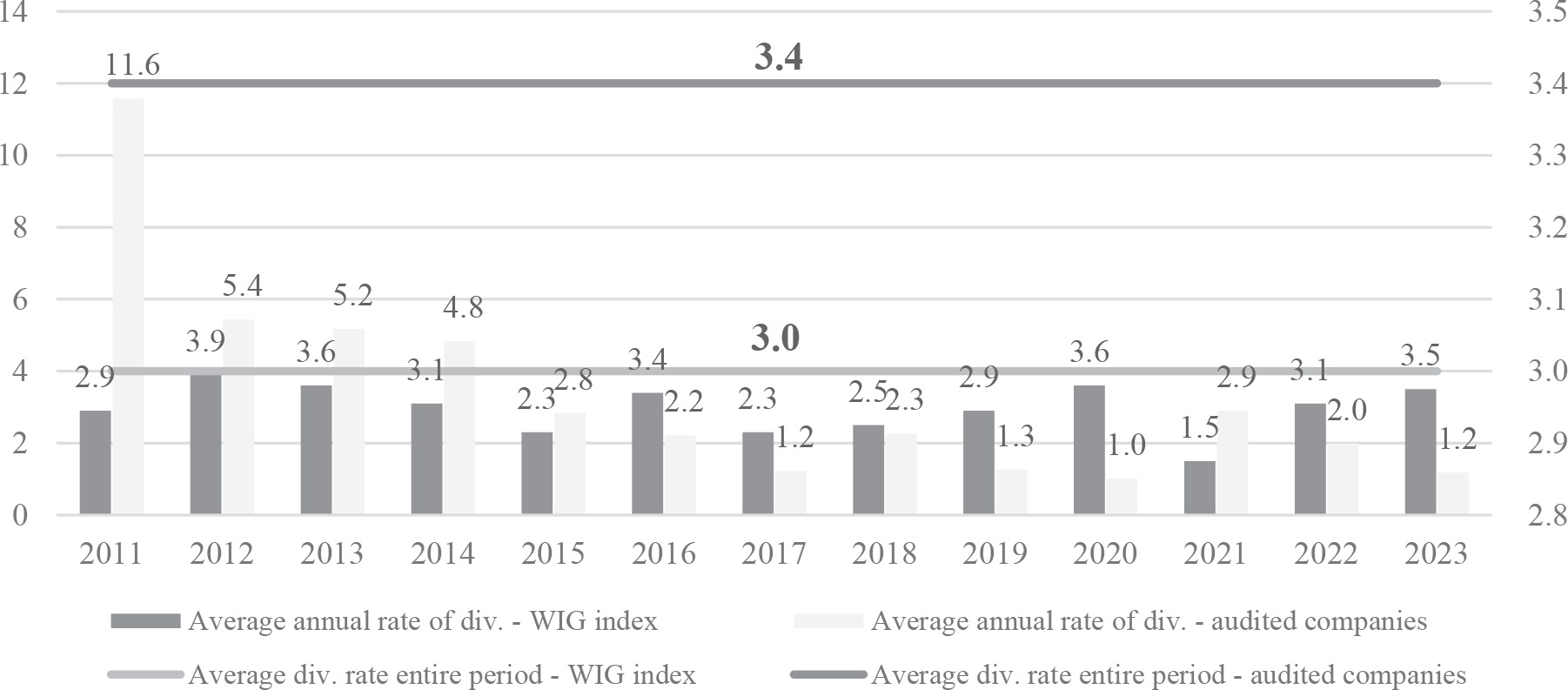
Figure 2.
Comparison of annual dividend yields from the WIG index with average annual dividend yields from the surveyed companies (in%).
Source: Own elaboration based on: Statystyki Giełdowe GPW [2023] https://www.gpw.pl/statystyki-gpw#0 [accessed: February 6, 2024].
Since 2011–2015, it can be seen that the average annual dividend rate for the surveyed companies was higher than for all companies included in the WIG index. On the other hand, in 2016–2023 (with the exception of 2021), it was the companies in the broad WIG index that had a higher dividend rate. The average dividend yield for the entire period under review (2011–2023) was 3.4%, which turned out to be higher than the average dividend yield for all companies included in the WIG index, which was 3.0%. Therefore, this gives the premise that the companies studied are characterized by a higher-than-average level of profit paid to shareholders.
Based on the daily closing prices from July 6, 2011 to September 29, 2023, the values of the 14-period RSI were calculated, and then transactions were made. Buy transactions were entered into when the value of the RSI index was from below the level of 20, and the sell transaction was entered into when the value of the RSI pierced from below the level of 80. Table 1 presents a summary of the average results of transactions for the selected companies.
Table 1.
Summary of transaction results
| Item/company | PZU | ENEA | JSW | KGHM | PGE | PKN | PKO BP | TPE | Average |
|---|---|---|---|---|---|---|---|---|---|
| Number of completed transactions | 11 | 17 | 12 | 13 | 12 | 13 | 10 | 13 | 13 |
| Average annual investment return (in %) | 6.55 | 2.77 | −2.52 | −0.28 | −3.48 | 11.63 | −1.10 | −11.46 | 0.26 |
| Average annual investment return including dividends (in %)* | 23.41 | 4.09 | −1.85 | 1.61 | −0.88 | 18.73 | 1.37 | −9.93 | 4.571 |
The highest number of transactions – 17 – was made by ENEA and the lowest – only 10 – by PKO BP. In contrast, the average number of transactions was 13. The difference in the number of transactions between ENEA and PKO BP may be due, among other things, to the level of volatility of both companies. PKO BP’s share price had a higher level of volatility (spread over the period under review – 28.77) than ENEA’s share price (spread: 13.38). Therefore, the RSI for ENEA was more often in the extreme zones (<20 and >80) than for the other company. For the other companies, the number of transactions oscillates around their average value. The average annual return obtained on the basis of concluded transactions turned out to be slightly positive and amounted to 0.26%. The highest return was recorded for PKN (11.63%) and the lowest for TPE (−11.46%). After taking into account the result of dividends, the average annual return rose to 4.57%. In this case, the highest return was for PZU shares (23.41%) and the lowest for TPE shares (−9.93%).
Based on the conducted buy/sell transactions in the stocks of the surveyed issuers concluded on the days when the RSI reached the designated cut-off levels, AR were calculated each time (for the finally qualified 75 buy transactions and 88 sell transactions) for the 7-day event window. This included the day on which the RSI generated a given buy/sell signal and the day occurring immediately before and after it (t-3 and t+3). The relatively short event window is designed to focus on determining the short-term impact [Lisicki, 2021] of indications of the popular technical analysis indicator oscillator of the market valuation of State Treasury companies listed on the WSE. The average values of the AR (AAR) for the eight surveyed issuers calculated separately for the concluded buy transactions and sell transactions are presented in Tables 2 and 3. Also included are the AAR calculated for the entire survey sample on each of the 7 days of the event window and presented in parentheses is the number of transactions considered in estimating the average values. Also included in Tables 2 and 3 were the cumulative abnormal returns (CAR) denoting the overall AR from the entire event window for all qualified cases separately and also averaged cumulative abnormal return (ACAR) for all qualified events [Perepeczo, 2010].
Table 2.
AARs in the event window involving buy trades determined by the trading signals of the RSI with their statistical significance
| Day of event window/issuer | PZU (9) | ENEA (10) | JSW (9) | KGHM (12) | PGE (9) | PKN (8) | PKO (7) | TPE (11) | AAR (75) |
|---|---|---|---|---|---|---|---|---|---|
| t3 | −0.23% | −0.16% | 4.55% | 0.66% | 0.02% | 1.02% | 0.00% | 0.44% | 0.79% |
| t−2 | 0.07% | 0.03% | 2.58% | 1.11% | 0.35% | 0.10% | 0.96% | −0.05% | 0.65% |
| t−1 | −0.10% | 0.06% | 0.43% | 0.13% | 0.62% | −0.35% | 0.07% | 0.21% | 0.14% |
| t0 | 0.30% | 0.55% | −4.34% | −1.24% | −0.16% | −2.80% | −0.22% | 0.92% | −0.87% |
| t+1 | −0.11% | 0.24% | −3.38% | 0.83% | 0.29% | 3.30% | 0.02% | −0.04% | 0.15% |
| t+2 | −0.26% | 1.05% | 2.23% | 0.90% | 0.20% | −1.28% | 0.17% | 0.29% | 0.41% |
| t+3 | 0.58% | 0.09% | 0.47% | 0.91% | 0.44% | 1.94% | 0.09% | 0.72% | 0.65% |
| CAR | 0.25% | 1.85% | 2.55% | 3.30% | 1.77% | 1.94% | 1.09% | 2.50% | ACAR |
| 1.91% | |||||||||
Table 3.
AARs in the event window involving sales trades determined by the trading signals of the RSI with their statistical significance
| Day of event window/issuer | PZU (10) | ENEA (16) | JSW (12) | KGHM (11) | PGE (10) | PKN (9) | PKO (9) | TPE (11) | AAR (88) |
|---|---|---|---|---|---|---|---|---|---|
| t−3 | −0.12% | −0.01% | −0.59% | −0.10% | −0.03% | −1.95% | −0.42% | 0.17% | −0.38% |
| t−2 | −0.25% | 0.58% | −0.67% | −0.98% | 0.08% | 0.09% | −0.86% | 0.17% | −0.23% |
| t−1 | 0.01% | 0.67% | −0.62% | −1.09% | −0.26% | −1.22% | −0.33% | 0.23% | −0.33% |
| t0 | 0.22% | 0.38% | −1.24% | −1.13% | 0.38% | 0.00% | −0.41% | 0.43% | −0.17% |
| t+1 | 0.17% | −0.32% | 0.28% | −0.58% | −0.29% | 1.00% | −0.07% | −0.13% | 0.01% |
| t+2 | 0.41% | 0.34% | 0.55% | 0.02% | 0.04% | −0.12% | −0.22% | 0.20% | 0.15% |
| t+3 | −0.84% | 0.34% | 0.49% | 0.10% | 0.03% | 0.50% | −0.31% | −0.01% | 0.04% |
| CAR | −0.40% | 1.98% | −1.80% | −3.76% | −0.06% | −1.69% | −2.62% | 1.06% | ACAR |
| −0.91% | |||||||||
Based on the presented research results on the AARs, their highest level was recorded at day t−3 for the buy trades determined on the basis of the RSI. This is particularly evident for the stocks of JSW (4.55%) and PKN (1.02%). However, the AAR value on day t0, on the day the RSI indicator generated a buy signal, is extremely interesting. According to the adopted hypothesis (H1), this signal should result in statistically significant positive ARs on the day it occurs. However, this does not happen. The AAR on this day for buy trades is -0.87%. This result can be interpreted as follows: the achieved AAR on the stocks of the surveyed issuers was, on average, 0.87 percentage points lower than the expected one (calculated on the basis of the market model [Sudarsanam, 2003]). It is possible to observe positive ARs that are noticeably different from zero (t-3, t-2, t+2, t+3), but none of these values show statistical significance (p < 0.01) verified by conventional cross-sectional t-test [Sorrescu, 2017].
The obtained results indicate that the buy signal generated by the RSI cut-off value of 20 does not cause a significant increase in the market value of the issuers on the day of its occurrence and in the next days. This result does not fit in with the expectations of the authors of the present study, for whom the natural consequence of this trading signal was increased demand for stocks [Fang et al., 2014; Agrawal et al., 2019] resulting in positive AR. Based on the presented research results, it can be assumed (contrary to the adopted H1) that the transactional buy signal generated by the RSI does not cause a statistically significant change in market valuation in each of the 7-day event window. It is worth mentioning that the ACAR in the studied event window was positive and amounted to 1.91%, but it was also not statistically significant.
The situation is similar in the case of AAR calculated for sell trading signals generated by the RSI. It can be assumed that on the day of intersection (or at most the following day) from below by this indicator of the cut-off value of 80, investors basing their investment strategy on the readings of this indicator should make a decision to sell shares [Mehta et al., 2023]. This, in turn, should generate the occurrence of statistically significant negative AR (H2), indicating a decline in the market value of the issuer [Boungou and Yatié, 2022]. The survey results presented in Table 3 partly fit into the presented assumption. Starting from day t-3 until the day the sell signal is generated t0, AARs are below zero. This is especially visible on day t-3, where the AAR is -0.38%. This is particularly evident for the stocks of PKN (-1.97%). However, none of these AARs are characterized by statistical significance verified by conventional cross-sectional t-test that could confirm the assumption made at the beginning of the study (about the existence of negative AARs on the day when sell signal was generated by the RSI indicator). Therefore, there are absolutely no indications for investors to start selling shares of the surveyed issuers.
The generation of a sell transaction signal by the RSI will not be a surprise (as the market is indicating a strong overbought stock-investors continue to buy stocks), the day of crossing the cut-off value of 80 should cause a change in the perception of the attractiveness of further buying of stocks and the beginning of the predominance of the supply side of the market over the demand side [Gumparthi, 2017]. Meanwhile, something like this is not observed, and on the contrary, in the following days (t+1, t+2, t+3) AARs are positive. It is worth noting that the ACAR return in the studied event window was only slightly lower than zero (−0.91%) and it was also not statistically significant.
The research results obtained in this study do not confirm the research hypotheses (both H1 and H2) adopted at the beginning of the paper. The stock purchase transaction signals generated by the RSI do not result in the existence of statistically significant positive AAR. Moreover, the sell transaction signals generated by this indicator also do not result in statistically significant negative AAR, which would indicate that investors have begun to sell off the stocks. These do not allow for the acceptance of H1 and H2 hypotheses proposed at the beginning of the paper. The market valuation of SOE companies (and other companies listed on the stock exchanges) caused by the trading signals generated by the RSI should be verified in subsequent studies, in order to clarify the relationships regarding the quotations of stock prices that occur on days adjacent to the day the RSI cut-off levels are reached.
6. Summary
The purpose of this study was to measure the value relevance of transaction signals (buy/sell) by the RSI on the case of State Treasury companies listed on the WSE. To this goal have been used the AR, which are the basis of the event study methodology. This method allows measuring changes in the market valuation of securities in response to various types of information coming into the financial market [Barber and Lyon, 2015; Kujawa and Ostrowska, 2016; Lisicki, 2021]. In this paper, this information was the trading signals generated by the aforementioned RSI. To achieve the goal, the two main hypotheses were set (H1 and H2).
Based on the purchase (sale) transaction signals generated by the RSI for the stocks of chosen State Treasury companies listed on the WSE during the adopted research period (July 06, 2011–September 29, 2023), AR were calculated each time for a 7-day event window (t−3 to t+3, where t0 was the day on which the signal occurred). On each of the days of the event window (for both buy and sell RSI signals), AARs are slightly different from zero. Moreover, there was no statistical significance of the obtained AARs. Based on the presented results, it cannot be concluded that buy (sell) transaction signals generated by the RSI indicator cause the occurrence of positive (negative) excess rates of return. Therefore, the use of the analyzed oscillator as a determinant of the moment of concluding a purchase (sale) transaction of securities should be considered [Agrawal et al., 2019].
The research results obtained in this study do not confirm the research hypotheses adopted at the beginning of the paper (both H1 and H2). The stock purchase trading signals generated by the RSI do not result in statistically significant positive AAR (H1). Also, the sell trading signals generated by this indicator do not result in the occurrence of statistically significant negative AAR (H2), which would be expected to indicate that investors have begun to sell off stocks.
Nevertheless, the study should point out some limitations, which were the small number of companies (only the largest SOEs). However, due to a certain pilot nature of the alternative research procedure conducted by the authors, the focus was not immediately on a broad spectrum of issuers, but only on the possible use of the presented method of scientific inquiry. However, it seems necessary that the research on the market valuation of SOEs listen on the WSE caused by trading signals generated by the RSI (as well as by other technical analysis indicators) should be verified by subsequent researchers involved in financial markets, in order to clarify the relationships occurring in this area. Further research related to the discussed issues may refer, for example, to the analysis of signals generated by oscillators other than RSI or indicators belonging to other groups, such as moving averages, volume indicators, or trend indicators. It is also worth repeating the research on the example of companies without the participation of the state treasury, and other developing or developed markets. The use of broader research samples or other research periods also seems interesting in the future.
7. Sources of funding
Co - finances by the Polish Minister of Science under the “Regional Initiative of Excellence” programme. for financing the costs of publication as part of the project entitled “UEKAT scientific, research and educational excellence program.”

Notes
[9] There may be a case in which the abnormal return, despite the positive (negative) sign, will not result in an increase (decrease) in market value, but the achievement of a higher (lower) than expected rate of return. However, such situations represent a small percentage of the results under the event study methodology, so for the purposes of this paper it was assumed that a positive (negative) abnormal return will symbolize an increase (decrease) in the market value of the issuer.