
Table 1.
Number and area of agricultural producers according to the size of agricultural land in 2021
| Size (ha) | Private peasant households | Farms | Agricultural enterprises | |||
|---|---|---|---|---|---|---|
| Thousands of pcs. | Thousands hectares | pcs. | Thousands hectares | pcs. | Thousands hectares | |
| Up to 1 | 3,066.6 | 4,785.8 | – | – | – | – |
| 1–5 | 717.6 | 1,120.0 | 1,766.0 | 5.8 | – | – |
| 5–10 | 82.4 | 128.5 | 1,790.0 | 5.4 | 37.0 | 8.9 |
| 10–50 | 54.9 | 85.7 | 11,632.0 | 266.7 | 711.0 | 24.9 |
| 50–100 | – | – | 4,641.0 | 323.0 | 679.0 | 159.5 |
| 100–500 | – | – | 6,771.0 | 1,620.5 | 2,600.0 | 669.8 |
| 500–1,000 | – | – | 1,262.0 | 897.7 | 1,966.0 | 1,416.4 |
| 1,000–5,000 | – | – | 926.0 | 1,581.6 | 3,919.0 | 8,568.8 |
| Over 5,000 | – | – | – | – | 601.0 | 5,273.8 |
| Total | 3,921.5 | 6,120.0 | 28,788.0 | 4,700.7 | 10,513.0 | 16,122.1 |
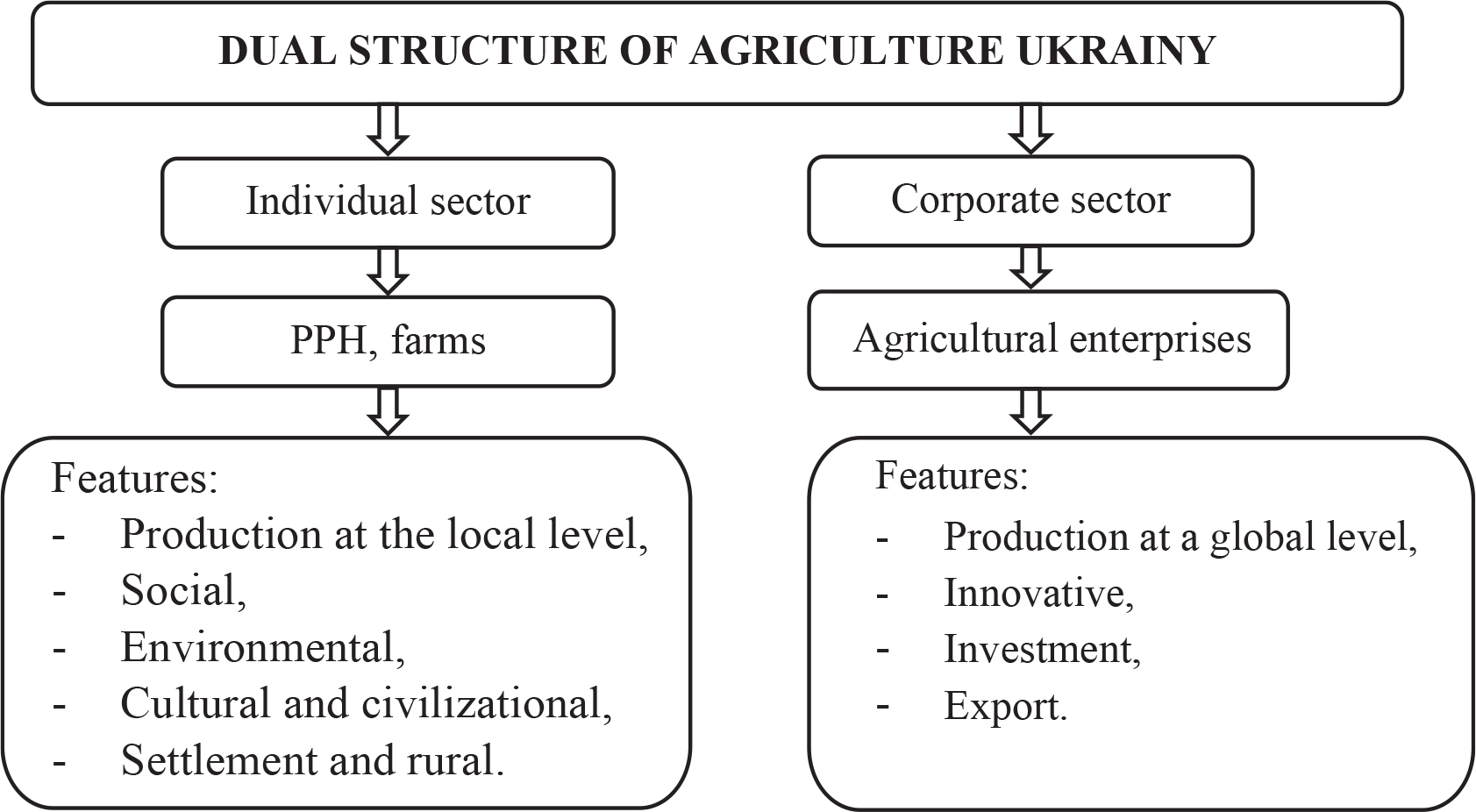
Figure 1.
Model of the agricultural system of Ukraine.
Source: Own study based on Marunyak et al. [2021].
Table 2.
Strengths, weaknesses, opportunities, and threats of Ukraine’s agricultural system in the process of accession to the European Union
| Parameters | Strengths | Weaknesses |
|---|---|---|
| Agricultural potential | S1 – large area of agricultural land; | W1 – high concentration of agricultural land used by agroholdings; |
| S2 – high soil fertility; | W2 – deterioration of soil quality due to intensification of agricultural production (monoculture); | |
| S3 – sufficient manpower; | W3 – lack of sufficient means of production on small farms; | |
| S4 – favorable natural and climatic conditions; | W4 – increasing climate risk in agriculture as a result of global climate change; | |
| Compliance of quality parameters and technology with EU regulations | S5 – implementation of approximately 70% of EU regulations in the agricultural sector of Ukraine *; | W5 – lack of sufficient knowledge of farmers in the field of farming in accordance with EU regulations; |
| W6 – focus of agroholdings on maximizing profits; | ||
| W7 – high cost and reduced efficiency by implementing GAEC standards; | ||
| Access to sales markets | S6 – high demand on the internal market and established sales channels on external markets. | W8 – loss of some export channels (Black Sea ports) and the associated increase in logistics costs and loss of part of the southeastern sales markets. |
| Parameters | Opportunities | Threats |
| Demand | O1 – access to EU sales markets as an EU member; | T1 – possible restrictions (transition periods) and production quotas; |
| Competitiveness | O2 – low cost of plant production and its high efficiency; | T2 – possible expansion of food of animal origin from other EU countries to the Ukrainian market; |
| EU agricultural policy | O3 – high level of support for small- and medium-sized agricultural producers in accordance with EU regulations; | T3 – a powerful lobby of agroholdings in the parliament and government of Ukraine; |
| O4 – possibility of implementing investments and innovations in the agricultural sector; | T4 – high cost of implementing environmental norms and standards in the agricultural sector; | |
| O5 – improving soil quality and, as a result, repairing environmental damage; | T5 – collapse of some agricultural producers who fail to implement EU regulations; | |
| O6 – increasing the number of organic producers. | T6 – increase in prices for groceries. |
Table 3.
Matrix of relationships between the strengths and weaknesses of Ukraine’s agricultural system and its opportunities and threats in the process of accession to the EU
| Strengths | SO strategies | ST strategies |
|---|---|---|
| O2 – low cost of plant production and its high efficiency; | T1 – possible restrictions (transition periods) and production quotas; |
| S5 – implementation of approximately 70% of EU regulations in the agricultural sector of Ukraine; |
|
|
| S6 – high demand on the internal market and established sales channels on external markets; |
|
|
| Weaknesses | WO-strategies | WT-strategies |
|
|
|
| W8 – loss of some export channels (Black Sea ports) and the associated increase in logistics costs and loss of part of the south-eastern sales markets. | O1 – access to EU sales markets as an EU member. | T1 – possible restrictions (transition periods) and production quotas. |