
1. Introduction
Inflow of foreign direct investment (FDI) to the food industry in Poland began in the 1970s with the entry of transnational corporations Coca-Cola and PepsiCo. Foreign capital began to flow to Poland on a large scale as early as the beginning of the 1990s. It was related to the change of the state system and the processes of economic transformation and privatization of food industry enterprises [Ambroziak, 2018]. In the period preceding Poland’s accession to the European Union (EU), most FDI was invested in the food industry in the second half of the 1990s (Chart 1). The most important factors contributing to the FDI inflow included: the possibility of relatively cheap purchase of enterprises (privatization) with their market share, the possibility of generating high profit, the expected very rapid development of a given market or its segment, the possibility of obtaining lower production costs (e.g., thanks to cheaper and relatively well-skilled labor), and the possibility of concentrating production in a given industry (e.g., tobacco, brewing) [Chechelski, 2008, 2017].
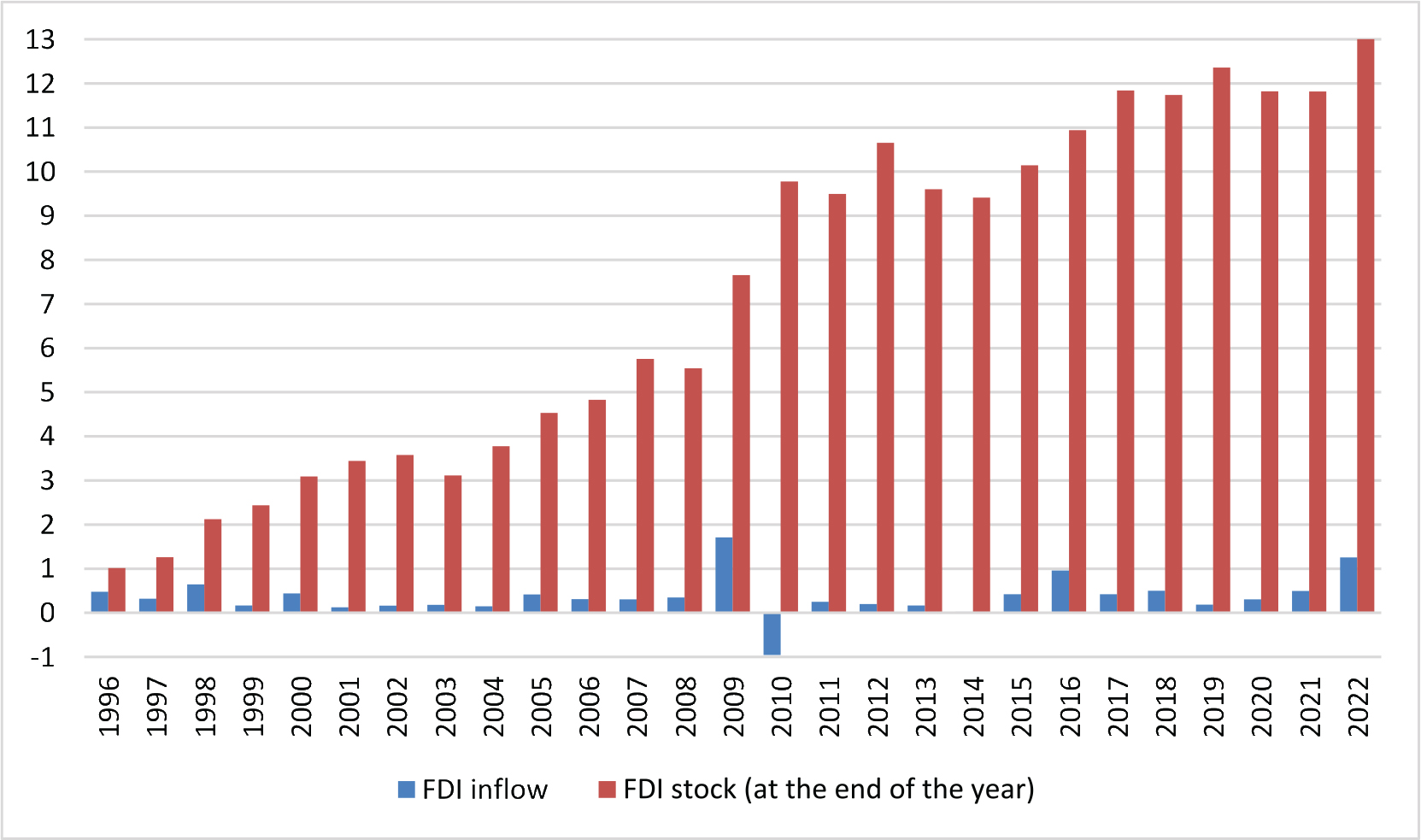
Chart 1.
Inward FDI flows and stocks in the food industry in Poland (in EUR billion).
Source: Own study based on data of National Bank of Poland. FDI, foreign direct investment.
Upon accession to the EU in May 2004, Poland became part of the Single European Market, where the principle of free movement of goods, services, capital, and people applies. On the one hand, this meant the need for agricultural producers and processors to adapt to the requirements and standards applicable in the Single European Market. On the other hand, thanks to the liberalization of customs barriers in access to EU countries’ markets, Polish agri-food products became more price competitive in the countries, which resulted in a growing demand for Polish food, also on the domestic market [Chechelski, 2008]. It favored further inflow of FDI into the food industry [Drożdż, 2012]. Investors were encouraged by lower production costs in Poland (especially labor costs), economic and political stability in Poland, and much faster development of the Polish economy (and food industry) than in other EU countries [Szczepaniak and Drożdż, 2023].
The value of inward FDI stock in the food industry at the end of 2022 amounted to EUR 13.1 billion (Chart 1). It was 34% more than at the end of 2010 and above four times more than at the end of 2003. Among the industrial processing sectors, the food industry was – next to the automotive and machinery industries – one of the leaders in attracting FDI. At the end of 2022, the food industry received almost 16% of the value of foreign capital in the form of FDI that went to the industrial processing section in Poland. Ambroziak [2020] concluded that after 2010, the FDI inflow to the food industry was mainly determined by reinvested earnings.
The tendency to attract foreign direct investors was undoubtedly influenced by the level of industry concentration, measured as a share of large companies (250 or more employees) in generating sold production, or employment in the industry. Some authors state that the relationship between the FDI inflow and the degree of concentration of an industry is two-way. On the one hand, highly concentrated industries attract more FDI [Zorska, 2007]. This allows foreign investors to achieve increasing economies of scale in production. On the other hand, the inflow of FDI to a given industry may contribute to increasing concentration, mainly in the form of oligopolistic structures [Szajner, 2017]. Thus, the degree of concentration is one of the variables considered in the research on the FDI intensity.
FDI in Poland’s agri-food sector has been the subject of some studies. Especially, quantitative analyses of the inward FDI flows and stocks were performed [Ambroziak, 2018, 2020; Ambroziak, Bułkowska, 2021], the impact on labor productivity [Chechelski, 2017], and the impact on export [Drożdż, 2012] were examined. The subject of analysis also concerned transnational corporations implementing FDI in the food industry [Chechelski, 2008, 2017]. However, there are few studies on enterprises with foreign capital in the food industry. An example is the study by Pawlak [2016] who analyzed FDI in the food industry (understood as the total production of food, beverages, and tobacco products) of the EU countries and indicated the extent to which enterprises with foreign capital differ from enterprises with domestic capital. In turn, studies that analyze individual sectors of the food industry are rare. In this context, the aim of the article was formulated, which is to assess changes in the food industry in Poland (including individual groups or classes of this industry) in 2010–2022 resulting from the FDI inflow to this industry. The food industry is understood here as the production of food, beverages, and tobacco products (Sections 10, 11, and 12 of the Polish Classification of Activities).
The structure of the article is as follows: The first part describes selected theoretical issues related to the impact of FDI on the economy of the host country. Then, methods and data sources are characterized. Next, the results of the study and the discussion of the obtained results were presented. The research results include mainly differences in the FDI intensity of groups and classes of the food industry, characteristics of companies with foreign and domestic capital, and the correlation between the FDI intensity and selected indicators used to assess the economic results of individual groups and classes. The article ends with a summary.
2. Selected theoretical issues related to the impact of FDI on the host country’s economy
FDI affects many areas of the economy of the country hosting the investment. The results of theoretical works and research studies do not provide a clear answer about the directions of these effects. This impact can be considered at different levels – microeconomic, mesoeconomic, and macroeconomic. Effects of the inflow will depend on many factors. One of the most important is the motive for undertaking FDI in the country hosting the investment. Investors’ motivations and goals largely determine which resources of the host country will be used and how. J.H. Dunning [1980] distinguished four groups of investors: (1) those looking for resources (resources-seeking), (2) those looking for markets (market-seeking), (3) those looking for an increase in efficiency (efficiency-seeking), and (4) those looking for strategic assets or capabilities (strategic assets-seeking) [Dunning and Lundan, 2008]. Resource-seeking investors strive to purchase various types of resources abroad (natural, human, technology) at a lower price than in the home country or also resources not available in the home market. Market-seeking investors make investments in another country to provide goods or services to that market. The motive of investors focused on improving efficiency is the possibility of achieving economies of scale or using the differences among countries in terms of factor abundance or costs. Investments aimed at acquiring strategic resources are intended to enable maintaining or strengthening the competitive position of the enterprise.
The FDI inflow to an industry may also be explained by the horizontal model of FDI (originally developed by Markusen [1984]) and the vertical model of FDI (originally developed by Helpman [1984]). The horizontal models predict that multinational activities can arise between similar countries. The theoretical modeling of vertical FDI was typically driven by differences in factor endowments. The decision to conduct vertical FDI can be described as a tradeoff between costs and benefits [Helpman, 1984]. This is only profitable as long as the costs of fragmentation are lower than the cost savings.
The alternative approach to determine the heterogeneity of firms is the Melitz [2003] model which concentrates firstly on the relationship between labor productivity and a firm’s ability to export. Only later researches concern the determinants of labor productivity. Cieślik et al. [2016] treated innovations as a key element that can increase the level of productivity. Their estimation results indicate that the probability of exporting is positively related to product and process innovations, firm size, the share of university graduates in productive employment, and foreign capital participation. The results also depend on the level of technology used in the analyzed sector and the relative importance of export market. Furthermore, Vogel and Wagner [2010] found for the first time a positive link between importing and productivity.
As Chechelski [2008] notes, individual sectors of the food industry are characterized by different susceptibility to globalization. Among the factors determining FDI inflow, Szymański [2004] included: the ease of standardizing products leading to unification of consumption patterns, differentiation of prices of production factors on world markets, which may be a source of competitive advantage, as well as the possibility of unification of marketing methods used in different countries, relative uniformity of applicable production standards on an international scale (e.g., regulations technical or phytosanitary), and the possibility of combining products into groups, which gives a specific effect for customers.
The impact of FDI on the economy of the host country takes place through various “channels” [Zorska, 2007]. The most important are explained further.
2.1. Technology transfer
FDI is one of the main channels for the transfer of technology and knowledge, which contributes to the increase in the productivity and competitiveness of enterprises [Saggi, 2002]. The transfer takes place through, among others: acquiring modern technology in a tangible form (modern machines and devices), transferring technology in an intangible form between the parent company and its branches, and bringing qualified employees from abroad [Witkowska, 2001]. In addition to the direct effects of technology and knowledge transfer, indirect effects (spillover effects) are extremely important. They involve the penetration of scientific and technical thought, new management, organization, and marketing methods from branches of foreign companies to domestic companies operating in a given industry and to the entire economy [Umiński, 2002]. Due to the more effective allocation of resources and their improvement due to the need for domestic and foreign enterprises to compete or cooperate, labor productivity increases [Weresa, 2002]. To explain factors determining transfer technology on the microeconomic level, the firm heterogeneity concept may be partly useful. Cieślik et al. [2016] demonstrated in the example of Polish firms that the probability of exporting was positively related to foreign capital participation in Polish firms.
2.2. Labor market
FDI affects the host country’s labor market by shaping employment and wages. Quantitative direct effects are related to changes in employment as a result of the inflow of foreign capital. Employment changes in the short term depend on how foreign investors enter the host country’s market. New enterprises (branches of parent enterprises) opened by investors in the host country (so-called greenfield investments) increase net capital in this country and create new jobs. In turn, takeovers and mergers, which involve primarily a change of ownership of an existing enterprise, usually favor restructuring, which often involves employment reduction. Thanks to cooperative links between the investor and domestic companies, causing multiplier effects in the host country’s economy, FDI inflow may also indirectly contribute to employment growth in the food industry (so-called quantitative indirect effects). When an investor uses imports as a source of supply or to replace domestic companies (pushing them out of the market), employment decreases [Karaszewski, 2004].
The inflow of FDI also leads to the disclosure of qualitative effects on the labor market of the host country. Positive direct effects are manifested in higher employee salaries, which reflect higher labor efficiency, as compared to domestic enterprises [Javorcik, 2015]. The increase in labor productivity is the result of the technology used and better equipment with means of production in companies with foreign capital (CFC), improving employee qualifications, and more effective methods of human resources management. In turn, positive indirect effects in the sphere of quality may be brought by the penetration into domestic enterprises and the spread of good work organization and management patterns among them. The effects mentioned above do not occur automatically. The scale of the effects depends on the ability of domestic enterprises to adopt new solutions [Jenkins, 2006].
Labor productivity is also a core of the Melitz model focusing on the firm’s heterogeneity concept. However in the basic version of the model, labor productivity is exogenously given and each firm has to pay different fixed costs of entry into domestic and foreign markets [Cieślik et al., 2016].
FDI may also cause negative effects in the qualitative sphere. They may manifest themselves in the introduction of undesirable employment practices by investors or the erosion of wage levels as a result of competition between domestic companies and foreign investors.
2.3. Foreign trade
As mentioned above, two models may describe the relationship between FDI and trade [Kojima, 1975; Ozawa, 1992]. The vertical model of FDI takes place when the multinational fragments the production process internationally, locating each stage of production in the country where it can be done at the least cost. The horizontal model of FDI occurs when the multinational undertakes the same production activities in multiple countries. Thus, vertical FDI is usually complementary to trade flows, while horizontal FDI substitutes trade flows [Weresa, 2002].
The impact of FDI on the foreign trade of the host country may be direct and indirect. Direct effects result from the fact that CFC may show a higher propensity to export than domestic companies that encounter numerous barriers to exporting [Moran, 2014]. The presence of foreign investors therefore favors the promotion of the activities of domestic companies in the host country through the so-called local links. They involve the supply of products, goods, and semi-finished products, as well as resources and production capabilities by domestic companies to the branches of international corporations [Smarzynska Javorcik, 2004]. Foreign ownership may mean higher productivity of firms highly internationalized. The heterogeneity concept developed by Melitz [2003] explains differences in labor productivity, which determined the ability to export. In turn, indirect effects occur when CFC constitute a channel of information about foreign markets, supporting the potential export opportunities of domestic companies.
The presence of foreign investors in the domestic market leads to increased competition, which may affect the growth of exports in the host country. However, Starzyńska [2012] notes that the presence of foreign investors does not always have to lead to strengthening the export capabilities of the host country. This occurs when the country receiving FDI is characterized by a large internal market, as is the case with Poland. Foreign investors’ strategy focuses on conquering the large and absorbent internal market. Export activity is only a secondary activity.
3. Research method and data sources
The study consists of two parts. The first part presents the characteristics of CFC and companies with domestic capital (CDC) for 21 food industry sectors, separated at the level of groups and classes of the Polish Classification of Activities for which data was available. First, the FDI intensity (the share of CFC in net revenues from the sale of products, goods, and materials) of individual industries was determined. Then, two groups of companies were compared using indicators such as the value of net revenues from the sale of products, goods, and materials per unit and average employment, as well as labor productivity expressed in the value of net revenues from the sale of products, goods, and materials per one employee. In the second part, the correlation between selected indicators used to assess the economic results of individual groups and classes and the FDI intensity was estimated. The indicators included the labor productivity, the share of export revenues in net sales revenues, average salary, the share of supply imports in operating costs, the share of energy in operating costs, and the ratio of revenues net sales to the value of fixed assets (productivity of fixed assets).
The use of the correlation index to examine the interdependence of two features is not always reliable. Real phenomena and features are interconnected, which means that the value of one feature depends on the simultaneous operation of many others [Chojnicki and Czyż, 1980]. One way to take into account the phenomenon of feature interdependence is to use partial correlation. It involves determining the interdependence of two out of many features, while consciously eliminating the influence of the remaining features on both correlated variables [Czaja and Preweda, 2000; Kowerski and Bielak, 2021].
The partial correlation coefficient between variable x1 and variable x2 when controlling variable x3 (denoted by the symbol r12,3) can be determined by the formula:
where, r12 r12, r12, are correlation coefficients between variables 1 and 2, variables 1 and 3, and variables 2 and 3, respectively.As mentioned above, an important variable that may influence the FDI intensity of a given industry is the level of its concentration. Therefore, when examining the correlation between the FDI intensity of groups and classes of the food industry and selected features of these groups and classes, the influence of the industry structure was excluded. As a proxy of industry structure, the share of large companies (250 employees or more) in generating net sales revenues from a given industry was used.
The scope of the analysis results from the availability of comparable data. The study used unpublished data from the Central Statistical Office of Poland, including the characteristics of CFC and CDC, as well as data on revenues, results, and costs of companies employing more than nine people (data from F-01 financial statements). The scope of available data meant that the ratio of net revenues from the sale of products, goods, and materials to average employment was adopted as a measure of labor productivity. Labor productivity is commonly measured by the ratio of gross value added per employee or sold production per employee. Net revenues from the sale of products, goods, and materials differ from gross value added, among others: in that they contain the value of inputs needed to produce output.
The term food industry means the production of food products (Section 10 of the Polish Classification of Activities), beverages (11), and tobacco products (12). The analysis covers the years 2010, 2014, and 2016–2022.
4. Research results and discussion
4.1. FDI intensity of industries
In 2010, CFC were responsible for 46% of net revenues from the sale of products, goods, and materials in the food industry. In 2010–2017, this share decreased by 6.2 percentage points, to 39.8% and then increased to 45% in 2020. The years 2021–2022 brought a decline in the importance of CFC in generating net revenues from sales of the food industry. In 2022, the companies accounted for 39.7% of the industry’s revenues. Chechelski [2017] notes that a large increase in the FDI intensity of the food industry took place before 2010, that is, under the conditions of Poland’s membership in the EU and before accession.
Among individual classes and groups of the food industry, changes in the share of CFC in generating net revenues from sales in 2010–2022 were bidirectional (Chart 2). Both declines and increases in the FDI intensity concerned not only activities with a high degree of globalization, but also activities with a low degree of globalization. The decline in the FDI intensity concerned, among others, the production of prepared animal feeds, the production of spirit drinks and beer, and to a lesser extent also milk processing, grain milling and starch production, red meat, potatoes, and fruit and vegetable processing. The share of CFC in generating net revenues from the sale increased most in the production of meat products and coffee and tea processing. The FDI intensity has also increased in the processing of poultry meat, fish processing, chocolate and confectionery production, as well as oils and fats.
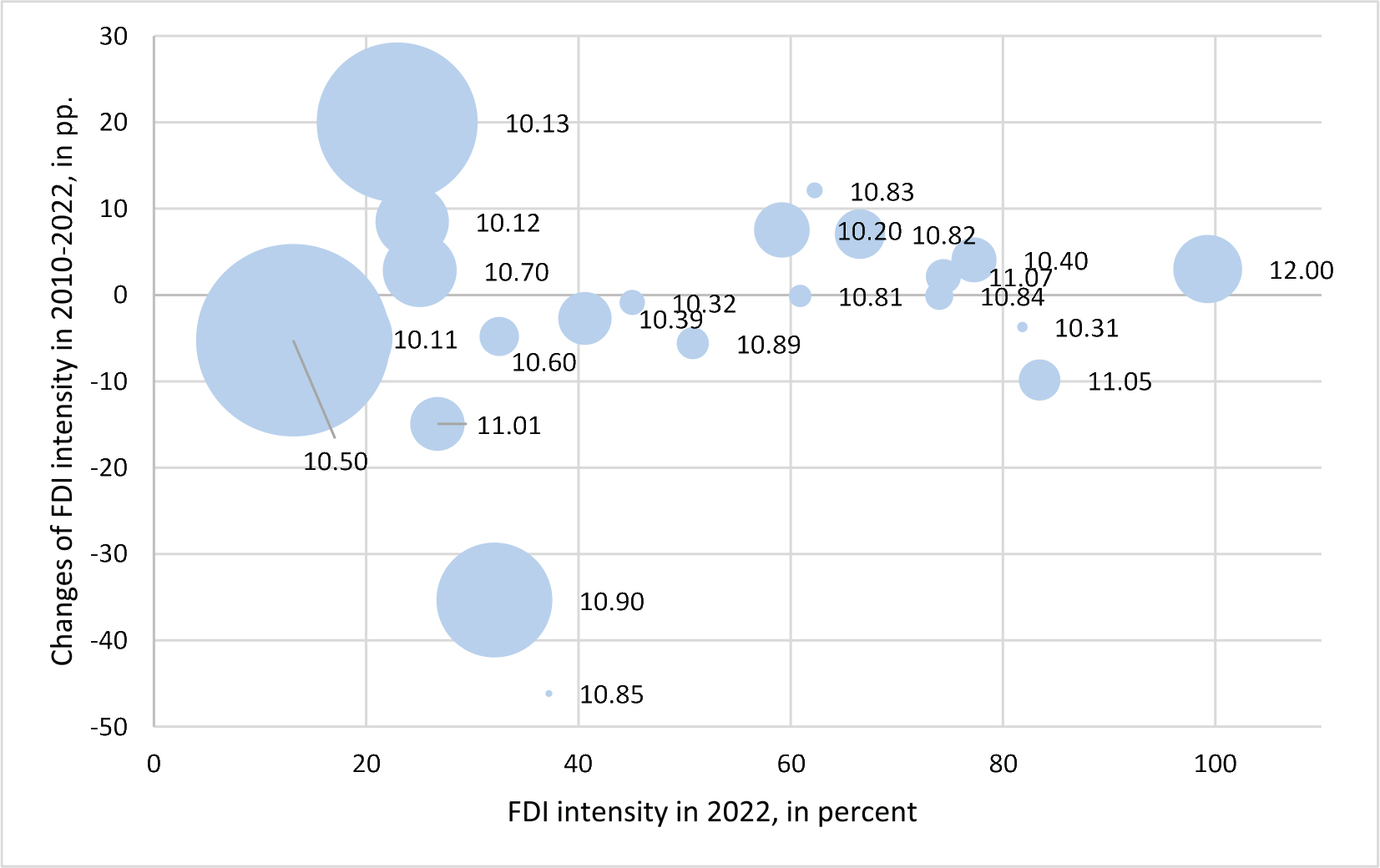
Chart 2.
The FDI intensity in the food industry. Remarks: FDI intensity means the share of enterprises with foreign capital in net revenues from the sale of products, goods, and materials. The size of a bubble reflects the share in the food industry. PCA code description in Table 1.
Source: Own study based on unpublished data from Central Statistical Office of Poland. FDI, foreign direct investment.
Table 1.
The importance of large firms (250 or more employees) in the food industry by group and class in 2022 (excluding microenterprises, including the tobacco industry)
| Polish classification of activities | Number of enterprises | Average employment | Sold production | ||||
|---|---|---|---|---|---|---|---|
| Number | Share of large firms (%) | In thousand | Share of large firms (%) | Value, in PLN billion | Share of large firms (%) | ||
| 10.11 | Processing and preserving of red meat | 537 | 4.8 | 35.0 | 46.9 | 27.6 | 38.2 |
| 10.12 | Processing and preserving of poultry meat | 154 | 10.4 | 15.6 | 57.5 | 16.4 | 52.3 |
| 10.13 | Production of meat products | 448 | 8.9 | 60.0 | 69.8 | 37.7 | 78.2 |
| 10.20 | Processing and preserving of fish | 125 | 10.4 | 17.5 | 66.7 | 15.5 | 69.3 |
| 10.31 | Processing and preserving of potatoes | 12 | 16.7 | 2.8 | 63.3 | 2.5 | 48.6 |
| 10.32 | Manufacture of juices | 57 | 15.8 | 7.0 | 67.2 | 6.7 | 77.1 |
| 10.39 | Processing of fruit and vegetables | 304 | 5.9 | 23.4 | 37.4 | 13.5 | 40.8 |
| 10.40 | Manufacture of oils and fats | 37 | 8.1 | 2.7 | 41.4 | 7.3 | 62.8 |
| 10.50 | Manufacture of dairy products | 204 | 18.6 | 36.8 | 70.5 | 38.8 | 77.3 |
| 10.60 | Manufacture of grain mill and starch products | 131 | 5.3 | 10.2 | 45.0 | 8.9 | 28.8 |
| 10.70 | Manufacture of bakery and farinaceous products | 2384 | 1.7 | 88.2 | 24.5 | 23.3 | 39.2 |
| 10.81 | Manufacture of sugar | 4 | 100.0 | 3.7 | 100.0 | 4.9 | 100.0 |
| 10.82 | Manufacture of chocolate and sugar confectionery | 102 | 15.7 | 22.0 | 75.2 | 13.1 | 70.8 |
| 10.83 | Processing of tea and coffee | 37 | 18.9 | 4.4 | 66.5 | 4.0 | 78.1 |
| 10.84 | Manufacture of condiments and seasonings | 58 | 15.5 | 8.8 | 79.4 | 5.7 | 84.7 |
| 10.89 | Manufacture of other food products | 140 | 7.9 | 13.2 | 55.8 | 7.8 | 52.0 |
| 10.90 | Manufacture of prepared animal feeds | 160 | 5.6 | 14.0 | 52.2 | 22.6 | 52.9 |
| 11.01 | Manufacture of spirits | 42 | 9.5 | 4.5 | 58.8 | 4.7 | 67.3 |
| 11.05 | Manufacture of beer | 51 | 9.8 | 8.2 | 78.3 | 9.3 | 83.7 |
| 11.07 | Manufacture of soft drinks | 69 | 11.6 | 7.5 | 59.1 | 8.5 | 75.8 |
| 12.00 | Manufacture of tobacco products | 16 | 31.3 | 8.0 | 93.8 | 7.6 | 94.6 |
| Food industry (10 + 11 + 12) | 5203 | 5.7 | 400.7 | 53.3 | 291.3 | 62.6 | |
In 2022, the most internationalized industry was the tobacco industry (foreign companies accounted for 99.3% of revenues from the sale), the brewing industry (83.4%), the potato industry (81.8%), and the oil industry (77%). The lowest share of CFC in net revenues from the sale (below 30%) was recorded in the processing of milk, red meat and poultry, the production of meat products as well as bakery and farinaceous products. The obtained results are consistent with the literature, which suggests that FDI is directed mainly to those industries in which capital exporters expect the highest efficiency [Chechelski, 2017].
4.2. Comparison of companies with foreign and domestic capital
From the comparison of companies with foreign and domestic capital resulted in two main conclusions. Firstly, CFC are, on average, larger than CDC, both in the case of average employment and average revenue from the sale of a company (Table 2). However, in 2010–2022, CDC were characterized by higher dynamics of average employment and revenue from the sale. Large differences between companies of both types characterized the production of beer, soft drinks, tobacco products, spices, and potato processing. Differences between companies may be explained by the heterogeneity concept. The FDI intensity is positively correlated with the share of larger firms in an industry. The obtained results confirmed the conclusions drawn from previous research and literature studies [Pawlak, 2016; Chechelski, 2017].
Secondly, companies with foreign and domestic capital differed in labor productivity. In 2010, the value of net revenues from CDC sales in the food industry per employee amounted to Polish currency (PLN) 398.6 thousand, which accounted for 42.1% of the level of labor productivity achieved in CFC. In 2010, in almost all types of activity, labor productivity measured by the value of net sales revenues per employee was higher in CFC than in CDC. The largest gap characterized the production of chocolate and confectionery, beer, and tobacco products.
In 2010–2022, the gap in terms of labor productivity between CDC and CFC in the food industry in Poland decreased significantly. In 2022, labor productivity in CDC accounted for as much as 73.2% of CFC productivity. The differences have decreased in most sectors of the food industry. However, in some industries, the gap was still large. The productivity in domestic companies in the tobacco industry, potato processing as well as the production of chocolate and confectionery products accounted for about 30% of the productivity of CFC (Table 2).
Table 2.
Comparison of companies with foreign and domestic capital
| PCA | Net revenue from sale per firm, in PLN million | Average employment per firm | Labor productivity, in PLN thousand per employee | |||||||||||||||
|---|---|---|---|---|---|---|---|---|---|---|---|---|---|---|---|---|---|---|
| CFC | CDC | CDC/CFC (CFC = 100) | CFC | CDC | CDC/CFC (CFC = 100) | CFC | CDC | CDC/CFC (CFC = 100) | ||||||||||
| 2010 | 2022 | 2010 | 2022 | 2010 | 2022 | 2010 | 2022 | 2010 | 2022 | 2010 | 2022 | 2010 | 2022 | 2010 | 2022 | 2010 | 2022 | |
| 10.11 | 262.7 | 254.8 | 35.8 | 114.6 | 13.6 | 45.0 | 543.0 | 163.4 | 95.4 | 100.0 | 17.6 | 61.2 | 483.7 | 1559.6 | 375.5 | 1146.4 | 77.6 | 73.5 |
| 10.12 | 323.1 | 799.5 | 71.0 | 204.7 | 22.0 | 25.6 | 563.4 | 346.7 | 145.2 | 124.3 | 25.8 | 35.8 | 573.5 | 2305.9 | 488.8 | 1647.1 | 85.2 | 71.4 |
| 10.13 | 39.8 | 1051.3 | 38.7 | 198.4 | 97.2 | 18.9 | 119.9 | 998.0 | 117.3 | 202.5 | 97.8 | 20.3 | 331.6 | 1053.4 | 329.6 | 980.0 | 99.4 | 93.0 |
| 10.20 | 179.5 | 690.0 | 31.3 | 117.1 | 17.4 | 17.0 | 306.6 | 667.2 | 99.4 | 96.7 | 32.4 | 14.5 | 585.5 | 1034.1 | 314.7 | 1211.0 | 53.8 | 117.1 |
| 10.31 | 228.1 | 890.9 | 30.9 | 84.9 | 13.5 | 9.5 | 458.5 | 547.7 | 114.2 | 174.4 | 24.9 | 31.8 | 497.5 | 1626.7 | 270.5 | 486.6 | 54.4 | 29.9 |
| 10.32 | 128.4 | 276.0 | 90.7 | 175.0 | 70.7 | 63.4 | 126.0 | 182.4 | 219.5 | 175.8 | 174.2 | 96.4 | 1019.1 | 1512.9 | 413.4 | 995.2 | 40.6 | 65.8 |
| 10.39 | 94.4 | 199.6 | 24.9 | 67.1 | 26.3 | 33.6 | 175.3 | 219.0 | 86.5 | 89.3 | 49.3 | 40.8 | 538.5 | 911.3 | 287.4 | 751.2 | 53.4 | 82.4 |
| 10.40 | 487.4 | 1218.1 | 125.0 | 230.4 | 25.6 | 18.9 | 283.6 | 211.4 | 87.5 | 52.0 | 30.9 | 24.6 | 1718.9 | 5761.5 | 1428.3 | 4432.2 | 83.1 | 76.9 |
| 10.50 | 290.7 | 532.3 | 92.8 | 388.8 | 31.9 | 73.0 | 330.9 | 358.0 | 161.2 | 224.3 | 48.7 | 62.7 | 878.6 | 1486.7 | 575.4 | 1733.1 | 65.5 | 116.6 |
| 10.60 | 128.1 | 287.1 | 35.8 | 126.3 | 28.0 | 44.0 | 186.3 | 208.8 | 59.7 | 96.3 | 32.0 | 46.1 | 687.6 | 1374.7 | 600.2 | 1310.8 | 87.3 | 95.4 |
| 10.70 | 87.3 | 223.1 | 13.4 | 46.6 | 15.3 | 20.9 | 223.7 | 277.5 | 81.9 | 112.2 | 36.6 | 40.4 | 390.1 | 804.1 | 163.4 | 414.9 | 41.9 | 51.6 |
| 10.81 | 940.8 | 1423.2 | 902.3 | 2742.8 | 95.9 | 192.7 | 528.3 | 668.9 | 1246.5 | 1815.5 | 235.9 | 271.4 | 1780.7 | 2127.9 | 723.8 | 1510.8 | 40.6 | 71.0 |
| 10.82 | 381.0 | 696.7 | 43.3 | 101.2 | 11.4 | 14.5 | 372.7 | 581.0 | 177.5 | 229.3 | 47.6 | 39.5 | 1022.3 | 1199.2 | 244.0 | 441.3 | 23.9 | 36.8 |
| 10.83 | 129.8 | 284.7 | 51.6 | 126.6 | 39.8 | 44.5 | 179.8 | 256.4 | 117.8 | 115.2 | 65.5 | 44.9 | 722.2 | 1110.4 | 438.4 | 1098.4 | 60.7 | 98.9 |
| 10.84 | 470.4 | 813.8 | 34.9 | 84.8 | 7.4 | 10.4 | 685.7 | 702.4 | 70.3 | 109.4 | 10.3 | 15.6 | 686.0 | 1158.6 | 496.1 | 775.0 | 72.3 | 66.9 |
| 10.85 | 133.5 | 133.4 | 9.7 | 51.9 | 7.3 | 38.9 | 212.8 | 155.0 | 42.5 | 86.3 | 20.0 | 55.6 | 627.5 | 860.5 | 227.7 | 602.0 | 36.3 | 70.0 |
| 10.89 | 166.7 | 222.0 | 40.5 | 82.5 | 24.3 | 37.2 | 293.5 | 284.3 | 111.6 | 85.2 | 38.0 | 30.0 | 567.9 | 780.9 | 362.9 | 968.3 | 63.9 | 124.0 |
| 10.90 | 451.7 | 555.2 | 47.4 | 308.5 | 10.5 | 55.6 | 281.9 | 212.7 | 43.9 | 108.9 | 15.6 | 51.2 | 1602.1 | 2610.7 | 1078.2 | 2832.2 | 67.3 | 108.5 |
| 11.01 | 287.8 | 1951.1 | 165.0 | 243.6 | 57.3 | 12.5 | 174.3 | 217.9 | 89.9 | 142.5 | 51.6 | 65.4 | 1650.6 | 3486.3 | 1835.0 | 3989.0 | 111.2 | 114.4 |
| 11.05 | 1567.0 | 1359.3 | 49.3 | 102.7 | 3.1 | 7.6 | 821.9 | 668.4 | 86.3 | 87.9 | 10.5 | 13.1 | 1906.7 | 2033.7 | 572.0 | 1169.4 | 30.0 | 57.5 |
| 11.07 | 505.7 | 909.9 | 34.3 | 88.1 | 6.8 | 9.7 | 742.3 | 457.0 | 98.2 | 83.1 | 13.2 | 18.2 | 681.2 | 1991.2 | 349.2 | 1060.6 | 51.3 | 53.3 |
| 12.00 | 1461.4 | 2374.4 | 90.3 | 51.2 | 6.2 | 2.2 | 634.4 | 844.9 | 122.0 | 71.3 | 19.2 | 8.4 | 2303.6 | 2810.2 | 740.5 | 717.5 | 32.1 | 25.5 |
| 10 + 11 + 12 | 301.7 | 555.3 | 41.5 | 147.0 | 13.8 | 26.5 | 319.0 | 360.9 | 104.1 | 130.6 | 32.6 | 36.2 | 945.7 | 1538.6 | 398.6 | 1126.1 | 42.1 | 73.2 |
1 Remarks: CFC, CDC, PCA code description in Table 1.
4.3. Role of CFC in the food industry in Poland
The calculated Pearson linear correlation coefficients showed that among the variables for which the relationship with the FDI intensity was examined, only four variables turned out to be statistically significant, and not always in the entire analyzed period. They were industry concentration index, labor productivity, average salary, and the share of import expenses in operating costs (Table 3). All variables showed a positive correlation with the FDI intensity. This means that the increased presence of foreign companies contributed to the improvement of the values of individual variables. The estimates also indicate an increasingly weaker relationship between labor productivity and the FDI intensity in subsequent years. Moreover, statistical significance decreased from year to year. In 2022, the relationship in question was no longer statistically significant. The calculations showed that in all years there was a strong positive correlation between average salary and the FDI intensity of the industry. This relationship was statistically significant at the significance level of α = 0.01. The concentration index was also positively correlated with the FDI intensity.
Table 3.
Pearson’s correlation coefficients between tde FDI intensity and selected variables
| 2010 | 2014 | 2016 | 2017 | 2018 | 2019 | 2020 | 2021 | 2022 | ||
|---|---|---|---|---|---|---|---|---|---|---|
| Concentration index | Coeff. | 0.502 | 0.529 | 0.586 | 0.671 | 0.651 | 0.652 | 0.595 | 0.506 | 0.493 |
| p-value | 0.021 | 0.014 | 0.005 | 0.001 | 0.001 | 0.001 | 0.004 | 0.019 | 0.023 | |
| Labor productivity | Coeff. | 0.568 | 0.527 | 0.541 | 0.520 | 0.506 | 0.418 | 0.430 | 0.400 | 0.181 |
| p-value | 0.007 | 0.014 | 0.011 | 0.016 | 0.019 | 0.059 | 0.052 | 0.073 | 0.434 | |
| Average salary | Coeff. | 0.853 | 0.860 | 0.744 | 0.830 | 0.827 | 0.834 | 0.824 | 0.849 | 0.706 |
| p-value | 0.000 | 0.000 | 0.000 | 0.000 | 0.000 | 0.000 | 0.000 | 0.000 | 0.000 | |
| Share of import expenses in operating costs | Coeff. | 0.256 | 0.269 | 0.325 | 0.366 | 0.365 | 0.501 | 0.400 | 0.373 | 0.379 |
| p-value | 0.262 | 0.239 | 0.150 | 0.103 | 0.104 | 0.021 | 0.072 | 0.096 | 0.090 | |
| Share of export in net revenue | Coeff. | −0.038 | −0.095 | −0.222 | −0.239 | −0.128 | −0.021 | −0.036 | −0.108 | 0.005 |
| p-value | 0.870 | 0.682 | 0.339 | 0.296 | 0.580 | 0.928 | 0.878 | 0.642 | 0.983 | |
| Share of energy in operating costs | Coeff. | −0.024 | −0.044 | −0.359 | −0.358 | −0.440 | −0.369 | −0.498 | −0.527 | −0.305 |
| p-value | 0.919 | 0.852 | 0.111 | 0.111 | 0.046 | 0.100 | 0.022 | 0.014 | 0.179 | |
| Relation of net revenue to assets | Coeff. | −0.262 | −0.254 | −0.094 | −0.126 | −0.148 | −0.282 | −0.149 | 0.028 | −0.166 |
| p-value | 0.251 | 0.267 | 0.685 | 0.585 | 0.522 | 0.216 | 0.520 | 0.905 | 0.472 |
This relationship was moderately strong and statistically significant in the analyzed period, at the level of 1% in most years. In turn, the share of import expenses in operating costs was positively correlated with the FDI intensity, and this relationship was statistically significant from 2017 at the 10% level.
After excluding the influence of the entity structure (degree of concentration as a variable determining a given pair of variables), the partial correlation coefficients of the features examined here and the FDI intensity of the industry, as well as the level of statistical significance of these coefficients, has changed (Table 4). In all years examined, the partial correlation coefficients between labor productivity and the FDI intensity were positive but lower than the total correlation coefficients between these variables. During the period under review, these differences decreased – from 0.18 points in 2010 to approximately 0.05 points after 2018. Lower values of the partial correlation coefficients between labor productivity and the FDI intensity than the total correlation coefficients indicate the relationship between labor productivity and the degree of industry concentration. Moreover, the statistical significance of the partial correlation coefficients was lower. As of 2019, they were not statistically significant at the 10% level, while the total correlation coefficients were statistically insignificant only in 2020.
Table 4.
Tde partial correlation between tde selected variable and tde FDI intensity
| 2010 | 2014 | 2016 | 2017 | 2018 | 2019 | 2020 | 2021 | 2022 | |||
|---|---|---|---|---|---|---|---|---|---|---|---|
| Labor productivity | FDI intensity | Coeff. | 0.393 | 0.390 | 0.425 | 0.387 | 0.475 | 0.371 | 0.362 | 0.342 | 0.115 |
| p-value | 0.086 | 0.089 | 0.062 | 0.092 | 0.034 | 0.108 | 0.116 | 0.141 | 0.630 | ||
| Concentration index | Coeff. | 0.411 | 0.215 | 0.425 | 0.049 | −0.137 | −0.075 | −0.011 | 0.025 | 0.090 | |
| p-value | 0.071 | 0.364 | 0.690 | 0.838 | 0.565 | 0.754 | 0.965 | 0.918 | 0.705 | ||
| Average wage | FDI intensity | Coeff. | 0.798 | 0.798 | 0.801 | 0.675 | 0.703 | 0.721 | 0.739 | 0.797 | 0.614 |
| p-value | 0.000 | 0.000 | 0.000 | 0.001 | 0.001 | 0.000 | 0.000 | 0.000 | 0.004 | ||
| Concentration index | Coeff. | 0.409 | 0.371 | 0.395 | 0.382 | 0.245 | 0.190 | 0.139 | 0.173 | 0.223 | |
| p-value | 0.074 | 0.107 | 0.084 | 0.097 | 0.297 | 0.421 | 0.559 | 0.466 | 0.345 | ||
| Share of import expenses in operating costs | FDI intensity | Coeff. | 0.023 | 0.171 | 0.242 | 0.261 | 0.297 | 0.441 | 0.337 | 0.323 | 0.342 |
| p-value | 0.334 | 0.471 | 0.304 | 0.266 | 0.200 | 0.051 | 0.146 | 0.165 | 0.140 | ||
| Concentration index | Coeff. | −0.010 | 0.122 | 0.050 | 0.031 | −0.023 | −0.079 | −0.013 | 0.010 | −0.015 | |
| p-value | 0.967 | 0.610 | 0.832 | 0.896 | 0.922 | 0.742 | 0.958 | 0.966 | 0.949 | ||
| Share of import expenses in operating costs | FDI intensity | Coeff. | 0.481 | 0.398 | 0.429 | 0.419 | 0.421 | 0.577 | 0.458 | 0.478 | 0.481 |
| p-value | 0.032 | 0.080 | 0.059 | 0.066 | 0.065 | 0.008 | 0.042 | 0.033 | 0.032 | ||
| Net revenue per firm | Coeff. | −0.482 | −0.327 | −0.303 | −0.219 | −0.227 | −0.330 | −0.244 | −0.329 | −0.339 | |
| p-value | 0.031 | 0.160 | 0.195 | 0.353 | 0.337 | 0.156 | 0.300 | 0.157 | 0.143 |
The obtained results are consistent with the FDI theory. The inflow of foreign capital in the form of direct investments involves the transfer of technology and knowledge from the parent company to the foreign subsidiary [Alfaro, 2016]. On the one hand, this translates into higher labor productivity in CFC. They have better production equipment and a higher level and quality of technical equipment than domestic companies. Pawlak [2016] also emphasizes that more skilled personnel is one of the sources of higher labor productivity in CFC. On the other hand, it leads to an increase in productivity in CDC as a result of indirect effects of the flow of technology and knowledge, called spillover effects [Crespo and Fontoura, 2007]. Scientific and technical thought, new management, organization, and marketing methods are spreading from CFC to domestic companies. Also, Weresa [2002] emphasizes the importance of competition/cooperation between domestic and foreign enterprises in increasing productivity.
In all the years examined, the partial correlation coefficient of the average salary and the FDI intensity of the industry showed a strong positive correlation. With the exception of 2016, the value of this coefficient was lower than the total correlation coefficient between these variables. This indicates that part of the variable relating to average salary was explained by the degree of industry concentration. Throughout the period under study, partial correlation coefficients were statistically significant at the 1% level.
Higher salaries in industries with a high FDI intensity reflect higher labor productivity compared to companies with domestic than foreign capital [Broniatowska and Strawiński, 2021]. Higher labor productivity is the result of the technology used and better equipment with means of production in CFC, improving employee qualifications, and more effective methods of human resources management [Zorska, 2007]. Due to spillover effects, productivity in domestic companies increases over time, and so do wages. The obtained results are therefore consistent with the theory.
Among the variables that showed a positive and statistically significant overall correlation with the FDI intensity for most of the period under study (since 2017) was the share of import expenses in operating costs. The partial correlation coefficients between these variables were lower than the total correlation coefficients, however, they turned out to be statistically insignificant at the 10% level except for 2019. If we take the average company size measured by net sales revenues per unit as a variable relating to the degree of industry concentration and exclude its impact on the share of import expenses in operating costs, the obtained partial correlation coefficient between the share of imports in operating costs and the FDI intensity will be positive and statistically significant.
The positive and mostly statistically significant relationship between the FDI intensity and the share of imports in the industry’s operating costs indicates that this share is higher in CFC than in domestic companies. As a result, the higher the share of CFC in a given industry, the higher the percentage of imports in the operating costs of this industry. This phenomenon may result from the policy pursued by the company’s headquarters toward foreign branches and central planning of supplies to such branches. Expenditures on imported products may not only include the purchase of machinery and equipment and the purchase of various types of software, but also the purchase of raw materials. For example, in 2022, import expenses accounted for as much as 55% of the operating costs of the fishing industry and 40% of the costs of the coffee and tea industry. They had the smallest share in poultry processing – only 3.1%. Furthermore, the high import intensity may also stem from the nature of contemporary international trade, which is a high intensity of intra-industry trade and global value chains.
It was not possible to statistically significantly estimate the correlation between the FDI intensity and the share of exports in the industry’s revenues. As mentioned earlier, the FDI theory does not provide a clear answer to the question about the direction of the relationship between FDI and export. This depends largely on the nature of the investments, and specifically on whether they are complementary or substitutes for exports. The obtained result may also result from the strategy of investing in Poland adopted by foreign investors. The goal of some investors may have been to capture the large and absorbent domestic market, and export activities only supplemented the activities of CFC. Starzyńska [2012] notes that CFC may show a higher propensity to export than domestic companies that encounter numerous barriers to exporting. Moreover, CFC cooperate with domestic companies, which helps to increase their productivity and competitiveness.
It was also not possible to confirm in a statistically significant way the relationship between the share of energy in the industry’s operating costs and the FDI intensity. FDI theory shows that the inflow of technology and knowledge may be associated with modern production solutions that are more energy efficient than those used by domestic companies. Also, the relationship between capital productivity measured as the ratio of net revenues from the sale of products, goods, and materials to fixed assets and the FDI intensity was statistically insignificant.
There is a need for further research on the impact of FDI on the food industry in Poland. The presence of foreign investors creates conditions for improving the competitiveness of food industry enterprises in foreign markets. The exports of the food industry contributed to the dynamic development of the agri-food sector in Poland after accession to the EU, and currently constitute about half of the sold production of this industry. Improving competitiveness will be facilitated by increasing labor productivity in the food industry through increased investment outlays on innovation [Łukiewska, 2015]. They also include the transfer of technology and knowledge to CFC in Poland, and then the transfer of various types of technological and organizational solutions to domestic companies. Mrówczyńska-Kamińska and Baer-Nawrocka [2018] postulate that the increase in productivity results from the growing share of fixed assets per employee. Digitalization may also be one of the instruments for improving competitiveness. Moreover, Łukiewska [2015] suggests extending research on capital productivity to include other important indicators, such as the technical infrastructure of labor or the rate of substitution of labor by capital.
5. Summary
The article assesses changes in the food industry in Poland (including individual groups or classes of this industry) in 2010–2022 resulting from the FDI inflow to this industry. This article thus fills the research gap in this area. The conclusions obtained from the study are as follows.
Firstly, there was a strong differentiation in the FDI intensity of individual groups and classes of the food industry. In 2022, CFC had the largest share in generating net revenues from the sale of products, goods, and materials in the tobacco, brewing, potato, and oil industries. The least internationalized industries were the processing of milk, red meat and poultry, the production of meat products, and bakery and farinaceous products. FDI is directed mainly to those industries in which investors expect the highest efficiency.
Secondly, CFC are usually larger (larger average employment in the company, higher net revenues per company) than CDC. This allows foreign investors to achieve greater benefits from the scale of production. Moreover, foreign capital in the form of FDI more often flows to those industries in which there are large entities (strong concentration).
Thirdly, CFC usually showed higher labor productivity than CDC. In 2010–2022, this distance decreased significantly. In 2022, labor productivity in CDC accounted for 73% of the productivity of CFC (in 2010 it was 42%). The higher labor productivity of CFC than of CDC may result primarily from the transfer of technology and knowledge from the parent company to the foreign subsidiary. The increase in labor productivity of CDC observed in the period under study and the reduction of the differences separating them from CFC in this respect can, in turn, be associated with the indirect effects of the flow of technology and knowledge (so-called spillover effects), consisting in their penetration into domestic companies.
Fourthly, the calculated partial correlation indices indicated a positive correlation of labor productivity in food industry sectors in Poland with the level of their internationalization. The average salary also showed a strong positive correlation with the FDI intensity. Higher salary in highly internationalized industries reflects higher labor productivity in CFC compared to CDC, and an increase in productivity in CDC as a result of the transfer of technology and knowledge. In turn, a positive correlation between the share of supply imports in operating costs and the FDI intensity indicates that FDI in the food industry in Poland was complementary to imports.
The greatest limitation of the study is its time scope, adopted due to the availability of comparable data. The years 2010–2022 belong to the period in which the level of cumulative FDI in the Polish food industry increased relatively little. Much greater changes were observed before 2010, and especially immediately after Poland’s accession to the EU. Nevertheless, the foreign capital that flowed until 2010 had an impact on the food industry and the changes taking place in it in relation to CFC and CDC.
There is a need for further research on the impact of FDI on the food industry in Poland and especially on the competitiveness of Polish producers in foreign markets. To improve competitiveness, an increase of labor productivity is necessary. This process can occur through increasing investment outlays on innovation which include the transfer of technology and knowledge to CFC in Poland, and then the transfer of various types of technological and organizational solutions to domestic companies. One of the instruments for improving competitiveness may be also digitalization.