
1. Introduction
High inflation is a phenomenon that has threatened the stability of the European Union (EU) to a very great extent since it started in 2022. The most frequently mentioned reasons are the post-COVID recovery and the energy crisis [Svabova et al., 2022; Dagar and Malik, 2023]. Energy is clearly a much stronger driver of inflation in Europe than anywhere else [Gros and Shamsfakhr, 2022]. Neri et al. [2023] showed that the energy shock in the fourth quarter of 2022 had an approximately 60% contribution to headline inflation and a 20–50% contribution to core inflation (depending on the model).
These observations prompt deeper analysis of the impact of changes in energy prices on inflation. Among other things, due to the fact that EU countries are still diverse in terms of consumption and production structure [Stejskal and Stávková, 2012; Małysa-Kaleta, 2015; Piekut and Piekut, 2022; Markowski, 2023], energy price fluctuations may affect not only the level of inflation but also its structure. This is confirmed by the amount of standard deviation among individual inflation categories (Table 1). Since 2022, a strong divergence in the price growth rate has been visible in almost every inflation category.
Table 1.
Standard deviation of the price growth rate in individual inflation categories in the European countries
| Inflation category | 2019 | 2020 | 2021 | 2022 | 2023 (until Septembera) |
|---|---|---|---|---|---|
| Food and non-alcoholic beverages | 1.74 | 1.58 | 1.16 | 5.46 | 4.58 |
| Alcoholic beverages, tobacco, and narcotics | 2.01 | 2.58 | 2.97 | 2.46 | 3.01 |
| Clothing and footwear | 1.43 | 1.57 | 1.84 | 3.37 | 3.16 |
| Housing, water, electricity, gas, and other fuels | 1.69 | 2.61 | 3.42 | 11.26 | 10.36 |
| Furnishings, household equipment, and routine household maintenance | 1.16 | 1.30 | 1.51 | 2.88 | 2.74 |
| Health | 1.26 | 1.44 | 1.58 | 2.64 | 3.78 |
| Transport | 0.91 | 1.87 | 2.69 | 4.27 | 3.72 |
| Communications | 2.68 | 2.19 | 2.44 | 2.34 | 3.29 |
| Recreation and culture | 1.39 | 1.38 | 1.35 | 2.86 | 2.99 |
| Education | 2.04 | 2.17 | 3.75 | 4.61 | 14.01 |
| Restaurants and hotels | 1.48 | 2.04 | 1.81 | 4.49 | 5.11 |
| Miscellaneous goods and services | 1.11 | 1.69 | 1.48 | 3.24 | 3.94 |
The above preliminary research determined the aims in this paper. The first aim was to assess the impact of changes in energy prices on the differentiation in price dynamics in individual inflation categories in EU countries. The answer to the question of what components of inflation vary among EU countries as a result of energy price fluctuations is an important issue in assessing the transfer of energy prices to other sectors of the economies. As shown in the calculations in Table 1, the energy shock of 2022 had significant consequences for the structure of the price growth rate in European countries. This observation determined the second aim of the paper, which was to isolate those components of inflation that significantly differentiated the EU countries in the crisis year of 2022. This is a particularly dangerous phenomenon, which may diversify the competitiveness of these economies and cause significant disruptions in the transmission of the common monetary policy and differences in individual consumption and wealth levels between EU countries. This situation poses a threat to real convergence processes and is particularly unfavorable for the so-called catching-up countries, mainly from the Central and Eastern European regions.
Achieving the goals is related to answering the following research questions:
Do energy price fluctuations have a statistically significant impact on the level of differentiation of individual inflation categories in EU countries?
If so, which inflation components differentiated EU countries in the face of the unprecedented energy shock in 2022?
Is it possible to distinguish any subgroups of countries that are similar to each other in terms of inflation structure?
Previous research has not addressed the issue of the direct impact of changes in energy prices on the level of differentiation in the inflation structure in EU countries. This article adds value to current research on the relationship between energy prices and inflation by taking into account the level of variation in the inflation structure among EU countries. Studying the effects of new crisis phenomena (such as the energy shock of 2022) is particularly important because they raise concerns about the stability of the EU and its future. The need to deepen research on inflation among the countries of the integration group can be evidenced by the research of Nitsch [2004], who, examining cases of the disintegration of such groups in the past, found that the most common cause was inflation. Due to the fact that economics is not an experimental science and research material is provided by new statistical data, it is necessary to use the latest information to update existing knowledge. The above issues constitute an added value of the article in relation to current research on the interdependence of energy prices and inflation and attempts to identify the effects of the 2022 energy shock.
2. Literature review – inflation structure and changes in energy prices
The issue of changes in price growth rates in individual inflation categories can be linked to convergence processes in the structure of individual consumption. As economic integration tightens, we can expect the standard of living and consumption structure to become more equal in the member countries, and, as a result, the inflation structure will become more uniform. Such effects correspond to the endogeneity theory due to the impact of integration on consumption being a natural consequence of participation in the common market and the use of a common currency. The convergence can be expected to be a result of changes in the labor market, the unification of technologies, the leveling of the pace of labor productivity growth, or the implementation of institutional solutions. In general, consumers in EU countries are involved in processes aimed at harmonizing consumption patterns [Gracia and Albisu, 2001]. A popular path of changes in this sphere, adequate to the development of a given economy, is the decreasing share of expenditure on basic goods (e.g. food) and the increasing share of expenditure on higher-order goods (e.g. recreation and culture). In general, trends in consumption patterns are determined by countries at a higher level of development, and the intensification of economic integration should mean convergence in this respect [Małysa-Kaleta, 2015]. Theories of modernization are a sociological supplement to the above economic assumptions about the convergence of consumption structures in EU countries [Treiman, 1977; Weber, 1988]. According to these theories, societies should be getting closer to each other over time. This means that consumption trends should become increasingly similar, and societies from less-developed countries should be closing the distance to more affluent countries [López, 2011].
In general, the economic integration process (and in particular, the adoption of the common currency) and the intensification of trade should lead to increased competition, greater price transparency within the EU, and a reduced scale of price discrimination. This is a factor contributing to the equalization of the price growth rate in some inflation categories. However, these mechanisms will not eliminate price differences in all product categories. The difficulties are the costs of transporting food goods and products that are not subject to trade, e.g., services provided on-site [Gajewski, 2012]. Research results in this aspect are ambiguous [Égert, 2007; Gil-Pareja and Sosvilla-Rivero, 2008; Fischer, 2012; Gajewski, 2012]. Research also confirms that the convergence process is not automatic, as signs of divergence can also be observed in some longer term series [Próchniak, 2019].
In the context of this study, the reaction of inflation, its structure, and the level of differentiation of its structure among EU countries to changes in energy prices are of key importance. The impact on the consumer price index can be both direct and indirect. Consumer price index (CPI) is influenced by electricity prices, heating, and transport costs. However, energy is also the main cost of producing many other products included in consumer inflation. This applies to both the industrial and agricultural sectors. The first stage of transfer is reflected in petroleum products and other energy goods and services that form part of the consumer basket. Indirect inflationary pressure may arise when higher energy prices increase the costs of non-energy production inputs, which may be reflected in core inflation [Baumeister et al., 2010; Conflitti and Luciani, 2019].
Energy price fluctuations may affect the level of differentiation in the inflation structure, among others, due to the fact that the structure of consumer spending among EU countries still exists despite many years of strengthening economic ties within the EU. Research results on consumption convergence are varied, with some of them proving convergence of spending structures among EU countries, while others have indicated stability in this respect [López, 2011; Stejskal and Stávková, 2012; Liobikienė and Mandravickaitė, 2013; Piekut and Piekut, 2022]. Additional research has indicated that individual components of inflation are characterized by varying degrees of persistence and heterogeneity of price-setting processes in sectors [Hertel and Leszczyńska, 2013]. Energy price fluctuations also have different distributional effects between households and economic sectors, which, in turn, may determine a different structure of price growth rates among individual countries. This may occur when the share of income spent on energy consumption (e.g., municipal services and transport) varies between households in individual countries (due to different levels of income and, therefore, the level of development of countries). Moreover, energy demand is inelastic in the short term, which means that the direct effect of energy price increases is heterogeneous [Battistini et al., 2022; Bettarelli et al., 2023]. Energy price increases can lead to lasting consequences in the structure of consumption and inflation, which vary among countries due to different parameters. Bettarelli et al. [2023], examining 129 developed and developing countries from 1970 to 2013, found that an increase in energy prices increased the Gini consumption inequality index and reduced/increased the share of consumption of lower/higher income deciles. These effects are not only greater, for example, in developing economies, but also vary depending on access to finance, the monetary policy framework, the period of economic prosperity, and the degree of involvement of fiscal transfers in compensation. It is worth pointing out that EU countries differ in most of the parameters mentioned.
Therefore, the answer to the question of whether energy price fluctuations have a statistically significant impact on the level of differentiation of individual inflation categories in EU countries (and if so, which components) is an important issue when assessing the transfer of energy prices to other sectors of the economy.
The level of inflation and its structure are quite heavily influenced by energy shocks, such as those from 2022 or even those from the 1970s. The effects of energy shocks are well described in the literature [e.g., Jahangir and Dural, 2018; Abdallah and Kpodar, 2020; Murshed and Tanha, 2021; Dagher and Hasanov, 2023]. Previous research on the topic of interdependence and the effect of the transmission of changes in energy prices to individual components of inflation only indirectly touches on the aspect of changes in the differentiation of the inflation structure in EU countries. In the context of a group of countries, research most often indicates a diversified response to inflation. Differences in the general price growth rate (CPI) may determine the heterogeneity of inflation structures between countries because the purchasing power in individual countries then weakens to a different extent. In such circumstances, national consumers shift their spending between consumption categories to varying degrees. This causes differences in the level of prosperity and real divergence. Abdallah and Kpodar [2020] examined 110 countries in the period from January 2000 to June 2016 and proved that the response of inflation to shocks related to retail energy prices is heterogeneous. This is due to the flexibility of labor markets, the energy intensity, and the credibility of monetary policy. In the case of strong shocks, the authors point to the asymmetry of effects in the case of low- and high-income countries. The asymmetric effect of the increase in oil prices and its translation into domestic inflation for 72 developed and developing economies in the years 1970–2015 was also observed by Choi et al. [2018]. Baumeister [2023] examined the 2022 shock and concluded that the inflationary effects have been relatively long-lasting in the euro area. The impact of the oil price shock on energy prices varied across countries. Although the scale of the reaction of core inflation to the increase in production costs was similar among the 19 euro area countries surveyed, the speed of transmission differed significantly (in Latvia, Lithuania, and Estonia, the cost channel was particularly strong). The sensitivity of inflation expectations and consumer confidence also varied significantly. This heterogeneity may result from structural differences related to the energy mix and competitive environment. Mínguez et al. [2023] examined the Spanish economy and came to the conclusion that under the conditions of the 2022 shock, there was an intensification of the transfer of changes in energy prices to other components of inflation. This was the impetus for inflation to spread to various sectors. The authors also point out that even smaller fluctuations in energy prices in the future may encourage companies to adjust prices more often, which may result in price increases in various categories of goods and services. Research has shown the diversified effect of energy price pass-through on European economies [Arpa et al., 2006; Castro et al., 2017] and that the temporary impact of energy prices on other components of inflation differs in individual EU countries [Baba and Lee, 2022]. Corsello and Tagliabracci [2023] have added that the dynamics of inflation in European countries are also heterogeneous due to diversified policies regarding mitigating the transfer of wholesale prices of electricity and gas to final consumers. The result was heterogeneity in the strength of the energy impulse, which was reflected in the diversified transmission of core and food inflation components in individual countries.
It is worth emphasizing that over the last two decades, the main source of energy price shocks has been crude oil. In Europe, crude oil resources are not sufficient to meet demand, so it is important to ensure a smooth supply. Fluctuations in crude oil prices and the high sensitivity of the financial situation of refineries to the level of margin mean that price risk in the refining sector is considered to be the most important [Łamasz et al., 2018]. The crisis of 2022, however, was different due to the sharp increase in natural gas prices [Gros and Shamsfakhr, 2022]. This has had a very strong and varied impact on European households because natural gas is important for heating and electricity production. For this reason, another factor determining the differences in the inflation structure in European countries may be the diversified energy mix and dependence on imports of fossil fuels, especially gas. Empirical research has confirmed that the composition of the energy mix does matter with regards to inflation [Markowski and Kotliński, 2023].
In the context of the considerations of this work, the above conditions should be defined as factors determining the differentiation of the inflation structure in EU countries. For this reason, it is justified to empirically verify which inflation components have been differentiated among EU countries in the face of the unprecedented energy shock of 2022. The answer to that question will determine if it is possible to distinguish any subgroups of countries that are similar to each other in terms of inflation structure.
3. Research methodology
In order to achieve the first aim of the research, i.e., verifying whether there is a statistical relationship between energy price fluctuations and the degree of differentiation in the rate of price growth in individual inflation categories among EU countries, econometric modeling was used. The standard deviation of the price growth dynamics of a given inflation category (as a measure of diversity) was adopted as the dependent variable and the energy price dynamics in the EU27 were adopted as the explanatory variable. The study used the Classification of Individual Consumption by Purpose (COICOP) and it was based on Eurostat data.
The stationarity of the series was tested using the Kwiatkowski, Phillips, Schmidt, and Shin stationarity test [Kwiatkowski et al., 1992] at a significance level of 0.05. In this test, the null hypothesis states that the tested series is stationarity in relation to the deterministic trend, against the alternative hypothesis that the first increment of this series is stationarity [Osińska and Stempińska, 2007a]. The study was based on the first increments to ensure the stationarity of the time series, which is desirable in econometric analysis in order to avoid the so-called apparent regression. The time series, which, after differentiation, turned out to be still non-stationary (Health), was excluded from the study.1
The relationship between the above two variables was assessed using the Granger causality test. This involved checking whether adding lagged values of the variable x to the model, where y is the explained variable and its lags are the explanatory variables, results in a better fit of the model than without adding these variables [Charemza and Deadman, 1997]. The causal significance of the variable x with respect to the variable y occurs when the total effect of the variables is statistically significant [Salamaga, 2018]. The analysis may use the F test, which is used to test restrictions. Formally, the test checks whether introducing variables into the model significantly reduces the residual variance [Hamulczuk et al., 2012].
Vector-autoregressive (VAR) models were used to conduct the test. They are an alternative to multiequation structural models [Wójcik, 2014]. Model parameters were estimated using the classical least squares method. The configuration of the model can be written in the following form [Osińska and Stempińska, 2007b]:
Where: A0 is the parameter matrix, Dt is a vector of deterministic variables (free term, seasonal variable, time variable, dummy variables), Zt is vector of observations of the current values of all variables, Ai are matrixes of autoregressive operators of individual processes, q is a vector of residual processes, and εt is the order of the VAR model.
The model lag order was selected based on the Akaike information criterion (AIC).2 The delay amounted to 12 months. Autocorrelation of random components was tested using the Ljung–Box test, and normality was tested using the Jarque–Bera test. For the vast majority of cases, the model verification was successful. The time range of the study was July 2013–September 2023. The starting date resulted from the fact that from July 2013, all of the current EU countries were already members of this group and the end date resulted from the availability of complete data at the time of calculations.
In order to achieve the second research aim, i.e., isolate those components of inflation that significantly differentiated the EU countries in the crisis year of 2022, it was necessary to conduct a cluster analysis to assess the similarity of the EU countries in terms of the inflation structure and to isolate clusters. The scope of the multidimensional observation concerning each object was determined by a set of adopted criteria. In this study, these were the variables representing the growth rate of individual components of inflation in 2022.
In the first stage of the study, variables were normalized (standardization rule) [Walesiak, 2014]. In the next step, the Euclidean distances between individual units were estimated. The Ward method was used to determine new distances for the reduced set of units [Ward, 1963].
An analysis of variance (ANOVA) was performed in order to isolate those components of inflation that significantly differentiated into clusters. It consisted of testing the significance of differences between the means. The test of significance, verifying whether a variable distinguishes between groups, is the F test. The following hypotheses were verified:
If the p-value is lower than the assumed significance level (0.05), H0 is rejected, and H1 is accepted.
The study also calculated the Wilks lambda coefficient (λ), which is the ratio of within-group variability to total variability [Rószkiewicz, 2002]:
Where: q is total variability (presented as the sum of squares of deviations of the examined feature from the general mean value), qR is intra-group variability, and qG is intergroup variability.
If the Wilks lambda coefficient reaches its maximum value of 1, the group means are equal. This indicates that there is no basis for classifying objects into groups. If, however, the value approaches 0, there is a basis for classifying objects according to a given criterion.
The canonical correlation coefficient was also estimated [Rószkiewicz, 2002]:
The larger the canonical correlation coefficient, the greater the discriminant power of the diagnostic variable. The larger it is, the greater the discriminatory power of the diagnostic variable.
4. Research results
Table 2 contains the results of the Granger test for VAR models in which the dependent variable was the standard deviation of the price growth rate in individual inflation categories (the category strictly related to “electricity, gas and other fuels” was omitted).
Table 2.
Granger causality test results
| Inflation category | Test statistics | p-value |
|---|---|---|
| Food and nonalcoholic beverages | 2.7867 | 0.0030 |
| Alcoholic beverages, tobacco, and narcotics | 0.80625 | 0.6431 |
| Clothing and footwear | 1.0322 | 0.4277 |
| Actual rentals for housing | 1.2079 | 0.2912 |
| Maintenance and repair of the dwelling | 1.6113 | 0.1036 |
| Water supply and miscellaneous services relating to the dwelling | 0.27527 | 0.9917 |
| Furnishings, household equipment, and routine household maintenance | 3.9316 | 0.0001 |
| Transport | 1.3618 | 0.2005 |
| Communications | 0.78471 | 0.6646 |
| Recreation and culture | 2.0902 | 0.0259 |
| Education | 5.4622 | 0.0000 |
| Restaurants and hotels | 3.2884 | 0.0006 |
| Miscellaneous goods and services | 1.2164 | 0.2855 |
Changes in energy prices in the EU(27) are the cause of changes in differentiation in five inflation categories among EU countries (p-value does not exceed the adopted significance level of 0.05). These are changes with a positive relationship. In the case of “food and non-alcoholic beverages,” this may be due to the different energy consumption by food production in EU countries. A statistically significant relationship was also observed in the case of “furnishings, household equipment and routine household maintenance,” which results from increased costs for consumers (it is worth emphasizing the “maintenance and repair of the dwelling” category, which is close to the significance level of 0.1). Causality was also observed for “recreation and culture,” “education,” and “restaurants and hotels.”
In general, it can be assumed that changes in energy prices influence the differentiation of the inflation structure in EU countries. As the calculations in Table 1 show, the energy shock of 2022 was of great importance for the increase in this differentiation. An important and interesting aspect of the study is, therefore, the grouping of countries according to the similarity of inflation structures (Figure 1) and the isolation of those components that significantly differentiated countries in the crisis year of 2022. In order to obtain more detailed information, one category of inflation has been separated (housing, water, electricity, and gas and other fuels) in order to more precisely assess the role of energy prices in the inflation structure.
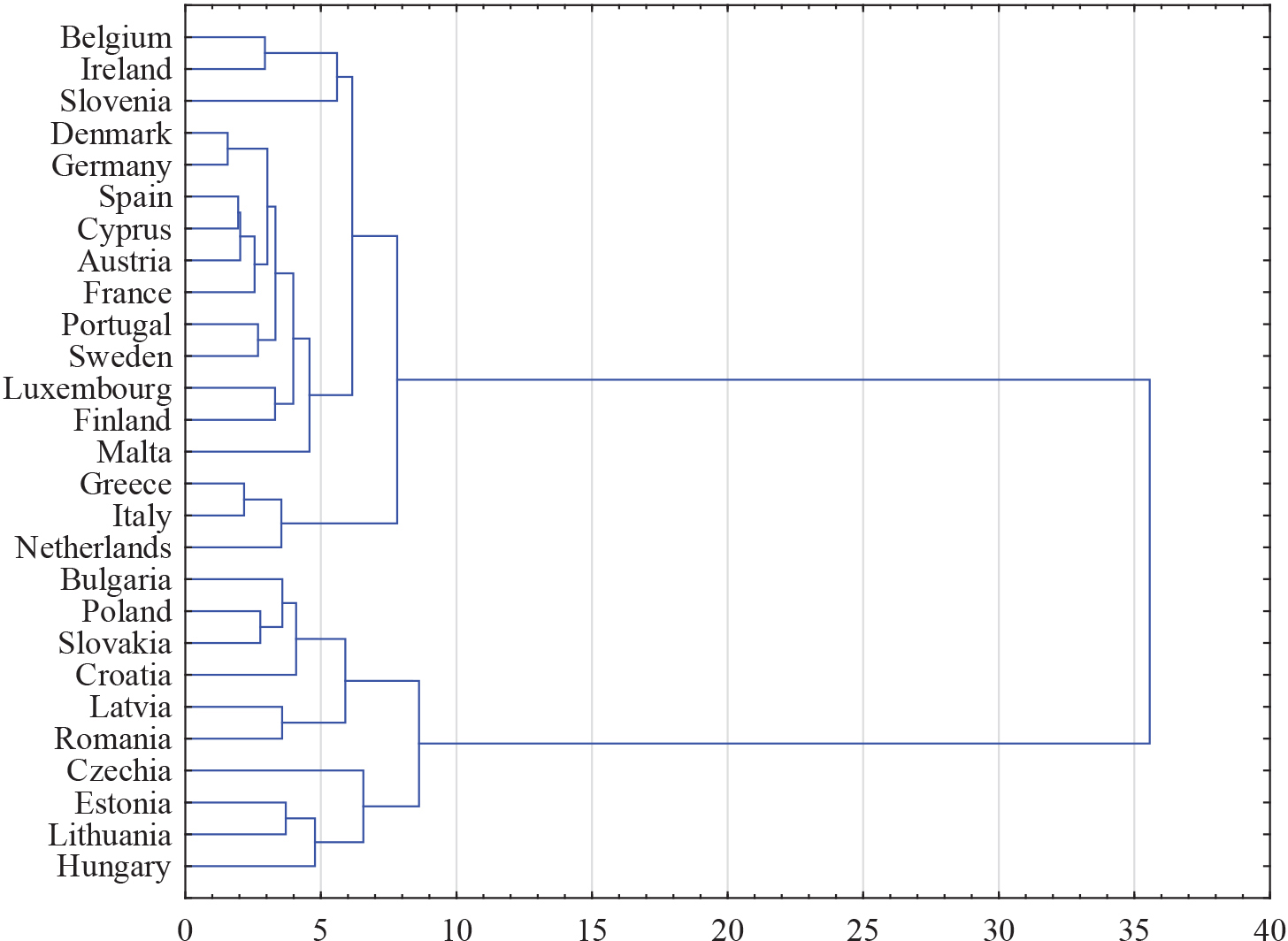
Figure 1.
Grouping of EU countries (2022).
Source: Own research based on Eurostat data. EU, European Union.
The result of the grouping is quite unambiguous. The first group consists of the old EU member states apart from Slovenia, Cyprus, and Malta (cluster 1). The second group consists of the countries of Central and Eastern Europe (CEE) and, with the exception of Lithuania, Estonia, Latvia, and Slovakia, they use their own national currencies rather than the euro (cluster 2). On the basis of the above observations, the possession of the common euro currency cannot be considered a differentiating factor belonging to a group (this is evidenced by the similarity of some countries in pairs, e.g., Poland and Slovakia, Latvia and Romania, or Portugal and Sweden). The obtained research results lead to the conclusion that an energy shock has various consequences in the inflation structure of the examined European countries.
Table 3 presents tests of equality of means of individual inflation categories in order to isolate those components of inflation that significantly differentiate these two groups.
Table 3.
Mean equality tests
| Inflation category | Mean (cluster 1) | Mean (cluster 2) | F-test | p-value | Wilks λ | Rc |
|---|---|---|---|---|---|---|
| Food and nonalcoholic beverages | 10.36 | 19.81 | 61.8426 | 0.0000 | 0.28787 | 0.84387 |
| Alcoholic beverages, tobacco and narcotics | 3.38 | 6.48 | 14.9433 | 0.0000 | 0.62589 | 0.6116 |
| Clothing and footwear | 2.51 | 6.68 | 14.2725 | 0.0008 | 0.63658 | 0.60284 |
| Actual rentals for housing | 3.47 | 8.94 | 6.46093 | 0.0176 | 0.79464 | 0.45317 |
| Maintenance and repair of the dwelling | 9.43 | 17.61 | 20.3340 | 0.0001 | 0.55145 | 0.66974 |
| Water supply and miscellaneous services relating to the dwelling | 2.19 | 6.43 | 19.7257 | 0.0001 | 0.55896 | 0.66411 |
| Electricity, gas, and other fuels | 43.63 | 39.20 | 0.17980 | 0.6752 | 0.99286 | 0.08450 |
| Furnishings, household equipment, and routine household maintenance | 6.85 | 10.85 | 20.8635 | 0.0001 | 0.54510 | 0.67447 |
| Health | 1.71 | 5.91 | 36.5719 | 0.0000 | 0.40603 | 0.77070 |
| Transport | 12.34 | 18.15 | 18.5896 | 0.0002 | 0.57353 | 0.65305 |
| Communications | 0.06 | 1.44 | 2.20623 | 0.1500 | 0.91891 | 0.28477 |
| Recreation and culture | 3.75 | 8.58 | 51.3843 | 0.0000 | 0.32729 | 0.82019 |
| Education | 1.20 | 5.36 | 29.2787 | 0.0000 | 0.46059 | 0.73445 |
| Restaurants and hotels | 7.50 | 15.38 | 65.6803 | 0.0000 | 0.27569 | 0.85106 |
| Miscellaneous goods and services | 3.10 | 9.12 | 110.8480 | 0.0000 | 0.18402 | 0.90331 |
In almost all inflation categories, with the exception of “Electricity, gas and other fuels,” the average inflation in the countries classified in the second cluster (CEE countries) was higher. According to the results of the F test, the means in the two separate clusters were significantly different for almost all categories (except for the aforementioned “electricity, gas and other fuels” and “communications”). However, the calculated Wilks lambda coefficients and canonical correlation do not allow the conclusion that all these variables are the basis for classifying EU countries into the two groups. Based on these coefficients, however, it can be concluded that the variables that may be considered discriminatory are “food and non-alcoholic beverages,” “health,” “recreation and culture,” “restaurants and hotels,” and “miscellaneous goods and services.”
Discriminant function analysis could also be considered in terms of multiple regression. The dependent variable is coded as two groups: 1 and 2. The explanatory variables are the categories of inflation (marked successively from x1 to x15). The interpretation of the results in the case of the two groups follows directly from the regression logic: the variables that have the largest (standardized) regression coefficients contribute the most to the discrimination of objects into groups.
The above equation allows the identification of those variables that most strongly discriminate and classify EU countries. The results confirm the above conclusions that these include: Miscellaneous goods and services (x15), Restaurants and hotels (x14), and Health (x9).
In general, it should be stated that the obtained research results correspond to the conclusions from other papers regarding the interdependence of changes in energy prices and inflation. Changes in energy prices have a significant impact on inflation, and owing to the research results obtained in this work, it is possible to identify inflation components that have responded to changes in energy prices in a statistically significant way. The literature survey presented in Section 2 also has shown that the pass-through effect varies among EU countries. The findings in this text seem to confirm this through the increase in the standard deviation of the price increase rate in individual inflation categories and the conducted cluster analysis and one-factor variance analysis.
5. Conclusions
Based on the obtained results, it can be concluded that there is a causal relationship between energy prices and the differentiation in the price growth rate with regard to certain inflation groupings. The categories for which a statistically significant relationship was observed were “food and non-alcoholic beverages,” “furnishings, household equipment and routine household maintenance,” “recreation and culture,” “education,” and “restaurants and hotels.”
In the face of the energy shock of 2022, differences have increased significantly. As shown via cluster analysis, in 2022, the EU member states became divided into two quite distinct groups. The first grouping consisting mainly of the old EU member states, and the second consisting of the countries of CEE. The obtained research results lead to a conclusion that the energy shock has had various consequences upon the inflation structure of the examined European countries, and this is, at least to some extent, conditioned by the level of economic development and production structure. The variables that have differentiated the identified clusters to the greatest extent were “food and non-alcoholic beverages,” “health,” “restaurants and hotels,” and “miscellaneous goods and services.”
The CEE countries were characterized as having higher price growth in almost every inflation subcategory. It is difficult to specify unambiguous causes. In 2022, increased energy costs were transferred to other spheres. However, it can be assumed that in the CEE countries, this transmission was faster despite the fact that the average price increase in these countries was lower within the energy category. Some countries from cluster 2 (CEE countries) experienced a depreciation of their national currencies in the analyzed period, which to some extent resulted in a relatively higher price level for imported goods. Countries from the two separate clusters are undoubtedly at different levels of economic development. The price transmission process was also affected by differences in the structures of these economies.
Due to these processes, diversification of the inflation structure may also cause significant disturbances in the transmission of monetary policy. The findings contained in this analysis have indicated that there is a risk of structural inadequacy within the European Central Bank’s (ECB) common monetary policy. This situation poses a threat to real convergence processes and is particularly unfavorable for the so-called catching-up countries with euro.
In 2023, during the period of widespread disinflation in the EU, the dispersion of price dynamics decreased slightly only in five categories, but increased in seven (Table 1). This shows that a one-time energy shock may have long-lasting economic consequences. Research has shown that energy shocks have a lasting impact on global inflation, the effects of which can last up to 2.5 years [Škare et al., 2023]. This situation poses a huge threat to European integration. Firstly, a diversified inflation structure causes differences in the costs incurred by economic entities in different sectors of the economy between countries. This causes differences in unit labor costs internationally and across sectors. Meanwhile, in sectors where the average rate of price growth is higher, it puts pressure on the appreciation of the real exchange rate, which should be an important stabilization mechanism under the conditions of monetary integration. When EU Member States differ in terms of labor productivity, the effect is to diversify the competitiveness of their economies. Additionally, differences in price growth rates in individual inflation categories lead to differences in individual consumption and differences in the level of wealth between EU countries.
Therefore, it seems that it is necessary to take actions aimed at reducing the risk of increasing differences in inflation structure among EU countries. The obtained research results are supportive of the conclusion that for inflation stability, it is advisable to increase the share of renewable energy sources in the energy mix. Empirical data have confirmed that the share of renewable energy has an observable impact with regard to inflation [Filippidis et al., 2021; Yıldırım and Kaya, 2021; Markowski and Kotliński, 2023]. Increasing renewables may help economies become more independent of fluctuations in energy prices on world markets, and thus may also contribute to reducing the pressure on the differentiating inflation structure.
A certain limitation of this particular research project may be the length and scope of the adopted time series. This is a starting point for further analyses, in which modeling should be carried out, e.g., for isolated clusters. Like any empirical study, VAR modeling is based on many assumptions (e.g., the chosen delay order). In order to substantiate the conclusions drawn, it is necessary to check the resistance of the obtained results to modifications of the adopted research method. The next point for further analysis may also be to verify the rate of transmission of energy prices to other categories of inflation and individual sectors of the economy. Studying the structure of consumer spending (with particular emphasis on those variables that discriminated the countries studied most) should also be the subject of future analyses.
Notes
[5] Due to the limited maximum volume of the article, the author will make the test results available at the reader’s request.
[6] The AIC criterion in almost all models (except for the models describing price differentiation in “Communications” and “ Recreation and culture”) indicated a 12-month delay. The remaining information criteria, Schwartz–Bayesian (BIC) and Hannan–Quinn (HQC), usually indicated a 1-month delay. However, such a period seems too short for the transmission of energy prices to other inflation categories. In order to obtain comparability of results, a lag order of 12 months was chosen for all 13 models.