
1. Introduction and literature review
The eastern enlargement of the European Union (EU) still remains a major issue addressed by researchers in that region. It is emphasized that the adoption of new rules by the EU-10 countries, applicable in the single European market (SEM) in connection with accession, is one of the most important determinants of changes in the structure of their exports and imports [Zaghini, 2005; Molendowski, 2007; Czarny and Śledziewska, 2009; Polan, 2010]. The accession of the EU-10 countries into the EU has been a driving force behind the significant dynamism of trade flows. The reduction in trade costs associated with the process of the EU regional integration enhanced the segmentation of production processes that improved further exploitation of comparative advantages and location and the production of new goods [Martinez-Zarzoso et al., 2015].
Authors of advanced studies of the commodity trade structure tend to focus on investigating export flows. In the case of analyses of the concentration and similarity of structures, researchers mostly use measures such as the share of major commodity groups in total trade, the Gini coefficient, or the Herfindahl–Hirschman index [NBP, 2014b]. A crucial component of the contribution of this article presented to scientific development is supplementing background knowledge with import flows. The inclusion of such flows is important (particularly in the case of studies of structural competitiveness 2 of the economies of countries engaged in the process of integration at such an advanced stage as that of the common market) because they allow to carry out in-depth examination of integration effects. At the same time, the use of the “Euclidean distance” index in the analysis bridges the research gap, broadening the range of commonly used measures.
It seems that an important addition to previous publications on this subject may be the presentation of findings from the analysis of changes in the dynamics and transformations in the structure of Polish foreign trade in relations with the EU-10 countries and the EU-15 in 2004–2017.
The analysis attempts to investigate the hypothesis whether, as a consequence of the eastern enlargement, the EU-10 and EU-15 markets were increasingly treated by the exporters and importers from Poland as a single market. The assumption adopted is that an important element of this analysis may be to identify the main trends observed in Poland and in the EU-10 countries, which became full members of the EU together with Poland (in 2004 or 2007). 3
The analysis focuses on determining the distance between structures using the selected similarity measure. The metric applied is the “Euclidean distance,” a measure from the group of indicators based on absolute individual structure differences. This study is based on foreign trade data published by Eurostat, according to the homogeneous trade classification (combined nomenclature [CN]) of exports and imports of the countries covered in 2004–2017 at the four-digit level of aggregation.
The presented analysis as a whole closes with conclusions and final remarks.
2. The new rules of trade after EU accession
For Poland and the other EU-10 countries, joining the EU meant, among other things, an essential change of previous principles and rules of trade with all partners. It primarily resulted from the adoption of the whole of acquis communautaire in the areas of the “free movement of goods” and the “customs union” applied by the EU-15.
Poland’s foreign trade policy rules were significantly harmonized with those of the common commercial policy of the EU even before EU accession. Under the Europe agreements, trade in industrial goods was almost fully liberalized. In the early 2000s, agreements were concluded to liberalize agricultural trade. In relations with third countries (other than the EU-15), in the 1990s, a number of free trade (or preferential trade) agreements were signed with countries that had entered into such agreements with the Community earlier. After accession, they became adjusted with the requirements of the EU common commercial policy [Kawecka-Wyrzykowska, 2004, pp. 88–91].
The adoption of the Community principle of the free movement of goods in relations with the EU-15 and the EU-10 countries involved the following:
the abolition of customs duties and any charges having an equivalent effect,
the elimination of all types of quantitative restrictions (quotas and ceilings),
the abolition of antidumping measures applicable before accession, and
the removal of physical, technical, and fiscal barriers related to crossing borders: border and customs controls, provisions regarding technical requirements for goods, and differentiated systems for the taxation of goods [Kawecka-Wyrzykowska, 2016, pp. 197–209].
For Poland (and for the other EU-10 countries), EU accession involved a change of the rules and conditions of trade, both with the EU-15 and in their mutual relations. Those decisions resulted in the following:
the inclusion of the EU-10 countries in the internal single market of the EU (with the free movement of goods and services and harmonized regulations concerning technical requirements for products) and
the adoption by the EU-10 countries of all the principles, rules, and instruments of the EU common commercial policy for third countries (the common customs tariff, nontariff tools, and the system of trade agreements with non-EU partners) [Molendowski, 2012, pp. 177–182].
3. Analysis method
This study is based on foreign trade data published by Eurostat, according to the homogeneous trade classification (CN) of exports and imports of the countries covered in 2004–2017 at the four-digit level of aggregation. It served to determine the shares of ca. 1,630 commodity groups in the composition of their exports and imports in each year of the period in question.
At the first stage of the analysis, the calculation procedures performed resulted in a uniform commodity classification of exports and imports of Poland (and of the other EU-10 countries) in relations with the EU-10 and the EU-15 in 2004–2017, broken down into headings (four-digit codes) of the customs tariff. It allowed to identify the structure of the commodity groups covered in particular years of the period under examination. The obtained analytical data on exports and imports of the countries in question in relations with the EU-10 and the EU-15 served as material for examination to formulate and verify the research hypotheses adopted.
For the purpose of facilitating further analysis, sets of data matrices were built with regard to the trade of Poland and the other EU-10 countries:
with the EU-10 and
with the EU-15.
The above relations are illustrated in Figure 1.
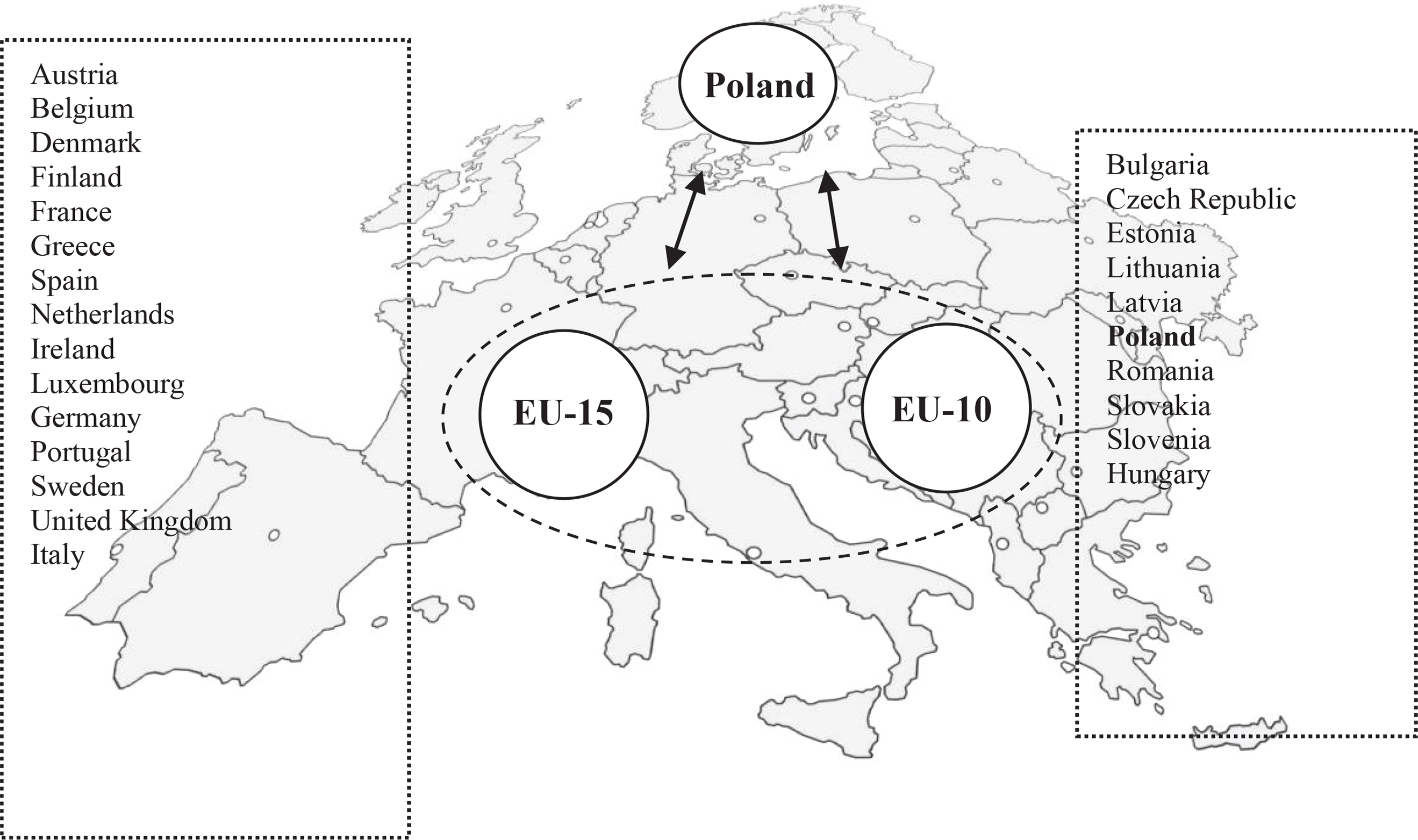
Figure 1
Countries covered by the analysis of increasing similarity of foreign trade structures.
Source: Authors’ own study based on Molendowski and Polan [2012, p. 34].
At the next stage of the analysis, seeking to find an answer to the question whether, in subsequent years of the period covered, the structure of exports and imports of Poland (and of other countries under examination) to and from the EU-10 was increasingly similar or different from the composition of their exports and imports to and from the EU-15, and distances between those structures were studied with the use of appropriate similarity measures. The metric applied is the main measure from the group of indicators based on absolute differences of individual structure indices: the “Euclidean distance.” 4
In order to calculate Euclidean distance “ej” (for subsequent years of the period 2004–2017) between the corresponding columns of specific pairs of matrices, the following formula was used:
where αij means the share of a commodity defined by its CN-4 code in exports (or imports) of a country to the EU-15, βij means the share of a commodity defined by its CN-4 code in exports (or imports) of a country to the EU-10, i is headings of the customs tariff at the four-digit level of disaggregation, and j is particular years for the period 2004–2017 for which specific “Euclidean distance” values were calculated.The structure distance index “ej” measured with the use of the above-mentioned formula takes values from 0 to 1. The closer to “0” the values are, the more similar the structures under examination; in contrast, the closer to 1, the greater the degree of dissimilarity between those structures (ej = 0 if the structures analyzed are identical, whereas ej = 1 if the structures are completely different) [Zeliaś, 1988, pp. 169–173].
The results of the calculations of similarity indices according to the “Euclidean distance” between particular structures are presented in Tables 1 and 2 and interpreted graphically in Figures 2 and 3.
Table 1
Similarity indices of the commodity structure of Poland’s exports (according to the Euclidean distance) to the EU-10 and the EU-15 in 2004–2017 (as compared with the rest of the EU-10)
| Year | PL | BG | CZ | EE | HU | LT | LV | RO | SI | SK | Mean** |
|---|---|---|---|---|---|---|---|---|---|---|---|
| 2004 | 0.098 | 0.170 | 0.092 | 0.160 | 0.103 | 0.203 | 0.276 | 0.139 | 0.179 | 0.182 | 0.160 |
| 2005 | 0.083 | 0.130 | 0.084 | 0.184 | 0.086 | 0.167 | 0.245 | 0.162 | 0.179 | 0.175 | 0.149 |
| 2006 | 0.090 | 0.124 | 0.082 | 0.211 | 0.084 | 0.151 | 0.216 | 0.148 | 0.168 | 0.195 | 0.147 |
| 2007 | 0.077 | 0.161 | 0.075 | 0.204 | 0.075 | 0.185 | 0.203 | 0.137 | 0.144 | 0.209 | 0.147 |
| 2008 | 0.077 | 0.119 | 0.079 | 0.168 | 0.075 | 0.094 | 0.149 | 0.138 | 0.138 | 0.194 | 0.123 |
| 2009 | 0.107 | 0.106 | 0.096 | 0.132 | 0.096 | 0.170 | 0.152 | 0.129 | 0.170 | 0.188 | 0.135 |
| 2010 | 0.098 | 0.111 | 0.095 | 0.171 | 0.097 | 0.118 | 0.166 | 0.123 | 0.169 | 0.179 | 0.133 |
| 2011 | 0.087 | 0.126 | 0.094 | 0.202 | 0.106 | 0.129 | 0.165 | 0.107 | 0.153 | 0.184 | 0.135 |
| 2012 | 0.076 | 0.121 | 0.091 | 0.216 | 0.093 | 0.161 | 0.168 | 0.094 | 0.134 | 0.207 | 0.136 |
| 2013 | 0.067 | 0.125 | 0.080 | 0.213 | 0.100 | 0.172 | 0.174 | 0.094 | 0.130 | 0.214 | 0.137 |
| 2014 | 0.063 | 0.117 | 0.082 | 0.224 | 0.112 | 0.152 | 0.175 | 0.091 | 0.130 | 0.219 | 0.137 |
| 2015 | 0.058 | 0.116 | 0.082 | 0.193 | 0.112 | 0.176 | 0.175 | 0.083 | 0.123 | 0.224 | 0.134 |
| 2016 | 0.055 | 0.109 | 0.072 | 0.170 | 0.101 | 0.169 | 0.159 | 0.074 | 0.108 | 0.230 | 0.125 |
| 2017 | 0.053 | 0.128 | 0.069 | 0.152 | 0.087 | 0.174 | 0.141 | 0.074 | 0.097 | 0.220 | 0.119 |
| Mean* | 0.078 | 0.126 | 0.084 | 0.186 | 0.095 | 0.159 | 0.183 | 0.114 | 0.144 | 0.201 | 0.137 |
| 2017–2004 change | −0.045 | −0.042 | −0.023 | −0.007 | −0.016 | −0.028 | −0.135 | −0.066 | −0.082 | 0.038 | −0.041 |
* The arithmetic mean of similarity indices for the country concerned throughout the period covered.
Source: Own calculations based on data from the database: EasyComext—Eurostat—International Trade [online], http://epp.eurostat.ec.europa.eu/newxtweb/.
Table 2
Similarity indices of the commodity structure of Poland’s imports (according to the Euclidean distance) from the EU-10 and the EU-15 in 2004–2017 (as compared with the rest of the EU-10)
| PL | BG | CZ | EE | HU | LT | LV | RO | SI | SK | Mean** | |
|---|---|---|---|---|---|---|---|---|---|---|---|
| 2004 | 0.096 | 0.143 | 0.107 | 0.159 | 0.100 | 0.080 | 0.147 | 0.090 | 0.092 | 0.104 | 0.112 |
| 2005 | 0.100 | 0.190 | 0.102 | 0.172 | 0.105 | 0.076 | 0.140 | 0.089 | 0.093 | 0.089 | 0.115 |
| 2006 | 0.081 | 0.145 | 0.093 | 0.184 | 0.110 | 0.086 | 0.127 | 0.081 | 0.081 | 0.096 | 0.108 |
| 2007 | 0.072 | 0.112 | 0.084 | 0.199 | 0.097 | 0.086 | 0.125 | 0.079 | 0.092 | 0.082 | 0.103 |
| 2008 | 0.072 | 0.124 | 0.084 | 0.258 | 0.097 | 0.085 | 0.158 | 0.077 | 0.082 | 0.077 | 0.111 |
| 2009 | 0.081 | 0.109 | 0.081 | 0.213 | 0.095 | 0.078 | 0.129 | 0.068 | 0.088 | 0.080 | 0.102 |
| 2010 | 0.078 | 0.100 | 0.085 | 0.168 | 0.113 | 0.091 | 0.094 | 0.072 | 0.075 | 0.083 | 0.096 |
| 2011 | 0.079 | 0.131 | 0.079 | 0.150 | 0.101 | 0.089 | 0.127 | 0.073 | 0.071 | 0.082 | 0.098 |
| 2012 | 0.077 | 0.114 | 0.078 | 0.121 | 0.092 | 0.096 | 0.132 | 0.073 | 0.071 | 0.091 | 0.095 |
| 2013 | 0.081 | 0.122 | 0.074 | 0.130 | 0.088 | 0.077 | 0.117 | 0.066 | 0.064 | 0.116 | 0.094 |
| 2014 | 0.073 | 0.114 | 0.073 | 0.127 | 0.094 | 0.084 | 0.078 | 0.064 | 0.078 | 0.109 | 0.089 |
| 2015 | 0.067 | 0.101 | 0.074 | 0.117 | 0.091 | 0.076 | 0.082 | 0.063 | 0.084 | 0.118 | 0.087 |
| 2016 | 0.069 | 0.093 | 0.078 | 0.106 | 0.081 | 0.073 | 0.085 | 0.064 | 0.072 | 0.115 | 0.084 |
| 2017 | 0.071 | 0.112 | 0.080 | 0.088 | 0.080 | 0.078 | 0.098 | 0.063 | 0.074 | 0.112 | 0.086 |
| Mean* | 0.078 | 0.122 | 0.084 | 0.156 | 0.096 | 0.083 | 0.117 | 0.073 | 0.080 | 0.097 | 0.099 |
| 2017–2004 change | −0.025 | −0.031 | −0.027 | −0.071 | −0.020 | −0.002 | −0.049 | −0.027 | −0.018 | 0.008 | −0.026 |
* The arithmetic mean of similarity indices for the country concerned throughout the period covered.
Source: As in Table 1.
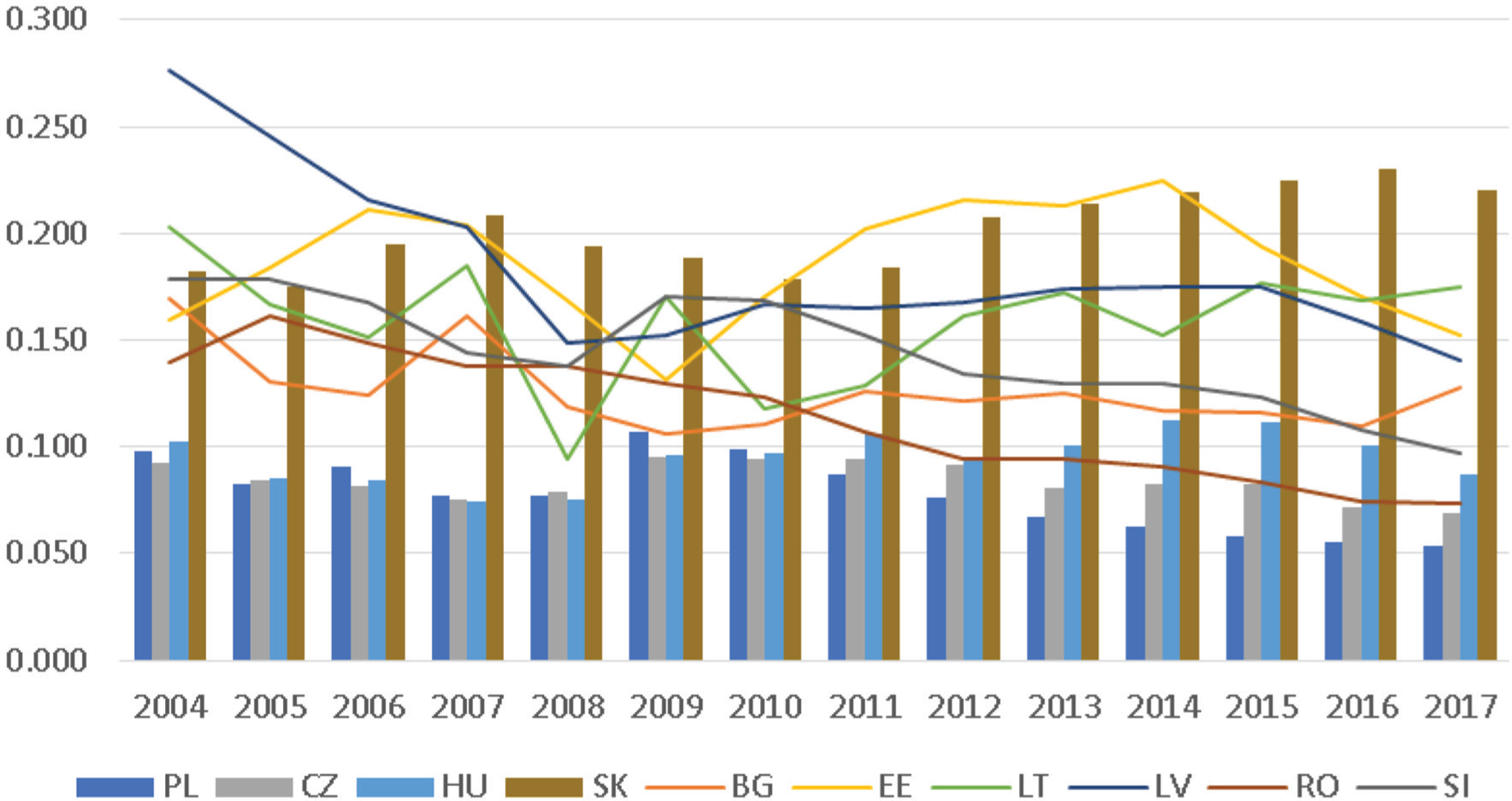
Figure 2
Similarity indices of the commodity structure of Poland’s exports (according to the Euclidean distance) in relations with the EU-10 and the EU-15 in 2004–2017 (as compared with the V4 countries and the EU-10).
Source: Author’s own study based on the data from Table 1.
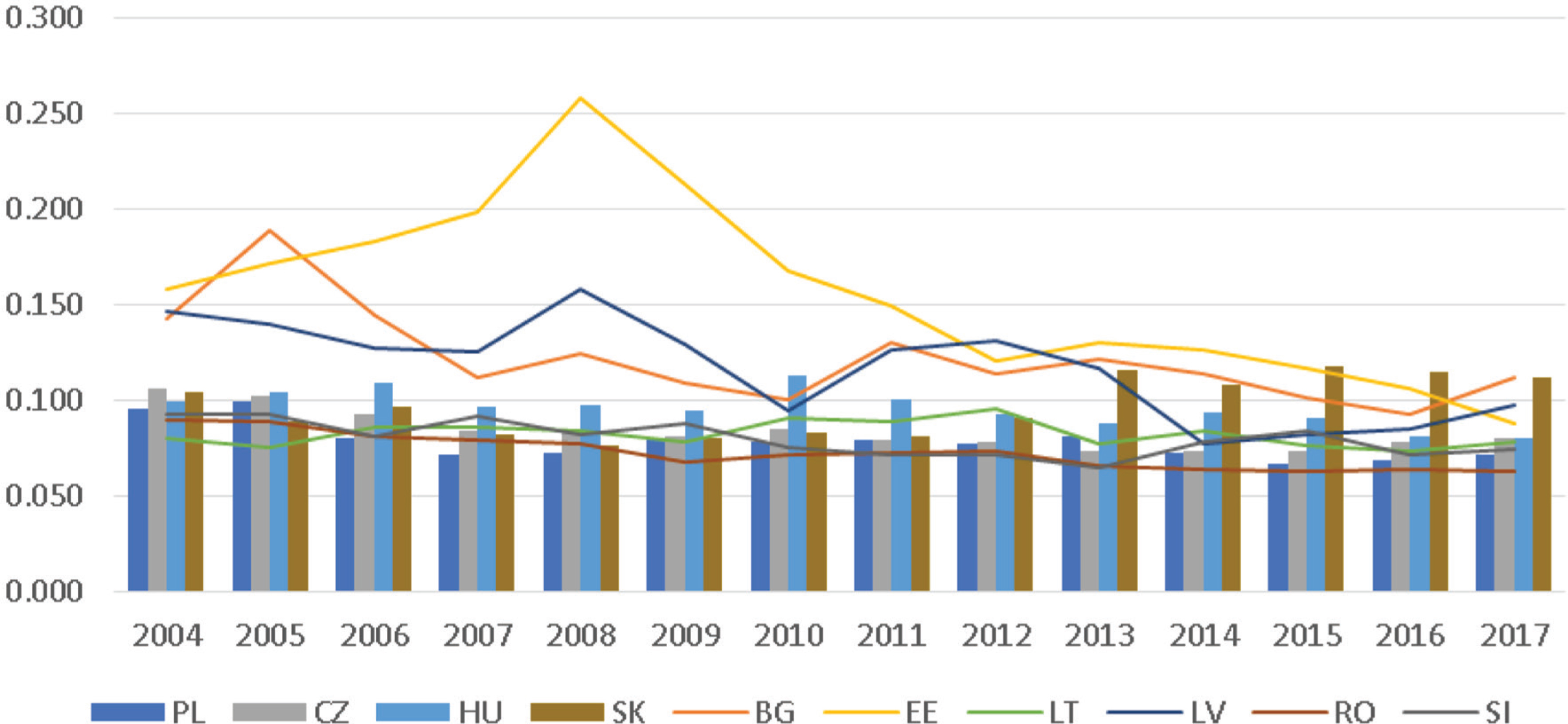
Figure 3
Similarity indices of the commodity structure of Poland’s imports (according to the Euclidean distance) from the EU-10 and the EU-15 in 2004–2017 (as compared with the rest of the EU-10).
Source: Author’s own study based on the data from Table 2.
4. Changes in the similarity of the commodity structures of Polish exports in relations with the EU-10 and the EU-15
In 2004–2017, both in Poland and in the EU-10 as a whole, exports showed a marked increase—particularly in mutual trade, whereas their growth rate in relations with the EU-15 was lower than that in total trade. The foreign sales of the EU-10 went up particularly fast in the first years after EU accession. Therefore, the countries concerned had used the period of preparations for EU membership to stimulate their trade links with their future EU partners. 5
There were also significant changes in the commodity structure of trade with major trading partners. It follows from the analysis of the structure similarity indices (cf. Table 1) that in 2004–2017 the structure of Polish exports to the EU-10 became distinctly more similar to that of exports to the EU-15. A similar trend, even though with a varying course, was observed for both the Visegrad (V4) Group countries and the other EU-10 countries.
In 2004—the first year of EU membership—the similarity index for the structures of Polish exports to the EU-10 and the EU-15 was 0.098. It means that those structures were already relatively similar. Approximately 90.2% of the commodity groups (at the level of four-digit CN codes) were exported to both the EU-10 (especially the V4 countries) and the EU-15. It is worth emphasizing that the structure similarity indices for the Czech Republic and Hungary were then similar with 0.092 and 0.103, respectively. The index was much higher (0.182) only in the case of Slovakia, which means that the country concerned only 81.8% of the commodity groups were found in exports to both the EU-10 and the EU-15. Regarding the rest of the EU-10, the indices were much higher, particularly for Latvia (0.276) and Lithuania (0.203). Thus, in addition to the Czech Republic and Hungary, Poland already ranked among countries characterized by the most similar commodity structures of exports to both the EU-10 and the EU-15.
Therefore, it is possible to state that as early as the first year of EU membership the structures of exports of Poland (and of the other V4 countries) in relations with the EU-10 and the EU-15 were largely similar, to a higher degree in the case of Poland, the Czech Republic, and Hungary, and ca. 10 pps lower for Slovakia. It means that already in the pre-accession period exporters from Poland (as well as from the Czech Republic and Hungary) started to treat both the EU-10 and EU-15 markets in a similar way. It resulted, inter alia, from various trade facilities introduced under the Europe agreements and the Central European Free Trade Agreement (CEFTA). The agreements in question provided for similar schedules for the elimination of trade barriers existing before their implementation and represented a major element of the process of preparations for full membership of the EU and presence in the SEM. It is also worth stressing that even in 2000 those structures were significantly more differentiated [Polan, 2010, pp. 67–80].
It also follows from the data presented in Table 1 that in the first years after accession, until as late as 2008, the structures continued to converge (as clearly illustrated in Figure 2). Concerning the V4 countries, the process was the most visible in Hungary, Poland, and the Czech Republic. The similarity indices characteristic of those countries became closer to “0” by 2.8, 2.1, and 1.3 pps, respectively. However, an opposite trend was noted in the case of Slovakia—the similarity index became more distant from the “0” level by ca. 1.2 pps. It must be emphasized that for the whole V4 group the index became closer to “0” by 1.3 pps.
At the same time, in the EU-10 as a whole the index became closer to “0” by 3.7 pps. The trend was the most evident in countries characterized by the least similar export structures in 2004, i.e., Latvia, Lithuania, and Bulgaria. But despite that favorable trend the export structures in the non-V4 EU-10 continued to be more differentiated in the trade relations under examination than in Poland, the Czech Republic, and Hungary.
However, those positive developments were arrested in the period of the global economic crisis. 6 Disadvantageous phenomena observed in the foreign trade of Poland and the other countries covered in the wake of the crisis were also reflected in changed structures of their exports. Those movements were the most evident in 2009. They consisted in the reversal of the previous trend of converging export structures in relations with the EU-10 and the EU-15. In the year in question, the similarity index for Poland became more distant from the 2008 level by 3 pps. A similar trend (although to a lesser degree) was also noted in the case of Hungary (2.1 pps) and the Czech Republic (1.7 pps), whereas in Slovakia it was even more intensive (3.2 pps). It is worth emphasizing that as early as 2010 that unfavorable trend stopped and the subsequent years of the period covered (2011–2017) again witnessed increasing similarity of the analyzed structures of Polish as well as Czech and Hungarian (from 2012) exports. Only in the case of Slovakia, following a minor improvement in the index in 2010–2011, from 2012 to as late as 2016 its value became more and more distant from “0,” whereas the export structures in both trade relations differentiated increasingly. The adverse effects of the global crisis were also visible in the rest of the EU-10 (with the exception of Romania).
When comparing the situation at the beginning and at the end of the period covered, one must stress that in 2004–2017 the commodity structure of Polish exports to the EU-10 became largely similar to the corresponding composition of trade with the EU-15. Over that period, the similarity index improved by 4.5 pps, i.e., to a much greater degree than in the case of the Czech Republic (2.3 pps) and Hungary (0.1 pps). It is also worth adding that in the whole period under investigation a more significant improvement in the similarity of export structures was noted only in Romania (by 6.6 pps) than in Poland, whereas roughly the same level was observed in Bulgaria (by 4.2 pps).
Therefore, Poland ranked among countries whose export structures in trade with the EU-10 and EU-15 showed the greatest convergence. In 2017, already more than 93% of commodity groups (according to CN-4 classification) were found in Polish exports to both the EU-10 and the EU-15.
Thus, it follows from the analysis of changes in the similarity of the commodity structure of exports of Poland and of the rest of the Visegrad Group in relations with the EU-10 and the EU-15 that in 2004–2017 their convergence proceeded with varying intensity in individual countries. The greatest advancement in the similarity of those structures was found in the case of Poland, followed by the Czech Republic and Hungary. As compared with the EU-10 as a whole, the achievements of Poland in that regard must also be considered among the most distinct.
5. Changes in the similarity of the commodity structures of Polish imports in relations with the EU-10 and the EU-15
As confirmed by the analysis of the data presented in Table 2 (and illustrated in Figure 3), the period 2004–2017 also (as the case of exports) witnessed growing similarity between the structure of Polish imports from the EU-10 and that of imports from the EU-15 (the value of the Euclidean distance index dropped from 0.096 in 2004 to 0.078 in 2017).
It must be emphasized that as early as 2004 those structures were relatively close. As many as 90.4% of commodity groups (according to CN-4 classification) were then found in Polish imports from both the EU-10 and the EU-15. It must be emphasized that the value of the structure similarity index for Poland was the lowest among all the Visegrad Group countries. In the case of Hungary it was 0.100, whereas for the Czech Republic and Slovakia the respective values were 0.107 and 0.104. It is also worth adding that those indices were close to the level of Poland (and to those of the V4 countries) in the case of three other countries from the EU-10: Lithuania (0.080), Romania (0.090), and Slovenia (0.092). As for the other three countries from the EU-10 group, the structures under examination were more differentiated. The respective values of the similarity indices were as follows: for Estonia—0.159, for Latvia—0.147, and for Bulgaria—0.143.
Therefore, one may argue that as early as the first year of EU membership the commodity structures of Polish imports from the EU-10 and the EU-15 were largely close to one another (as in the case of exports). A similar situation also took place in all the V4 countries and in three other countries from the EU-10 group.
It means that already in the pre-accession period Polish importers as well as those from the majority of the EU-10 started to treat suppliers from both the EU-10 and the EU-15 in a similar way. It resulted from the preparations for full membership of the EU that had begun as early as the mid-1990s (inter alia, under the Europe agreements or the CEFTA ).
It also follows from the data presented in Table 2 that in the first years after accession, until as late as 2008, the structures continued to converge (as can be seen in Figure 3). The process was particularly significant in the case of Poland (the similarity index became closer to “0” by 2.4 pps). A similar trend also occurred in the other Visegrad Group countries. The similarity indices became closer to “0” even by 2.7 pps in the case of Slovakia, for the Czech Republic by 2.3 pps; only in Hungary the trend did not materialize (as the similarity index became closer by 0.3 pps). Concerning the rest of the EU-10, the trend was not as unambiguous. Some of those countries even experienced growing differences in the similarity structure by 9.9 pps in the case of Estonia or by 1.1 pps for Latvia. It is clearly illustrated in Figure 3.
The global economic crisis had no unequivocal effect—as observed in the case of exports—on differences in the commodity structure of imports.
In the case of Poland, the changes noted in 2009 consisted in the reversal of the previous trend of converging import structures in relations with the EU-10 and the EU-15. In the year in question, the similarity index for Poland became more distant from “0” by ca. 1 pps against the 2008 level. A similar trend (although to a lesser degree) was only observed in the case of Slovakia. As for the Czech Republic and Hungary, the reversal of the previous trends was not seen until 2010. It is also worth stressing that in 2009–2010 Estonia, Latvia, and Bulgaria even experienced greater similarity of the trade structures under analysis.
In subsequent years (from 2010 in Poland and from 2011 in the case of other countries), the structures examined began to converge again. But the rate of the convergence of those structures was already much lower than before the crisis.
When comparing the situation in the first year of membership and at the end of the period covered, one must emphasize that in 2004–2017 the commodity structure of Polish imports from the EU-10 became largely similar to the corresponding composition of trade with the EU-15. Similar changes were also observed in other V4 countries (with the exception of Slovakia). The structure similarity index became closer to “0” in the case of Poland by 2.5 pps, for the Czech Republic by 2.7 pps, whereas for Hungary it was by 2.0 pps. At the same time, in the case of Slovakia it became more distant by 0.8 pps. Slovakia was the only country in the EU-10 as a whole where the structures of imports from the EU-10 and EU-15 were more differentiated in 2017 than in 2004. It must be emphasized that in 2017 approximately 92.9% of commodity groups (according to CN-4 classification) were found in Polish imports from both the EU-10 and the EU-15 (in exports—93.2%).
It is worth adding that in the period covered the countries that were most successful in bringing their import structures closer were those characterized by the greatest relative differentiation of those structures at the beginning of the period in question: Estonia, Latvia, and Bulgaria.
Therefore, it follows from the analysis of changes in the similarity of the structure of imports of Poland and of the rest of the Visegrad Group (with the exception of Slovakia) in trade with the EU-10 and the EU-15 that the period 2004–2017 saw their convergence. It proceeded with varying intensity in individual countries. The greatest advancement in the similarity of those structures was found in the case of the Czech Republic, followed by Poland and Hungary. Concerning most of the rest of the EU-10, in the period covered the structures became closer as well.
The trends described earlier demonstrate that importers from Poland and the other V4 countries and from the EU-10 whose transactions influenced the structure of imports increasingly took the opportunity to purchase similar products in both the EU-10 and the EU-15 markets.
6. Summary and conclusions
As demonstrated by the analysis of changes in the structures of exports and imports of Poland and of the rest of the EU-10 countries, the ongoing liberalization of trade between those countries in the pre-accession period and in the first years of membership of the EU was largely correlated with similar processes in their relations with the EU-15. In the period under examination (2004–2017), it brought about convergence of the commodity structures of Polish imports from and exports to partners from both the EU-10 and the EU-15.
The trends described in this article result from factors such as differentiated intensity of the processes of the liberalization of Poland’s foreign trade with the EU-10 and the EU-15. Joining the EU involved the adoption of uniform rules of trade with the EU-10 and with the EU-15. Furthermore, on May 1, 2004, all the previously existing barriers were removed. Therefore, it created favorable conditions for continued convergence of trade structures in relations with the EU-10 and the EU-15.
It is worth emphasizing that the period covered also witnessed marked convergence of the structures of Poland’s exports and imports in relations with the EU-10 and the corresponding structures characteristic of trade with the EU-15. The convergence was more distinct in exports than in imports. It is attributable to greater opening up of the EU-10 markets for their export products together with ongoing liberalization, which built a basis for increasing similarity of the export structures under analysis. However, it is worth emphasizing that Polish producers and exporters took advantage of the changed trade conditions to a much greater degree resulting from EU accession than their partners from the other Visegrad Group countries and the new Member States. The differentiated intensity of the processes of the liberalization of Poland’s foreign trade with the EU-10 and the EU-15 influenced important trends in the development of trade links before and after accession [Kawecka-Wyrzykowska et al., 2017, pp. 64–68]. Joining the EU involved the adoption of uniform rules of trade with the EU-10 and the EU-15. Furthermore, on May 1, 2004, all the previously existing barriers were removed. Therefore, it created favorable conditions for continued convergence of trade structures in relations with the EU-10 and the EU-15.
The analysis of changes in the structures of exports and imports of Poland and of the rest of the EU-10 countries, between 2004 and 2017, indicated a growing similarity of the commodity structures of Polish imports from and exports to partners from both the EU-10 and the EU-15. The ongoing liberalization of trade between EU-10 countries in the pre-accession period and in the first years of membership of the EU was largely correlated with similar processes in their relations with the EU-15.
The growth in trade structure similarity was more distinct in exports than in imports. It is attributable to greater opening up of the EU-10 markets for their export products together with ongoing liberalization, which built a basis for increasing similarity of the export structures under analysis.
Those trends may corroborate the hypothesis that the liberalization of Poland’s mutual trade with the EU-10 and the EU-15 was a major driver of favorable changes in the structure of Polish exports and imports. Furthermore, the changes represented an important condition for adequate preparation for benefiting from participation in the internal single market of the Member States of the European Union.
The ongoing liberalization of trade and its robust growth in both trade relations under analysis allowed Polish producers, investors, and exporters and importers to make decisions taking into account not only of the domestic market needs but also of the requirements of ca. 500 million consumers from the enlarged EU. The rising similarity of the trade structures may corroborate the hypothesis that such decisions were increasingly taken in practice in the period covered.
A significant element supporting those trends was decisions made by producers, importers, and exporters from Poland and the other EU-10 countries. To a growing degree, their decisions resulted from the capital involvement of transnational corporations (particularly from the EU-15). These economies have been very active and involved in production-sharing networks. Those undertakings increasingly treated the EU-10 countries markets as essential elements of the common market of the EU. As a result, they also launched the manufacture of products and components for the needs of the whole market of the enlarged EU in the territories of the EU-10 countries. It triggered additional flows of exports to the EU-10, with simultaneous replacement of previous imports from the EU-15 with imports from the EU-10 [Martinez-Zarzoso et al., 2015].
To recapitulate, the analysis conducted allows to conclude that for more than a dozen years Polish exporters and importers, as their partners from the EU-10 countries, have contributed to the increasing similarity of the structures of their respective countries’ trade and the EU patterns mostly shaped by the EU-15. From the point of view of Poland and of the other EU-10 countries, it reflects the ongoing unification of the foreign trade system and its arrangement toward the recognition of both areas as a single market.