
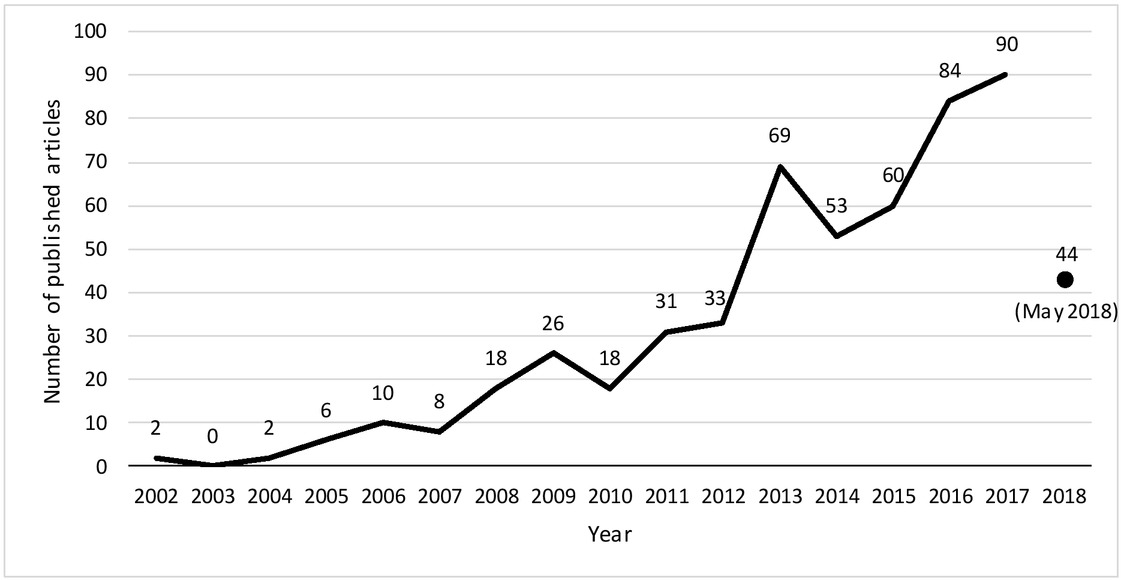
Figure 1
Distribution of publications describing the association between employee engagement and company performance in the period 2002–2018. Source own elaboration.
Table 1
Geographical structure of the reviewed studies
| Number | Country where the study was conducted | Number of research reports | Number | Country where the study was conducted | Number of research reports |
|---|---|---|---|---|---|
| 1 | USA | 10 | 14 | Turkey | 2 |
| 2 | The Netherlands | 10 | 15 | Republic of Korea | 2 |
| 3 | UK | 6 | 16 | Nigeria | 2 |
| 4 | India | 6 | 17 | Czech Republic | 1 |
| 5 | Pakistan | 4 | 18 | Lithuania | 1 |
| 6 | Spain | 3 | 19 | Finland | 1 |
| 7 | Canada | 3 | 20 | Italy | 1 |
| 8 | China | 3 | 21 | Greece | 1 |
| 9 | Malaysia | 3 | 22 | Cyprus | 1 |
| 10 | Germany | 2 | 23 | Indonesia | 1 |
| 11 | Republic of Ireland | 2 | 24 | Jordan | 1 |
| 12 | Portugal | 2 | 25 | Australia | 1 |
| 13 | Israel | 2 |
[i] Source own elaboration.
Table 2
Categorization of reviewed articles based on the type and level of analyzed performance
[i] Source own elaboration.
Table 3
Subcategorization of reviewed articles based on type and level of analyzed performance
| Individual level | Team level | Organizational level | |
|---|---|---|---|
| Process performance | 61 studies | 8 studies | 1 study |
| Task performance | 40 studies | 7 studies | 1 study |
| Contextual performance | 45 studies | 2 studies | 1 study |
| Outcome performance | 4 studies | 4 studies | 3 studies |
| Financial performance | 2 studies | 4 studies | 2 studies |
| Nonfinancial performance | 2 studies | 2 studies | 3 studies |
[i] Source own elaboration.
Table 4
Terms and definitions of employee engagement adopted by various authors
| Term and definition | Author(s) of the definition | Research using the particular definition |
|---|---|---|
| Employee engagement is “a positive, fulfilling | Schaufeli et al | 54 studies |
| work-related state of mind that is characterized by vigour, dedication, and absorption. Rather than a momentary and specific state, engagement refers to a more persistent and pervasive affective–cognitive state that is not focused on any particular object, event, individual, or behaviour” | [2002] | Akhtar et al., 2016; Alessandri et al., 2018; Ali et al., 2018; Bakker and Bal, 2010; Bakker et al., 2012; Bal and De Lange, 2015; Barnes and Collier, 2013; Castanheira, 2016; Cesário and Chambel, 2017; Chong and Lee, 2017; Chughtai and Buckley, 2011; Dijkhuizen et al., 2016; Eldor and Harpaz, 2016; Eldor, 2017; Farndale et al., 2014; Findikli, 2015; Fletcher, 2016; Freeney and Fellenz, 2013; Gordon and Demerouti, 2015; Gorgievski and Moriano, 2014; Gutermann et al., 2017; Halbesleben and Wheeler, 2008; Kapil and Rastogi, 2017; Karatepe, 2011; Karatepe and Aga, 2016; Karatepe and Olugbade, 2016; Kašpárková et al., 2018; Kataria et al., 2013; Khan and Malik, 2017; Kovjanic and Schuh, 2013; Lathabhavan et al., 2017; Lazauskaite-Zabielske et al., 2018; Lin et al., 2016; Lorente and Salanova, 2014; Maden, 2015; Mäkikangas et al., 2016; Menguc and Auh, 2013; Nazir et al.,2017; Nazli and Sheikh Khairudin, 2018; Park et al., 2017; Reijseger et al., 2017; Salanova and Agut, 2005; Schmitt et al., 2016; Shantz and Alfes, 2013; Shantz et al., 2016; Steffens and Haslam, 2014; Suan Choo, 2016; Tims and Bakker, 2013; Tims et al., 2015; Van Beek and Taris, 2014; Wang et al., 2015; Xanthopoulou and Bakker, 2008; Xanthopoulou et al., 2009; Yalabik and Popaitoon, 2013 |
| Personal engagement is “the harnessing of | Kahn [1990] | 5 studies |
| organization members’ selves to their work roles; in engagement, people employ and express themselves physically, cognitively, and emotionally during role performances” | Alfes and Truss, 2013; Badal and Harter, 2014; Kim and Koo, 2017; Rahman et al., 2017; Zhong et al., 2016 | |
| Job engagement is “the extent to which an | Saks [2006] | 2 studies |
| individual is psychologically present in a work role” | Albdour and Altarawneh, 2014; Saks, 2006 | |
| Organizational engagement is “the extent to which an individual is psychologically present in his role as a member of an organization” | ||
| Work engagement is “a relatively enduring state | Christian et al | 1 study |
| of mind referring to the simultaneous investment of personal energies in the experience or performance of work” | [2011] | Benn et al., 2015 |
| Employee engagement “represents an | Myrden and | 1 study |
| employee’s enthusiasm, passion and commitment to their work and to the organization, the willingness to invest themselves and expand their discretionary effort to help the employer succeed” | Kelloway [2015] | Myrden and Kelloway, 2015 |
| Employee engagement is “a cognitive | Shuck and | 1 study |
| emotional, and behavioural state directed toward desired organizational outcomes” | Wollard [2010] | Shuck and Zigarmi, 2015 |
| Employee engagement is “the relative strength of an employee’s involvement in and enthusiasm about his or work” | Tritch [2003] | 1 study Medlin et al., 2016 |
[i] Source own elaboration.
Table 5
Scales used to quantify the level of employee engagement
Source own elaboration.
2 General work engagement was assessed with the UWES-9 questionnaire, whereas state work engagement was measured with UWES-17.
Table 6
Data sources used to quantify performance
[i] Source own elaboration.
Table 7
Statistical modeling techniques applied to verify the association between employee engagement and performance
[i] Source own elaboration.