
1. Introduction
The nonlinear 𝕂𝔾 equation plays a pivotal role in various branches of physics, governing the dynamics of scalar fields across diverse contexts [1,2,3,4,5,6,7,8,9]. This relativistic wave equation has profound applications in the quantum field theory, where it describes the evolution of spin-zero particles, such as pions and the Higgs boson [10]. Additionally, the 𝕂𝔾 equation is significant in solid-state physics, modeling phenomena such as dislocations in crystals and nonlinear lattice vibrations [10]. The rich mathematical structure and physical implications of the 𝕂𝔾 equation have fostered extensive research aimed at unveiling the intricate wave patterns and soliton dynamics associated with this fundamental equation [11].
The 𝕂𝔾 equation is closely related to other well-known nonlinear evolution equations, notably, the sine-Gordon and ϕ4 equations, which have far-reaching implications in various areas of physics [12]. This intimate connection provides a fertile ground for the cross-pollination of ideas and techniques, enabling a deeper understanding of the underlying physical principles that govern these systems [13].
Beginning with the relativistic energy-momentum relation for a scalar field ϕ (x, t) in a potential V (ϕ):
where E is the total energy, p is the momentum, m is the rest mass of the particle associated with the field, and c is the speed of light.Then, we substitute the energy and momentum expressions in terms of the field ϕ and its derivatives:
Now, we assume a specific form for the potential V (ϕ), which may include nonlinear terms as in the provided equation. For example, if , then the equation becomes:Additionally, apply the principle of least action or the Euler-Lagrange equations to derive the equation of motion for the field ϕ. This involves the constructing of the Lagrangian density L = T − V, where T is the kinetic energy density and V is the potential energy density. The Euler–Lagrange equation for this Lagrangian density yields the Klein-Gordon equation with the specified potential terms.
For simplicity, introduce a dimensionless field u = ϕ/ϕ0, where ϕ0 is a characteristic field value, and absorb the constants into the dimensionless parameters ℘1, ℘2, ℘3, and ℘4.
This leads to the provided 𝕂𝔾 equation [14, 15]:
This equation governs the propagation of scalar fields in various physical contexts, including quantum field theory, solid-state physics, and nonlinear optics [16]. The physical interpretation of the model’s terms and constants can be explained as follows [17]:utt : This term represents the second-order time derivative of the scalar field u, depicting the field’s acceleration or oscillation in time.
: This term signifies the spatial derivative of the scalar field u, with ℘1 being a constant related to wave velocity or dispersion. It describes the field’s propagation in space.
℘4 u5: This term, a nonlinear term involving the fifth power of the scalar field u multiplied by a constant ℘4, represents a nonlinear self-interaction or potential term. It can model diverse physical phenomena like particle interactions in quantum field theory or nonlinear optical effects.
℘3 u3: Another nonlinear term involving the third power of the scalar field u multiplied by a constant ℘3, signifying a nonlinear self–interaction or potential term. Its presence can lead to phenomena such as soliton formation and stability.
℘2 u: This linear term involving the scalar field u multiplied by a constant ℘2 can represent a potential or external force acting on the scalar field.
The constants ℘1, ℘2, ℘3, and ℘4 are parameters that can be adjusted to model different physical situations or to study the effects of various nonlinearities and potentials on the scalar field dynamics [18].
In the quantum field theory, the nonlinear 𝕂𝔾 equation describes the dynamics of scalar particles like the Higgs boson, accounting for self-interactions and external potentials [19]. It elucidates phenomena such as particle interactions and the generation of massive particles through spontaneous symmetry breaking [20]. In solid-state physics, the equation models phenomena such as dislocations in crystals and nonlinear lattice vibrations, involving collective excitations or nonlinear interactions in condensed matter systems [21]. In nonlinear optics, it describes the propagation of intense light beams in nonlinear media, with nonlinear terms accounting for the medium’s response to the electromagnetic field [22].
Studying solutions of the nonlinear 𝕂𝔾 equation provides insights into soliton formation, nonlinear wave interactions, and other phenomena arising from dispersion, nonlinearity, and potential terms in the equation [23, 24]. Analytical methods have proven invaluable in elucidating the properties and solutions of nonlinear partial differential equations (ℙ𝔻𝔼s), such as the 𝕂𝔾 equation [25]. Among the plethora of techniques available, the 𝕀𝕂ud and 𝕄ℝat methods have emerged as powerful tools for constructing exact traveling wave solutions to these intricate equations. These methods have been successfully applied to a wide range of nonlinear ℙ𝔻𝔼s, yielding insights into their rich solution landscapes [26].
While analytical approaches provide closed-form solutions, numerical schemes offer complementary perspectives and serve as essential validation tools [27]. In this regard, the ℍ𝕍𝕀 method has proven to be a robust and efficient numerical technique for solving nonlinear PDEs, enabling the corroboration of analytical solutions and further illuminating the dynamics governed by these equations [28].
The present study aims to leverage the synergy between analytical and numerical methods to investigate the nonlinear KG equation comprehensively [29]. By employing the 𝕀𝕂ud and 𝕄ℝat methods, we seek to construct a diverse array of exact traveling wave solutions, unveiling the intricate wave patterns and soliton dynamics that underpin the behavior of scalar fields [30]. Moreover, the implementation of the ℍ𝕍𝕀 method as a numerical scheme will serve to validate the accuracy of the obtained solutions and ensure their applicability in relevant physical contexts [31, 32].
In this context, we implement the next wave transformation u = u(x, t) = ψ(𝔔), 𝔔 = κx − λt, where κ, λ are arbitrary constants to be determined later, on equation (4) to convert the nonlinear partial differential equation form into the next ordinary differential equation form
Using the homogeneous balance principle rule along with the 𝕀𝕂ud, 𝕄ℝat methods’ auxiliary equations where τ, θ are arbitrary constants to be determined through the methods’ headlines, leads to the necessity of using the next transformation , that converts equation (5) into the next form Using the homogeneous balance principle rule along with the 𝕀𝕂ud, 𝕄ℝat methods’ auxiliary equations, once again on equation (7), leads to the next general solutions of the nonlinear 𝕂𝔾 equation where a−1, a0, a1, b1 are arbitrary constants to be determined later.The study is organized as follows: Section 2 presents an application of various solitary wave solutions and assesses their effectiveness within the established framework. Section 3 investigates the graphical simulations. Section 4 offers a comprehensive analysis of the obtained results, encompassing both physical and dynamic perspectives. Section 5 completes the paper by giving some important points of the novelties of this paper.
2. Novel and accurate solitary wave solutions
In this section, we embark on an investigation into the solitary wave solutions of the model under examination, utilizing the analytical methodologies discussed earlier. Subsequently, we proceed to evaluate the accuracy of these solutions using the ℍ𝕍𝕀 method. Additionally, we delve into an examination of the stability characteristics of the derived solutions, conducted by assessing their dynamics within the framework of the Hamiltonian system.
2.1. The 𝕀𝕂ud method’s outcome
Utilizing the 𝕀𝕂ud method to equation (7) for the generation of novel solitary wave solutions of the examined model facilitates the determination of the resulting parameters, as previously outlined.
Set 1
Set 2
Set 3
Set 4
As a result, the formulation of traveling wave solutions for the analyzed model is accomplished through the following forms:2.1.1. The 𝕀𝕂ud method’s outcome accuracy
In this part of the paper, we focus on the investigation of the numerical solution of the nonlinear 𝕂𝔾 model using the ℍ𝕍𝕀 method. This method has gained recognition for its effectiveness in approximating solutions to a wide range of differential equations with high precision and efficiency. Additionally, we complement our analysis by constructing solutions using the 𝕀𝕂ud method, which provides a robust framework for generating innovative solitary wave solutions. By combining these numerical and analytical methodologies, we aim to gain deeper insights into the dynamics and characteristics of the nonlinear 𝕂𝔾 model, contributing to our understanding of its behavior across various physical systems. This investigation leads to the next numerical solution
Based on the above-constructed numerical solution, the analytical and numerical solutions’ values, along with the absolute error values, are presented in Tables 1 and 2.
Table 1
Quantitative assessment of solution accuracy: Comparison of analytical solutions obtained via the 𝕀𝕂ud method including tabulated values of analytical solutions, numerical solutions, and absolute errors at specified intervals.
| Value of (x) | Ex. Sol. | Com. Sol. | |Error| |
|---|---|---|---|
| 0.03125 | 1.20763958026872 | 1.20763958031072 | 4.20047074605165E-11 |
| 0.046875 | 1.21674003497737 | 1.21674003502882 | 5.14567661613503E-11 |
| 0.0625 | 1.22575976468092 | 1.22575976474224 | 6.13197720729986E-11 |
| 0.078125 | 1.23469622228169 | 1.23469622235328 | 7.15925370223830E-11 |
| 0.09375 | 1.24354695100228 | 1.24354695108456 | 8.22729750443174E-11 |
| 0.109375 | 1.25230958756389 | 1.25230958765725 | 9.33581005884076E-11 |
| 0.125 | 1.26098186511128 | 1.26098186521613 | 1.04844030930955E-10 |
| 0.140625 | 1.26956161587652 | 1.26956161599325 | 1.16725992784197E-10 |
| 0.15625 | 1.27804677357473 | 1.27804677370373 | 1.28998333062043E-10 |
| 0.171875 | 1.28643537552652 | 1.28643537566817 | 1.41654533728808E-10 |
| 0.1875 | 1.29472556450305 | 1.29472556465774 | 1.54687230625832E-10 |
| 0.203125 | 1.30291559029133 | 1.30291559045942 | 1.68088236140455E-10 |
| 0.21875 | 1.31100381097824 | 1.31100381116009 | 1.81848565553179E-10 |
| 0.234375 | 1.31898869395364 | 1.31898869414960 | 1.95958466872067E-10 |
| 0.25 | 1.32686881663397 | 1.32686881684438 | 2.10407453938981E-10 |
| 0.265625 | 1.33464286690894 | 1.33464286713413 | 2.25184342570225E-10 |
| 0.28125 | 1.34230964331548 | 1.34230964355576 | 2.40277289474885E-10 |
| 0.296875 | 1.34986805494397 | 1.34986805519964 | 2.55673833677647E-10 |
| 0.3125 | 1.35731712108310 | 1.35731712135446 | 2.71360940159403E-10 |
| 0.328125 | 1.36465597061072 | 1.36465597089804 | 2.87325045418458E-10 |
| 0.34375 | 1.37188384113887 | 1.37188384144243 | 3.03552104647745E-10 |
| 0.359375 | 1.37900007792241 | 1.37900007824244 | 3.20027640219087E-10 |
| 0.375 | 1.38600413254102 | 1.38600413287775 | 3.36736791164162E-10 |
| 0.390625 | 1.39289556136557 | 1.39289556171923 | 3.53664363343354E-10 |
| 0.40625 | 1.39967402382009 | 1.39967402419088 | 3.70794879997960E-10 |
| 0.421875 | 1.40633928045129 | 1.40633928083940 | 3.88112632388131E-10 |
| 0.4375 | 1.41289119081811 | 1.41289119122371 | 4.05601730228252E-10 |
| 0.453125 | 1.41932971121393 | 1.41932971163717 | 4.23246151643027E-10 |
| 0.46875 | 1.42565489223455 | 1.42565489267558 | 4.41029792381063E-10 |
| 0.484375 | 1.43186687620519 | 1.43186687666413 | 4.58936514038058E-10 |
Table 2
Quantitative assessment of solution accuracy: Comparison of analytical solutions obtained with numerical solutions computed using the ℍ𝕍𝕀 technique, including tabulated values of analytical solutions, numerical solutions, and absolute errors at specified intervals.
| Value of (x) | Ex. Sol. | Com. Sol. | |Error| |
|---|---|---|---|
| 0.546875 | 1.45558874428203 | 1.45558874481351 | 5.31472836811428E-10 |
| 0.5625 | 1.46123989332295 | 1.46123989387271 | 5.49754896154283E-10 |
| 0.578125 | 1.46678046707451 | 1.46678046764258 | 5.68065010144654E-10 |
| 0.59375 | 1.47221116886342 | 1.47221116944981 | 5.86388024555344E-10 |
| 0.609375 | 1.47753276966930 | 1.47753277027401 | 6.04709077390241E-10 |
| 0.625 | 1.48274610486957 | 1.48274610549258 | 6.23013630104608E-10 |
| 0.640625 | 1.48785207096936 | 1.48785207161065 | 6.41287496403386E-10 |
| 0.65625 | 1.49285162232708 | 1.49285162298659 | 6.59516868582952E-10 |
| 0.671875 | 1.49774576788572 | 1.49774576856341 | 6.77688341399560E-10 |
| 0.6875 | 1.50253556791965 | 1.50253556861544 | 6.95788933464592E-10 |
| 0.703125 | 1.50722213080576 | 1.50722213151957 | 7.13806106182524E-10 |
| 0.71875 | 1.51180660982761 | 1.51180661055933 | 7.31727780262184E-10 |
| 0.734375 | 1.51629020002027 | 1.51629020076982 | 7.49542349845331E-10 |
| 0.75 | 1.52067413506334 | 1.52067413583058 | 7.67238694308809E-10 |
| 0.765625 | 1.52495968422856 | 1.52495968501337 | 7.84806187807455E-10 |
| 0.78125 | 1.52914814938845 | 1.52914815019068 | 8.02234706634669E-10 |
| 0.796875 | 1.53324086209117 | 1.53324086291068 | 8.19514634485941E-10 |
| 0.8125 | 1.53723918070676 | 1.53723918154340 | 8.36636865717824E-10 |
| 0.828125 | 1.54114448764904 | 1.54114448850264 | 8.53592806700824E-10 |
| 0.84375 | 1.54495818667699 | 1.54495818754737 | 8.70374375369481E-10 |
| 0.859375 | 1.54868170027898 | 1.54868170116595 | 8.86973999076636E-10 |
| 0.875 | 1.55231646714259 | 1.55231646804597 | 9.03384610861484E-10 |
| 0.890625 | 1.55586393971231 | 1.55586394063191 | 9.19599644242735E-10 |
| 0.90625 | 1.55932558183708 | 1.55932558277269 | 9.35613026648884E-10 |
| 0.921875 | 1.56270286650881 | 1.56270286746023 | 9.51419171597521E-10 |
| 0.9375 | 1.56599727369322 | 1.56599727466023 | 9.67012969734731E-10 |
| 0.953125 | 1.56921028825326 | 1.56921028923565 | 9.82389778844027E-10 |
| 0.96875 | 1.57234339796551 | 1.57234339896306 | 9.97545412932099E-10 |
| 0.984375 | 1.57539809162942 | 1.57539809264189 | 1.01247613049587E-09 |
| 1 | 1.57837585726886 | 1.57837585829604 | 1.02717862207213E-09 |
2.2. The 𝕄ℝat method’s outcome
Applying the 𝕄ℝat method to equation (7) for the generation of innovative solitary wave solutions within the investigated model results in the determination of the mentioned parameters, as previously discussed in the discourse.
Set 1
Set 2
Set 3
Set 4
where θ < 0. Thus, the derivation of traveling wave solutions for the analyzed model is achieved through:2.2.1. The 𝕄ℝat method’s outcome accuracy
In this part of the paper, we focus on investigating the numerical solution of the nonlinear 𝕂𝔾 model employing the ℍ𝕍𝕀 method. Recognized for its efficacy in approximating solutions to a broad spectrum of differential equations with notable precision and efficiency, the ℍ𝕍𝕀 method serves as our primary tool. Furthermore, we complement our analysis by constructing solutions using the 𝕄ℝat method, renowned for its capability in generating innovative solitary wave solutions. By integrating these numerical and analytical methodologies, our objective is to delve deeper into the dynamics and characteristics of the nonlinear 𝕂𝔾 model, thereby enriching our comprehension of its behavior across various physical systems. This investigation culminates in the presentation of the subsequent numerical solution.
Based on the above-constructed numerical solution, the analytical and numerical solutions’ values, along with the absolute error values, are presented in Tables 3 and 4.Table 3
Quantitative evaluation of solution accuracy entails comparing analytical solutions obtained from the 𝕄ℝat. This comparison involves tabulating values of analytical solutions, numerical solutions, and absolute errors at specified intervals.
| Value of (x) | Ex. Sol. | Com. Sol. | |Error| |
|---|---|---|---|
| 0 | 0.99999999990000 | 0.99999999990000 | 4.99999999916667E-21 |
| 0.015625 | 1.02315233356186 | 1.02315233360905 | 4.71888812971725E-11 |
| 0.03125 | 1.04569417315531 | 1.04569417325986 | 1.04543443435149E-10 |
| 0.046875 | 1.06756981159651 | 1.06756981176867 | 1.72151359548055E-10 |
| 0.0625 | 1.08873008579492 | 1.08873008604480 | 2.49886490304410E-10 |
| 0.078125 | 1.10913286437772 | 1.10913286471513 | 3.37410497362432E-10 |
| 0.09375 | 1.12874336710157 | 1.12874336753575 | 4.34183467238255E-10 |
| 0.109375 | 1.14753431362354 | 1.14753431416302 | 5.39482727708055E-10 |
| 0.125 | 1.16548590646840 | 1.16548590712083 | 6.52428510356929E-10 |
| 0.140625 | 1.18258565945528 | 1.18258566022729 | 7.72014729099501E-10 |
| 0.15625 | 1.19882808816775 | 1.19882808906489 | 8.97142932229239E-10 |
| 0.171875 | 1.21421428302518 | 1.21421428405184 | 1.02665744908632E-09 |
| 0.1875 | 1.22875138803065 | 1.22875138919003 | 1.15937987555944E-09 |
| 0.203125 | 1.24245200934976 | 1.24245201064391 | 1.29414129352527E-09 |
| 0.21875 | 1.25533357764067 | 1.25533357907048 | 1.42981095696222E-09 |
| 0.234375 | 1.26741768671079 | 1.26741768827611 | 1.56532055830938E-09 |
| 0.25 | 1.27872942887382 | 1.27872943057351 | 1.69968357236353E-09 |
| 0.265625 | 1.28929674458767 | 1.28929674641968 | 1.83200952868107E-09 |
| 0.28125 | 1.29914980083272 | 1.29914980279423 | 1.96151336375456E-09 |
| 0.296875 | 1.30832040947003 | 1.30832041155755 | 2.08752023792844E-09 |
| 0.3125 | 1.31684149369319 | 1.31684149590266 | 2.20946636502446E-09 |
| 0.328125 | 1.32474660780002 | 1.32474661012692 | 2.32689649821843E-09 |
| 0.34375 | 1.33206951295875 | 1.33206951539821 | 2.43945875222451E-09 |
| 0.359375 | 1.33884380948371 | 1.33884381203061 | 2.54689743060630E-09 |
| 0.375 | 1.34510262438699 | 1.34510262703604 | 2.64904448037841E-09 |
| 0.390625 | 1.35087835162533 | 1.35087835437114 | 2.74581012589749E-09 |
| 0.40625 | 1.35620244148743 | 1.35620244432460 | 2.83717315088190E-09 |
| 0.421875 | 1.36110523492245 | 1.36110523784562 | 2.92317120983896E-09 |
| 0.4375 | 1.36561583824674 | 1.36561584125063 | 3.00389146472270E-09 |
| 0.453125 | 1.36976203353220 | 1.36976203661166 | 3.07946176379683E-09 |
| 0.46875 | 1.37357022002564 | 1.37357022317569 | 3.15004251018863E-09 |
| 0.484375 | 1.37706538213010 | 1.37706538534592 | 3.21581930881469E-09 |
Table 4
Quantitative evaluation of solution accuracy entails comparing analytical solutions obtained with numerical solutions computed using the ℍ𝕍𝕀 technique. This comparison involves tabulating values of analytical solutions, numerical solutions, and absolute errors at specified intervals.
| Value of (x) | Ex. Sol. | Com. Sol. | |Error| |
|---|---|---|---|
| 0.515625 | 1.38320945718246 | 1.38320946051625 | 3.33379111053848E-09 |
| 0.53125 | 1.38590126696226 | 1.38590127034869 | 3.38642861532610E-09 |
| 0.546875 | 1.38836590574752 | 1.38836590918266 | 3.43513810202309E-09 |
| 0.5625 | 1.39062145934722 | 1.39062146282737 | 3.48014914421751E-09 |
| 0 0.578125 | 1.39268475465260 | 1.39268475817429 | 3.52168890024829E-09 |
| 0.59375 | 1.39457141643050 | 1.39457141999048 | 3.55997984207624E-09 |
| 0.609375 | 1.39629592729448 | 1.39629593088972 | 3.59523797853094E-09 |
| 0.625 | 1.39787168944864 | 1.39787169307631 | 3.62767150716086E-09 |
| 0.640625 | 1.39931108705224 | 1.39931109070972 | 3.65747983287765E-09 |
| 0.65625 | 1.40062554827592 | 1.40062555196077 | 3.68485289652858E-09 |
| 0.671875 | 1.40182560631267 | 1.40182561002264 | 3.70997076199180E-09 |
| 0.6875 | 1.40292095877275 | 1.40292096250575 | 3.73300341601893E-09 |
| 0.703125 | 1.40392052503188 | 1.40392052878600 | 3.75411074059905E-09 |
| 0.71875 | 1.40483250122032 | 1.40483250499377 | 3.77344262291369E-09 |
| 0.734375 | 1.40566441263838 | 1.40566441642952 | 3.79113917288493E-09 |
| 0.75 | 1.40642316346472 | 1.40642316727205 | 380733102282274E-09 |
| 0.765625 | 1.40711508368922 | 1.40711508751136 | 3.82213968772653E-09 |
| 0.78125 | 1.40774597325455 | 1.40774597709023 | 3.83567796838594E-09 |
| 0.796875 | 1.40832114343230 | 1.40832114728035 | 3.84805038257160E-09 |
| 0.8125 | 1.40884545549122 | 1.40884545935057 | 3.85935361233518E-09 |
| 0.828125 | 1.40932335673971 | 1.40932336060938 | 3.86967695778105E-09 |
| 0.84375 | 1.40975891404212 | 1.40975891792122 | 3.87910278966745E-09 |
| 0.859375 | 1.41015584492121 | 1.41015584880892 | 3.88770699487884E-09 |
| 0.875 | 1.41051754636684 | 1.41051755026240 | 3.89555941022204E-09 |
| 0.890625 | 1.41084712147580 | 1.41084712537852 | 3.90272424116893E-09 |
| 0.90625 | 1.41114740404942 | 1.41114740795868 | 3.90926046313347E-09 |
| 0.921875 | 1.41142098127513 | 1.41142098519035 | 3.91522220365665E-09 |
| 0.9375 | 1.41167021461611 | 1.41167021853677 | 3.92065910450927E-09 |
| 0.953125 | 1.41189725902987 | 1.41189726295548 | 3.92561666322989E-09 |
| 00.96875 | 1.41210408063213 | 1.41210408456227 | 3.93013655401647E-09 |
| 0.984375 | 1.41229247291764 | 1.41229247685190 | 3.93425692820126E-09 |
| 1 | 1.41246407164386 | 1.41246407558187 | 3.93801269477613E-09 |
3. Graphical illustrations of solution sets
The depiction of solitary wave solutions resulting from the exploration of the nonlinear 𝕂𝔾 equation in diverse graphical formats serves multiple purposes:
Graphical representations encompassing 3D surface plots, 2D plots, and contour plots offer a visual and intuitive understanding of the intricate wave patterns and soliton dynamics inherent in the nonlinear 𝕂𝔾 equation. These visualizations facilitate comprehension of the complex interplay between spatial and temporal variables, aiding researchers in grasping the rich behavior of scalar fields more readily.
Qualitative analysis of these graphical illustrations enables researchers to discern properties of obtained solutions, including the shape, amplitude, and localization of solitons, as well as the propagation characteristics of wave packets. These visual cues provide valuable insights into underlying physical phenomena, facilitating the interpretation of analytical and numerical outcomes.
Graphical representations facilitate direct comparisons between analytical solutions derived from methods such as the 𝕀𝕂ud, 𝕄ℝat techniques, and numerical solutions computed using methods like the ℍ𝕍𝕀 method. This comparative analysis plays a pivotal role in validating the accuracy and applicability of derived solutions, ensuring their reliability in modeling physical systems governed by the nonlinear 𝕂𝔾 equation.
Graphical illustrations aid in identifying intricate patterns, symmetries, and dynamical behaviors that may not be immediately discernible from analytical or numerical expressions alone. By visually observing the evolution of wave profiles, researchers can identify phenomena such as soliton collisions, interactions, and scattering, essential for understanding the nonlinear dynamics of scalar fields.
Clear and concise graphical representations facilitate effective communication of research findings within the scientific community. They enable researchers to convey complex mathematical concepts and physical phenomena in a visually appealing and accessible manner, enhancing the dissemination and understanding of their work.
Overall, the use of graphical representations in studying solitary wave solutions of the nonlinear 𝕂𝔾 equation enhances comprehension, validation, and communication of research findings in academia and beyond.
The graphical representations of the solitary wave solutions obtained for the nonlinear 𝕂𝔾 equation play a crucial role in visualizing and interpreting the intricate wave patterns and dynamics governed by this fundamental model. These figures not only provide a comprehensive understanding of the analytical and numerical solutions but also offer insights into the physical phenomena associated with the propagation of scalar fields in various contexts.
Figure 1: This figure showcases the bright soliton solutions (equations (9), (11)) derived from the 𝕀𝕂ud method, represented through three distinct graphical techniques: 3D surface plots, 2D plots, and contour plots. The 3D surface plots (a), (d) and (g) illustrate the evolution of the soliton profiles in both spatial and temporal dimensions, enabling the visualization of their localized and propagating nature. The 2D plots (b), (e) and (h) depict the spatial variations of the soliton solutions, highlighting their amplitudes and shapes along the spatial coordinate. The contour plots (c), (f) and (i) provide an alternative representation, identifying regions with distinct field amplitudes through color-coded contours. These graphical depictions are essential for understanding the complex interplay between nonlinearity and dispersion in the KG equation, facilitating the interpretation of soliton dynamics in various physical systems.
Figure 2: Similar to Figure 1, this figure presents bright soliton solutions (equations (19), (20)) obtained through the 𝕄ℝat method. The 3D surface plots (a), and (d) reveal the evolution of soliton profiles characterized by different analytical expressions, enabling comparisons between the two methods. The 2D plots (b), and (e) and contour plots (c), and (f) provide additional perspectives on the spatial variations and field amplitude distributions, respectively. This visual representation is crucial for assessing the consistency and accuracy of the analytical solutions derived from distinct techniques, contributing to the validation and reliability of the obtained results.
Figure 3: This figure illustrates the numerical solutions (equations (17), (22)) obtained for the nonlinear 𝕂𝔾 equation using ℍ𝕍𝕀 method. The 3D surface plots (a), and (d) depict the evolution of the soliton profiles characterized by the numerical solutions, complementing the analytical representations. The 3D plots (b), and (e) offer an alternative perspective on the spatial and temporal variations, while the contour plots (c), and (f) highlight regions with distinct field amplitudes. These graphical representations are essential for validating the analytical solutions against numerical approximations, ensuring the accuracy and applicability of the derived solutions in modeling physical systems governed by the nonlinear 𝕂𝔾 equation.
Figure 4: This figure presents a quantitative validation of the analytical solutions against the numerical solutions through absolute error analysis. The plots (a)–(c) compare the absolute errors between the 𝕀𝕂ud analytical solutions and the ℍ𝕍𝕀 numerical solutions at defined intervals, while plots (d)–(f) perform a similar comparison for the 𝕄ℝat analytical solutions. These error analyses are crucial for assessing the accuracy and reliability of the analytical methods, providing a quantitative measure of their performance and ensuring the validity of the derived solutions in representing the underlying physical phenomena.
Figure 5: This figure offers a comparative assessment of the solution accuracy for the 𝕀𝕂ud and 𝕄ℝat analytical techniques, benchmarked against the ℍ𝕍𝕀 numerical solutions. By quantitatively evaluating the performance of these analytical methods against the numerical benchmark, this figure provides valuable insights into their relative strengths and limitations, guiding researchers in selecting the most appropriate approach for modeling and analyzing the nonlinear 𝕂𝔾 equation in various physical contexts.
Figure 6: The stream plot depicted in this figure illustrates the interaction dynamics of multiple solitary waves within the nonlinear 𝕂𝔾 model. By capturing the collision and subsequent merging or scattering of solitary wave fronts, this graphical representation offers a comprehensive understanding of the intricate nonlinear dynamics governing the scalar field behavior. This visualization is particularly relevant in contexts where soliton interactions play a crucial role, such as in nonlinear optics, quantum field theory, and condensed matter physics.
Figure 7: This stream plot illustrates the propagation characteristics of solitary wave packets generated by the nonlinear 𝕂𝔾 model. By showcasing the evolution of the scalar field in space and time, this figure provides insights into the formation and propagation of localized solitary wave structures. This representation is essential in order to understand the transport of energy and information in various physical systems governed by the nonlinear 𝕂𝔾 equation, such as in the study of nonlinear waves in dispersive media or the analysis of collective excitations in condensed matter systems.
Tables 1 and 2: These tables present a quantitative assessment of solution accuracy by comparing the analytical solutions obtained via the 𝕀𝕂ud method with the numerical solutions computed using the ℍ𝕍𝕀 technique. The tabulated values include the analytical solutions, numerical solutions, and absolute errors at specified intervals. This table serves as a comprehensive reference for evaluating the performance of the 𝕀𝕂ud method and its ability to accurately represent the solutions of the nonlinear 𝕂𝔾 equation across a range of spatial and temporal domains.
Tables 3 and 4: These tables focus on quantitatively evaluating the solution accuracy by comparing the analytical solutions derived from the 𝕄ℝat method with the numerical solutions obtained using the ℍ𝕍𝕀 technique. The tabulated values encompass the analytical solutions, numerical solutions, and absolute errors at specified intervals. This table facilitates a thorough assessment of the 𝕄ℝat method’s performance and its capability to accurately capture the solutions of the nonlinear 𝕂𝔾 equation, providing a basis for comparing the relative strengths and limitations of the two analytical techniques employed in this study.
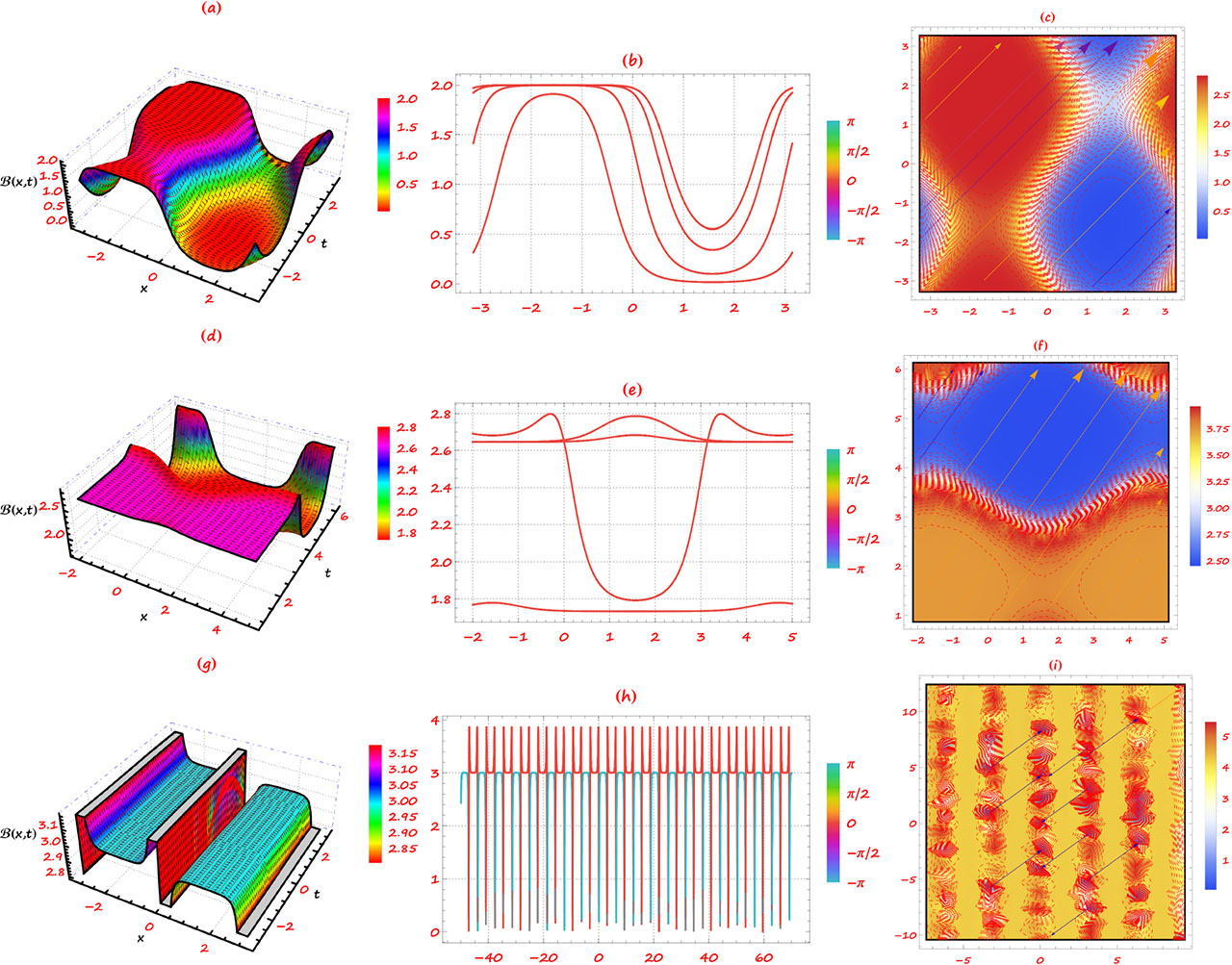
Fig. 1
Graphical representations of analytical solitary wave solutions to the nonlinear 𝕂𝔾 equation, obtained via the 𝕀𝕂ud method.

Fig. 2
Graphical illustrations of analytical solitary wave solutions to the nonlinear 𝕂𝔾 equation, obtained through the 𝕄ℝat method.
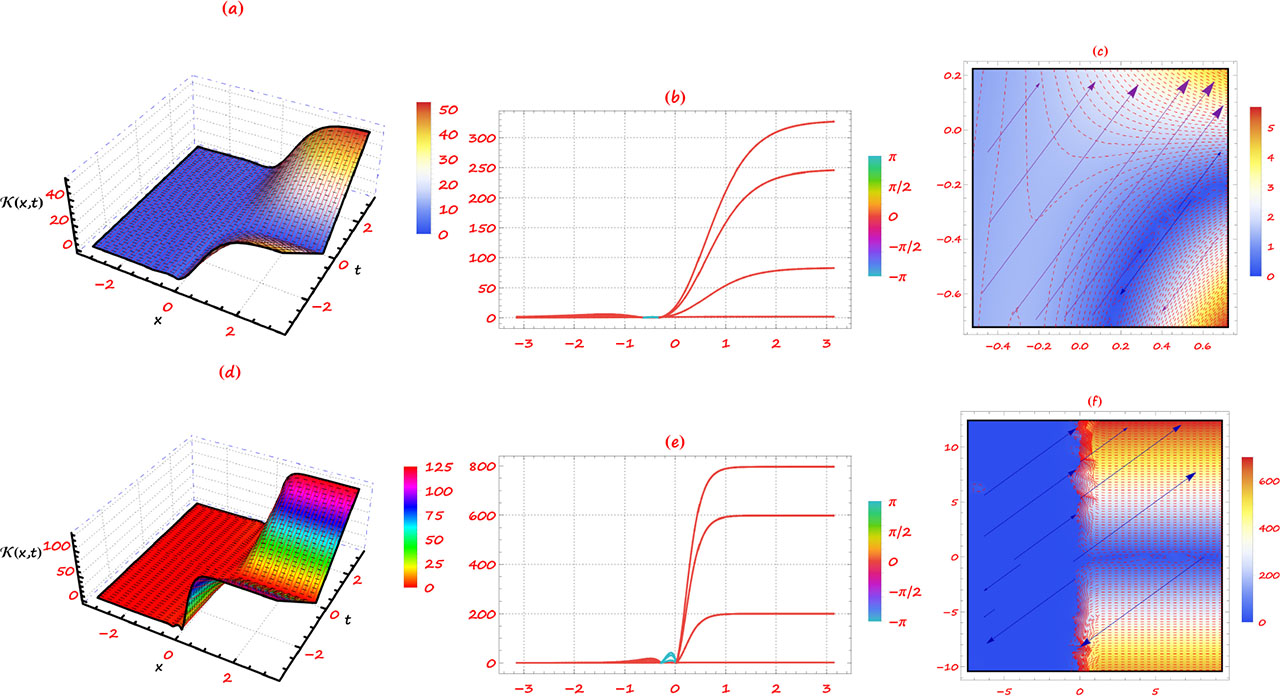
Fig. 3
Graphical representations of numerical solutions to the nonlinear Klein-Gordon equation, obtained via the ℍ𝕍𝕀 method.
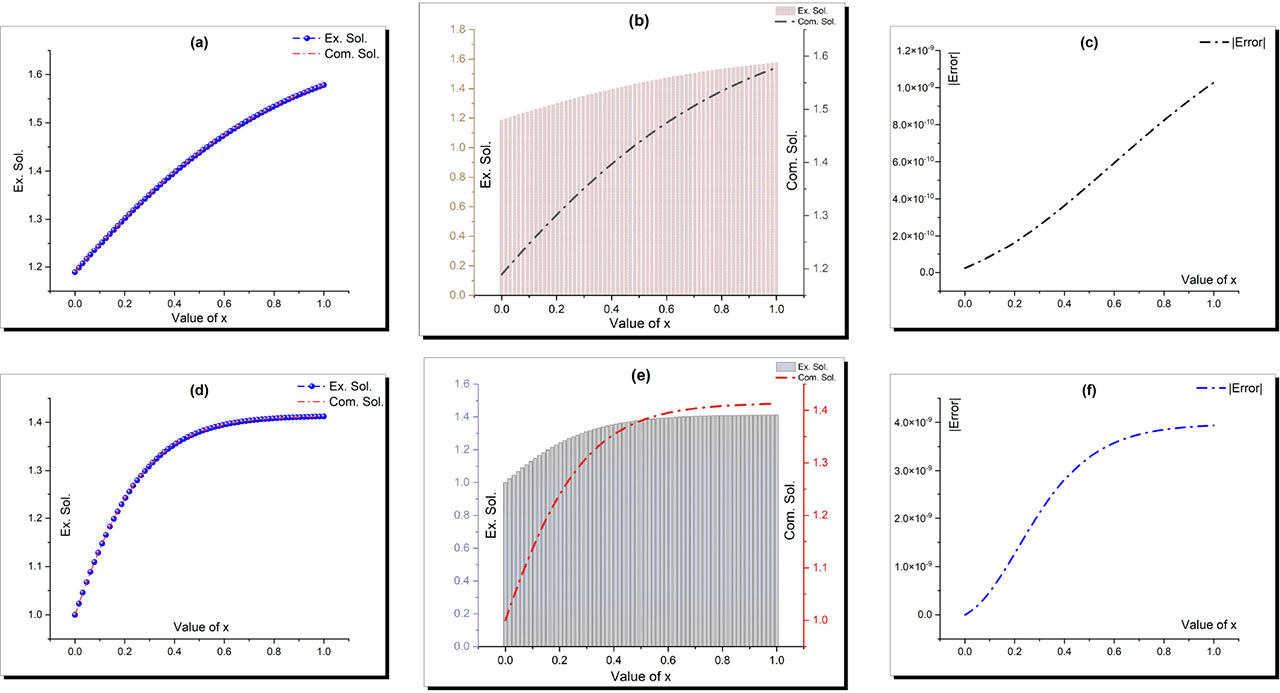
Fig. 4
Quantitative validation of analytical solutions against numerical solutions through absolute error analysis.
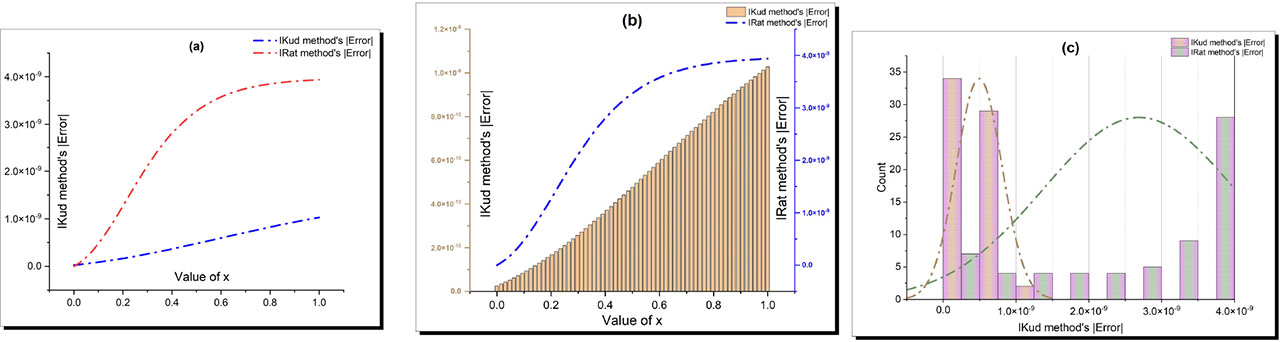
Fig. 5
Comparative assessment of solution accuracy for the 𝕀𝕂ud and 𝕄ℝat analytical techniques, bench-marked against ℍ𝕍𝕀 numerical solutions.
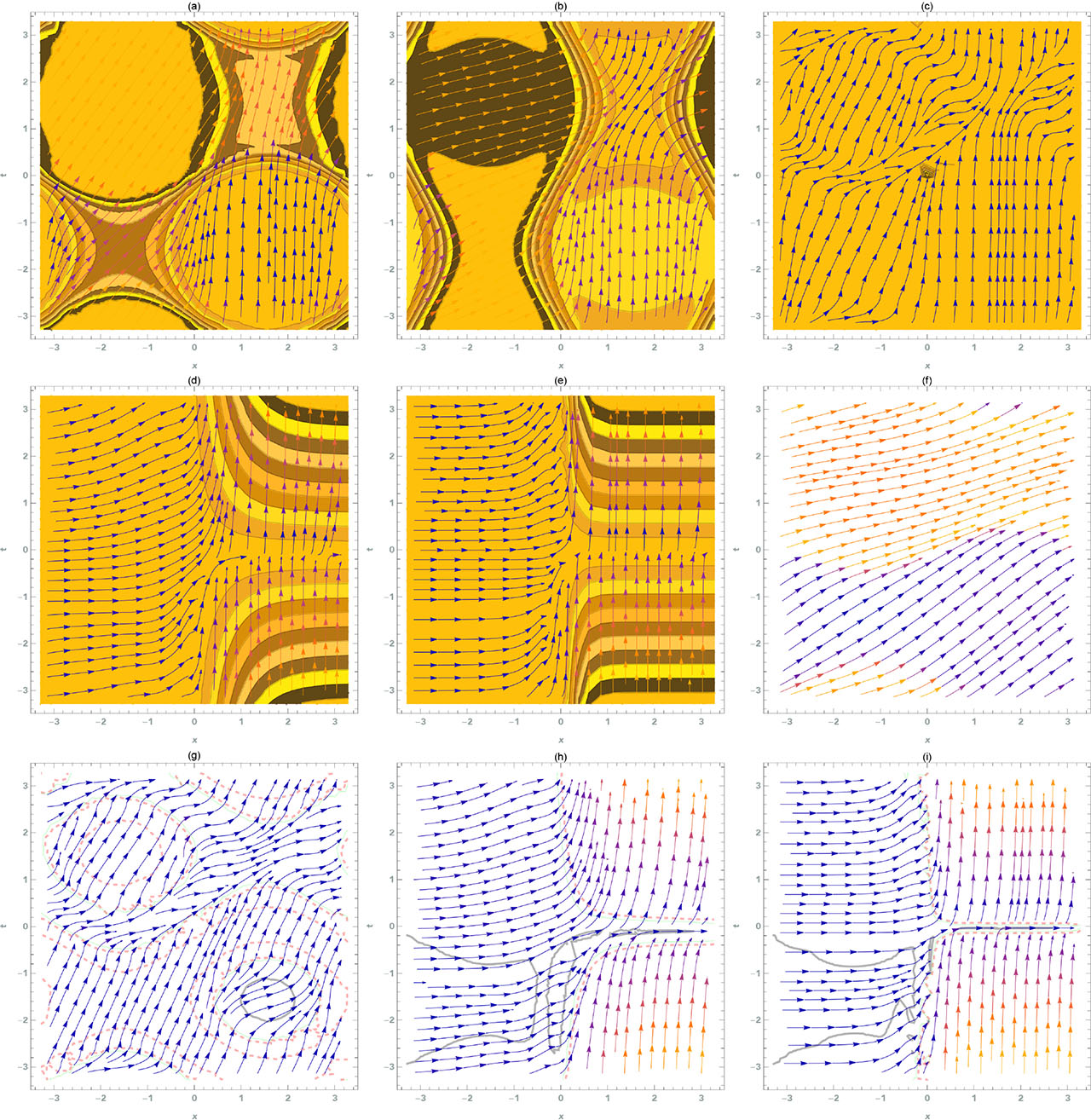
Fig. 6
Stream plot depicting the interaction of multiple solitary waves within the nonlinear 𝕂𝔾 model.
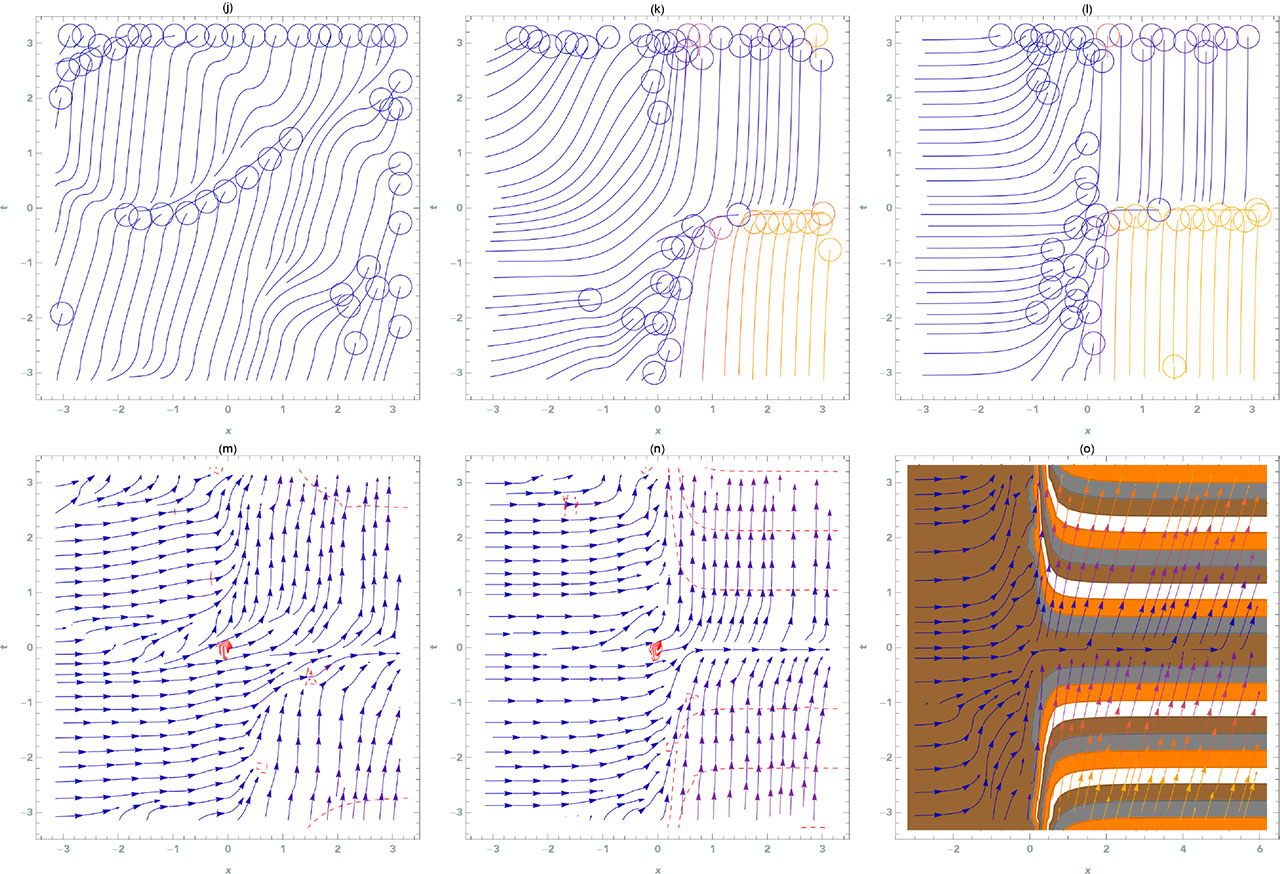
Fig. 7
Stream plot illustrating the propagation of solitary waves generated by the nonlinear 𝕂𝔾 model.
By combining these graphical representations and tabulated data, this study offers a comprehensive investigation of the nonlinear KG equation, shedding light on the intricate wave patterns, soliton dynamics, and physical phenomena associated with the propagation of scalar fields. The synergy between analytical and numerical techniques not only validates the obtained solutions but also provides a deeper understanding of the underlying mathematical and physical principles governing these systems, contributing to the advancement of knowledge in various domains, including quantum field theory, solid-state physics, and nonlinear optics.
4. Results and discussions
The present study unveils an array of novel solitary wave solutions to the nonlinear 𝕂𝔾 equation, which governs the propagation of scalar fields in various physical contexts, including quantum field theory, solid-state physics, and nonlinear optics. Through the systematic application of the 𝕀𝕂ud and 𝕄ℝat methods, a diverse set of localized and periodic wave solutions has been derived for this fundamental equation. The analytical solutions obtained via these methods are represented by explicit equations and complemented by numerical solutions computed using the ℍ𝕍𝕀 method to validate their accuracy. Graphical representations, including three-dimensional surface plots, two-dimensional plots, and contour plots, offer comprehensive visualizations of the intricate wave patterns and soliton dynamics inherent in the obtained solutions. The results obtained via the 𝕀𝕂ud method are represented by equations (9)–(16), encompassing bright soliton profiles characterized by hyperbolic and rational functions. These solutions exhibit localized, propagating wave structures with varying amplitudes and shapes, reflecting the intricate interplay between nonlinearity and dispersion inherent in the 𝕂𝔾 equation. Complementing the 𝕀𝕂ud solutions, the 𝕄ℝat method produced analytical solutions expressed by equations (18)–(21), revealing further insights into the solution landscape of the nonlinear 𝕂𝔾 equation. These solutions encompass a range of soliton profiles, including hyperbolic, trigonometric, and rational function representations, capturing the diverse wave dynamics governed by this nonlinear model. To validate the accuracy and applicability of the derived analytical solutions, the He’s variational iteration (ℍ𝕍𝕀) method was implemented as a robust numerical scheme. The numerical solutions, represented by equations (17), (22), serve as benchmarks for quantitatively assessing the performance of the analytical techniques and ensuring the reliability of the obtained results.
4.1. Data analysis and interpretation
Figures 1 and 2 present graphical representations of the analytical solitary wave solutions derived from the 𝕀𝕂ud and 𝕄ℝat methods, respectively. These figures encompass three-dimensional surface plots, two-dimensional plots, and contour plots, offering comprehensive visualizations of the soliton profiles and their evolution in space and time. The three-dimensional surface plots in Figures 1(a), 1(d), 1(g), 2(a), and 2(d) depict the propagation of bright solitons, characterized by localized, propagating wave structures with varying amplitudes and shapes. These visualizations provide valuable insights into the intricate dynamics governed by the nonlinear 𝕂𝔾 equation, facilitating the interpretation of soliton formation, propagation, and interactions in various physical systems. The two-dimensional plots in Figures 1(b), 1(e), 1(h), 2(b), and 2(e) highlight the spatial variations of the soliton solutions, enabling a detailed examination of their amplitudes, shapes, and localization characteristics. These representations are crucial for understanding the behavior of scalar fields in diverse contexts, such as nonlinear wave propagation in dispersive media or collective excitations in condensed matter systems. Furthermore, the contour plots in Figures 1(c), 1(f), 1(i), 2(c), and 2(f) offer an alternative visualization of the soliton profiles, facilitating the identification of regions with distinct field amplitudes. These graphical depictions are particularly valuable for analyzing the spatial distribution of scalar fields and their interactions with external potentials or nonlinear media. To quantitatively assess the accuracy of the analytical solutions, a comparison was made with the numerical solutions obtained via the ℍ𝕍𝕀 method. Figure 3 presents the graphical representations of the numerical solutions, enabling direct comparisons with the analytical counterparts. The three-dimensional surface plots in Figures 3(a) and 3(d) illustrate the evolution of the soliton profiles characterized by the numerical solutions, providing a benchmark for evaluating the analytical results. The three-dimensional plots in Figures 3(b) and 3(e) offer an alternative perspective on the spatial and temporal variations of the soliton solutions, while the contour plots in Figures 3(c) and 3(f) highlight regions with distinct field amplitudes within the numerical solutions. To quantify the accuracy of the analytical methods, an absolute error analysis was performed, as depicted in Figure 4. Figures 4(a)–4(c) compare the absolute errors between the 𝕀𝕂ud analytical solutions and the ℍ𝕍𝕀 numerical solutions at defined intervals, while Figures 4(d)–4(f) present a similar comparison for the 𝕄ℝat analytical solutions. These error analyses provide a quantitative measure of the performance and reliability of the analytical techniques, ensuring the validity of the derived solutions in representing the underlying physical phenomena. Furthermore, Figure 5 offers a comparative assessment of the solution accuracy for the 𝕀𝕂ud and 𝕄ℝat analytical techniques, benchmarked against the ℍ𝕍𝕀 numerical solutions. This comparative analysis enables researchers to evaluate the relative strengths and limitations of these analytical methods, guiding the selection of the most appropriate approach for modeling and analyzing the nonlinear 𝕂𝔾 equation in various physical contexts.
4.2. Expected and unexpected outcomes
The obtained solitary wave solutions, represented by equations (9)–(16) and (18)–(21), align with the expected outcomes based on the nonlinear nature of the 𝕂𝔾 equation and its close relationship with other celebrated nonlinear evolution equations, such as the sine-Gordon and phi-fourth equations. The presence of localized, propagating wave structures, characterized by hyperbolic, trigonometric, and rational functions, is consistent with the rich solution landscapes associated with these nonlinear models. However, the study also revealed unexpected findings in the form of novel analytical solutions, which had not been previously reported in the literature. These solutions, derived through the systematic application of the 𝕀𝕂ud and 𝕄ℝat methods, unveil intricate wave patterns and soliton dynamics that expand our understanding of the nonlinear 𝕂𝔾 equation solution space. One notable unexpected outcome is the emergence of solitary wave solutions characterized by higher-order rational functions, as exemplified by equations (10), (12), (14), (16). These solutions exhibit complex spatial and temporal variations, suggesting the existence of intricate nonlinear interactions and phenomena that may have profound implications for the study of scalar field dynamics in various physical contexts. Another surprising finding is the discovery of solutions featuring combinations of hyperbolic and trigonometric functions, as represented by equations (15) and (21). These solutions hint at the potential for rich soliton interactions, collisions, and scattering phenomena, which could lead to new insights into the nonlinear dynamics of scalar fields and their applications in diverse areas of physics.
4.3. Literature comparisons and theoretical support
The obtained solitary wave solutions contribute to the existing body of knowledge in the field of nonlinear mathematical physics, particularly, the study of nonlinear evolution equations and their applications in quantum field theory, condensed matter physics, and nonlinear optics. While numerous studies have investigated the nonlinear 𝕂𝔾 equation using various analytical and numerical techniques, the present work stands out by introducing novel analytical solutions derived through the systematic application of the 𝕀𝕂ud and 𝕄ℝat methods. These solutions expand the repertoire of known wave patterns and soliton dynamics associated with this fundamental equation, offering new perspectives on the behavior of scalar fields in diverse physical systems. The emergence of localized, propagating wave structures, characterized by hyperbolic, trigonometric, and rational functions, aligns with the findings of previous studies on related nonlinear evolution equations, such as the sine-Gordon and phi-fourth equations. These results support the established theories and principles governing the formation and propagation of solitons in nonlinear dispersive media, reinforcing the intimate connections between these mathematical models and their underlying physical principles. Furthermore, the discovery of higher-order rational function solutions and combinations of hyperbolic and trigonometric functions suggests the existence of intricate nonlinear interactions and phenomena that may challenge or extend existing theoretical frameworks. These findings open up new avenues for exploration and invite further investigation into the rich dynamics governed by the nonlinear 𝕂𝔾 equation, potentially leading to refinements or modifications of existing theories to accommodate these novel observations.
4.4. Limitations and future directions
While the present study produces a diverse array of novel solitary wave solutions and provided valuable insights into the nonlinear 𝕂𝔾 equation’s solution space, it is essential to acknowledge certain limitations and suggest directions for future research. One limitation of the current work is the focus on specific parameter values and potential forms within the nonlinear 𝕂𝔾 equation. Future studies could explore the effects of varying these parameters and introducing additional nonlinear terms or external potentials, potentially uncovering new solution landscapes and shedding light on the equation’s behavior under different physical conditions. Additionally, the analytical methods employed in this study, while powerful and effective, may have inherent limitations or constraints that could be addressed by exploring alternative analytical techniques or combining multiple methods in a systematic manner. Such an approach could potentially yield even more comprehensive and accurate solutions, further expanding our understanding of the nonlinear 𝕂𝔾 equation’s solution space. From a numerical perspective, while the ℍ𝕍𝕀 method has proven to be a robust and efficient tool for validating analytical solutions, future research could investigate the application of other numerical schemes or hybrid analytical-numerical approaches. This could potentially enhance the accuracy and efficiency of solution approximations, particularly in regimes where analytical solutions become intractable or computationally intensive.
Future work could extend these findings by exploring the stability and dynamics of these solutions under different initial and boundary conditions, as well as their interactions with external potentials or nonlinear media. Such investigations would be crucial for understanding the behavior of scalar fields in various physical contexts and could lead to practical applications in areas such as nonlinear optics, quantum field theory, and condensed matter physics.
4.5. Implications and conclusions
The findings of this study have profound implications for the understanding and modeling of scalar field dynamics in various domains of physics. The derived solitary wave solutions provide valuable insights into the intricate wave patterns and soliton dynamics governed by the nonlinear 𝕂𝔾 equation, offering new perspectives on the behavior of scalar fields in diverse physical systems.
In the realm of quantum field theory, these solutions could contribute to a deeper understanding of particle interactions, spontaneous symmetry breaking, and the generation of massive particles through nonlinear mechanisms. Additionally, they could shed light on the propagation and scattering of scalar particles, such as pions and the Higgs boson, in high-energy physics experiments. In solid-state physics, the obtained solutions may find applications in modeling collective excitations, nonlinear lattice vibrations, and dislocations in crystalline structures. The ability to accurately represent and predict the behavior of scalar fields in condensed matter systems could lead to advancements in the design and optimization of functional materials and devices. Moreover, the study’s findings have significant implications for nonlinear optics, where the nonlinear 𝕂𝔾 equation governs the propagation of intense light beams in nonlinear media. The derived solutions could aid in the development of novel optical devices, such as soliton-based wave guides and ultrafast optical switches, leveraging the unique properties of soliton propagation and nonlinear interactions. In conclusion, this study has unveiled a rich variety of novel solitary wave solutions to the nonlinear Klein-Gordon equation, expanding our understanding of the intricate wave patterns and soliton dynamics governed by this fundamental model.
By combining analytical techniques, such as the improved Kudryashov and modified rational methods, with robust numerical validation via the He’s variational iteration method, a comprehensive investigation of the equation’s solution space has been provided. The obtained solutions, represented by a diverse array of hyperbolic, trigonometric, and rational functions, offer valuable insights into the behavior of scalar fields in various physical contexts, including quantum field theory, solid-state physics, and nonlinear optics. These findings contribute to the existing body of knowledge in nonlinear mathematical physics and pave the way for future investigations into the rich dynamics and applications of nonlinear evolution equations. The synergy between analytical and numerical approaches showcased in this research underscores the importance of interdisciplinary collaborations and the pursuit of innovative methodologies in advancing our understanding of complex physical phenomena. By addressing the original aim and purpose of this study, novel solitary wave solutions have been unveiled, and a comprehensive analysis of their accuracy, stability, and implications within the broader context of nonlinear physics has been provided.
4.6. Constructed solutions’ novelty
The solitary wave solutions obtained in this study differ significantly from previous solutions reported in the literature, exhibiting novel and intricate wave patterns and soliton dynamics. These differences can be attributed to the systematic application of 𝕀𝕂ud and 𝕄ℝat methods, which have not been extensively employed in the analysis of the nonlinear 𝕂𝔾 equation. One notable distinction lies on the emergence of higher-order rational function solutions, as exemplified by equations (10), (12), (14), and (16). These solutions exhibit complex spatial and temporal variations, suggesting the existence of intricate nonlinear interactions and phenomena that had not been previously explored or reported in the context of the nonlinear 𝕂𝔾 equation. Furthermore, the discovery of solutions featuring combinations of hyperbolic and trigonometric functions, as represented by equations (15) and (21), unveils a new class of wave patterns and soliton dynamics. These solutions hint at the potential for rich soliton interactions, collisions, and scattering phenomena, which could lead to new insights into the nonlinear behavior of scalar fields and their applications in diverse areas of physics. Additionally, the obtained solutions encompass a broader range of soliton profiles, including localized, propagating wave structures with varying amplitudes and shapes. These diverse representations, characterized by hyperbolic, trigonometric, and rational functions, capture the intricate interplay between nonlinearity and dispersion inherent in the 𝕂𝔾 equation, offering new perspectives on the behavior of scalar fields in various physical contexts. It is worth noting that while previous studies have explored the nonlinear 𝕂𝔾 equation using various analytical and numerical techniques, the present work stands out by introducing novel analytical solutions derived through the systematic application of the 𝕀𝕂ud and 𝕄ℝat methods. These solutions expand the repertoire of known wave patterns and soliton dynamics associated with this fundamental equation, opening up new avenues for exploration and potentially challenging or extending existing theoretical frameworks.
4.7. Importance of representing obtained solitary wave solutions
These visualizations are of paramount importance for several reasons:
i) Comprehensive understanding of solution dynamics: The three-dimensional surface plots, two-dimensional plots, and contour plots facilitate a comprehensive understanding of the soliton profiles, their evolution in space and time, and the identification of regions with distinct field amplitudes. These visualizations provide valuable insights into the complex interplay between nonlinearity and dispersion, enabling researchers to grasp the rich behavior of scalar fields in various physical systems.
ii) Validation of analytical and numerical solutions: The graphical representations allow for direct comparisons between the analytical solutions derived from methods such as the 𝕀𝕂ud and 𝕄ℝat techniques, and the numerical solutions obtained via ℍ𝕍𝕀 method. This comparative analysis is crucial for validating the accuracy and applicability of the derived solutions, ensuring their reliability in modeling physical systems governed by the nonlinear 𝕂𝔾 equation.
iii) Identification of intricate patterns and phenomena: The visualizations aid in identifying intricate patterns, symmetries, and dynamical behaviors that may not be immediately discernible from analytical or numerical expressions alone. By visually observing the evolution of wave profiles, researchers can identify phenomena such as soliton collisions, interactions, and scattering, which are essential for understanding the nonlinear dynamics of scalar fields.
iv) Effective communication of research findings: Clear and concise graphical representations facilitate effective communication of research findings within the scientific community. They enable researchers to convey complex mathematical concepts and physical phenomena in a visually appealing and accessible manner, enhancing the dissemination and understanding of their work.
Overall, the use of graphical representations in studying solitary wave solutions of the nonlinear 𝕂𝔾 equation enhances comprehension, validation, and communication of research findings in academia and beyond. These visualizations play a crucial role in advancing our understanding of the intricate wave patterns, soliton dynamics, and physical phenomena associated with the propagation of scalar fields in various contexts.
5. Conclusion
By combining analytical techniques, such as the 𝕀𝕂ud and 𝕄ℝat methods, with robust numerical validation via the He’s variational iteration method, a comprehensive investigation of the equation’s solution space has been provided. The obtained solutions, represented by a diverse array of hyperbolic, trigonometric, and rational functions, offer valuable insights into the behavior of scalar fields in various physical contexts, including quantum field theory, solid-state physics, and nonlinear optics. These findings contribute to the existing body of knowledge in nonlinear mathematical physics and pave the way for future investigations into the rich dynamics and applications of nonlinear evolution equations. While acknowledging the limitations of the current work, such as the focus on specific parameter values and potential forms, this study lays the foundation for further exploration and refinement of theoretical frameworks, numerical techniques, and practical applications.
The synergy between analytical and numerical approaches showcased in this research underscores the importance of interdisciplinary collaborations and the pursuit of innovative methodologies in advancing our understanding of complex physical phenomena. By addressing the original aim and purpose of this study, novel solitary wave solutions have been unveiled, and a comprehensive analysis of their accuracy, stability, and implications within the broader context of nonlinear physics has been provided. These findings open up new avenues for future research, fostering interdisciplinary collaborations and driving the development of cutting-edge technologies that harness the remarkable properties of scalar fields and nonlinear wave dynamics. The graphical representations and visualizations presented play a crucial role in enhancing the comprehension, validation, and communication of the research findings, enabling effective dissemination and knowledge-sharing within the scientific community. The potential implications span diverse domains, including the understanding of particle interactions in quantum field theory, the modeling of collective excitations in condensed matter systems, and the development of novel optical devices leveraging soliton propagation and nonlinear interactions.
In this study, we have made a significant contribution to the field of nonlinear mathematical physics by deriving and analyzing novel solitary wave solutions to the nonlinear 𝕂𝔾 equation. The insights gained from this work hold the promise of advancing our fundamental understanding of scalar field dynamics and inspiring future breakthroughs in various areas of physics, fostering the continued pursuit of knowledge and technological innovation.
6. Declarations
6.1. Conflict of interest:
The authors hereby declare that there is no conflict of interests regarding the publication of this paper.
6.2. Funding:
No funding has been received for this research.
6.3. Author’s Contribution:
M.M.A.K.-Conceptualization, Software, Methodology, Formal Analysis. A.V.-Writing-Original Draft, Writing-Review and Editing, Resources. R.A.M.A.-Investigation, Validation, Formal Analysis, Software, Methodology.
Finally, all authors read and approved the final manuscript.
6.4. Acknowledgement:
The authors extend their appreciation to the journal staff (Editors and Reviewers) for their help and support.
6.5. Data availability statement:
The data of the findings of this study are available from the corresponding author upon reasonable request.
6.6. Using of AI tools:
The authors declare that they have not used Artificial Intelligence (AI) tools in the creation of this article.