
1. Introduction
Throughout the paper, G shall denote a finite, simple, and undirected graph. Let V (G) = {v1,v2,···, vn} denote the set of all vertices of G, and let E(G) denote the set of all edges of G. The order of G is the number of elements in V (G). Let vi,vj∈V (G). We say that the vertex vi is adjacent to vj provided there is an edge from vi to vj or vice versa. If the vertices vi and vj are adjacent to each other, it shall be denoted by vi ∼ vj. The total number of vertices in G that are adjacent to a given vertex v is known as the degree of v. The join of two graphs G1 and G2 is is denoted by G1 + G2.
The adjacency matrix A(G) of G is defined as A(G) = (aij)n×n is an n × n matrix defined as follows:
.The Laplacian matrix L(G) of G is defined as L(G) = (lij)n×n is defined as follows:
.Here, di denotes the degree of the ith vertex vi. The Laplacian matrix L(G) of a graph G has all its eigenvalues as real numbers. Moreover, L(G) is a positive semidefinite matrix. Consequently, all the real eigenvalues of L(G) are non-negative. It is known that the summation of row entries in a Laplacian matrix is zero. Thus, the determinant of L(G) is always 0. Hence, 0 is always an eigenvalue of L(G).
A sequence of vertices and edges in a graph G is known as a walk. A walk is said to be closed if the starting vertex is the same as the ending vertex. If all the edges are different in a walk, then it is known as a trail. A path is a trail in which no vertex is repeated. A closed path is said to be a cycle. The number of edges in a path is known as the length of the path. The distance matrix of a connected graph G is defined as D(G) = (dij)n×n, where dij = d(vi,vj) is the distance between two vertices vi and vj. The sum of distances from a vertex v to all other vertices of G is known as the transmission of v. The transmission of a vertex v is denoted by Tr(v). The transmission matrix of G is an n × n matrix where each diagonal entry denotes the transmission of the vertex v, and each off-diagonal entry is 0. The distance Laplacian matrix DL(G) of a connected graph G is defined as DL(G) = Tr(G) − D(G). It was introduced in [1]. The distance signless Laplacian matrix DQ(G) is defined as DQ(G) = Tr(G) + D(G). Recently, researchers have studied the two matrices extensively, for example, see [2,3,4,5,6,7,8].
Both the matrices, namely the distance Laplacian matrix and distance signless Laplacian matrix of a graph are positive semi-definite matrices. Consequently, both the matrices have non-negative eigenvalues.
Over the last few decades, various researchers have pondered whether it is possible to predict the eigenvalues of a graph by observing the structure of a graph. One way to study the given problem is to perform various graph operations and create new graphs from existing graphs. Several graph operations have been introduced by researchers till now, some of them being join of two graphs, disjoint union, Cartesian product, direct product, lexicographic product. Several variants of corona product of two graphs have also been introduced and studied by various researchers in the recent past. Readers may refer to the papers [9,10,11,12,13,14] for a detailed discussion in this regard. Moreover, researchers have determined the eigenvalues of the resulting graph operations in terms of existing graphs. Readers are suggested to see the papers [15] and [16] for more details. Recently, in [17], the authors have determined the distance Laplacian and distance signless Laplacian spectrum of generalized wheel graphs. They have also introduced a new graph class and named it the dumbbell graph. The authors continued their study on dumbbell graphs in [18]. The above works motivate us to study the Laplacian as well as the distance Laplacian spectrum of the generalized fan graph in this paper. We have also introduced a new graph class and deduced its Laplacian and the distance Laplacian spectrum.
2. Preliminaries
The following definitions and theorems will be used in the subsequent sections.
Definition 1
[19] Let M be a order n matrix defined as follows:
Each block Mij has order ni × nj for 1 ≤ i, j ≤ t, and M is equal to its transpose. Moreover, n = n1 + … + nt. For 1 ≤ i, j ≤ t, let bij denote a matrix in which each element of bij is obtained by adding all the entries in Mij and then dividing by the number of rows. The matrix B = (bij) so obtained is known as the quotient matrix of M. Additionally, if for each pair i, j, the sum of the entries in each row of Mij is constant, then we call B as the equitable quotient matrix of M.There is a relation between the set of eigenvalues of B and M, which is given by the following theorem.
Theorem 1
[19, Lemma 2.3.1] If ρ(M) is the set of eigenvalues of M, and ρ(B) is the set of eigenvalues of B, then ρ(B) is contained in ρ(M).
3. Laplacian spectra of generalized fan graph and a new graph class
We first determine the eigenvalues of Laplacian matrix of generalized fan graphs. We then introduce a new graph class and determine its Laplacian spectrum.
Definition 2
The generalized fan graph, denoted by Fm,n, is given by , where is the null graph on m vertices, and Pn is the path graph on n vertices.
To determine the Laplacian spectrum of the generalized fan graph Fm,n, we shall first require the following result from [20, Corollary 3.7].
Theorem 2
Let G1 + G2 denote the join of two graphs G1 and G2. Then
where n1 and n2 are orders of G1 and G2 respectively.Theorem 3
If m,n ≥ 2, then the Laplacian eigenvalues of Fm,n are 0 having multiplicity 1, m + n having multiplicity 1, n having multiplicity m − 1, and having multiplicity 1 for 1 ≤ j ≤ n − 1.
Proof
We know that the Laplacian eigenvalues of are 0 having multiplicity m. Hence, . Moreover, using [19, Section 1.4.4], we find that the Laplacian eigenvalues of Pn are , where 0 ≤ j ≤ n − 1. Hence, the characteristic polynomial of the Laplacian matrix of Pn is given as follows:
Thus, using Theorem (2), we get,
Hence the result follows.We shall now introduce a new graph class and derive the Laplacian spectrum of the same. We shall denote the new graph class by 𝒩 𝒞 (Fm,n). We shall define the new graph in what follows.
Definition 3
The graph 𝒩 𝒞 (Fm,n) has 2(m + n) vertices and is obtained by connecting m vertices at the centers of two generalized fan graphs Fm,n, where m,n ≥ 2 through m-edges.
We shall now illustrate the newly defined graph class 𝒩 𝒞 (Fm,n) with an example in what follows.
Example 4
We consider m = 3 and n = 4. We have the following two graphs namely, (Figure 1) and P4 ( Figure 2). We shall first construct the generalized fan graph Fm,n.
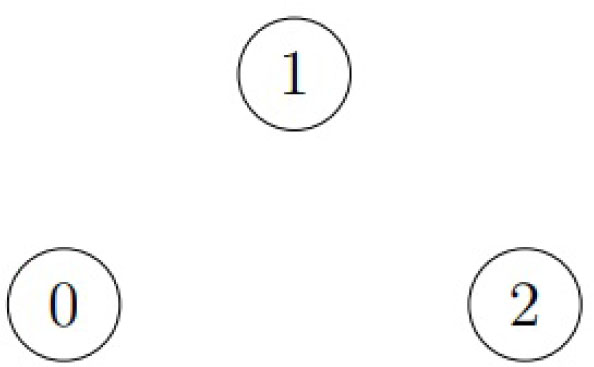
Fig. 1

Fig. 2
P4
Using and P4, the generalized fan graph F3,4 in Figure (3) is given as follows:
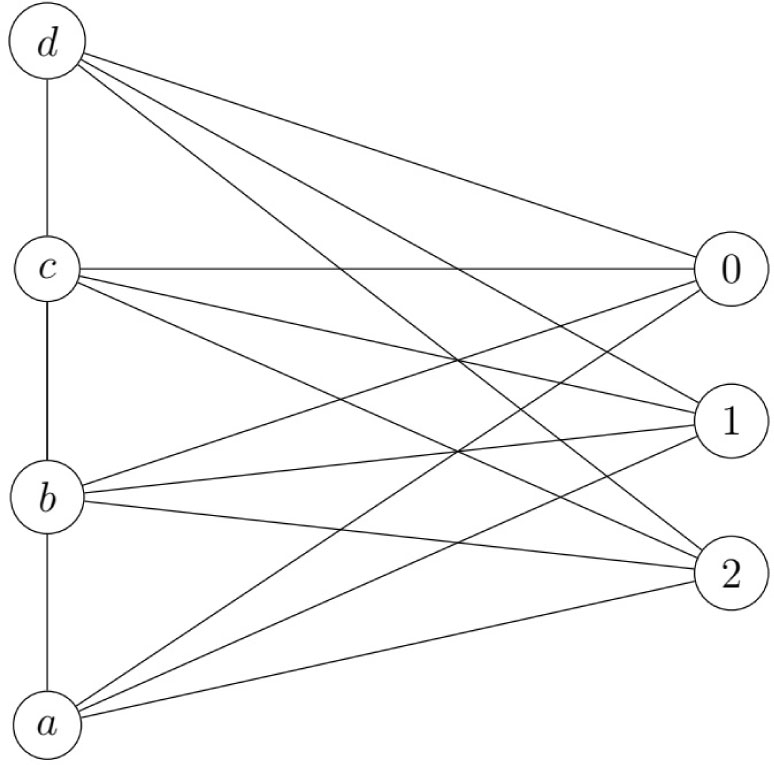
Fig. 3
The generalized fan graph F3,4.
Using Definition (3), the new graph class 𝒩 𝒞 (F3,4) is given as follows (Figure 4):
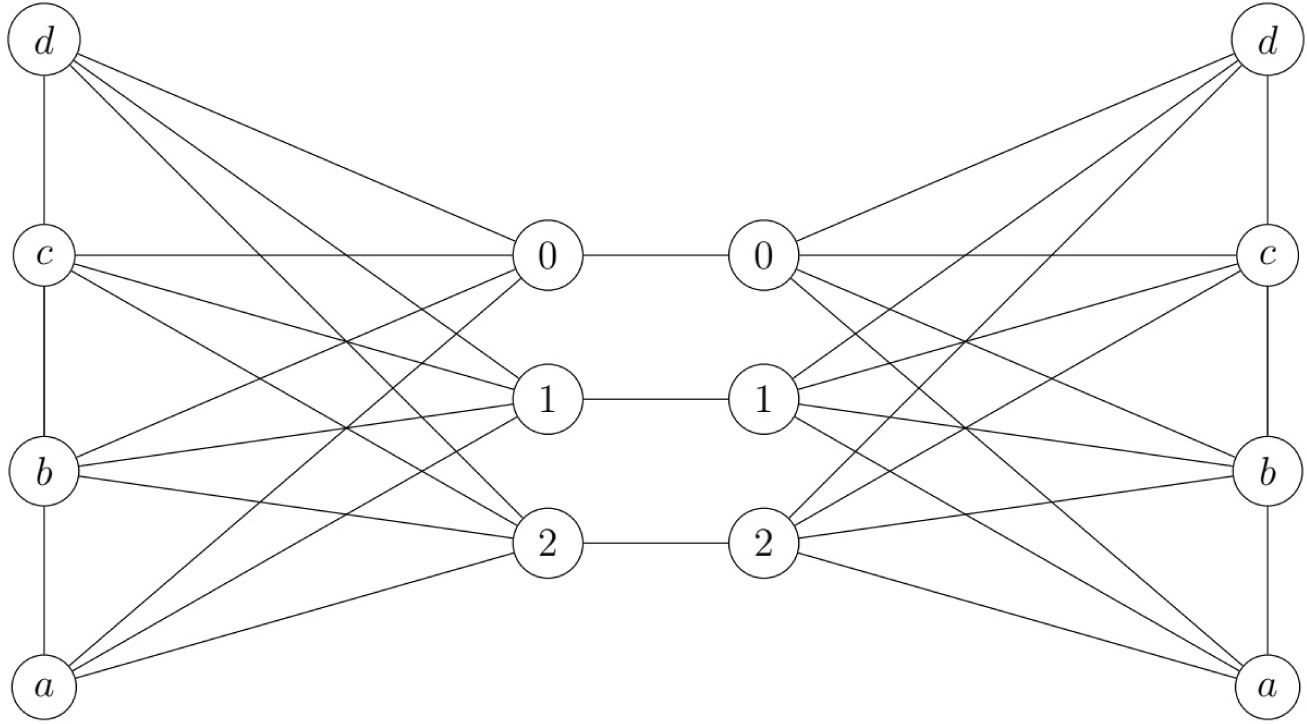
Fig. 4
The graph 𝒩 𝒞3,4.
We shall now illustrate the Laplacian eigenvalues of 𝒩 𝒞m,n in what follows. It is known that the Laplacian eigenvalues of Pn are 0 and having multiplicity 1 for 1 ≤ j ≤ n − 1.
Theorem 5
If m,n ≥ 2, then the Laplacian eigenvalues of 𝒩 𝒞 (Fm,n) are as follows:
having multiplicity 2 for 1 ≤ j ≤ n − 1,
n having multiplicity m − 1,
n + 2 having multiplicity m − 1,
having multiplicity 1,
m + n having multiplicity 1,
0 having multiplicity 1.
Proof
We shall first index the vertices of Pn, then list the vertices of . We again list the vertices of the second copy of and finally list the vertices of the second copy of Pn. Thus the Laplacian matrix of 𝒩 𝒞 (Fm,n) is given as follows:
Now, since L(Pn) is a singular matrix, so zero will be an eigenvalue of L(Pn). The eigenvector corresponding to the eigenvalue 0 is 1 = [1,1,…, 1]T. For a symmetric matrix, if λi and λj are two distinct eigenvalues with eigenvectors vi and vj respectively, then vi and vj are orthogonal to each other. Let λ (≠ = 0) be an eigenvalue of L(Pn) having eigenvector v. Then, 1T v = 0.
Let vi, 2 ≤ i ≤ m be an eigenvector corresponding to the eigenvalue of Pn. Let . Now L(𝒩 𝒞 (Fm,n)) Vi = (λi + m)Vi. Thus, λi + m is an eigenvalue of L(𝒩 𝒞 (Fm,n)). Similarly, let , we observe that L(𝒩 𝒞 (Fm,n)) Wi = (λi +m) Wi. Thus, again, we find that λi +m is an eigenvalue of L(𝒩 𝒞 (Fm,n)) for 2 ≤ i ≤ m. Hence, we observe that λi + m is an eigenvalue of L(𝒩 𝒞 (Fm,n)) for 2 ≤ i ≤ m having multiplicity 2.
Let .
We have
We thus obtain L(𝒩 𝒞 (Fm,n)) Xi = nXi. Thus, n is an eigenvalue of L(𝒩 𝒞 (Fm,n)). Hence, we find that n is an eigenvalue of L(𝒩 𝒞 (Fm,n)) having multiplicity m − 1.
Let . Now L(𝒩 𝒞 (Fm,n)) Xi = (n + 2) Yi. Thus, n + 2 is an eigenvalue of L(𝒩 𝒞 (Fm,n)) having multiplicity m − 1.
Thus, we determine 2(n + m − 2) eigenvalues of L(𝒩 𝒞 (Fm,n). We shall now use Definition (1). We shall now use Theorem (1) to find the 4 remaining eigenvalues of L(𝒩 𝒞 (Fm,n). We find that they are contained in the spectrum of matrix B given as follows:
The characteristic polynomial of B is :On solving Θ(B,x) = 0, we obtain the required result.
4. Distance Laplacian spectrum of generalized fan graph and a new graph class
In this section, we evaluate the distance Laplacian spectrum of the generalized fan graph. We then determine the distance Laplacian spectrum of the new graph class that was introduced in the previous section. To determine the distance Laplacian spectrum of the generalized fan graph, we shall need the given theorem.
Theorem 6
Let G1 be a graph on n1 vertices having Laplacian eigenvalues 0 = λ1 ≤ λ2 ≤ … λn1 and G2 be a graph on n2 vertices having Laplacian eigenvalues 0 = µ1 ≤ µ2 ≤ … ≤ µn2. Then the distance Laplacian spectrum of G1 +G2 consists of n2 +2n1 −λi having multiplicity 1 for 2 ≤ i ≤ n1, n1 +2n2 −µi having multiplicity 1 for 2 ≤ j ≤ n2, and 0,n1 + n2 having multiplicity 1.
Proof
We shall first index the vertices of the graph G1. We then index the vertices of the graph G2. We have:
Here,
and,We know that the Laplacian matrix L(G1) is a singular matrix having a determinant as 0. Moreover, since the sum of the entries of each row is 0, so 0 will be an eigenvalue of L(G1). Hence, we have L(G1) 1 = L(G1)[1,1,…, 1]T = 0. Let λi be a non-zero eigenvalue of L(G1) whose eigenvector is vi, 2 ≤ i ≤ n. Moreover, 1T vi = 0.
Let . We obtain,
Thus, if λi is an eigenvalue of L(G1) for 2 ≤ i ≤ n1, we find that n2 +2n1 −λi is an eigenvalue of DL(G1 +G2). This provides us with n1 − 1 distance Laplacian eigenvalues of G1 + G2.
Let µj be an eigenvalue of L(G2). Let w be an eigenvector of µj. Using similar arguments as given above, we find that n1 + 2n2 −µi is a distance Laplacian eigenvalue of G1 + G2 corresponding to eigenvector W. Here, .
This provides us with n1 +n2 −2 distance Laplacian eigenvalues of G1 +G2. The remaining two eigenvalues of DL(G1 + G2) can be obtained by using the concept of equitable partitions ( Definition 1). Since each block matrix of DL(G1 + G2) has a constant row sum, we find that the equitable quotient matrix of DL(G1 + G2) is given as follows:
Since , using Theorem (1), we find that the eigenvalues of DL(G1 + G2) are n2 + 2n1 −λi having multiplicity 1 for 2 ≤ i ≤ n1, n1 + 2n2 − µi having multiplicity 1 for 2 ≤ j ≤ n2, and 0,n1 + n2 having multiplicity 1.
We now determine the distance Laplacian spectra of the generalized fan graph Fm,n.
Theorem 7
The spectrum of the distance Laplacian matrix of Fm,n consists of n + m having multiplicity m − 1, having multiplicity 1 for 0 ≤ j ≤ n − 1, and 0,m + n having multiplicity 1.
Proof.
We know . Using Theorem (6), the eigenvalues of the distance Laplacian matrix of Fm,n are n + m having multiplicity m − 1, having multiplicity 1 for 0 ≤ j ≤ n − 1, and 0,m + n having multiplicity 1.
Corollary 7.1
The distance Laplacian spectrum of the usual fan graph F1,n consists of having multiplicity 1 for 0 ≤ j ≤ n − 1, and 0,n + 1 having multiplicity 1.
4.1. Distance Laplacian spectrum of 𝒩 𝒞 (Fm,n)
In our next theorem, we shall now determine the distance Laplacian spectrum of the new graph class 𝒩 𝒞 (Fm,n).
Theorem 8
The distance Laplacian spectrum of 𝒩 𝒞 (Fm,n) consists of:
(5n + 3m −λi) having multiplicity 2 for 2 ≤ i ≤ n,
3n + 5m − 4 having multiplicity m − 1,
3n + 5m − 2 having multiplicity m − 1,
, where A = 24n + 9n2 − 14nm − 24m + 9m2 + 16, having multiplicity 1,
3(n + m) having multiplicity 1, and
0 having multiplicity 1.
Proof.
We shall first index the vertices of Pn, then list the vertices of . We again list the vertices of the second copy of and finally list the vertices of the second copy of Pn. We have:
Here,
Assuming λi to be an eigenvalue of L(Pn) with eigenvector vi for 2 ≤ i ≤ n, we have 1T vi = 0.
Considering , we obtain,
Thus, we observe that (5n+3m−λi) becomes an eigenvalue of DL(𝒩 𝒞 (Fm,n)) having multiplicity 1. Here, 2 ≤ i ≤ n.
Let for 2 ≤ i ≤ n. We observe that DL(𝒩 𝒞 (Fm,n)) Wi = (5n + 3m −λi) Wi.
Thus, (5n + 3m −λi) is an eigenvalue of DL(𝒩 𝒞 (Fm,n)) having multiplicity 1 for 2 ≤ i ≤ n. Hence we find that (5n + 3m −λi) is an eigenvalue of DL(𝒩 𝒞 (Fm,n)) having multiplicity 2 for each 2 ≤ i ≤ n.
Moreover, we observe that 3n + 5m and 3n + 5m − 4 are eigenvalues of DL(𝒩 𝒞 (Fm,n)) having multiplicity m − 1.
This gives us 2(n + m − 2) eigenvalues of DL(𝒩 𝒞 (Fm,n)). The remaining 4 eigenvalues of DL(𝒩 𝒞 (Fm,n)) are contained in the spectrum of B where
The characteristic polynomial of B is x4 + (−12m − 12n + 4)x3 + (45m2 + 98mn + 45n2 − 24m − 36n)x2 + (−54m3 − 186m2n − 186mn2 − 54n3 + 36m2 + 108mn + 72n2)x.
On solving, we find that the eigenvalues of B are , 3(n + m) and 0 having multiplicity 1, where A = 24n + 9n2 − 14nm − 24m + 9m2 + 16.
5. Conclusion
In this paper, our main aim is to determine the Laplacian and the distance Laplacian spectrum of the generalized fan graph Fm,n. Moreover, we also introduce a new graph class and determine its Laplacian as well as its distance Laplacian spectrum. We illustrate our results with various examples.
We now provide the readers with a problem for future work. The matrix Dt(G) = tTr(G) + (1 −t)D(G),0 < t < 1, is known as the generalized distance matrix of a graph G.
We encourage the readers to determine the spectrum of the generalized distance matrix of the generalized fan graph as well as the new graph class introduced in this paper.
6. Declarations
6.1. Conflict of interest:
The authors state that there is no conflict of interest.
6.2. Author’s contributions:
S.B.-Conceptualization, Methodology, Formal Analysis, Writing-Review and Editing, Supervision. S.G.-Resources, Writing-Original Draft, Methodology. The final submitted version of this manuscript has been read and approved by all the authors.
6.3. Funding:
Not applicable.
6.4. Acknowledgement:
Not applicable.
6.5. Data availability statement:
The article includes all the data that support the findings of this study.
6.6. Using of AI tools:
The authors declare that they have not used Artificial Intelligence (AI) tools in the creation of this article.