
1. Introduction
Number theory is concerned with the properties of integers and the research in number theory has been conducted since antiquity. As an example, one can mention the Erathostenes Sieve which sifts out primes from a number sequence, first mentioned in [1]. Further prime research have been the focus of many researchers following Erathostenes as can be seen from this list of references [2, 3, 4, 5, 6, 7, 8]. One of the prominent number theorists of the 20th century was Ramanujan for whom Hardy attributes the following anecdote: “I had ridden in taxicab No. 1729, and remarked that to me the number seemed a rather dull one, and that I hoped it was not an unfavourable omen. ’No,‘ he reflected, it is a very interesting number; it is the smallest number expressible as the sum of two cubes in two different ways. That is, 1729 = 13 + 123 = 93 + 103.” [9]. This shows that one of the areas of interest for number theorists is to find various facts about specific integers or combinations of integers. In the past, the establishment of these facts was limited by the extent to which computations could be performed. Today, powerful computers have made it possible to vastly extend the size and complexity of these computations.
One area of number theory research has been to find patterns (constellations) in the sequence of integers and of particular interest has been finding patterns of primes, see for example the article by Granville [10, 11]. Also, the question of whether there is an unbounded number of twin primes has been extensively studied by [12, 13]. Another area of interest has been prime constellations (i.e. particular patterns of primes). Specific examples have been studied by [14, 15, 16] and others. For example, the Green-Tao theorem [14] proves that arbitrary long arithmetic progressions of primes exist.
As noted above, computers have made it possible to perform experiments to validate theoretical results in number theory as well as experimentally suggest conjectures for new theorems [17, 18]. In Zhang et. al. [19], it is stated that “it is known that primes contain unusual patterns”. The paper further lists some of these patterns.
The patterns called prime constellations are summarized in [20]. These patterns include twin primes, cousin primes, prime triplets, quadruplets and 5 tuplets.
In this paper, some new patterns called symmetric prime constellations are defined that have certain symmetry properties. These constellations are theoretically and computationally explored and examples of these constellations are exhibited. However, a result like the theorem quoted above [14] is unlikely to be proven for the constellations discussed here for reasons to be discussed hereafter. The theoretical and computational results presented are still a reflection of the fact that primes have certain distributive properties [10, 21]. These results and examples could lead to further conjectures and new results as discussed by Polya [22]. In [23] emerging applications of number theory, where the results in this paper might have applications, are surveyed. These applications include some important areas such as cryptography, information security, DNA modelling, image compression, among others.
2. Prime constellations
By a “constellation”, we mean a finite pattern of primes.
This paper is concerned with certain symmetric constellations of n primes embedded in an increasing sequence of m integers j1,⋯, jm where j1 and jm are primes and ji+1 − ji = 1, i = 1, ⋯, m − 1, there are exactly n primes in the sequence and if ji is a prime of the constellation then so is jm−i. Such symmetric constellations are called C(m,n) constellations. The extent of a C(m,n) constellation is |C(m,n)| = m = jm − j1 + 1.
In this paper, the existence of C(m,n) constellations are demonstrated for various values of n and m. For some values of n, it is shown that there are constellations with the smallest possible extent.
Note that given a sequence of consecutive integers two primes in the sequence are separated by an odd number of integers.
The symmetric constellations C(m,n) can be divided into two classes depending on n being even or odd. Let the sequence of integer of the constellation be j1, ⋯, jm.
If n is odd the center of the constellation is a prime c = ⌊jm/j1⌋.
If n is even. Then the center of the constellation is c = (jm/ − j1)/2+1 where c is now a composite integer. In this case, the base case for constellations is given by ⋯, c − 1, c, c + 1, ⋯ where c − 1 and c + 1 are are primes and c is an even integer. A second case is defined by a central constellation c−2, c−1, c, c+1, c+2 where c − 2 and c + 2 are primes and c is an odd integer. A third case is defined by a central constellation c − 3, c − 2, c − 1, c, c + 1, c + 2, c + 3 where c − 3 and c + 3 are primes and c is even.
2.1. Definitions
The “center” c of a symmetric prime n-tuple (constellation) is meant the midpoint between the largest and the smallest primes defining the tuple. It is also called the “n-center”.
The letter E in a table will denote “even”.
The letter P in a table will denote “prime”.
If C(m,n) is a symmetric prime constellation then it will also be called an n-tuple.
A 2-tuple is a synonym for a double prime constellation.
A 3-tuple is a synonym for a triple prime constellation.
A 4-tuple is a synonym for a quadruple prime constellation.
A 5-tuple is a synonym for a quintuple prime constellation.
A 6-tuple is s synonym for a sixtuple prime constellation.
A 7-tuple is a synonym for a seventuple prime constellation.
An 8-tuple is a synonym for a octuple prime constellation.
ei denotes an even i-th element of a constellation.
cj denotes a composite j-th element of a constellation.
pk denotes a k-th element of constellation that is prime.
d denotes the center of a tuple.
m is the “extent” of a C(m,n) constellation.
“rel. index” will be used to indicate offset relative to a specified number, generally the center of a tuple.
2.2. Preliminaries
The following result is frequently used: given a list of k consecutive positive integers, exactly one of the integers is divisible by k. (For a proof see for example [24].)
The following two results are known and also proven here.
Theorem 1
The minimum separation between two double prime centers is greater than or equal to 6.
Proof
Let p1, d1, p2, c1, p3, d2, p4 be two double primes where d2 −d1 = 4. Then, d1 and d2 are both divisible by 3 which is not possible. Hence d2 − d1 > 4. The sequence 11, 12, 13, 14, 15, 16, 17 provides an example where d2 − d1 = 6.
Theorem 2
The constellation
of three double primes is not possible provided p1 > 5.Proof
Consider p2, e1, c1, e2, p3. Then, one of the numbers must be divisible by 5. p2 and p3 are prime. Then e1 is not divisible by 5 since it would imply the p4 was divisible by 5. c1 is also not divisible by 5 since it would imply that p6 would be divisible by 5. Similarly e2 cannot be divisible by 5 since it would imply p1 be divisible by 5. This proves the theorem since none of the 5 numbers can be divisible by 5 in this constellation.
Note that there is one case of the constellation in Eq. 1 with the list of primes being (5, 7, 11, 13, 17, 19).
As noted, the divisibility with respect to 2, 3, 5 is determined by the two double primes in the sequence p1, d1, p2, e1, c1, e2, p3, d2, p4. Carrying these divisibilities to the following sequence e3, c2, e4, c3, e5, c4, e6, c5, e7, c6, e8, c7, e9 leaves only c3, c6, c7 unconstrained by the divisibilities of 2, 3, 5 and leave the possibilities of these entries being composite or primes. Constraining c6, c7 to be primes then provides the smallest possible constellation of a pair of double primes at a minimum distance followed by a double prime. The centers of the first pair of double primes are d1 and d2 and the center of the double constellation is c1. From Table 1, it is clear that the third double prime would have a center at c8. Hence the minimum distance possible between the constellation consisting of the two pairs of double primes and the next double prime must be greater than or equal to c8 − c1 = 15.
Table 1
Closest double prime to a constellation formed by a double prime pair.
| sequence | p1 | d1 | p2 | e1 | c1 | e2 | p3 | d2 | p4 | e3 | c2 |
|---|---|---|---|---|---|---|---|---|---|---|---|
| divisors/prime | prime | 2, 3 | prime | 2 | 3, 5 | 2 | prime | 2, 3 | prime | 2, 5 | 3 |
| sequence | e4 | c3 | e5 | c4 | e6 | c5 | e7 | c6 | e8 | c7 | e9 |
| divisors/prime | 2 | 2, 3 | 5 | 2 | 3 | 2 | 2, 3, 5 | 2 |
In Table 2, it is computationally shown that the minimum distance between the two pairs of double primes is an achievable 15, or equivalently that the minimum extent for such a constellation is 21 = c7 − p1 + 1 where p1 and c7 are respectively the smallest and the largest primes.
Table 2
The first few examples of computations according to Table 1.
| The pair of double primes. | p1 | p2 | p3 | p4 | ||
|---|---|---|---|---|---|---|
| The next double primes. | c6 | c7 | ||||
| sequence 1 | 11 | 13 | 17 | 19 | 29 | 31 |
| sequence 2 | 18041 | 18043 | 18047 | 18049 | 18059 | 18061 |
| sequence 3 | 97841 | 97843 | 97847 | 97849 | 97859 | 97861 |
| sequence 4 | 165701 | 165703 | 165707 | 165709 | 165719 | 165721 |
| sequence 5 | 392261 | 392263 | 392267 | 392269 | 392279 | 392281 |
| sequence 6 | 663581 | 663583 | 663587 | 663589 | 663599 | 663601 |
| sequence 7 | 1002341 | 1002343 | 1002347 | 1002349 | 1002359 | 1002361 |
| sequence 8 | 1068701 | 1068703 | 1068707 | 1068709 | 1068719 | 1068721 |
For sequences 2, 3, 5, 6 and 7 the entry c3 is a composite number and for sequences 1, 3 and 8 c3 is prime. Note also the regularity of the last digits of the primes. This is due to c1 having a factor of 5. There are 35 such constellations up to 10 < 7 consisting of two double primes at minimum distance between them followed by a third double prime at smallest distance from the first two double primes.
The question is now, can Table 1 be expanded so that symmetric constellations can be defined? A possible expansion is shown in the table in Figure 1 where an added entry called rel. index has been added for each entry. The rel. index is a number indicating the relative integer distance to the central entry e8 in the table. In the new table, the original divisor constraints with respect to 2, 3, 5 of Table 1 have been expanded by the divisor 7 tested for the range of rel. indices −19 to −13 with the original divisors 2, 3, 5 resulting in c3, c6, c7, c10, c12, c13, c17, c19 being unspecified. Then the red arrows show that all the entries at the 7 rel. indices −19 to −13 cannot be a multiple of 7 hence a contradiction to the assumption that a symmetric table with the primes p1, p2, p3, p4, c3, c6, c7, c10, c12, c13, c17, c19, i.e. a 12-tuple, is impossible in this form.
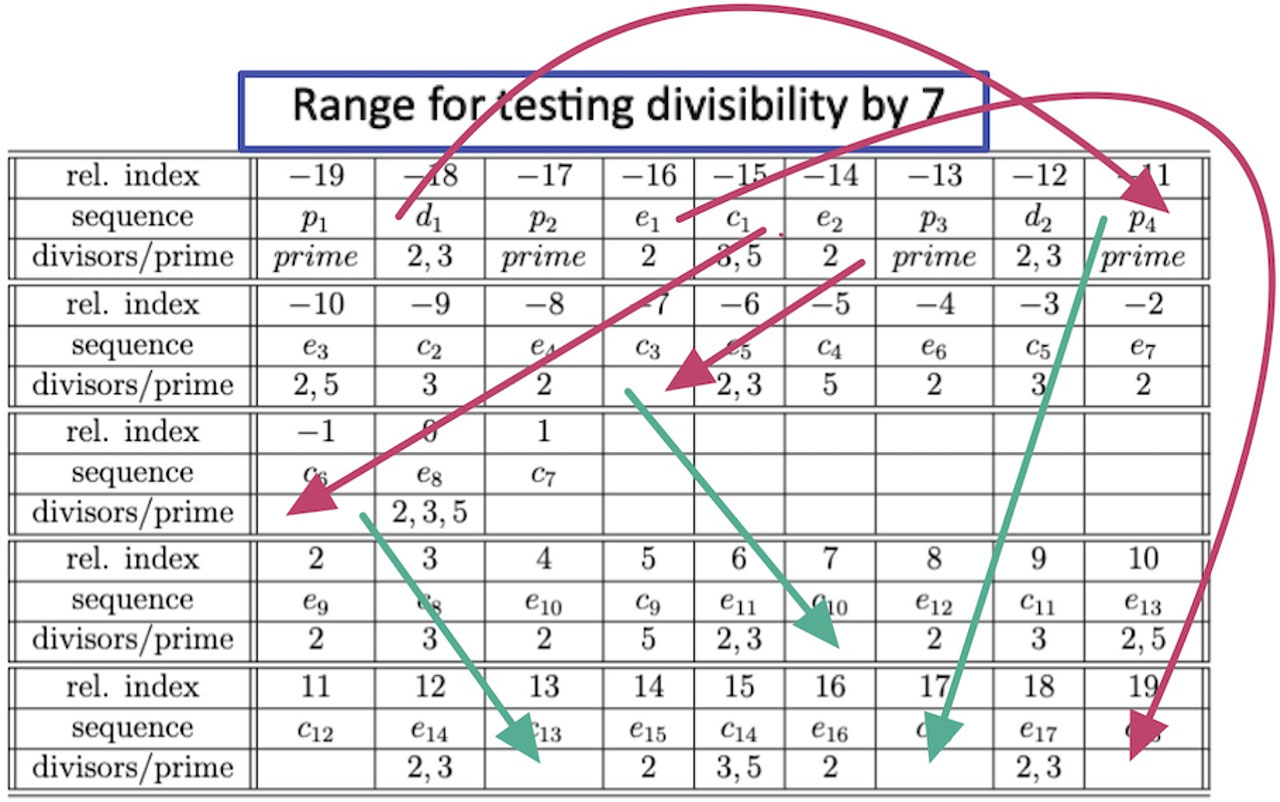
Fig. 1
Expanded Table 1.
The possible symmetric constellations C(m,n) which are now considered are restricted by the following theorems.
Theorem 3
Consider a symmetric C(m,n) constellation where n is odd. Then the center of the constellation is a prime P and the constellation can only have primes at offsets k * 6,k = 1,⋯from P.
Proof
The only possibility for the symmetric distribution of the primes constrains the center of the constellation to be a prime P. Let the sequence of integers around P be denoted by ei, where |i| = 1, 2, ⋯. Consider e−1, P, e1. Then, this is a sequence of three consecutive integers hence one and only one element of the sequence is divisible by 3. Suppose this is e1. Then, the symmetry requirement means that e2 is also divisible by 3. Hence e−1 and e1 are both divisible by 3, a contradiction to the original claim that only one of the numbers in the sequence e−1, P, e1 is divisible by 3. Now consider the sequence e−5, c−4, e−3, c−2, e−1, P,e1, c2, e3, c4, e5. The same argument as above implies that c2 and c−2 must be divisible by 3. Since e1, e3, e5 and e−1, e−3, e−5 are even the first possible prime would be e6. In the tables in Figures 2 and 3, the rel. index denotes the relative offsets of the integers from the center prime P which is at rel. index 0. By extending the above results to a table it follows that the only possible indices that can be prime are at locations offset from P by 6 * k, |k| = 1, 2, ⋯ as shown in the tables in Figure 2 and 3 depending on whether rel. index −1 or rel. index +1 is divisible by 3. The possible symmetric constellation are the same in both cases.
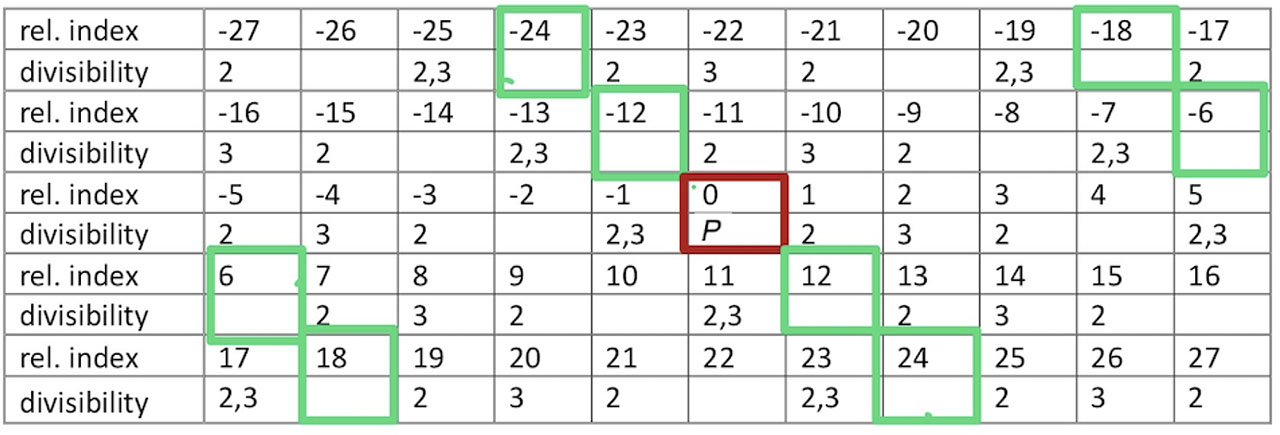
Fig. 2
Divisibility relative to center prime - odd case - rel. index −1 divisible by 3.
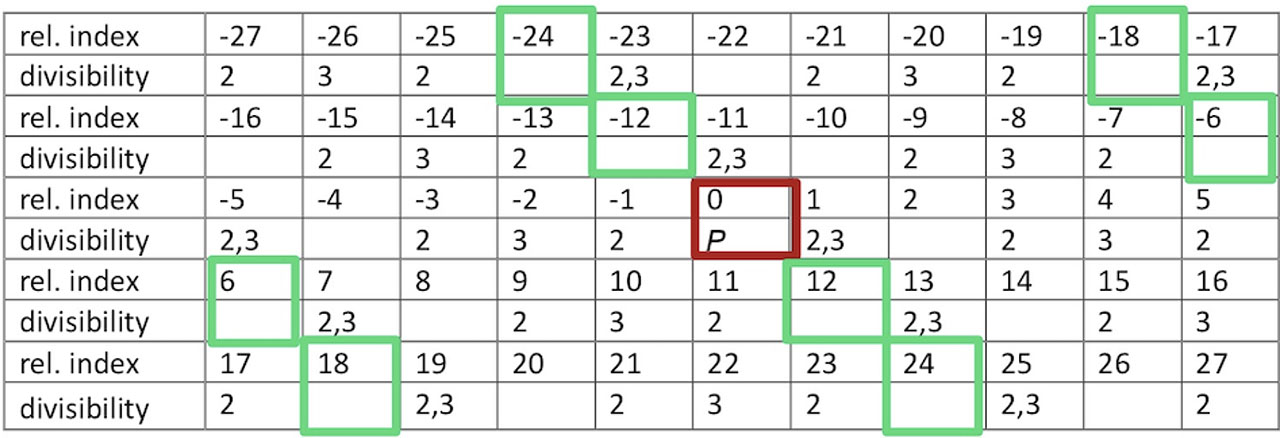
Fig. 3
Divisibility relative to center prime - odd case - rel. index 1 divisible by 3.
Theorem 4
Consider a symmetric C(m,n) constellation where n is even. Then the center of the constellation is a composite number c and the constellation base case can only have primes at locations given in table in Figure 4. The even second case can only have primes at locations given in table in Figure 5.
Proof
Due to the symmetry requirement the center of the constellation would have to be a composite number c with index 0 as used in Figures 4 and 5 or not an index item. In the first case, the extent of the constellation is m and the smallest resp. largest primes are p1 and pm. Then m = 2w + 1 where w is the number of items the left, resp. right of c. For the second case m = 2w which contradicts the fact that there is an odd number of times between two primes.
The base case of the 3 entries around the prime center for the even case is therefore pi−1, ci, pi+1. Clearly ci is divisible by 2 and 3. The possible base cases of even symmetric constellations would therefore have to conform to the divisibilities given in Figure 4.
The second case of even symmetric n-tuple has the 5 entries around the prime center as pi−2, ci−1, ci, ci+1, pi+2 where c−1 and c+1 are even. Consider ci, ci+1, pi+1. Suppose ci+1 is divisible by 3. This would imply that pi−2 is divisible by 3, hence a contradiction. So, ci is divisible by 3. The resulting divisibilities are given in Figure 5.
Note that in Figure 2, there are empty non-colored entries at rel. indices −26, −14, −2, 10, 22 as well as −20, −8, 4, 16 and for Figure 3 the empty entries are −22, −10, 2, 14, 26 and −16, −4, 8, 20. As the value of n is increased some of these entries may be primes which will not have corresponding symmetric primes hence the constellation might be non-symmetric.
Some simple examples illustrating these definitions are provided when discussing the double (two-tuple) and quadruple (four-tuple) prime constellations.
In this paper, symmetric prime constellations are considered for various values of m and n. Of particular interest are symmetric constellations having the smallest possible extent for a fixed value of n.
Since a double prime is a pair of primes p1 and p2 separated by a composite even number e1 it is an even symmetric C(3, 2) constellation which clearly has a minimal extent 3.
As noted, a great deal of research has also focused on whether there is an infinite number of double primes or not, see for example [12, 25].
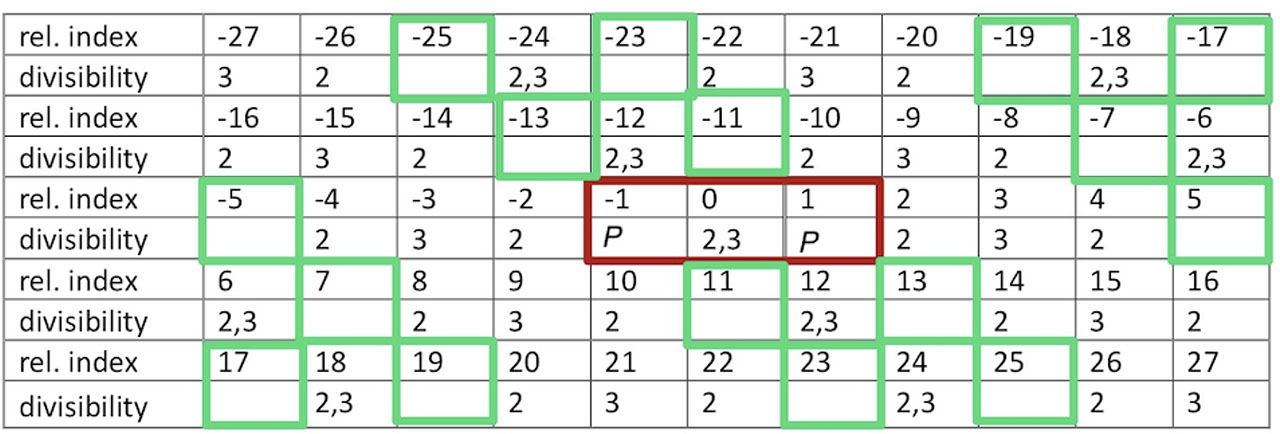
Fig. 4
Divisibility relative to composite center - even base case.
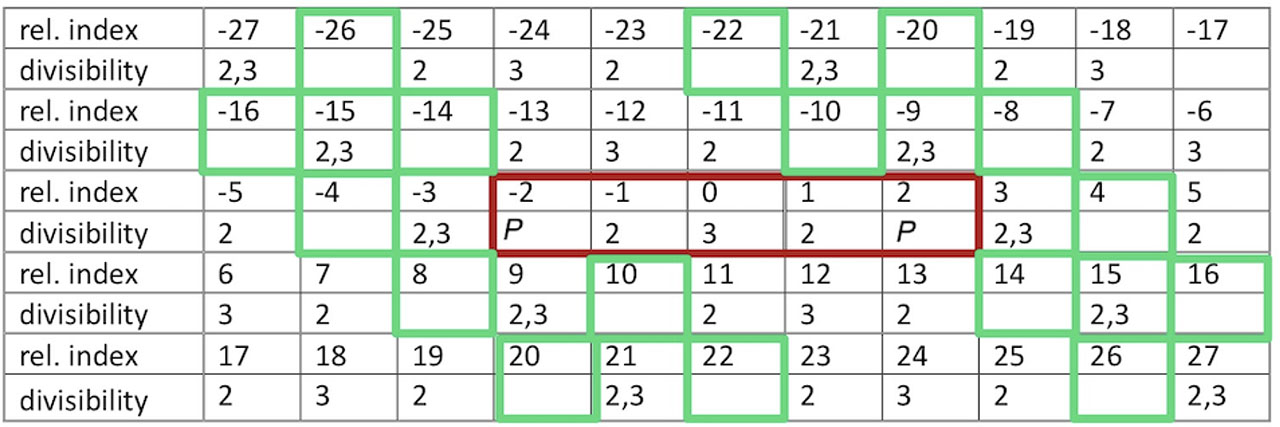
Fig. 5
Divisibility relative to composite center - even second case.
3. Symmetric triple (three-tuple) prime constellations
One might ask if there are non-symmetric and symmetric prime constellations where n = 3 of the form p1, e1, p2, e2, p3, i.e. m = 5. Indeed, there is at least one example: 3, 4, 5, 6, 7 where 3, 5, 7 are primes and 4, 6 are both even and composite.
To show that there are no further constellations of this kind the simple result used in Theorem 3 is needed. That is, given a sequence of n consecutive positive integers one and only one of the integers is divisible by n. Therefore considering that p1, e1, p2 is a sequence of three numbers at least one has to be divisible by 3. Since p1 and p2 are primes it means that e1 is divisible by 3. In the same manner p2 or p3 has to be divisible by 3. This means that one of the other sequences e1, p2, e2 and e1, p2, e2 has two numbers divisible by 3, which is not possible. The only resolution is that one of p1, p2 or p3 is composite hence the C(5, 3) constellation p1, e1, p2, e2, p3 is not possible. The next triple constellations possible are therefore either case_1: p1, e1, p2, e2, c1, e3, p3 where c1 is a composite integer or case_2: p1, e1, c1, e2, p2, e3, p3 where c1 is a composite. In both cases, the constellations are non-symmetric.
The first few examples of case_1 constellations are the triple sets of primes: (5, 7, 11), (11, 13, 17), (17, 19, 23), (41, 43, 47), (101, 103, 107), (107, 109, 113) where the first four constellations overlap and the last two constellations overlap. The first few examples of case_2 constellations are the triple sets of primes: (7, 11, 13), (13, 17, 19), (37, 41, 43), (67, 71, 73), (97, 101, 103), (103, 107, 109) where the first two constellations and the last two constellations overlap. In each case parentheses are used to clearly distinguish the constellations. These constellations are not symmetric and hence do not fall into the general theme of this paper. Checking if they can form a basis for 6-tuples or 7-tuples results in one case that will be considered in the section on 6-tuples. There are no possible 7-tuples on the basis of these two cases due to Theorem 3.
The question now is whether symmetric triple constellations exist and if therefore there are triple minimal constellations. The first potential triple symmetric constellation would be the C(9, 3) constellation p1, e1, c1, e2, p2, e3, c2, e4, p3 where c1, c2 and c3 are composite. Divisibility properties for this constellation are given in Table 3. The sequence is read from left to right and top to bottom.
Table 3
Potential triple prime, C(9, 3).
| Parameter | value | value | value | value | value | value | value | value | value |
|---|---|---|---|---|---|---|---|---|---|
| rel. index | −4 | −3 | −2 | −1 | 0 | 1 | 2 | 3 | 4 |
| constellation | p1 | e1 | c1 | e2 | p2 | e3 | c2 | e4 | p3 |
| divisors/prime | P | 2 | C | 2 | P | 2 | C | 2 | P |
Then, both from the divisibility by 3 for the sequence e2, p2, e3 and from Theorem 3 it follows that this is not a possible symmetric constellation. The next potential symmetric constellation with 3 primes is the C(13, 3) constellation p1, e1, c1, e2, c2, e3, p2, e4, c3, e5, c4, e6, p3. The properties of this constellation are given in Table 4.
Table 4
Potential triple prime, C(13, 3).
| Parameter | val | val | val | val | val | val | val | val | val | val | val | val | val |
|---|---|---|---|---|---|---|---|---|---|---|---|---|---|
| rel. index | −6 | −5 | −4 | −3 | −2 | −1 | 0 | 1 | 2 | 3 | 4 | 5 | 6 |
| constellation | p1 | e1 | c1 | e2 | c2 | e3 | p2 | e4 | c3 | e5 | c4 | e6 | p3 |
| divisors/prime | P | 2 | C | 2 | C | 2 | P | 2 | C | 2 | C | 2 | P |
Since this does not contradict Theorem 3, it is a possible symmetric triple constellation. The first example of such a constellation is given by Table 5.
Table 5
Triple prime (47, 53, 59) with m = 13.
| Parameter | val | val | val | val | val | val | val | val | val | val | val | val | val |
|---|---|---|---|---|---|---|---|---|---|---|---|---|---|
| constellation | 47 | 48 | 49 | 50 | 51 | 52 | 53 | 54 | 55 | 56 | 57 | 58 | 59 |
| factors | 47 | 24 * 3 | 77 | 2 * 52 | 3 * 17 | 22 * 13 | 53 | 2 * 33 | 5 * 11 | 23 * 7 | 3 * 19 | 2 * 29 | 59 |
Further examples for the centers p2 of triple primes of this kind are 157, 167, 257, 263, 273. There are 758163 such triple primes up to 109 showing that they are relatively common. Having eliminated the possibilities of smaller symmetric constellations of triple primes it follows that this version of C(13, 3) is a minimal symmetric triple constellation.
4. Symmetric quadruple (four-tuple) prime constellations
Quadruple prime constellations were discussed in the context of a hierarchy of primes in [26, 27].
Quadruple primes might be formed from two double primes each having 2-centers d1 and d2, with d1 < d2. This would define an even base case for a quadruple prime if they are separated by 3 non-primes. It is the smallest distance possible between two double primes if d1 ≥ 6 (assuming that the 2-centers are greater than 6) (see also Theorem 4). A symmetric quadruple prime constellation sequence would therefore be p1, e1, p2, e2, c, e3, p3, e4, p4 where e1 = d1, e4 = d2 and the centers of such quadruple primes are given by c = (d2 + d2)/2.
Let's consider e2, c, e3. One of the integers has to be divisible by 3. It cannot be e2 since this would imply p2 would be divisible by 3, a contradiction since p4 is a prime. For e3 being divisible by 5 it would imply p1 being composite, a contradiction. Hence c is divisible by 3. Then consider p2, e2, c, e3, p3 and assume one of the numbers is divisible by 5. It cannot be e3 since this would imply that p1 is composite, assume p1 > 5. Similarly for e3. Since p2 and p3 are primes, it shows that c must have a factor of 5. Note also that both one of e1, e2, c, e3 and e2, c, e3, e4 must be divisible by 7. In Table 6, the divisibilities for these quadruple primes are shown assuming p1 is a prime greater than 5.
Table 6
Divisibility of symmetric 4-tuple prime C(3, 9) by 2, 3 and 5.
| Parameter | value | value | value | value | value | value | value | value | value |
|---|---|---|---|---|---|---|---|---|---|
| rel. index | −4 | −3 | −2 | −1 | 0 | 1 | 2 | 3 | 4 |
| constellation | p1 | e1 | p2 | e2 | c | e3 | p3 | e4 | p4 |
| divisors/prime | P | 2, 3 | P | 2 | 3, 5 | 2 | P | 2, 3 | P |
Computational examples of symmetric quadruple prime constellations are provided in Table 7.
Table 7
Some 4-tuple symmetric primes, C(9, 4).
| constellations | p1 | p2 | p3 | p4 | q |
|---|---|---|---|---|---|
| quadruple prime, special case 1 | 5 | 7 | 11 | 13 | 9 |
| quadruple prime 2 | 11 | 13 | 17 | 19 | 15 |
| quadruple prime 3 | 101 | 103 | 107 | 109 | 105 |
| quadruple prime 4 | 191 | 193 | 197 | 199 | 195 |
| quadruple prime 5 | 821 | 823 | 827 | 829 | 825 |
| quadruple prime 6 | 1481 | 1483 | 1487 | 1489 | 1485 |
| quadruple prime 7 | 1871 | 1873 | 1877 | 1879 | 1875 |
There are 4768 symmetric quadruple C(9, 3) primes up to 108.
It is also interesting that the sequences of the lowest digit are 1, 3, 7, 9 starting with the second quadruple prime. Since no counterexample to this was found up to 107, it is conjectured that this sequence of lowest digit holds for all quadruple primes starting from the second one. The conjecture was easily verified by considering the trailing 5 for the center and then counting forwards and backwards from the center. I.e. p1 is four steps backwards from q hence counting down from 5 results in 1 and so on.
These quadruple constellations are also minimal symmetric quadruple prime constellations from the above discussion.
5. Symmetric quintuple (five-tuple) prime constellations
The most obvious choice for a quintuple symmetric prime constellation would be to simply change the center of the quadruple prime constellation in Table 6 to a prime. This would result in a sequence of 5 primes only separated by even integers which can be easily shown to be impossible. It is also not possible from consulting the tables in Figures 2 and 3.
For the next choices for a symmetric quintuple prime Theorem 3 is consulted. Hence the first possible constellation with 5 primes will be with primes at the first two possible locations shown in Figure 2 or 3. Consider therefore the sequence of consecutive integers starting with p1
where p1,⋯, p5 are the primes of the 5-tuple and p3 the center. Divisibilities of this sequence are shown in Table 8.Table 8
Possible symmetric quintuple prime C(25, 5).
| Parameter | val | val | val | val | val | val | val | val | val | val | val | val |
|---|---|---|---|---|---|---|---|---|---|---|---|---|
| rel. index | −12 | −11 | −10 | −9 | −8 | −7 | −6 | −5 | −4 | −3 | −2 | −1 |
| constellation | p1 | e1 | c1 | e2 | c2 | e3 | p2 | e4 | c3 | e5 | c4 | e6 |
| divisors/prime | prime | 2 | 2 | 2 | prime | 2 | 2 | 2 | ||||
| rel. index | 0 | |||||||||||
| center | p3 | |||||||||||
| prime | prime | |||||||||||
| rel. index | 1 | 2 | 3 | 4 | 5 | 6 | 7 | 8 | 9 | 10 | 11 | 12 |
| constellation | e7 | c5 | e8 | c6 | e9 | p4 | e10 | c7 | e11 | c8 | e12 | p5 |
| divisors/prime | 2 | 2 | 2 | prime | 2 | 2 | 2 | prime |
Consider then the sub-sequence c4, e6, p3, e7, c5. One of the numbers in the sequence must be divisible by 5. Assume it is c4. This would imply p1 is composite which is not possible since it is a prime. p3 is prime by assumption. c5 is not possible since it would imply p5 was composite. In a similar manner e6 and e7 cannot be divisible by 5. Hence there is a contradiction since one of the 5 consecutive numbers must be divisible by 5.
For the next possible constellations expanded the constellations by adding p1 − 6 and p5 + 6 to be prime at rel. indices −18, 18 (Case_1) and then choosing either the entries at rel. location −6, 6 to be prime or rel. entries locations −12, 12 to be prime (Case_2).
For case 1, it results in Table 9 where the constellation entries have been renamed.
Table 9
Case_1: possible symmetric quintuple prime.
| Parameter | val | val | val | val | val | val | val | val | val | val | val | val |
|---|---|---|---|---|---|---|---|---|---|---|---|---|
| rel. index | −18 | −17 | 16 | −15 | −14 | −13 | −12 | −11 | −10 | −9 | −8 | −7 |
| constellation | p1 | e1 | c1 | e2 | c2 | e3 | c3 | e4 | c4 | e5 | c5 | e6 |
| divisors/prime | prime | 2 | 2 | 2 | 2 | 2 | 2 | |||||
| rel. index | −6 | −5 | −4 | −3 | −2 | −1 | ||||||
| constellation | p2 | e7 | c6 | e8 | c7 | e9 | ||||||
| divisors/prime | prime | 2 | 2 | 2 | ||||||||
| rel. index | 0 | |||||||||||
| center | p3 | |||||||||||
| prime | prime | |||||||||||
| rel. index | 1 | 2 | 3 | 4 | 5 | 6 | ||||||
| constellation | e10 | c8 | e11 | c9 | e12 | p4 | ||||||
| divisors/prime | 2 | 2 | 2 | prime | ||||||||
| rel. index | 7 | 8 | 9 | 10 | 11 | 12 | 13 | 14 | 15 | 16 | 17 | 18 |
| constellation | e13 | c10 | e14 | c11 | e15 | c12 | e16 | c13 | e17 | c14 | e18 | p5 |
| divisors/prime | 2 | 2 | 2 | 2 | 2 | 2 | prime |
However, consider the sequence e9, p3, e10. One of these integers must be divisible by 3. Suppose this is e9. Then, this would mean that p2 is composite hence a contradiction. A similar argument holds for e10. Hence, the Case_1 constellation is not possible.
The second choice is to allow the original p2 and p4 to be composite and require the entries at rel. index −6 and +6 to be prime. The resulting table with renamed entries and divisibilities is Table 10 and where p3 is still the center prime of the constellation.
Table 10
Case_2: possible symmetric quintuple primes.
| Parameter | val | val | val | val | val | val | val | val | val | val | val | val |
|---|---|---|---|---|---|---|---|---|---|---|---|---|
| rel. index | −18 | −17 | 16 | −15 | −14 | −13 | −12 | −11 | −10 | −9 | −8 | −7 |
| constellation | p1 | e1 | c1 | e2 | c2 | e3 | p2 | e4 | c3 | e5 | c4 | e6 |
| divisors/prime | prime | 2 | 2 | 2 | prime | 2 | 2 | 2 | ||||
| rel. index | −6 | −5 | −4 | −3 | −2 | −1 | ||||||
| constellation | c5 | e7 | c6 | e8 | c7 | e9 | ||||||
| divisors/prime | 2 | 2 | 2 | |||||||||
| rel. index | 0 | |||||||||||
| center | p3 | |||||||||||
| prime | prime | |||||||||||
| rel. index | 1 | 2 | 3 | 4 | 5 | 6 | ||||||
| constellation | e10 | c8 | e11 | c9 | e12 | c10 | ||||||
| divisors/prime | 2 | 2 | 2 | |||||||||
| rel. index | 7 | 8 | 9 | 10 | 11 | 12 | 13 | 14 | 15 | 16 | 17 | 18 |
| constellation | e13 | c11 | e14 | c12 | e15 | p4 | e16 | c13 | e17 | c14 | e18 | p5 |
| divisors/prime | 2 | 2 | 2 | prime | 2 | 2 | 2 | prime |
Case_2 was tested numerically and the following results were obtained as shown in Table 11.
Table 11
Some Case_2 C(37, 5) 5-tuple symmetric primes.
| constellation | p1 | p2 | p3 | p4 | p5 |
|---|---|---|---|---|---|
| quintuple 1 | 18713 | 18719 | 18731 | 18743 | 18749 |
| quintuple 2 | 25603 | 25609 | 25621 | 25633 | 25639 |
| quintuple 3 | 28051 | 28057 | 28069 | 28081 | 28087 |
| quintuple 4 | 31033 | 31039 | 31051 | 31063 | 31069 |
| quintuple 5 | 97423 | 97429 | 97441 | 97453 | 97459 |
| quintuple 6 | 103651 | 103657 | 103669 | 103681 | 103687 |
There are 5162 instances of these quintuple primes up to 109. It is interesting to note that there are two types of these primes depending on the sequence of low order digits. These types are distinguished by the divisibility by 3 of the even integers that are just before or just after the center prime.
6. Symmetric six-tuple prime constellations
In the same manner, as in the previous section an obvious choice for symmetric six-tuple constellations would be to start with the symmetric quadruple constellations and extend those with a prime at the first extension from the extremes of the quadruple constellation obtaining a new constellation p1, e1, p2, e2, p3, e3, c1, e4, p4, e5, p5, e6, p6.
This is clearly not a possible constellation since it would include sequences of three consecutive primes (i.e. p1, e1, p2, e2, p3) only separated by even integers which has been shown to be impossible, except for the trivial case of 3, 4, 5.
Hence, either p1 and p2 (and symmetrically p5 and p6) or p2 and p3 (and symmetrically p4 and p5) have to be separated by an even-odd-even sequence.
In the first case, the resulting sequence would be
Let's Consider e4, c2, e5. One of the integers in this sequence must be divisible by 3. Suppose this is e4. This would imply p4 being divisible by 3 which is not possible since it is a prime. A similar argument holds for e5. Hence c2 is divisible by 3.
Now consider p3, e4, c2, e5, p4. In this case, one of the integers in the sequence must be divisible by 5. Let's Consider e4. It is is divisible by 5 then this implies p5 is divisible by 5 which is not possible since p5 is a prime. By symmetry e5 is not divisible by 5. Since p3 and p4 are primes it leaves c2 which is therefore divisible by 5.
For the sequence p3, e4, c2, e5, p4, e6, p5 consider again e4. If e4 is divisible by 7 then so would be p1 as well, which is not possible since p1 is a prime. Similarly e5 is excluded from being divisible by 7. For e6 being divisible by 7 would imply p2 begin divisible by 7, yet another contradiction. The remaining integers are prime, except for c2 which therefore is divisible by 7.
The resulting divisibility properties of the sequence in Eq. 3 are provided in Table 12. This is an example of an even constellation that conforms to the divisibility properties found in Figure 5.
Table 12
Divisibility of symmetric six-tuple prime constellations - C(17, 6). Center configuration is even second case p3, e4, c2, e5, p4.
| Parameter | value | value | value | value | value | value |
|---|---|---|---|---|---|---|
| rel. index | −8 | −7 | −6 | −5 | −4 | −3 |
| constellation | p1 | e1 | c1 | e2 | p2 | e3 |
| divisibility/prime | prime | 2, 3, 7 | 2, 5 | prime | 2 | |
| center | p3 | e4 | c2 | e5 | p4 | |
| rel. index | −2 | −1 | 0 | 1 | 2 | |
| constellation | prime | 2, 3 | 3, 5, 7 | 2 | prime | |
| rel. index | 3 | 4 | 5 | 6 | 7 | 8 |
| constellation | e6 | p5 | e7 | c3 | e8 | p6 |
| divisibility/prime | 2 | prime | 2, 3, 7 | 2 | prime |
There are two items of interest in this case. First of all, the low order digits of the primes in the constellations form a sequence 7, 11, 13, 17, 19, 23 by subtracting the first prime less 7 from the sequence of primes for a given sixtuple. That is, for example for the second sixtuple the same sequence as is given for the first sixtuple prime is repeated if 97 − 7 is subtracted from the primes. This is explained by considering that c2 in Table 12 is divisible by 5 and not divisible by 2, hence the low digit of c2 is 5. The rest follows by counting up and down from c2.
There is also a large jump from the first 5 sixtuples to the following ones as shown in Table 13.
Table 13
The first few symmetric sixtuple constellations with C(17, 6) are given here.
| constellation | p1 | p2 | p3 | p4 | p5 | p6 |
|---|---|---|---|---|---|---|
| sixtuple prime 1 | 7 | 11 | 13 | 17 | 19 | 23 |
| sixtuple prime 2 | 97 | 101 | 103 | 107 | 109 | 113 |
| sixtuple prime 3 | 16057 | 16061 | 16063 | 16067 | 16069 | 16073 |
| sixtuple prime 4 | 19417 | 19421 | 19423 | 19427 | 19429 | 19433 |
| sixtuple prime 5 | 43777 | 43781 | 43783 | 43787 | 43789 | 43793 |
| sixtuple prime 6 | 1091257 | 1091261 | 1091263 | 1091267 | 1091269 | 1091273 |
There are 18 sixtuples of this kind up to 107.
One can ask if it is possible to combine two triple prime constellations symmetrically around an even center to obtain sixtulpe primes and if so, do they have a smaller width. The divisibility of such a constellation would be as in Table 14. That is, the sequence p3, e7, p4 constants of three consecutive integers, one of which has to be divisible by 3. Since e7 is the only possible choice the entries divisible by 3 can be entered into the table together with the divisibility by 2. Then consider the sequence c4, e6, p3, e7, p4 of consecutive integers. One of these integers must be divisible by 5. It cannot be c4 since this would imply that p1 is a prime. Similarly e6 is not a candidate since this would imply that p2 would be a prime. Since p3 and p4 are primes it leaves e7 which is therefore divisible by 5.
Table 14
Divisibility of symmetric sixtuple prime constellations with C(27, 6), even base case.
| Parameter | val | val | val | val | val | val | val | val | val | val | val | val |
|---|---|---|---|---|---|---|---|---|---|---|---|---|
| rel. index | −13 | −12 | −11 | −10 | −9 | −8 | −7 | −6 | −5 | −4 | −3 | −2 |
| constellation | p1 | e1 | c1 | e2 | c2 | e3 | p2 | e4 | c3 | e5 | c4 | e6 |
| divisibility | prime | 2, 3 | 2, 5 | 3 | 2 | prime | 2, 3 | 5 | 2 | 3 | 2 | |
| rel. index | −1 | 0 | 1 | |||||||||
| constellation | p3 | e7 | p4 | |||||||||
| divisibility | prime | 2, 3, 5 | prime | |||||||||
| rel. index | 2 | 3 | 4 | 5 | 6 | 7 | 8 | 9 | 10 | 11 | 12 | 13 |
| constellation | e8 | c5 | e9 | c6 | e10 | p5 | e11 | c7 | e12 | c8 | e13 | p6 |
| divisibility | 2 | 3 | 2 | 5 | 2, 3 | prime | 2 | 3 | 2, 5 | 2, 3 | prime |
The first few symmetric sixtuples of this kind are given in Table 15
Table 15
The first few symmetric sixtuple constellations C(27, 6), even base case.
| constellation | p1 | p2 | p3 | p4 | p5 | p6 |
|---|---|---|---|---|---|---|
| sixtuple prime 1 | 587 | 593 | 599 | 601 | 607 | 613 |
| sixtuple prime 2 | 19457 | 19463 | 19469 | 19471 | 19477 | 19483 |
| sixtuple prime 3 | 101267 | 101273 | 101279 | 101281 | 101287 | 101293 |
| sixtuple prime 4 | 179807 | 179813 | 179819 | 179821 | 179827 | 179833 |
| sixtuple prime 5 | 193367 | 193373 | 193379 | 193381 | 193387 | 193393 |
There are 66 such sixtuples up to 107.
There is also another similar case as shown in Table 16. In previous case there was one composite center with a prime on each side. In the new case there are two primes at the center of the sixtuple separated by three composite numbers. Otherwise the two cases are similar. Here c5 is clearly divisible by 3. Then consider the sequence p3, e7, c5, e8, p4. One of these integers must be divisible by 5. Since e7 cannot be divisible by 5 since it would imply p6 being composite it follows that c5 is the only choice due to the symmetry and the fact that p3 and p4 are prime.
Table 16
Divisibility of symmetric sixtuple prime constellations - with C(29, 6).
| Parameter | val | val | val | val | val | val | val | val | val | val | val | val |
|---|---|---|---|---|---|---|---|---|---|---|---|---|
| constellation | p1 | e1 | c1 | e2 | c2 | e3 | p2 | e4 | c3 | e5 | c4 | e6 |
| divisibility | prime | 2 | 3 | 2 | 5 | 2, 3 | prime | 2 | 3 | 2 | 2, 3 | |
| constellation | p3 | e7 | c5 | e8 | p4 | |||||||
| divisibility | prime | 2 | 3, 5 | 2 | ||||||||
| constellation | e9 | c6 | e10 | c7 | e11 | p5 | e12 | c8 | e13 | c9 | e14 | p6 |
| divisibility | 2, 3 | 2 | 2, 5 | 3 | 2 | prime | 2, 3 | 5 | 2 | 3 | 2 | prime |
There are 34 sixtuples of this kind up to 107 and the first 7 examples are shown in Table 17. Note that the last digits of the primes are the same for each sixtuple due to the center being odd and divisible by 5.
Table 17
The first few symmetric sixtuple constellations, third case, are given with C(29, 6).
| constellation | p1 | p2 | p3 | p4 | p5 | p6 |
|---|---|---|---|---|---|---|
| sixtuple prime 1 | 151 | 157 | 163 | 167 | 173 | 179 |
| sixtuple prime 2 | 20101 | 20107 | 20113 | 20117 | 20123 | 20129 |
| sixtuple prime 3 | 128461 | 128467 | 128473 | 128477 | 128483 | 128489 |
| sixtuple prime 4 | 297601 | 297607 | 297613 | 297617 | 297623 | 297629 |
| sixtuple prime 5 | 350431 | 350437 | 350443 | 350447 | 350453 | 350459 |
| sixtuple prime 6 | 354301 | 354307 | 354313 | 354317 | 354323 | 354329 |
| sixtuple prime 7 | 531331 | 531337 | 531343 | 531347 | 531353 | 531359 |
Considering the table in Figure 5 the question is whether the minimal possible configuration p1, e1, p2, e2, c1, e3, p3, e4, p4, e5, c2, e6, p5, e7, p6 in Table 18 will produce sixtuple primes.
Table 18
Divisibility of possible symmetric six-tuple prime constellation - C(15, 6). Even base case.
| Parameter | value | value | value | value | value | value |
|---|---|---|---|---|---|---|
| constellation | p1 | e1 | p2 | e2 | c1 | e3 |
| divisibility/prime | prime | 2, 3 | prime | 2 | 2 | |
| center | p3 | e4 | p4 | |||
| constellation | prime | 2, 3 | prime | |||
| constellation | e5 | c2 | e6 | p5 | e7 | p6 |
| divisibility/prime | 2 | 2 | prime | 2 | prime |
A computation up to 109 produced one example: 5, 7, 11, 13, 17, 19.
Proof for the impossibility of such constellations for p1 > 5 was given in Theorem 2.
From the table in Figure 5 it can be seen that another possible minimal sixtuple constellation in this case would be p1, e1, c1, e2, p2, e3, p3, e4, c2, e5, p4, e6, p5, e7, c3, e8, p6. Will this C(17, 6) constellation produce symmetric sixtuple prime constellations?
Again a computation produces one example 5, 9, 11, 15, 17, 21. A proof similar to the proof in Theorem 2 shows that there are no further examples when p1 > 5.
7. Symmetric seventuple prime constellations
From Theorem 3, it is clear that the only possible symmetric seventuple prime constellations have to involve primes which are offset k * 6, k = 1⋯ steps away from the prime center of the constellation.
In the following the rel. index will denote the locations of primes symmetrically relative to a prime center c. As an example, the locations of the primes in the case of −24, −12, −6, 0, 6, 12, 24 are as shown in Eq. 4.
Also, from the discussion above it turns out that the first offset with the first prime greater than 5 is not a possible choice as noted when discussing the quintuple constellations. Hence the prime locations of Eq. 4 are not possible.
Numerically experimenting with the choice 1 −24, −18, −12, 0, 12, 18, 24 provided no seventuples for values up to 109. The possible proof that there are no seventuples of this form is missing currently.
The next possible choice was therefore offsets −30, −18, −12, 0, 12, 18, 30 with the center prime p4. In Table 19, the sequence of primes is shown interleaved between composite even and composite odd numbers. The divisibility with respect to 2, 3 in this case is then shown in Table 20 for the case when the even number to the left of the center prime p4 is divisible by 3. The divisibility of the case where the number to the right of the center is divisible by 3 is symmetric with respect to the center to the first case and not displayed here.
Table 19
With rhe rel. indices (−30, −18, −12, 0, 12, 18, 30) for possible symmetric seven-tuple prime constellations.
| Parameter | val | val | val | val | val | val | val | val | val | val | val | val |
|---|---|---|---|---|---|---|---|---|---|---|---|---|
| rel. index | −30 | −29 | −28 | −27 | −26 | −25 | −24 | −23 | −22 | −21 | −20 | 19 |
| constellation | p1 | e1 | c1 | e2 | c2 | e3 | c3 | e4 | c4 | e5 | c5 | e6 |
| rel. index | −18 | −17 | −16 | −15 | −14 | −13 | −12 | −11 | −10 | −9 | −8 | 7 |
| constellation | p2 | e7 | c6 | e8 | c7 | e9 | p3 | e10 | c8 | e11 | c9 | e12 |
| rel. index | −6 | −5 | −4 | −3 | −2 | −1 | 0 | 1 | 2 | 3 | 4 | 5 |
| constellation | c10 | e13 | c11 | e14 | c12 | e15 | p4 | e16 | c13 | e17 | c14 | e18 |
| rel. index | 6 | 7 | 8 | 9 | 10 | 11 | 12 | 13 | 14 | 15 | 16 | 17 |
| constellation | c15 | e19 | c16 | e20 | c17 | e21 | p5 | e22 | c18 | e23 | c19 | e24 |
| rel. index | 18 | 19 | 20 | 21 | 22 | 23 | 24 | 25 | 26 | 27 | 28 | 29 |
| constellation | p6 | e25 | c20 | e26 | c21 | e27 | c22 | e28 | c23 | e29 | c24 | e30 |
| rel. index | 30 | |||||||||||
| constellation | p7 |
Table 20
Divisibility of symmetric seventuple prime constellations C(61, 7).
| rel. index | −30 | −29 | −28 | −27 | −26 | −25 | −24 | −23 | −22 | −21 | −20 | 19 |
| constellation | p1 | e1 | c1 | e2 | c2 | e3 | c3 | e4 | c4 | e5 | c5 | e6 |
| divisibility | prime | 2, 3 | 2 | 3 | 2 | 2, 3 | 2 | 3 | 2 | |||
| rel. index | −18 | −17 | −16 | −15 | −14 | −13 | −12 | −11 | −10 | −9 | −8 | 7 |
| constellation | p2 | e7 | c6 | e8 | c7 | e9 | p3 | e10 | c8 | e11 | c9 | e12 |
| divisibility | prime | 2, 3 | 2 | 3 | 2 | prime | 2, 3 | 2 | 3 | 2 | ||
| rel. index | −6 | −5 | −4 | −3 | −2 | −1 | 0 | 1 | 2 | 3 | 4 | 5 |
| constellation | c10 | e13 | c11 | e14 | c12 | e15 | p4 | e16 | c13 | e17 | c14 | e18 |
| divisibility | 2, 3 | 2 | 3 | 2 | prime | 2, 3 | 2 | 3 | 2 | |||
| rel. index | 6 | 7 | 8 | 9 | 10 | 11 | 12 | 13 | 14 | 15 | 16 | 17 |
| constellation | c15 | e19 | c16 | e20 | c17 | e21 | p5 | e22 | c18 | e23 | c19 | e24 |
| divisibility | 2, 3 | 2 | 3 | 2 | prime | 2, 3 | 2 | 3 | 2 | |||
| rel. index | 18 | 19 | 20 | 21 | 22 | 23 | 24 | 25 | 26 | 27 | 28 | 29 |
| constellation | p6 | e25 | c20 | e26 | c21 | e27 | c22 | e28 | c23 | e29 | c24 | e30 |
| divisibility | prime | 2, 3 | 2 | 3 | 2 | 2, 3 | 2 | 3 | 2 | |||
| rel. index | 30 | |||||||||||
| constellation | p7 | |||||||||||
| divisibility | prime |
The first few seventuples of the type shown in Tables 19 and 20 are given in Table 21 and there are 73 such seventuples up to 109.
Table 21
The first few symmetric seventuple constellations C(61, 7).
| constellation | p1 | p2 | p3 | p4 | p5 | p6 | p7 |
|---|---|---|---|---|---|---|---|
| seventuple 1 | 12003179 | 12003185 | 12003191 | 12003197 | 12003209 | 12003227 | 12003221 |
| seventuple 2 | 14907619 | 14907625 | 14907631 | 14907637 | 14907649 | 14907667 | 14907661 |
| seventuple 3 | 19755271 | 19755277 | 19755283 | 19755289 | 19755301 | 19755319 | 19755313 |
Note the number of blank entries for the divisibilities in Table 20. These entries can be composite or prime. If one or more of these entries are prime then the constellation might not satisfy the symmetry condition and it would have more than 7 primes. However, if the two entries c10 and c15 are the added primes then the resulting constellation is symmetric and might possibly be a 9-tuple. Referring to Figure 6 this possibility is now contradicted shown as follows. The red boxes are the original 7-tuple primes and yellow boxes the two added possible primes. The green rectangle have 5 consecutive entries and hence one should be a multiple of 5. Then the red arrows point to p5 and p6 which are a multiple of 5 steps from e14 and c12 respectively. The yellow arrows point to c10 and c15 which are 5 steps each from e15 and e16. The last item is p4 which is a prime. Since none of the entries in the green box can be a multiple of 5 it contradicts the original assumption and hence the constellation is not possible.
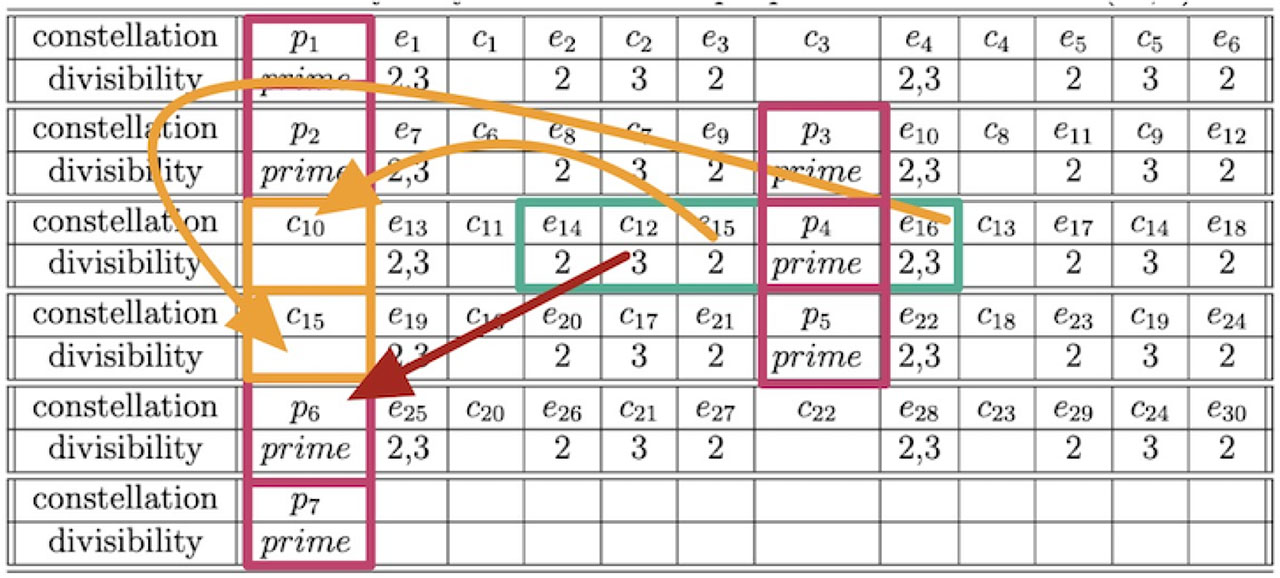
Fig. 6
Proof of impossibility of suggestion for Table 20.
In general, as the tuples increase in number these added non-specified entries cause greater and greater problems when searching for pure n-tuple constellations, especially for the odd numbered tuples, where by pure is meant that there are no other primes in the constellation.
8. Symmetric octuple prime constellations
In [26, 27], general octuple prime constellations with centers n + 19 were discussed.
These octuple constellations were generated on the bases of two quadruple constellations based on one 4-tuple with entries p1, e1, p2, e2, c1, e3, p3, e4, p4 and the first possible following 4-tuple with entries p5, e16, p6, e17, c12, e18, p7, e19, p8, e20, as shown in Table 22. In the general case the entries at c6 and c7 were allowed to be primes or composite numbers. Only the cases where both of those entries are composite numbers confirm to the strict definition used here for symmetric prime constellations. The widths of these octal constellations are m = 39.
Table 22
Divisibility of symmetric octuple prime constellations.
| Parameter | val | val | val | val | val | val | val | val | val | val |
|---|---|---|---|---|---|---|---|---|---|---|
| rel. index | −19 | −18 | −17 | −16 | −15 | −14 | −13 | −12 | −11 | −10 |
| constellation | p1 | e1 | p2 | e2 | c1 | e3 | p3 | e4 | p4 | e5 |
| divis | prime | 2, 3 | prime | 2 | 3, 5 | 2, 7 | prime | 2, 3 | prime | 2, 5 |
| rel. index | −9 | −8 | −7 | −6 | −5 | −4 | −3 | −2 | −1 | 0 |
| constellation | c2 | e6 | c3 | e7 | c4 | e8 | c5 | e9 | c6 | e10 |
| divis | 3 | 2 | 7 | 2, 3 | 5 | 2 | 3 | 2 | ? | 2, 3, 5, 7 |
| rel. index | 1 | 2 | 3 | 4 | 5 | 6 | 7 | 8 | 9 | 10 |
| constellation | c7 | e11 | c8 | e12 | c9 | e13 | c10 | e14 | c11 | e15 |
| divis | ? | 2 | 3 | 2 | 5 | 2, 3 | 7 | 2 | 3 | 2, 5 |
| rel. index | 11 | 12 | 13 | 14 | 15 | 16 | 17 | 18 | 19 | 20 |
| constellation | p5 | e16 | p6 | e17 | c12 | e18 | p7 | e19 | p8 | e20 |
| divis | prime | 2, 3 | prime | 2, 7 | 3, 5 | 2 | prime | 2, 3 | prime | 2, 5 |
Note that the number of undetermined entries is 2 in this case whereas in the 7-tuple case there were 14 such entries (Table 20).
Examples of these symmetric prime constellations were computed up to 210 * 109 finding 439 such constellations.
Another possibility is to consider Table 12 and then asking that c1 and c3 be primes. This would result in two double primes that are too close, hence disproving the existence of such constellations.
A further approach to symmetric octuple constellations is to start with the sequence prime-composite-prime and then check to see if this sequence can be the central core of an octal constellation.
Computing with this C(39, 8) constellation resulted in 29 cases of 8-tuple up to 109. As examples, the primes of the first and last case are given in Table 24.
Table 23
Divisibility of symmetric octuple prime constellation - second case.
| Parameter | val | val | val | val | val | val | val | val | val | val | val | val |
|---|---|---|---|---|---|---|---|---|---|---|---|---|
| rel. index | −19 | −18 | −17 | −16 | −15 | −14 | −13 | −12 | −11 | −10 | −9 | −8 |
| constellation | p1 | e1 | c1 | e2 | c2 | e3 | p2 | e4 | c3 | e5 | c4 | e6 |
| divis | prime | 2, 3 | ? | 2 | 3, 5 | 2 | prime | 2, 3 | ? | 2, 5 | 3 | 2 |
| rel. index | −7 | −6 | −5 | −4 | −3 | −2 | ||||||
| constellation | p3 | e7 | c5 | e8 | c6 | e9 | ||||||
| divis | prime | 2 | 5 | 2 | 3 | 2 | ||||||
| rel. index | −1 | 0 | 1 | |||||||||
| constellation | p4 | e10 | p5 | |||||||||
| divis | prime | 2, 3, 5 | prime | |||||||||
| rel. index | 2 | 3 | 4 | 5 | 6 | 7 | ||||||
| constellation | e11 | c7 | e12 | c8 | e13 | p6 | ||||||
| divis | 2 | 3 | 2 | 5 | 2, 3 | prime | ||||||
| rel. index | 8 | 9 | 10 | 11 | 12 | 13 | 14 | 15 | 16 | 1 | 18 | 19 |
| constellation | e14 | c9 | e15 | c10 | e16 | p7 | e17 | c11 | e18 | c12 | e19 | p8 |
| divis | 2 | 3 | 2, 5 | ? | 2, 3 | prime | 2 | 3, 5 | 2 | ? | 2, 3 | prime |
Table 24
First and last computed cases for constellation in Table 23.
| Parameter | value | value | value | value | value | value | value | value |
|---|---|---|---|---|---|---|---|---|
| first case | p1 | p2 | p3 | p4 | p5 | p6 | p7 | p8 |
| 344231 | 344237 | 344243 | 344251 | 344253 | 344259 | 344263 | 344267 | |
| last case | p1 | p2 | p3 | p4 | p5 | p6 | p7 | p8 |
| 944554301 | 944554307 | 944554313 | 944554321 | 944554323 | 944554329 | 944554333 | 944554337 |
Yet another possibility is to start with a 6-tuple constellation as shown in Table 14. Noting that in this case the entries c1 and c8 are required to be composite for the 6-tuple case it seems reasonable to ask for what happens if these entries are required to be prime. Testing this up to 1010 results in 102 cases of eigthtuple primes where the first few are given in Table 25.
Table 25
The first few symmetric eight-tuple constellations C(27, 8) with rel. indices at (−13, −11, −7, −1, 1, 7, 11, 13).
| constellation | p1 | p2 | p3 | p4 | p5 | p6 | p7 | p8 |
|---|---|---|---|---|---|---|---|---|
| eight-tuple 1 | 17 | 19 | 23 | 29 | 31 | 37 | 41 | 43 |
| eight-tuple 2 | 1277 | 1279 | 1283 | 1289 | 1291 | 1297 | 1301 | 1303 |
| eight-tuple 3 | 113147 | 113149 | 113153 | 113159 | 113161 | 113167 | 113171 | 113173 |
| eight-tuple 4 | 2580647 | 2580649 | 2580653 | 2580659 | 2580661 | 2580667 | 2580671 | 2580673 |
| eight-tuple 5 | 20737877 | 20737879 | 20737883 | 20737889 | 20737891 | 20737897 | 20737901 | 20737903 |
A further example of octal primes is provided by the sequence of rel. indices (−17, −13, −11, −1, 1, 11, 13, 17)
This results in 160 case where the first few have centers: (30, 103980, 113160, 1322160, 2668230). Of these cases 28 have a prime at rel. index −7 or 7 or both.
An example of octal primes with a larger span is given by the case C(47, 8) with rel. indices (−23, −19, −17, −1, 1, 17, 19, 23). When testing for examples 66 cases were found up to 1010 with 24 of the cases having one or more of integers with rel. indices (−13, −11, −7, 7, 11, 13) being prime.
A second example with C(47, 8) is provided by rel. indices (−23, −19, −13, −1, 13, 19, 23). Up to 30 * 1010 199 examples were found. 89 of the examples had one or more of the integers at re. indices (−17, −11, −7, 7, 11, 17) being prime.
A third example with C(47, 8) with rel. indices of the primes being (−23, −19, −11, −1, 1, 11, 19, 23) provided 90 examples of which 40 had one or more primes at the rel. indices (−17, −13, −7, 7, 13, 17).
A further example C(47, 8) constellations with rel. indices of the primes being (−23, −13, −7, −1, 1, 7, 13, 23) provided 115 examples of which 60 had one or more primes at the rel. indices (−19, −17, −11, 11, 17, 19).
9. Symmetric 9-tuple prime constellations
As noted when the number of the primes increases for the odd symmetry case the number of possible constellations are reduced.
This lead to a conjecture that there were no symmetric 9-tuple constellations possible. The conjecture was disproved by selecting the sequence of primes at rel. indices (−60, −42, −30, 0, 18, 30, 42, 60).
Checking for 9-tuple primes up to 2 * 1010 one case was found as shown in Table 26.
Table 26
9-tuple prime, C(120, 9).
| Parameter | value | value | value | value |
|---|---|---|---|---|
| constellation | p1 | p2 | p3 | p4 |
| location | c − 60 | c − 42 | c − 30 | c − 18 |
| divisors/prime | 12383210011 | 12383210029 | 12383210041 | 12383210053 |
| center | p5 | |||
| location | c | |||
| prime | 12383210071 | |||
| constellation | p6 | p7 | p8 | p9 |
| location | c + 18 | c + 30 | c + 42 | c + 60 |
| divisors/prime | 12383210089 | 12383210101 | 12383210113 | 12383210131 |
A further larger number of examples with one or more added primes were also found which did not satisfy the strict symmetry requirements, but some of these could possibly be 12-tuples.
10. 10-tuple prime constellations
For some 10-tuple prime constellations consider Table 23 and the sequence of rel. indices (−19, −17, −13, −11, −7, −1, 1, 7, 11, 13, 17, 19) in the table. As noted, it was shown that for this case all of the rel. indices could not be prime. Removing a pair of rel. indices might, however, provide examples for 10-tuples.
For the first case of changing the entries at rel. indices −19, 19 to be composite two examples of 10-tuples with rel. indices (−17, −13, −11, −7, −1, 1, 7, 11, 13, 17) were found when testing up to 1010 as shown in Table 27.
Table 27
The two 10-tuples found up to 30 * 1010 with rel. indices (−17, −13, −11, −1, 1, 11, 13, 17) when entries with indices (−19, 19) in the table in Figure 1 are composite.
| 10-tuple center | factors of center | entry index −1 | entry index +1 |
|---|---|---|---|
| 30 | (2, 3, 5) | prime | composite |
| 113160 | (2(3), 3, 5, 23, 41) | composite | composite |
For the second case of rel. indices the three (−19, −17, −13, −11, −1, 1, 11, 13, 17, 19) allowing the entries at rel. indices (−7, 7) to be composite the three cases listed in Table 28.
Table 28
The three 10-tuples found with rel. indices (−19, −17, −13, −11, −1, 1, 11, 13, 17, 19) when entries with indices (−7, 7) in the table in Figure 1 are composite.
| 10-tuple center | factors of center | entry index −7 | entry index +7 |
|---|---|---|---|
| 39713433690 | (2, 3, 5, 7, 23, 8222243) | composite | composite |
| 66419473050 | (2, (3, 2), (5, 2), (7, 2), 3012221) | composite | composite |
| 71525244630 | (2, 3, 5, (7, 3), 6950947) | composite | composite |
For the third case of rel. indices (−19, −17, −13, −11, −7, 7, 11, 13, 17, 19) allowing the entries at rel. indices −1, 1 to be composite the four cases listed in Table 29 were found.
Table 29
The four 10-tuples found when rel. indices (−19, −17, −13, −11, −7, 7, 11, 13, 17, 19) are specified with (−1, 1) in the table in Figure 1 being composite.
| 10-tuple center | factors of center | entry index −1 | entry index +1 |
|---|---|---|---|
| 30 | (2, 3, 5) | composite | composite |
| 1864508550 | (2, 3, 5, 5, 241, 151577) | composite | composite |
| 4763132670 | (2, 3, 5, 7193, 22073) | composite | composite |
| 5302859550 | 2, 3, 5, 5, 167, 211691 | composite | composite |
In Table 22 the entries c6 and c7 were not specified (see also Figure 5 from [26]). If these additional entries were primes then this would be examples of symmetric C(39, 10) of even case one prime constellations.
Numerically testing for this case resulted in three examples of such constellations up to 210 * 109. These constellations had centers 39713433690, 66419473050, 71525244630. In Table 30 the center of the first 10-tuple prime is t = 39713433690 = 2 * 3 * 5 * 7 * 23 * 8222243.
Table 30
The first 10-tuple C(39, 10) prime constellation, center c = 39713433690.
| rel. index | −19 | −17 | −13 | −11 | −1 |
| prime | p1 | p2 | p3 | p4 | p5 |
| value | 39713433671 | 39713433673 | 39713433677 | 39713433679 | 39713433689 |
| rel. index | 1 | 11 | 13 | 17 | 19 |
| prime | p6 | p7 | p8 | p9 | p10 |
| value | 39713433691 | 39713433701 | 39713433703 | 39713433707 | 39713433709 |
In Figure 7 the complete list of integers and their divisors are given for the first prime listed in Table 30.
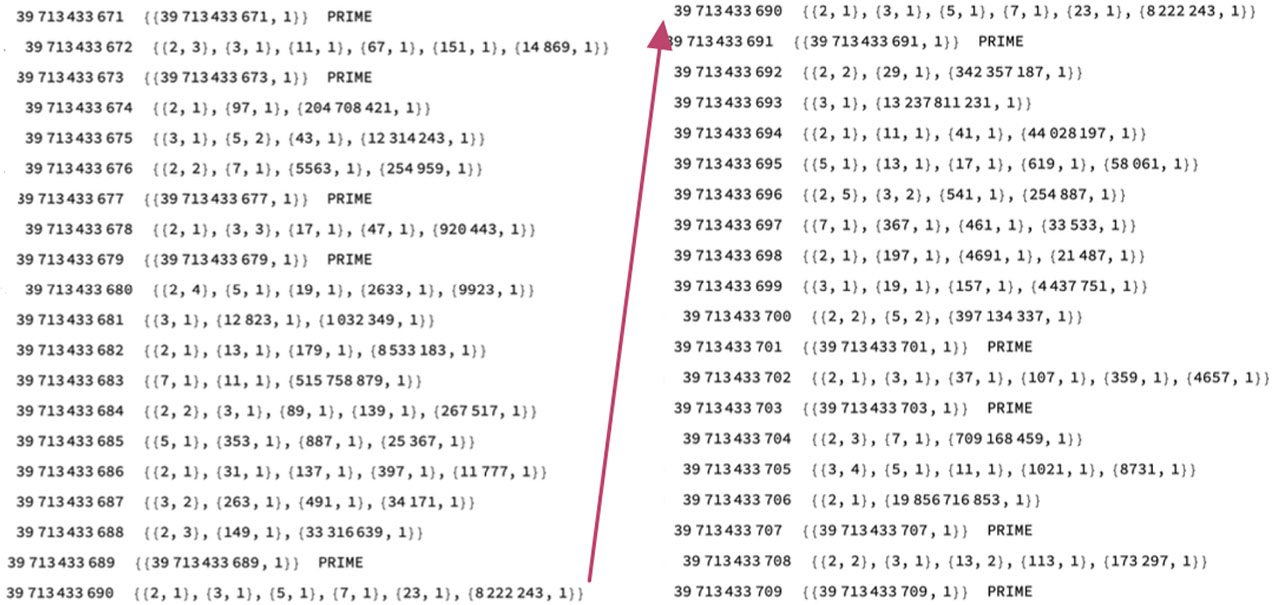
Fig. 7
Complete table for the first 10-tuple.
Some examples pf 10-tuple symmetric constellations C(47, 10) are now provided.
The first example is provided by the sequence of primes at rel/index (−23, −17, −13, −7, −1, 1, 7, 13, 17, 23)
Testing up to 30 * 1010 resulted in one example with the rel. index center 30.
For the sequence of primes at rel/index (−23, −19, −17, −13, −1, 1, 13, 17, 19, 23) no results were obtained when testing for centers up to 30 * 1010.
Another example of C(47, 10) is provided by the sequence of primes at rel. index (−23, −17, −13, −11, −1, 1, 11, 13, 17, 23). In this case there were 3 resulting 10-tuples with centers 30, 807213960, 6296082240. The result with the center 30 has three extra primes at the integers 11, 23, 37 whereas the other two results had no extra primes in the ranges of the constellations..
Another example C(47, 10) is provided by the sequence of primes at rel. index (−23, −19, −17, −13, −11, 11, 13, 17, 19, 23) where one result was found with the central prime being 6697423110 = (2, 3, 5, 7, 167, 353, 541).
A further example C(47, 10) is provided by the sequence of primes at rel. index (−23, −17, −13, −7, −1, 1, 7, 13, 17, 23) One case with center at 30 when testing for examples up to 30 * 1010.
An example where the rel. indices of the 10-tuple are (−23, −19, −17, −11, −7, 7, 11, 17, 19, 23) results in 5 cases when testing up to 30 * 1010 one of which has an added prime at rel. index 3. The centers of the 5 case are listed in Table 31.
Table 31
Centers of the 5 10-tuple constellations C(47, 10).
| 90 | 1011208680 | 2233694520 | 4143953640 | 6486125010 |
For a last example the rel. indices are (−23, −19, −13, −7, −1, 1, 7, 13, 19, 23). Of the three examples found with centers listed in Table 32, the first constellation has primes at re. indices (−17, 11) and the second constellation has a prime at rel index (11). The last case has no primes at the rel. indices (−17, −11, 11, 17).
11. The possible minimal symmetric constellations
Table 33 lists the minimal even symmetric constellations found so far.
Table 33
Summarizing the even symmetric constellations, smallest extent so far.
| configurations | value of m | number of cases | m is minimal ? | comment |
|---|---|---|---|---|
| 2-tuples (double primes) | 3 | no limit | YES obvious | extensively studied |
| 4-tuples (quadruple primes) | 9 | 166 cases up to 107 | YES as shown in section 4. | |
| 6-tuples (sixtuple primes) | 17 | 18 cases up to 107 | YES as shown in section 6 | The cases with m < 17 were shown to be not possible using divisibility by 2, 3, 5, 7. |
| 8-tuples (octuple primes) | 27 | 28 cases up to 1010 | Not verified | The cases with m = 27 have the smallest extent found so far |
| 10-tuples | 35 | 2 cases up to 1010 | Not verified | The cases with m = 35 were the minimal extent found so far |
Table 34 lists the moinimal odd symmetric constellations found so far.
Table 34
Summarizing the odd symmetric constellations, smallest extent so far.
| constellations | value of m | number of cases | is minimal ? | comment |
|---|---|---|---|---|
| 3-tuples (triple primes) | 13 | 758163 up to 109 | YES by construction | m = 7, 11 not possible by symmetry, m = 5, 7 not possible by construction |
| 5-tuples (qunintuple primes) | 37 | 124 up to 107 | YES as shown in section 5 | The cases with m < 37 were shown to be not possible using Theorem 3 |
| 7-tuples (qunintuple primes) | 73 | 124 up to 109 | NO | |
| 9-tuples | 121 | 124 up to 2 * 1010 | NO | 121 is the smallest extent found so far |
12. Conclusion
Symmetric prime constellations have been defined and a number of cases of such constellations have been found numerically.
There are a number of possible further questions that can be explored.
Is there any relationship between and n-tuple and the minima extent of the n-tuple?
What is the maximal n for an odd n-tuple and for an even n-tuple?
What are the conditions for two n-tuple forming a 2n-tuple for even n and a 2n + 1-tuple for odd n (assuming the center of the 2n + 1-tuple is a prime).
Can a symmetric 12-tuple constellation be found?
For each value of n can all the possible constellations up to a specified limit be found?
Does a 16-tuple exist as based on the octuples from the hierarchy presented in [26]?
If this would be the case, such a 16-tuple would have to conform to the divisibilities shown in Figure 8.
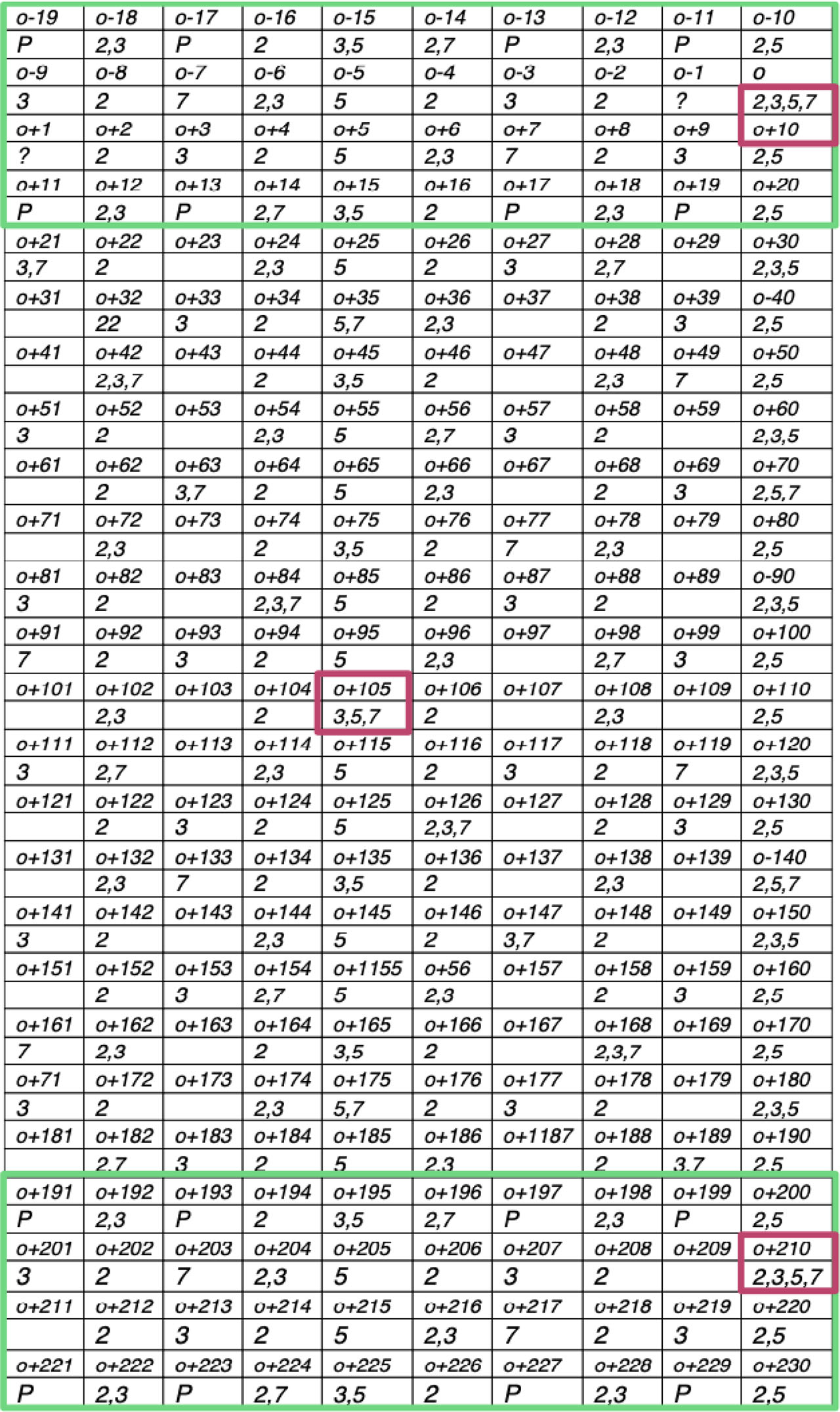
Fig. 8
Table for a possible 16-tuple based on octuples.
13. Declarations
13.1. Conflict of interest
There is no conflict of interest.
13.2. Author's contributions
J.R.-Conceptualization, Methodology, Formal Analysis, Writing-Review and Editing, Validation, Writing-Original Draft, Resources. All authors read and approved the final submitted version of this manuscript.
13.3. Funding
No funding was received to assist with the preparation of this manuscript.
13.4. Acknowledgement
Not applicable.
13.5. Data availability statement
All data that support the findings of this study are included within the article.
13.6. Using of AI tools
The authors declare that they have not used Artificial Intelligence (AI) tools in the creation of this article.