
1. Introduction
Artificial intelligence (AI) has become a major influence in today’s world, reconfiguring a variety of industries and affecting society at a global level (Kok et al., 2009; McCarthy 2007; Shubhendu & Vijay 2013). At this point in history, the entry of AI into society and its influence are no longer speculations but realities that spark discussions regarding its development, how fast it is evolving and its effects (Agrawal et al., 2017; Bommasani et al., 2021; OpenAI 2022; Dwivedi et al. 2023). When analysing AI, generative AI and natural language processing (NLP) stand out as technologies with strong potential to transform the creative industries, including music and the music business (Chopra et al. 2013; Kadam 2023; Le 2019; Liddy 2001; Anantrasirichai & Bull 2022; Bommasani et al. 2021; Dwivedi et al. 2023).
In the music industry, AI has several implications. First of all, AI is already used by many artists and producers to create music or assist them in the production process, obtaining new sounds, speeding up tasks, enhancing quality or overcoming creative challenges (Alaeddine & Tannoury 2021; Bala & Sangwan 2022). Second, this type of AI can also help with mastering, being able to perform autonomous changes or simply offering suggestions (Olayeni 2023; Bala & Sangwan 2022). Third, AI is used to analyse large amounts of data and generate music recommendations on streaming platforms (Anantrasirichai & Bull 2022; Oğul 2024).
Although all these applications in music production and recommendation are documented, the role that AI can play in promotion is not so intensively explored. It can be noted that AI is used in promotional activities, such as creating social media content through ChatGPT and audience analysis (Borg 2024; Kadam 2023; Maijanen 2023), but the reliability and effectiveness of these strategies in comparison with traditional methods and the standards imposed by literature and specialists are not investigated. The music market is arguably a crowded one (Borg 2020; Haynes & Marshall 2018; Kadam 2023; Lieb 2018; Meler & Škoro 2013), so being up-to-date with the newest distribution and promotion tools is necessary for any emerging artist. This research gap represents a real opportunity to research how generative AI, such as ChatGPT, can be used in promotional campaigns and to what extent they align with industry standards and insights from experts.
Therefore, this paper introduces generative AI in the context of music promotion, a fertile ground to analyse the implications of AI in the creative industries. Thus, this paper proposes to establish starting points in terms of the accuracy and efficiency of promotion strategies generated by AI, offering suggestions for the efficient use of ChatGPT, such as efficient prompting and involving industry experts. The paper also aims to provide a deeper understanding of AI’s contribution to promotion, preparing the ground for new explorations and experiments on how AI can replace or enhance traditional promotion methods.
In order to assess ChatGPT’s potential, it is first necessary to identify key promotion strategies. In the music industry, there are many such strategies and tools (Allen 2022; Beeching 2010; Borg 2020; Chertkow & Feehan 2012; Hutchison 2013). Among these, the most relevant could be elements such as the artist or band website, social networks and their content, and videos published on different video-sharing platforms (Baskerville & Baskerville 2019; Beeching 2010; Franklin 2011). In order to get efficient results and for the algorithms to favour user engagement, following certain efficiency standards is required (Gillespie 2014; Bucher 2012; Cotter 2019). Thus, it becomes clear that analysing whether ChatGPT is able to offer correct and complete advice on how to implement these promotion methods is needed.
This study brings both novelty and relevance to this field by testing ChatGPT’s capabilities and introducing a new evaluation instrument that can be applied beyond the music industry. From a practical point of view, the present study contributes to research on AI-generated content and its application in the music industry, an area still underexplored. From a practical point of view, the present study offers suggestions for effective use and a scalable method for evaluating ChatGPT’s effectiveness in music promotion, supporting further investigation into its role in the industry and its evolution over time.
2. Literature Review
2.1. What is AI?
The definition of AI varies and has different meanings across the many disciplines where it is used or analysed, but a common distinction is between approaches or definitions that aim to mimic human thinking or behaviour and approaches that focus on rational, goal-oriented problem-solving. In practice, most AI systems in use so far are designed for specific tasks rather than general intelligence (Kok et al. 2009; Russell & Norvig 2021). According to Shubhendu and Vijay (2013), AI can be regarded as a branch of computer science that deals with systems characterised by intelligence. These systems can understand and perform tasks, draw conclusions based on data, understand natural language and even interpret visual materials. AI can be considered a field in continuous and strong development, made up of several subfields, from general learning and perception to chess playing, solving mathematical problems or helping in the medical field. AI has significant potential to support a broad range of intellectual tasks; however, its performance remains domain and data dependent, so current systems mainly assist specific activities and may fail outside familiar conditions (Shubhendu & Vijay 2013; Verma 2018; Bender et al. 2021; Bommasani et al. 2021).
Currently, the concept of general or strong AI is just theoretical. Instead, what is available today is narrow or weak AI that is designed to carry out specific functions. The distinction is important when discussing the output of ChatGPT, as it is both articulate and broad in what it has to say but does not really always understand what it is talking about (Sajja 2021; Marrone et al. 2024).
As McCarthy (2007) notes, AI develops intelligent machines, more specifically intelligent computer programs. Although the term includes “intelligence,” AI is computational rather than biological; however, this does not imply open-ended intelligence, because current systems remain constrained by training data, objectives and model design (Castro 2016; McCarthy 2007; Mondal 2020; Bender et al. 2021; Marrone et al. 2024). The present and upcoming AI developments will change business plans in a variety of fields and industries, from production and transport to finance, entertainment and health. As part of AI, machine learning is becoming increasingly significant in the industry (Brynjolfsson & McAfee 2017; Davenport & Ronanki 2018). However, although interest in AI has grown, the attention is not always positive. While some are excited that AI will ease physical labour, others are worried about job elimination (Agrawal et al. 2017).
Even critical views are relevant when discussing music business-related cases. The issue of training data sources, copyright and licensing emerges when discussing generative AI. The policies indicate that there needs to be enough human authorship in copyright, despite the use of AI tools. The issue of revenue and motivation for creators emerges as a problem when discussing creative markets (U.S. Copyright Office 2023; CISAC 2024).
Environmental impact is another rising concern, as the training and usage of large language models require significant computing resources and energy consumption. This has also led to the need for efficiency reporting in addition to performance. It is significant for providing guidelines for repeated prompting and usage at a large organisational level (Strubell et al. 2019; Schwartz et al. 2020; Luccioni et al. 2023).
Even so, AI has many advantages, one being its ability to make predictions based on data it analyses. As Agrawal (2017) observes, features such as data storage, retrieval, computational speed and algorithms have reduced the costs of machine learning-based predictions. Still, for AI to carry out these tasks effectively, it needs large amounts of data to learn (Floridi 2020).
In conclusion, AI is a rapidly growing field, which, despite uncertainties and initial disadvantages, has the potential to change industries and facilitate or eliminate many repetitive everyday tasks.
2.2. What is ChatGPT?
These days, when we mention AI in conversations, it is no surprise that ChatGPT comes to mind early on for most people. ChatGPT is a highly advanced chatbot based on a large language model developed by OpenAI, designed to generate and revise natural-language text in response to user prompts (OpenAI 2022; Lund & Wang 2023; Rospigliosi 2023). It excels at providing responses to questions, problems and tasks in a manner that mimics natural language (George & George 2023; Kalla et al. 2023; Lund & Wang 2023).
NLP, seen both as a subfield of AI and as a related field, is based on helping computers understand human language, achieved by computational techniques that analyse language for various tasks (Chopra et al. 2013; Liddy 2001). Simply put, the practical purpose of NLP is to understand, process, manipulate and present a language in a manner as close as possible to human language (Chowdhary & Chowdhary 2020; Chopra et al. 2013; Liddy 2001).
ChatGPT can generate fluent, human-like text across many tasks (Kirmani 2022; Lund & Wang 2023), but outputs can be convergent and overly generic because they reflect patterns learned from training data. It can also be said that ChatGPT or similar tools may produce confident statements that are poorly grounded or incorrect (OpenAI 2022; Bender et al. 2021; Dwivedi et al. 2023). Additionally, ChatGPT is able to mimic a more natural style of conversation, a dialogue, a completely different experience compared to search engines (Rospigliosi 2023), as those typically don’t support follow-up questions or expanding on answers. Thus, regardless of the current issues, it is obvious that one of ChatGPT’s key strengths is how natural the delivered information is. This is particularly useful in fields where natural language is essential, like customer service or translations. In addition, ChatGPT is able to perform a large number of tasks simultaneously, as well as process very large amounts of information in a short time, making it a valuable tool in the business environment (Kalla et al. 2023).
People can make use of ChatGPT without specialised knowledge in computer science (George & George 2023). Moreover, ChatGPT learns from context and from previous messages, leading to more relevant answers. The implications are great, and in fields such as education or health, ChatGPT can bring a lot of value by facilitating processes of customised learning or offering quick solutions based on the predictive analysis of patterns in data (George & George 2023).
It is important to mention that ChatGPT also has limits, such as bias. The information provided by ChatGPT is based on the various data that it was trained on, with the risk of sometimes generating incorrect or biased answers. Therefore, it is important to carefully analyse the generated data (Kalla et al. 2023). In addition, in the educational field, for example, ChatGPT can be used to assist the learning process, but it should not be treated as a replacement for a qualified instructor or practitioner because outputs can be incomplete or misleading without expert supervision (Kasneci et al., 2023). Although ChatGPT can simplify the role, the teacher, for example, must be present to provide guidance or a more complex assessment of students (Ausat et al. 2023).
2.3. How ChatGPT can be used as a Marketing Tool
In the field of marketing and promotion, ChatGPT can come with some notable advantages. ChatGPT can create marketing content such as product descriptions, advertisements or any other promotional texts in a significantly shorter time than a human can (Rivas & Zhao 2023). This can be used in favour of those responsible for content marketing, because it offers them higher speed, so they can focus on audience engagement much more efficiently. In addition to content generation, ChatGPT is also useful for market research and for data and content analysis (Rivas & Zhao 2023; Biswas 2023).
ChatGPT also comes with the advantage of automation by reducing repetitive manual tasks and lowering the costs related to content generated in digital marketing (George & George 2023). Social media posts, descriptions or promotional texts can be made or improved by ChatGPT. It can even analyse people’s responses to such content or posts, drawing conclusions and analysing reactions such as opinions or emotions (Biswas 2023).
However, as in other fields, it is necessary to analyse the ethical and accuracy implications. Besides the fact that users and companies should be transparent regarding the use of ChatGPT, the accuracy of the data, the need for empathy and human touch, and the lack of context awareness must be taken into account (Rivas & Zhao 2023; Biswas 2023).
It is, therefore, clear that ChatGPT is a complex chatbot with very diverse practical applications, capable of facilitating work and processing large amounts of information, but despite its advantages, it must be used with an awareness of the potential bias in the information it generates and the need for human touch and emotional intelligence in performing tasks. However, if used in a balanced way, fields such as marketing can be helped significantly (Biswas 2023; Kalla et al. 2023; Rivas & Zhao 2023).
2.4. Music Marketing and Promotion Fundamentals
Understanding the impact of technology on music promotion requires recognising that music has long been organised as a commercial product, with significant money invested in producing, distributing and promoting it (Borg 2020; Hull 2004; Wikström 2020). Although music itself is intangible, it is distributed via physical items such as CDs and DVDs, as well as digital files (Borg 2020; Wikström 2020). As a result, branding and marketing play a big role in music promotion, which has led to music’s physical and technological forms being treated as commodities (Dann & Jensen 2007; Morris 2005; Rutter 2016).
Following that, promotion is a key aspect that an artist needs to succeed in the music industry. An artist needs to find a way to stand out and be remembered if they are to achieve their goals, such as selling more records and performing more concerts. Promotional tools such as websites, social media and video content have become essential for self-promotion (Allen 2022; Beeching 2010; Borg 2020; Donham, Macy & Rolston, 2022; Weisman 2015).
An artist’s website serves as the foundation of an artist’s online presence. Websites provide a comprehensive and controlled image of the artist, allowing them to present listeners with essential tools for branding such as biographies, opinions, images, music, sales links, news, events and videos (Beeching 2010; Borg 2020; Chertkow & Feehan 2012; Donham, Macy & Rolston 2022; Weisman 2015). Artists can also obtain mailing lists and facilitate the direct sale of records or merchandise. These online spaces should feature professional photos, clean and well-organized front pages, attractive images that reflect the brand personality and call-to-action buttons linking to social media, contact forms, videos and music streaming or purchasing platforms (Baskerville & Baskerville 2019; Beeching 2010; Donnelly 2017; Donham, Macy & Rolston 2022; Weisman 2015).
While websites form the foundation of an artist’s promotional efforts, social media has replaced some of their functions. Social media networks let artists connect with their fans and promote their music through text, pictures, videos and live streams, affordably or for free (Borg 2020; Franklin 2011; Hutchison 2013; Stafford 2010). Social media platforms stand out as a way for artists to build relationships with their fans through direct interactions like messages and comments. Using these networks, artists can also announce new projects, music releases, merch drops, upcoming shows or collaborations. That said, staying consistent is key to using these tools effectively for brand promotion (Beeching 2010; Borg 2020).
Video content is another major part of promotion and works hand in hand with social media, and it is an audio-visual form of expression that can be an effective tool for artists in their promotion and distribution efforts (Borg 2020; Holt 2011; Iliya 2020). While we often think of traditional music videos, the term also includes teasers, vlogs, live performances and behind-the-scenes footage. Through video, artists can also collaborate with other musicians or content creators. However, financial investments and professional equipment are sometimes necessary for high-quality content (Beeching 2010; Borg 2020).
Therefore, it can be seen how promotion can be considered a vital aspect in the career of any artist seeking success, at least a commercial one, and it can materialize through activities such as building and updating a website, staying active on social media and producing regular video content. All these promotional tools help artists get noticed, stand out and form real connections with fans, and what matters most is using them consistently and authentically to build both the music and the brand.
2.5. AI and ChatGPT as New Promotion Tools in the Music Industry
The development of AI has led to an increase in the implications it can have in the music industry. In addition to the production of music by AI (Alaeddine & Tannoury 2021; Olayeni 2023; Oğul 2024), AI manages to carry out processes such as content generation, audience analysis and music recommendation, offering new ways for musicians to promote their artistic product.
Consequently, it is noted that AI has multiple uses, starting from creation and distribution and going all the way to the personalisation of musical experiences. This AI-powered recommendation and personalisation can be encountered on streaming platforms such as Spotify, where algorithms create personalised playlists for its users (van de Haar et al. 2019). These new technologies of music recommendation on streaming platforms work by analysing the preferences and listening behaviours of users, offering tailored playlists and recommendations, thus managing to offer unique experiences that increase engagement and consumption (van de Haar et al. 2019; Kadam 2023; Olayeni 2023).
A common definition frames creativity as producing outputs that are both novel and appropriate or valuable in context (Runco & Jaeger, 2012). As far as musical creation is concerned, Generative AI systems can produce novel combinations that resemble creative output, even though creative agency and authorship remain contested and typically depend on human direction, selection and responsibility (Marrone et al., 2024; U.S. Copyright Office, 2023). There are AI technologies, such as those from Google or Meta, which generate songs for users automatically, resulting in an industry where such songs will be found more often (Bala & Sangwan 2022; Oğul 2024). Although these technologies are still in development, they are already sophisticated, at least on a technological level. AI can generate music, but it is also used to improve mixing, mastering and sound design processes, helping artists save time and money and bypass the need for strong technical skills (Alaeddine & Tannoury 2021; Anantrasirichai & Bull 2022; Olayeni 2023; Oğul 2024).
AI is noticeable in live performances as well. Different AI systems can respond to live inputs and give artists the opportunity to offer musical experiences, engage with the audience and be innovative (Bala & Sangwan 2022; Olayeni 2023). For example, robotic musicianship research has demonstrated real-time interactive improvisation with a robotic marimba player in response to human performers (Hoffman & Weinberg 2011). Moreover, live productions can be assisted by AI in terms of lights and stage visuals, providing support for the way the music is presented, not just for the music itself (Olayeni 2023).
Although it is obvious that AI will increasingly influence musical creation, artists and specialists often argue that AI should be used as an auxiliary or collaborative tool, not as a replacement for human art and creativity (IFPI 2023; CISAC 2024). More precisely, AI can be used to automate repetitive tasks and offer suggestions, allowing artists to focus on the creative and imaginative aspects of their work (Alaeddine & Tannoury 2021; Bala & Sangwan 2022). Thus, AI can be used to help artists become faster and more efficient, to overcome creative blocks and to experiment (Bala & Sangwan 2022).
Therefore, it can be highlighted that the potential of AI is growing in the music industry, with opportunities in innovation, creation, promotion and collaboration (Bala & Sangwan 2022; Pinheiro 2021). The introduction of AI as a tool in the music industry will help artists and companies remain competitive and up-to-date with creation, distribution and performance (van de Haar et al. 2019; Pinheiro 2021).
In terms of promotion, AI and tools such as ChatGPT are used to help artists create content and communication strategies. AI tools, as Kadam (2023) notes, can help artists analyse fan behaviours and then personalise and optimise content distribution. NLP-driven chatbots can increase engagement with fans through real-time interactions, promoting artist concerts or facilitating online campaigns such as contests or surveys. ChatGPT, as Borg (2024) suggests, can already be used by artists to help them create promotional materials such as biographies, social media posts and press releases. In this sense, AI impacts the industry by facilitating content creation and presentation processes (Meena, Jingar & Gupta 2020). Besides this, AI is already used in event marketing by extracting valuable demographic information and analysing it to help approach specific target audiences in promotion (Maijanen 2023).
Although AI and ChatGPT show great potential in music promotion, there is a notable gap in the academic literature on how tools like ChatGPT can be used to promote artists and their music, more specifically, research carried out in a formal or scholarly context analysing and testing the effectiveness of these tools. The use of complex generative AI for music promotion, particularly by independent artists and small teams without dedicated marketing staff, is a newly emerging topic, so it is expected that research is still in its early stages. The way in which AI can contribute to strategies and promotion campaigns for artists thus requires testing and analysis in order to explore how these technologies enhance promotional and commercial aspects.
3. Methodology
Based on the reviewed literature on the music industry, promotion methods, generative AI and the ways in which it can be used, as well as the theme and objectives of this work, the following research questions are raised:
RQ1. Can ChatGPT generate a promotional website strategy for music artists that meets industry efficiency criteria?
RQ2. Can ChatGPT generate a promotional social media content strategy for music artists that meets industry efficiency criteria?
RQ3. Can ChatGPT generate a promotional video content strategy for music artists that meets industry efficiency criteria?
In order to analyse the differences between the two cases, ChatGPT and industry criteria, while keeping the structure of a content analysis grid or codebook devised from concepts in literature, a combined method is used, more precisely, a comparative content analysis. Since this is a comparative analysis, the small number of cases does not allow for statistical interpretation (Lijphart 1971). Specifically, there are two cases in this research, which are then compared, while also respecting content analysis standards. Concretely, each ChatGPT output is coded against the literature-derived criteria (presence/absence per code), enabling comparison of coverage patterns across website, social media and video prompts.
A mixed inductive and deductive approach is used (Figure 1). In the first case, an inductive approach is used by analysing literature to identify concepts and suggestions, from which codes are generated. In the second case, the deductive approach is used to analyse AI-generated texts based on the codes generated in the first case (Catanzaro 1988; Elo & Kyngäs 2008; Fereday & Muir-Cochrane 2006; Mayring 2000; Thomas 2006), specifically those related to efficiency suggestions. The goal is to determine whether any of the predefined codes from the first case are present in the second case.
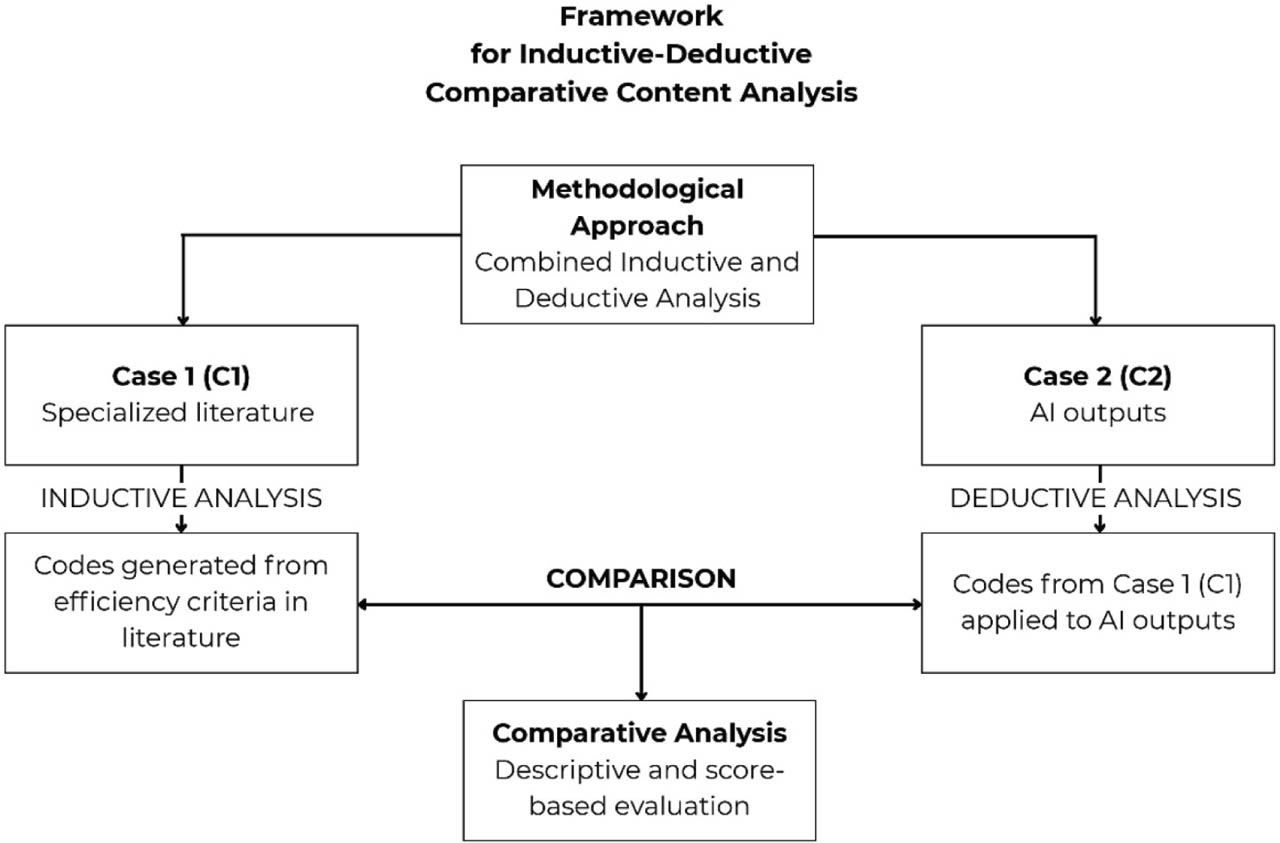
Figure 1.
Framework for inductive-deductive comparative content analysis.
Here, “deductive” refers to theory-driven (directed) content analysis in which categories are defined a priori from the literature and used to code the AI outputs. Therefore, the study does not test statistical hypotheses, but answers research questions through structured category-based coding and comparison (Hsieh & Shannon 2005; Elo & Kyngäs 2008; Mayring 2000; Assarroudi et al. 2018). Consistent with guidance for deductive qualitative research, we formulate deductive research questions rather than hypotheses (Robinson 2025).
3.1. Criteria from Specialised Literature
The first case analysed (C1) is the specialised literature, where promotion methods and efficiency criteria were identified. This was achieved by randomly selecting specialised books and articles that present promotion mechanisms and tips for musical artists and highlight the different tools and ways in which this can be done. Therefore, according to the theoretical review, the promotion methods chosen are artist website, social media and video content, all of which are widely mentioned and detailed in the literature (Baskerville & Baskerville 2019; Beeching 2010; Borg 2020; Chertkow & Feehan 2012; Donham, Macy & Rolston 2022; Donnelly 2017; Hutchison 2013; Weisman 2015). For each individual method, three efficiency standards, also called codes, were generated and chosen randomly after identifying concepts and promotion suggestions, with the condition being that they are present in multiple specialised books or research articles in the literature review (Figure 2).
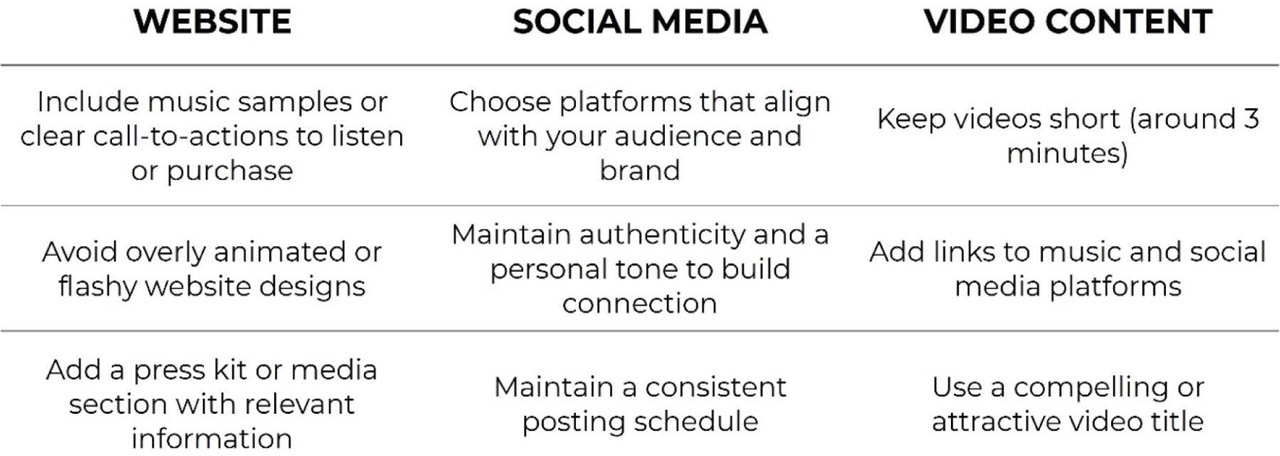
Figure 2.
Efficiency criteria (codes) for the promotional tools based on the literature.
Thus, first, for the website, the identified criteria are using music samples or call-to actions to encourage music consumption (Allen 2022; Beeching 2010; Borg 2020; Chertkow & Feehan 2012; Donham, Macy & Rolston 2022; Donnelly 2017; Herstand 2023; Hutchison 2013; Tortorella 2013), avoiding creating websites that are too flashy or animated (Baker 2005; Beeching 2010; Borg 2020; Chertkow & Feehan 2012; Donnelly 2017; Hutchison 2013; Tortorella 2013) and including a press kit or media section (Allen 2022; Beeching 2010; Borg 2020; Chertkow & Feehan 2012; Donnelly 2017; Hutchison 2013; Herstand 2023; Tortorella 2013).
Then, for social media content, the criteria are choosing the social media platforms that best fit the audience (Beeching 2010; Borg 2020; Donham, Macy & Rolston 2022; Donnelly 2017; Franklin 2011; Herstand 2023; Iliya 2020; Penchev 2019), using an authentic and personal communication style (Beeching 2010; Borg 2020; Donham, Macy & Rolston 2022; Donnelly 2017; Herstand 2023; Iliya 2020; Penchev 2019; Tortorella 2013) and respecting a posting schedule (Beeching 2010; Borg 2020; Chertkow & Feehan 2012; Donham, Macy & Rolston 2022; Donnelly 2017; Franklin 2011; Herstand 2023; Iliya 2020; Penchev 2019; Tortorella 2013).
Finally, for video content, the chosen criteria is keeping the videos concise (Borg 2020; Coulter 2022; Hutchison 2013; Radovanović 2022; Weisman 2015), using links for other pages of the artists and their music (Borg 2020; Chertkow & Feehan 2012; Donham, Macy & Rolston 2022; Donnelly 2017; Weisman 2015), as well as using an attractive title (Borg 2020; Chertkow & Feehan 2012; Donham, Macy & Rolston 2022; Hutchison 2013; Weisman 2015).
The overall objective of the paper is not to indisputably highlight whether a particular criterion is correctly replicated by AI, but rather whether ChatGPT can generally provide quality answers, regardless of the chosen criteria, so a randomised approach in choosing these standards is suitable.
3.2. Analysing Criteria in ChatGPT-Generated Texts
This first case or content (C1), inspired by the literature, is, therefore, compared with the second case (C2), which consists of AI-generated content produced by ChatGPT in response to prompts related to each promotion method.
When analysing the presence of specific tips or criteria in a promotion strategy guide, it is self-evident that a code, also named criterion in the present case, is present only once, in a list with several distinct tips; therefore, understanding that a quantification in such content analyses is not always relevant or definitory (Krippendorff 2018). Therefore, analysing frequency in terms of how many times the specific code appears in the generated text does not make sense in the current situation, so merely the presence of the code is analysed in this case.
Thus, simply put, the interpretation of the results is done using the promotion efficiency criteria in the role of codes, and the identification of their presence or absence in the texts generated by AI. Later, when the general results are taken into consideration, the cumulative presence of all three criteria of a promotion method in the three generated texts will also be presented in percentages, for a more crystallised illustration of the results.
3.3. Instrument
Three different content analysis grids or codebooks will be created, for each promotion method, which also play the role of displaying the results. These tables primarily contain the codes themselves, more specifically, the three efficiency standards for each individual promotion method. In addition, they also contain a variable that shows the prevalence of the code relative to the number of texts generated, three to be exact. Finally, the table also includes a column that shows the exact quotes where each code was identified.
The generalised grid (Table 1) that will be used to centralise the data includes all the mentioned elements, as well as their abbreviations. Thus, c refers to the criterion or standard of efficiency, nGT is the number of generated texts, in this case, three for each method, nGTc indicates how many of those texts meet the criterion and eGT shows an example quote from the actual results generated by ChatGPT.
Table 1.
Content analysis grid in the form of a score sheet.
| Efficiency criterion (c) | Number of generated texts in which the criterion appears out of the total (nGTc/nGT) | Example in the generated text (eGT1, eGT2…eGTn) |
|---|---|---|
| c1 | nGTc1/nGT | eGTn: “…” |
| c2 | nGTc2/nGT | eGTn: “…” |
| c3 | nGTc3/nGT | eGTn: “…” |
In the interpretation of the results, their narrative explanation is also accompanied by numerical or percentage-based representations, for a clearer illustration of the extent to which the standards or criteria are found in the analysed texts.
This percentage display will be achieved by calculating the overall efficiency, composed of an average of the percentages of the three individual criteria in the three texts generated by ChatGPT. Therefore, the following simple weighted average formula can be developed and applied to show the total percentage in which the efficiency criteria are found:
TES = total efficiency score;
nGTc = number of texts in which the criterion (c1, c2 or c3) appears; ≤nGT;
w% = weight of the criterion expressed in percentages; n × w% = 100%, meaning every criterion has the same importance, and no matter how many, they will always sum to approximately 100%; and
nGT = number of generated texts.
3.4. Procedure
The procedure involves creating prompts entered into the ChatGPT 3.5 platform by OpenAI, asking the AI to offer a strategy for three promotional tools identified from the literature: an artist website, social media and video content. Although newer versions may exist, ChatGPT 3.5 is a free tool used to test its ability to generate promotional strategies for comparison with industry standards, offering a base for future research to examine its performance against the capabilities of newer models.
Since the results are compared to literature-based industry efficiency standards, the concept of efficiency was added to the prompts so that the answers take this into account. The prompts were detailed, giving the ChatGPT platform more ways to contextualise the information. This mimics a natural situation, where different artists or artist managers can ask ChatGPT for ideas on different aspects of the particular promotion method.
A pretest of the platform revealed that ChatGPT does not always know how to prioritise content or what categories and exact information to create unless specific details are offered. The presented information sometimes differs from one result to another. Therefore, each prompt was entered three times, generating nine texts, three for each method, helping to draw a more consistent conclusion. Therefore, the prompts entered in ChatGPT are the following:
P1. Create an efficient promotional website strategy for a music artist; include website ideas, tips for an efficient website, what elements it should include and methods to promote or distribute the website
P2. Create an efficient promotional social media content strategy for a music artist; include post ideas, tips for efficient posts, a post example and methods to promote or distribute the post
P3. Create an efficient promotional video content strategy for a music artist; include video ideas, tips for an efficient video, title and script, and methods to promote or distribute the video.
The generated results will be analysed and entered in the previously mentioned codebook tables, the total efficiency scores (TESs) will be calculated and then they will be interpreted.
4. Results
The first promotion tool, the website (Table 2), obtained moderate results regarding the presence and prevalence of the code in all three texts. The efficiency criterion for the inclusion of music samples or music consumption call-to-action buttons in a website was identified in two of the three generated texts. However, ChatGPT sometimes generated identical information from one text to another, including in the segments for this first criterion. The second criterion, the need for a site not to be very flashy or overloaded with animations, was found in all three generated texts. While in the first two texts, the information was identical, in the third, it was formulated differently but retained the same meaning. The third criterion, the inclusion of a press/media section, was not mentioned in any of the texts.
Table 2.
Website strategy analysis.
| Efficiency criterion code | Number of generated texts in which the criterion appears out of the total | Example in the generated text |
|---|---|---|
| Include music samples or clear call-to-action to listen or purchase | 2/3 | eGT2, eGT3: Make sure it’s easy for fans to access and stream your music. |
| Avoid overly animated or flashy website designs | 3/3 | eGT1, eGT2: Avoid cluttering the site with too many visuals or text |
| Add a press kit or media section with relevant information | 0/3 | eGT3: Avoid overcrowding the website with too much text or visuals |
In Table 3, the presence of the three criteria of a social media strategy is represented. The first criterion, the need for the artist to choose the social platforms that fit them and their target audience best, is found in two of the three texts, with examples that illustrate that platforms shouldn’t be chosen at random. The second criterion, stating that the artist must be personal or authentic on social media for a solid artist image, is found in only one text. This text contains an example that illustrates personal stories or behind-the-scenes moments used to create a better connection with fans. Finally, the third criterion, creating and respecting a consistent posting schedule, is found in all three texts, and the examples clearly refer to the creation of a calendar or posting schedule.
Table 3.
Social media strategy analysis.
| Efficiency criterion code | Number of generated texts in which the criterion appears out of the total | Example in the generated text |
|---|---|---|
| Choose platforms that align with your audience and brand | 2/3 |
|
| Maintain authenticity and a personal tone to build connection | 1/3 | eGT3: Sharing behind-the-scenes moments or personal stories can help build a connection with the audience |
| Maintain a consistent posting schedule | 3/3 |
|
Table 4.
Video content strategy analysis.
| Efficiency criterion (c) | Number of generated texts in which the criterion appears out of the total (nGTc/nGT) | Example in the generated text (eGT1, eGT2…eGTn) |
|---|---|---|
| Keep videos short (around 3 min) | 3/3 |
|
| Add links to music and social media platforms | 2/3 |
|
| Use a compelling or attractive video title | 1/3 | eGT1: Craft a catchy title that reflects the content of the video and grabs the viewer’s attention |
The third content analysis (Table 4) shows how the texts generated by ChatGPT meet the criteria for a video content strategy. The first criterion says that the videos must be short, concise and preferably not exceed 3 min in length. This criterion was identified in all three texts. While one text generally notes the clips should be short, the other two clearly state they should be between 3 min and 5 min. The second criterion, suggesting the inclusion of references and direct links in videos or their descriptions, is mentioned in two of the three texts. They mention elements such as call-to-action for social media or links leading to streaming and music buying platforms. The third and last criterion, using an interesting or attractive title, is mentioned in only one of the texts.
5. Discussion
Overall, the results reveal moderate efficiency in the music promotion strategies content generated by ChatGPT. There is no clear pattern when using the same prompt several times. While sometimes content and sentences are identical, other times results differ greatly, with fewer or different categories. Regarding the current research questions, the results show moderate performance in all situations.
The first research question (RQ1) asks whether ChatGPT can produce for a music artist a website promotion strategy that considers criteria from specialized literature, such as using call-to-action sections, keeping the design clean and not too flashy, and including an information section for media and press (Allen 2022; Beeching 2010; Baker 2005; Borg 2020; Chertkow & Feehan 2012; Donham, Macy & Rolston 2022; Donnelly 2017; Herstand 2023; Hutchison 2013; Tortorella 2013). In two of the three texts, the first criterion is found, including actual music or call-to-action sections to listen to the music. The criterion recommending a site with as few animations and flashy images as possible was identified in all three texts. On the other hand, the last efficiency criterion or standard, including a press or media section, was not found in any of the three texts. Thus, the total efficiency score (TES) is 55%, meaning an artist cannot rely on a single text generated by one prompt to cover all basic tips for this promotion tool. However, with repeated prompts or including new information, possibly from specialised sources, the score might increase.
The second research question (RQ2) aims to find out if ChatGPT mentions the standards regarding an efficient social media content strategy, more specifically choosing the right platforms, being authentic and personal, as well as respecting a posting schedule (Beeching 2010; Borg 2020; Chertkow & Feehan 2012; Donham, Macy & Rolston 2022; Donnelly 2017; Franklin 2011; Herstand 2023; Iliya 2020; Penchev 2019; Tortorella 2013). The criterion suggesting choosing social media platforms specific to the artist and their target audience is mentioned in two of the three texts. The second criterion, which highlights the artist’s need to be personal and authentic to cultivate a good image on social media, is mentioned in a single text. Finally, the criterion aimed at the artist’s creation of a posting schedule can be found in all three texts, in similar forms. The TES is thus 66%. From this second question, combined with the first, one can see a need to know better how the prompts should be created for more comprehensive results.
The third research question (RQ3) concerns the video content strategy, trying to find out if the texts generated by ChatGPT meet the criteria chosen from literature, more specifically keeping the videos short and concise, making references or offering links to the social media accounts and music buying or streaming platforms, as well as creating a catchy video title (Borg 2020; Chertkow & Feehan 2012; Coulter 2022; Donham, Macy & Rolston 2022; Donnelly 2017; Hutchison 2013; Radovanović 2022; Weisman 2015). Thus, the first criterion, keeping the videos short or concise, can be found in all generated texts, which refer both to the need for shorter clips as a whole and to recommended lengths of approximately 3–5 min. The second criterion advises the artists to use references and links that lead to their social media pages and to where people can stream or buy their music. The criterion is mentioned in two of the three texts, once as advice, and the second time in the form of an example of a voiceover or script that the artist could use when making a promotional video. The third criterion suggests giving the video a catchy or interesting title. This was mentioned in only one text, in which the artist is advised to choose an attractive title that illustrates the content. The TES is again 66%, so a video content strategy made by ChatGPT for a music artist can be a starting point, but it needs more prompt attempts with the help of a specialist. This further highlights the need for researchers, artists and industry specialists to be trained in how to write a prompt as efficiently as possible.
6. Conclusions
It is fair to say that ChatGPT shows potential in generating promotional strategies, but because its results are inconsistent, reliability varies. It seems that in some cases the AI-generated texts are quite varied or even significantly different, while in other cases they contain identically reproduced segments, even though the same prompt is used each time. This highlights the need for users to build and refine prompts carefully and to seek input from industry specialists when looking at the results.
As a result of these inconsistencies, certain promotion criteria or strategies stated in the literature have been omitted in the AI results. ChatGPT managed to reliably address aspects such as a clean website, the need for a content posting schedule, and how long the clips should be, but it missed others, such as attractive titles or the media sections on websites. Although the information generated by an assistant such as ChatGPT can be a good starting point, refining the prompts and involving industry specialists can be necessary for correct information that leads to the application of effective strategies.
These results clearly demonstrate variability in the responses generated by the AI through ChatGPT in the version used in this study, and highlight the importance of clear guidelines for formulating effective prompts, especially when generating promotion strategies for music artists, an area where improvements can lead to more useful and consistent outputs.
Thus, in order for a user to be able to use the results of ChatGPT in a way that offers higher-quality strategies, three suggestions are proposed. Therefore, the user should:
(1) Repeatedly use the prompt in different forms and wording
(2) Self-educate and experiment with the techniques and strategies for writing efficient prompts
(3) Compare and complete the results with specialised literature or directly with industry professionals
The value of this work comes not only from testing the capabilities of ChatGPT, but also from the related conclusions, raising many questions regarding how the chatbot generates messages, decides what information to offer and chooses how to organise or categorise data. At the same time, this paper introduces a new tool to test ChatGPT’s capabilities, structured as a combined analysis framework, a procedure, a data reporting table and a formula applicable beyond the music industry. This tool can be adjusted and scaled for different research objectives. The questions, research ideas and practical suggestions, along with the supporting literature and empirical analysis, offer a solid foundation for further investigations on how AI and ChatGPT influence music artist promotion and how ChatGPT continues to evolve across its versions.
7. Limits and Perspectives
One of the main limits is that sometimes the chatbot identically repeats segments and at other times, omits others completely if they were already generated in previous texts, even when the conversation starts fresh. Therefore, several prompts must always be used, and each result should be analysed independently at first. In addition, although ChatGPT offers proper categories and classifications for information, it does not always respect a structure in the results, even with identical prompting. Sometimes the information is more complex and concise, while at other times it is presented in a more narrative manner.
Another limitation is the lack of established standards and techniques for the creation and efficient use of prompts. Although ChatGPT does not meet all the efficiency standards chosen from the literature, if the user details the prompts and asks for specific information, the chatbot could provide comprehensive results more consistently. Moreover, this study uses ChatGPT 3.5, so future or newer versions might generate different results, making additional testing necessary. In this way, this paper can prove to be a valuable starting point for comparative and longitudinal analyses on how the capabilities of ChatGPT evolve from one version to another.
In terms of research, a limitation could be the small number of cases. If the research expanded to include several promotion methods, using a higher number of efficiency criteria for each, thus shifting from a comparative content analysis of cases towards a full-scale quantitative content analysis, the results referring to ChatGPT efficiency could differ. In addition, not all efficiency standards or criteria apply or should apply to each artist and their unique context. However, the paper constitutes a successful preliminary test, offering a workflow to analyse the achievement of the criteria, a fertile ground for research on several cases, as well as new tools and grids that can be replicated in various fields where ChatGPT and AI research is performed.