
1. Introduction
The live music sector can be seen as a thriving sector. Many studies have shown that the concert sector is in good shape, in terms of the number of gigs (Mulder 2023), audience numbers (LIVE 2024), revenues from international tours (Goldman Sachs 2024) as well as in terms of predictions for the future (Technavio 2025). However, at the same time, the live sector is a fragile market in some respects, for instance, when it comes to the income of the majority of artists (Hesmondhalgh et al. 2021), the rising costs involved in organising concerts (Forde 2025) and increasing regulatory pressure (Carah et al. 2021, Mulder & Hitters 2024). In a previous study we concluded that the live music sector in general is largely affected by uncertainties (Mulder and Hitters, 2024). However, the main threat to the industry in recent years came from a cause not foreseen by anyone within the live music ecosystem: the coronavirus disease 2019 (COVID-19) pandemic that gripped the entire world for a long time. From the beginning of the pandemic, it was clear that this threat also had a major impact on the market of concerts and festivals, which are characterised by the gathering of (mostly) large numbers of people.
While the pandemic has negatively affected consumer spending for the total music industry, the impact on the live sector has been most significant (Denk et al. 2022; Meyn & Albers 2024). Our study focuses on the situation in the Netherlands, where the annual number of visitors to pop concerts and festivals fell by 94% in 2020 compared with that in the previous year. In the following year, the total number of visitors was 13% of the number who attended live music the year before the pandemic (Respons 2024). Already after 1 year of lockdown, the Dutch event industry reportedly suffered a loss of 11 billion euros in total (VVEM 2021), including a 92 million loss for
Dutch pop venues (VNPF 2021). On a global scale, the 2020 results of Live Nation showed a decline of 84% in concert revenue, 88% in ticketing revenue and 65% in sponsorship revenue compared with the previous year (Live Nation Entertainment 2021).
The ban on concerts and festivals was finally in place for 2 years, at least in the Netherlands. The reopening in spring 2022 justified optimism for the global live music industry. In 2022, Live Nation planned a record amount of concerts and reported a record-breaking operating income in the first quarter of 2022, with significant increases in ticket sales compared with the pre-pandemic years (Live Nation Entertainment 2021, 2022), pointing towards a record concert attendance in 2022. Despite this short-term optimism, there were also concerns about the sustainable future of the live music sector in the post-pandemic period. These concerned not only the uncertainty associated with organising live music but also the behaviour of live music consumers. During the pandemic, several studies appeared casting doubt on whether audiences would still return en masse after venues reopened. It was debated whether people still wanted – or dared – to go to concerts, whether mass gatherings should be allowed to take place at all (Schlagenhauf & Deuel 2022), and whether online concerts would not (partly) take over the market. In a study on concertgoer motivations conducted just before the COVID-19 breakout and published during the pandemic, Mulder and Hitters (2021: 371) pointed at possible effects of the lockdown on motivations for visiting live music, begging the question of whether audiences would return to the clubs, concert halls and festivals. The ban on live music for 2 years in the Netherlands raised the question of to what extent the motivations for visiting concerts would be affected by this absence. And does this absence particularly affect the social motivations for visiting concerts? By reconducting the 2019 survey on motivations for concert attendance in the period just after venues had reopened, in this paper we aim to understand changes in the need for live music at the time when it is absent for longer periods of time. By doing so, we add to several issues within the academic debate on live music. First, this study contributes to our knowledge on the cultural, social and experiential value of live music. Many studies in these fields emphasise the fact that these values are constructed from elements typical of the physical copresence of a concert experience (e.g., Behr et al. 2016; Moss et al. 2019; Mulder & Hitters 2024; Radbourne et al. 2014). All these studies refer to terms as proximity (to the artist), immersion and corporeal sensations being part of a crowd and physical participation as crucial parts in the value creation of live music. A comparison of a 2019 study on the motivations for visiting concerts and an identical study immediately after a 2-year absence of physical gatherings benefits our understanding of the impact of this absence on the value of live music; do concertgoers value their activity differently when they have not had that the opportunity in the previous 2 years? Second, this study contributes to the debate about the development and value of livestreaming offerings in relation to (regular) concerts in the music industry, sparked by the situation during the pandemic. Particularly as the pandemic posed a high security risk of mass gatherings and for a long time it was uncertain if and how people would want to return to concert halls again (Dowd et al. 2022; Drury et al. 2021; Ryu & Cho 2022). Adding to the many studies that aimed to capture the value of experiencing a livestreamed performance (e.g., Guibert 2023; Onderdijk et al. 2021; Vandenberg et al. 2021), the added value of our study is in the measurement of motivations for physical concert attendance both ex ante and ex post. That is because apart from measuring how people value the alternative offer to visiting concerts during the pandemic, it is equally important to map the change in willingness to physically visit concert halls prior to and immediately after the pandemic. This will give better insight into what trade-offs people make in terms of music consumption, even in times when gathering in large crowds is less obvious. Third, our findings add to the (predominantly pre-pandemic) debate on motivations people have for visiting live music (Brown & Knox 2017; Kruger & Saayman 2015; Kulczynski et al. 2016; Mulder & Hitters 2021; Perkins 2012). Repeating a study on motivations for visiting concerts within the same geographic and cultural contexts, immediately after 2 years of lockdown, enables us to gather insights into the influence of absence on these motivations: are we even more motivated to see artists perform live after times of absence compared with times of abundance or are these effects not apparent?
The research question for this study is: what is the effect of long-standing absence of live pop music on the visitor motivations of pop concert attendees? By seeking answers to this question, we aim to enrich the knowledge about concertgoers’ motivations, to better understand the value of live music and to gain insights in the consequences of disruptions such as a pandemic to the cultural sector. Also, industry professionals such as pop venue directors, music marketeers and concert organisers may benefit from more insight into the motivations of concert visitors by gaining a better overview of the effect of the pandemic and adapt their business models accordingly. When we mention ‘the lockdown’ in this study, we refer to the period when no concerts with regular venue occupancy were allowed in the Netherlands, from March 2020 to March 2022.
2. Theoretical Framework
Motivations are considered fundamental to the behaviour of individuals (Mayo & Jarvis 1981; Snepenger et al. 2006). Murray (1964: 7) defines a motive as “an internal factor that arouses, directs and integrates a person’s behaviour”). Hence, visiting a pop music concert is a directed action which is triggered by multiple motivations in order to fulfil a desired need (Crompton & McKay 1997; Iso-Ahola 1980). Live music is found to be the favourite mode of music consumption (Brown & Krause 2020) as well as the strongest musical experience (Lamont 2011). Especially in times where music is abundantly available in digital format, individuals are increasingly dedicated to music in live atmospheres (Jones 2015; Kjus & Danielsen 2014). Several studies have particularly focused on the difference between recorded music and live music to explain why live music is favoured. Most of these studies highlight the social sharing and communal audience experience as an important reason for preferring live music (Earl 2001; Kjus & Danielsen 2014; Radbourne, Johanson & Glow 2014; Swarbrick et al. 2019). The proximity to artists also stimulates live music attendance, while features such as unpredictability and immersion further distinguish the live music experience from recorded music (Radbourne et al. 2014; Swarbrick et al. 2019). Brown and Knox (2017) state that live music is able to offer music listeners something more valuable which recorded music is unable to satisfy, namely a unique experience.
An important contribution to the measuring of live music motivations was the work by Kulczynski et al. (2016), who developed the Concert Attendance Motivation Scale (CAMS), specifically aimed to measure the motivations of visitors to pop music concerts. Building on the CAMS, Mulder and Hitters (2021) developed the Live Music Motivation Scale (LMMS), which aimed to capture the general motivations for visiting both pop concerts and festivals. The LMMS includes six components: togetherness, discovery, escapism, being there, uniqueness and music-specific characteristics. As this paper builds on the LMMS framework, a description of these components is displayed in Table 1
Table 1.
Live Music Motivation Scale
| Motivational Component | Motivation | Description | References |
|---|---|---|---|
| Togetherness | Socialisation | Interaction, sharing the experience with others and feeling part of a group of like-minded people | (Kulczynski et al., 2016; Perkins, 2012) |
| Uninhibited behaviour | Engaging in behaviour such as dancing, partying, singing, moshing | (Kulczynski et al., 2016; Perkins, 2012) | |
| Event-specific characteristics | Likings of the atmosphere that the places in which live performances take place can offer | (Kulczynski et al., 2016) | |
| Discovery | Curiosity Enrichment | Curious about what will happen at the show Discover something new to enrich and develop oneself | (Brown & Knox, 2017; Earl, 2001) (Crompton & McKay, 1997) |
| Discovery | Discover new things at live concerts | (Brown & Knox, 2017) | |
| Escapism | Escaping everyday life | Change pace of the regular and escape life with its corresponding responsibilities, boredom and stress | (Kruger & Saayman, 2015; Kulczynski et al., 2016) |
| Uninhibited behaviour | Engage in behaviour that is not allowed in a normal social setting | (Kulczynski et al., 2016) | |
| Being There | Status | Showing off to others and feeling special in relation to non-visitors | (Kulczynski et al., 2016; Perkins, 2012) |
| Hero worship | Thrill of being in physical proximity to the artist and being physically attracted to the artist | Brown & Knox, 2017; Earl, 2001;Kulczynski et al., 2016) | |
| Uniqueness | Unique experience Unpredictability | Once-in-a lifetime feeling Unknown aspects of the live performance | (Brown & Knox, 2017; Kruger & Saayman, 2015) |
| Must see the artist | Desire to see the artist live at least once in one’s life | (Brown & Knox, 2017) (Kruger & Saayman, 2015) | |
| Music-Specific | Differentiation | Hearing new music and versions that differ from the recorded music | (Brown & Knox, 2017; Kulczynski et al., 2016) |
2.1. Motivations and COVID-19
In their research on online livestreamed concerts during the lockdown caused by COVID-19, Vandenberg, Berghman and Schaap (2021) find that participants missed the collective experience of physical events. Attenders of livestreams prominently outed their frustration about the lack of socialisation opportunities in virtual format as it could not match the collective energy of physical events: “In grief of not being physically surrounded by fellow participants, livestream concerts are being compared to physical events and clearly disfavoured for not providing a similar collective experience” (Vandenberg et al. 2021: 149). Virtual concerts were merely treated as recordings instead of live experiences as the missing of collectiveness restrained viewers from being fully immersed. In a similar line, music fans are likely to participate in virtual livestreams to satisfy missing social needs (Onderdijk et al. 2021; Swarbrick et al. 2021). These studies indicate that music fans crave the ability to socialise and collectively experience concerts again after a prolonged period of limited opportunities. This desire is expected to be converted into an increase of the togetherness motivation component after the lockdown.
Hypothesis 1a: Togetherness is significantly more important for pop music concert attendees after the lockdown compared with before the pandemic.
Socialisation and the sense of belonging are of key importance during adolescence (Ellis & Zarbatany 2017; Tomova et al. 2021). While leisure is often used to socialise, the lockdown deprived young people from significant aspects of their social life (van Leeuwen et al. 2020). Young people prominently stated missing social contact during the lockdown and reported increased loneliness during this period (Panchal et al. 2021). Also, multiple studies illustrate that demographic variables partly explain differences in motivations for visiting live music and should therefore be taken into account in further motivation research (Kruger & Saayman 2015; Pilcher & Eade 2016; Uysal et al. 1993). Kulczynski et al. (2016) advocate further research into whether and how demographic variables – most importantly age – impact motivations for live pop concerts. Thus, being able to engage in social events seems to be of particular crucial importance to young adults and they crave the ability of going out to party and socialise again after the limits on social contact instigated by the lockdown (Joshi 2021). Therefore, it is predicted that the togetherness component is of relative importance for young people. Here, and also in hypothesis 4b, respondents aged 18–25 years are compared with four other age groups. We preferred this setup over a dichotomous approach (18–25 years and >25 years) to be able to identify in detail where significant differences occur. Using five age groups allows for a more detailed analysis of the difference between young people and other age groups.
Hypothesis 1b: After the lockdown, togetherness is significantly more important to 18–25 years old compared with (1) people aged between 26 and 35 years old, (2) people aged between 36 and 49 years old, (3) people aged between 50 and 59 years old and (4) people aged 60 years and older.
The literature shows that music streaming leads to a substantial increase in the diversity of music consumption and has even become the leading music discovery method (Datta et al. 2018; Lindsay 2016). The pandemic has accelerated the continuous trend towards digitalisation of the music industry, shown in a significant increase in music listening on streaming platforms (Cabedo-Mas et al. 2021; Denk et al. 2022; Fink et al. 2021). Simultaneously, a co-evolution of streaming and live music consumption exists (Naveed et al. 2017), as music streaming positively affects live music attendance (Mortimer et al., 2012; Papies & van Heerde 2017). Kawase and Obata (2016) show that being exposed to liked music increases the desire to see it performed live. Likewise, Aly-Tovar et al. (2020) state that the discovery process on streaming services generates a positive effect on the demand for live music. Hence, the significant increase of recorded music consumption through streaming services during the lockdown and thus more discovery of music and artists is likely to be anticipated in an increasing desire to discover this new music and artist in live format.
Hypothesis 2: Discovery is significantly more important for pop music concert attendees after the lockdown compared with before the pandemic.
Multiple studies have discovered an increase in boredom and stress levels among individuals due to lockdowns of the pandemic (Boylan et al. 2021; Liu et al. 2021). People have increasingly reported escapism behaviour during the pandemic to deal with the increased psychological distress (Fernandes et al. 2020; Wulf et al. 2021). Leisure is the most prominent way in which people can out this escapism behaviour (Walker et al. 2019), and music was then also perceived to reduce stress, facilitate relaxation and escape during the pandemic (Cabedo-Mas et al. 2021; Fink et al. 2021). However, people were assigned to indoor leisure behaviour and thus also unable to visit live music concerts because of the lockdowns. Therefore, after a period of increased boredom and stress, as well as being unable to engage in outdoor leisure behaviour to escape this stress and boredom, it can be expected that the pandemic has increased the escapism motivations for pop music concerts.
Hypothesis 3: Escapism is significantly more important for pop music concert attendees after the lockdown compared with before the pandemic.
The period of adolescence is critical to identity formation (Shaw et al. 1995) and leisure provides the contextual freedom for youngsters to explore and define their identity (Iwasaki et al. 2018; Layland et al. 2018). The most important motivations to consume music are indeed related to one’s identity and values (Schäfer & Sedlmeier 2009). The latter study shows that individuals prefer music which is able to express one’s own identity and values. Live concerts allow for enveloping fan identity, both individually and communally, with the artists or music being fundamental to the identity formation (Bennett 2015). This explains that live music allows for (adolescent) individuals to develop an identity, but this identity will also be formed, validated and secured when one’s able to participate in the community it belongs to, like in the live music setting or in online fan groups. Bennett (2015) states that the live music component is fundamental to fan identity formation. Frith (2007) also claims that music is inherent to people’s sense of self and live concerts allow for the social recognition of one’s identity. On a practical level, live concert attendees increasingly use their phones to capture footage and share this on social media platforms where it serves to showcase as a living experience to further strengthen virtual identity and connect with other fans (Gündüz 2017; Lingel & Naaman 2012). Although fans could still virtually express their appreciation for the artists or music during the lockdown, the long-standing closure of pop venues limited the youth in their identity formation. Conversely, music is especially important in the identity formation of youths. Young adulthood is even found to be the formative phase for developing musical preferences (ter Bogt et al. 2011). Also, the study of Dilmperi et al. (2011) shows that attendance rates for live music summits among people between 15 and 30 years old and Bonneville-Roussy et al. (2013) demonstrate that young people attribute significantly more importance to music than older people. The being there motivation component includes status enhancement elements which are related to identity formation (Kulczynski et al. 2016; Mulder & Hitters 2021). Hence, having to deal for a prolonged period of time with no opportunities for enhancing one’s status with the corresponding identity formation through live music, while this is especially important to youths, young concert visitors are expected to show an increase and relative importance of the being there component after the lockdown.
Hypothesis 4a: Being there is significantly more important for young pop music concert attendees after the lockdown compared to before the pandemic.
Hypothesis 4b: After the lockdown, being there is significantly more important to 18–25 years old compared with (1) people aged between 26 and 35 years old, (2) people aged between 36 and 49 years old, (3) people aged between 50 and 59 years old and (4) people aged 60 years and older.
Based on the hypotheses we formulated for this research, we defined the conceptual model seen in Figure 1.
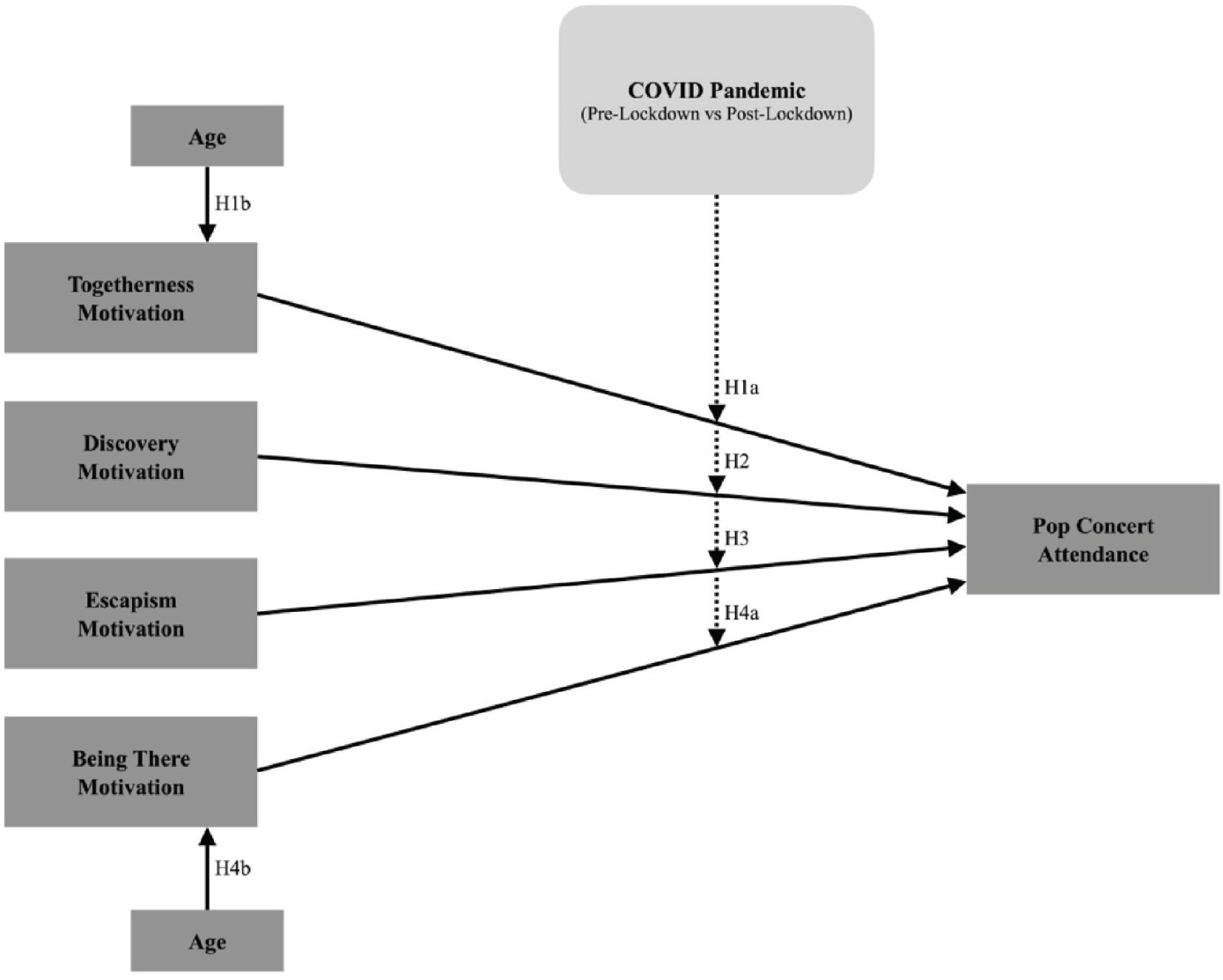
Figure 1.
Conceptual Model.
3. Methods
3.1. Research Design
In order to analyse whether motivations of concertgoers have changed due to the pandemic, the data from the study of Mulder and Hitters (2021) were made available to the current study. They applied a quantitative survey method to examine the visitor motivations of pop concert visitors in the Netherlands in the latter part of 2019, only months before the lockdown due to the pandemic was declared. The numerical values produced by a survey allow to compare differences between groups (Matthews & Ross 2010). Therefore, in order to address the differences in visitor motivations between concert visitors and the individuals visiting a concert after the lockdown, as well as differences between various age groups, the current study likewise conducted a quantitative survey method using the same scale to measure motivations of pop concert visitors after the lockdown in the Netherlands.
3.2. Operationalisation
The LMMS scale is based on the classification of existing visitor motives in the literature into four clusters: personal, artistic, social and setting and the item question design is based on the CAMS of Kulczynski et al. (2016). Both the CAMS and LMMS (Mulder & Hitters 2021: 365) reported sufficient reliability and validity measures, making the LMMS an appropriate measure for the current study. Furthermore, the study of Mulder and Hitters (2021) used a comparable sample to the current study, as both are samples of the Dutch population of pop concert visitors. The LMMS includes 23 items, clustered into six components: togetherness, discovery, escapism, being there, uniqueness and music specific characteristics. Questions were formulated on a 5-point Likert scale that asked participants to what extent they agree with the statements regarding motives for attendance. Following these items, respondents were asked if there were any other motivations for them for going to the concerts (open question). The end of the questionnaire included demographical variables regarding age, gender and level of education to be able to determine the degree of representativeness as well as to perform statistical analyses for the first and fourth hypotheses.
3.3. Data Collection
An online questionnaire hosted on the QualtricsXM software was available from 1 April 2022, until 8 May 2022, and distributed through various live music channels. The survey was distributed in the same way and through the same channels as the 2019 survey, to ensure optimal matching between the two samples (e.g. Podiuminfo newsletter, Mojo newsletter, MusicMeter forum and FestiLeaks forum). Conveniently distributing the survey through these channels was likely to reach a broad range of individuals who already have an interest in live pop music and are therefore more likely to have visited a concert in the requested period.
The data collection period followed multiple periods of lockdown and ongoing restrictions due to the coronavirus. These restrictions shut down the live performance industry and prevented live concerts, especially in ‘regular’ format, from happening for almost 2 years. The COVID-19 restrictions for concert venues were lifted at the end of February 2022 in the Netherlands, and this research has purposely been carried out to measure the effects of an ongoing absence of pop concerts on concertgoers’ motivations. The field research took place immediately after reopening of the venues, to strengthen the validity of the results. After the participants provided informed consent, respondents of the survey were explicitly asked whether they had visited a pop concert since the reopening from March 2022 onwards, to minimise practical differences between the pre- and post-lockdown concert visit. If this was not the case, respondents were not able to further fill in the questionnaire. During the data collection, we were well aware that not everyone would want to revisit places where many people congregate immediately after the reopening of the venues, either from a risk-avoidance perspective or from increased health risks of contamination. Although there were indeed signs that particularly older people would be reluctant to resume their old behaviour, this proved more applicable to museums and theatres than to pop venues (Van de Lustgraaf 2022). In general, the annual number of pop concert visitors in 2023 in the Netherlands was higher than in 2019 (VNPF 2023). Nevertheless, in our data collection we paid due attention to the distribution of respondents over all age groups.
Furthermore, the present study exclusively focuses on pop concert visitors, in contrary to the study of Mulder and Hitters (2021) that includes both pop music concerts and festivals. Because of the limited number of festivals happening in the first months after lifting the lockdown, it was deemed unlikely to obtain a sufficient sample size of festival visitors. Hence, the data of the current study were exclusively compared with the data of concert visitors from the pre-lockdown study.
3.4. Analytical Strategy
The LMMS is proved to be a valid and reliable measure of visitor motivations in the research of Mulder and Hitters (2021: 365). Also, the underlying structure of visitor motivations is already established in their research. Hence, a reliability analysis was executed on each component in order to make sure that the items within one component sufficiently correlate. After these reliability analyses, the pre-lockdown data of concertgoers’ motivations was combined with the dataset of the current study. To likewise ensure reliability standards within the combined sample, a new reliability analysis was performed on each motivational component. Independent sample t-tests and one-way ANOVAs were carried out to test the statistical significance of the results. IBM SPSS Statistics 28.0 was used for the analysis.
4. Results
4.1. Sample Description
The post-lockdown survey initiated a gross response of 597 respondents. Two of the respondents did not agree to the survey consent form and 41 participants indicated they did not visit a live concert yet after the lockdown; 25 respondents did not fill in any question, while 108 respondents did not finish the survey. This resulted in a total of 421 valid responses. The percentage of women is 58.9%, the male share is 39.7% and 1.4% identified as non-binary. Participants’ average age was 33.94 years (standard deviation [SD] = 13.60). The most named educational level was higher vocational (bachelor in applied science; 32.5%), followed by academic (bachelor/master in science or arts; 30.1%), intermediate vocational (24.5%) and primary/secondary (12.9%). Overall, the sample obtained in the post-lockdown study is similarly distributed across gender and level of education compared with the pre-lockdown study (see Table 2). For age groups, the post-lockdown study is slightly overrepresented in the 18–25 category compared with the sample of the pre-lockdown study.
Table 2.
Sociodemographic Characteristics of Participants
| Characteristic | Pre-lockdown study (n = 749) | Post-lockdown study (n = 421) | Full sample (n = 1170) | |||
|---|---|---|---|---|---|---|
| n | % | n | % | n | % | |
| Gender | ||||||
| Female | 486 | 65.1 | 244 | 58.9 | 730 | 62.9 |
| Male | 261 | 34.9 | 164 | 39.7 | 425 | 36.6 |
| Non-Binary | 0 | 0 | 6 | 1.4 | 6 | 0.5 |
| Age Groups | ||||||
| 18-25 | 204 | 27.4 | 173 | 41.3 | 377 | 32.4 |
| 26-35 | 135 | 18.1 | 77 | 18.4 | 212 | 18.2 |
| 36-49 | 204 | 27.4 | 95 | 22.7 | 299 | 25.7 |
| 50-59 | 152 | 20.4 | 58 | 13.8 | 210 | 18.0 |
| >60 | 50 | 6.7 | 16 | 3.8 | 66 | 5.7 |
| Education | ||||||
| Primary / secondary | 59 | 8.1 | 53 | 12.9 | 112 | 9.8 |
| Intermediate vocational | 210 | 29.0 | 101 | 24.5 | 311 | 27.4 |
| Higher vocational | 304 | 41.9 | 134 | 32.5 | 438 | 38.5 |
| Academic | 152 | 21.0 | 124 | 30.1 | 276 | 24.3 |
4.2. Reliability Analyses
A reliability analysis was performed on each motivational component in both the post-lockdown study and on the motivational components in the combined post- and pre-lockdown sample (see Table 3). The togetherness, discovery, escapism and being there motivational components all showed scores for internal reliability, which are considered good or acceptable (Field 2018). Nevertheless, the music-specific and uniqueness components showed lower scores for Cronbach’s alpha, as expected based on the reliability results in the study of Mulder and Hitters (2021).
Table 3.
Internal Reliability Coefficient Motivational Components
| Motivational Component | Post-lockdown Study | Combined Sample |
|---|---|---|
| α | α | |
| Togetherness | .79 | .82 |
| Discovery | .74 | .74 |
| Escapism | .76 | .77 |
| Being There | .70 | .68 |
| Uniqueness | .52 | .47 |
| Music Specific | .62 | .57 |
Yet, the aim of the present study to investigate differences in visitor motivations does not include these components, making their reliability measure less relevant to this study as it does not affect the analyses.
4.3. Hypothesis Testing
4.3.1. Comparison pre-lockdown vs post-lockdown
The independent samples t-tests indicated that post-lockdown participants score significantly higher on the togetherness, discovery and escapism motivational components than pre-lockdown participants (see Table 4). Consequently, the empirical study supports hypotheses 1a, 2 and 3. For being there, the independent samples t-test indicated that young post-lockdown participants score significantly higher than young pre-lockdown visitors (see Table 4). Hence, also hypothesis 4a is supported.
Table 4.
Independent samples t-tests for togetherness, discovery, escapism and being there
| Motivational Component | Pre-lockdown study | Post-lockdown Study | Levene’sTest (Sig.) | t | df | Sig. (2-tailed) | ||
|---|---|---|---|---|---|---|---|---|
| M | SD | M | SD | |||||
| Togetherness | 2.83 | 0.87 | 3.54 | 0.87 | .559 | -13.41 | 1168 | <.001 |
| Discovery | 2.84 | 1.03 | 3.30 | 1.02 | .230 | -7.33 | 1167 | <.001 |
| Escapism | 2.75 | 0.97 | 3.48 | 0.95 | .277 | -12.44 | 1168 | <.001 |
| Being There* | 2.94 | 0.92 | 3.30 | 0.94 | .762 | -3.76 | 375 | <.001 |
4.3.2. Togetherness and being there age comparison
Including only the respondents from the post-lockdown obtained sample, respondents between 18 and 25 years old scored the highest on the togetherness and being there motivation components (see Table 5).
Table 5.
Togetherness and Being There in post-lockdown sample according to age groups
| Age Groups: | Togetherness | Being There | ||||
|---|---|---|---|---|---|---|
| M | SD | n | M | SD | n | |
| 18-25 years | 3.80 | 0.77 | 173 | 3.30 | 0.94 | 173 |
| 26-35 years | 3.56 | 0.80 | 77 | 2.67 | 0.89 | 77 |
| 36-49 years | 3.38 | 0.89 | 95 | 2.54 | 0.84 | 95 |
| 50-59 years | 3.17 | 0.91 | 58 | 2.45 | 0.88 | 58 |
| >60 years | 2.93 | 1.00 | 16 | 2.09 | 0.94 | 16 |
For togetherness, ANOVA revealed a significant main effect for age groups (see Table 6). Consequently, we conducted a Tukey’s honest significant difference (HSD) test to assess the significance of differences between pairs of group means. This post hoc test revealed that participants aged between 18 and 25 years scored significantly higher on the togetherness motivational component than participants aged between 36 and 49 years old (Mdifference = 0.43, p < 0.001, = H1b.2), participants aged between 50 and 59 years old (Mdifference = 0.64, p < 0.001, = H1b.3) and participants aged 60 years and older (Mdifference = 0.88, p < 0.001, = H1b.4). However, participants aged between 18 and 25 years did not significantly differ on the togetherness motivational component from participants aged between 26 and 35 years (p = 0.199, ≠ H1b.1). Thus, the data in this study do not support hypothesis 1b.1, however, they do support hypotheses 1b.2, 1b.3 and 1b.4.
Table 6.
Results of the one-way analyses of variance in post lockdown sample using age groups as criterion
| Motivational Component | Sum of Squares | df | Mean Square | F | Sig. | Partial η2 |
|---|---|---|---|---|---|---|
| Togetherness | 28.80 | 4 | 7.20 | 10.38 | <.001 | .091 |
| Being There | 64.66 | 4 | 16.17 | 19.89 | <.001 | .161 |
For being there, the ANOVA revealed a significant main effect for age groups (see Table 6). Tukey HSD revealed that participants aged between 18 and 25 years scored significantly higher on the being there motivational component than participants aged between 26 and 35 years old (Mdifference = 0.62, p < 0.001, = H4b.1), participants aged between 36 and 49 years old (Mdifference = 0.76, p < 0.001, = H4b.2), participants aged between 50 and 59 years old (Mdifference = 0.85, p < 0.001, = H4b.3) and participants aged 60 years and older (Mdifference = 1.21, p < 0.001, = H4b.4). Hence, the data support hypotheses 4b.1–4b.4.
5. Discussion
Overall, the findings of the study indicate that the four motivational components togetherness, discovery, escapism and being there have all become stronger motivations immediately after the long-standing absence of live music. This shows that first of all, the pandemic and its corresponding lockdowns have affected the motivations of pop concert visitors. Second, the exact effect demonstrates that the togetherness, discovery and escapism motivations are of greater importance to all live music concert attendees after the lockdown than pre-lockdown, while the being there motivation was found to be of greater importance, in particular to young pop concert attendees, after the lockdown compared with before the pandemic.
Togetherness, which is defined by its social prominence, is significantly more important to visitors after the lockdown. This supports the idea that the lack of social contact during the pandemic period has put more importance on the collectiveness of concert attendance. As demonstrated in the study of Vandenberg et al. (2021), people missed the socialisation opportunities and collective energy that concerts provide. Hence, they were found to be more motivated to attend concerts because they can spend time, interact and collectively experience music with loved ones and other like-minded people.
Also, the discovery component was found to be a strong motivator for visiting live concerts, significantly increasing from before the COVID-19 pandemic. The curiosity of what will happen at the show, and the desire for personal enrichment and discovering new things are more important for concert attendees after the lockdown than before. A possible reason for this increase can be the rise in music streaming during the pandemic (Cabedo-Mas et al. 2021; Denk et al. 2022; Fink et al. 2021), which has led to more discovery of artists (Mortimer et al. 2012) and resulted in an increasing demand for live music due to the conjunction of streaming with its counterpart (Aly-Tovar et al. 2020; Naveed et al. 2017; Papies & van Heerde 2017). Also, despite the claim of Charron (2017) that the limitless availability of information online has made concert attendance irrelevant for discovering new music, our results demonstrate that visiting a concert for discovery purposes is still very relevant today and has even increased during the pandemic period. It suggests that visitors remain curious to discover new things in live format, which underscores the importance of live concert experiences in an increasingly digitalised world (Bennett 2015; Brown & Knox 2017; Jones 2015).
The escapism component was also of greater importance to the concert visitors post-lockdown than pre-lockdown. This suggests that the ability for escaping everyday life is more important as a motivator of attending a concert after multiple lockdowns than it was before. The most likely explanation is the increased boredom and stress levels that individuals experienced during the pandemic (Boylan et al. 2021; Liu et al. 2021). Others have found increased escapism behaviour during the pandemic, mainly limited to indoor leisure (Fernandes et al. 2020; Wulf et al. 2021). This effect is now also indicated for the live sector.
Moreover, it was hypothesised that for young concert visitors, the being there motivational component would have increased after multiple lockdowns due to its connection with identity formation which is of significant importance to young adults (Iwasaki et al. 2018; Layland et al. 2018). Our research indeed supports the idea that youngsters’ concert attendance is motivated more strongly by hero worship and status considerations. This could arguably be explained by the limited opportunity to explore and define one’s identity through live music for a prolonged period of time. It could also be the result of an increasing desire for the emotional experiences of being in the proximity of an artist (Radbourne et al. 2014).
In response to the call of Kulczynski et al. (2016) for more research into the influence of demographic variables on concertgoers’ motivations, this study found significant effects, not dissimilar to other studies into live music motivations (Kruger & Saayman 2015; Pilcher & Eade 2016; Uysal et al. 1993). Age was found to have a significant effect on the togetherness and being there motivations. For togetherness, people aged between 18 and 25 years old scored significantly higher than people aged 36 years and older after the lockdown. This shows that in line with earlier research, the crucial importance of social contact during adolescence, which was indicated to be missed during the pandemic lockdowns (Panchal et al. 2021), has resulted in a relative importance of togetherness for young adults compared with visitors aged 36 years and older. This suggests that the idea of finally being able to interact again with others, spend time with beloved ones, to feel part of a group of like-minded people and again receiving that sense of belonging that was missed (Tomova et al. 2021), is an even stronger motivator to visit concerts for youths, despite its overall increase for pop concert visitors.
For being there, respondents aged between 18 and 25 years old scored significantly higher than all other age groups, meaning that being there motivations are more important to young adults in visiting pop concerts after the pandemic than older generations. The status-related items of this component are closely related to identity formation, which is critical to adolescents (Shaw et al. 1995). Besides, this component also includes items related to hero worship, such as being in the proximity of the artists and finding the artists physically attractive, which help to establish, express and validate fan identity (Bennett 2015). This result indicates that the opportunity to enhance one’s status, receive social recognition and express one’s (fan) identity through concert attendance is more important to young adults than to older generations, corresponding to the critical importance of identity formation for youths.
The empirical results reported in this study should be considered in the light of some limitations. First, the age group between 18 and 25 years old is slightly overrepresented in the post-lockdown sample compared with the pre-lockdown sample. There was likely some level of selection bias in the sample as younger people have likely been more eager to visit live concerts shortly after the lockdown, while older people were still more cautious about visiting cultural activities since the virus was still circulating. Second, in general the post-lockdown sample could be affected by the bias that people with a more risk-avoiding character would wait longer to return to concert venues, which could have an effect on the results. However, during the period of our empirical research, there were signs that particularly older people were underrepresented in the venues in the months after reopening. Because the survey controlled for a representative age distribution, we minimised the risk of this bias. Altogether, given the aims of this study, in our research design we preferred to measure immediately after reopening instead of waiting for several months or longer. Third, the LMMS that was used for this study needs to be cautiously used. Although it did not affect the present work, the internal consistency scores of the uniqueness and music-specific components are, arguably, just on or above the threshold (Taber 2018). This indicates that the LMMS may need to be critically revised and adapted in further research. Finally, whether the actual differences found in motivations between the pre-lockdown sample and post-lockdown sample is caused by the pandemic cannot be stated with full certainty. Other changes during this 2-year time period between both studies or other differences between the samples may have caused motivational differences. Nevertheless, the pandemic was a constant factor which affected all individuals’ lives, and numerous respondents addressed this as a motivator in the open question of our survey.