
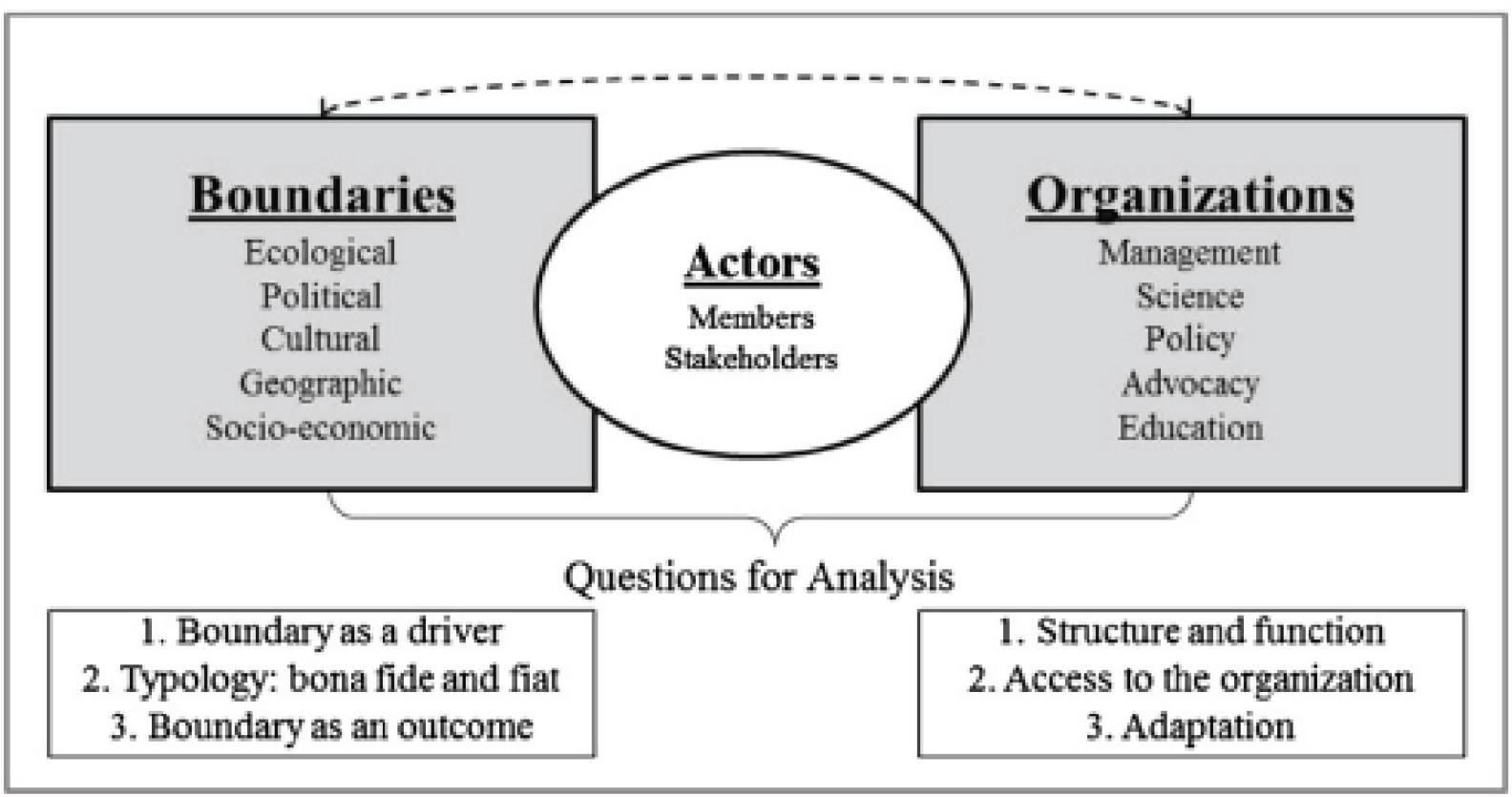
Figure 1:
Framework for Conducting Transboundary Organisational Analyses.
Source: Steinlieb et al., 2013, p. 122.
Table 1:
List of Study Participants
| Code | Category | Role | Gender | Length of Interview |
|---|---|---|---|---|
| C1 | IFS Consortium | Financial Services Ireland Apprenticeship Lead | Female | 66.19 |
| C2 | IFS Consortium | NCI Apprenticeship Lead | Male | 98.28 |
| P1 | National Policy Stakeholder | Executive Director Solas | Female | 56.45 |
| C3 | IFS Consortium | Financial Services Ireland Director | Male | 61.63 |
| C4 | IFS Consortium | Global Head of Talent IFS Participating Employer | Female | 50.44 |
| P2 | National Policy Stakeholder | Education Policy Director Employer Body and Apprenticeship Council Member | Male | 88.48 |
| P3 | National Policy Stakeholder | Regional Skills Manager and Apprenticeship Council Member | Female | 71.05 |
| C5 | IFS Consortium | NCI Vice President | Male | 62.30 |
| P4 | National Policy Stakeholder | Dept. of Education & Skills, Apprenticeship Lead and Apprenticeship Council Member | Male | 66.26 |
| P5 | National Policy Stakeholder | Higher Education Authority, Apprenticeship Lead and Apprenticeship Council Member | Female | 72.14 |
| P6 | National Policy Stakeholder | Chair of Apprenticeship Council | Male | 56.36 |
| P7 | National Policy Stakeholder | Quality Qualifications Ireland, Apprenticeship Lead and Apprenticeship Council Member | Male | 69.57 |
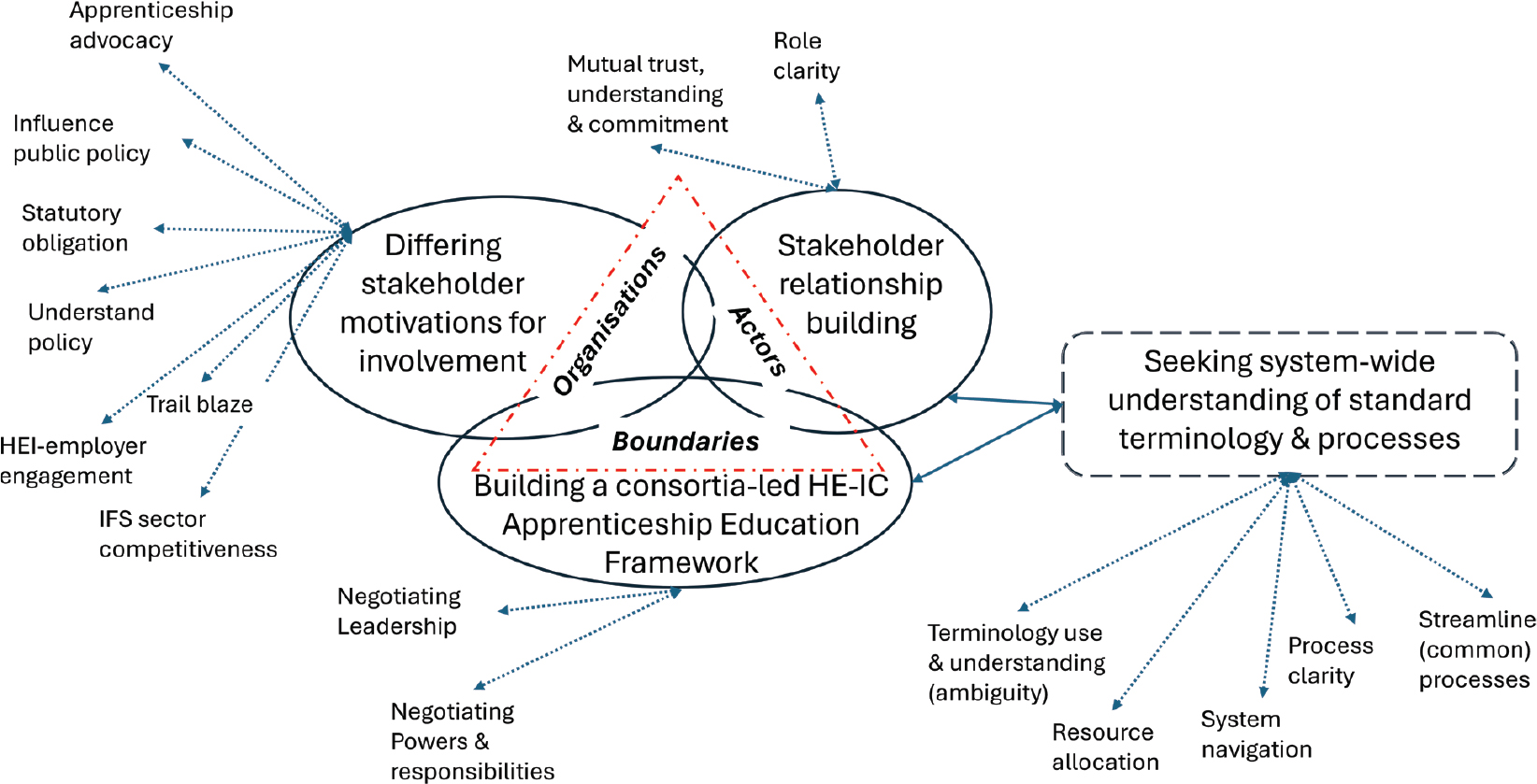
Figure 2:
Thematic Map.
Table 2:
Summary of Findings
| Themes | Sub themes | Findings from Participants | Documentary Review |
|---|---|---|---|
| Theme 1: Differing Stakeholder Motivations for Involvement | Consortium as trailblazer | The consortium approach was a disruptor in several ways as it was a requirement of funding that it had to be industry led. This was a significant move away from the structures supporting ‘traditional’ apprenticeships, for whom Solas is the co-ordinating body. Participants believe the benefits of the new apprenticeships and processes needed to be promoted across that eco-system to garner a holistic system-wide level of support. | When the study commenced in 2016, there was very little documentation about the leadership and formation of apprenticeship consortia. Subsequent participant-led process revealed new documents that had not been published at the time of the design and development of the IFS apprenticeships programme (cf. D13, D14, D15). |
| To meet statutory obligations | Statutory obligations are a clear motivation for key stakeholders (e.g. HEI, Industry). | Apprenticeship is in the Industrial Training Act 1967 (D1) and is referred to in cf. D3, D4, D7, D9, D11. | |
| To meet employer engagement goals (HEI funding model enticement) | The funding model is encouraging HEIs to get closer to industry, with many funding initiatives requiring evidence of close collaboration with industry. However, in the IFS sector, where many employers are US-parented multi-national corporations, employer engagement in large numbers remains a challenge. | Department of Education & Skills and the Department of Enterprise Business & Innovation promote engagement between HEIs and industry, with several streams of funding promoting such collaboration. Specific published strategies for the IFS sector support these policies in practice (cf. D8, D22). | |
| To match Financial Services Ireland and IFS ambition and to contribute to IFS sector competitiveness | The overriding motivator for the involvement of FSI as the representative body for the financial services sector is to contribute to the sector’s competitiveness. This finding is inconsistent with FSI’ ability to attract participating employers. The IFS sector has a culture of graduate recruitment and not apprenticeship, as observed by several participants. Only small pockets of IFS employers are engaging with apprenticeship and the majority of those are engaging in a relatively small way. There appears to be a disconnect between the employer body and the sector’s employers in seeing the value of apprenticeship as a solution to talent development & skills shortages. | The ‘Strategy for the Development of Ireland’s International Financial Services sector to 2025’ (D22) has specific action points on the IFS apprenticeships that link directly to participants’ points about apprenticeship aiding the competitiveness of the sector. It sets out a vision for talent in the sector that has apprenticeship at its core (D22); however, there is little guidance on how to instil a culture of apprenticeship in stakeholder organisations. | |
| To understand the new policy | Understanding the policy surrounding the new apprenticeship model emerged as being an important factor. | As the new’ apprenticeship model emerged from various stakeholders’ engagement with the planning process in Ireland, it became a key element in several policy documents, from the Department of Education & Skills (cf. D4, D5, D6, D7, D8, D10, D12, D13, D14, D17, D18, D19, D20). It is also evident in sectoral strategy documents and specific to this study, the IFS sector strategy documents (D8, D22). | |
| To influence Public Policy | The importance of FSI’ voice within the apprenticeship ecosystem is apparent due to the crucial differentiating point of apprenticeships being employer led. The need for FSI to act on behalf of their members is balanced with a need to also influence public policy. | See: ‘Ibec Submission to Consultation on Government Review of Apprenticeships’ (D3) ‘IFS2020: A Strategy for Ireland’s International Financial Services sector 2015-2020’ (D8) and the suite of consortium specific documents (D9). | |
| Theme 2: Stakeholder Relationship Building | Defining HEI and industry roles | The expanded role of the HEIs in the wider apprenticeship system was of concern to several participants due to there being varying levels of clarity around the HEI role. For example, there is a perception that the HEI is taking the lead in some consortia, when it should be led by the industry partner. | The HEI and Industry roles are not elaborated on in the documentation. Clarification would aid consortia operation. |
| Building mutual understanding, trust and commitment | The relationship between the HEI and FSI is viewed by both parties as strong and robust, focused on building a common vision. Not all apprenticeship HEI-IC are viewed as positive. Participants discussed a lack of understanding of each other’s drivers, commitments, pressures and timelines as potential barriers to creating the necessary levels of trust between parties. Factors underpinning this discord include, for example, mismanagement of expectations, misalignment of objectives and misunderstanding of each other’s roles and responsibilities. | Relationship management is not mentioned in the documentation. | |
| Theme 3: Building a consortium-led HE-IC apprenticeship education framework | Leadership | Strong belief that the consortium should be employer-led. | |
| Powers and Responsibilities | The consortium has decision-making powers in relation to many aspects of the IFS Apprenticeship: setting salary and benefits; designing recruitment and selection processes; designing and delivering programme content; recruiting employers; and monitoring performance of apprentices and mentors. Required negotiation around duties assigned to AOs, such as approval of employers, that could be carried out by the consortium under the guidance of Solas. | Guideline documents have been developed by the Apprenticeship Council and Solas since the IFS Apprenticeships began, which provide more clarity on the powers of the Consortium and the stakeholders, based partly on initial feedback from stakeholders in 2016 (D13, D14, D15). | |
| Theme 4: Seeking system-wide understanding of standard terminology & processes | Use and understanding of apprenticeship terminology (ambiguity issues) | There is varied use and understanding of apprenticeship terminology. Some disagreed with its use, while others appreciated the history of the term and the protections afforded by the legislation. Varying levels of understanding of key terms were of concern to all participants. Participants believe a system wide understanding of apprenticeship terminology is needed to enhance understanding. | The term ‘Apprenticeship’ was traced from its origins in the 1967 Industrial Training Act up to the definition provided by the Action Plan to Expand Apprenticeship and Traineeship in Ireland 2016-2020. Evidence that the education policy stakeholders and the education provider are more aligned in a common understanding the terms ‘apprenticeship’ and ‘work-based learning’, than the industry and representative bodies. |
| Clarity around overall process | Several of the consortium felt that lack of clarity and understanding challenged the overall process. There are several processes that were established because of the 1967 legislation, which applied to existing apprenticeships. These also extend to the new apprenticeships. Collective view is that the overall process should be more responsive and dynamic to fulfil ecosystem needs and requirements. | Apprenticeship Review (2013) established new apprenticeships under the 1967 legislation rather than wait for a considerable period for new legislation to be drafted, passed and enacted. There are acknowledged limitations and some of the gaps in the process and supports, which had not been provided in the initial documentation, have now been at least partially fulfilled by documents published since 2017 (cf. D13, D14, D15). | |
| Navigation of Systems | Participants believe the system lacks cohesion, which employers found hard to navigate. The criticisms were on two levels: a need to streamline processes within the system, and the overall education system. All participants were in favour of streamlining the overall apprenticeship process to remove barriers to HE-IC. | Documentation developed when planning the apprenticeships (D1-14) may need to be streamlined based on practical experience. | |
| Streamlining (common) processes | Consistent view that there needs to be a common process. There was also a strong sense that the current processes could be streamlined further. The consensus is that the steps in some of the processes need to be removed to make it leaner. There is an acknowledged difference of pace between how HEIs and industry operate and in most cases for very valid reasons. | Documentation developed when planning the apprenticeships (D1-14) may need to be streamlined based on practical experience. The perceived lack of common process aligns with the current global and national debate about the need for integration of the further and higher education systems and intent to move away from a binary system to a more seamless single tertiary education framework (cf. D17, D18, D19). | |
| Need for resources | Time, cost and availability of human resources are acknowledged challenges facing HEI and industry collaboration partners. Financial support, or lack thereof, was considered important by several participants. These views of consortium participants reinforce the perceived commitment of resources required by both the HEI and the employer to achieve Apprenticeship success. |
1 Code: FSI: Financial Services Ireland, employer representative body; HEI: Higher Education Institute; D: Document, Appendix 2.
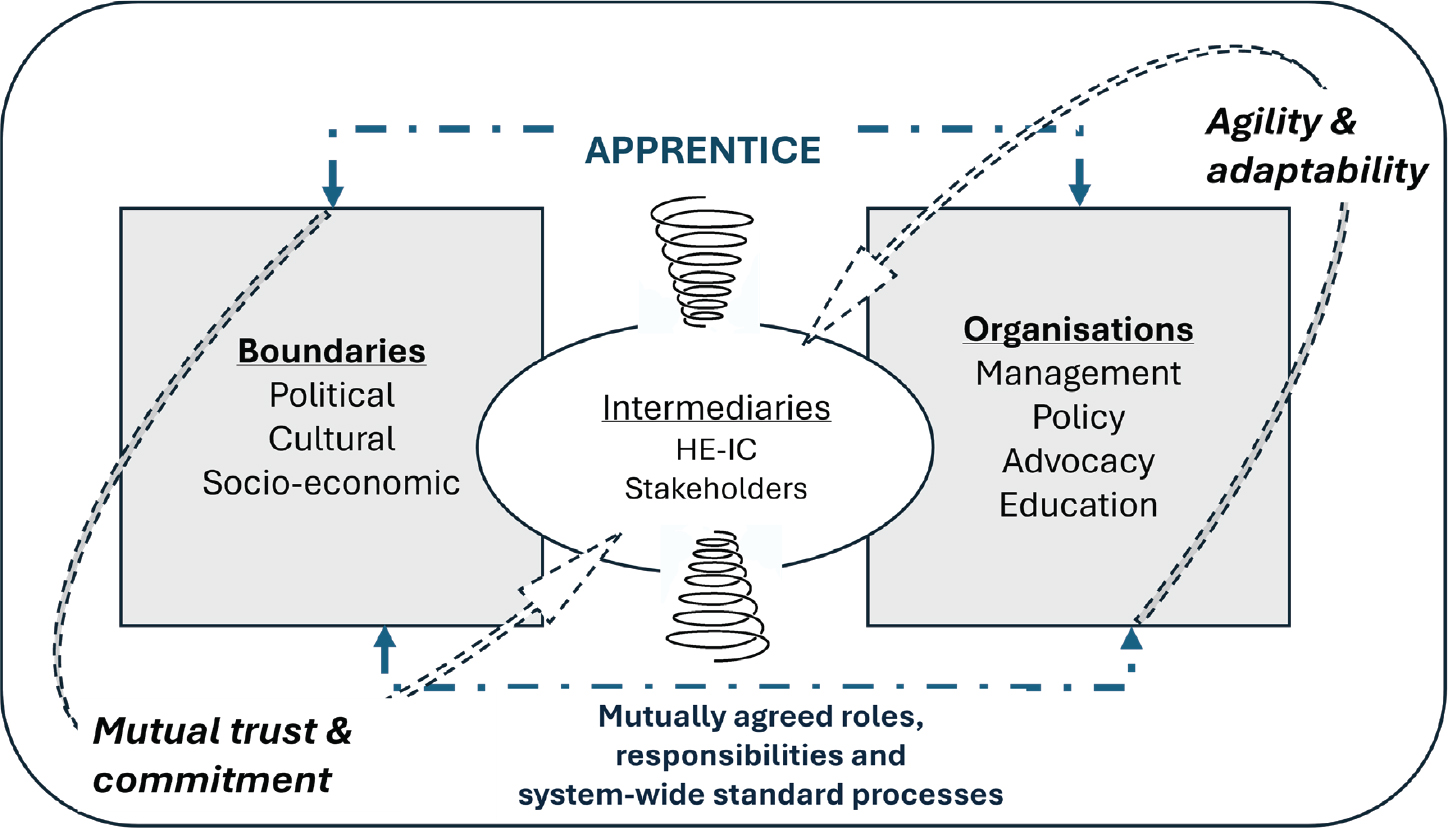
Figure 3:
Consortium-led IFS Apprenticeship Education Framework.
Adapted from: Steinlieb et al., 2013.
| No. | Reference | Original Purpose | Intended Audience | Related Themes |
|---|---|---|---|---|
| D1 | Industrial Training Act 1967, Government Publications, Ireland | To make better provision for industrial and commercial training and to establish an overseeing structure and to define its powers and duties. | Education Providers, Employers, Apprentices, Apprenticeship Stakeholders | Ambiguity about the use of apprenticeship terminology; importance of the apprenticeship stakeholder relationships; policy context & processes. |
| D2 | Department of Education & Skills, 2011. National Strategy for Higher Education to 2030 | To present a vision of an Irish higher education sector that can successfully meet the many social, economic and cultural challenges that face us over the coming decades, and meet its key roles of teaching and learning, research, scholarship, and engagement with wider society. | Higher Education Providers, Employers, | Differing stakeholder motivations for involvement; policy context & processes. |
| D3 | Ibec 2013. Submission to Consultation on Government Review of Apprenticeships | To represent the views of Ibec business sector members about the government review of apprenticeships | Apprenticeship Council members, Department of Education & Skills, Department of Enterprise Business & Innovation, Ibec sector bodies. | Ambiguity about the use of apprenticeship terminology; differing stakeholder motivations for involvement; policy context & processes; barriers and challenges to HEI and industry collaboration. |
| D4 | Department of Education & Skills, 2013. Apprenticeship Review-Background Issues Paper, Government of Ireland, Dublin. | To determine whether the current model of apprenticeship should be retained, adapted or replaced by an alternative model of vocational education and training for apprentices - taking into account the needs of learners, the needs of employers, the needs of the economy and the need for cost effectiveness into the future. | Department of Education & Skills, Department of Enterprise Business & Innovation, Solas, Higher Education Authority, Quality Qualifications Ireland, Education Providers in Further and Higher Education. | Ambiguity about the use of apprenticeship terminology; differing stakeholder motivations for involvement; policy context & processes; barriers and challenges to HEI and industry collaboration. |
| D5 | Solas, 2013. International Financial Services Occupational Profiles, Dublin. | To underpin each apprenticeship and to determine whether an Industrial Training Order is required to designate a new industrial activity or whether an existing Order is sufficient to cover that activity. | IFS Apprenticeship Consortium, IFS Employers, National College of Ireland, Financial Services Ireland, Apprentices, Workplace Mentors, Authorised Officers | Importance of the apprenticeship stakeholder relationships |
| D6 | Department of Business Enterprise & Innovation, 2013. Action Plan for Jobs, Government of Ireland, Dublin. | To provide the next step in the Government’s plan to rebuild the economy and support the transition to a sustainable, jobs rich economy based on enterprise, innovation and exports. | Employers, Education Providers, | Differing stakeholder motivations for involvement; policy context & processes; barriers and challenges to HEI and industry collaboration. |
| D7 | Department of Education & Skills, 2013. Review of Apprenticeship Training in Ireland. | To determine whether the apprenticeship model should be “retained, adapted or replaced by an alternative model of vocational education and training” | Employers, Education Providers, Solas, HEA, QQI, Ibec, Financial Services Ireland | Ambiguity about the use of apprenticeship terminology; differing stakeholder motivations for involvement; policy context & processes; barriers and challenges to HEI and industry collaboration. |
| D8 | Department of Business Enterprise & Innovation, 2015 & 2018. IFS2020: A Strategy for Ireland’s International Financial Services sector 2015-2020. | To set out a new vision and strategy for Ireland’s International Financial Services sector | IFS Employers, Financial Services Ireland, Education Providers | Differing stakeholder motivations for involvement; policy context & processes; barriers and challenges to HEI and industry collaboration. |
| D9 | IFS Apprenticeship Consortium. 2015. | For governance and guidance purposes, Consortium Terms of Reference; Consortium Contract with NCI; Consortium Contract with Apprenticeship Council; Consortium Contracts with IFS Apprenticeship Employers; NCI IFS Apprenticeship Contract with the HEA. | IFS Consortium, Financial Services Ireland, Ibec, National College of Ireland, IFS Employers, Solas, HEA, QQI, Apprenticeship Council, | Importance of the apprenticeship stakeholder relationships; policy context & processes; barriers and challenges to HEI and industry collaboration. |
| D10 | Department of Education & Skills, 2016. Action Plan for Education 2016-2019 | To set out the central vision and Statement of Strategy of the Department of Education & Skills and Action Plan for the Irish Education and Training System to become best in Europe over the next decade. | Education Providers, Employers | Ambiguity about the use of apprenticeship terminology; differing stakeholder motivations for involvement; policy context & processes; barriers and challenges to HEI and industry collaboration. |
| D11 | Quality Qualifications Ireland (QQI). 2016. Statutory Quality Assurance Guidelines developed by QQI for Providers of Statutory Apprenticeship Programmes. | To provide substantial and tailored guidance for the development, delivery and evaluation of apprenticeship programmes by the relevant parties with quality assurance accountability to QQI | Education Providers, Employers, Apprenticeship Consortia, Apprenticeship Council, Solas, HEA, QQI Panel Members | Ambiguity about the use of apprenticeship terminology; differing stakeholder motivations for involvement; policy context & processes; barriers and challenges to HEI and industry collaboration. |
| D12 | Department of Education & Skills, 2016. National Skills Strategy 2025. | To ensure a more dynamic, responsive and high-quality education and training system that provides all learners with the knowledge and skills they need to participate fully in society and the economy. | Employers, Education Providers, Ibec, | Differing stakeholder motivations for involvement; policy context & processes; barriers and challenges to HEI and industry collaboration. |
| D13 | Department of Education & Skills, 2017. Action Plan to Expand Apprenticeship and Traineeship in Ireland 2016-2020. | To set out an action plan to significantly grow work-based learning over the coming five years using the apprenticeship and traineeship modes of learning and skills development. | Apprenticeship Council, Solas, HEA, QQI, Education Providers, Employers, Ibec sectoral bodies | Ambiguity about the use of apprenticeship terminology; differing stakeholder motivations for involvement; policy context & processes; barriers and challenges to HEI and industry collaboration. |
| D14 | Apprenticeship Council, 2017. Developing a National Apprenticeship Handbook. Government of Ireland, Dublin. | To explain the steps involved in developing a national apprenticeship, with links to supplementary information and resources with the primary intention of assisting consortia involved in developing apprenticeships, as well as anyone interested in the apprenticeship development process. | Apprenticeship Consortia, Employers, Education Providers | Ambiguity about the use of apprenticeship terminology; differing stakeholder motivations for involvement; policy context & processes; barriers and challenges to HEI and industry collaboration. |
| D15 | Apprenticeship Council, 2017. Apprenticeship Code of Practice for Employers and Apprentices. | To assist employers and apprentices to understand their duties and responsibilities relating to the Apprenticeship Programme. | Employers, Apprentices, Education Providers | Ambiguity about the use of apprenticeship terminology; differing stakeholder motivations for involvement; policy context & processes. |
| D16 | Dublin Regional Skills Forum, 2018-2019. Dublin Regional Skills Strategy, Dublin. | To provide an opportunity for employers and the education and training system in the Dublin Region to work together to meet the emerging skills needs of their regions. | Dublin based Employers, Higher & Further Education Providers, Dublin Chamber, IDA, Enterprise Ireland, Ibec, SFA, Department of Employment and Social Protection. | Differing stakeholder motivations for involvement; policy context & processes; barriers and challenges to HEI and industry collaboration. |
| D17 | Department of Education & Skills, 2019. Action Plan for Education 2019. | To set out the priorities for the Department of Education and Skills and its agencies and aegis bodies for the year | Education Providers, Employers, | Policy context & processes; barriers and challenges to HEI and industry collaboration. |
| D18 | Department of Education & Skills, 2019. Statement of Strategy 2019-2021, Government of Ireland, Dublin. | To set out the strategic actions to be achieved in response to the needs of learners, employers and society, at every level in the education and training system, in the context of significant national and international change, evolving skill demands and changing demographics | Education Providers, Employers | Policy context & processes; barriers and challenges to HEI and industry collaboration. |
| D19 | Government of Ireland, 2019. Future Jobs Ireland, Government of Ireland, Dublin. | To set out an agenda to respond to future risks and to ensure that Ireland seeks to ensure Ireland benefits from the changes that are already happening in the world of technology, artificial intelligence and robotics, and the move to a low-carbon economy. | Differing stakeholder motivations for involvement; policy context & processes | |
| D20 | Department of Public Expenditure & Reform, 2019. National Development Project Ireland 2040. | To build the Ireland of tomorrow and prepare for a future society which will have an extra one million people, and 660,000 more people at work. | Differing stakeholder motivations for involvement; policy context & processes | |
| D21 | Department of Education & Skills, 2022. Technology Skills 2022. | To set out a plan to provide appropriate education and training pathways for people to train, learn and upskill in a variety of high-level ICT skills which are sought after by a diverse range of industries. | Differing stakeholder motivations for involvement; policy context & processes | |
| D22 | Government Publications, 2019. Ireland for finance: The strategy for the development of Ireland’s international financial services sector to 2025. | To set out a whole-of-Government strategy for the further development of the international financial services sector in Ireland to 2025 including the employment target for the Strategy is to reach 50,000 people in direct employment in the sector by 2025. | Differing stakeholder motivations for involvement; policy context & processes; barriers and challenges to HEI and industry collaboration. |