
INTRODUCTION
This paper explores the principles applicable to consortium-led financial services apprenticeship programme design, development, accreditation and delivery (Barbolla & Corredera, 2009; Gulbrandsen et al., 2011; Perkmann et al., 2011). Leveraging the experience and knowledge of national policy stakeholders and consortium members of an International Financial Services (IFS) Apprenticeship programme in Ireland, this study informs the higher education industry collaboration (HE-IC) process in a way that will enhance HE-IC apprenticeship frameworks in the financial services sector. The aim of this research is to create a process for enacting a consortium-led financial services apprenticeship education framework. The research questions ask: what is the process for developing, implementing and enacting a higher education financial services apprenticeship education framework? and, how can this framework serve as a mechanism for higher education institute and industry collaboration? Insights from apprenticeship education, HE, and industry collaboration literature informs the empirical research. Findings from this interpretive case study suggest that HE-IC is key to achieving employer-led apprenticeship education programme success. This study offers a valuable contribution to the limited research in this domain (Giblin, 2020; McNally, 2025; Sheerin & Brittain, 2024). It addresses the dearth of studies relating to apprenticeship within the business and management education sphere (Daly, 2017; Martin et al., 2024), and answers calls for research focused on HE apprenticeship programmes (Kundu et al., 2024). A research-informed framework provides greater insight into creating a process for enacting an apprenticeship education framework as a mechanism for facilitating broader HE-IC, thereby extending boundary organisation theory.
The remainder of this paper is structured as follows. The literature review explores education-focused HE-IC and consortia insights alongside HE apprenticeship framework research to help establish the criteria relevant to the design and development of a consortia-led financial services apprenticeship education framework. A single longitudinal interpretive case study explores the evolution of a consortium-led IFS suite of apprenticeship education programmes in Ireland from 2016 to 2020 and captures subjective and contextual experience of apprenticeship consortium members and policy stakeholders. Findings suggest that successful HE-IC within the consortium is core to the achievement of successful apprenticeship education programme outcomes. The proposed consortium-led financial services apprenticeship education framework precedes contributions to theory, recommendations for practice, research limitations and future research avenues.
LITERATURE REVIEW
HE-IC research has historically been focused on research collaborations (Thune, 2011; Bertoletti & Johnes, 2021; Sjöö & Hellström, 2019). This is partly explained by tradition, as the majority of apprenticeship education provision has traditionally been provided by the further education sector (Anderson et al., 2012; King et al., 2016). More recent studies highlight the value of HE-IC education programmes (Crawford-Lee, 2024; Lillis & Bravenboer, 2020), and address contemporary HE-IC education opportunities including, collaborative learning (Laitinen-Väänänen et al., 2024), project-based learning (Naseer et al., 2025), the impact of apprenticeship on the learning process (Hahn, 2012), and the need for direct industry input into HE programmes (Hahn & Gangeness, 2019; Kadhila et al., 2024). Education-focused HE-IC has emerged as a focal point in the contemporary global HE landscapes (Zhuang et al., 2025). Regional studies include Europe (Hahn, 2012), Asia (Zhuang et al., 2025), North America (Hahn & Gangeness, 2019), the Middle East (Al Harrasi & Al Subhi, 2024) and Africa (Kadhila et al., 2024). These studies acknowledge the growing significance of apprenticeship in HE (Crawford-Lee, 2024; Hahn, 2012; Lillis & Bravenboer, 2020). They explore the multi-dimensional nature of HE-IC (cf. Al Harrasi & Al Subhi, 2024), the need for strategic alignment and industry expertise integration (Hahn & Gangeness, 2019; Kadhila et al., 2024), the necessity for informed adequate resource allocation (Al Harrasi & Al Subhi, 2024) to help fulfil strategic HE-IC education goals, barriers to collaboration (Kadhila et al., 2024), and the need for education-focused HE-IC (Zhuang et al., 2025). All are consistent in their calls for greater interaction between higher education and industry, and for more focused research on education collaboration programmes.
Under this mantel, the co-design of apprenticeship HE frameworks offer insight into multi-stakeholder collaboration to produce apprenticeship education models that fulfil all stakeholder needs (Bravenboer, 2016; Charlton & Power-Mason, 2025; Rowe et al., 2016). This approach seeks to more deeply engage the employer in the programme design process (Hahn & Gangeness, 2019; Kadhila et al., 2024), which challenges the historically preserved role of higher education institutes (HEIs) as primary masters of programme design. Evidence from the literature suggests that HEIs are grappling with how these HE-IC apprenticeship frameworks can be developed, implemented and enacted in practice (Crawford-Lee, 2024; Kadhila et al., 2024; McNally, 2025), reinforcing the value of this paper. Criteria for consideration include internal structural characteristics, the existence of institutional support mechanisms, the existence of governance mechanisms for collaboration processes, and the management and motivation of human talent and collaboration teams (Pertuz et al., 2021, p. 288).
Before contemplating the HE-IC process, it is important to consider the definition of apprenticeship within the research context (Republic of Ireland). The definition utilised by the Department of Education and Skills (2013. p7) is:
A programme of structured education and training which formally combines and alternates learning in the workplace with learning in an education or training centre. It is a dual system, a blended combination of on-the-job employer-based training and off-the-job training.
It is acknowledged that apprenticeship education should facilitate skills and knowledge development that benefits all stakeholders: apprentice, industry and the wider socio-economy (OECD, 2025). Research consistently presents a need for HE to establish mutually beneficial partnerships with industry (Baleeiro Passos et al., 2023; Bertoletti & Johnes, 2021; Karlsdottir et al., 2023; Pertuz et al., 2021), a strong advocate and working group are necessary for a successful HE-IC outcome (Liew et al., 2012). As articulate by Pertuz et al. (2021, p. 288), HE-IC relationships should generate “trust among the members of the collaboration, effective communication between the members of the collaboration, shared objectives and mutual understanding of the needs and relevant aspects of the collaboration process, the ability to share resources and costs in the cooperation process”. Notably, successful collaboration relies on ‘goal setting, continuous dialogue, reflective assessment, commitment, and trust as key elements’ (Laitinen-Väänänen et al., 2024, p.0). When successful, these collaborative relationships have been found to positively impact management and organisation of both parties, contributing mutual economic, institutional and social gains (Ankrah & Omar, 2015; Laitinen-Väänänen et al., 2024). However, these benefits can only be gleaned when both parties negotiate a balanced socio-economic approach to collaboration, where the apprentice remains at the heart of the collaborative activity. While the value of the apprenticeship model is evident, literature points to a need for a clearer process for developing, implementing and enacting HE-IC apprenticeship education models in the business and management domain (Daly, 2017; Martin et al., 2024), to enable HE-IC partners to collaborate more effectively. These insights lead to institutional boundary theory as a means of exploring consortium-led HE-IC apprenticeship models in greater depth.
THEORETICAL UNDERPINNING – INSTITUTIONAL BOUNDARY THEORY
To understand the changing institutional boundaries of academia and industry within consortium-led apprenticeship ambitions and to help mitigate the ‘blurring’ of these boundaries (Cohen, 2021; Reale & Primeri, 2015), boundary organisation theory guides this study. Under these auspices, being a boundary organisation means managing social tensions, requiring “ongoing, adaptive processes of navigating these dynamic tensions over time” (Parker & Crona, 2012, p. 273). In its performance, a boundary organisation needs to be “adaptive and able to create changes in organisational structures and activities; it must also negotiate boundary objects” (Gustafsson & Lidskog, 2018, p.5). Drawing on boundary organisation theory within a HE context, Emad & Roth (2008, p.3) discuss the “conflicts and contradictions between policy-maker objectives and end-user implementation”. Changes affecting HEIs impact on the boundaries between them and other entities; thus, stability can only be achieved temporarily and in relation to differing specific variables (Reale & Primeri, 2015), requiring a willingness to trust consortia partners when destabilising individual organisation systems (Schilke & Cook, 2013).
Prysor & Henley (2017, p.2210) eloquently describe this environment as a “perfect storm”, when considering the external challenges faced by HEIs and say that this has resulted in “increased relevance of the traditional understanding of the defining boundaries of a university”. Cohen (2021), Parker & Crona (2012), and Rajalo & Vadi (2017) reinforce this view in the HE context, finding that boundary management should be seen as an ongoing dynamic process to reconcile the multiple tensions of the stakeholders, lending itself to the consortium-led proposal within this paper. Prysor & Henley (2017) go on to discuss the importance of psychological and emotional boundaries as well as horizontal, vertical, cultural, and geographical boundaries when engaging with the challenges and opportunities affiliate to this HE-IC. In summary, today’s HEIs interact at their boundaries with many different organisations, leading to new collaboration opportunities, such as the HE-IC apprenticeship opportunity at the heart of this study. Considering the HE-IC context, Sternlieb et al. (2013, p. 117) offer useful insight in their description of transboundary organisations, described as “an umbrella term to group the literature on boundary organizations, intermediaries and bridging organizations”. The transboundary organisation helps explain the dynamics that might exist in HE-IC, where each involved organisation’s intermediaries help navigate boundaries and organisations in pursuit of an IFS apprenticeship education framework.
This study seeks to explore the HE-IC activity within a newly formed apprenticeship education consortium, to help identify the principles applicable to HE-IC apprenticeship education design, development, accreditation and delivery (Barbolla & Corredera, 2009; Felce, 2019; Quew-Jones, 2023). We1 are guided by Sternlieb et al.’s (2013) conceptual framework, to help identify HE-IC transboundary organisation dynamics (Fig. 1).
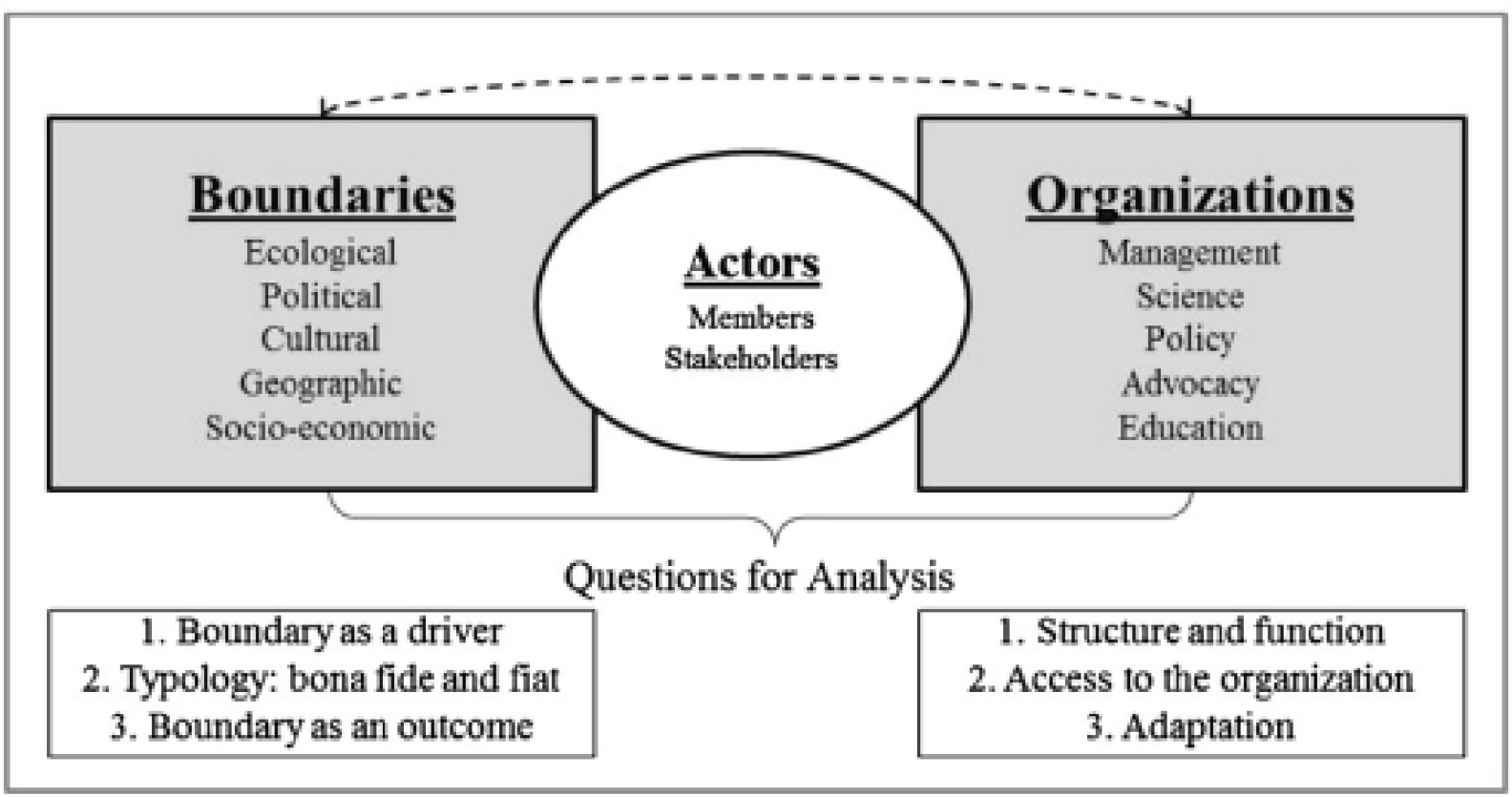
Figure 1:
Framework for Conducting Transboundary Organisational Analyses.
Source: Steinlieb et al., 2013, p. 122.
Figure 1 draws on the proposition that the activity at the boundary between two activity systems is a collaborative learning opportunity (Engestom, 1987). Actors, who in this study include HE, industry, policy and public sector stakeholders, act as intermediaries between boundaries and organisations. Informed by boundary organisational theory, each activity system has its own tensions and contradictions, both within and between the interacting systems. The two activity systems negotiate to form new meanings that extend beyond the boundaries of both, and they generate a shared object of activity, which in this study is the pursuit of a consortium-led HE-IC financial services apprenticeship education framework.
When contemplating HE-IC apprenticeship models, Quew-Jones (2023) concludes that while employers appreciate being involved in the design of these apprenticeship education programmes, they are concerned about the administrative responsibility to maintain regular contact with the multitude of stakeholders. A critical success factor is that HEI’s infrastructures are agile, flexible and responsive regarding the design, delivery and assessment (Rowe et al., 2016), reinforcing the need for trust to be built between consortia partners if destabilising individual organisation systems (Laitinen-Väänänen et al., 2024; Pertuz et al., 2021; Reale & Primeri, 2015 Schilke & Cook, 2013). Transferable concepts within HE-IC research collaboration literature also point to necessity, reciprocity, efficiency, stability, legitimacy and asymmetry as central to success in HE-IC contexts (Ankrah & Al-Tabaa, 2015). The building of mutual trust and commitment, based on repeated patterns of reciprocal behaviours and interactions over time, should lead to an enhanced mutual understanding by all partners (Plewa et al., 2015; Stańczyk et al., 2022). These criteria should help guide the research design in the current case context, Ireland.
RESEARCH CONTEXT
Ireland’s apprenticeship system is a statutory, regulated part of the formal tertiary education system. The introduction of the Apprenticeship Action Plan (Department of Education and Skills, 2016) and the subsequent Action Plan for Apprenticeship (Department of Further and Higher Education, Research, Innovation and Science, 2022) sought to modernise Ireland’s apprenticeship system, targeting 10,000 new apprentice registrations by 2025. HEIs can now be involved in the development and delivery of apprenticeships, leading to HE awards up to and including doctorate level (McNally, 2025). These plans also included a “consortium-led” model of apprenticeship, that was first introduced in 2016. This paper focuses on an IFS consortium-led apprenticeship education framework. Ireland’s IFS sector is part of a global financial sector that involves industries associated with banking, lending, insurance, investment, and other activities related to the allocation of wealth and money. This sector is a vital contributor to the Irish and world economy. Global market estimates that the financial services market is worth circa US$33.5 trillion in 2024, equating to 31% of the world’s economy (Benchmark International, 2024). In Ireland, the sector has grown from a standing start in the 1980s to a point where 430 companies employ 56,000 people directly in IFS, including more than 200 Irish-owned companies (Department of Enterprise, Tourism and Employment, 2024). Approximately one-third of those employed in the IFS sector work outside the Greater Dublin area in regional locations, reinforcing its value to Ireland’s regional economy. The importance of financial education for the effective advice and use of financial services is well documented (Ansar et al., 2023). One key to meeting IFS demand is being able to educate and certify the people who provide these services (Rabinovich et al., 2017). Known to improve digital and financial literacy skills, in addition to product design, financial services education is of specific value in an increasingly digitised environment (Ansar et al., 2023). These indicators reinforce the value of this study’s research aim; the development of a consortium-led IFS apprenticeship education framework.
METHODOLOGY
The longitudinal research, carried out over a 5-year period from 2016 to 2020, offers insight from a single interpretive case; a HE-IC consortium-led IFS Apprenticeship Programme developed in Ireland. The research questions ask: what is the process for developing, implementing and enacting a higher education financial services apprenticeship education framework? and, how can this framework serve as a mechanism for higher education institute and industry collaboration? The study explores the social reality that is created by the subjective experience of the individuals involved in the IFS apprenticeship programme, who construct understanding collaboratively to create a shared experience of reality (Campbell, 2000). I (lead author) was a member of the IFS Apprenticeship Consortium2 and observed the design process affiliate to this programme, in pursuit of the research questions. My co-authors and I developed the resultant framework, considering research-led insights from the field. An interpretive semi-structured interview approach was adopted to allow for the apprenticeship phenomenon to be studied in its natural context. This process involved several stages. The design stage included: obtaining ethical approval from relevant bodies; identification of a conceptual framework drawn from extant literature and boundary organisation theory (Fig. 1), the crafting of research-informed data collection tools (e.g., interview guide, appendix 1, documentary review, appendix 2), and formulation of the research plan. The data collection stage involved recruiting research participants, securing informed consent, and ultimately conducting 12 semi-structured interviews (Table 1).
Table 1:
List of Study Participants
| Code | Category | Role | Gender | Length of Interview |
|---|---|---|---|---|
| C1 | IFS Consortium | Financial Services Ireland Apprenticeship Lead | Female | 66.19 |
| C2 | IFS Consortium | NCI Apprenticeship Lead | Male | 98.28 |
| P1 | National Policy Stakeholder | Executive Director Solas | Female | 56.45 |
| C3 | IFS Consortium | Financial Services Ireland Director | Male | 61.63 |
| C4 | IFS Consortium | Global Head of Talent IFS Participating Employer | Female | 50.44 |
| P2 | National Policy Stakeholder | Education Policy Director Employer Body and Apprenticeship Council Member | Male | 88.48 |
| P3 | National Policy Stakeholder | Regional Skills Manager and Apprenticeship Council Member | Female | 71.05 |
| C5 | IFS Consortium | NCI Vice President | Male | 62.30 |
| P4 | National Policy Stakeholder | Dept. of Education & Skills, Apprenticeship Lead and Apprenticeship Council Member | Male | 66.26 |
| P5 | National Policy Stakeholder | Higher Education Authority, Apprenticeship Lead and Apprenticeship Council Member | Female | 72.14 |
| P6 | National Policy Stakeholder | Chair of Apprenticeship Council | Male | 56.36 |
| P7 | National Policy Stakeholder | Quality Qualifications Ireland, Apprenticeship Lead and Apprenticeship Council Member | Male | 69.57 |
Five members of the IFS Apprenticeships Consortium (C1-C5) and seven national policy stakeholders (P1-P7) were interviewed. Two of the IFS Consortium members represent industry (Financial Services Ireland) and two represent the studied HEI (National College of Ireland [NCI], of which the lead author is a staff member). The fifth member is the largest employer of IFS apprentices and Vice Chair of the IFS Consortium. The seven national policy stakeholders each represent one of the seven bodies that in total comprise the apprenticeship national policy landscape as it pertains to higher education in Ireland.
Interviews were held either in person or by phone, allowing for a flexible way to collect responses from the participants while gaining an insight into their perspectives and their perceptions. Interviewing HE-IC boundary intermediaries (Sternlieb et al., 2013) allowed for multiple perspectives to emerge in pursuit of deep description. When gathering the data, I was conscious of my insider status, as familiarity could result in questions not being asked, issues not being explored, assumptions being made and views not being challenged (Cowley & Kelliher, 2023). Maintaining a researcher reflective log proved useful in recording the research observations and thoughts of the interview and data management process, in particular, the inherent challenges and possible improvements (Brinkmann & Kvale, 2015). Balance was also maintained through the identification and review of 22 relevant professional documents referenced by the interview participants (appendix 2, coded as D1 to D22); including a review of national policy documents (e.g. Review of Apprenticeship Training in Ireland D7; Action Plan to Expand Apprenticeship and Traineeship in Ireland 2016-2020 D13) and selected stakeholder documents (e.g. Ibec3 Submission to Consultation on Government Review of Apprenticeships D3; International Financial Services specific documentation D9) as identified by participants. The documentary review helped decipher the roles, responsibilities, accountabilities and internal and external organisational supports required to implement the consortia-led apprenticeship education programme in the case context. This exercise enhanced understanding of consortium organisations and the boundaries within and between these participants (Sternlieb et al., 2013). My co-authors, who were independent of the data collection process, reviewed the results of the analysis and a draft of the case study report to help mitigate against insider bias (Cowley & Kelliher, 2023).
Inductive thematic analysis (Braun & Clark, 2006) proved a good fit with the theoretical underpinning of the study. It helped us understand more about the processes, systems, culture and conditions that influence the realities of individuals (Brinkmann & Kvale, 2015; Meyer, 2001; Qu & Dumay, 2011), seeking to collaborate from the worlds of HE and industry. Data analysis was iterative, aided by NVivo. The interview responses were recorded and transcribed, and participants were asked to review the transcribed interviews for accuracy and clarification. We then went through each of the scripts several times, identifying the most frequently occurring themes by using different coloured highlighter pens and noting them in the margins. Over several iterations, themes emerged. We individually and collectively studied the interaction between the themes and sub-themes using a thematic map (Miles & Huberman, 1994; Fig. 2), and sub themes were noted using this iterative process of data analysis (Dey, 1993), informing the authentic record presented in the findings.
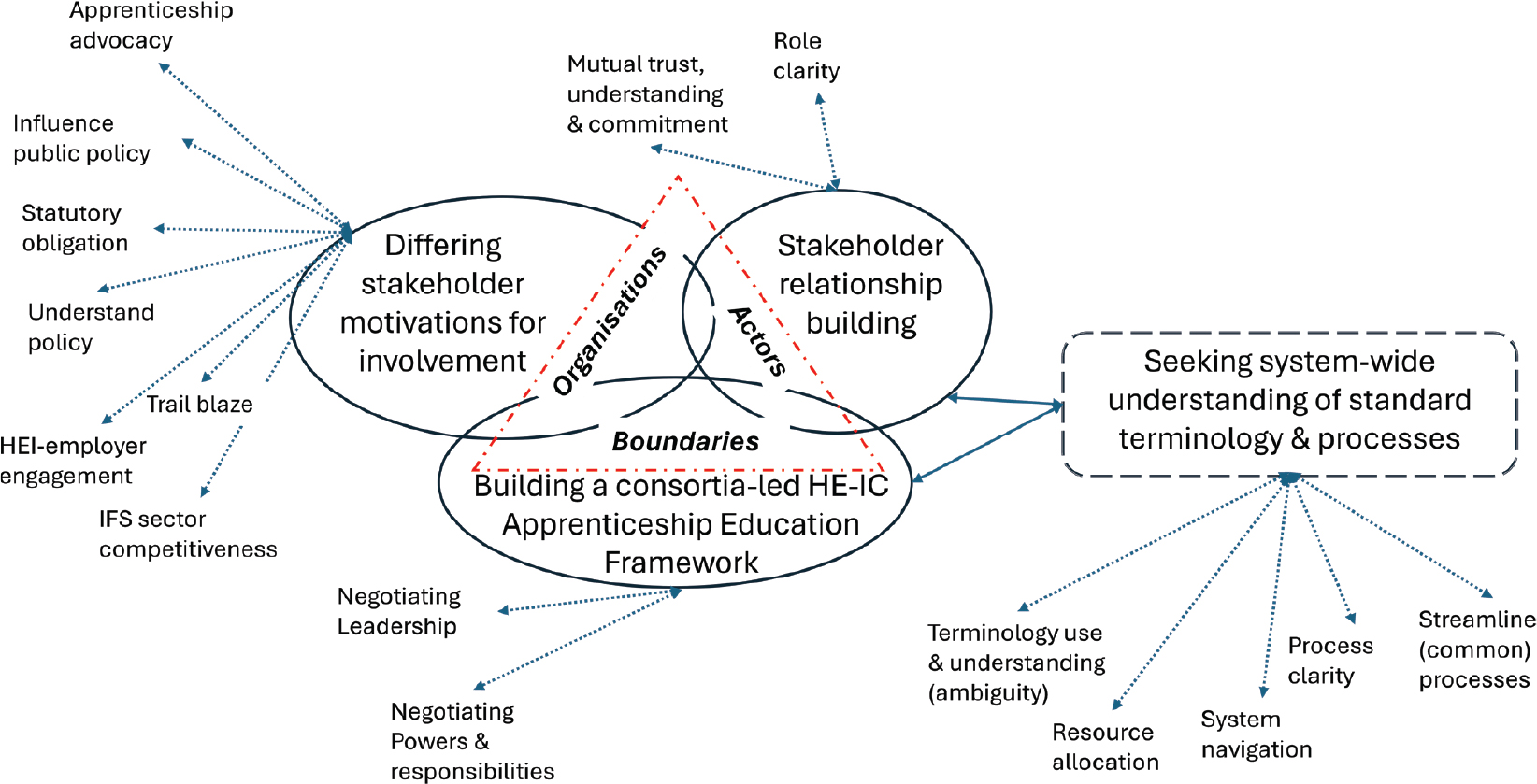
Figure 2:
Thematic Map.
Organisations, actors and boundaries lie at the heart of the emergent themes (centre, Fig. 2). Collectively, the identified themes and sub-themes (Fig. 2, left to right) show how (1) differing stakeholder motivations for involvement can influence engagement with and belief in the apprenticeship model and policy context; how (2) role clarity, integrity, commitment and mutual trust help build stakeholder relationships; how, (3) leadership, powers and responsibilities are negotiated when building a consortia-led HE-IC framework, and how, (4) consortia operation requires a system wide understanding of standard terminology and processes in the pursuit of clear responsibilities and strong consortium relationships.
FINDINGS
This longitudinal study commenced in 2016, when new HE’ apprenticeships were first introduced in Ireland. The studied case was the first HE apprenticeship to be accredited by Quality & Qualifications Ireland4 (QQI) under a new accreditation system5 and the delivered suite of IFS apprenticeships paved the way for several apprenticeships in both the further education and HE systems. In the studied case, IFS Apprenticeship consortium parties worked closely with national policy stakeholders and apprenticeship consortia to design and develop a suite of HE apprenticeship programmes for the IFS sector, in partnership with the industry’s representative body - Financial Services Ireland (a member of Ibec) - and the participating HEI - NCI. This consortium-led approach to apprenticeship education design was described by the Chair of the Apprenticeship Council as a process where “we are building the bridge at the same time as we walk over it” (P6), offering frontier insight for those who followed.
The findings yielded in-depth responses and strong views and explored expectations of and foundations for the consortium-led IFS apprenticeship programme. They provided specific insight from which to develop, implement and enact a consortium-led IFS apprenticeship education framework as a mechanism for facilitating enhanced HE-IC relationships. The findings exhibit the evolution of key themes and how they interact with each other (Fig. 2), as exhibited in the findings.
Theme 1: Differing Stakeholder Motivations for Involvement
The motivation for involvement in apprenticeships varied greatly both within and between the policy and consortia participants. Organisations such as the Department of Education and Skills6, SOLAS7, the Higher Education Authority (HEA)8 and QQI all had statutory reasons for being involved. The Department of Education and Skills were the originators of the consortium idea and were motivated by a need to review the then apprenticeship system and by an apprenticeship renaissance in Europe, as “there was this sort of sense that countries with high performing apprenticeship systems, were countries that have low levels of youth unemployment” (P4), a key concern of the Irish government. Reflecting on the time of the Apprenticeship Review (D4) (2011-12), when unemployment was high in Ireland, P4 felt that the economic drivers for a new apprenticeship model were very strong (OECD, 2012). He also felt that “the review itself kind of took on a life of its own to a certain extent” and that there were “influential voices around the review table” (P4), criteria which are explored below. It was not a stated intention of the Review Group (D4, 2013) to expand the apprenticeship occupations into new sectors or to set up new collaborative structures - these were “unexpected” by-products of the process. Extending apprenticeships into new non-traditional occupations had been difficult for some employers to grasp,
I don’t think there is an understanding of what the new apprenticeships involve. The IFS Industry for instance has experience of graduate programmes, but they’re very different to apprenticeships. I don’t think there is an awful lot of knowledge about what an apprenticeship is, and the commitments involved. (C2).
P6 stated that the HEA’s ambition is to establish apprenticeship as “a route of choice” for larger numbers across different sectors. Apprenticeship was a new landscape for the HEA, and their motivation for being involved in the consortium were as funders and advocates for HEIs to develop and provide apprenticeships in these expanded sectors. HEIs vary from Technological Universities9 who are experienced in delivering craft apprenticeships, to Universities, Colleges and private HEIs, who had no delivery experience. QQI, as the guarantors of quality of the National Framework of Qualifications, had a clear statutory role in the accreditation process for all new apprenticeships, in both further and higher education (D11). Their remit was to ensure that,
… if a particular apprenticeship programme purports to do something [then our responsibility is to ensure] that it can be done and that the institution can demonstrate their ability to deliver in a way that ensures the quality of the programme and the experience for the learner. So, we are objective neutral and process intensive (P7).
Employer’ motivation is articulated by the Financial Services Ireland director (C3),
As a sector director, I am responsible for the competitiveness of the sector…a tangible item for the apprenticeship is that talent and skills is incredibly important for the sector. Notwithstanding whether we’re in a growth phase or a decline phase, it’s incredibly important that the right talent is coming through, at all times, into the sector. So, the apprenticeship route is one of the clear things that we need to put an effort in to create that pathway. It is creating more skills for the sector, and finding talent that might otherwise not get in. (C3).
Documentary review reinforces these motivations; the Strategy for the Development of Ireland’s International Financial Services sector to 2025 (D22), and its predecessor (D8) sets out a vision for talent in the sector that has apprenticeship at its core. The longer-term aspiration for the IFS sector is for employers to incorporate C4’s suggestion of “apprenticeship is part of who we are and what we do” into their future strategic plans, reinforcing the ambition to embed a culture of apprenticeship in Ireland. The above articulation of Financial Services Ireland’s motivation is at odds with the experience of C1, as she struggles at the coalface of encouraging IFS employers to recruit apprentices, stating that “…this is such a ‘hard sell’ to the employers”. There appears to be a disconnect within the sectoral representative body and the experience of C1 as she continually makes significant efforts to ‘sell’ and ‘re-sell’ the concept and benefits of apprenticeship on an annual basis. The goal of: “a bigger pipeline of talent and that will have greater outcomes for the overall sector in terms of diversity and retention” (C4) is not getting through to the wider sector, even when supported by highly motivated and committed IFS employers. The message that this: ‘national talent play’ (C4) is not being understood by most IFS employers, despite the best efforts and intentions of the employer body (Ibec) and sectoral representatives including Financial Services Ireland. P2 advised that, “you’ve got to differentiate between employers and the people who are paid to represent employers and their perspective. There’s a different dynamic going on there”. P2 alludes to the role of the employer body as an ‘intermediary’ in context. Notably, the IFS sector has a culture of graduate recruitment and not apprenticeship, as observed by several participants (cf. C1, C2, C3, C4, P2, P3, P6), which may partly explain the disconnection described above. This was an important issue, as the numbers that are required to make this apprenticeship model sustainable in the longer term would not be reached, without industry commitment.
The motivation for other industry stakeholders was to influence education and labour market policy in pursuit of industry goals, resulting in senior intermediaries joining the consortium; “Typically, we have to be very strategic in what we get involved with and how we get involved. So, I thought about it and said … I will be the one to represent Ibec” (P2). From the HEI perspective, the proposed consortium was not an easy sell,
…there was a lot of internal resistance, I wouldn’t have been overly excited by the commercials to be honest. A lot of investment was required, and we had to redirect scarce resources to something that is a very long and slow cook. If we get the employers taking on lots of apprenticeships that would be fantastic, really cool. I passionately believe in the apprenticeship concept, it is in mine and the college’s DNA, but it needs to make financial sense and without a scaling up from employers that is difficult. (C5).
However, alignment with NCI’s origins created an attraction to a consortium that: “was going to shape the future of the higher education sector …this was an entrepreneurial move which was also aligned with our historical roots and our philosophy” (C2).
These mixed motivations for involvement in the apprenticeships were to be expected, based on the variety of participants interviewed (Table 1). Policy stakeholders were clear about their organisation’s reason for involvement, while others commitment was more nuanced; “being part of the same apprenticeship eco-system did not automatically guarantee commitment and that had to be worked on” (P3). While words of encouragement were helpful, “we are all motivated by the same desire, by maintaining a system that works for all” (P6), organisational commitment would prove to be an important factor in maintaining motivation in times when the apprenticeship programme development journey became arduous. Alignment of belief systems and ambition to excel in apprenticeships in Ireland became a powerful shared motivation for NCI and the lead employer, and a driving force for the IFS Apprenticeships consortium. Ultimately, there was a collective motivation to ‘crack the code and make this work’ and a strong sense of ‘doing the right thing for the country’ with an undertone of ‘even if the country doesn’t realise it yet’.
Theme 2: Stakeholder Relationship Building
The formation of the consortium was one of the first tasks for the groups approved to design, develop, accredit and deliver new apprenticeship programmes (D9). This was a very different experience to that of other apprenticeship arrangements. As articulated by P3, the consortium-led IFS apprenticeship education programme,
…brings into play everything, funding challenges, issues about roles, responsibilities, rules of engagement, the curriculum versus the work experience piece, you could ultimately say this system brings all that into play.
All participants commented on the importance of sustainable stakeholder relationships within the consortium when building this framework. This new approach involved HEIs and had to be industry-led to access funding (cf. D7, D11, D13, D14, D15). This was a significant move away from the structures supporting the ‘traditional’ further education apprenticeships where educators led the apprenticeship programme and Solas was the co-ordinating body. The consortium approach was therefore, “a disruptor…. there’s a disruptive element to all of this” (P1). This insight highlights how the role of the HEI on the IFS consortium is more nuanced than its typical role on programme development and quality management committees. The role of HEIs as co-creators rather than leaders in the new framework was seen as an opportunity by several participants (P3, P4, P5, P7), perhaps best expressed by P4:
You’ve heard me say this on numerous occasions, about apprenticeships that are driven primarily from education and training situations, [they] just don’t work. They’re conceived by the education partner because the industry partner did not spare the time to get involved, because they are time poor. Yeah. And they can be a bit passive in the development phase and things like that. And there are definitely scenarios where problems are being solved by education and training institutions that should be solved by industry.
The composition of the IFS consortium and particularly the steering group was, “made up of mostly senior HR professionals who represent organisations involved in apprenticeship representing Ireland for their organisation or even European base” (C2). While effective and efficient in making HR based decisions around the new apprenticeship framework, C4 suggested:
That while it’s important to have HR involved, having a few CEOs as part of the consortium could be really helpful as they could bring a different perspective plus use their network to get the message out. (C4).
Building relationships with CEOs could also help alleviate the perceived disconnect between the employer body (e.g., Financial Services Ireland, Ibec) and IFS sector employers in seeing the value of apprenticeship as a solution to talent development needs and industry skills shortages. Employers looked at the utilisation of learning in the work context as a ‘collaboration between the college, the individual and the company to be able to make sure that the learning is utilised in real time. It’s adding value to all three – it’s like a tripartite relationship in the creation of value’ (C4). Reflecting on the consortia formation stage, P5 believed that “more value would have been gained for all” if the HEA had engaged in more one-to-one meetings with each consortium rather than the larger ‘townhall’ group meetings that were held intermittently. As articulated by the HEA representative (P5),
Looking back on the early days, I think we [HEA] could have been more involved in the formation of the consortia. I think this was a resource issue. Instead of big groups meeting, I think there could have been smaller group meetings and us having more one-to-one meetings with the consortia would have been of benefit.
Policy stakeholders, who had knowledge of the apprenticeship system, felt that, overall, newly established consortia continued to be led by educators (the HEIs) rather than industry. In the IFS Consortium, the collective view was that it was industry led, albeit by Financial Services Ireland as the industry’s representative body, but with a very strong input from NCI (D9). C4 reflected that this was partly due to “the nature of the financial services industry. It is so driven by tight regulation and robust internal processes, so it was always going to have to be industry led”. This view is reinforced in the IFS sectoral strategy documents (D8, D22).
Role clarity was raised as a key factor in successful consortia. P2 highlighted the need for employers to understand the system to fulfil,
… the role of employers and the people who are paid to represent employers. There is a different dynamic going on there. Now we like to think that we represent employers authentically, but we are in the middle of a system, and we get to know people very well in the system, and some would argue that you need to be part of what you do, to actually achieve anything.
P3, who had oversight on apprenticeships across a variety of industries, cited a best practice consortium example,
There is an excellent example of a consortium that I have witnessed…all parties were in clear agreement that apprenticeship as opposed to any other development intervention was the answer for their skills issue…all the roles were clarified up front with guest appearances from the relevant stakeholders such as Solas. The education provider role was also well explained. There was an existing relationship with the education provider and a trust in them that definitely helped.
The role of NCI as the HEI on the IFS consortium was very different to any previous industry partnership role and therefore needed to be negotiated. Industry partnerships are core to how NCI operates yet as articulated by C2, “We needed to set and manage expectations of everyone involved to develop an apprenticeship properly, even when we were not entirely sure of the parameters”. When asked to elaborate on the difference, C2 responded:
With this, there are a lot of external stakeholders, and that changes the game completely. So, it’s actually building the blocks for those external relationships and that takes time, their involvement takes time. And this is a pressure because from a college perspective there is an urgency on programme development yet there are a number of dependencies on so many stakeholders. But to do it right takes time. But when you’ve got an external party involved, you need to be very clear about what can be delivered and when.” (C2)
As observed by P3, “there is a significant element of clarity needed for both education providers and industry in relations to roles and responsibilities and the level of commitment needed”, reinforcing the dependencies challenge raised by C2. Commitment to the relationship, founded in willingness to adapt and innovate, required a “‘can do’ attitude … in our education partners” (C1) for the consortium to work. NCI’s willingness to “do whatever is needed and lead on innovations such as use of e-portfolios and designing the mentor training programme …” (C1), helped reinforce the relationship with industry partners early on. Trust was something to be built over time, based on tangible evidence of stakeholder commitment, underpinned by transparency in the way partners work together, “so you need time to build up trust, and allow time for people to understand their perspectives and the systems that other people are working in” (C3). C3 gave an example:
So, you know, when you go to one of the big international banks. We don’t realise until we get into the process that they may have six or seven layers of approvals required before they can sign an apprenticeship contract. And then on the other side, that industry might go, ‘Well, we want this to start on October 31’. And we’re telling you in July, and they may not understand that there are timetables and structures and processes that must be followed [in HEIs], in order for that to start.
When considering this challenge, C1 reflected on the value of “transparency in the way the college [NCI] works. This all helps to build the trust”. The importance of aligning values is reinforced by C2, “both organisations [HE and Industry] need to acknowledge that apprenticeship is different and that they value it”. This mutuality led to stronger relationships with IFS employers. C1 provided anecdotal insight from IFS employers in the early days of the consortium, “they saw FSI and NCI as a very strong partnership especially in the employer information sessions and company visits”. C4 concurred, “there appeared to be a very positive relationship between FSI and NCI”. There was also a sense of joint accountability and “being in this together” (C1).
Based on these findings, the alignment of values and ambition of both education and employer partners combined with trust, transparency and a belief in the value of the apprenticeship concept helped strengthen relationships within the IFS Consortium. This is also reflected in the documentation (D5).
Theme 3: Building a Consortium led HE-IC Education Framework
The IFS Consortium is managed by the Financial Services Ireland Apprenticeship Lead with two key employers, State Street and Fidelity, holding the Chair and Vice-Chair positions (correct as of 2021). Leadership of the consortium emerged as a sub-theme, with a prevailing view that “a consortium where there is clear leadership and ownership from industry obviously works best” (P5), with “…one industry body leading” (P3) at its helm. This evolved from being a requirement of the approval and funding process to it being a forum that addresses key strategic issues within the IFS sector. C3 summarised the vision for the consortium,
I think it is important that the Consortium is seen as a guiding group with strong employer leadership advising the rest of us what needs to be done. I think this group should be used for game changer decisions. (C3)
The IFS Consortium was established without a full understanding of the overlap with the various statutory agencies, despite the requirement to deliver on ambitious outcomes from design, development and accreditation of apprenticeships programmes through to the recruitment of employers and apprentices. Thus, relationships with Solas, the HEA and QQI in those early days were key. Solas provided the processes and the set up and development funding. The HEA provided guidance, advocacy and annual funding for the apprentices, and the relationship with QQI was focused on the accreditation approval for IFS apprenticeships.
As the consortium was a new concept, there were initially teething problems when negotiating powers and responsibilities within the new apprenticeship programmes. The consortium had decision making powers in relation to many aspects of the IFS apprenticeship: setting salary and benefits; designing recruitment and selection processes; designing and delivering programme content; recruiting employers; and monitoring performance of apprentices and mentors (D9). Some of the duties assigned to Solas authorised officers (AO)10 in the traditional apprenticeship model, such as approval of employers, appeared to be ones that could be carried out by the consortium under the guidance of Solas. However, the AO role is set out in the legislation and among their duties are the powers to ensure that the employer:
… has adequate facilities for the training of persons by way of apprenticeship in an employment in the activity or trade, arrange with the employer for the taking by him of a person into an employment in the activity or trade by way of apprenticeship” and can “examine the methods used in the training and instruction of any person whom he finds employed in a designated industrial activity in any premises mentioned in paragraph (b) of this subsection and give advice in such training and instruction. (D1).
This created some tension in the consortium, as articulated by C1, “It’s like we are trusted to make the big decisions but not the ones that would make the whole process easier for everyone” (C1). Notably, guidance documents were developed by the Apprenticeship Council and Solas since the IFS Apprenticeships were first developed, which provide more clarity on the powers of the Consortium (cf. D13, D14, D15), based partly on initial feedback from stakeholders in 2016-17. Clarity of responsibilities across the range of apprenticeship stakeholders is a strong theme based on the study’s findings. As stated by P2, “we made a significant challenge even more difficult by the lack of clarity”. Most participants agreed that there was some confusion at the outset and some of that confusion appeared to still exist after the consortium was established. There is a keen awareness that the multitude of stakeholders involved had resulted in the view that “at times it can appear confusing as to who is responsible for what” (C2). The overlap between the role of the Consortium and the role of the Solas AOs also lead to confusion, especially in the early days. Even the most collaborative of the stakeholders found that it could,
… be a difficult space - we work well with Solas who look after all of the process parts and we come in and do the funding side for the HEIs, and even with the best will in the world from all concerned, it is blurry. (P5)
In this consortium, there appeared to be more clarity about the Financial Services Ireland and HE responsibilities with, “FSI largely focused on recruitment” [and the] “academic nature of the programme, managing the quality of delivery is the prime focus of the college” (C2).
Theme 4: Seeking System-wide Understanding of Standard Terminology and Processes
A key output of the Apprenticeship Review Process in 2013 and the subsequent establishment of the Apprenticeship Council in 2014 was the decision to continue to use the term ‘apprenticeship’ to help govern new apprenticeship occupations. This decision appears to have been driven by the pragmatic use of the existing Industrial Training Act of 1967 legislation to ensure protection of all involved parties,
…… it’s a pragmatic acceptance that we have to work within a statutory framework because it is already there and to dismantle it would have required bigger changes. The statutory framework provides the backing of the Industrial Training Order and that is a defining characteristic of Apprenticeships both pre and post review. (P4)
The importance of the protection of the legislation (D1) was appreciated more by the policy stakeholders than the employer and HEI representatives. Views varied as to how useful this strategy would be in the IFS context, with some believing the term could negatively impact employer engagement,
I think the fact that it is called an apprenticeship is a negative term for the companies we’re dealing with, if we’d been allowed to call it something else that might make a difference. And it might make it more attractive… (C1).
This is borne out by C1’s perspective that “use of the term apprenticeship has made this an even harder sell to employers than it should have been” and the employer body representatives found it difficult to commit to the term as “… a great concept, but a very slow burn commercially” (C5). These contrasting views were echoed in day-to-day conversations by those operating in the apprenticeship sphere. It was suggested that “the use of the UK term ‘Degree Apprenticeship’ could possibly work” (P5), and that there could be a protocol for titling apprenticeships to convey the qualification level achieved, rather than changing the term,
There needs to be some protocol for titling apprenticeships so that the title conveys something as well as the qualification level … Changing the term – instinctively I’d say I wouldn’t go there …I would be inclined to educate the population as to what the term apprenticeship is about rather than change it …don’t throw out the baby with the bath water. (P6).
The consortium agreed that a universal protocol should incorporate terminology around the new apprenticeships, including meaning of terms like; authorised officers (D1), industrial training orders (D1), occupational profile, work-based mentors, e-portfolio, work-based assessments. While understood by the national policy stakeholders; the HEIs, Financial Services Ireland and Industry stakeholders were largely unaware of, or unsure of, what these terms meant. These terms are fundamental to the design and operation of the apprenticeship education model and therefore needed to be understood by all parties. It was acknowledged that the need for a universal protocol could increase as the sectors involved in apprenticeship were extended.
The theme of processes kept recurring, from the overall system processes through to more localised operational processes. One of the fundamental questions raised was, ‘…whether the statutory apprenticeship basis is the right one. In retrospect I can see why they went that route. And that relates to process’ (P2). The focus in the first few years (2013-2017), was on extending apprenticeships in to new sectors (P1, P4, P6) and providing guidance for the development of new apprenticeships (D13, D14, D15). The main emphasis in subsequent years (2018-2020) was on engagement with employers and while this is still ongoing, several policy stakeholders suggest that it would be timely now to review and streamline the processes. P2 reflected,
On the process, it can be difficult to get a grasp of an understanding and to get over each of the hurdles required…the process can create barriers as well… Just look at the 12-step process (D14) and then you figure out why this thing isn’t working as efficiently as, or effectively as it should? I mean, why do you need 12 steps? You can pull steps out of that, as long as there is no impact on the quality.”
This employer-led perspective was countered somewhat by HEI stakeholders, who noted that programme design and development were core activities of HEIs and usually a known quantity. Thus, a key HEI task was, “to exercise their expertise in the space of programme development and in particular accreditation” (C2). The most significant and radical process streamline that was suggested is that of one government agency being accountable for everything to do with apprenticeship (P2),
This one is probably the most difficult one in that you’ve got to bring them under a unified agency. Yeah. You know, there’s got to be one body that’s doing this. Does it have to be statutory based? Yes, I think it does. So okay, there’s a solution. Have a root and branch review and allocate resources accordingly, if there is a true and strong commitment to the future of sustainable apprenticeships.
Ultimately, the consortium, ‘delivered an infrastructure and a set of processes that can develop new apprenticeships. It might be clunky, and it could do with some refinement’ (P6). P2 and others expressed a need for the new apprenticeship process to be more responsive, dynamic, and in tune with industry’s need for agility rather than, ‘tethered to legislation that is over 50 years old’ (P2). These requirements raised the challenge of resourcing the consortium-led apprenticeship model and financial support, or lack thereof, was raised by several participants (P1, P3, P4, P6, P7), such that “the reality of the kinds of ancillary costs of the apprentice to the enterprise [are] considered” (P7). P1 extrapolated this point, highlighting resource-based barriers to industry engagement,
So, you know, mentoring, organising quality, workplace learning, you know, an employer especially an SME is questioning, ‘do I have the time and resources for this - can I do this?’ And then, you know, that’s a barrier (P1).
Considering the HEI perspective, C5 raised concerns around, “management and measurement of the work-based element and the impact that has on achieving consistency of learning outcomes based on the resources and commitment of the employers”. This aligns with the need for commercial viability of apprenticeship education delivery.
SUMMARY OF FINDINGS
All participants articulated their organisations’ motivations for being involved with apprenticeship and for ‘sticking’ with apprenticeships on what has been acknowledged across the board as ‘a journey not without challenges’. The motivation for all participants was in fulfilment of their organisational objectives, with a heavier emphasis from the policy stakeholders. The importance of the role of the Consortium is highlighted by all participants. All conclude that there was a lack of guidelines, although this ambiguity was balanced by the recognition that all were in the same place together, “building the bridge and walking over it at the same time” (P6). Leadership of the consortium was identified as a sub-theme, and particularly the need for employer leadership at the heart of the consortium. Findings indicate a strong sense of there being a challenge in both the use of and understanding of the term ‘apprenticeship’ and its implication for the commitment required from the various parties to ensure sustainable delivery of a consortium-led financial services apprenticeship education framework. The integrity of the term is acknowledged in its use in the traditional sense but its appropriateness in new professional contexts is questioned, particularly by those participants interacting with employers. Most stakeholders agreed that there was confusion around roles and responsibilities. A lack of clarity exists to different degrees in the national policy stakeholder landscape and within the context of the consortium members. The role of the HEI appeared to be the one with the most clarity. Some felt that lack of clarity about roles and responsibilities reduced understanding of the level of commitment required by all partners in the consortium. The need for robust processes came through very strongly, from the overarching national apprenticeship system through to the processes specific to the consortium members and the apprentices. There is a divergence of opinion as to whether processes can be streamlined further with the Consortium members, and employer representatives most strongly stating the need for process refinement. Extraction of the core themes are summarised in Table 2.
Table 2:
Summary of Findings
| Themes | Sub themes | Findings from Participants | Documentary Review |
|---|---|---|---|
| Theme 1: Differing Stakeholder Motivations for Involvement | Consortium as trailblazer | The consortium approach was a disruptor in several ways as it was a requirement of funding that it had to be industry led. This was a significant move away from the structures supporting ‘traditional’ apprenticeships, for whom Solas is the co-ordinating body. Participants believe the benefits of the new apprenticeships and processes needed to be promoted across that eco-system to garner a holistic system-wide level of support. | When the study commenced in 2016, there was very little documentation about the leadership and formation of apprenticeship consortia. Subsequent participant-led process revealed new documents that had not been published at the time of the design and development of the IFS apprenticeships programme (cf. D13, D14, D15). |
| To meet statutory obligations | Statutory obligations are a clear motivation for key stakeholders (e.g. HEI, Industry). | Apprenticeship is in the Industrial Training Act 1967 (D1) and is referred to in cf. D3, D4, D7, D9, D11. | |
| To meet employer engagement goals (HEI funding model enticement) | The funding model is encouraging HEIs to get closer to industry, with many funding initiatives requiring evidence of close collaboration with industry. However, in the IFS sector, where many employers are US-parented multi-national corporations, employer engagement in large numbers remains a challenge. | Department of Education & Skills and the Department of Enterprise Business & Innovation promote engagement between HEIs and industry, with several streams of funding promoting such collaboration. Specific published strategies for the IFS sector support these policies in practice (cf. D8, D22). | |
| To match Financial Services Ireland and IFS ambition and to contribute to IFS sector competitiveness | The overriding motivator for the involvement of FSI as the representative body for the financial services sector is to contribute to the sector’s competitiveness. This finding is inconsistent with FSI’ ability to attract participating employers. The IFS sector has a culture of graduate recruitment and not apprenticeship, as observed by several participants. Only small pockets of IFS employers are engaging with apprenticeship and the majority of those are engaging in a relatively small way. There appears to be a disconnect between the employer body and the sector’s employers in seeing the value of apprenticeship as a solution to talent development & skills shortages. | The ‘Strategy for the Development of Ireland’s International Financial Services sector to 2025’ (D22) has specific action points on the IFS apprenticeships that link directly to participants’ points about apprenticeship aiding the competitiveness of the sector. It sets out a vision for talent in the sector that has apprenticeship at its core (D22); however, there is little guidance on how to instil a culture of apprenticeship in stakeholder organisations. | |
| To understand the new policy | Understanding the policy surrounding the new apprenticeship model emerged as being an important factor. | As the new’ apprenticeship model emerged from various stakeholders’ engagement with the planning process in Ireland, it became a key element in several policy documents, from the Department of Education & Skills (cf. D4, D5, D6, D7, D8, D10, D12, D13, D14, D17, D18, D19, D20). It is also evident in sectoral strategy documents and specific to this study, the IFS sector strategy documents (D8, D22). | |
| To influence Public Policy | The importance of FSI’ voice within the apprenticeship ecosystem is apparent due to the crucial differentiating point of apprenticeships being employer led. The need for FSI to act on behalf of their members is balanced with a need to also influence public policy. | See: ‘Ibec Submission to Consultation on Government Review of Apprenticeships’ (D3) ‘IFS2020: A Strategy for Ireland’s International Financial Services sector 2015-2020’ (D8) and the suite of consortium specific documents (D9). | |
| Theme 2: Stakeholder Relationship Building | Defining HEI and industry roles | The expanded role of the HEIs in the wider apprenticeship system was of concern to several participants due to there being varying levels of clarity around the HEI role. For example, there is a perception that the HEI is taking the lead in some consortia, when it should be led by the industry partner. | The HEI and Industry roles are not elaborated on in the documentation. Clarification would aid consortia operation. |
| Building mutual understanding, trust and commitment | The relationship between the HEI and FSI is viewed by both parties as strong and robust, focused on building a common vision. Not all apprenticeship HEI-IC are viewed as positive. Participants discussed a lack of understanding of each other’s drivers, commitments, pressures and timelines as potential barriers to creating the necessary levels of trust between parties. Factors underpinning this discord include, for example, mismanagement of expectations, misalignment of objectives and misunderstanding of each other’s roles and responsibilities. | Relationship management is not mentioned in the documentation. | |
| Theme 3: Building a consortium-led HE-IC apprenticeship education framework | Leadership | Strong belief that the consortium should be employer-led. | |
| Powers and Responsibilities | The consortium has decision-making powers in relation to many aspects of the IFS Apprenticeship: setting salary and benefits; designing recruitment and selection processes; designing and delivering programme content; recruiting employers; and monitoring performance of apprentices and mentors. Required negotiation around duties assigned to AOs, such as approval of employers, that could be carried out by the consortium under the guidance of Solas. | Guideline documents have been developed by the Apprenticeship Council and Solas since the IFS Apprenticeships began, which provide more clarity on the powers of the Consortium and the stakeholders, based partly on initial feedback from stakeholders in 2016 (D13, D14, D15). | |
| Theme 4: Seeking system-wide understanding of standard terminology & processes | Use and understanding of apprenticeship terminology (ambiguity issues) | There is varied use and understanding of apprenticeship terminology. Some disagreed with its use, while others appreciated the history of the term and the protections afforded by the legislation. Varying levels of understanding of key terms were of concern to all participants. Participants believe a system wide understanding of apprenticeship terminology is needed to enhance understanding. | The term ‘Apprenticeship’ was traced from its origins in the 1967 Industrial Training Act up to the definition provided by the Action Plan to Expand Apprenticeship and Traineeship in Ireland 2016-2020. Evidence that the education policy stakeholders and the education provider are more aligned in a common understanding the terms ‘apprenticeship’ and ‘work-based learning’, than the industry and representative bodies. |
| Clarity around overall process | Several of the consortium felt that lack of clarity and understanding challenged the overall process. There are several processes that were established because of the 1967 legislation, which applied to existing apprenticeships. These also extend to the new apprenticeships. Collective view is that the overall process should be more responsive and dynamic to fulfil ecosystem needs and requirements. | Apprenticeship Review (2013) established new apprenticeships under the 1967 legislation rather than wait for a considerable period for new legislation to be drafted, passed and enacted. There are acknowledged limitations and some of the gaps in the process and supports, which had not been provided in the initial documentation, have now been at least partially fulfilled by documents published since 2017 (cf. D13, D14, D15). | |
| Navigation of Systems | Participants believe the system lacks cohesion, which employers found hard to navigate. The criticisms were on two levels: a need to streamline processes within the system, and the overall education system. All participants were in favour of streamlining the overall apprenticeship process to remove barriers to HE-IC. | Documentation developed when planning the apprenticeships (D1-14) may need to be streamlined based on practical experience. | |
| Streamlining (common) processes | Consistent view that there needs to be a common process. There was also a strong sense that the current processes could be streamlined further. The consensus is that the steps in some of the processes need to be removed to make it leaner. There is an acknowledged difference of pace between how HEIs and industry operate and in most cases for very valid reasons. | Documentation developed when planning the apprenticeships (D1-14) may need to be streamlined based on practical experience. The perceived lack of common process aligns with the current global and national debate about the need for integration of the further and higher education systems and intent to move away from a binary system to a more seamless single tertiary education framework (cf. D17, D18, D19). | |
| Need for resources | Time, cost and availability of human resources are acknowledged challenges facing HEI and industry collaboration partners. Financial support, or lack thereof, was considered important by several participants. These views of consortium participants reinforce the perceived commitment of resources required by both the HEI and the employer to achieve Apprenticeship success. |
1 Code: FSI: Financial Services Ireland, employer representative body; HEI: Higher Education Institute; D: Document, Appendix 2.
DISCUSSION
These findings highlight the importance of role clarity, commitment and trust in building sustainable HE-IC relationships (Bravenboer, 2016; Charlton & Power-Mason, 2025; Rowe et al., 2016; Schilke & Cook, 2013). The findings point to a need for expectations around leadership, powers and responsibilities to be negotiated and agreed to successfully embed trust and commitment within and across the boundaries of the consortium (Schilke & Cook, 2013; Reale & Primeri, 2015), while acknowledging differing internal structures, functions and socio-economic obligations in member organisations. The need for a strong advocate and working group for a successful HE-IC outcome (Liew et al., 2012) is reinforced in this study, wherein the HE-IC intermediaries ‘play an important role in facilitating connections and interactions between actors from different backgrounds, as well as working across conventionally resistant boundaries between actions, scales, and actors’ (Sternlieb et al., 2013, p. 122). Expectations of agility and adaptability within and between consortia members (Gustafsson & Lidskog, 2018) are balanced with HEI responsibility for a quality-led apprenticeship education, thereby contributing mutual economic, institutional and social gains (Ankrah & Omar, 2015; Laitinen-Väänänen et al., 2024). Consistent with prior studies (cf. Cohen, 2021; Parker & Crona, 2012; Prysor & Henley, 2017; Rajalo & Vadi, 2017), the new apprenticeships impact the boundaries between HEIs and other entities, requiring a willingness to trust consortia partners when destabilising individual organisation systems (Schilke & Cook, 2013). The pursuit of a system-wide understanding of standard terminology and processes such that the consortia-led IFS apprenticeship education framework becomes and remains a shared object must be the common goal. Thus, those representing HE, industry, policy and public sector organisations act as intermediaries between boundaries and organisations where each activity system has its own tensions and contradictions, both within and between the interacting systems (Fig. 2).
Drawing on Steinlieb et al.’s (2013) transboundary organisation framework (Fig.1) and the findings (see Fig. 2 thematic map), the consortium-led IFS apprenticeship education framework places the apprentice at the heart of the framework (Fig. 3, top centre spiral). Intermediaries, perform as boundary negotiators on behalf of HE-IC stakeholder organisations. Consortium members work together to pursue an optimised apprenticeship education approach. Mutual trust and commitment (Fig. 3, left) among consortia members helps transcend boundaries (Sternlieb et al., 2013), while agility and adaptability within and across collaborative organisations (top right) helps build a sustainable HE-IC framework. The circular motion (Fig. 3, centre vertical column) exhibits the dynamics that exist within and between each criterion (mutual trust and commitment, and agility and adaptability), as intermediaries gain the comfort needed to release organisational access and connect individual organisation’s activities and practices across boundaries. Mutually agreed roles, responsibilities and system-wise processes are built to ensure common understanding (Fig. 3, bottom centre). Over time, consortia-led standardised structures and functions (bottom centre spiral) guide the sustained delivery of an adaptive and agile IFS apprenticeship education framework.
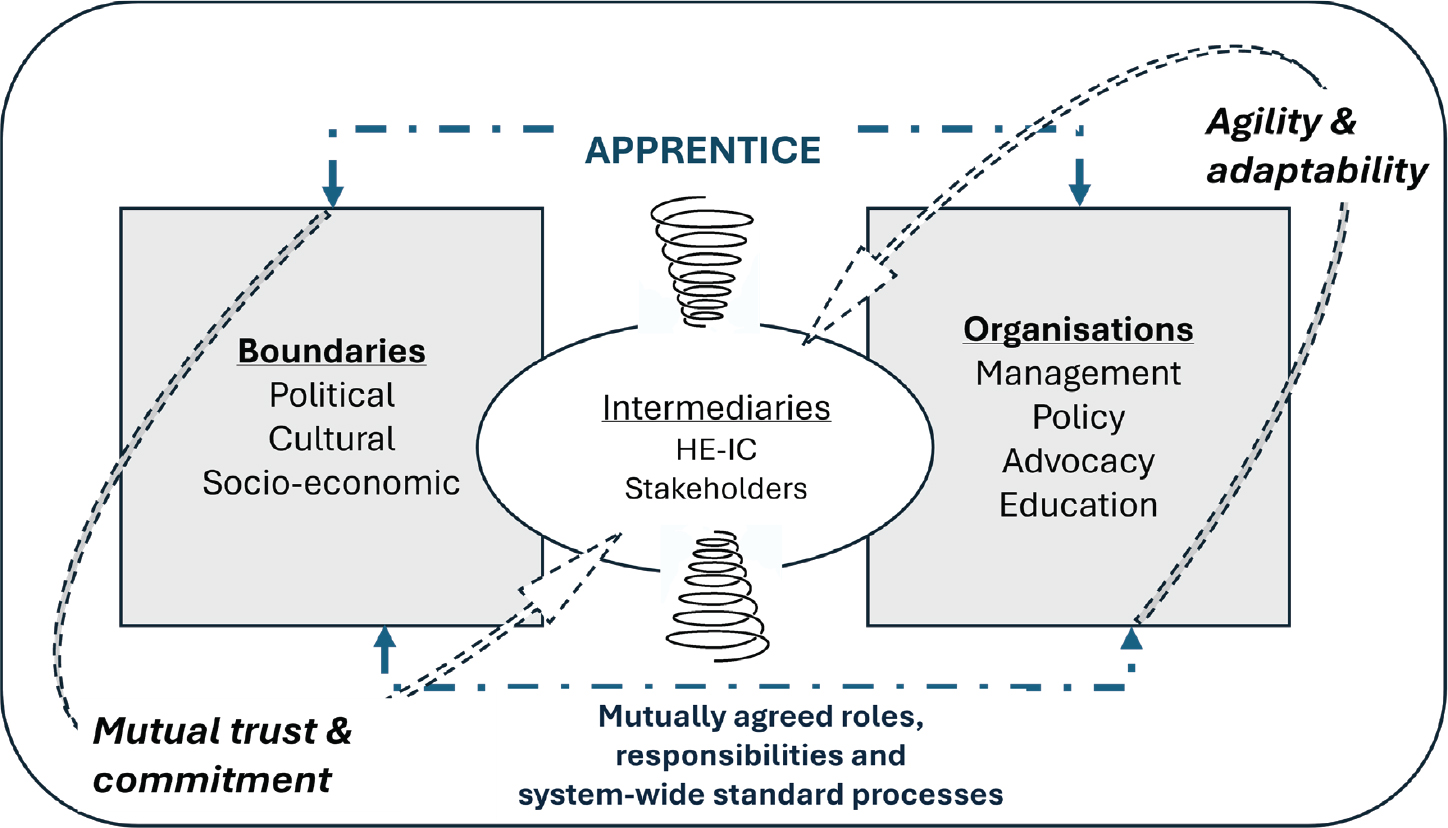
Figure 3:
Consortium-led IFS Apprenticeship Education Framework.
Adapted from: Steinlieb et al., 2013.
CONTRIBUTION TO THEORY AND PRACTICE
This research offers insight into the process for developing, implementing and enacting a consortium-led IFS apprenticeship education model (research question 1), and provides a basis for enhanced education focused HE-IC (research question 2). It helps identify the principles applicable to HE-IC apprenticeship education design, development, accreditation and delivery (Barbolla & Corredera, 2009; Felce, 2019; Kundu et al., 2024; Quew-Jones, 2023). The study extends the argument for HEI involvement in programme design and delivery (Anderson et al., 2012; Hahn & Gangeness, 2019; Kadhila et al., 2024) and offers enhanced insight into HE-IC apprenticeship education models in the business and management domain (Daly, 2017; Martin et al., 2024).
This study contributes to both the theoretical and applied discourse by offering stakeholders and in particular HEIs in collaboration with industry partners a process to develop, implement and enact a HE-IC apprenticeship education framework (Fig. 3).
Theoretically, the proposed framework extends transboundary theory (Steinlieb et al., 2013) and exhibits transboundary dynamics that exist within and between each criterion (mutual trust and commitment, and agility and adaptability, Fig. 3). It shows the trajectory needed to release organisational access and connect individual organisation’s activities and practices across boundaries. The application of transboundary organisation theory helped reconceptualise the co-design of consortium-led HE apprenticeship education and adds to existing research, offering insight into factors that can enhance education focused HEI-IC. In this study, actors (e.g., industry, industry representatives, HEIs, government agencies and policy makers) collectively formed new meanings that extended beyond their organisational boundaries and generated a shared object of activity that ultimately informed the consortium-led IFS apprenticeship education framework (Fig. 3). These collaborative relationships positively impacted management and organisation of various involved parties (Siegel et al., 2003), contributing mutual economic (Lehmann & Menter, 2015), institutional and social gains (Ankrah & Al-Tabaa, 2015). However, these benefits can only be gleaned when all parties negotiate a balanced socio-economic approach to collaboration, where the apprentice remains at the heart of the collaborative activity (Liew et al., 2013). Specifically, the framework exhibits the need for mutually agreed roles, responsibilities and system-wise processes to ensure common understanding, while consortia-led standardised structures, terminology and functions are necessary to guide the sustained delivery of an adaptive and agile IFS apprenticeship education framework.
From a practical perspective, the study reconceptualises the co-design of HE apprenticeship education and identifies factors that can enhance HE-IC. The proposed framework (Fig.3) offers a useful tool to policy stakeholders, HEIs, Industry, apprenticeship consortia, and those interested in the successful enactment of an apprenticeship education model. The participant-led documentation identification process revealed several new documents that had not been published at the time of the design and development of the IFS apprenticeships programme (D14, D15, appendix 2). These documents are useful guides for HEIs on Consortia’s developing apprenticeships. Future consortia with aspirations of setting up new apprenticeships are advised to seek clarity about apprenticeship and surrounding terminology based on the findings, including statutory obligations and operational deployment.
RESEARCH LIMITATIONS AND AVENUES FOR FUTURE RESEARCH
The researcher-as-insider acknowledges the potential for both conscious and unconscious bias in the pursuit of this study and the underlying research questions (Cowley & Kelliher, 2023). Mitigation against these challenges included the maintenance of a reflective log, referral to academic literature relating to dual role challenges, and full engagement with co-authors, and practice and academic peers. These findings are focused on the study of a single apprenticeship programme in one sector. Nuances in the IFS sector, and in Ireland, that may not be replicated in other sectors or countries although the findings and proposed framework (Fig. 3) are transferable to other contexts.
The topic of HE apprenticeships presents an intriguing avenue for future research. Researchers could consider studying apprenticeships in other sectors, and/or other countries as there are potentially sectoral and country-specific nuances that may apply. The development of HE-IC apprenticeship processes and procedures could also be pursued, as could a study underpinned by team configuration and the principles of team role to help guide consortia configuration, considering the activities exhibited in the proposed framework (Fig.3).
Notes
[3] The authors will refer to themselves in the first person throughout the paper; ‘I’ refers to the first author, while ‘we’ refers to all authors.
[4] The International Financial Services Apprenticeship Consortium is the steering group for the International Financial Services Apprenticeships programme, Ireland.
[5] Ibec [Irish Business and Employers Confederation] are Ireland’s largest business membership organisation, representing a diverse range of home-grown and multinational companies across all economic sectors. It acts as a voice for business, lobbying government and providing a wide range of professional services and management training for its member organisations. See: www.ibec.ie.
[6] QQI is the national agency responsible for qualifications and quality assurance in further education and training and higher education in Ireland.
[7] The ‘New Apprenticeships and QQI’ circular (ref. 2016/01 QQI CL) clarified matters relating to the awarding, quality assurance and recognition of New Apprenticeships for members of consortia proposing New Apprenticeships. See: https://www.qqi.ie for further details.
[8] The Department of Education and Skills (DES) is an Irish government department with responsibility for education and training, whose mission is to facilitate individuals through learning, to achieve their full potential and contribute to Ireland’s social, cultural and economic development (accurate as of 2016).
[10] The HEA leads the strategic development of the Irish higher education and research system with the objective of creating a coherent system of diverse institutions with distinct missions.
[11] Technological Universities (TUs) are designated HEIs in Ireland with a mission to provide vocationally and professionally oriented education, with a strong emphasis on science, technology, and industry-focused research. See: https://hea.ie/technological_universities/
Appendices
Appendix 1: Interview Guide
Initial Questions
Tell me a bit about yourself and your professional background
How long have you been at this organisation?
What is your current role in relation to apprenticeship?
How long have you been in this role?
Apprenticeship Overview
5. What does the term apprenticeship mean to you?
6. What does the term work based learning mean to you?
7. How do you view the relationship between work-based learning and apprenticeship?
8. Do you believe these terms are well understood in HEIs and Industry?
Prompt - If not, why do you think that is?
Organisational Influence on HEI – Industry engagement
9. What is your organisation’s role in relation to apprenticeships?
10. What was your organisation’s objective in getting involved with apprenticeships?
11. Does your organisation encourage HEIs and industry to work together on apprenticeships?
12. How did this occur?
Prompts
– At what level in each organisation did the initial engagement happen at?
– Is there any contractual documentation supporting the partnerships?
– Was your organisation involved in drafting or recommending such documentation?
– Was a steering group appointed?
– Did this process influence engagement between the HEIs and industry?
13. What impact, if any, did your organisation’s involvement have on the effectiveness of these collaborations?
14. Where there any barriers to collaboration?
15. What were the benefits, if any of this collaboration?
Prompts
– Do you think the partners can see the benefits?
– Who were the beneficiaries?
– Are there incentives for either party?
16. Is there anything that you think that was learned from the apprenticeship process that could be applied to other HEI and industry collaboration projects?
HEI-Industry: Relationship Management
Note to self: HE sector’ reports note that HEIs need to be more proactive and dynamic in their collaboration with industry.
Have you seen any examples of HEI-Industry collaboration in the range of new apprenticeships?
How would you describe the relationship between the two parties (HEI and Industry)?
What, if any tensions, exist? (e.g. internal systems, culture, ways of working)
Follow up questions
– Could these tensions have been prevented? How?
– What have you learned from this experience?
What challenges, if any, did you observe in the formation and management of the consortia?
Follow up questions –
– How were these challenges managed?
– What did you and your organisation learn from observing these challenges?
Roles, responsibilities and accountabilities
In cases where HEIs and Industry worked on apprenticeships together, in your experience,
5. Was it clear what each party was bringing to the table? If so how was that evidenced?
6. Did one party take the lead?
Prompts
– If so, who?
– Why do you think that is the case?
7. How were roles, responsibilities and accountabilities allocated and managed?
Prompts (when relevant, ‘Can you give some examples to illustrate your answer?’)
– Were they evenly allocated?
– Were there clear boundaries around the roles?
– Was one party seen to be more accountable, responsibility than the other? Why do you think this was the case?
– Was a project lead assigned?
– How was the project lead(s) assigned? (one or both organisations)
– Were they (the project lead) supported by their own organisation?
– Was a project team established?
– What roles are within the team?
8. How well do you think the roles of the HEI and industry partners were understood?
9. Could you see the expertise of each party come to the fore at different stages of the process?
10. Where apprenticeships seen as a priority in terms of allocation of resources and support?
Closing Questions
What qualities do you think each party needs to have to make collaboration a success?
Have your organisation’s expectations in the apprenticeship context been met? If not, why do you think that is?
What has been the biggest learning for you and your organisation?
What advice would you give to HEIs and industry partners starting out on the apprenticeship journey?
Is there anything else you feel I should have asked or that you would like to tell me?
Thank you for your time
Appendix 2: Documentary Review
| No. | Reference | Original Purpose | Intended Audience | Related Themes |
|---|---|---|---|---|
| D1 | Industrial Training Act 1967, Government Publications, Ireland | To make better provision for industrial and commercial training and to establish an overseeing structure and to define its powers and duties. | Education Providers, Employers, Apprentices, Apprenticeship Stakeholders | Ambiguity about the use of apprenticeship terminology; importance of the apprenticeship stakeholder relationships; policy context & processes. |
| D2 | Department of Education & Skills, 2011. National Strategy for Higher Education to 2030 | To present a vision of an Irish higher education sector that can successfully meet the many social, economic and cultural challenges that face us over the coming decades, and meet its key roles of teaching and learning, research, scholarship, and engagement with wider society. | Higher Education Providers, Employers, | Differing stakeholder motivations for involvement; policy context & processes. |
| D3 | Ibec 2013. Submission to Consultation on Government Review of Apprenticeships | To represent the views of Ibec business sector members about the government review of apprenticeships | Apprenticeship Council members, Department of Education & Skills, Department of Enterprise Business & Innovation, Ibec sector bodies. | Ambiguity about the use of apprenticeship terminology; differing stakeholder motivations for involvement; policy context & processes; barriers and challenges to HEI and industry collaboration. |
| D4 | Department of Education & Skills, 2013. Apprenticeship Review-Background Issues Paper, Government of Ireland, Dublin. | To determine whether the current model of apprenticeship should be retained, adapted or replaced by an alternative model of vocational education and training for apprentices - taking into account the needs of learners, the needs of employers, the needs of the economy and the need for cost effectiveness into the future. | Department of Education & Skills, Department of Enterprise Business & Innovation, Solas, Higher Education Authority, Quality Qualifications Ireland, Education Providers in Further and Higher Education. | Ambiguity about the use of apprenticeship terminology; differing stakeholder motivations for involvement; policy context & processes; barriers and challenges to HEI and industry collaboration. |
| D5 | Solas, 2013. International Financial Services Occupational Profiles, Dublin. | To underpin each apprenticeship and to determine whether an Industrial Training Order is required to designate a new industrial activity or whether an existing Order is sufficient to cover that activity. | IFS Apprenticeship Consortium, IFS Employers, National College of Ireland, Financial Services Ireland, Apprentices, Workplace Mentors, Authorised Officers | Importance of the apprenticeship stakeholder relationships |
| D6 | Department of Business Enterprise & Innovation, 2013. Action Plan for Jobs, Government of Ireland, Dublin. | To provide the next step in the Government’s plan to rebuild the economy and support the transition to a sustainable, jobs rich economy based on enterprise, innovation and exports. | Employers, Education Providers, | Differing stakeholder motivations for involvement; policy context & processes; barriers and challenges to HEI and industry collaboration. |
| D7 | Department of Education & Skills, 2013. Review of Apprenticeship Training in Ireland. | To determine whether the apprenticeship model should be “retained, adapted or replaced by an alternative model of vocational education and training” | Employers, Education Providers, Solas, HEA, QQI, Ibec, Financial Services Ireland | Ambiguity about the use of apprenticeship terminology; differing stakeholder motivations for involvement; policy context & processes; barriers and challenges to HEI and industry collaboration. |
| D8 | Department of Business Enterprise & Innovation, 2015 & 2018. IFS2020: A Strategy for Ireland’s International Financial Services sector 2015-2020. | To set out a new vision and strategy for Ireland’s International Financial Services sector | IFS Employers, Financial Services Ireland, Education Providers | Differing stakeholder motivations for involvement; policy context & processes; barriers and challenges to HEI and industry collaboration. |
| D9 | IFS Apprenticeship Consortium. 2015. | For governance and guidance purposes, Consortium Terms of Reference; Consortium Contract with NCI; Consortium Contract with Apprenticeship Council; Consortium Contracts with IFS Apprenticeship Employers; NCI IFS Apprenticeship Contract with the HEA. | IFS Consortium, Financial Services Ireland, Ibec, National College of Ireland, IFS Employers, Solas, HEA, QQI, Apprenticeship Council, | Importance of the apprenticeship stakeholder relationships; policy context & processes; barriers and challenges to HEI and industry collaboration. |
| D10 | Department of Education & Skills, 2016. Action Plan for Education 2016-2019 | To set out the central vision and Statement of Strategy of the Department of Education & Skills and Action Plan for the Irish Education and Training System to become best in Europe over the next decade. | Education Providers, Employers | Ambiguity about the use of apprenticeship terminology; differing stakeholder motivations for involvement; policy context & processes; barriers and challenges to HEI and industry collaboration. |
| D11 | Quality Qualifications Ireland (QQI). 2016. Statutory Quality Assurance Guidelines developed by QQI for Providers of Statutory Apprenticeship Programmes. | To provide substantial and tailored guidance for the development, delivery and evaluation of apprenticeship programmes by the relevant parties with quality assurance accountability to QQI | Education Providers, Employers, Apprenticeship Consortia, Apprenticeship Council, Solas, HEA, QQI Panel Members | Ambiguity about the use of apprenticeship terminology; differing stakeholder motivations for involvement; policy context & processes; barriers and challenges to HEI and industry collaboration. |
| D12 | Department of Education & Skills, 2016. National Skills Strategy 2025. | To ensure a more dynamic, responsive and high-quality education and training system that provides all learners with the knowledge and skills they need to participate fully in society and the economy. | Employers, Education Providers, Ibec, | Differing stakeholder motivations for involvement; policy context & processes; barriers and challenges to HEI and industry collaboration. |
| D13 | Department of Education & Skills, 2017. Action Plan to Expand Apprenticeship and Traineeship in Ireland 2016-2020. | To set out an action plan to significantly grow work-based learning over the coming five years using the apprenticeship and traineeship modes of learning and skills development. | Apprenticeship Council, Solas, HEA, QQI, Education Providers, Employers, Ibec sectoral bodies | Ambiguity about the use of apprenticeship terminology; differing stakeholder motivations for involvement; policy context & processes; barriers and challenges to HEI and industry collaboration. |
| D14 | Apprenticeship Council, 2017. Developing a National Apprenticeship Handbook. Government of Ireland, Dublin. | To explain the steps involved in developing a national apprenticeship, with links to supplementary information and resources with the primary intention of assisting consortia involved in developing apprenticeships, as well as anyone interested in the apprenticeship development process. | Apprenticeship Consortia, Employers, Education Providers | Ambiguity about the use of apprenticeship terminology; differing stakeholder motivations for involvement; policy context & processes; barriers and challenges to HEI and industry collaboration. |
| D15 | Apprenticeship Council, 2017. Apprenticeship Code of Practice for Employers and Apprentices. | To assist employers and apprentices to understand their duties and responsibilities relating to the Apprenticeship Programme. | Employers, Apprentices, Education Providers | Ambiguity about the use of apprenticeship terminology; differing stakeholder motivations for involvement; policy context & processes. |
| D16 | Dublin Regional Skills Forum, 2018-2019. Dublin Regional Skills Strategy, Dublin. | To provide an opportunity for employers and the education and training system in the Dublin Region to work together to meet the emerging skills needs of their regions. | Dublin based Employers, Higher & Further Education Providers, Dublin Chamber, IDA, Enterprise Ireland, Ibec, SFA, Department of Employment and Social Protection. | Differing stakeholder motivations for involvement; policy context & processes; barriers and challenges to HEI and industry collaboration. |
| D17 | Department of Education & Skills, 2019. Action Plan for Education 2019. | To set out the priorities for the Department of Education and Skills and its agencies and aegis bodies for the year | Education Providers, Employers, | Policy context & processes; barriers and challenges to HEI and industry collaboration. |
| D18 | Department of Education & Skills, 2019. Statement of Strategy 2019-2021, Government of Ireland, Dublin. | To set out the strategic actions to be achieved in response to the needs of learners, employers and society, at every level in the education and training system, in the context of significant national and international change, evolving skill demands and changing demographics | Education Providers, Employers | Policy context & processes; barriers and challenges to HEI and industry collaboration. |
| D19 | Government of Ireland, 2019. Future Jobs Ireland, Government of Ireland, Dublin. | To set out an agenda to respond to future risks and to ensure that Ireland seeks to ensure Ireland benefits from the changes that are already happening in the world of technology, artificial intelligence and robotics, and the move to a low-carbon economy. | Differing stakeholder motivations for involvement; policy context & processes | |
| D20 | Department of Public Expenditure & Reform, 2019. National Development Project Ireland 2040. | To build the Ireland of tomorrow and prepare for a future society which will have an extra one million people, and 660,000 more people at work. | Differing stakeholder motivations for involvement; policy context & processes | |
| D21 | Department of Education & Skills, 2022. Technology Skills 2022. | To set out a plan to provide appropriate education and training pathways for people to train, learn and upskill in a variety of high-level ICT skills which are sought after by a diverse range of industries. | Differing stakeholder motivations for involvement; policy context & processes | |
| D22 | Government Publications, 2019. Ireland for finance: The strategy for the development of Ireland’s international financial services sector to 2025. | To set out a whole-of-Government strategy for the further development of the international financial services sector in Ireland to 2025 including the employment target for the Strategy is to reach 50,000 people in direct employment in the sector by 2025. | Differing stakeholder motivations for involvement; policy context & processes; barriers and challenges to HEI and industry collaboration. |