
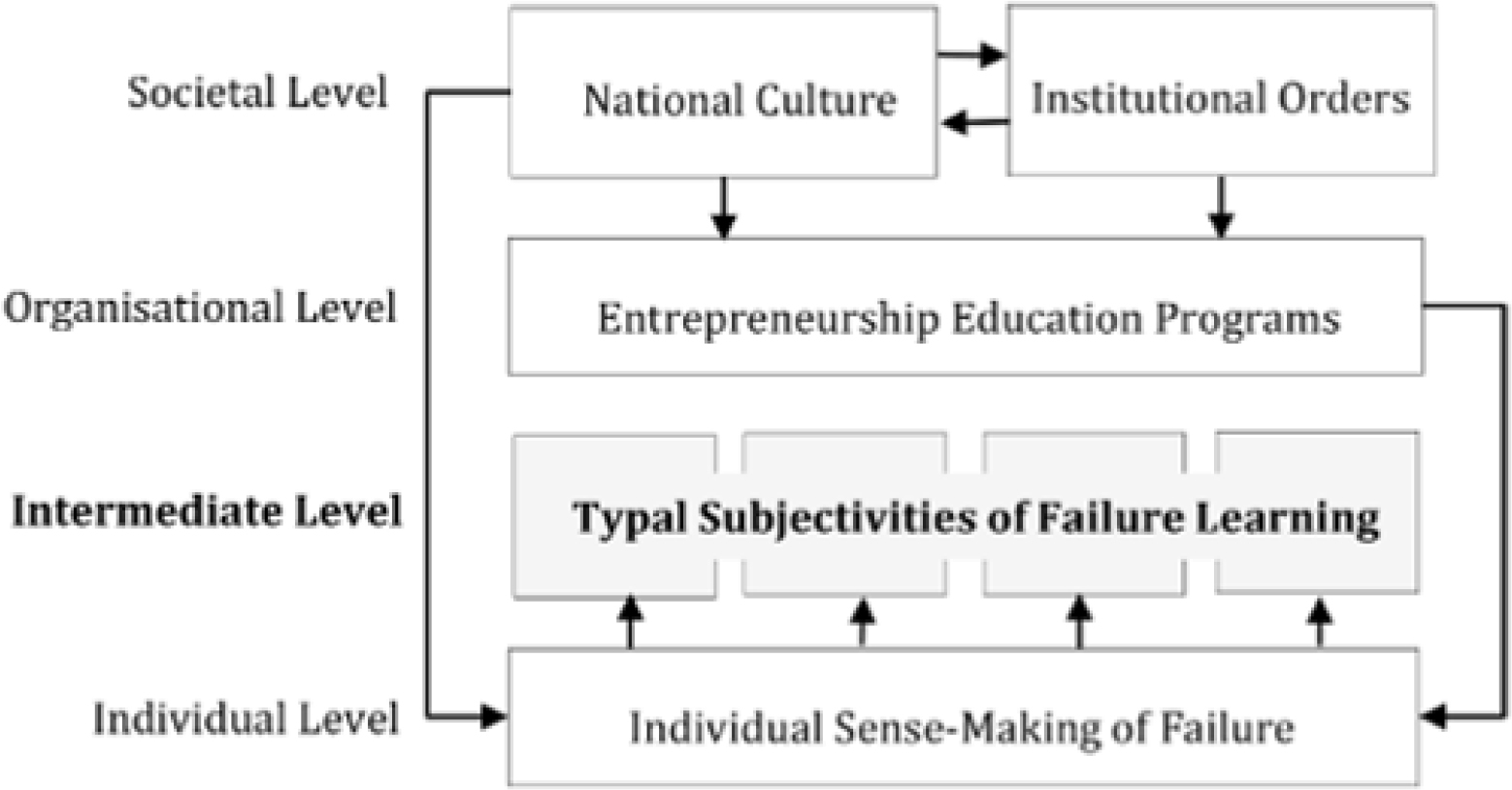
Figure 1:
Embedment of Typal Subjectivities of Failure Learning.
Source: Valliere, 2019, Heinze et al. 2022.
Table 1:
Case stories
| Case | Type | Failure Learning Strategies |
|---|---|---|
| Bjoern | Reflective Creator | Bjoern’s strategy involves continuous learning and critical feedback. He uses setbacks as opportunities to plan carefully, relying on motivational resources to rebuild self-confidence. His proactive approach helps him recognise early warning signs and take preventive measures, leveraging self-doubt as a learning tool. |
| Connie | Intuitive Analyst | Connie emphasises self-awareness and holistic reflection. She processes failure by acknowledging her strengths and weaknesses, seeking better-fitting partners in the future. She values planning and establishing solid structures over the “Fail-Fast-Fail-Often” approach, integrating a spiritual understanding into her new ventures. |
| Rita | Expressive Realist | Rita’s approach is marked by self-confidence and self-reliance. Failure triggers her fighting spirit, and she views it as a new beginning rather than an end. She avoids assigning blame and values freedom and flexibility in her work, focusing on future opportunities, and maintaining several entrepreneurial projects simultaneously. |
| Joseph | Growth-oriented Pragmatist | Joseph integrates reflective learning and values honest feedback. He keeps a diary to clarify his thoughts and lessons learned from failures. In his new career as intrapreneur, he embraces the substantial risk of failure in projects, viewing learning as a crucial project goal. His experience underscores the importance of critical feedback and resilience. |
1 Source: Case stories are based on Heinze (2020).
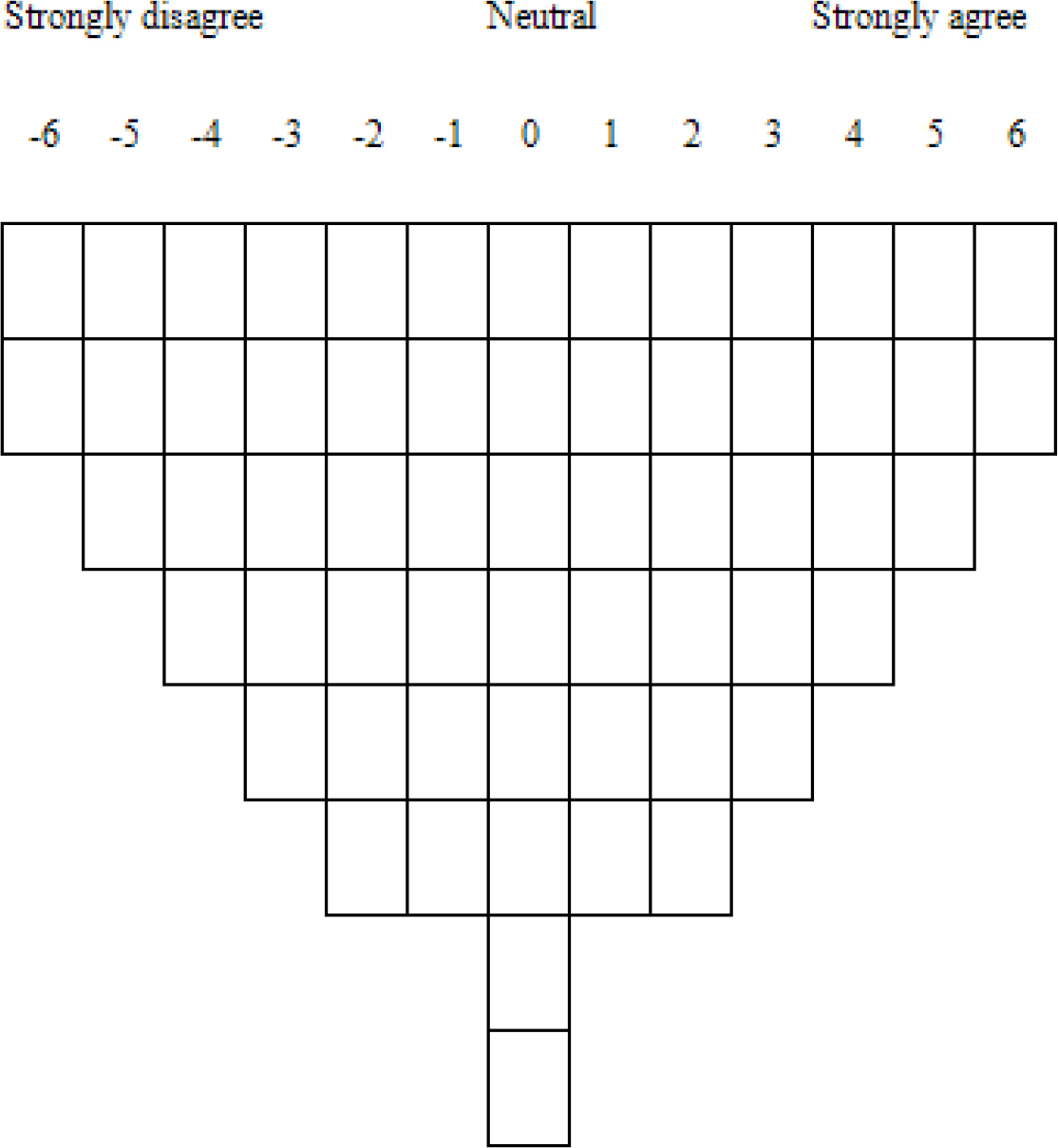
Figure 2:
Q-sorting template, adopted from Watts and Stenner (2012).
Table 2:
Factor characteristics
| No of loadings | Eigenvalues | Explained variance % | Composite reliability | S. E. scores | |
|---|---|---|---|---|---|
| Factor 1 | 9 | 3.95 | 15.2 | 0.9655172 | 0.1856953 |
| Factor 2 | 4 | 2.84 | 10.9 | 0.952381 | 0.2182179 |
| Factor 3 | 5 | 2.62 | 10.1 | 0.9411765 | 0.2425356 |
| Factor 4 | 3 | 2.21 | 8.5 | 0.9230769 | 0.2773501 |
| Factor 5 | 2 | 1.74 | 6.7 | 0.8888889 | 0.3333333 |
| Total | 23 | 51.4 |
Table 3:
Descriptive statistics of participants
| Age (average) | Gender | Work experience | Ent. experience | Interest in Ent. | Failure experience | ||
|---|---|---|---|---|---|---|---|
| Male | Female | ||||||
| Factor 1 | 22 | 22% | 78% | 100% | 22% | 4.1 | 11% |
| Factor 2 | 22 | 50% | 50% | 100% | 33% | 3.2 | 50% |
| Factor 3 | 21 | 60% | 40% | 100% | 25% | 1.8 | 40% |
| Factor 4 | 20 | 33% | 67% | 100% | 66% | 5.0 | 33% |
| Factor 5 | 21 | 100% | 0% | 100% | 100% | 3.0 | 50% |
| Total | 21.5 | 46% | 54% | 100% | 54% | 3.8 | 29% |
Table 4:
Core Beliefs of the Optimistic Learners
| Core beliefs | Meaning |
|---|---|
| Failure is crucial for Learning | Failure provides critical lessons that contribute to personal and professional development. |
| Failure is necessary for Future Success | Overcoming failure is seen as a prerequisite for achieving success in the future. |
| Trust in Own Abilities | They have confidence in their own skills and capabilities, which helps them navigate through failures. |
| Trust in Relationships | They believe in the importance of trust within their professional and personal relationships, which supports resilience and recovery from setbacks. |
| Positive Attitude | Maintaining a positive mindset is crucial for them, enabling them to face challenges with optimism. |
| Active Engagement with Failure | They do not shy away from failure but actively engage with it, learning and growing from each experience. |
Table 5:
Core Beliefs of the Cautious Individualists
| Core Beliefs | Meaning |
|---|---|
| Opportunity to Grow | They view failure primarily as a chance for personal and professional growth. |
| Denial of Emotional Stress | They tend to deny or downplay the emotional stress associated with failure, focusing instead on the practical lessons learned. |
| Self-Trust | They exhibit strong trust in their own abilities and show no self-doubt. |
| Distrust of Others | This group tends to distrust others, which may impact their ability to work collaboratively in entrepreneurial settings. |
| Fail Fast, Fail Often | They agree with the concept that frequent failure can lead to rapid learning and adaptation. |
| Success Without Failure | They believe it is possible to be successful without having previously failed, indicating a nuanced view of the role of failure in achieving success. |
| Ambiguity About Energizing Failure Experience | They exhibit ambivalence about whether failure can be an energising and motivating experience. |
Table 6:
Core beliefs of the risk-averse realists
| Core Beliefs | Meaning |
|---|---|
| Avoidance of Failure | They prefer to avoid failure whenever possible, indicating a risk-averse mindset. |
| Preference for Feedback and Advice | They value receiving feedback and advice, suggesting a preference for guided learning and support rather than learning through failure. |
| Discomfort with Engaging with Failure | This group does not like to engage with failure, reflecting a reluctance to face challenges that may lead to setbacks. |
| Rejection of “Fail Fast, Fail Often” philosophy | They disagree with the idea of frequent failure as a path to success, contrasting with more entrepreneurial mindsets that embrace failure as part of the learning process. |
Table 7:
Core beliefs of the social sufferers
| Core Beliefs | Meaning |
|---|---|
| Suffering from Failure | They acknowledge and suffer from the emotional stress associated with failure. |
| Emotional Stress | They confirm the significant emotional impact that failure has on them. |
| Failure Causes | They lack a clear understanding of the causes of their failures, which might contribute to their emotional distress. |
| Relationships | They show ambiguity about the role of relationships in their entrepreneurial journey, reflecting uncertainty in relying on others |
| Rejection of “Fail Fast, Fail Often” philosophy | They disagree with the idea of embracing frequent failures as a learning strategy, contrasting with more optimistic entrepreneurial philosophies. |
Table 8:
Core Beliefs of the Reflective Strategists
| Core Beliefs | Meaning |
|---|---|
| Need for Time | They need time to make sense of and process failure, indicating a reflective approach to learning from setbacks. |
| Self-Doubt but Readiness to Fight | They experience self-doubt but are prepared to confront and overcome challenges, demonstrating resilience and determination. |
| Careful Engagement with Failure | They recognise the challenges in engaging with failure, which might slow down their immediate response but also ensures a more deliberate and cautious approach. |
| Number | Statement |
|---|---|
| 1 | Fail fast, fail often. |
| 2 | Be open, learning can also be a result of failure. |
| 3 | Learning works best with people you get along with well. |
| 4 | For learning to take place, I need an opportunity to reflect upon the failure. |
| 5 | Critical events (such as failure) are important learning experiences. |
| 6 | At the end, I can only trust myself. |
| 7 | Things need time; short-term perspectives do not help. |
| 8 | Consistent structures / agreements / contracts are important. |
| 9 | To recognise one‘s limitations. |
| 10 | I know about my strengths and weaknesses, and I will look for partners accordingly. |
| 11 | Every conversation about the critical event leads to new questions and this is how I learn. |
| 12 | Learning is a process that takes time. |
| 13 | I lost my sense of ease; now safety comes first. |
| 14 | I am more afraid to lose control. |
| 15 | I have never felt more freedom and readiness to take up the fight as I have nothing to lose anymore. |
| 16 | I’m now aware of my negative thoughts and will deal with these. |
| 17 | The critical event forced me to learn learn content such as accounting, leadership, marketing. |
| 18 | Get rid of self-doubt as it hinders finishing the critical event. |
| 19 | When you are enthusiastic about your business / profession, you will try it again. |
| 20 | I need some time to make sense of the failure event. |
| 21 | Learning is to recognise conditions required for future success. |
| 22 | Learning happens without actively addressing the critical event, i. e. through reading. |
| 23 | Motivation is a major prerequisite for all projects. |
| 24 | Never blame somebody for the failure, there are 1000 factors, but no one to blame for. |
| 25 | The worst thing to do after failure is to hide oneself. |
| 26 | If all goes well with the first try, then it’s luck alone. |
| 27 | In the event of crisis, I am stronger than I thought. |
| 28 | After failure, I just do not get it anymore. |
| 29 | I am just grateful I did overcome the failure event. |
| 30 | From failure I can learn more than from success. |
| 31 | A diary is a good tool to learn from failure. |
| 32 | To recognise what I did right (despite the failure). |
| 33 | Critical feedback extremely supports learning from failure. |
| 34 | You have to face your anxieties, to look where it hurts. |
| 35 | Failure needs a closing, such as a speech, presentation, meeting with persons concerned. |
| 36 | A crisis is a chance and shows areas for growth and development. |
| 37 | Look for people who are already there where you would like to be. |
| 38 | Motivational books, podcasts or videos support my sense-making. |
| 39 | When climbing a rock, I need to have safety devices. |
| 40 | New projects have to be approached in a systematic manner. |
| 41 | You have to figure out the bad ingredients, when the cake does not taste well. |
| 42 | Perfectionism leads to failure (mostly). |
| 43 | Not try to do it all on my own, rather I should work together with professionals. |
| 44 | It hurts to deal with the failure. |
| 45 | Learning is supported by a positive stance on the future. |
| 46 | At university there is not enough opportunity to prepare for critical events. |
| 47 | A lot of learning happens intuitively, I do not really think about it. |
| 48 | I do not make commitments anymore. |
| 49 | The failure is my enemy which I will defeat and hence growth from the battle. |
| 50 | It is better to fail than not try at all. |
| 51 | The most important thing is that no third party will get damaged. |
| 52 | Learning from failure happens first through process routines and later intuitively. |
| 53 | A factual and accurate decision can be emotionally wrong at the same time. |
| 54 | Friends often do not tell the truth after failure. |
| 55 | I have learnt to recognise early warnings and I am prepared to act in a more pro-active manner. |
| 56 | Failure is a catalyst for new energy. |
| 57 | My social environment has changed; true friends are still with me. |
| 58 | Sometimes I have experienced paralyzing self-doubts. |
| 59 | You have to accept that it’s over now. |
| 60 | Failure is not a prerequisite for success. |
| No. of loadings | Eigenvalues | Explained variance in % | Reliability | Standard error of factor scores | |
|---|---|---|---|---|---|
| factor 1 | 9 | 4.36 | 16.77 | 0.97 | 0.16 |
| factor 2 | 7 | 3.11 | 11.96 | 0.97 | 0.19 |
| factor 3 | 6 | 2.83 | 10.88 | 0.96 | 0.20 |
| total | 22 | 39.61 |
| No. of loadings | Eigenvalues | Explained variance in % | Reliability | Standard error of factor scores | |
|---|---|---|---|---|---|
| factor 1 | 9 | 4.55 | 17.50 | 0.97 | 0.16 |
| factor 2 | 6 | 3.06 | 11.76 | 0.96 | 0.20 |
| factor 3 | 3 | 2.40 | 9.23 | 0.92 | 0.28 |
| factor 4 | 4 | 1.89 | 7.28 | 0.94 | 0.24 |
| total | 22 | 45.77 |
| No. of loadings | Eigenvalues | Explained variance in % | Reliability | Standard error of factor scores | |
|---|---|---|---|---|---|
| factor 1 | 9 | 3.95 | 15.19 | 0.97 | 0.19 |
| factor 2 | 4 | 2.84 | 10.93 | 0.95 | 0.22 |
| factor 3 | 5 | 2.62 | 10.07 | 0.94 | 0.24 |
| factor 4 | 3 | 2.21 | 8.49 | 0.92 | 0.28 |
| factor 5 | 2 | 1.74 | 6.70 | 0.89 | 0.33 |
| total | 23 | 51.37 |
| Statement | Factor scores of factor 1 | Factor scores of factor 2 | Factor scores of factor 3 | Factor scores of factor 4 | Factor scores of factor 5 |
|---|---|---|---|---|---|
| 1 | –5 | 4 | –6 | –5 | –2 |
| 2 | 1 | 2 | 1 | 0 | 0 |
| 3 | –1 | 1 | –1 | –1 | 2 |
| 4 | 4 | 3 | –4 | 0 | –1 |
| 5 | 5 | 3 | 3 | 4 | 4 |
| 6 | –6 | 5 | 0 | 2 | –3 |
| 7 | –1 | –3 | –3 | –3 | 3 |
| 8 | 0 | –2 | –3 | –5 | 2 |
| 9 | –3 | –2 | 2 | –4 | –4 |
| 10 | 0 | 2 | 1 | 1 | –4 |
| 11 | 2 | 1 | –1 | 4 | 5 |
| 12 | 5 | 5 | 1 | 5 | –2 |
| 13 | –3 | –6 | 0 | 2 | –1 |
| 14 | –1 | –5 | –5 | 2 | –1 |
| 15 | 0 | 1 | –3 | –2 | 6 |
| 16 | 2 | –1 | 0 | –1 | –6 |
| 17 | 0 | 0 | 0 | –2 | 1 |
| 18 | –3 | –3 | –3 | 2 | 1 |
| 19 | 1 | 3 | 0 | 0 | 3 |
| 20 | 0 | –3 | 0 | 1 | 0 |
| 21 | 4 | 4 | –1 | 3 | –5 |
| 22 | –2 | 3 | 1 | –2 | –2 |
| 23 | 2 | 5 | 6 | 5 | 0 |
| 24 | –1 | 2 | –4 | 0 | –3 |
| 25 | 0 | 2 | –4 | –1 | 2 |
| 26 | –2 | –4 | –5 | –4 | –2 |
| 27 | 3 | 4 | 4 | 6 | 0 |
| 28 | –6 | –4 | –2 | –5 | –3 |
| 29 | 3 | –1 | 2 | –2 | 6 |
| 30 | 6 | –1 | –5 | 2 | 0 |
| 31 | 1 | –3 | 3 | 1 | –5 |
| 32 | 3 | 0 | –2 | 0 | 4 |
| 33 | 3 | 1 | 5 | 0 | 1 |
| 34 | 1 | –1 | 2 | 5 | –2 |
| 35 | 1 | 0 | –2 | 0 | 1 |
| 36 | 5 | 6 | 2 | 1 | 2 |
| 37 | 1 | 3 | 3 | –4 | –4 |
| 38 | –5 | –5 | –2 | 3 | 1 |
| 39 | –2 | –1 | 2 | –2 | 4 |
| 40 | –2 | 0 | 0 | –6 | –6 |
| 41 | –3 | –2 | –4 | 6 | 4 |
| 42 | –2 | –4 | –2 | –3 | –3 |
| 43 | 0 | 0 | 4 | –1 | 2 |
| 44 | 2 | –2 | 3 | 4 | 0 |
| 45 | 4 | 0 | 6 | 3 | 2 |
| 46 | –4 | –1 | 5 | –1 | 5 |
| 47 | –1 | 1 | 4 | 1 | –3 |
| 48 | –4 | –6 | –3 | –2 | –4 |
| 49 | –1 | –2 | 4 | 1 | –1 |
| 50 | 6 | 1 | –1 | –1 | –1 |
| 51 | –3 | –4 | 2 | –4 | 0 |
| 52 | 3 | 0 | 1 | 2 | 4 |
| 53 | 2 | 4 | 1 | 3 | 1 |
| 54 | –4 | –3 | –1 | 4 | –2 |
| 55 | –2 | 2 | 0 | –3 | 3 |
| 56 | 4 | 0 | –2 | –3 | 3 |
| 57 | 2 | 6 | 5 | –3 | 3 |
| 58 | 0 | –5 | –1 | 3 | 0 |
| 59 | –5 | –2 | 3 | –6 | –5 |
| 60 | –4 | 2 | –6 | 0 | –2 |