
INTRODUCTION
Entrepreneurial failure is a widespread phenomenon and has increasingly become a focus of academic research (Czakon et al., 2024). Despite this, failure is rarely addressed in entrepreneurship education (hereafter EE), even though EE has grown globally in higher education institutions (Alvarado-Valenzuela et al., 2023). EE has been criticised as being underdeveloped (Carey and Matlay, 2010) and focuses on start-up, growth, and success, with limited attention paid to failure (Eesley and Lee, 2021; Pellegrini et al., 2021). This omission leaves students unprepared to navigate or learn from setbacks effectively and potentially hinders them from developing an entrepreneurial mindset.
This gap in EE aligns with broader critiques of how failure is framed in contemporary systems. For example, Knott and Posen (2005) highlight how venture failure can enhance industry efficiency and yield social benefits, while Appadurai and Alexander (2019) critique the commodification of failure in advanced capitalism, where only a privileged few “fail up.” These critiques highlight the need to address failure as a systemic phenomenon, beyond individual responsibility, particularly in EE. At the same time, studies on drop-out rates suggest that university students are frequently exposed to failure during their studies but lack formal education on the topic (Aina et al., 2022). This raises critical questions: if failure is not included in EE, are students deprived of a realistic and balanced view of entrepreneurial challenges (Alvarado-Valenzuela et al., 2023) and how do students perceive, make sense of, and learn from failure in their EE journeys? These questions frame our research, which explores how entrepreneurship students perceive the concept of failure and develop strategies to learn from it.
While there is no agreed definition of entrepreneurial failure, for our study we adopt Cope’s (2011, p. 605) definition, which conceptualises entrepreneurial failure as “the termination of a business which has fallen short of its goals.” While it has been recognised as a learning opportunity (Cope, 2011), the learning process remains underexplored (McGrath, 1999). Reactions to failure vary between negative emotions such as grief, confusion, loss of confidence or fear and positive emotions such as liberation, self-actualisation, or recognition of own strengths, and significantly influence what and how individuals learn (Cardon et al., 2005; Heinze, 2013; Jenkins, Wiklund and Brundin, 2014; Ucbasaran et al., 2013). While scholars have suggested incorporating an entrepreneurial mindset - including optimism, resilience, and learning from failure into education (Kuratko and Morris, 2018), broader transformations are also needed. For instance, Dodd et al. (2022) advocate for integrating sustainability, social justice, and hope into entrepreneurship pedagogy to challenge dominant narratives of success and failure. Similarly, Crosina et al. (2023) emphasize the importance of addressing negative experiences to foster higher-order learning and the development of an entrepreneurial mindset.
In the Irish context, the 2021 Global Entrepreneurship Monitor (GEM) report noted a rising fear of failure, deterring entrepreneurial activity. Anecdotally, business failure rates in Ireland are increasing, particularly post-pandemic. However, little is known about whether this fear of failure affects students as future entrepreneurs and business leaders. Most research to date on learning from failure focuses on the experience of the individual or entrepreneur themselves, yet Seo, Kim and Mesquita (2024) point to research which looks at vicarious entrepreneurial failure which suggests that the effects of entrepreneurial failure are not limited to those who experience failure but extend to those who indirectly observe entrepreneurial failure. This exploratory study investigates students’ perceptions of and attitudes toward learning from failure in an entrepreneurial education context. We ask how students make sense of the concept of learning from failure and develop strategies to learn from it, providing answers to how to address the topic of entrepreneurial failure at an intermediate level.
We contribute to the conversation on EE in several ways. Using Q-Methodology, we identify and analyse typal subjectivities among business students at an Irish business school regarding their sense-making and learning from failure. Our findings reveal five distinct learning archetypes, shedding light on the diverse ways students process and learn from failure. By applying the concept of entrepreneurial learning, we systematically interpret these attitudes, bridging the gap between individual-level and societal-level perspectives on failure. Using narratives or case stories, we provide a pedagogical template for entrepreneurship educators to introduce the topic of failure in EE which conceptualises failure as a learning tool. Our paper is structured as follows: first, we discuss relevant theories in entrepreneurial learning and failure learning. Next, we outline our methodology, followed by a presentation and discussion of our findings. Finally, we highlight our contributions and suggest avenues for future research.
ENTREPRENEURIAL LEARNING
Conceptually, entrepreneurial learning has been placed between learning theories and entrepreneurship research (Harrison and Leitch, 2005), focusing on the idea that knowledge about how and when learning takes place are similarly important to understand the workings of the entrepreneurial process (Wang and Chugh, 2014). In their systematic review of the literature, Wang and Chugh (2014) propose different sets of learning types crucial to understand the challenges in entrepreneurship. These sets include individual and collective learning, exploratory and exploitative learning, and intuitive and sensing learning. As we will focus on intuitive and sensing learning in our study, we now present a brief overview of these styles.
The concepts of intuitive and sensing learning styles were initially developed by Jung (1971) and later operationalized by McCaulley (1981). Sensing learning involves learning through external contacts like sights, sounds, and physical sensations, focusing on concrete facts and details. On the other hand, intuitive learning involves understanding relationships between facts and discovering possibilities, characterised by abstract and conceptual thinking. Sensing learners are practical and detail-oriented and apt at discovering existing opportunities by analysing market conditions. Conversely, intuitive learners are abstract thinkers, inclined to create new opportunities through conceptual insights. Sensing and intuitive learning can be aligned with Kolb’s (1984) experiential learning theory, which emphasises the transformation of concrete experiences into abstract conceptualisation through reflective observation, a process that is crucial in understanding entrepreneurial learning (Wang and Chugh, 2014). Furthermore, Bandura’s (1977) social learning theory also explains sensing learning by suggesting that learning occurs through social interactions, observations, and imitation of role models. Hence, entrepreneurial skills and the self-efficacy of entrepreneurs are influenced by their social environment and interactions, highlighting the importance of social context in entrepreneurial learning and development (Cope, 2005; Heinze et al., 2022; Wang and Chugh, 2014). We will now provide a brief overview of the literature on learning from failure.
LEARNING FROM FAILURE
The topic of entrepreneurial failure (hereafter EF) has gained prominence in both scientific and popular debates about entrepreneurship (Czakon et al., 2024; Walsh and Cunningham, 2017). The scant literature on EF primarily focuses on conceptualisations of failure (Jenkins and McKelvie, 2016; Khelil, 2016), failure attribution (Cardon, Stevens and Potter, 2011; Franco and Haase, 2010), causes and consequences of failure (Ucbasaran et al., 2013), failure attribution and sensemaking (Mandl, Berger and Kuckertz, 2016; Mantere et al., 2013), the stigma of failure (Simmons, Wiklund and Levie, 2014), learning from failure (Cope, 2011; Shepherd, 2003), and the role of passion in overcoming failure (Walsh and Cunningham, 2024). What we do know is that failure is highly prevalent and may occur at any age and stage of a venture’s development (Thornhill and Amit, 2003). However, EF is rarely addressed in formal education, leaving potential entrepreneurs, including students of entrepreneurship, unprepared for setbacks.
Entrepreneurs’ growth and development are significantly influenced by learning from failure and loss, as these experiences are frequent and impactful in the entrepreneurial process (McGrath, 1999; Shepherd et al., 2014; Ucbasaran et al., 2013; Wolfe and Shepherd, 2015). Loss is experienced by an entrepreneur due to their organisation’s demise (Shepherd, 2003). Hence, business failure evokes negative emotional responses akin to grief (Crosina and Pratt, 2019). Learning in this context involves sensemaking (Byrne and Shepherd, 2015), which helps individuals interpret and make sense of surprising or confusing events (Weick, 1995). However, sensemaking is complex in failure contexts due to the emotional and cognitive challenges involved (Stroebe, 1999). Entrepreneurs focus alternately on what is lost and on future possibilities, an emotional oscillation which shapes the sensemaking process (Byrne and Shepherd, 2015).
Cultural differences in the stigmatisation and fear of failure play a critical role in understanding learning processes (Wennberg, Pathak and Autio, 2013; Baù et al., 2017). Prior exploratory studies highlight typal similarities and differences in failure learning across cultures (Heinze et al., 2022), offering valuable insights for developing programs that encourage healthy and resilient approaches to failure.
Despite the already established understanding of the dynamics of entrepreneurial learning and the role of failure and its crucial role for enhancing entrepreneurial education and practice, there is still lack of a detailed examination of individual ways to learn from failure. Crosina et al. (2023) suggest that this could be due to the potential negative emotional reaction of students to the reality of business failure, as well as the reluctance of educators to present such experiences to students. To address this gap, we developed a research design guided by the theoretical foundations in two ways. First, the concepts of sensing and intuitive learning offered a lens to examine how students process failure narratives. Second, the literature on failure highlighted the importance of typal differences in learning, informing our decision to use Q-Methodology to capture subjective perspectives and explore how failure narratives influence students’ entrepreneurial learning. In the next section we detail our research design to address our research question: how do students of entrepreneurship perceive, make sense of, and develop strategies to learn from the concept of failure?
METHODOLOGY
This research adopts Q-Methodology, which is particularly relevant when the objectives of the research are to explore perceptions of individuals, in this case perceptions of learning from failure of students at a business school in Ireland. According to Herrington and Coogan (2011), Q-Methodology is a useful way to unpack the points of view about a particular topic. A key advantage of Q-Methodology is that it facilitates insights into the perceptions and sense-making of individuals, in this case entrepreneurship students, where social aspects are related to individual agency. Our research aims to understand the perspectives of entrepreneurship in relation to the meaningfulness and significance of different attitudes to learn from failure. By using Q-Methodology, we can distil data at an intermediate level (see Figure 1) to increase our understanding of ways to support future entrepreneurs in their ability to accept the likelihood of failure and to figure out how to learn from such instances.
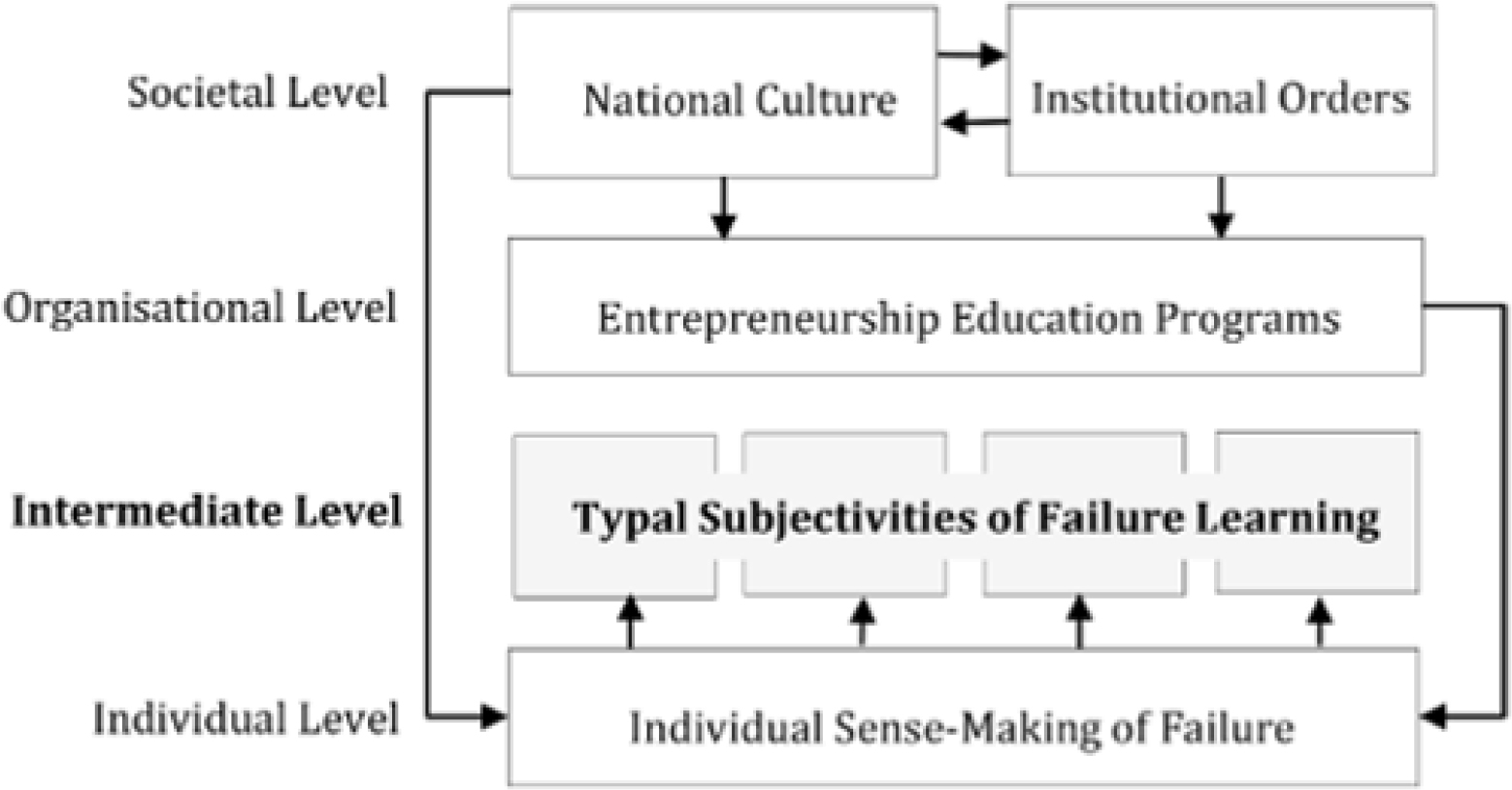
Figure 1:
Embedment of Typal Subjectivities of Failure Learning.
Source: Valliere, 2019, Heinze et al. 2022.
The focus is on quality as opposed to quantity and small samples are suitable for analysis. As indicated by Brown (1980), distinct perspectives on any topic are limited, hence the idea that any set of statements reflecting a broad heterogeneous range of opinions will reveal the existence of groups with similar viewpoints. The phases of a Q-study include the development of a concourse, the development of the Q-sample, selection of the p set, conduct of the Q-sort and analysis of the data.
An existing concourse developed by Heinze (2020), was used for this study. Prior to the Q-sort, students were presented with four vignettes detailing individuals’ stories of learning from failure. Table 1 provides a summary of the case stories, which were developed from interviews with entrepreneurs who experienced business failure (Heinze, 2020). These case stories were crafted to represent prototypical examples of the typal subjectivities identified in earlier research. They include statements like those in the concourse used for the Q-sort, thereby creating a bridge between the narratives and the sorting process. By engaging with these narratives, students were given the opportunity to delve into the lived experiences of failure, gaining familiarity with the key themes and statements presented in the Q-sort. This preparatory step facilitated deeper engagement with the broader topic of learning from entrepreneurial failure. The use of stories to promote entrepreneurship and to highlight the individual in entrepreneurship has been highlighted as a valuable pedagogical tool by Whelan and O’Gorman (2007).
Table 1:
Case stories
| Case | Type | Failure Learning Strategies |
|---|---|---|
| Bjoern | Reflective Creator | Bjoern’s strategy involves continuous learning and critical feedback. He uses setbacks as opportunities to plan carefully, relying on motivational resources to rebuild self-confidence. His proactive approach helps him recognise early warning signs and take preventive measures, leveraging self-doubt as a learning tool. |
| Connie | Intuitive Analyst | Connie emphasises self-awareness and holistic reflection. She processes failure by acknowledging her strengths and weaknesses, seeking better-fitting partners in the future. She values planning and establishing solid structures over the “Fail-Fast-Fail-Often” approach, integrating a spiritual understanding into her new ventures. |
| Rita | Expressive Realist | Rita’s approach is marked by self-confidence and self-reliance. Failure triggers her fighting spirit, and she views it as a new beginning rather than an end. She avoids assigning blame and values freedom and flexibility in her work, focusing on future opportunities, and maintaining several entrepreneurial projects simultaneously. |
| Joseph | Growth-oriented Pragmatist | Joseph integrates reflective learning and values honest feedback. He keeps a diary to clarify his thoughts and lessons learned from failures. In his new career as intrapreneur, he embraces the substantial risk of failure in projects, viewing learning as a crucial project goal. His experience underscores the importance of critical feedback and resilience. |
1 Source: Case stories are based on Heinze (2020).
The interviews were conducted using Interpretative Phenomenological Analysis (IPA), a method known for generating rich, in-depth data about individuals’ sensemaking processes. These interviews yielded 164 statements describing how and what entrepreneurs learned in the aftermath of failure. With an iterative screening process, we reduced the initial pool to 60 statements capturing the full spectrum of perspectives on learning from failure while avoiding redundancy. These statements align closely with the theoretical frameworks presented in this study, particularly the concepts of entrepreneurial learning and sensemaking, and provide the foundation for identifying typal subjectivities among the students. In January 2024, the Q-sort was conducted with final year undergraduate business students at, a business school in Ireland by applying an online tool using the Q-Method software package.
During class, after a lecture delivered by one of the authors and some discussion of both the research on learning from failure as well as experiences of failure, students were introduced to the task of sorting a set of 60 statements according to their agreement, disagreement, and ambivalence. The lecture was part of a twelve-week course titled “SME and Family Business Management” offered to final year Business students, as part of a suite of entrepreneurship modules. A list of the statements included can be found in Appendix 1. The set of statements was derived from the concourse developed in the Q-study, which itself was drawn from interviews with entrepreneurs who experienced business failure (Heinze, 2020). Figure 2 shows the typical matrix applied in a Q-study that forces a quasi-normal distribution which was used in our study.
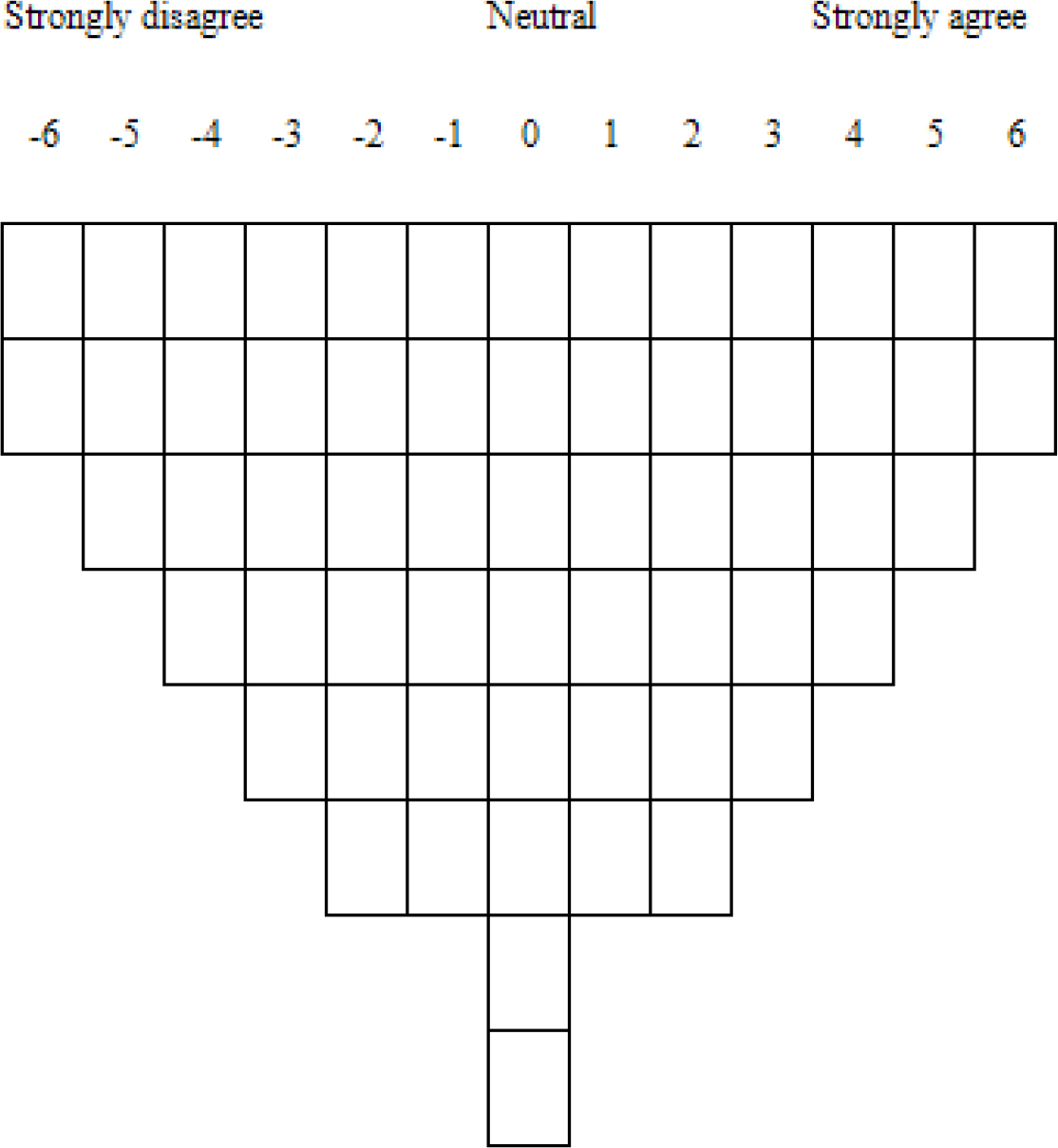
Figure 2:
Q-sorting template, adopted from Watts and Stenner (2012).
In total, 70 students took part in the exercise. Their data was exported in CSV format and imported into the R platform, a free software environment for statistical computing and graphics and analysed by application of the Q-Method package (Zabala, 2014). Here, the Q-sets become subjects, and the individual Q-sorts become variables (Sinclair, 2019). Individual viewpoints are clustered into similar opinions or standpoints. Factors are extracted by Principal Component Analysis (PCA) and varimax-rotated for maximum differentiation. Thereafter, factors are selected iteratively using both the researchers’ theoretically informed judgement and loadings that maximise both the number of statements that have significant loading onto the factors and the number of participants accounting for the factors. Separate factors represent typal subjectivities, where significantly differing loadings represent individual attitudes that are not universally held by the group of students participating in the study. Due to our observationduring the sort and following discussion we decided to exclude sorts from students who did not fully engage with the exercise. This resulted in 24 responses considered for further analysis.
RESULTS
In this paper, we first present the set of typal subjectivities yielded by application of Q-methodology focusing on the statistical procedures. Typal is a term used in Q-methodology and represents a typified view based on common responses. To explore the number and quality of typal subjectivities between undergraduate students enrolled at an Irish Business School, three outcomes of factor rotation were carried out. Appendix 2 compares the different scenarios of extracted factors and their corresponding quality indicators for rotation. Due to the researchers’ expertise in combination with the quality indicators, the decision for the 5-factor model has been taken. Table 2 shows the rotation results.
Table 2:
Factor characteristics
| No of loadings | Eigenvalues | Explained variance % | Composite reliability | S. E. scores | |
|---|---|---|---|---|---|
| Factor 1 | 9 | 3.95 | 15.2 | 0.9655172 | 0.1856953 |
| Factor 2 | 4 | 2.84 | 10.9 | 0.952381 | 0.2182179 |
| Factor 3 | 5 | 2.62 | 10.1 | 0.9411765 | 0.2425356 |
| Factor 4 | 3 | 2.21 | 8.5 | 0.9230769 | 0.2773501 |
| Factor 5 | 2 | 1.74 | 6.7 | 0.8888889 | 0.3333333 |
| Total | 23 | 51.4 |
Investigation of factor loadings, eigenvalues, explained variance, factor correlations and composite reliability scores suggests the five-factor solution, accounting for 51.4 % of the variance. One Q-sort exhibited cross-loadings and therefore non-defining variables. Each factor extracted represents a shared opinion of participants. All factors extracted meet standard criteria by showing eigenvalues more than 1.00, at least two Q-sorts, significantly loading on each factor (p < 0.05) and satisfactory reliability scores, namely composite reliability > 0.7 (Hair et al., 2014). A table containing the factor scores that indicate agreement, or disagreement is presented in Appendix 3. To get a better understanding about the students’ demographic data, previous experiences, and personal interests in becoming an entrepreneur, a questionnaire was distributed. Table 3 provides the summarised information per factor.
Table 3:
Descriptive statistics of participants
| Age (average) | Gender | Work experience | Ent. experience | Interest in Ent. | Failure experience | ||
|---|---|---|---|---|---|---|---|
| Male | Female | ||||||
| Factor 1 | 22 | 22% | 78% | 100% | 22% | 4.1 | 11% |
| Factor 2 | 22 | 50% | 50% | 100% | 33% | 3.2 | 50% |
| Factor 3 | 21 | 60% | 40% | 100% | 25% | 1.8 | 40% |
| Factor 4 | 20 | 33% | 67% | 100% | 66% | 5.0 | 33% |
| Factor 5 | 21 | 100% | 0% | 100% | 100% | 3.0 | 50% |
| Total | 21.5 | 46% | 54% | 100% | 54% | 3.8 | 29% |
With regards to age, our participants belong to the expected generational cohort. The gender distribution is balanced. All participants have worked either as an intern or part-time employee. Furthermore, in total more than half of the participants referred to previous entrepreneurial activities, either within their family or self-, respectively peer-founded business. However, overall, their interest in entrepreneurship as a future career trajectory is mixed. On a 7-item-scale, they scored with an average of 3.8. An interesting finding is that almost one-third of the students have already been exposed to entrepreneurial failure.
As already stated, the factor analysis suggests a solution expressing five typal subjectivities in learning from failure. Each of the types takes a different approach to make sense and to utilise failure to learn. It is worth mentioning that each of the types show both attitudes to make the best from failure as well as attitudes that may be limiting regarding personal growth and learning from failure. Before we report on the distinctive elements of our analysis, we would like to pay attention to the consensus or similarities between participants. Our results suggest that undergraduate students perceive failure as a crucial learning experience and are willing to engage with failure. Interestingly, they also strongly agreed with a statement claiming they feel prepared to deal with failure due to their education. Turning to the factor analysis and deeper qualitative interpretation, we will now discuss the specific characteristics of each of the factors. We decided to address key factors based on the case study provided as a pre-reading, a general interest in entrepreneurship as a career trajectory, as well as the overall perception of failure.
Type 1 - Optimistic Learners
Most participants resonated with the story of Bjoern, an entrepreneur who lost his entire assets but became a wiser and more knowledgeable investor. This connection suggests that Optimistic Learners value long-term learning and growth from failure experiences. Optimistic Learners exhibit strong entrepreneurial tendencies, characterised by a proactive approach to identifying and exploiting business opportunities. The Optimistic Learners’ perception of failure is to view failure as an essential part of the learning process and a stepping stone to future success. Table 4 provides a summary of their attitudes towards failure and learning from it.
Table 4:
Core Beliefs of the Optimistic Learners
| Core beliefs | Meaning |
|---|---|
| Failure is crucial for Learning | Failure provides critical lessons that contribute to personal and professional development. |
| Failure is necessary for Future Success | Overcoming failure is seen as a prerequisite for achieving success in the future. |
| Trust in Own Abilities | They have confidence in their own skills and capabilities, which helps them navigate through failures. |
| Trust in Relationships | They believe in the importance of trust within their professional and personal relationships, which supports resilience and recovery from setbacks. |
| Positive Attitude | Maintaining a positive mindset is crucial for them, enabling them to face challenges with optimism. |
| Active Engagement with Failure | They do not shy away from failure but actively engage with it, learning and growing from each experience. |
Overall, Optimistic Learners represent a typal subjectivity that is characterised by an elevated level of adaptability and a constructive approach to dealing with failures. These students embody a proactive and positive mindset towards entrepreneurial challenges, seeing failure as an opportunity for growth and learning. Their ability to trust in themselves and their relationships, combined with a positive attitude, enables them to actively engage with and learn from their failures, positioning them well for future entrepreneurial success.
Type 2 - Cautious Individualists
Interestingly, none of the participants in type 2 connected with the failure stories from the provided case study. Type 2, Cautious Individualists show a mixed interest in entrepreneurship; on the one hand there is evidence for high entrepreneurial orientation despite past failure, on the other there is no interest reported at all. Furthermore, Cautious Individualists show distinct attitudes towards failure as evidenced in Table 5 below.
Table 5:
Core Beliefs of the Cautious Individualists
| Core Beliefs | Meaning |
|---|---|
| Opportunity to Grow | They view failure primarily as a chance for personal and professional growth. |
| Denial of Emotional Stress | They tend to deny or downplay the emotional stress associated with failure, focusing instead on the practical lessons learned. |
| Self-Trust | They exhibit strong trust in their own abilities and show no self-doubt. |
| Distrust of Others | This group tends to distrust others, which may impact their ability to work collaboratively in entrepreneurial settings. |
| Fail Fast, Fail Often | They agree with the concept that frequent failure can lead to rapid learning and adaptation. |
| Success Without Failure | They believe it is possible to be successful without having previously failed, indicating a nuanced view of the role of failure in achieving success. |
| Ambiguity About Energizing Failure Experience | They exhibit ambivalence about whether failure can be an energising and motivating experience. |
To conclude, Cautious Individuals represent a typal subjectivity marked by a pragmatic approach to failure, where failure is seen as a functional step towards improvement rather than an emotional setback. The type’s lack of connection with the case study stories suggests they might not see external narratives as relevant to their own experiences. Their strong self-trust combined with distrust in others may lead to a more individualistic approach to entrepreneurship, potentially limiting collaborative opportunities. The mixed feelings about failure’s energising effects reflect a balanced perspective that values practical outcomes over emotional reactions.
Type 3 - Risk-Averse Realists
As with the Optimistic Learners, we observed resonance with Björn’s story of overcoming failure and becoming a wiser investor. Additionally, students related to Conny’s story, who struggled significantly after her failure and took time to recover. This is in line with the low entrepreneurial orientation within the group: Risk-Averse Realists show the least interest taking up entrepreneurial activities among the factors observed in our study. Risk-Averse Realists display a clear aversion to failure, characterised by the following attitudes (Table 6).
Table 6:
Core beliefs of the risk-averse realists
| Core Beliefs | Meaning |
|---|---|
| Avoidance of Failure | They prefer to avoid failure whenever possible, indicating a risk-averse mindset. |
| Preference for Feedback and Advice | They value receiving feedback and advice, suggesting a preference for guided learning and support rather than learning through failure. |
| Discomfort with Engaging with Failure | This group does not like to engage with failure, reflecting a reluctance to face challenges that may lead to setbacks. |
| Rejection of “Fail Fast, Fail Often” philosophy | They disagree with the idea of frequent failure as a path to success, contrasting with more entrepreneurial mindsets that embrace failure as part of the learning process. |
Taken together, Risk-Averse Realists represent a typal subjectivity characterised by a preference for stability and structured support over the trial-and-error approach commonly associated with entrepreneurial ventures. Their low entrepreneurial orientation suggests a cautious approach to risk-taking, and their inclination towards seeking feedback and advice indicates a reliance on external validation and guidance. The group’s aversion to engaging with failure and disagreement with the “fail fast, fail often” philosophy further underscores their preference for minimizing risks and avoiding potential setbacks. This mindset may limit their exposure to the learning opportunities that failure can provide, but it aligns with their desire for a more secure and predictable path to success.
Type 4 – Social sufferers
Similar to the Optimistic Learners and the Risk-Averse Realists, we observed a certain resonance with Bjoern’s story of learning from failure, this resonates with the idea of long-term learning and strive for resilience. Additionally, there has also been a connection with Rita’s story, who felt liberated by her failure, seeing it as a new beginning. Rita emphasises self-reliance and the absence of self-doubt, believing that failure is not the end but a transition to new opportunities. Interestingly, the Social Sufferers show the strongest interest in pursuing a career in entrepreneurship, despite their experiences and perceptions of failure. This is especially interesting as students in this factor exhibit a complex relationship with failure, characterised in Table 7.
Table 7:
Core beliefs of the social sufferers
| Core Beliefs | Meaning |
|---|---|
| Suffering from Failure | They acknowledge and suffer from the emotional stress associated with failure. |
| Emotional Stress | They confirm the significant emotional impact that failure has on them. |
| Failure Causes | They lack a clear understanding of the causes of their failures, which might contribute to their emotional distress. |
| Relationships | They show ambiguity about the role of relationships in their entrepreneurial journey, reflecting uncertainty in relying on others |
| Rejection of “Fail Fast, Fail Often” philosophy | They disagree with the idea of embracing frequent failures as a learning strategy, contrasting with more optimistic entrepreneurial philosophies. |
Social Sufferers represent a typal subjectivity marked by a high interest in entrepreneurship but also significant emotional responses to failure. Their connection to the stories of Bjoern and Rita suggests a desire to emulate such growth and energy, though they currently struggle with understanding and processing their own failures. Their self-motivation and control-oriented approach indicate a reliance on personal strength and resilience, while their ambiguity about relationships reflects a cautious approach to collaboration. This group draws strength from their negative experiences, using their emotional struggles as a source of motivation to push forward. Hence, they embody a complex mix of aspirational resilience and current emotional vulnerability, striving to balance these aspects in their entrepreneurial pursuits.
Type 5 - Reflective strategists
In this group we found a connection with the last of our four case study stories, in which Joseph’s narrative emphasises the importance of honest feedback from friends and learning from mistakes with them. He applies this knowledge in his recent entrepreneurial activities, accepting high failure risks while valuing the learning process. Our analysis yielded evidence that Reflective strategists exhibit a thoughtful and measured approach to failure, summarised in Table 8.
Table 8:
Core Beliefs of the Reflective Strategists
| Core Beliefs | Meaning |
|---|---|
| Need for Time | They need time to make sense of and process failure, indicating a reflective approach to learning from setbacks. |
| Self-Doubt but Readiness to Fight | They experience self-doubt but are prepared to confront and overcome challenges, demonstrating resilience and determination. |
| Careful Engagement with Failure | They recognise the challenges in engaging with failure, which might slow down their immediate response but also ensures a more deliberate and cautious approach. |
Reflective strategists represent a typal subjectivity that is reflective and cautious in dealing with failure. Their need for time to process failure and their experience of self-doubt are balanced by a readiness to fight and overcome challenges. This indicates a resilience that is not immediately reactive but rather contemplative and strategic. Their connection to Joseph’s story, which emphasises learning from honest feedback and valuing the learning process itself, highlights their appreciation for thoughtful and measured responses to failure. They recognise the importance of critical feedback and see the potential for learning as an integral part of any project. This balanced perspective makes them well-suited to environments where reflective thinking and cautious risk-taking are valued. We will now present a comparative analysis highlighting the distinguishing characteristics of our typology.
Starting with the interest in taking up entrepreneurship as a career trajectory, we found that both the Optimistic Learner as well as the Social Sufferer show strong entrepreneurial aspirations, although their motivation may differ. They are followed by the Cautious Individualists and Reflective Strategists, both expressing ambivalence about pursuing an entrepreneurial career, again for varied reasons. Finally, the Risk-Averse Realists express little interest in taking up entrepreneurship as a career.
Turning to the distinguishing attitudes towards failure represented by our five typal subjectivities, the Optimistic Learners (Factor 1) demonstrate positivity as they actively engage with failure and value it as a learning opportunity. However, the attitudes of the Reflective Strategist (Factor 5) towards learning from failure might be the most successful in the long term. Although the Reflective Strategists need time to process failure, the more reflective approach might help to avoid over-optimism and enhance critical exploration of failure and learning from it. Both Cautious Individuals (Factor 2) as well as Social Sufferers (Factor 4) provide a mixed picture of supportive and non-supportive attitudes toward learning from failure. The attitudes of the Cautious Individuals are ambiguous and distrustful, as they see failure as an opportunity for growth but are ambiguous about failure’s benefits and distrust others. The attitudes of the Social Sufferers are emotional and self-reliant, as they suffer from failure but also show self-responsibility and autonomy. The attitudes of the Risk-Averse Realists (Factor 3) are the least positive as they are avoidant of failure, preferring thus denying opportunity for innovation or personal growth.
Concerning the distinguishing emotional responses to failure, positive emotions are demonstrated by Optimistic Learners, as overall, they engage with failure and maintain a positive attitude. Also, Reflective Strategists experience positive emotions as they know what is good for them (taking time to reflect), how to overcome self-doubt, and learn from failure. The Cautious Individualists seem to be free of negative emotions, however, as they deny the experience of stress, they may also deny the emotional impact of failure. This is like the Risk-Averse Realists who completely avoid engaging with failure and dislike its emotional toll. The emotional response of the Social Sufferer is negative, as they struggle with the emotional impact. However, as they acknowledge emotional stress and strive for resilience, this response is considered healthier than the ones from Factors 2 and 3.
Finally, we access the strengths and challenges of our five factors regarding entrepreneurial learning. Here we differentiate the dimensions of “Learning about Oneself,” “Learning about the Venture” and “Learning about Relationships,” based on studies by Cope (2011) and Quan and Hung (2016). Regarding Learning About Oneself, Optimistic Learners have strong self-awareness, confidence in their abilities, and a positive attitude toward personal growth. Therefore, it might be challenging for them to learn about themselves as they tend to overlook deeper personal flaws due to their optimism. Cautious Individualists are their high self-reliance as well as their confidence in personal abilities, and their denial of emotional stress can be challenging for a deeper personal understanding of the failure experience. The Risk-Averse Realists actively seek feedback and advice, and they are open to guided self-improvement. On the other hand, they might be challenged due to their aversion to failure, as it is likely to limit personal growth from negative experiences. Social Sufferers are highly aware of emotional responses to failure, and their potential for deep self-reflection. Their challenge is their continuing struggle with self-doubt and emotional stress. Last, the Reflective Strategists might be best prepared to learn about themselves, as their strength lies in their reflective approach, showing their willingness to confront self-doubt and learn from it.
In relation to the dimension of learning about the venture, the Optimistic Learners, with their strong entrepreneurial orientation and readiness to learn from failure, are likely to improve their business strategies. On the other hand, there is a risk of over-optimism potentially leading to repeated mistakes. Cautious Individualists are well prepared to see failure as a growth opportunity, and they show practical attitudes in learning from business mistakes. They are challenged by their distrust in others which is likely to limit collaborative learning and feedback. Although the Risk-Averse Realists might be challenged by their preference for stability, hindering innovation and bold decisionmaking, due to their careful and cautious approach they are also prepared to learn from business activities. The Social Sufferers are motivated to improve and learn from failure, although their lack of understanding of failure causes might lead to misattributing reasons for business setbacks, For the Reflective Strategists, their strength is to value learning from both successes and failures. In respect to challenges, their cautious approach may limit rapid innovation and risk-taking.
Finally, in the dimension Learning About Social Relationships, the Optimistic Learners’ trust in relationships and their interest in feedback can be a strength in collaborative environments, however, it might also lead to an over-reliance on positive feedback, missing critical insights. For the Cautious Individualists, their distrust of others and reluctance to engage deeply with social networks might limit their ability for relational learning. Same as the Optimistic Learners, Risk-Averse Realists value feedback and advice from trusted sources. However, due to risk aversion, they may not fully engage with failure-related social dynamics. The Social Sufferers ambiguity about relationships might lead to a deeper understanding once clarity is achieved. This is similar for the Cautious Individualists, whose initial distrust and emotional stress can impede relational learning. There are similarities between the Reflective and the Optimistic Learners and Risk-averse Realists, as they also value honest feedback and constructive criticism from trusted relationships. With their reflective nature they might be better prepared to avoid over-reliance on positive feedback.
To summarise, each type demonstrates unique strengths and challenges across the categories of learning as discussed. Optimistic Learners and Reflective Strategists show strong abilities in personal and venture learning, though their approaches differ. Cautious Individualists and Risk-Averse Realists exhibit practical learning strategies, but their distrust and risk aversion pose challenges. Social Sufferers, while struggling with emotional responses, have the potential for deep relational learning and self-improvement if they overcome their initial hurdles. In the next section, we will discuss the typology in the context of entrepreneurial learning. Furthermore, we will highlight implications for EE.
DISCUSSION
The aim of this research is to explore how students of entrepreneurship perceive, make sense of, and learn from failure. Using narratives or case stories and a Q-sort to capture vicarious entrepreneurial failure (Seo et al., 2024), which refers to the indirect effects of an experience of the entrepreneurial failure of others, we demonstrate that individual heterogeneous experiences can be grouped and presented in a framework of five failure learning archetypes as discussed in the previous section. The five distinguishing factors yielded by the application of Q-Methodology demonstrate unique attitudes to make sense of and overcome failure. Optimistic Learners and Reflective Strategists seem to be prepared to accept failure as a likely outcome of entrepreneurship activities, although their approaches to overcome failure differ. Social Sufferers show a strong entrepreneurial aspiration and potential for self-improvement, however, they must overcome emotional distress first. Cautious Individualists and Risk-Averse Realists are rather challenged by their distrust and risk aversion, therefore might be in need of support before developing aspiration for personal growth and embracing failure as a source for innovation. The learning archetypes can be used by educators as the basis for classroom discussion to conceptualise failure as a learning tool and to explore attitudes towards and how students make sense of EF and indirect experiences of EF. Narratives and discussion of learning archetypes with students may help educators to introduce the topic of failure in EE in a “safe” way and counteract some of the fears alluded to by Crosina et al. (2023) including the potentially negative emotional reactions of students to the reality of business failure.
EE has been criticised as being underdeveloped (Carey and Matlay, 2010) with a strong focus on start-up, growth, and success, with limited attention paid to failure (Eesley and Lee, 2021; Pellegrini et al., 2021). The inclusion of learning from failure in EE is necessary for students to develop an entrepreneurial mindset. Our research demonstrates that critical life experiences such as failure can lead to a variety of personal learning strategies with certain patterns that are rooted in general learning concepts but show a higher complexity due to their manifold entanglements. The learning archetypes developed by Q-Methodology allow us to understand common and differing attitudes regarding the concept of failure and how to overcome such an experience. Each of the five typal subjectivities yielded by our research consists of a mixture of strategies, some of them supporting the ability to learn from failure, some of them hindering it. This study advances our understanding of the emotional oscillation process proposed by Byrne and Shepherd (2015). The sorting process reveals how the sensemaking takes place, and how students oscillate between loss and restoration orientation, resulting in their ability to acquire and apply new knowledge and skills (Spreitzer et al., 2005).
Based on the results of our study, we suggest there is a need to balance individual learning preferences, based on personality and behavioral styles. The framework of failure learning archetypes as proposed in this study focuses on the relational dynamics of learning from failure and hence shows implications for nascent entrepreneurs about their failure learning ability, in the spirit of Kolb’s (1984) experiential learning cycle. We compiled a conceptual comparison of all five failure learning archetypes which can be used as a pedagogical template, alongside narratives of business failure in EE. Corbett (2005) argues that learning is a social process creating knowledge through the transformation of experience (Kolb, 1984). Cope (2005) proposes a dynamic learning perspective as a valuable and distinctive perspective of entrepreneurship covering not only the start-up phase of a new venture. As entrepreneurial learning is characterised by concepts of metamorphosis, discontinuity, and change, critical events such as failure are significant experiences through which the relationship between reflection, learning, and action can be discovered as prescribed by Kolb’s (1984) model of experiential learning.
Although we recognise the importance of distinguishing between sensing and intuitive learning (Wang and Chugh, 2014), our study reveals some shortcomings of this two-dimensional classification. With our typology, we can demonstrate that, at least in learning from failures, more complex processes are observed that cannot be categorized as sensing or intuitive. Theoretical reasoning of the empirical results suggests that each of the types show some good preconditions for learning in the aftermath of failure but also face challenges in their abilities to learn from failure. For example, Reflective Strategists in this study, who in general show good prerequisites for failure learning, may need to develop oscillation grief recovery strategies (Shepherd, 2003; Shepherd et al., 2016). It is recommended that the Optimistic pay attention to the root causes of failure and recognise signs of overconfidence that may hinder higher-level learning.
In a similar vein as the Reflective Strategists, the Social Sufferers may prefer restoration recovery and might benefit from a stronger oscillation orientation. Furthermore, Social Sufferers are likely to benefit from higher self-compassion to overcome their negative emotions and to increase chances for double-loop and higher-level learning. Isichei, Olabosinde and Shaibu (2024) propose an integrated model with self-compassion as a mediator of entrepreneurial resilience and business survival. Their research draws attention to the significant role of selfcompassion as an element of the entrepreneurial mindset. Finally, both the Cautious Individualists as well as the Risk-averse Realists seem to have a great need to develop competencies to accept and overcome failure. They must fight many battles and will certainly profit from coaching and training in both areas of emotion regulation and learning about social relationships and the venture itself. These results are also in line with research on the effects of resilience on venture failure, leading to the proposal that entrepreneurs who exhibit resilience are more reflective and learn more from their failure experience (Corner, Singh and Pavlovich, 2017).
EE has to offer different pathways to ensure a realistic presentation of the entrepreneurial career track, enhancing the chances to let students better understand and make sense of their own preferences and underlying reasons. Otherwise, actors in the field of EE can draw from the findings to enhance their understanding and to apply methods and instruments to increase the understanding of the role of emotions in learning from failure. Methods such as mentoring, coaching and peer feedback are already recognised in some entrepreneurship programs, however, the introduction of reflective diaries or mindfulness programs to enhance self-passion may further improve individual levels of emotional intelligence. Alvarado- Valenzuela et al. (2023) show how students applied vicarious learning from failure to recognise the importance of adaptable behavior. Furthermore, often new ventures are founded by an entrepreneurial team, and integrating individual entrepreneurial behaviors in collective actions may be additionally challenging. Workshops based on the failure learning archetypes may help to create a failure-accepting and learning-focused culture.
CONCLUSION
While it has been suggested that EE programmes should address the development of an entrepreneurial mindset, including the ability to learn from failure (Kuratko and Morris, 2018), few EE programmes focus on failure. The initial findings of our study suggest that Irish undergraduate students feel their EE supports them in their ability to deal with failure. However, to support students also in their sense-making and learning from failure, knowledge of students’ individual attitudes is essential. As most archetypes in our study includes international students, an understanding of all types is important, given our increasingly diverse student body. While prior research (see Heinze et al., 2022) shows that differences in attitudes and sense-making of failure may arise across cultures, this study did not account for cultural differences as the focus was more on the development of learning archetypes for discussion. However, while this is noted as a potential limitation, future research could focus on cultural differences.
The findings of our study have implications for entrepreneurship educators as we illustrate the importance of the softer facets of EE such as emotions and feelings towards learning from failure. EE is a major agent for societal change (Garavan et al., 2010). Not everyone will become an entrepreneur; however, all members of society need to be more entrepreneurial and develop an entrepreneurial mindset. Therefore, EE needs to prepare students for the reality of the entrepreneurial journey in addressing societal challenges.
Further research could draw on the typology to develop a deeper understanding on typal differences in Psychological Capital (PsyCap), a higher-order construct introduced by Luthans and Youssef in 2004, rooted in the principles of the positive psychology movement (Seligman and Csikszentmihalyi, 2000). PsyCap captures an individual’s state-like psychological capacities that contribute to performance improvement and successful entrepreneurial behaviour. An analysis of the five archetypes based on the four dimensions of PsyCap would firstly provide insights into their psychological capital resources. Secondly, such an analysis could also demonstrate to what extent measures to improve psychological capital can impact the type-specific processing and learning from failures, enhancing the development of an entrepreneurial mindset.
Appendices
APPENDIX 1
LIST OF STATEMENTS IN Q-SORT
| Number | Statement |
|---|---|
| 1 | Fail fast, fail often. |
| 2 | Be open, learning can also be a result of failure. |
| 3 | Learning works best with people you get along with well. |
| 4 | For learning to take place, I need an opportunity to reflect upon the failure. |
| 5 | Critical events (such as failure) are important learning experiences. |
| 6 | At the end, I can only trust myself. |
| 7 | Things need time; short-term perspectives do not help. |
| 8 | Consistent structures / agreements / contracts are important. |
| 9 | To recognise one‘s limitations. |
| 10 | I know about my strengths and weaknesses, and I will look for partners accordingly. |
| 11 | Every conversation about the critical event leads to new questions and this is how I learn. |
| 12 | Learning is a process that takes time. |
| 13 | I lost my sense of ease; now safety comes first. |
| 14 | I am more afraid to lose control. |
| 15 | I have never felt more freedom and readiness to take up the fight as I have nothing to lose anymore. |
| 16 | I’m now aware of my negative thoughts and will deal with these. |
| 17 | The critical event forced me to learn learn content such as accounting, leadership, marketing. |
| 18 | Get rid of self-doubt as it hinders finishing the critical event. |
| 19 | When you are enthusiastic about your business / profession, you will try it again. |
| 20 | I need some time to make sense of the failure event. |
| 21 | Learning is to recognise conditions required for future success. |
| 22 | Learning happens without actively addressing the critical event, i. e. through reading. |
| 23 | Motivation is a major prerequisite for all projects. |
| 24 | Never blame somebody for the failure, there are 1000 factors, but no one to blame for. |
| 25 | The worst thing to do after failure is to hide oneself. |
| 26 | If all goes well with the first try, then it’s luck alone. |
| 27 | In the event of crisis, I am stronger than I thought. |
| 28 | After failure, I just do not get it anymore. |
| 29 | I am just grateful I did overcome the failure event. |
| 30 | From failure I can learn more than from success. |
| 31 | A diary is a good tool to learn from failure. |
| 32 | To recognise what I did right (despite the failure). |
| 33 | Critical feedback extremely supports learning from failure. |
| 34 | You have to face your anxieties, to look where it hurts. |
| 35 | Failure needs a closing, such as a speech, presentation, meeting with persons concerned. |
| 36 | A crisis is a chance and shows areas for growth and development. |
| 37 | Look for people who are already there where you would like to be. |
| 38 | Motivational books, podcasts or videos support my sense-making. |
| 39 | When climbing a rock, I need to have safety devices. |
| 40 | New projects have to be approached in a systematic manner. |
| 41 | You have to figure out the bad ingredients, when the cake does not taste well. |
| 42 | Perfectionism leads to failure (mostly). |
| 43 | Not try to do it all on my own, rather I should work together with professionals. |
| 44 | It hurts to deal with the failure. |
| 45 | Learning is supported by a positive stance on the future. |
| 46 | At university there is not enough opportunity to prepare for critical events. |
| 47 | A lot of learning happens intuitively, I do not really think about it. |
| 48 | I do not make commitments anymore. |
| 49 | The failure is my enemy which I will defeat and hence growth from the battle. |
| 50 | It is better to fail than not try at all. |
| 51 | The most important thing is that no third party will get damaged. |
| 52 | Learning from failure happens first through process routines and later intuitively. |
| 53 | A factual and accurate decision can be emotionally wrong at the same time. |
| 54 | Friends often do not tell the truth after failure. |
| 55 | I have learnt to recognise early warnings and I am prepared to act in a more pro-active manner. |
| 56 | Failure is a catalyst for new energy. |
| 57 | My social environment has changed; true friends are still with me. |
| 58 | Sometimes I have experienced paralyzing self-doubts. |
| 59 | You have to accept that it’s over now. |
| 60 | Failure is not a prerequisite for success. |
APPENDIX 2
| No. of loadings | Eigenvalues | Explained variance in % | Reliability | Standard error of factor scores | |
|---|---|---|---|---|---|
| factor 1 | 9 | 4.36 | 16.77 | 0.97 | 0.16 |
| factor 2 | 7 | 3.11 | 11.96 | 0.97 | 0.19 |
| factor 3 | 6 | 2.83 | 10.88 | 0.96 | 0.20 |
| total | 22 | 39.61 |
APPENDIX 3
Factor scores of the statements
| Statement | Factor scores of factor 1 | Factor scores of factor 2 | Factor scores of factor 3 | Factor scores of factor 4 | Factor scores of factor 5 |
|---|---|---|---|---|---|
| 1 | –5 | 4 | –6 | –5 | –2 |
| 2 | 1 | 2 | 1 | 0 | 0 |
| 3 | –1 | 1 | –1 | –1 | 2 |
| 4 | 4 | 3 | –4 | 0 | –1 |
| 5 | 5 | 3 | 3 | 4 | 4 |
| 6 | –6 | 5 | 0 | 2 | –3 |
| 7 | –1 | –3 | –3 | –3 | 3 |
| 8 | 0 | –2 | –3 | –5 | 2 |
| 9 | –3 | –2 | 2 | –4 | –4 |
| 10 | 0 | 2 | 1 | 1 | –4 |
| 11 | 2 | 1 | –1 | 4 | 5 |
| 12 | 5 | 5 | 1 | 5 | –2 |
| 13 | –3 | –6 | 0 | 2 | –1 |
| 14 | –1 | –5 | –5 | 2 | –1 |
| 15 | 0 | 1 | –3 | –2 | 6 |
| 16 | 2 | –1 | 0 | –1 | –6 |
| 17 | 0 | 0 | 0 | –2 | 1 |
| 18 | –3 | –3 | –3 | 2 | 1 |
| 19 | 1 | 3 | 0 | 0 | 3 |
| 20 | 0 | –3 | 0 | 1 | 0 |
| 21 | 4 | 4 | –1 | 3 | –5 |
| 22 | –2 | 3 | 1 | –2 | –2 |
| 23 | 2 | 5 | 6 | 5 | 0 |
| 24 | –1 | 2 | –4 | 0 | –3 |
| 25 | 0 | 2 | –4 | –1 | 2 |
| 26 | –2 | –4 | –5 | –4 | –2 |
| 27 | 3 | 4 | 4 | 6 | 0 |
| 28 | –6 | –4 | –2 | –5 | –3 |
| 29 | 3 | –1 | 2 | –2 | 6 |
| 30 | 6 | –1 | –5 | 2 | 0 |
| 31 | 1 | –3 | 3 | 1 | –5 |
| 32 | 3 | 0 | –2 | 0 | 4 |
| 33 | 3 | 1 | 5 | 0 | 1 |
| 34 | 1 | –1 | 2 | 5 | –2 |
| 35 | 1 | 0 | –2 | 0 | 1 |
| 36 | 5 | 6 | 2 | 1 | 2 |
| 37 | 1 | 3 | 3 | –4 | –4 |
| 38 | –5 | –5 | –2 | 3 | 1 |
| 39 | –2 | –1 | 2 | –2 | 4 |
| 40 | –2 | 0 | 0 | –6 | –6 |
| 41 | –3 | –2 | –4 | 6 | 4 |
| 42 | –2 | –4 | –2 | –3 | –3 |
| 43 | 0 | 0 | 4 | –1 | 2 |
| 44 | 2 | –2 | 3 | 4 | 0 |
| 45 | 4 | 0 | 6 | 3 | 2 |
| 46 | –4 | –1 | 5 | –1 | 5 |
| 47 | –1 | 1 | 4 | 1 | –3 |
| 48 | –4 | –6 | –3 | –2 | –4 |
| 49 | –1 | –2 | 4 | 1 | –1 |
| 50 | 6 | 1 | –1 | –1 | –1 |
| 51 | –3 | –4 | 2 | –4 | 0 |
| 52 | 3 | 0 | 1 | 2 | 4 |
| 53 | 2 | 4 | 1 | 3 | 1 |
| 54 | –4 | –3 | –1 | 4 | –2 |
| 55 | –2 | 2 | 0 | –3 | 3 |
| 56 | 4 | 0 | –2 | –3 | 3 |
| 57 | 2 | 6 | 5 | –3 | 3 |
| 58 | 0 | –5 | –1 | 3 | 0 |
| 59 | –5 | –2 | 3 | –6 | –5 |
| 60 | –4 | 2 | –6 | 0 | –2 |