
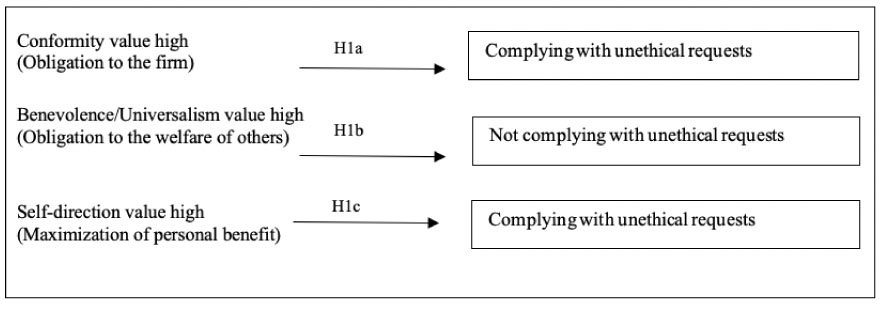
Figure 1
Summary of the Phase I hypotheses.
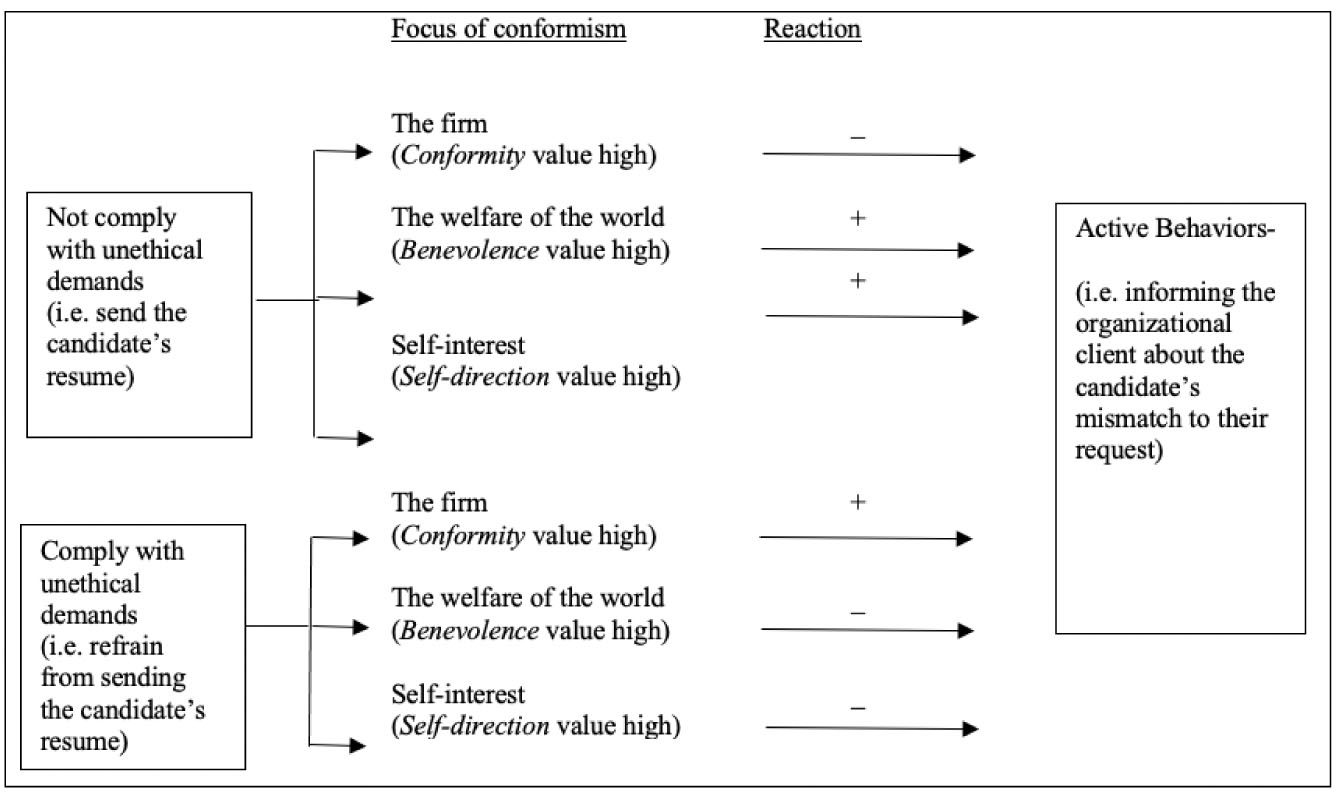
Figure 2
Summary of the Phase II hypotheses
Table 1
Mean, standard deviation, and percentage of agreement for the different scenarios
| Ethic_conform1,2 | Ethic_mention3 | |||
|---|---|---|---|---|
| M | SD | No (%) | Yes (%) | |
| 1. In addition to professional requirements, the client asks that the candidate will be secular (not religious). You find a candidate that suits all the professional requests, who is ultra-orthodox.* | 4.98 | 2.76 | 12.5 | 87.5 |
| 2. For a marketing job, the client asks that all candidates will be young and energetic. You find a perfect candidate, although he is over 40. | 6.78 | 2.200 | 12.5 | 87.5 |
| 3. You are looking for a production worker for a factory. The candidate has extensive experience as a production worker. In the past year, he suffered an accident, which caused him a handicap. This limitation affects the output of his work. | 6.06 | 2.26 | 9.1 | 90.9 |
| 4. The client requires interviewing the candidates before finalizing a decision on the position. You found a suitable candidate according to the professional requirements and after a face-to-face interview, you found out that the candidate is pregnant. | 6.92 | 2.32 | 27.3 | 72.7 |
| 5. The client requires interviewing the candidates before finalizing a decision on the position. In a face-to-face interview, you noticed that the candidate neglected their physical appearance or was inappropriately dressed. | 4.37 | 2.71 | 28.4 | 71.6 |
| 6. During a telephone interview, the candidate informs you that she is in the process of fertility treatment. As is well known, due to fertility treatments, the candidate may be absent more frequently than usual. | 7.15 | 2.15 | 44.3’ | 55.7 |
| 7. In addition to the professional requirement, the client asks that the candidate have served in the army. However, this work does not require military experience. You found a candidate that meets all the professional requirements, but did not serve in the army. | 6.40 | 2.68 | 33.0 | 67.0 |
1 ethic_conform: the mean and standard deviation in regard to the question: “Will you send along the candidate resume to the client?”
* All the scenarios ended with the question, “Will you send along the candidate resume to the client?”
‘In this scenario, the question for HR employees was “If so, will you tell the candidate to alter his appearance before the interview with the client?”
Table 2
Regression analysis between ethical judgments, cognitive thinking style, values and demographic variables.
| Model 1. | Model 2. | ||||
|---|---|---|---|---|---|
| Ethic_conform | Ethic_mention | ||||
| Model l 1 | Model 1.2 | Model 2.1 | Model 2.3 | Model 2.4 | |
| Demographic attribution | |||||
| Age | −.084 (.03) | −.183 (.03) | .332* (.00) | .346* (.00) | .284* (.00) |
| Tenure | .157 (.05) | .202 (.05) | −.029 (.00) | −.003 (.00) | .065 (00) |
| Education (0-first degree, 1-second degree) | .166* (.23) | .166* (.23) | .031 (.04) | .019 (.04) | .075 (.04) |
| Values | |||||
| Benevolence | −.041 (.14) | −.196* (.02) | −.210* (.023 | ||
| Self-direction | .018 (.12) | .032 (.02) | .039 (.02) | ||
| Universalism | .252* (.13) | −.002 (.00) | .085 (.02) | ||
| Conformity | .024 (.09) | .154* (.02) | .162* (.01) | ||
| Ethic_obeying | −.338*** (.01) | ||||
| R2 (%) | .091** | .155** | .100** | .145** | .242** |
| F for change in R2 | .043* | .034 | .097*** | ||
| Std. Error | 1.31 | 1.29 | .232 | .230 | .218 |
[i] Notes: 1. Dependent variable: Ethic_conform - the readiness to send the candidate resume in spite of the unethical request; Ethic_mention - the sum of the seven decisions regarding whether the HR employee will inform the organizational client about the candidate mismatch with the clients’ request.
[ii] 2. Independent variables included - “benevolence”, “self-direction”, “universalism” and “conformity”.
[iii] 3. Standard errors presented in parentheses.
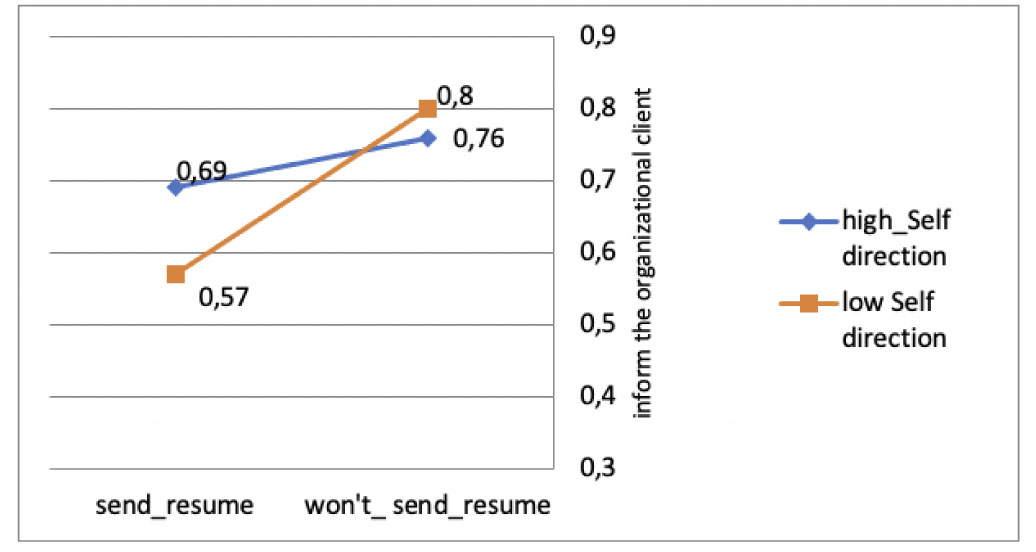
Figure 3
Interaction effect between self-direction, sending resumé, and the willingness to inform the organizational client about the mismatch.
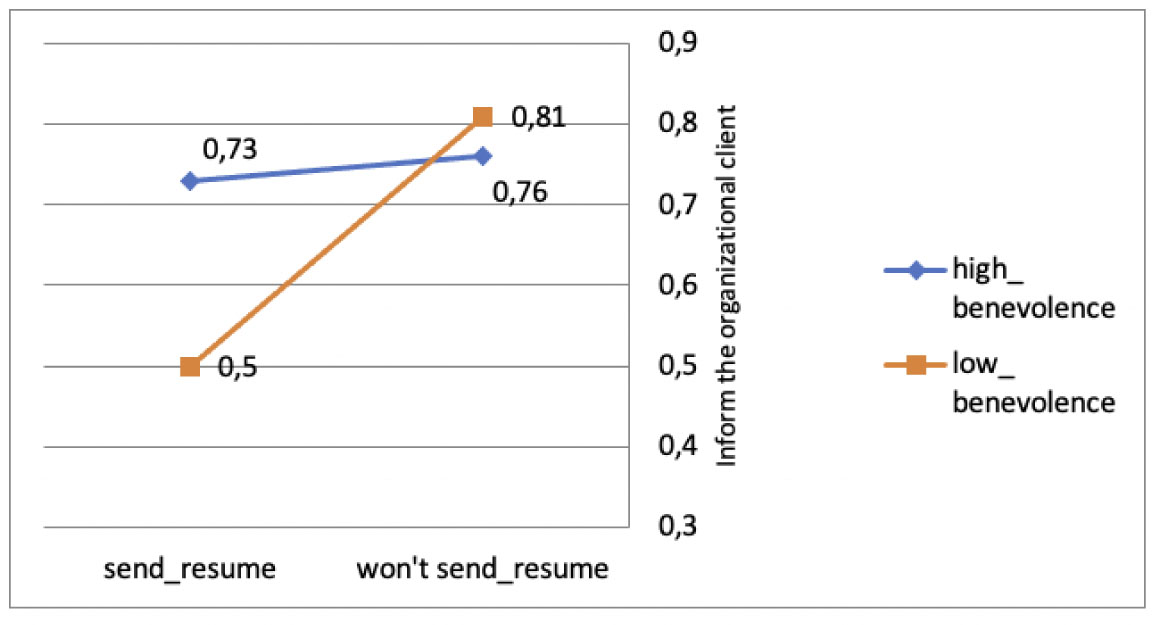
Figure 4
Interaction effect between benevolence, sending resumé, and the willingness to inform the organizational client about the mismatch.
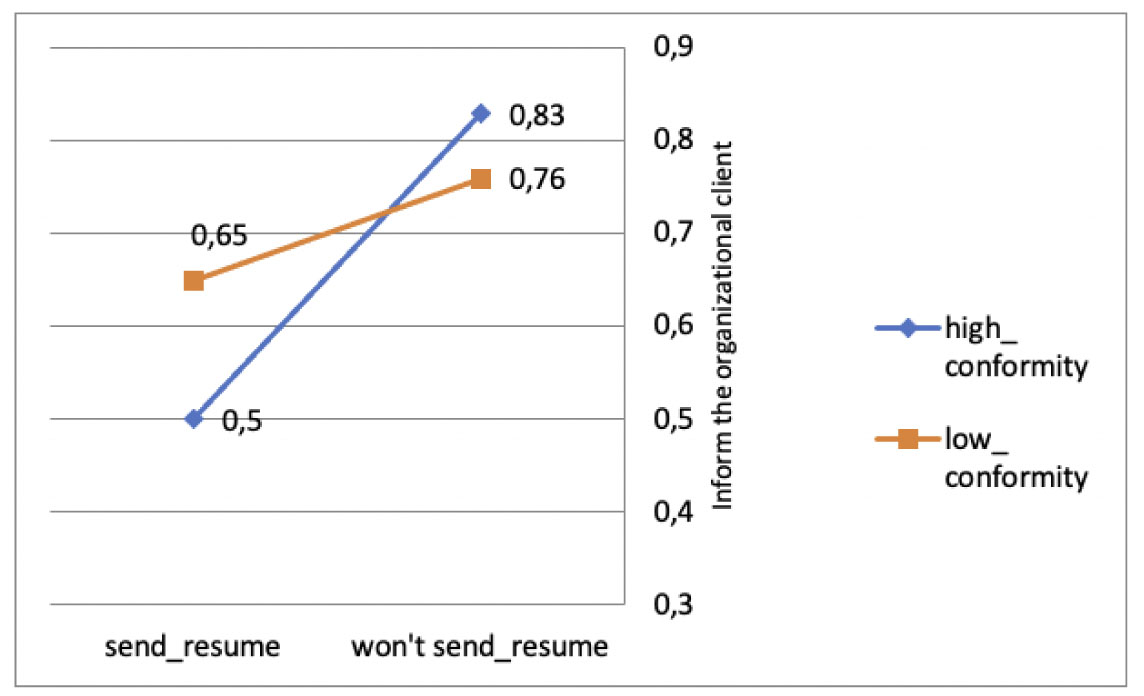
Figure 5
Interaction effect between conformity, sending resumé, and the willingness to inform the organizational client about the mismatch.