

Table 2:
Description of the study population (N=103): Sociodemographic and performing-art-specific characteristics (PA=performing art; BMI=body mass index; IQR=interquartile range).
| Age | years mean (SD), range | 38.57 (16.44), 18–82 | |||
|---|---|---|---|---|---|
| Gender | n (%) | female | 60 (58.3) | ||
| male | 43 (41.7) | ||||
| BMI | mean (SD), range | 24.6 (5.0), | |||
| 17.0–45.0 | |||||
| PA (single answer) and specifications (multiple answers possible) | n (%) | instrument playing | 65 (63.1) | ||
| keys | 31 (47.7) | ||||
| strings | 28 (43.1) | ||||
| wind | 25 (38.5) | ||||
| percussion | 3 (4.6) | classic | 65 (71.4) | ||
| others | 3 (4.6) | church music | 34 (37.4) | ||
| jazz | 18 (19.8) | ||||
| singing | 26 (25.2) | pop | 32 (35.2) | ||
| soprano | 7 (26.9) | rock | 15 (16.5) | ||
| mezzo soprano | 10 (38.5) | folk music | 8 (8.8) | ||
| alto | 11 (42.3) | marching music | 4 (4.4) | ||
| tenor | 7 (26.9) | musical | 16 (17.6) | ||
| bass | 1 (3.8) | others | 9 (9.9) | ||
| baritone | 4 (15.4) | ||||
| others | 2 (7.7) | ||||
| dancing | 9 (8.7) | ballet | 6 (66.7) | ||
| jazz dance | 2 (22.2) | ||||
| standard | 2 (22.2) | ||||
| latin american | 2 (22.2) | ||||
| modern | 3 (33.3) | ||||
| others | 2 (22.2) | ||||
| acting | 3 (2.9) | theatre | 2 (66.7) | ||
| others | 1 (33.3) | ||||
| Age of starting the PA | years mean (SD), range | 11.7 (8.9), 4–55 | |||
| Average time of practicing the PA (recently) | hours/week mean (SD), range | 19.4 (15.8), 0–80 | |||
| Average time of practicing the PA (since starting to perform) | hours/week mean (SD), range | 2.3 (2.5), 0–16.8 | |||
| Income regarding PA (recently) | n (%) | main income | 44 (42.7) | n=44 with professional training in at least one of the PA | |
| secondary income | 27 (26.2) | n=20 with professional activity and/or professional training in at least one of the PA | |||
| no income | 32 (31.1) | n=9 with professional training in at least one of the PA, n=3 with private lessons | |||
| Individual meaning of the PA for the participant (NRS from 0=no meaning at all to 10=the greatest meaning) | median (IQR), range | 9 (2), 2–10 | For 88.4% of the artists, playing an instrument/singing/dancing/acting is very important (8–10/10 points on the NRS) | ||
| Evaluation of how bad a PA failure would be (NRS from 0=no meaning at all to 10=the greatest meaning) | median (IQR), range | 9(2), 1–10 | For 85.4% of the artists, it would be very bad if they were no longer able to play their instrument/sing/dance/act (8–10/10 points on the NRS) | ||
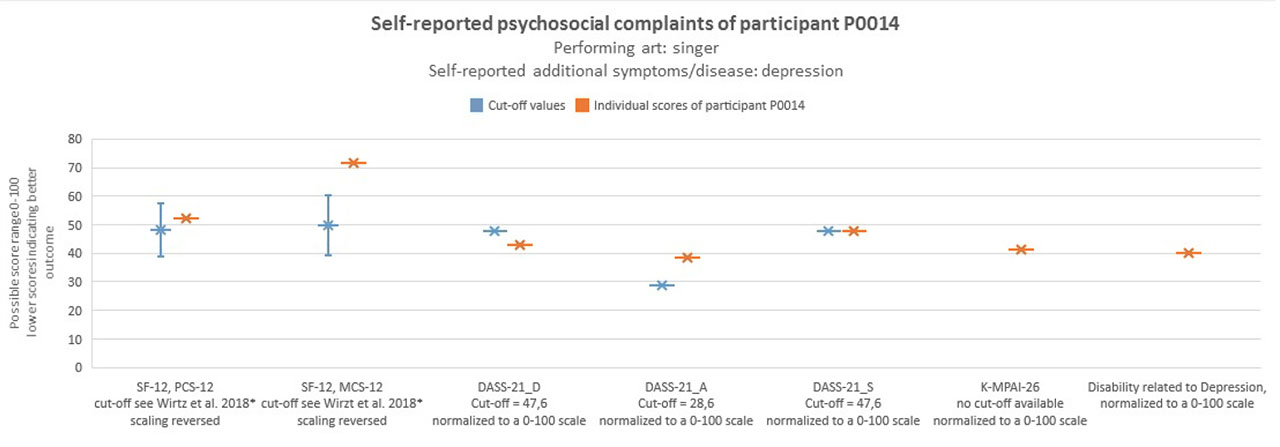
Figure 3:
Participant P0014's individual self-reported psychosocial complaints: Scores of the 12-item Shortform Survey (SF-12) aggregated to the Physical Component Summary (PCS-12) and the Mental Component Summary (MCS-12) scale (*cut-off values referring to Wirtz et al. 2018, electronic supplement 1, mean +/− 1SD for the relevant age group of P0014); scores of the 21-item Depression Anxiety Stress Scales aggregated to the Depression Scale (DASS-21_D), the Anxiety Scale (DASS-21_A), and the Stress Scale (DASS-21_S) (respective cut-off values referring to Nilges & Essau (no year)); total sum score of the Kenny Music Performance Anxiety Inventory 26-item form (K-MPAI-26) (no cut-off value available); Disability related to Depression, considered by P0014 as additional disease/symptoms).
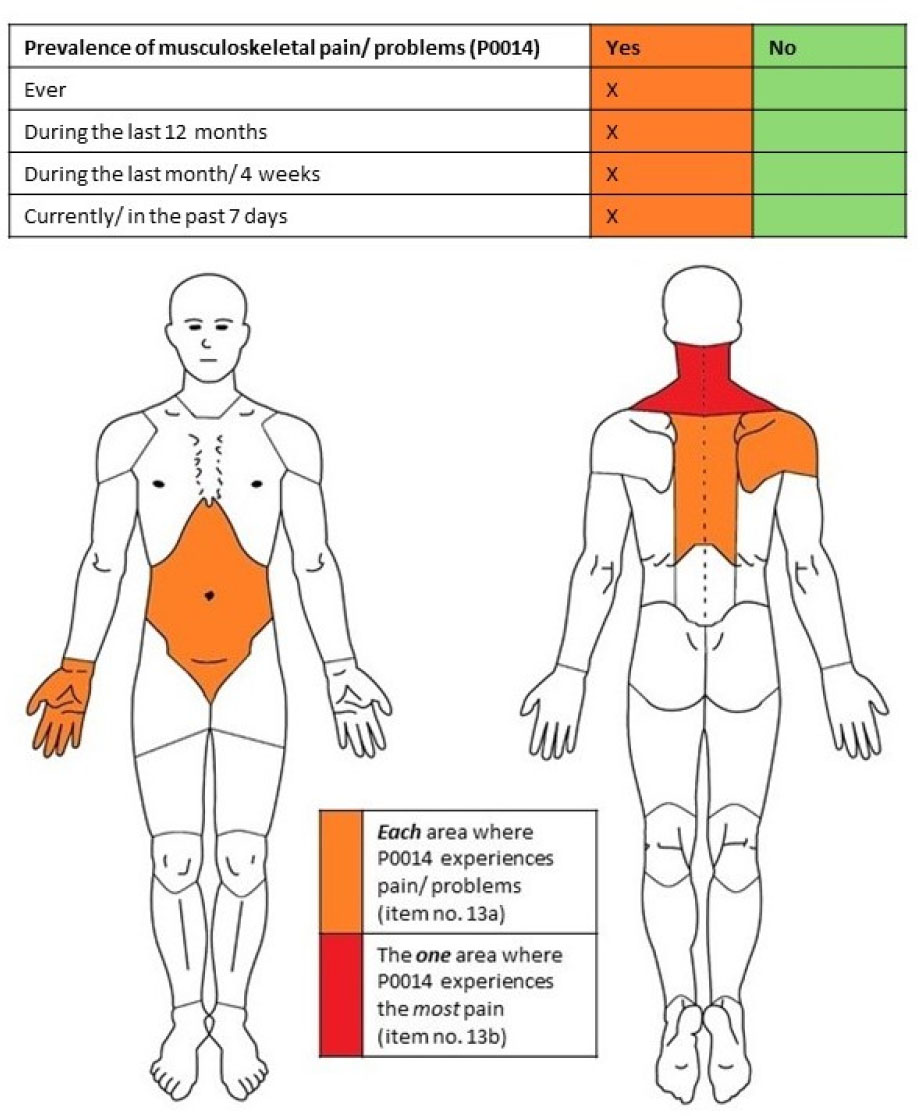
Figure 4:
Participant P0014's individual descriptions and location of musculoskeletal pain/problems (physical health dimension): orange areas represent „…each of the areas where you experience pain/problems.” (MPIIQM-G, item 13a); red area represents “…the one area that hurts the most” (MPIIQM-G, item 13b).
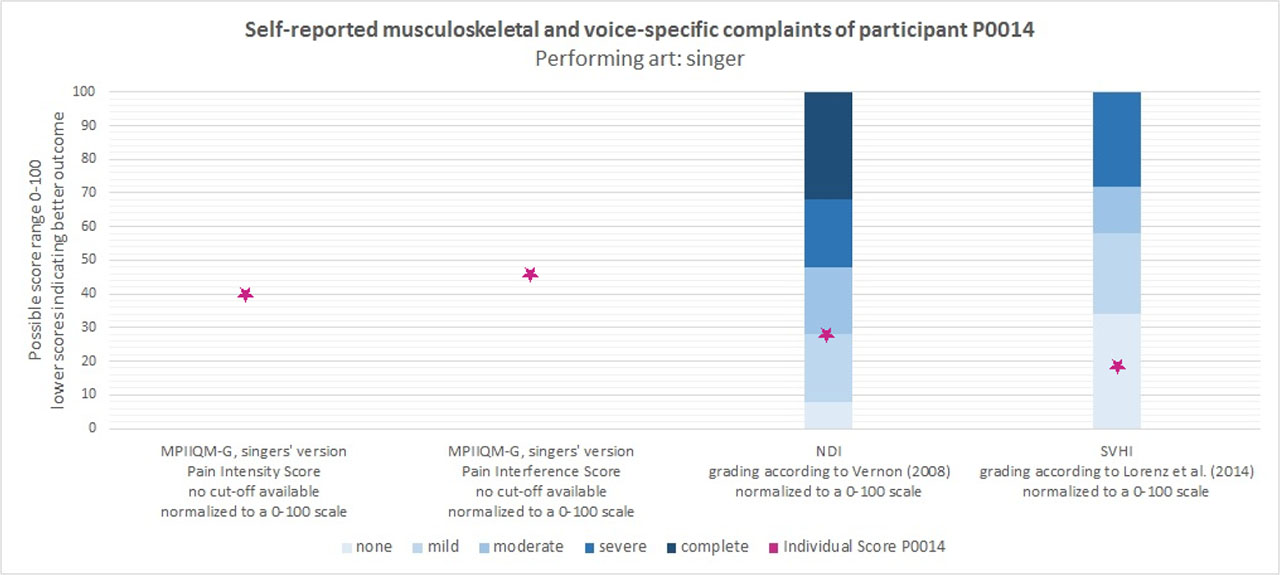
Figure 5:
Participant P0014's individual musculoskeletal and voice-specific complaints (physical health dimension): Scores of the Pain Intensity Scale of the Musculoskeletal Pain Intensity and Interference Questionnaire for Musicians (MPIIQM-G, singers'/actors' version) (no cut-off value available) and the Pain Interference Scale of the MPIIQM-G (MPIIQM, singers'/actors' version) (no cut-off value available); Scores of the Neck Disability Index (NDI) (grading shown in stacked bars); Score of the Singing Voice Handicap Index (SVHI) (grading shown in stacked bars).