

Table 1
Participants' characteristics.
| Item | Response | Frequency (%) | Mean (SD) |
|---|---|---|---|
| Gender (n = 816) | Female | 771 (94.5) | |
| Male | 45 (5.5) | ||
| Age in years (n = 815) | 44 (± 11) | ||
| Years of working experience (n = 812) | 17 (± 10) | ||
| Professional status (n = 816) | Practice owner | 523 (64.1) | |
| Employee | 259 (31.7) | ||
| Freelancer | 20 (2.5) | ||
| Other | 14 (1.7) | ||
| Participation by state (n = 816) | Bavaria | 165 (20.2) | |
| North Rhine-Westphalia | 149 (18.3) | ||
| Baden-Württemberg | 99 (12.1) | ||
| Lower Saxony | 81 (9.9) | ||
| Hesse | 66 (8.1) | ||
| Rhineland-Palatinate | 61 (7.5) | ||
| Berlin | 48 (5.9) | ||
| Hamburg | 39 (4.8) | ||
| Saxony | 23 (2.8) | ||
| Brandenburg | 21 (2.6) | ||
| Schleswig-Holstein | 19 (2.3) | ||
| Saarland | 14 (1.7) | ||
| Mecklenburg-West Pomerania | 12 (1.5) | ||
| Thuringia | 8 (1) | ||
| Saxony-Anhalt | 8 (1) | ||
| Bremen | 3 (0.4) |
Table 2
Use and suitability of videoconferencing. (Please note: The specification in parentheses corresponds to the indication codes of the German ‘Heilmittelkatalog’ (therapeutic remedies catalogue). The dashes in the first column indicate that the answer options were not available for this question.
| Disorder | Frequency used (%) n = 707 | Frequency inappropriate (%) n = 816 |
|---|---|---|
| Language development disorder (SP1) | 565 (80) | 139 (17) |
| Articulation disorder (SP3) | 484 (70) | 139 (13) |
| Aphasia or dysphasia (SP5) | 299 (42) | 75 (9) |
| Oral swallowing disturbance (SCZ) | 271 (38) | 160 (20) |
| Speech motor dysfunction (SP6) | 270 (38) | 89 (11) |
| Functional voice disorder (ST2) | 262 (37) | 121 (15) |
| Orofacial dysfunction (OFZ) | 236 (33) | 107 (13) |
| Speech disorder (SPZ) | 188 (27) | 57 (7) |
| Stuttering (RE1) | 184 (26) | 88 (11) |
| Auditory perceptual disorder (SP2) | 174 (25) | 207 (25) |
| Organic voice disorder (ST1) | 163 (23) | 136 (17) |
| Rumbling (RE2) | 50 (7) | 88 (11) |
| Speech disorders in high degree hearing loss or deafness (SP4) | 42 (6) | 346 (42) |
| Psychogenic dysphonia (ST4) | 32 (5) | 218 (27) |
| Rhinophony (SF) | 32 (5) | 117 (14) |
| Psychogenic aphonia (ST3) | 26 (4) | 239 (30) |
| Dysphagia (SC1) | - | 435 (53) |
| Damage to the head and neck section (SC2) | - | 291 (36) |
| Nothing applies | - | 227 (28) |
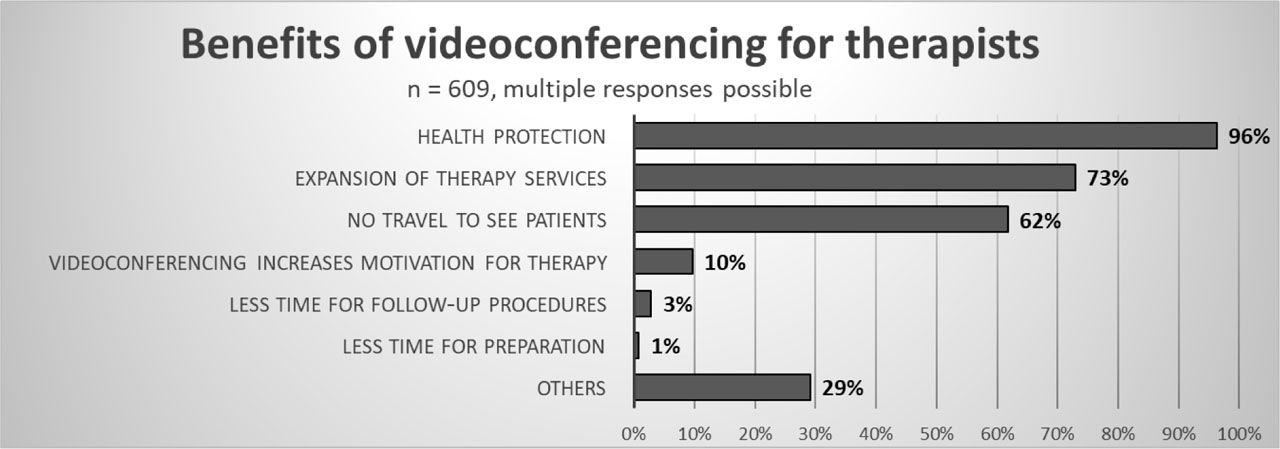
Figure 1
Benefits of videoconferencing for therapists.
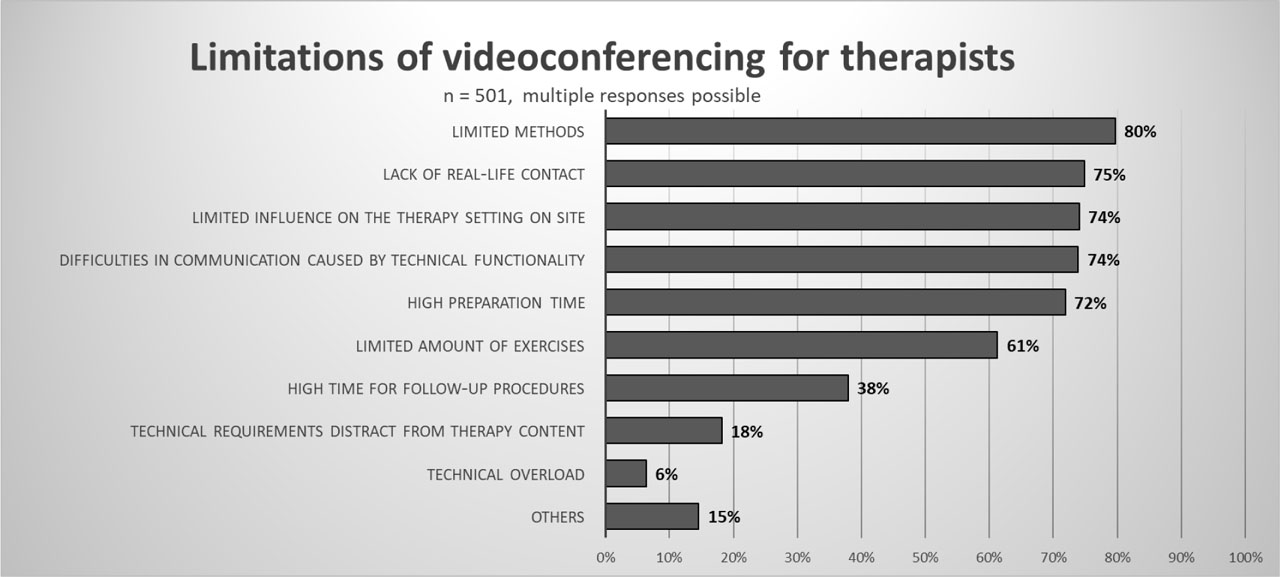
Figure 2
Limitations of videoconferencing for therapists.
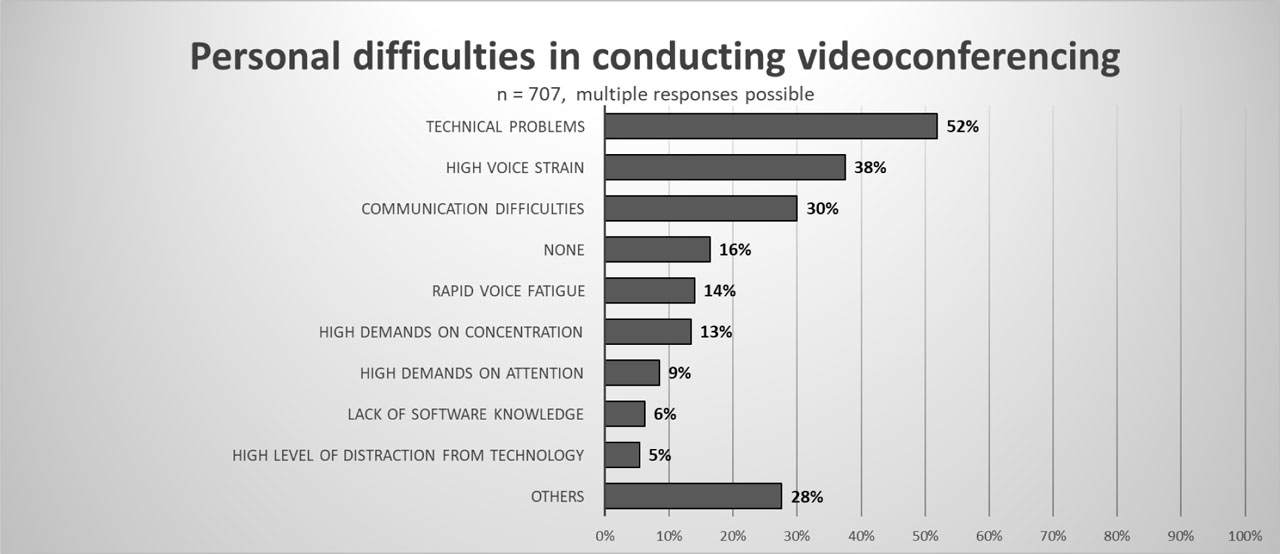
Figure 3
Personal difficulties in conducting videoconferencing.
Table 3
Future prospects of videoconferencing, N = 816.
| Question | ‘Yes’ (%) | ‘No’ (%) | ‘I don’t know’ (%) |
|---|---|---|---|
| Do you see any useful applications for videoconferencing in outpatient speech and language therapy? | 661 (81) | 89 (11) | 66 (8) |
| Can you imagine using videoconferencing in addition to frequency enhancement if this would enable better and/or faster therapy success? | 646 (79) | 113 (14) | 57 (7) |
| Can you imagine conducting some therapy sessions in the therapy process online, without affecting therapy success? | 676 (83) | 82 (10) | 58 (7) |
| Can you imagine conducting some therapy sessions in the therapy process online, without affecting the relation between you and your patient? | 662 (81) | 96 (12) | 58 (7) |
| ‘Yes’ (%) | ‘No’ (%) | ‘I don’t care’ (%) | |
| Should videoconferencing be included in standard healthcare? | 636 (78) | 137 (17) | 43 (5) |