

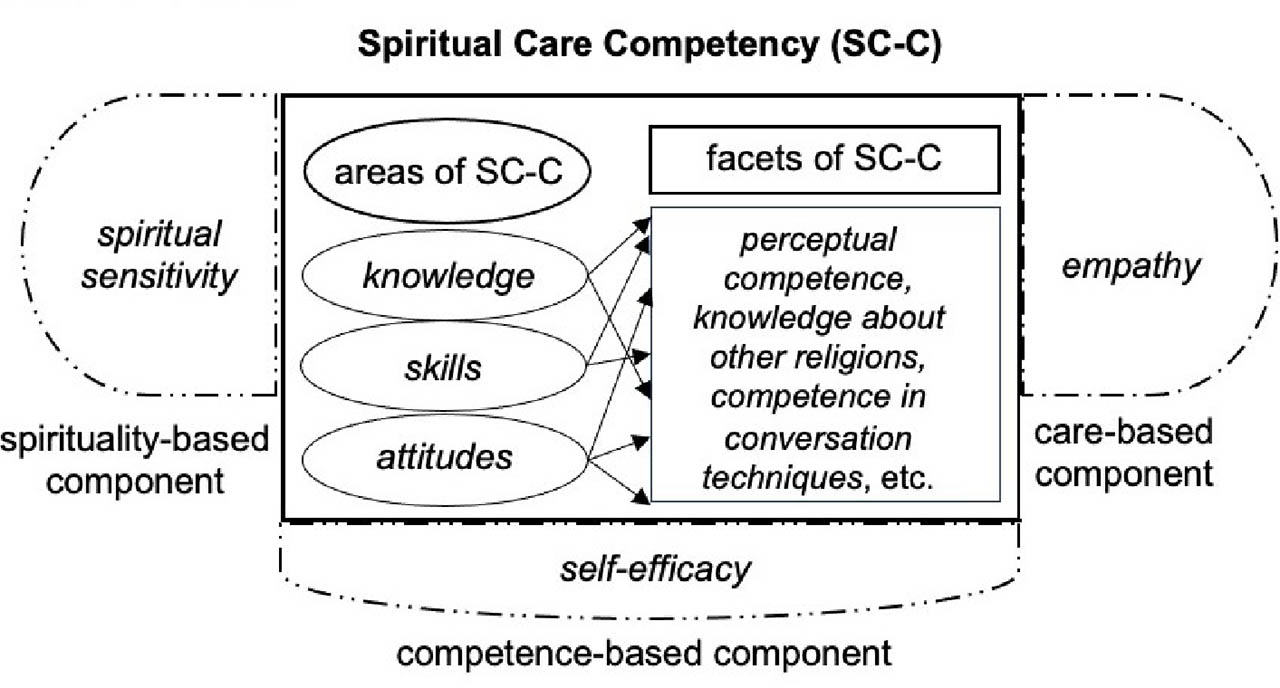
Figure 1
Outcome variables.
Table 1
Description of study population.
| Variables | IG, n = 78 | CG, n = 67 | p |
|---|---|---|---|
| Age in years, mean (SD; range) | 26.6 (8.2; 19–56) | 25.0 (6.9; 19–52) | .90 (t = .90) 2 |
| Nationality*: German, % | 92% | 96% | .54 (χ2 = 1,24)1 |
| Gender*: female, n (%) | 63 (81%) | 50 (75%) | .13 (χ2 = 4.04) 1 |
| Marital status*, % | .85 (χ2 = 1.38) 1 | ||
| single | 68% | 69% | |
| married | 16% | 15% | |
| Study subject*, n (%) | .00 (χ2 = 66.67) 1 | ||
| medicine | 12 (15%) | ||
| nursing science | 5 (6%) | ||
| theology/religious education | 14 (18%) | ||
| healthcare sciences | 6 (8%) | ||
| social work | 31 (39%) | 67 (100%) | |
| others (psychology, philosophy/medical ethics) | 6 (8%) | ||
| Semesters studied, mean (SD) | 5.5 (2.7) | 4.7 (2.0) | 1.82 (t = .07)2 |
| Previous vocational training In healthcare sector, % | 31% | 27% | .32 (χ2 = 2.27) 1 |
| Self-assessed religiosity/spirituality (1 = not at all, 6 = completely true), mean (SD) | |||
| spiritual | 4.6 (1.3) | 3.7 (1.3) | .00 (t = 4.35)2 |
| religious | 4.2 (1.4) | 3.4 (1.4) | .00 (t = 3.10)2 |
| Religious preference, % | .25 (χ2 = 6.67) 1 | ||
| Catholic | 64% | 48% | |
| Protestant | 15% | 28% | |
| Muslim | 3% | 2% | |
| other | 3% | 3% | |
| none | 12% | 18% | |
| Familiarity with spiritual care, % | 27% | 7% | .00 (χ2 = 9.38) 1 |
IG = Intervention Group; CG = Comparison Group; SD = standard deviation
Table 2
Reliability of scales.
| Measures | Pre-test (Cronbach's α) | Post-test (Cronbach's α) | ||
|---|---|---|---|---|
| IG | CG | IG | CG | |
| Spiritual care competency areas (12-ksa) | .63 – .68 | .57 – .75 | .60 – .71 | .57 – .72 |
| Spiritual care competency facets (SCCQ) | .45 – .93 | .46 – .78 | .55 – .93 | .31 – .79 |
| Spiritual sensitivity (SSS) | .42 – .74 | .30 – .72 | .56 – .77 | .50 – .72 |
| Empathy (SPF) | .60 – .81 | .59 – .77 | .59 – .80 | .70 – .79 |
| General self-efficacy (GSES) | .88 | .88 | .87 | .86 |
[i] 12-ksa= 12 items measuring knowledge, skills, attitudes concerning spiritual care; SCCQ= Spiritual Care Competence Questionnaire; SSS= Spiritual Sensitivity Scale; SPF= Saarbrücker Persönlichkeitsfragebogen; GSES= General Self-Efficacy Scale; IG = Intervention Group; CG = Comparison Group
Table 3
Mean, standard deviations, and repeated measures analyses of variances (ANOVA) in spiritual care competency measures at baseline (T0) and after (T1) intervention (Intervention Group) or interim interval (Comparison Group).
| Measures | IG (n = 78) | CG (n = 67) | Time by intervention Effecta | Partial η2 | ||||||
|---|---|---|---|---|---|---|---|---|---|---|
| M (T0) | SD (T0) | M (T1) | SD (T1) | M (T0) | SD (T0) | M (T1) | SD (T1) | |||
| Primary outcomes | ||||||||||
| Spiritual care competency areas (12-ksa) | ||||||||||
| Knowledge | 6.08 | 1.70 | 7.96 | 1.14 | 5.39 | 1.67 | 5.66 | 1.64 | F (1, 142) = 28.95*** | 0.17 |
| Skills | 6.23 | 1.57 | 7.56 | 1.33 | 5.56 | 1.69 | 5.84 | 1.57 | F (1, 142) = 15.53*** | 0.10 |
| Attitudes | 7.77 | 1.34 | 8.84 | 1.01 | 6.88 | 1.98 | 7.02 | 1.74 | F (1, 142) = 11.13*** | 0.07 |
| Spiritual care competency facets (SCCQ) | ||||||||||
| Perceptual competence | 3.09 | 0.49 | 3.26 | 0.41 | 2.81 | 0.59 | 2.79 | 0.59 | F (1, 143) = 3.61 | 0.03 |
| Team-spirit | 1.75 | 0.63 | 2.09 | 0.70 | 1.56 | 0.58 | 1.66 | 0.60 | F (1, 142) = 4.38* | 0.03 |
| Documentation competence | 1.40 | 0.62 | 2.84 | 0.85 | 1.22 | 0.40 | 1.37 | 0.46 | F (1, 143) = 87.45*** | 0.38 |
| Self-awareness and proactive opening | 2.71 | 0.61 | 2.93 | 0.53 | 2.18 | 0.67 | 2.24 | 0.63 | F (1, 141) = 3.29 | 0.02 |
| Knowledge about other religions | 2.79 | 0.55 | 3.05 | 0.61 | 2.80 | 0.70 | 2.60 | 0.58 | F (1, 140) = 17.46*** | 0.11 |
| Competence in conversation technique | 3.45 | 0.60 | 3.53 | 0.47 | 3.27 | 0.62 | 3.22 | 0.61 | F (1, 140) = 1.71 | 0.01 |
| Proactive empowerment competence | 2.75 | 0.67 | 3.03 | 0.58 | 2.27 | 0.79 | 2.30 | 0.72 | F (1, 141) = 3.46 | 0.02 |
| Secondary outcomes | ||||||||||
| Spirituality-based component: Spiritual sensitivity (SSS) | ||||||||||
| Awareness sensing | 3.90 | 0.85 | 4.04 | 0.72 | 3.75 | 0.75 | 3.66 | 0.80 | F (1, 142) = 6.27* | 0.04 |
| Mystery sensing | 4.06 | 0.57 | 4.12 | 0.61 | 3.79 | 0.59 | 3.75 | 0.65 | F (1, 142) = 1.10 | 0.01 |
| Value sensing | 4.40 | 0.67 | 3.75 | 0.65 | 3.76 | 0.88 | 3.76 | 0.77 | F (1, 141) = 3.26 | 0.02 |
| Community sensing | 3.94 | 0.84 | 3.85 | 0.84 | 3.34 | 0.90 | 3.39 | 0.94 | F (1, 141) = 1.30 | 0.01 |
| Care-based component: Empathy (SPF) | 3.79 | 0.36 | 3.80 | 0.39 | 3.67 | 0.38 | 3.67 | 0.44 | F (1, 143) = 0.03 | 0.00 |
| Competence-based component: General self-efficacy (GSES) | 2.88 | 0.45 | 3.00 | 0.39 | 2.90 | 0.44 | 2.91 | 0.37 | F (1, 143) = 5.71* | 0.04 |
12-ksa= 12 items measuring knowledge, skills, attitudes concerning spiritual care; SCCQ= Spiritual Care Competence Questionnaire; SSS= Spiritual Sensitivity Scale; SPF= Saarbrücker Persönlichkeitsfragebogen; GSES= General Self-Efficacy Scale; IG = Intervention Group; CG = Comparison Group
Note.