

Table 1
Characteristics of the sample.
| number | percentage | |
|---|---|---|
| gender | ||
| female | 103 | 67.3 |
| male | 50 | 32.7 |
| age (years) | ||
| M (SD) | 24.0 (2.9) | |
| highest level of education | ||
| Mittlere Reife | 35 | 22.9 |
| Fachabitur | 29 | 19.0 |
| Abitur | 69 | 45.1 |
| University degree | 20 | 13.1 |
| examination grade | ||
| very good (1) | 31 | 20.3 |
| good (2) | 86 | 56.2 |
| satisfactory (3) | 33 | 21.6 |
| sufficient (4) | 3 | 2.0 |
| type of clinic | ||
| outpatient sector | 124 | 81.1 |
| inpatient sector | 27 | 17.6 |
| other | 2 | 1.3 |
| professional experience (months) | ||
| M (SD) | 8.2 (3.2) | |
| employment | ||
| full-time | 119 | 77.8 |
| part-time | 28 | 18.3 |
| marginally employed | 6 | 3.9 |
| days of sick leave | ||
| 0 – 5 days | 101 | 66.5 |
| 6 – 10 days | 36 | 23.5 |
| 11 – 15 days | 8 | 5.2 |
| 16 – 20 days | 4 | 2.6 |
| more than 20 days | 3 | 2.0 |
| not specified | 1 | 0.7 |
| gross income (per month) | ||
| < 1.000 € | 17 | 11.1 |
| 1.000 - < 1.500 € | 14 | 9.2 |
| 1.500 - < 2.000 € | 40 | 26.1 |
| 2.000 - < 2.500 € | 66 | 43.1 |
| 2.500 - < 3.000 € | 12 | 7.8 |
| ≥ 3.000 € | 3 | 2.0 |
| not specified | 1 | 0.7 |
| residence (federal state) | ||
| Baden-Wuerttemberg | 37 | 24.2 |
| Bavaria | 24 | 15,7 |
| North Rhine-Westphalia | 24 | 15.7 |
| Rhineland-Palatinate | 17 | 11.1 |
| Brandenburg | 10 | 6.5 |
| Lower Saxony | 8 | 5.2 |
| others | 31 | 21.6 |
| not specified | 2 | 1.3 |
[i] M= mean; SD= standard deviation
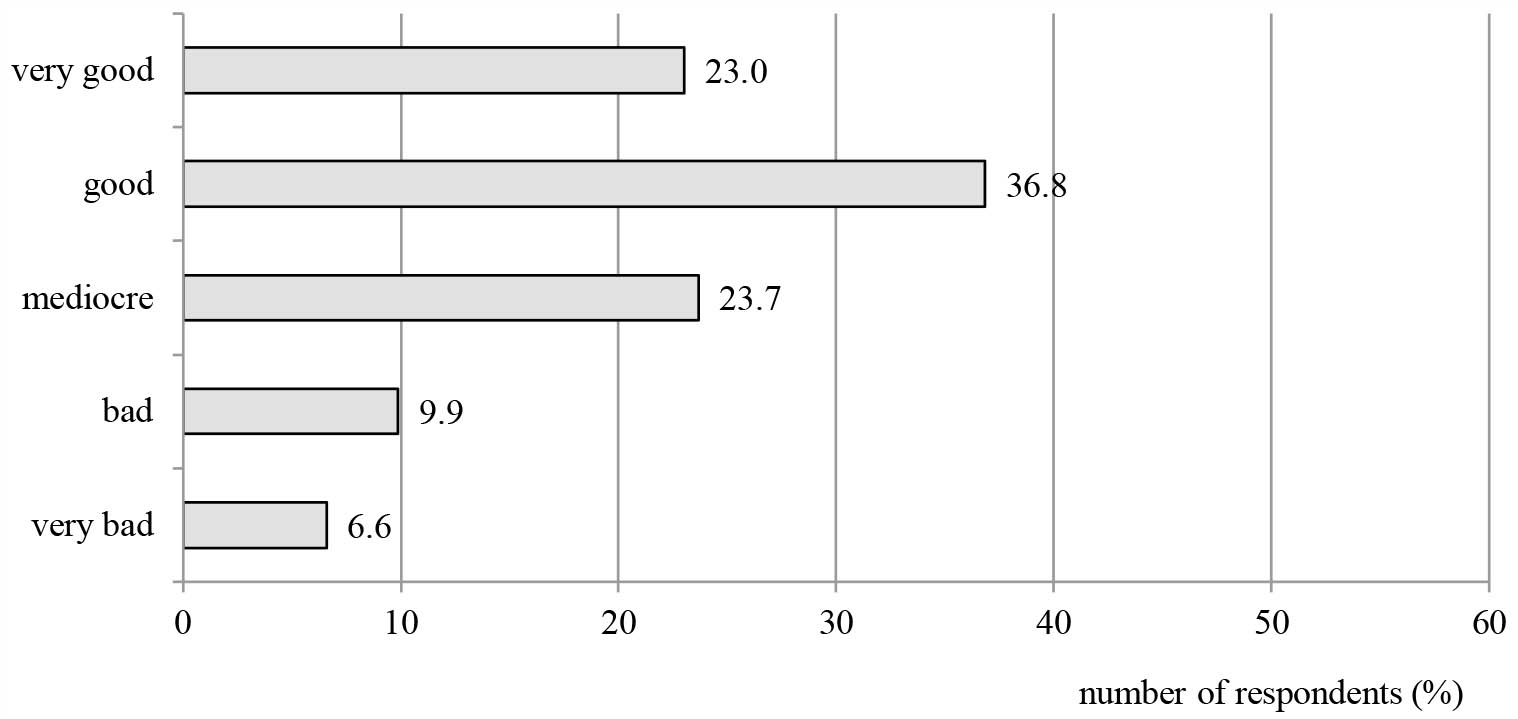
Figure 1
Rating of professional training received at vocational school.
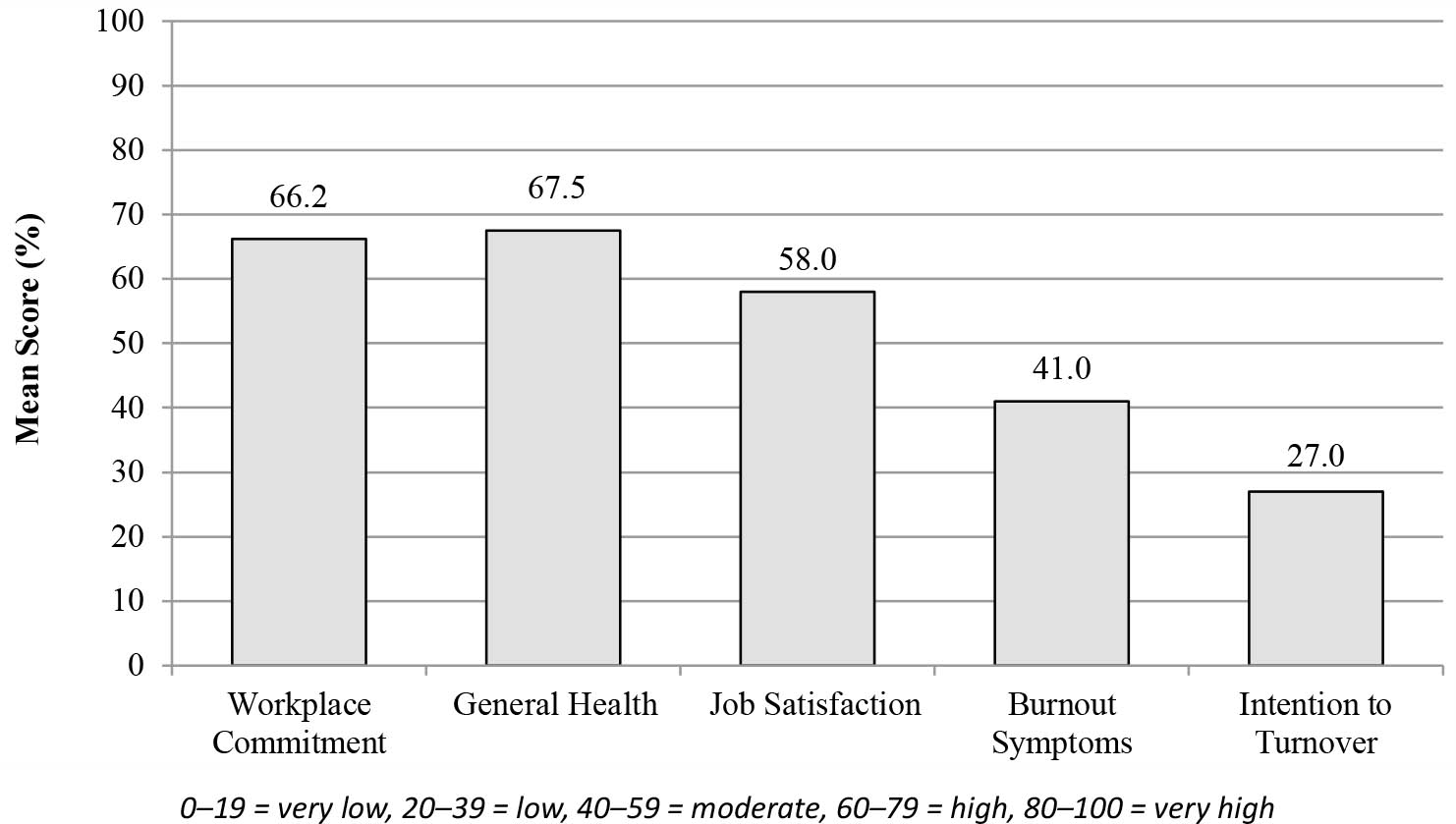
Figure 2
Different aspects of job strain.
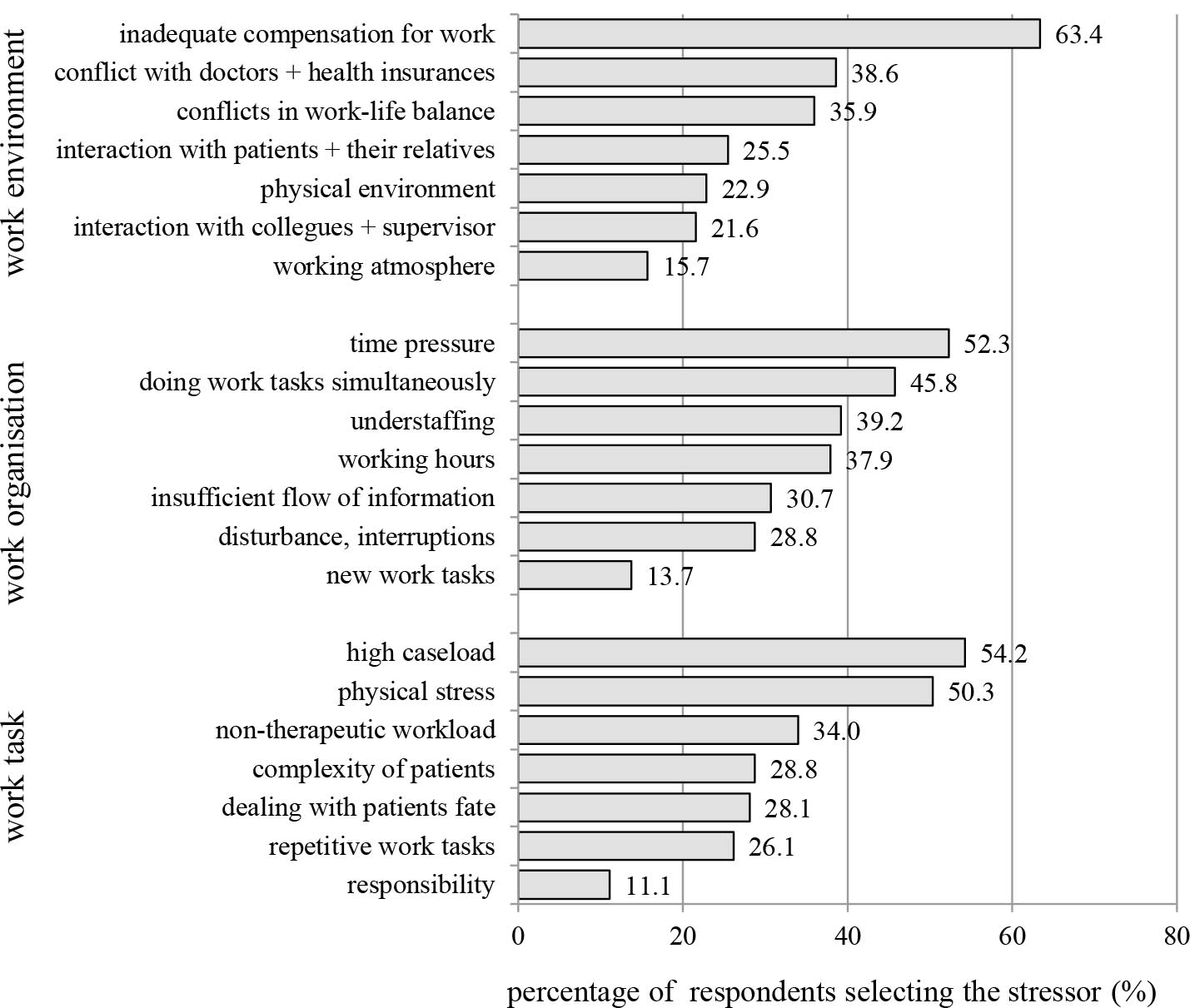
Figure 3
Workplace stressors.
| A1 Arbeitsengagement | |
|---|---|
| Wie oft treffen folgende Aussagen auf dich zu? | |
| 5 immer | |
| 4 oft | |
| 3 manchmal | |
| 2 selten | |
| 1 nie / fast nie | |
| N kann ich nicht beurteilen | Quelle: |
| Bei meiner Arbeit bin ich voller Energie. | COPSOQ B14.1 |
| Ich bin von meiner Arbeit begeistert. | COPSOQ B14.2 |
| Ich gehe völlig in meiner Arbeit auf. | COPSOQ B14.3 |
| A2 Gesundheitszustand | |||
|---|---|---|---|
| Wenn Du den besten denkbaren Gesundheitszustand mit 10 Punkte bewertest und den schlechtesten denkbaren mit 1 Punkt: Wie viele Punkte vergibst Du dann für Deinen derzeitigen Gesundheitszustand? | |||
| Schlechtester denkbarer Zustand | 1 2 3 4 5 6 7 8 9 10 | Bester denkbarer Zustand | COPSOQ B12 |
| A3 Arbeitszufriedenheit | |
|---|---|
| Wenn Du deine Arbeitssituation insgesamt betrachtest, wie zufrieden bist Du mit folgenden Faktoren? | |
| 5 sehr zufrieden | |
| 4 zufrieden | |
| 3 teils - teils | |
| 2 unzufrieden | |
| 1 sehr unzufrieden | |
| N kann ich nicht beurteilen | |
| Deinen Berufsperspektiven | COPSOQ B11.1 |
| Den Leuten, mit denen Du arbeitest | COPSOQ B11.2 |
| Den körperlichen Arbeitsbedingungen | COPSOQ B11.3 |
| Der Art und Weise, wie Deine Abteilung geführt wird | COPSOQ B11.4 |
| Die Art und Weise, wie Deine Fähigkeiten genutzt werden | COPSOQ B11.5 |
| Deinem Lohn / Gehalt | COPSOQ B11.6 |
| Deiner Arbeit insgesamt unter Berücksichtigung aller Umstände | COPSOQ B11.7 |
| A4 Burnout - Symptome | |
|---|---|
| Bitte gib für jede der folgenden Aussagen an, inwieweit diese auf dich zutrifft. Wie häufig… | |
| 1 nie / fast nie | |
| 2 einige Male im Jahr | |
| 3 einige Male im Monat | |
| 4 einige Male in der Woche | |
| 5 jeden Tag | |
| N kann ich nicht beurteilen | |
| … bist Du körperlich erschöpft? | COPSOQ B13.1 |
| … bist Du emotional erschöpft? | COPSOQ B13.2 |
| … fühlst Du dich ausgelaugt? | COPSOQ B13.3 |
| … kommst Du zur Arbeit, obwohl Du dich richtig krank und unwohl fühlst? | COPSOQ B13.4 |
| … kannst Du in deiner Freizeit die Arbeit nicht vergessen? | COPSOQ B13.5 |
| A5 Gedanke an Berufs-/Stellenwechsel | |
|---|---|
| Wie oft hast Du seit Berufsbeginn daran gedacht… | |
| 1 nie / fast nie | |
| 2 einige Male im Jahr | |
| 3 einige Male im Monat | |
| 4 einige Male in der Woche | |
| 5 jeden Tag | |
| N kann ich nicht beurteilen | |
| … deinen Beruf aufzugeben? | COPSOQ B10.1 |
| … deine Arbeitsstelle zu wechseln? | COPSOQ B10.2 |
| B Belastungsfaktoren |
|---|
| Bitte kreuze an, welche der folgenden Faktoren dich bei der Arbeit (negativ) belasten. (Mehrfachantworten möglich) |
| 1 ja |
| 2 nein |
| Wenn ja: Wie häufig tritt der angegebene Belastungsfaktor in Deinem Arbeitsalltag auf? |
| 1 häufig |
| 2 manchmal |
| 3 selten |
| 4 nie |
| N kann ich nicht beurteilen |
| B1 Allgemeine und soziale Arbeitsumgebung | |
|---|---|
| Umgebungsbedingungen (z.B. Raum, Lärm, Licht, Ausstattung) | Lindsay et al., 2008; Keller et al., 2010 |
| Betriebsklima | Brattig et al., 2014 |
| Interaktion mit Kollegen + Vorgesetzten | Brattig et al., 2014; Keller et al., 2010 |
| Interaktion mit Patienten + Angehörigen | Keller et al., 2010 |
| Interaktion mit Ärzten + Krankenkasse | Brattig et al., 2014 |
| Arbeit-Freizeit-Konflikte (Work-Life Balance) | Brattig et al., 2014; Keller et al., 2010 |
| Mangelnde Entschädigung für erbrachte Leistungen (z.B. Gehalt, Lob, Anerkennung) | Keller et al., 2010 |
| B2 Arbeitsorganisation | |
| Arbeitszeiten | Keller et al., 2010 |
| Zeitdruck, schnell arbeiten müssen | Brattig et al., 2014; Lohmann-Haislah, 2012 |
| Verschiedenartige Arbeiten gleichzeitig betreuen (z.B. Fango, Therapie, Rezeption) | Lohmann-Haislah, 2012 |
| Bei der Arbeit gestört, unterbrochen werden | Lohmann-Haislah, 2012 |
| Konfrontation mit neuen Aufgaben | Lohmann-Haislah, 2012 |
| Fehlender Informationsfluss / Kommunikation im Team | Lohmann-Haislah, 2012 |
| Personelle Unterbesetzung | Lindsay et al., 2008 |
| B3 Arbeitsaufgabe | |
| Arbeitsmenge (tägliche Patientenanzahl) | Lindsay et al., 2008; Keller et al., 2010 |
| Komplexität der Patienten (z.B. Multimorbidität) | Lindsay et al., 2008 |
| Konfrontation mit Patientenschicksalen, Emotionaler Stress | Brattig et al., 2014; Keller et al., 2010 |
| Ständig wiederkehrende Arbeitsvorgänge | Lohmann-Haislah, 2012 |
| Nicht-therapeutische Tätigkeit (z.B. Rezeptionstätigkeit, Büro) | |
| Hohe Verantwortung | Keller et al., 2010 |
| Körperliche Belastung (z.B. Rücken, Handgelenke) | Keller et al., 2010 |
| B4 Weitere Faktoren (Optional) | |
| Freie Eingabe | |
| C Soziodemographische Daten |
|---|
| C1 Geschlecht: Bitte gib Dein Geschlecht an.
1 weiblich 2 männlich |
| C2 Alter: Bitte gib Dein Alter an.
Freie Angabe in Jahren |
| C3 Bildungsabschluss: Bitte gib den höchsten Bildungsabschluss an, den du bisher erreicht hast.
1 Fachhochschul-/ Hochschulabschluss 2 Abitur, Hochschulreife 3 Fachabitur, Fachhochschulreife 4 Mittlere Reife 5 Hauptschulabschluss |
| C4 Wohnort: Bitte geb das Bundesland an, in welchem Du aktuell wohnst.
Auswahl Bundesland |
| C5 Examensnote: Mit welcher Note hast Du Deine Ausbildung zum Physiotherapeut(in) abgeschlossen?
1 sehr gut (1) 2 gut (2) 3 befriedigend (3) 4 ausreichend (4) |
| C6 Art der Einrichtung: Wo arbeitest du als Physiotherapeut(in)?
1 ambulante Einrichtung (Praxis, ambulantes Rehazentrum) 2 stationäre Einrichtung (Krankenhaus, stationäres Rehazentrum) 3 sonstige Einrichtung → Freie Angabe |
| C7 Länge der Berufstätigkeit: Seit wann bist Du als Physiotherapeut(in) tätig?
Freie Angabe in Monaten |
| C8 Krankheitstage seit Berufsbeginn: An wie vielen Tagen seit Berufsbeginn bliebst Du aufgrund eines gesundheitlichen Problems der Arbeit fern? 1 0 – 5 Tage 2 6 – 10 Tage 3 11 – 15 Tage 4 16 – 20 Tage 5 mehr als 20 Tage |
| C9 Arbeitsumfang: Wie viele Stunden in der Woche bist Du als Physiotherapeut(in) tätig?
1 Vollzeit (wöchentliche Arbeitszeit ≥ 35h) 2 Teilzeit (wöchentliche Arbeitszeit von 15 – 34 h) 3 Minijob 4 Ich bin nicht als Physiotherapeut(in) tätig |
| C10 Monatliches Bruttoeinkommen: Wie hoch ist ungefähr Dein monatliches Bruttoeinkommen?
1 bis unter 1000€ 2 1.000€ bis unter 1.500€ 3 1.500€ bis unter 2.000€ 4 2.000€ bis unter 2.500€ 5 2.500€ bis unter 3.000€ 6 3.000€ oder mehr |
| C11 Bewertung der Ausbildung |
|---|
| Bitte gib an, inwieweit Du folgenden Aussagen zustimmst.
5 stimme voll zu 4 stimme eher zu 3 unentschieden 2 stimme eher nicht zu 1 stimme gar nicht zu N kann ich nicht beurteilen |
| Rückblickend betrachtet bewerte ich meine Ausbildung als sehr gut. |
| Was ich in meiner Ausbildung gelernt habe, kann ich in meiner Arbeit voll anwenden. |
| Meine Ausbildung hat mich nicht gut auf den Berufsstart vorbereitet.* |
| Durch meine Ausbildung fühle ich mich den beruflichen Anforderungen, die an mich gestellt werden, gewachsen. |
| C12 Externe Einflussfaktoren (7) |
|---|
| Bitte kreuze diejenigen Faktoren oder Ereignisse an, die auf dich zutreffen. (Mehrfachantwort möglich)
1 nicht ausgewählt 2 ausgewählt |
| Arbeitsplatzwechsel seit Berufsbeginn |
| Besuch von Fortbildungen parallel zur Arbeit |
| Wohnortwechsel in den vergangenen vier Wochen |
| (Erholungs-)Urlaub in den vergangenen vier Wochen |
| Versorgung von Kindern oder pflegebedürftigen Angehörigen |
| Belastende Ereignisse im Privatleben seit Berufsbeginn |
| Vorliegen einer diagnostizierten psychischen Erkrankung (z.B. Depression) |
| C13 Persönliche Ressourcen (4) | |
|---|---|
| Wie schätzt Du folgende Faktoren für dich ein?
5 sehr positiv 4 positiv 3 neutral 2 negativ sehr negativ N kann ich nicht beurteilen | |
| Eigenes (Fach-)Wissen | |
| Soziale Unterstützung (durch Freunde, Familie) | Keller et al. 2010; Lohmann-Haislah, 2012 |
| Möglichkeiten zum Stressausgleich (z.B. Sport, Entspannung) | |
| Deinem Handlungsspielraum | Brattig et al., 2014; Lohmann-Haislah, 2012 |
| A1 Workplace commitment | |
|---|---|
| How often do the following statements apply to you? | |
| 5 always | |
| 4 often | |
| 3 sometimes | |
| 2 seldom | |
| 1 never / hardly ever | |
| N Can’t judge | References: |
| At my work, I am full of energy. | COPSOQ B14.1 |
| I am enthusiastic about my work. | COPSOQ B14.2 |
| I am immersed in my work. | COPSOQ B14.3 |
| A2 State of health | |||
|---|---|---|---|
| If you evaluate the best conceivable state of health at 10 points and the worst at 0 points: How many points do you then give to your present state of health? | |||
| worst conceivable state of health | 1 2 3 4 5 6 7 8 9 10 | best conceivable state of health | COPSOQ B12 |
| A3 Job satisfaction | |
|---|---|
| Regarding your work in general, how pleased are you with the following aspects?
5 very satisfied 4 satisfied 3 neither / nor 2 unsatisfied highly unsatisfied N Can’t judge | |
| Your work prospects | COPSOQ B11.1 |
| The people you work with | COPSOQ B11.2 |
| The physical working conditions | COPSOQ B11.3 |
| The way your group is run | COPSOQ B11.4 |
| The way your abilities are used | COPSOQ B11.5 |
| Your salary | COPSOQ B11.6 |
| Your job as a whole, everything taken into consideration | COPSOQ B11.7 |
| A4 Symptoms of burnout | |
|---|---|
| For each of the following statements please state how far they apply to you. How often…
1 never / hardly ever 2 a few times a year 3 a few times a month 4 a few times a week 5 every day N Can’t judge. | |
| … do you feel physically exhausted? | COPSOQ B13.1 |
| … do you feel emotionally exhausted? | COPSOQ B13.2 |
| … do you feel worn out? | COPSOQ B13.3 |
| … does it occur that you come to work, even though you really feel unwell and sick? | COPSOQ B13.4 |
| … are you not able to stop thinking about work in your free time? | COPSOQ B13.5 |
| A5 Intention to turnover | |
|---|---|
| Since job entry, how often have you thought about …
1 never / hardly ever 2 a few times a year 3 a few times a month 4 a few times a week 5 every day N Can’t judge. | |
| … giving up your profession? | COPSOQ B10.1 |
| … changing your job? | COPSOQ B10.2 |
| B Workplace stressors |
|---|
| Please tick all stressors that cause job stress to you. (multiple answers possible)
1 not selected 2 selected |
| If yes: How often does the selected stressor appear at work?
1 often 2 sometimes 3 seldom 4 never / hardly ever N Can’t judge. |
| B1 General and social work environment | |
|---|---|
| Physical environment (e.g. rooms, noise, light, equipment) | Lindsay et al., 2008; Keller et al., 2010 |
| Working atmosphere | Brattig et al., 2014 |
| Interaction with colleagues + supervisor | Brattig et al., 2014; Keller et al., 2010 |
| Interaction with patients + their relatives | Keller et al., 2010 |
| Interaction with medical doctors + health insurances | Brattig et al., 2014 |
| Conflicts in work-life balance | Brattig et al., 2014; Keller et al., 2010 |
| Inadequate compensation for work (e.g. salary, praise, recognition) | Keller et al., 2010 |
| B2 Work organisation | |
| Working hours | Keller et al., 2010 |
| Time pressure, need to work fast | Brattig et al., 2014; Lohmann-Haislah, 2012 |
| Disturbance, interruptions at work | Lohmann-Haislah, 2012 |
| Dealing with new work tasks | Lohmann-Haislah, 2012 |
| Insufficient flow of information / communication in team | Lohmann-Heislah, 2102 |
| Understaffing | Lindsay et al., 2008 |
| B3 Work task | |
| Caseload (daily number of patients) | Lindsay et al., 2008; Keller et al., 2010 |
| Complexity of patients (e.g. multimorbidity) | Lindsay et al., 2008; |
| Dealing with patients fate, emotional stress | Brattig et al., 2014; Keller et al., 2010 |
| Repetitive work tasks | Lohmann-Haislah, 2012 |
| Non-therapeutic workload (e.g. reception work, paper work) | |
| High responsibility | Keller et al., 2010 |
| Physical stress (e.g. back, wrist) | Keller et al., 2010 |
| B4 Additional stressors (optional) | |
| Free-text field | |
| C Sociodemographic characteristics |
|---|
| C1 Gender: Please specify your gender.
1 female 2 male |
| C2 Age: Please specify your age.
Free input in years |
| C3 Educational level: Please tick the highest level of education you have completed.
1 University degree 2 Abitur, Hochschulreife 3 Fachabitur, Fachhochschulreife 4 Mittlere Reife 5 Hauptschulabschluss |
| C4 Residence: Please specify the federal state you live in.
Selection of the German federal states |
| C5 Examination grade: What was your final grade at state examination?
1 very good (1) 2 good (2) 3 satisfactory (3) 4 sufficient (4) |
| C6 Type of clinic: Where do you work as physical therapist?
1 outpatient sector (practice for physical therapy, outpatient rehabilitation centre) 2 inpatient sector (hospital, inpatient rehabilitation centre) 3 other → free text input |
| C7 Clinical experience: Since when have you been working as physical therapist?
Free input in months |
| C8 Days of sick leave since job entry: How many days since job entry have you been absent from work due to health problems?
1 0 – 5 days 2 6 – 10 days 3 11 – 15 days 4 16 – 20 days 5 20 days or more |
| C9 Type of employment: How many hours do you work a week as physical therapist?
1 full-time (weekly working hours ≥ 35h) 2 part-time (weekly working hours 15 – 34 h) 3 marginally employed 4 I do not work as physical therapist. |
| C10 Monthly gross salary: What is your approximate gross monthly income?
1 under 1.000€ 2 1.000€ to under 1.500€ 3 1.500€ to under 2.000€ 4 2.000€ to under 2.500€ 5 2.500€ to under 3.000€ 6 3.000€ and more |
| C11 Rating of vocational training |
| Please indicate how far you agree with the following statements.
5 to a very large extent 4 to a large extent 3 somewhat 2 to a small extent to a very small extent N Can’t judge |
| In retrospect, I rate the professional training received at vocational school as very good. |
| I can fully apply at work what I have learned at vocational school. |
| Professional training did not prepare me well for job entry.* |
| Due to professional training I feel that I am able to meet job-related requirements. |
| C12 External factors influencing job strain (7) |
|---|
| Please tick all factors that apply to you. (multiple answers possible)
1 not selected 2 selected |
| Job change since career entry |
| Advanced training in addition to work |
| Change of place of residence since career entry |
| Taken vacation in the previous four weeks |
| Responsible for the care of children or dependent relatives |
| Experienced stressful events in personal life |
| Suffer from a diagnosed psychological disease (e.g. depression) |
| C13 Personal resources (4) | |
|---|---|
| How do you rate the following resources for you personally?
5 very positive 4 positive 3 neutral 2 negative 1 very negative N Can’t judge | |
| Own professional expertise | |
| Social support (friends, family) | Keller et al. 2010; Lohmann-Haislah, 2012 |
| Possibilities for stress reduction (e.g. sport, relaxation) | |
| Job control | Brattig et al., 2014; Lohmann-Haislah, 2012 |