
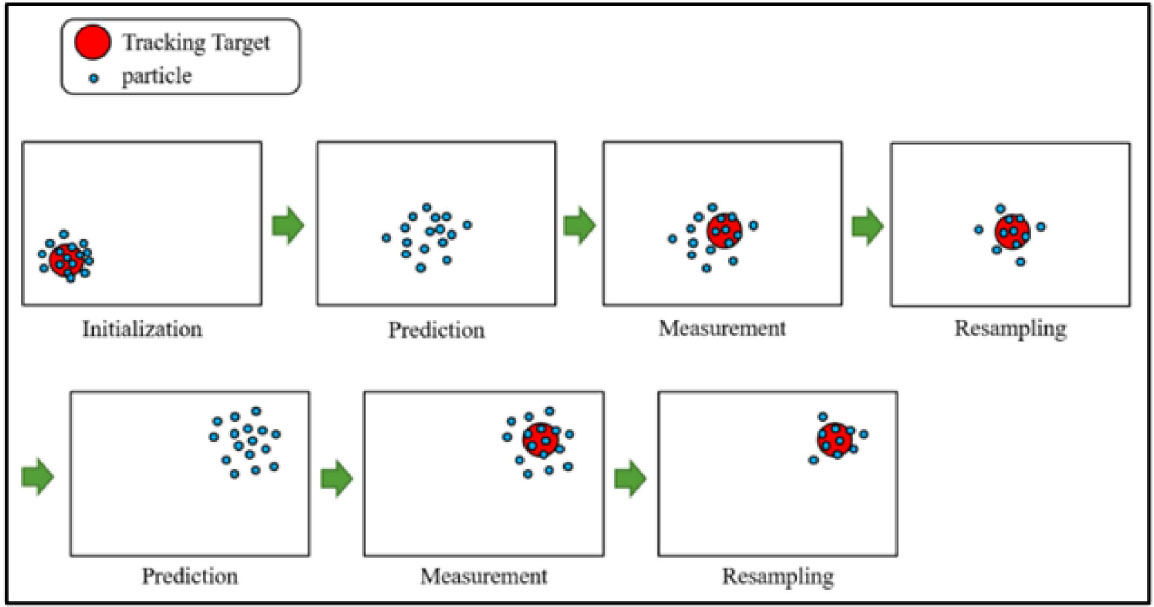
Figure 1.
Particle filter overview
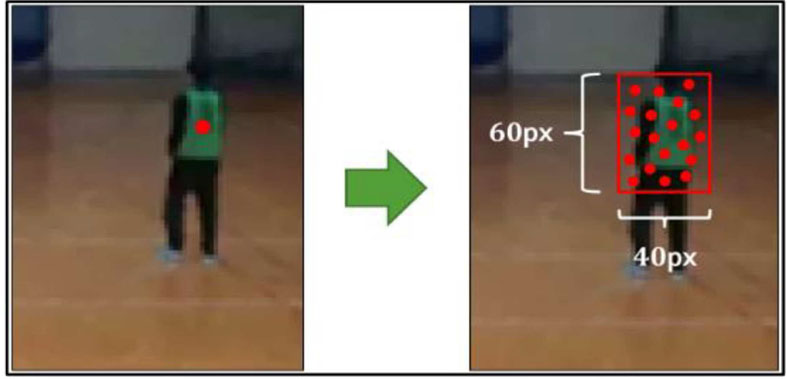
Figure 2.
Initialization
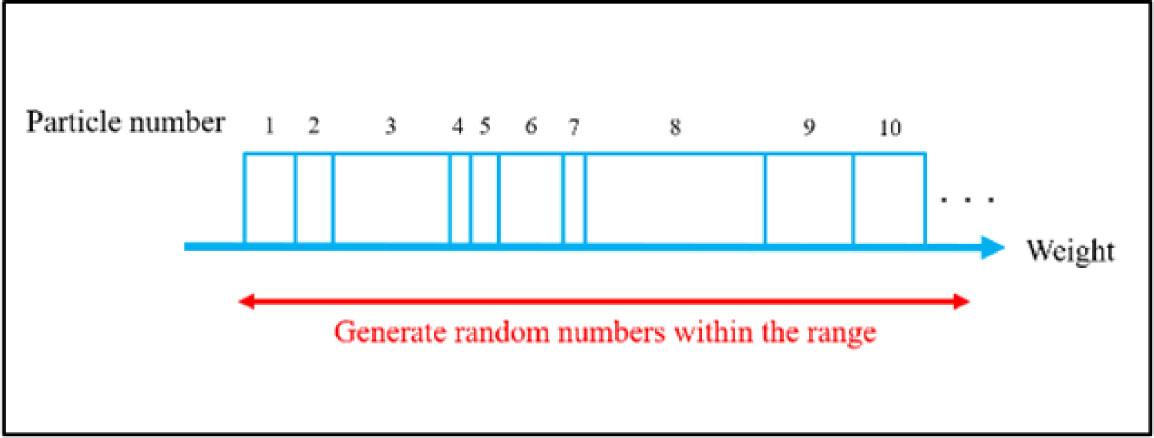
Figure 3.
Particle extraction during resampling
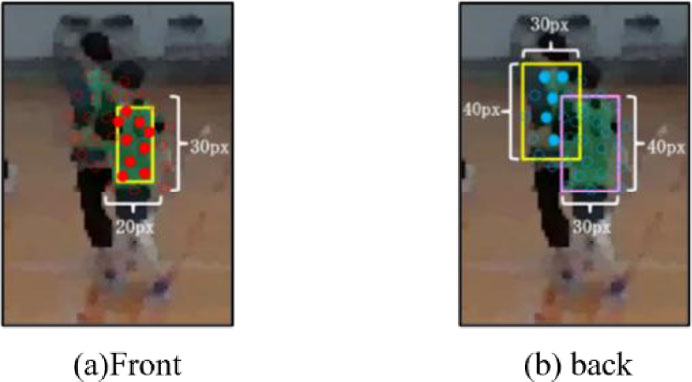
Figure 4.
Processing of close players
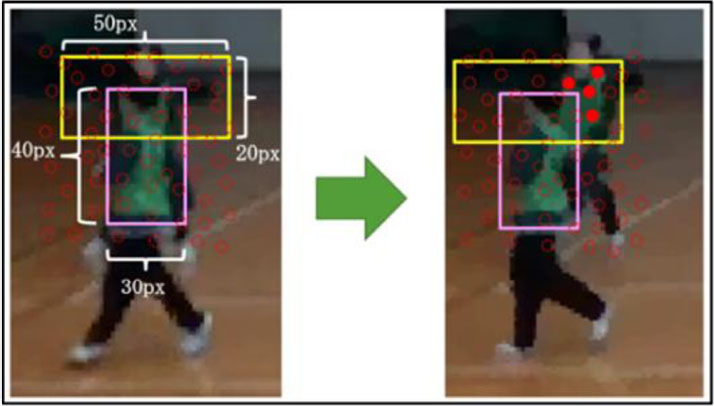
Figure 5.
Processing of hidden players
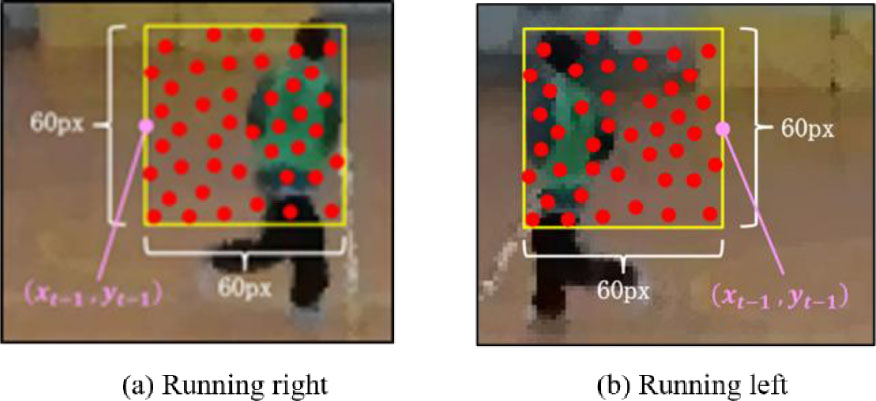
Figure 6.
Processing of running players: (a) Rightward, (b) Leftward
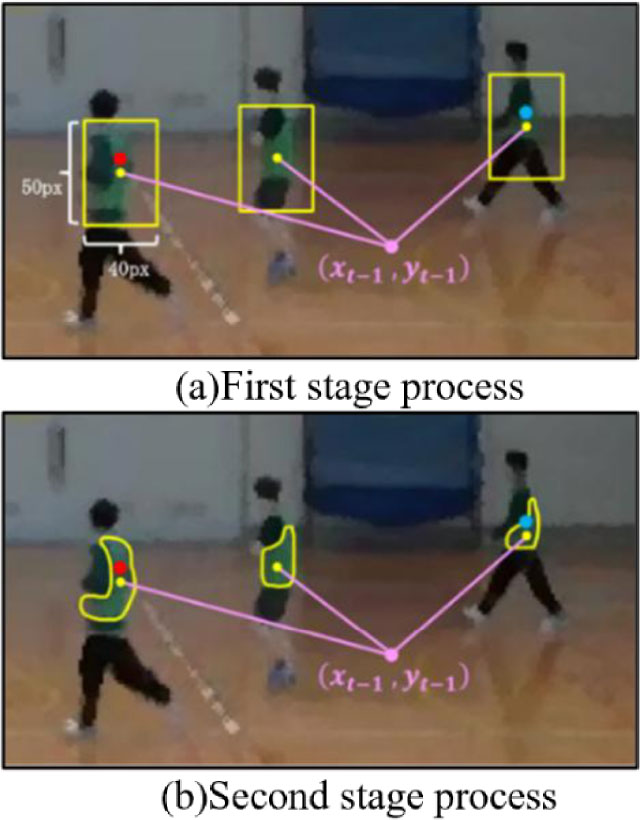
Figure 7.
Re-detection of players
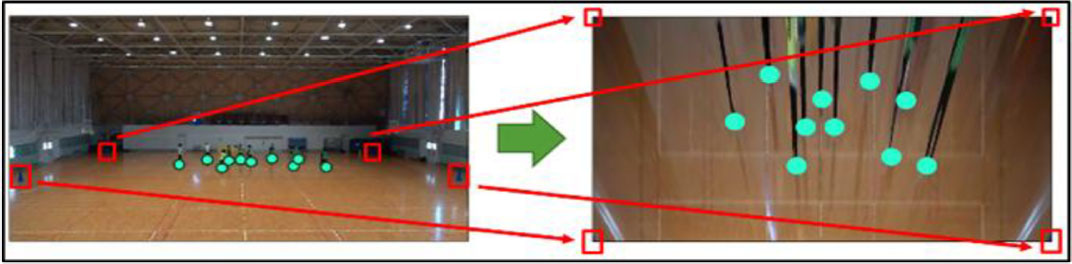
Figure 8.
Calculating coordinates on the court
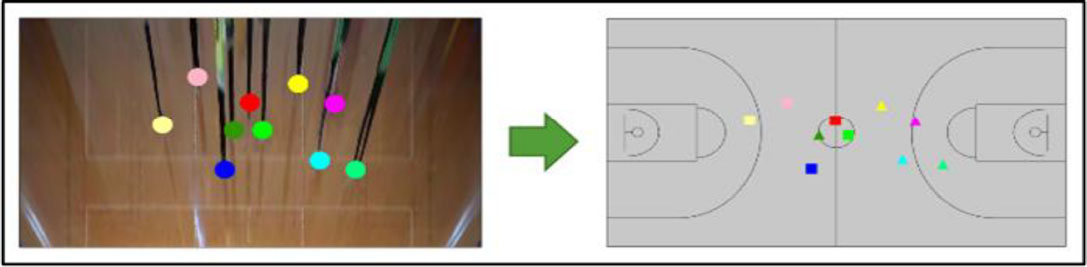
Figure 9.
Visualization of players on the court
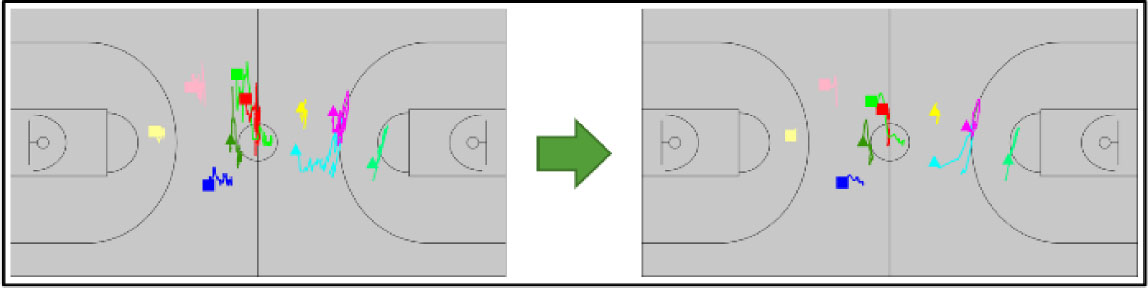
Figure 10.
Smoothing process
Table 1.
Tracking Accuracy for Players and Ball
| Target | Total Instances | Successful | Accuracy (%) |
|---|---|---|---|
| Player Tracking | 98,970 | 88,576 | 89.50 |
| Ball Tracking | 9,897 | 7,451 | 75.29 |
Table 2.
Pass and Shot Judgment Accuracy
| Judgment Type | Total | Correct | Incorrect | Accuracy (%) |
|---|---|---|---|---|
| Pass Match Rate | 35 | 25 | 10 (14 Over, 23 Missed) | 71.43 |
| Pass Recall Rate | – | – | – | 60.34 |
| Shot Match Rate | 10 | 9 | 1 | 90.91 |
| Shot Recall Rate | – | – | – | 52.63 |
Table 3.
Ball Tracking Accuracy Under Different Conditions
| Condition | Accuracy (%) |
|---|---|
| Normal Speed | 91.5 |
| High-Speed Movement | 85.2 |
| During Occlusion | 79.8 |
Table 4.
Pass Detection Performance
| Metric | Value |
|---|---|
| True Positives | 32 |
| False Positives | 3 |
| False Negatives | 4 |
| Precision (%) | 91.4 |
| Recall (%) | 88.9 |
Table 6.
Team Ball Possession Statistics
| Team | Possession Frames | Possession (%) |
|---|---|---|
| Team A (Yellow) | 5760 | 58.3 |
| Team B (Green) | 4137 | 41.7 |
Table 7.
Pass Success Rate per Team
| Team | Total Passes | Successful | Unsuccessful | Success Rate (%) |
|---|---|---|---|---|
| Team A | 18 | 16 | 2 | 88.9 |
| Team B | 17 | 14 | 3 | 82.4 |
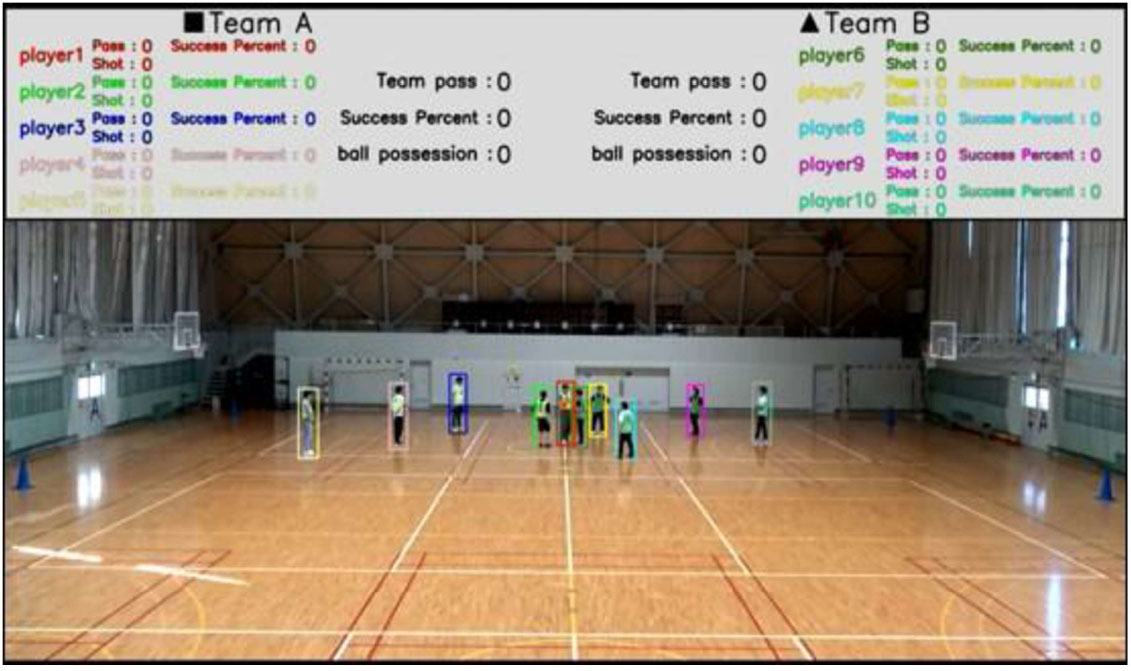
Figure. 11.
Experimental results 1
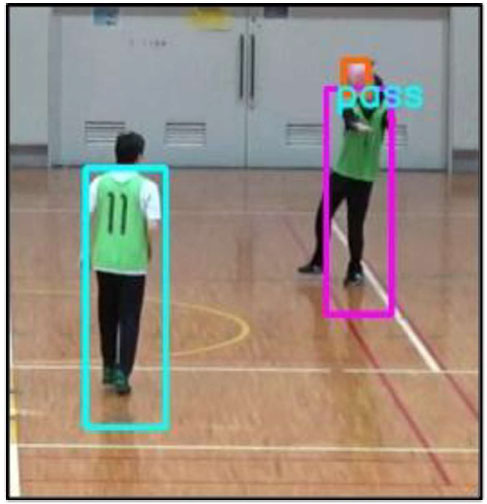
Figure. 12.
Examples of successful pass and shot judgments
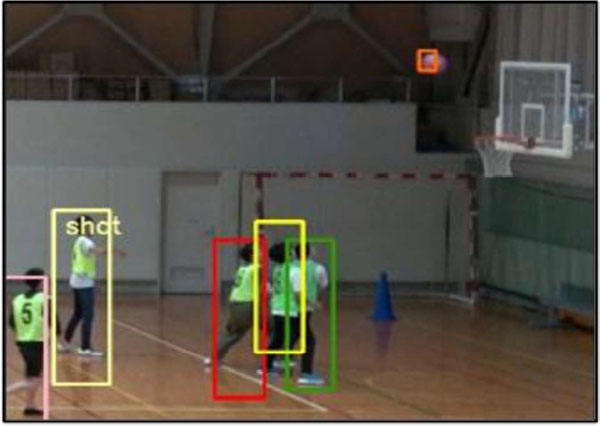
Figure. 13.
Examples of successful pass and shot judgments
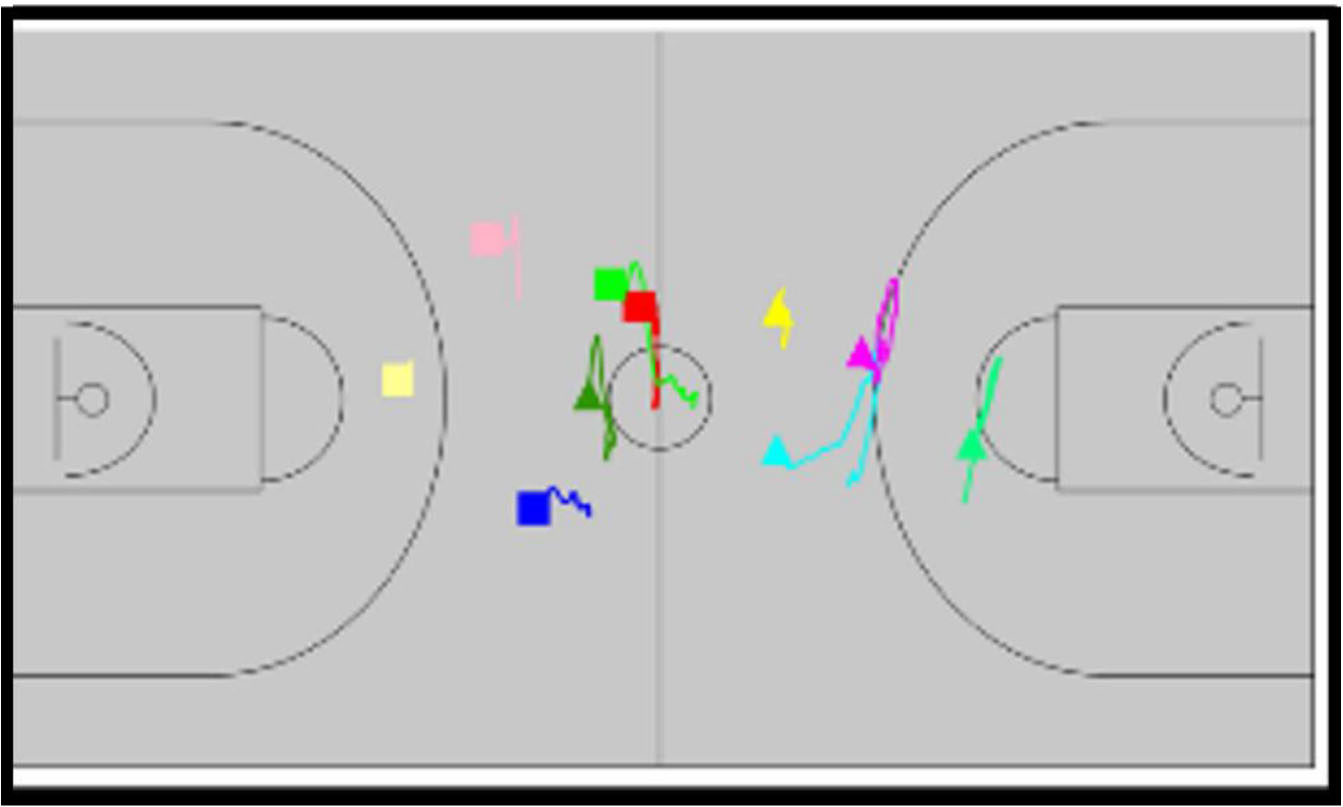
Figure. 14.
Trajectory diagram
Table. 8.
Qualitative comparison between our method and deep learning-based trackers such as Basketball-SORT.
| Aspect | Proposed Method | Deep Learning-based Methods (e.g., Basketball-SORT) |
|---|---|---|
| Traceability / Interpretability | High: explicit particle filter updates (prediction, resampling, correction) allow analysis of success/failure | Low: decisions based on embeddings and association rules are challenging to interpret. |
| Robustness under Occlusion | Suitable for player tracking (via redetection and embeddings); weaker for ball in long passes | Dependent on embedding generalization, it may fail under basketball-specific occlusion. |
| Data Requirement | Works without large-scale annotated datasets | Requires extensive annotated data for training embeddings |
| Real-time Feasibility | Runs on CPU with modest computational load | Often requires GPU acceleration for real-time performance |
| Generalization to Basketball Dynamics | Tailored for short passes, dribbling, and occlusion patterns specific to basketball | Trained on generic MOT datasets; not optimized for basketball-specific motions |