
Table 1.
Invitations and attendances according to the app.
| Player status with respect to event | Coach status with respect to player’s attendance | ||
|---|---|---|---|
| Player present | Player not present | Total | |
| Invitation accepted | 7,509,952 (71.3%) | 315,137 (3.0%) | 7,825,089 (74.3%) |
| Invitation not accepted | 195,008 (1.9%) | 2,517,841 (23.9%) | 2,712,849 (25.7%) |
| Total | 7,704,960 (73.1%) | 2,832,978 (26.9%) | 10,537,938 (100.0%) |
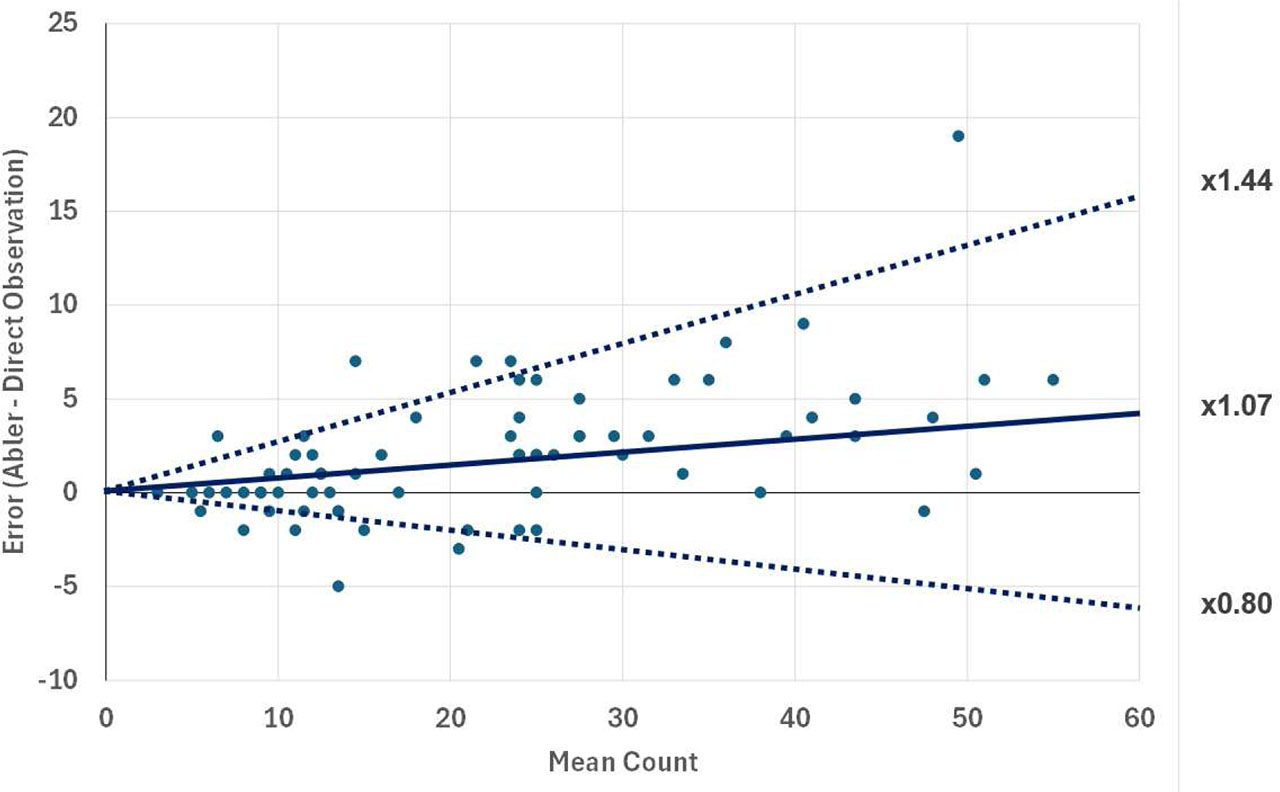
Figure 1.
Differences between Abler attendance data and direct observation counts.
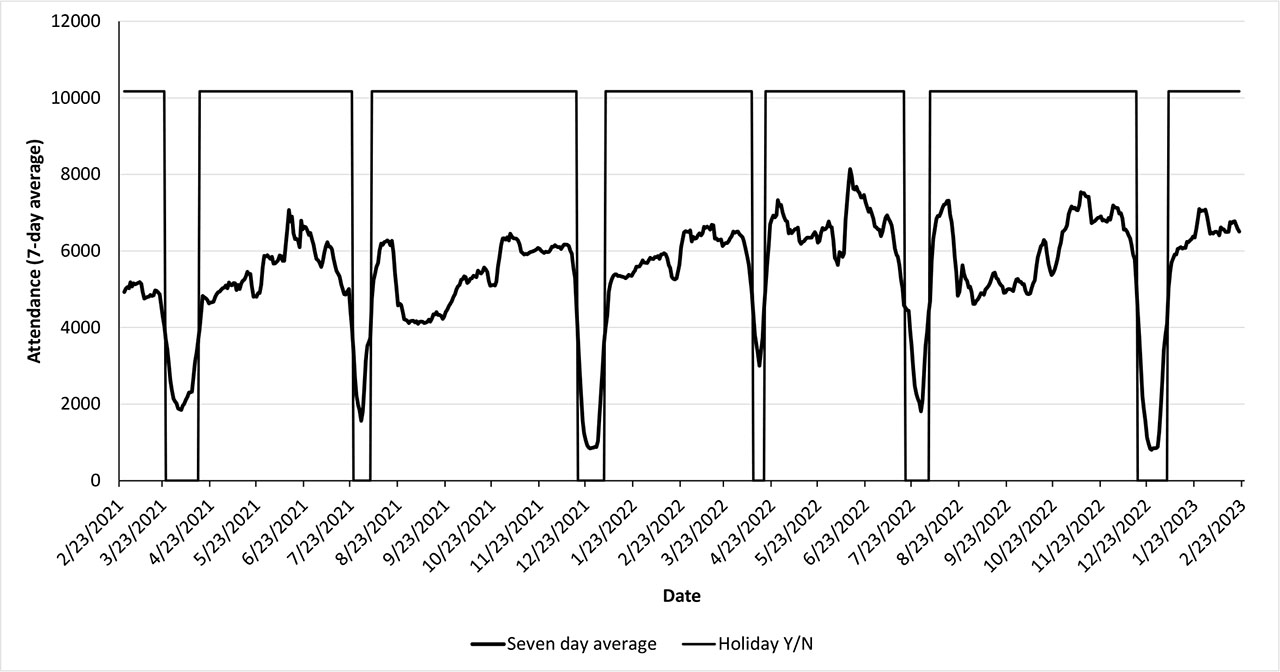
Figure 2.
Interactive exploration of normal training days within soccer (assuming a normal training day had an attendance above the 15th percentile within each year).
Table 2.
Participation level of players.
| Group | Female | Male | Total |
|---|---|---|---|
| Players | |||
| Non-attenders | 749 (4.0%) | 669 (3.0%) | 1,418 (3.5%) |
| Samplers | 2,390 (12.7%) | 2,299 (10.4%) | 4,689 (11.5%) |
| Participants (20 plus sports) | 15,727 (83.4%) | 19,091 (86.5%) | 34,818 (85.1%) |
| Total | 18,866 (100.0%) | 22,059 (100.0%) | 40,925 (100.0%) |
| Player-sport pairs | |||
| Non-attenders | 1,918 (6.4%) | 2,056 (5.6%) | 3,974 (6.0%) |
| Samplers | 6,881 (23.0%) | 7,680 (28.7%) | 14,561 (21.9%) |
| Participants (20 plus sports) | 21,145 (70.6%) | 26,741 (73.3%) | 47,886 (72.1%) |
| Total | 29,944 (100.0%) | 36,477 (100.0%) | 66,421 (100.0%) |
Table 3.
Participation, transferring between sports and drop-out.
| Participation pattern over the two-year period | Status at the end of the two-year observation period | ||
|---|---|---|---|
| Still participating | Dropped-Out | Total | |
| Female | |||
| Single sport | 6,996 (62.8%) | 4,147 (37.2%) | 11,143 |
| Multiple sports without transferring | 2,150 (92.6%) | 171 (7.4%) | 2,321 |
| Transferring between sports | 1,840 (81.3%) | 423 (18.7%) | 2,263 |
| Total | 10,986 (69.9%) | 4,741 (30.1%) | 15,727 |
| Male | |||
| Single sport | 8,393 (66.1%) | 4,307 (33.9%) | 12,700 |
| Multiple sports without transferring | 3,481 (94.0%) | 222 (6.0%) | 3,703 |
| Transferring between sports | 2,215 (82.4%) | 473 (17.6%) | 2,688 |
| Total | 14,089 (73.8%) | 5,002 (26.2%) | 19,091 |
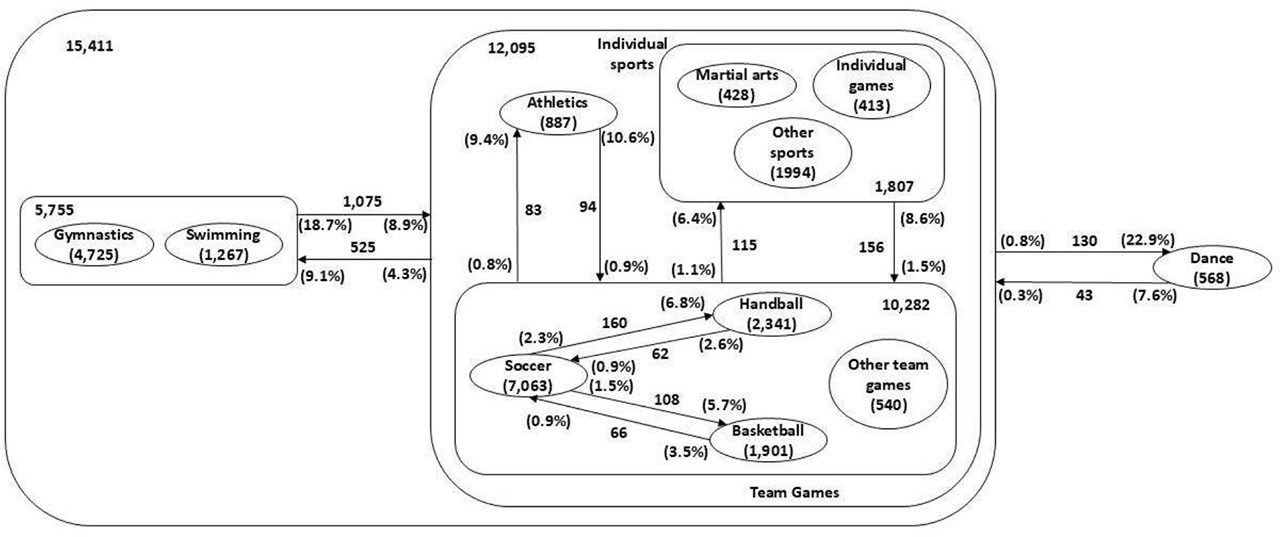
Figure 3.
Transfers between sports for females. Arrows show the number of girls making transfers with this value expressed as a percentage of girls in the donor and recipient sports in parentheses. The number of girls who participated in each sport is shown within the circle or rounded rectangle for each sport. The rounded rectangles represent higher order sports classes.
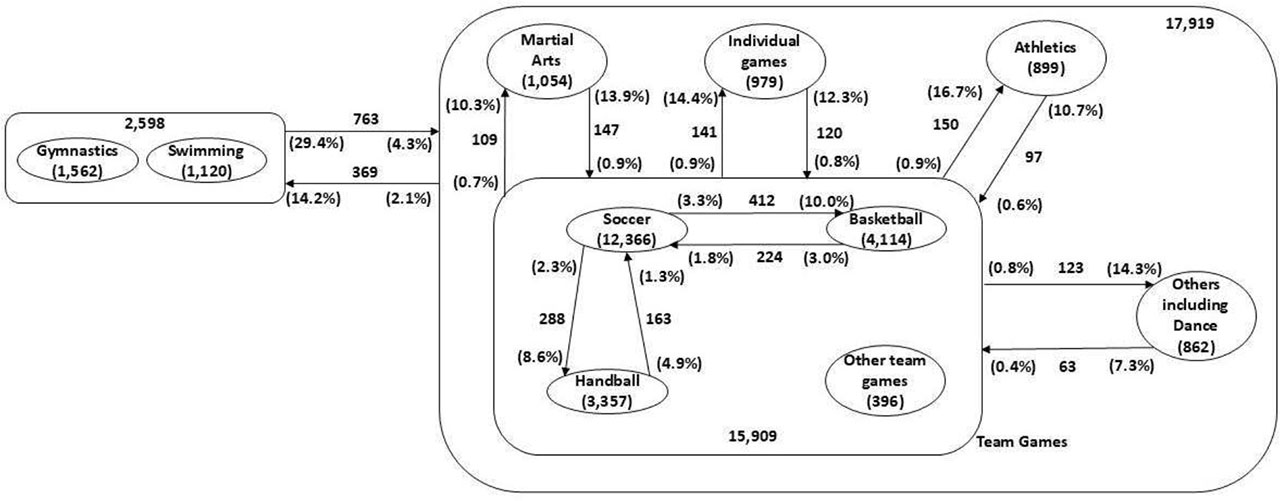
Figure 4.
Transfers between sports for males. Arrows show the number of boys making transfers with this value expressed as a percentage of boys in the donor and recipient sports in parentheses. The number of boys who participated in each sport is shown within the circle or rounded rectangle for each sport. The rounded rectangles represent higher order sports classes.