
Introduction
Participation in youth sport benefits health and well-being for individuals (Grima et al., 2017; Liu et al., 2023) as well as reducing medical costs and having social benefits for communities (Sport England, 2023). Therefore, drop-out from sport is an important issue within sport and exercise research (Gould, 1987; Crane et al., 2014). Understanding the reasons why some children and adolescents drop out of sport before becoming adults provides knowledge that can be used by policy makers to help prevent drop-out. The focus of the current research study is on patterns of sports participation of young people. Specifically, the current research is concerned with the relative effects of specializing in a single sport or sampling multiple sports when participating in youth sport. There has been academic debate in recent years about the advantages and disadvantages of specialization in youth sport compared with sampling multiple sports (Bell et al., 2018; Giusti et al., 2020; Kliethermes et al., 2020; Barth et al., 2022). On the one hand, there is evidence that early specialization is associated with later success in gymnastics (Law et al., 2007) and soccer (Ford et al., 2009). On the other hand, there is evidence from track and field athletics that participation in multiple sports during childhood and adolescent years is associated with greater improvement in athletics performance between the ages of 19 and 25 years than focusing solely on athletics during childhood and adolescent years (Barth and Güllich, 2021). Several meta-analyses have concluded that participating in multiple sports during youth years has benefits over early specialization in a single sport. For example, those specializing in sport between 14 and 15 years of age are more likely to become elite adult athletes than those who specialised at 13 years of age (Kliethermes et al., 2020). Another study found that those who specialise in sport had greater risk of burnout than those who sampled multiple sports (Giusti et al., 2020). A third meta-analysis found that world class adult athletes had engaged in more coach-led practice within multiple sports during their childhood and adolescence years than adult national class athletes had done (Barth et al., 2022). A meta-analysis done by Bell et al. (2018), that compared the injury risk between highly, moderately and low specialised athletes, acknowledged that four of the five studies included were previous meta-analyses due to the lack of original research in the area. Thus, there is a need for further original research comparing participation in single and multiple sports.
It is difficult to classify young people involved in sport as samplers or specialisers. For example, Myer et al. (2016) defined a true specialiser as someone who exclusively participated in a single sport over a period of at least eight months while DiStefano et al. (2018) defined a true sampler as someone who had participated in more than one sport over a period of a year. Carder et al. (2020) used these definitions in a systematic review and meta-analysis of injury risk between people with different participation patterns in youth sport. In so doing, it was necessary to classify 29% of their sample as “other”. The meta-analysis found that there was a higher injury risk for the true specialisers than the “others”, and a higher injury risk for the “others” than the true samplers.
The recognition of youth sport participation patterns other than true specialisation and true sampling provides an opportunity to explore these other patterns. The sports participation pattern of interest in the current investigation is where a young athlete moves from one sport to another. Specifically, the current research is interested in patterns where a young athlete drops out of one sport but continues to participate in another sport that they commenced after starting their original sport. This is a relatively new area of research within youth sport and so it is necessary to consider the terminology to be used to represent moving from one sport to another. Three terms that immediately came to mind for the authors were “transitioning”, “migration” and “transferring”. The term “transition” has been used to represent transition events within the lives of athletes (Wylleman and Lavallee, 2004; Stambulova et al., 2021). Using the term “migration” to represent moving from one sport to another is also problematic due to the accepted use of the term “migration” to represent athletes migrating between countries (Rojo et al., 2022). The term “transfer” is often used in sports media when discussing players being traded between professional clubs. However, the term “talent transfer” has been used recently in academic research to represent athletes moving from one sport to another (Riot et al., 2019; van Harten et al., 2021; Green et al., 2024). Therefore, the current investigation will also use the term “transfer” to be consistent with previous research in this area.
The scope of the current research is youth sport in Iceland. Iceland’s municipality-based sports clubs offer opportunities in multiple sports. Thus, some findings from the current study may be relevant to other countries where sports clubs engage in multiple sports. An advantage of conducting the research in Iceland is the detailed recording of youth sport attendance using the Abler app (Abler, Reykjavik, Iceland). This app is used for sports club management, communication between players, parents and coaches, and organizing training sessions. Typically, clubs use the app to register players and manage memberships and resources. Coaches can plan training sessions using the app and send invitations to players registered to their teams. Players and / or their parents can accept invitations, coaches can record attendances at training sessions, and parents can monitor their children’s attendance of sport and communications with clubs and coaches. The details recorded about training attendance provide an opportunity to investigate the dynamics of youth sport participation. For instance, the exact dates when players commenced or ceased attending training are recorded. The app is used by 60% of young people aged between 5 to 19 years in Iceland at the time of writing, making this a near population-level study. Furthermore, a child uses the same user ID on the app for each sport they are involved in, allowing the investigation of transfers between sports.
There is a need to apply an analytics approach when dealing with youth sports attendance data. These data are big data that include the five features of big data described by Bai and Bai (2021): volume, velocity, variety, veracity and value. The tens of millions of event invitation records generated using the Abler app since 2017 are consistent with the volume required to be classed as big data. The velocity of the data is the extent to which the data are growing. The app is used in real-time by young people, parents and coaches with new invitations to training sessions and attendances being added on a daily basis. The variety of data are consistent with the entities and relationships between entities described by Bai and Bai (2021). In particular, the entities within the data include athletes, coaches, clubs, events and sports. Veracity is the extent to which the data conform to the real-world sports behaviour that is represented in the data. It is necessary to assess the accuracy of the data and to treat any incomplete, incorrect, or inconsistent records. The value of the data is derived from their potential use to evaluate youth sport and model factors associated with different participation patterns. Youth sport attendance data need to be preprocessed. This preprocessing includes the data cleaning, reduction and aggregation activities listed by Siddiqa et al. (2016) for big data. Visualisation is a further area of analytics that is relevant to the current investigation. The transfers could be represented as a crosstabulation of donor and recipient sports. However, this would make transfer sequences of more than two sports difficult to recognise. There is a wealth of data visualisation techniques for temporal data that can be considered for presenting any transfer patterns that are found (Klasen et al., 2023). The research also involves computer science when developing data structures and algorithms. The invitation data needed to be reduced to abstract summary records reflecting each player’s involvement in each sport they were invited to. Each player’s summary records then needed to be aggregated to represent their overall participation in sport. This required algorithms to be devised to analyse temporal patterns within the attendance data, and to analyse these within normal seasons for the sports.
Having considered the need to investigate transferring between sports and recognised the role for analytics principles in such research, the current investigation aims to uncover transfer patterns within youth sport in Iceland. The primary purpose of the investigation is to describe the transfers that occur within girls’ and boys’ sports. A secondary purpose is to compare the rate of drop-out from sport between those transferring between sports, those who specialise in a single sport, and those who sample multiple sports without transferring.
Methods
Research Design
This research uses a reductive approach to investigate youth sport participation patterns derived from event invitation records. The first step in this process was to collate anonymised invitation records produced by the Abler app over a two-year observation period. The data were cleansed to remove any records with incomplete or incorrect values. A vital step was validating the attendances in the data against observed attendances at actual training sessions. The data were explored to determine holiday and inter-season breaks for each sport as well as to determine the length of absence that represents potential drop-out from a sport. Further exploration was needed to determine a volume of attendance that would represent participation in a sport rather than sampling the sport. Once these data exploration activities were completed, it was possible to operationalise transferring, participation and drop-out. The invitation records were reduced to summary records for each sport-athlete pairing. Where athletes participated in more than one sport, the periods of participation were inspected to determine any transfers between sports. This allowed participants to be classified as samplers without transferring, specialisers or athletes who transfer between sports. Chi square tests of independence were used to determine if dropout was associated with participation pattern. Finally, hierarchical network charts were used to visualise transfer patterns within Icelandic youth sport.
Data Source
The data used in the current study were gathered using the Abler app (Abler, Reykjavik, Iceland) which is a communications management system for sports clubs. The app is used to manage club and team membership, plan training sessions, and communicate information about training sessions between coaches, players and parents. The app is used by about 343,000 users in 500 sports organizations Iceland, the UK, and Germany. The app was used by 40,925 young people in 137 sports clubs in Iceland between February 2021 and February 2023. This represents 60% of children and adolescents born in the country between 2003 and 2017. Coaches invite players to events, mainly training sessions, and then players or their parents can indicate whether they will be attending the event or not. When events take place, coaches mark which players were present using the app, and parents are able to monitor their children’s attendance.
The current investigation used all event data in Iceland from the 23rd February 2021 to the 24th February 2023; this period included the last 366 days of Covid restrictions in Iceland, and the first 366 days since the restrictions were lifted. During the last year of Covid restrictions, fitness centres and swimming pools were permitted to open to 75% capacity with commonly used equipment being disinfected between use by different guests. Contact and non-contact sports were allowed but with the number of participants limited to 100 and the number of spectators being limited to 200 with no refreshment sales taking place. The data were provided as a file of 11,382,013 invitation records which contained the following fields:
Event identifier
Day, month and year of the event
Event type (match, training, general, or class)
Event status (open or cancelled)
Sport Type (there were 45 different sports and activities in the data during the two-year observation period)
The club that organised the event
Anonymised user identifier
Player status with respect to event (whether they have accepted the invitation or not)
Coach status with respect to the player’s attendance (the player is marked present or absent)
Player gender (female or male)
Player birth year and month
Data Cleaning
Data processing was done in R (RStudio, Posit Software, Boston, MA) which is a programming language and development environment for statistical analysis and data visualization. The data were loaded into an R data cleaning script to identify and remove any invitation records containing incorrect or incomplete values. Any invitation records for events that were cancelled were removed from the data set. Any day, month or year fields that were not completed or that contained invalid values were excluded. There were much fewer invitations to young people born before 2003 and after 2017 than for young people born in the years from 2003 to 2017. Therefore, those born before 2003 or after 2017 were removed from the data. This left 10,537,938 clean invitation records. A player was counted as present at an event if the player accepted the invitation and the coach marked the player present. Table 1 shows that there was agreement about attendance between the data provided by players and coaches for 95.1% of invitations.
Table 1.
Invitations and attendances according to the app.
| Player status with respect to event | Coach status with respect to player’s attendance | ||
|---|---|---|---|
| Player present | Player not present | Total | |
| Invitation accepted | 7,509,952 (71.3%) | 315,137 (3.0%) | 7,825,089 (74.3%) |
| Invitation not accepted | 195,008 (1.9%) | 2,517,841 (23.9%) | 2,712,849 (25.7%) |
| Total | 7,704,960 (73.1%) | 2,832,978 (26.9%) | 10,537,938 (100.0%) |
Data Validation
While the 95.1% agreement between players and coaches with respect to attendance was encouraging, it was essential to validate the data recorded on the Abler app against actual observed attendances at events organised by clubs. Therefore, 71 events at 8 different clubs were observed, the number of players counted, and entered into a google document that included the club, sport, age group, gender, date, and time of each event being observed. These events covered the most popular four sports (soccer, gymnastics, basketball and handball), girls’ and boys’ events, multiple age groups, as well as clubs from the capital region of Iceland and other regions. The total number of players who attended these sessions was 1,528. The corresponding data recorded on the Abler app for these events were provided by Abler with the number of participants being compared to the observed totals. The number of attendees from the Abler data only included those invitations where the child or parents indicated they would be attending and where the coach marked the players present. According to the Abler data, there were 1,674 attendances at these events from 2,000 invitations. There was a strong positive correlation between the observed counts and the number of attendees according to the Abler data (r = 0.975). There was heteroscedasticity in the data with a positive correlation between absolute errors and average values between direct observation and the app (r = 0.527). Therefore, 95% ratio limits of agreement were used to describe the errors between direct observation and attendances recorded by the app. The 95% ratio limits of agreement were 1.07x/÷1.34 as illustrated in Figure 1; the lower and upper limits being x0.80 and x1.44 respectively. Thus, the Abler data overestimated attendance by 7% compared to direct observation.
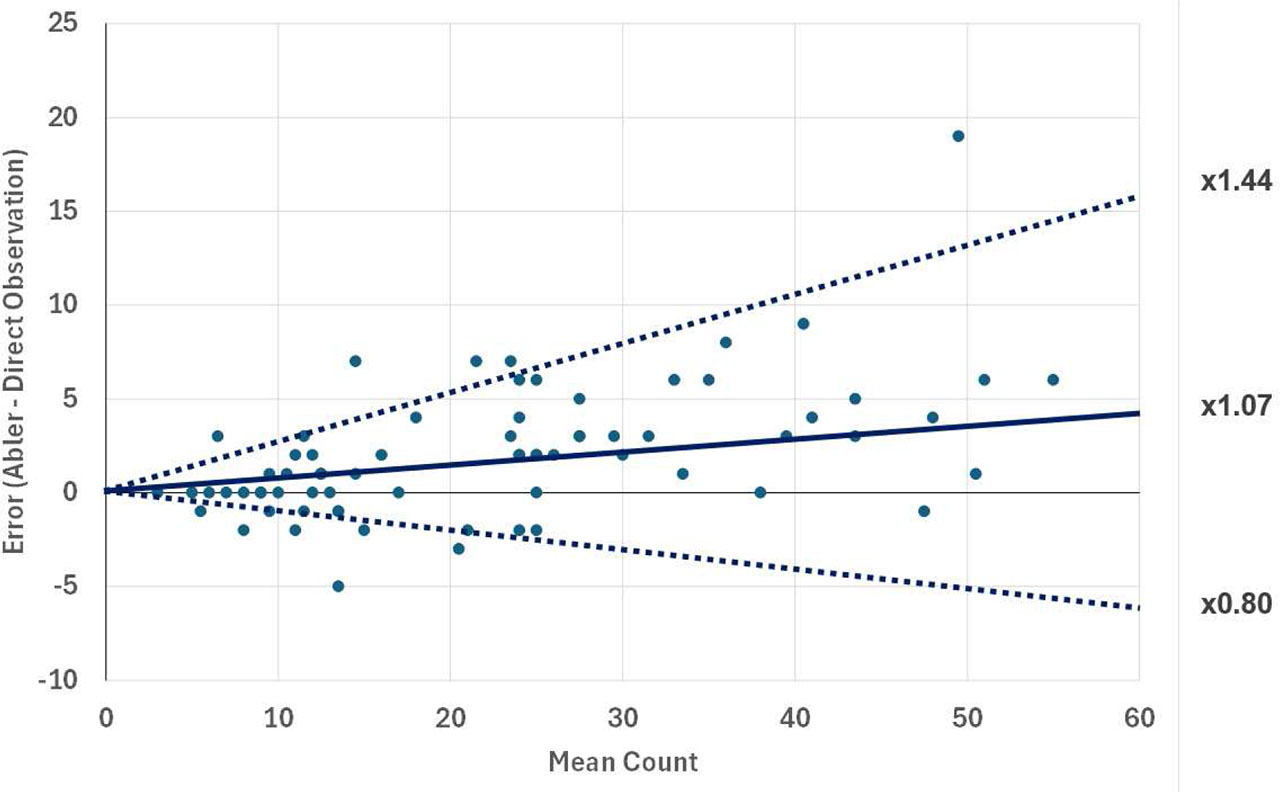
Figure 1.
Differences between Abler attendance data and direct observation counts.
Adjustments can be made for the known systematic bias of 7% when interpreting any results of analysing Abler data. It is worth remembering that the 95% ratio limits of agreement are extreme limits such that only 5% of errors should be outside these limits. The level of agreement between Abler’s data and data derived from direct observation needs to be considered in relation to the analytical goals of studies. Broad summary variables, such as number of attendances over a two-year period, can be considered as 7% above actual attendance levels for the average person in a sport. Analysing the dynamics of attendance patterns at the level of individual sessions and days off is not recommended because 7 attendances in every 107 attendances recorded are false positive attendances. Broader variables such as drop-out from a sport are less problematic. When an athlete drops out of a sport, they can de-register from the given sport at the given club relatively quickly.
Normal training seasons, holidays and inter-season breaks for sports
A purpose of the analysis was to identify potential drop-out from sports. Many sports are timetabled into seasons, for example in Iceland, basketball and handball are winter sports while soccer is a summer sport. Therefore, it was necessary to exclude normal holiday periods and inter-season breaks from any absences counted for players. This was done using an exploratory approach to decide the percentile of daily attendance totals to use as a cut-off value between normal training days for a sport and holiday periods or inter-season breaks. A spreadsheet was programmed to plot the total attendance for a sport over the 732-day observation period. Most sports showed weekly peaks and troughs with the lowest values being at weekends. It was, therefore, decided to calculate and plot seven-day average attendances rather than raw daily attendance totals. The spreadsheet was used to explore each sport in turn. A percentile was entered to distinguish the days where the seven-day average for attendance for the sport was above and below this percentile for attendances. This percentile was applied separately to the first and second 366 days of the observation period because overall attendance was 15% lower during the last 366 days of Covid restrictions than during the 366 days that followed. Figure 2 uses soccer as an example. Various percentiles were considered. The authors agreed that the 15th percentile best distinguished between normal training days from holidays and inter-season breaks for this sport. Different sports have seasons of differing lengths. Thus, there was a range of percentiles used to distinguish normal training days from holiday and inter-season breaks. These percentiles ranged from the 12th for gymnastics, which had the longest seasons, to the 80th for sailing and summer camps, which had the shortest seasons. The normal training days and holiday or inter-season breaks determined during this exploratory exercise were saved in a 732 × 45 (day × sport) calendar array of binary cells.
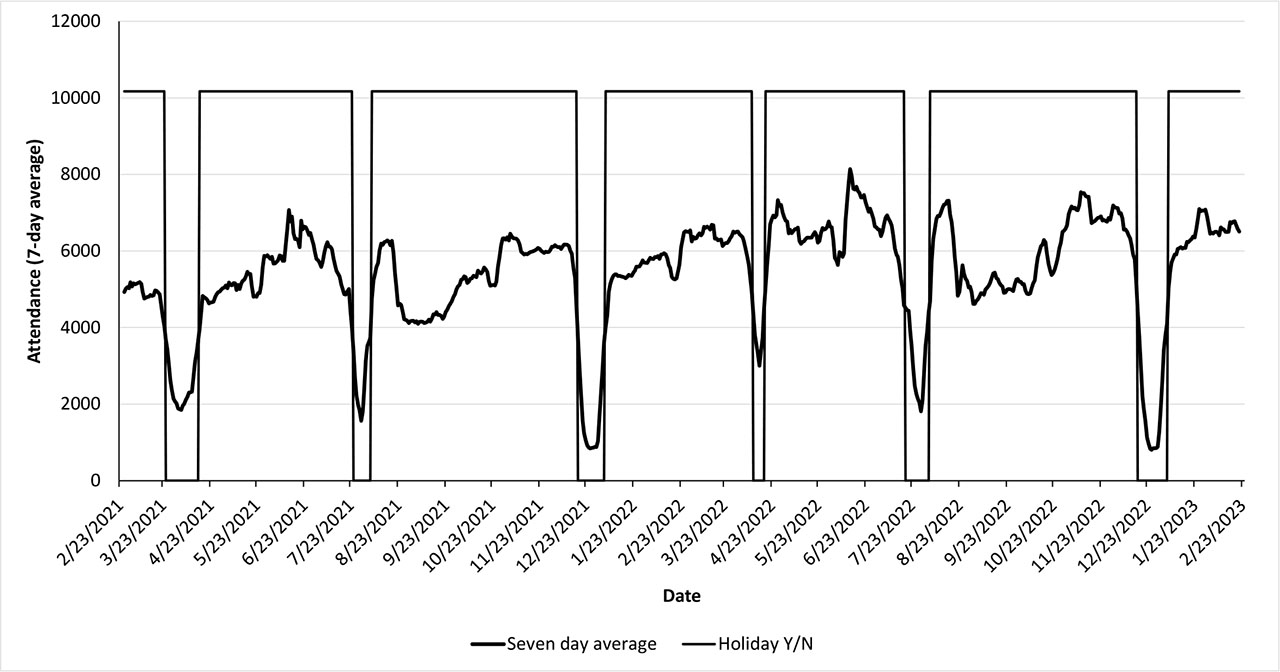
Figure 2.
Interactive exploration of normal training days within soccer (assuming a normal training day had an attendance above the 15th percentile within each year).
Data Processing
Having produced a data file of 10,537,938 clean invitation records and a calendar data structure to distinguish normal training days from other days for each sport, the next step was to reduce the data to a file of summary records for each player-sport pair. An R script was written to produce the file of summary records. The players’ invitations were traversed noting the day (1 to 732) within the two-year observation period where the first and last attendances occurred. The number of days between the last attendance and the end of the two-year observation period was calculated excluding any normal holidays or inter-season breaks during these days. The following variables were stored in the summary record for the player-sport pair:
Anonymised user identifier
The sport
Birth month and birth year of the player
Gender of the player
The total number of invitations the player received to events in the sport
The number of events where the player was present (according to the player and the coach using the app)
First attendance (days into the two-year observation period)
Last attendance (days into the two-year observation period)
The length of the gap at the end of the two-year observation period.
This processing reduced the data to 66,421 player-sport pairings with some young people having summary records for more than one sport.
Exploratory analysis of participation records
The next stage of the process was to add two fields to the summary records for each player-sport pairing. The first additional field was to classify the player as someone who sampled the sport, someone who participated in the sport, or someone who did not attend any events they were invited to. The second additional field was to represent whether the player had dropped out of the sport or not. A player was classified as a non-attender if they did not accept any invitations from the given sport. The number of days indicating participation beyond sampling the sport needed to be high enough to represent a commitment to the sport, but low enough so that the number of players classed as participants would be comparable with participation rates reported in previous research. It was decided to use 20 or more attendances recorded by Abler to represent participation and 1 to 19 attendances to represent sampling the sport. The number of individual young people represented in the data was 40,925. The 34,818 (85.1%) of the young people who attended at least 20 attendances recorded in at least one sport is comparable with the 80% reported by Halldorsson et al. (2017) for the number of 10 year olds practicing sports at clubs Iceland.
The number of missed normal training days at the end of the two-year observation period that would represent the potential for drop-out also needed to be an optimal value. This value needed to be long enough to be beyond an absence expected due to a minor injury but short enough to avoid counting some players as still participating in a sport when they may have dropped out. The cumulative frequency for the gap at the end of the two-year observation period excluding holidays was plotted. This curve exhibited two “elbows” where the gradient dramatically shallowed. One of these elbows was after 4 days which was too short to represent drop-out, and the other was at 27 days. Given that sports participation typically fits within weekly work, education and social schedules, it was decided to count gaps in attendance of up to 28 days as normal gaps in attendance with gaps of 29 days or more counting as drop-out. This meant that 26,273 (39.6%) of the person-sport pairs would count as potential drop-out from a sport. This was similar to the 35% annual drop-out rate in youth sport in the USA (Eitzen and Sage, 2009) and some young people counted as dropping out of one sport still participate in other sports(s).
Operationalising transferring
The 34,818 players who participated in 20 or more events for at least one sport needed to be classified into three groups to permit transferring to be studied. They were classified as participating in a single sport, participating in multiple sports without transferring, or participating in multiple sports with at least one transfer from one sport to another. A transfer from a doner sport to a recipient sport is counted where the same player participated in both sports, with the first attendance of the donor sport being before the first attendance of the recipient sport, the last attendance of the donor sport being before the last attendance of the recipient sport, and the player having dropped out of the donor sport.
Statistical analysis
The percentage of girls and boys who are classified as transferrers, specialisers and multi-sport samplers without transferring were determined. The percentage of each of these groups who drop out of sport was determined for girls and boys. Chi squared tests of independence were used to determine if drop-out rate is influenced by participation pattern.
Creating sport transfer graphs
Separate sport transfer graphs were produced for females and males. These graphs displayed the main transfers between pairs of sports. The main transfers between sports were those where at least 5% of the transfers for the given gender were between the same pair of sports in either direction. There were 6,490 cases of players transferring between a pair of sports, including more than one transfer for some players; 2,938 were by females and 3,552 by males. Some sports had low numbers of participants, and low numbers of transfers. Therefore, these sports were combined for the purpose of creating the sports network graphs. Martial arts were combined into a single class and any team games other than soccer, basketball and handball were combined into an “Other team games” class. “Individual games” was a combined class consisting of archery, badminton, bowling, frisbee golf, and table tennis. Athletics and swimming were kept separate for both genders and dance was kept as a separate sport for the females. However, it was necessary to use a class “Other sports” to represent 16 sports that did not fit into the individual games, team games or martial arts classes. The “Other sports” included dance for the males but not for females.
While the number of transfers between some pairs of sports and sports types did not reach the 5% threshold to be represented on the sport transfer graphs, further combining of sports and sports types was done to create a hierarchy of sports types within these charts. For example, soccer, basketball, handball and “Other team games” were combined into a higher order “Team games” class allowing transfers to be counted between this class and athletics. Note that the total number of participants in a higher order class may be lower than the sum of the totals for the sports types it brings together because there may be individuals participating in more than one of these sports. Combining sports into higher order sports classes considered the nature of the sports, for example other team games would be integrated with soccer, basketball and handball. It was also necessary to consider whether the transfers for a sport were mainly away from the sport or into the sport. For example, more participants transferred from gymnastics and swimming to other sports than transferred from other sports into gymnastics and swimming. Therefore, these two sports were combined into a higher order class allowing transfers to reach the threshold set for inclusion in the sports transfer graphs.
Results
Table 2 summarises the data for the individual players as well as the player sport pairs within the study. Gender had a significant influence on participation level (χ22 = 82.7, p < 0.001) with a greater proportion of males being classed as participants than females. Table 3 shows the number of young people who transfer between sports. There were 14.4% of females and 14.1% of males who transferred between at least one pair of sports over the two-year observation period. Those who transferred between sports had a lower drop-out rate than those who participated in a single sport but a higher drop-out rate than those who did multiple sports without transferring. Participation pattern had a significant influence on drop-out for the females (c22 = 977.4, p < 0.001) and for the males (c22 = 1275.5, p < 0.001). Follow-up chi square tests that excluded those doing single sports revealed a significantly higher drop-out rate for those transferring between sports than those doing multiple sports without transferring for both girls (χ21 = 130.3, p < 0.001) and boys (χ21 = 216.3, p < 0.001).
Table 2.
Participation level of players.
| Group | Female | Male | Total |
|---|---|---|---|
| Players | |||
| Non-attenders | 749 (4.0%) | 669 (3.0%) | 1,418 (3.5%) |
| Samplers | 2,390 (12.7%) | 2,299 (10.4%) | 4,689 (11.5%) |
| Participants (20 plus sports) | 15,727 (83.4%) | 19,091 (86.5%) | 34,818 (85.1%) |
| Total | 18,866 (100.0%) | 22,059 (100.0%) | 40,925 (100.0%) |
| Player-sport pairs | |||
| Non-attenders | 1,918 (6.4%) | 2,056 (5.6%) | 3,974 (6.0%) |
| Samplers | 6,881 (23.0%) | 7,680 (28.7%) | 14,561 (21.9%) |
| Participants (20 plus sports) | 21,145 (70.6%) | 26,741 (73.3%) | 47,886 (72.1%) |
| Total | 29,944 (100.0%) | 36,477 (100.0%) | 66,421 (100.0%) |
Table 3.
Participation, transferring between sports and drop-out.
| Participation pattern over the two-year period | Status at the end of the two-year observation period | ||
|---|---|---|---|
| Still participating | Dropped-Out | Total | |
| Female | |||
| Single sport | 6,996 (62.8%) | 4,147 (37.2%) | 11,143 |
| Multiple sports without transferring | 2,150 (92.6%) | 171 (7.4%) | 2,321 |
| Transferring between sports | 1,840 (81.3%) | 423 (18.7%) | 2,263 |
| Total | 10,986 (69.9%) | 4,741 (30.1%) | 15,727 |
| Male | |||
| Single sport | 8,393 (66.1%) | 4,307 (33.9%) | 12,700 |
| Multiple sports without transferring | 3,481 (94.0%) | 222 (6.0%) | 3,703 |
| Transferring between sports | 2,215 (82.4%) | 473 (17.6%) | 2,688 |
| Total | 14,089 (73.8%) | 5,002 (26.2%) | 19,091 |
Figures 3 and 4 show the sport transfer networks for the girls and boys respectively. Gymnastics and swimming were donor sports with a net transfer from these sports to other sports. There was a net transfer from soccer to basketball and handball. A difference between the genders was that there was a net transfer from athletics to team games for the girls but a net transfer from team games to athletics for the boys. It was necessary to combine “Individual games”, “Martial arts” and “Other sports” for the females to reveal a net transfer from these sports to team games. However, it was possible to consider “Individual games” and “Martial arts” separately for the boys. There was a net transfer from “Martial arts” to “Team games” for the boys but a net transfer away from “Team games” to “Individual games”.
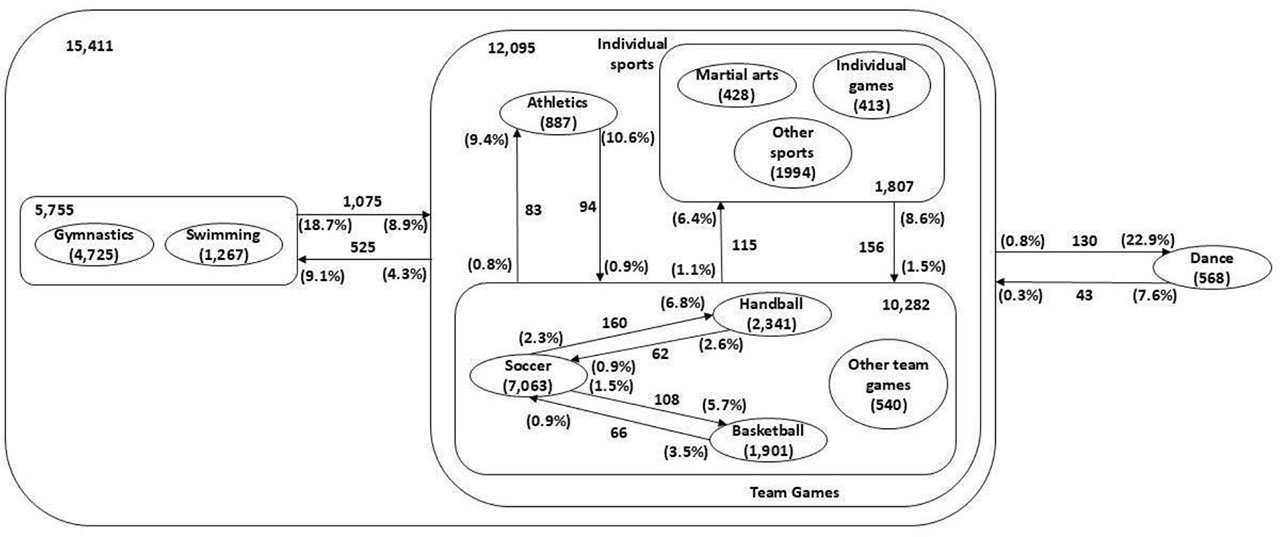
Figure 3.
Transfers between sports for females. Arrows show the number of girls making transfers with this value expressed as a percentage of girls in the donor and recipient sports in parentheses. The number of girls who participated in each sport is shown within the circle or rounded rectangle for each sport. The rounded rectangles represent higher order sports classes.
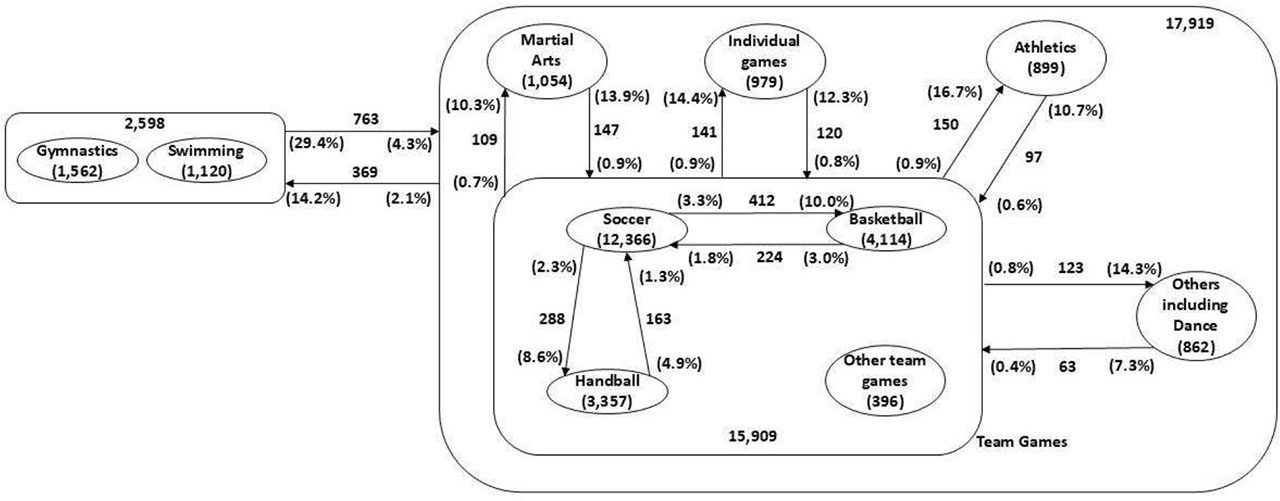
Figure 4.
Transfers between sports for males. Arrows show the number of boys making transfers with this value expressed as a percentage of boys in the donor and recipient sports in parentheses. The number of boys who participated in each sport is shown within the circle or rounded rectangle for each sport. The rounded rectangles represent higher order sports classes.
Discussion
The current investigation has found that there are a greater number of boys than girls attending organized youth sport training sessions in Iceland (Table 2). This is due to the greater number of invitations sent to boys and the greater percentage of invitations that are accepted by boys. The lower number of girls registering for sports may be explained by gender stereotype effects (Cormack and Hand, 2020) with girls participating in so-called masculine sports having more neutral gender role beliefs, confidence and a sense of skill development (Desforges-Houle and Tacon, 2025). The number of boys participating in organized Icelandic youth sport is 21% higher than the number of girls. This is concerning as studies of youth sport participation in other countries have found narrower gaps between boys’ and girls’ participation levels. For example, in the USA 56% of boys and 52% of girls aged 6 to 17 years participate in community sport or take sports lessons in school (Eitzen and Sage, 2009). In Canada, 71% of boys and 64% of girls aged 5 to 17 years participate in youth sport (Canadian Fitness and Lifestyle Research Institute, 2022).
Swimming and gymnastics are two main donor sports in Icelandic youth sport (Figures 3 and 4). There are examples in previous research of elite level swimmers and non-elite gymnasts transferring to other sports (van Harten et al., 2021). Possible reasons for young people transferring from these sports at a young age may be due to the commitment required to be successful in these sports (Chatard and Stewart, 2011; Malina et al., 2013) or a perceived lack of development pathways for older children and adolescents (Green et al., 2024). Gymnastics develops fundamental movement skills (Rudd et al., 2017) that may benefit participation in recipient sports. Similarly, there is evidence that swimming can develop fundamental movement skills that can be transferred to other sports (Sinclair and Roscoe, 2023).
The net transfer from soccer to basketball and handball can be explained by the competition for opportunities in soccer. Soccer is the most popular youth sport in Iceland and there is competition for places on club teams during youth sport years. Some girls and boys may, therefore, perceive there to be greater opportunities to compete for their club in another team game. This is consistent with greater opportunities being one of the catalysts for transferring between sports (Green et al., 2024). Team games share many cognitive and physical requirements and the similarities between donor and recipient sports is a theme covered in a recent review of research into transferring between sports (Riot et al., 2019).
The current investigation has determined some differences in transferring between sports for girls and boys. For example, there is a net transfer from athletics into team games by the girls but a net transfer from team games to athletics for the boys. Previous research in Australia has found that athletics is one of the donor sports for women’s soccer (Hoare and Warr, 2000). A further explanation for girls transferring from athletics to team games is that team games offer an opportunity for socialisation through physical activity which has been suggested as important for females (Craike et al., 2009). For boys, there are many role models who successfully transferred from team games to athletics (Collins et al., 2014).
Dance has been found to be a recipient sport for girls (Figure 3). Dance is a feasible alternative to traditional sport for physiological and psychological benefits (Tao et al., 2022). Motives for girls participating in dance are enjoyment, creative expression, friendships and opportunities to compete regardless of ability (Shannon, 2016).
While transferring between sports results in lower dropout rates than doing a single sport, transferring has a significantly higher dropout rate than doing multiple sports (Table 3). This agrees with previous research that dropout rates for true specialisers are higher and dropout rate for true samplers are lower than for other participation patterns more generally (Carder et al., 2020). Some of those transferring from donor sports to recipient sports may only be participating in a single sport towards the end of the two-year observation period. Previous research has found higher dropout rates for those specialising in single sports during childhood and adolescent years than for those who delayed specialisation until later (Barth and Güllich, 2021).
In conclusion, transferring between sports occurs during Icelandic youth sport with about one person in seven transferring between sports during these years. Young athletes who transfer between sports have a lower dropout rate from sport than those specialising in a single sport but a higher dropout rate than those who sample multiple sports without transferring.