
Table 1.
Main risk components in contemporary management
| Type of risk | Essence of the risk | Sectors where it is particularly salient | Key regulations / standards | Selected research |
|---|---|---|---|---|
| Cross-cutting corporate risk landscape | Overall spectrum of financial and non-financial threats associated with uncertainty in markets, technology and regulation | All sectors, especially large corporations and financial institutions | General risk management frameworks and corporate governance codes | Hopkin (2018); Aven (2016); Kendrick (2015); Dionne (2013); World Economic Forum (2023); McKinsey & Company (2021) |
| Financial risk | Volatility in capital markets, credit exposures, liquidity constraints and exchange rate fluctuations | Banking, insurance, capital markets, and asset management | Basel III; market risk and capital adequacy rules; investment services regulation | Jorion (2007); Basel Committee on Banking Supervision (BCBS, 2011); European Parliament & Council of the European Union (2014) |
| Operational risk in internal processes and services | Losses resulting from inadequate processes, human errors, system failures or weak internal controls; in financial services, these are closely linked to service operations and workflow design | Banks, payment institutions, back-office and shared service centers | Basel II/III operational risk standards; internal control and audit guidelines | BCBS (2011); Xu et al. (2017); Pinedo & Xu (2017) |
| Legal and regulatory risk | Exposure arising from non-compliance with laws, regulations and industry standards, including conduct-of-business and investor-protection rules | Highly regulated sectors such as finance, pharmaceuticals, and energy and utilities | MiFID II; sectoral regulations; data protection and consumer protection laws | Hull (2015); European Parliament & Council of the European Union (2014) |
| ESG / environmental and social risk | Climate, environmental and social issues affecting firm value and stakeholder expectations; includes climate litigation, carbon transition risk and social responsibility | Publicly listed companies, carbon-intensive industries, and consumer brands | ESG disclosure regimes, sustainable finance regulations, stewardship codes | Giese et al. (2019); Eccles & Klimenko (2019); Fatemi et al. (2018); La Torre et al. (2020) |
| Technological and digital transformation risk | Risks associated with implementing and integrating new digital technologies (e.g., AI, IoT), including failed projects, legacy constraints and loss of competitiveness | IT-intensive sectors, financial services, retail, logistics | Digitalization policies, IT governance and cybersecurity guidelines | Bharadwaj et al. (2013); Sebastian et al. (2017) |
| Cybersecurity risk | Threats related to cyber-attacks, data breaches and disruption of digital infrastructure, with severe financial and reputational consequences | Critical infrastructure, finance, healthcare, telecommunications, laboratories and public services | Data protection laws (e.g., GDPR), cybersecurity directives and sectoral security standards | Bessis (2020); Singer & Friedman (2014); Europol (2018); Sony Corporation (2011); CERT-UA (2023); UODO (2023); Von Solms & Van Niekerk (2013) |
| Reputational risk | Loss of stakeholder trust and brand value due to crises, scandals, product failures or governance problems; amplified by social media | Consumer brands, transport, manufacturing, technology and financial institutions | Indirectly shaped by disclosure rules, consumer protection and litigation frameworks | Coombs (2019); Lash & Wellington (2007); Shepardson (2025); Johnson (2024) |
| Geopolitical risk | Political instability; armed conflicts; sanctions and changes in trade policy affecting macroeconomic conditions and supply chains | Energy, manufacturing, global supply chains, high-tech and critical raw materials | Sanctions, trade agreements, export control rules | Bremmer (2022); Allison (2017); Colgan & Keohane (2017) |
Table 2.
Use of AI in management
| Management area | Typical AI techniques | Meaning for management | Selected research |
|---|---|---|---|
| Data analytics and forecasting | Machine learning, predictive modelling, and big data analytics | Faster processing of large datasets, better market forecasts, and data-driven decision-making | Chen et al. (2012); Makridakis (2017); Russell & Norvig (2020) |
| Process optimization and automation | Robotic Process Automation (RPA) and ML-based anomaly detection | Cost reduction, fewer errors in repetitive tasks, and fraud detection in finance | Willcocks et al. (2017); Bessen (2019); Goodfellow et al. (2016) |
| Human resource management | Recommendation algorithms, ML-based profiling, and decision-support systems | Enhanced candidate selection, talent development, and personalized training | Tambe et al. (2019); Kaplan & Haenlein (2019); Jarrahi (2018) |
| Strategic decision-making and innovation | Advanced analytics, simulation models and AI-supported scenario planning | Support for strategic choices, innovation management, and long-term performance improvement | Makridakis (2017); McKinsey & Company (2021); Russell & Norvig (2020); Brynjolfsson & McAfee (2017) |
| Customer interaction and marketing | LLM-based chatbots (e.g., GPT-4, Bard), recommender systems, and natural language processing (NLP) | Automated customer service, personalized offers, and improved customer experience | Huang & Rust (2021); Buhalis & Volchek (2021); Van der Aalst et al. (2018) |
Table 3.
Key AI concepts in risk management
| Concept | Role in risk management | Applications | Selected research |
|---|---|---|---|
| Robust rolling (R2) framework | Adaptively models non-stationary financial time series via rolling time windows | R2-RD, R2-PCA, R2K-Means for regime detection, PCA, and clustering | Hirsa et al. (2023); Hirsa et al. (2024); Holmes et al. (2024) |
| Dynamic risk modelling | Emphasizes continuous updating of inputs and parameters in the presence of market turbulence and fat-tailed risks | Scenario analysis, stress testing, and regime-switching models | Taleb (2007); Alexander (2008) |
| Modelling nonlinear shifts in risk exposure | Captures complex, time-varying and nonlinear relationships between risk factors and losses | Regularization, ensemble methods, and nonlinear regression | Hastie et al. (2009) |
| Quantitative risk management and early warning | Provides tools for measuring, aggregating and monitoring risks, including dynamic value-at-risk and multivariate dependence | Early warning systems, tail risk measures, and dependence modelling | McNeil et al. (2015) |
| Volatility and time-series risk models | Models changing volatility and serial dependence, which are crucial for portfolio risk and stress testing | GARCH-type models, volatility forecasting, and risk factor dynamics | Engle (2004); Tsay (2010) |
| Operational and anomaly-related risk | Uses AI and anomaly detection to identify irregular patterns linked to fraud, cyber incidents and process breakdowns | Fraud detection, cyber risk monitoring, transaction surveillance | Bussmann et al. (2020) |
| Data and model infrastructures for risk oversight | Highlights the importance of metadata, model infrastructures and data governance in central banks and financial institutions | Model inventories, risk data aggregation and reporting | Bholat et al. (2016) |
Table 4.
Key AI methods in risk management – advantages and limitations
| Method / approach | Typical risk management applications | Main advantages / limitations for risk management | Selected research |
|---|---|---|---|
| Linear models (e.g., logistic regression) | Credit scoring, probability-of-default estimation, simple stress tests | High interpretability and auditability; limited ability to model complex nonlinear relationships | Bücker et al. (2020); Gürtler & Zöllner (2023) |
| Tree-based and boosting methods (e.g., random forests, gradient boosting) | Default risk modelling, fraud detection, transaction monitoring | High predictive accuracy and robustness; reduced transparency and explainability for supervisors | Friedman (2001); Bussmann et al. (2020) |
| Neural networks and deep learning | Bankruptcy prediction, cyber risk analysis, anomaly detection in operations | Ability to model intricate nonlinear dependencies; “black-box” nature and high computational costs complicate governance | Goodfellow et al. (2016); Hosaka (2019) |
| Hybrid and explainable models | Credit, market, operational and conduct risk models requiring a balance between performance and transparency | Combine predictive, decision-making and explanatory features to satisfy regulatory and ethical requirements | Misheva et al. (2021) |
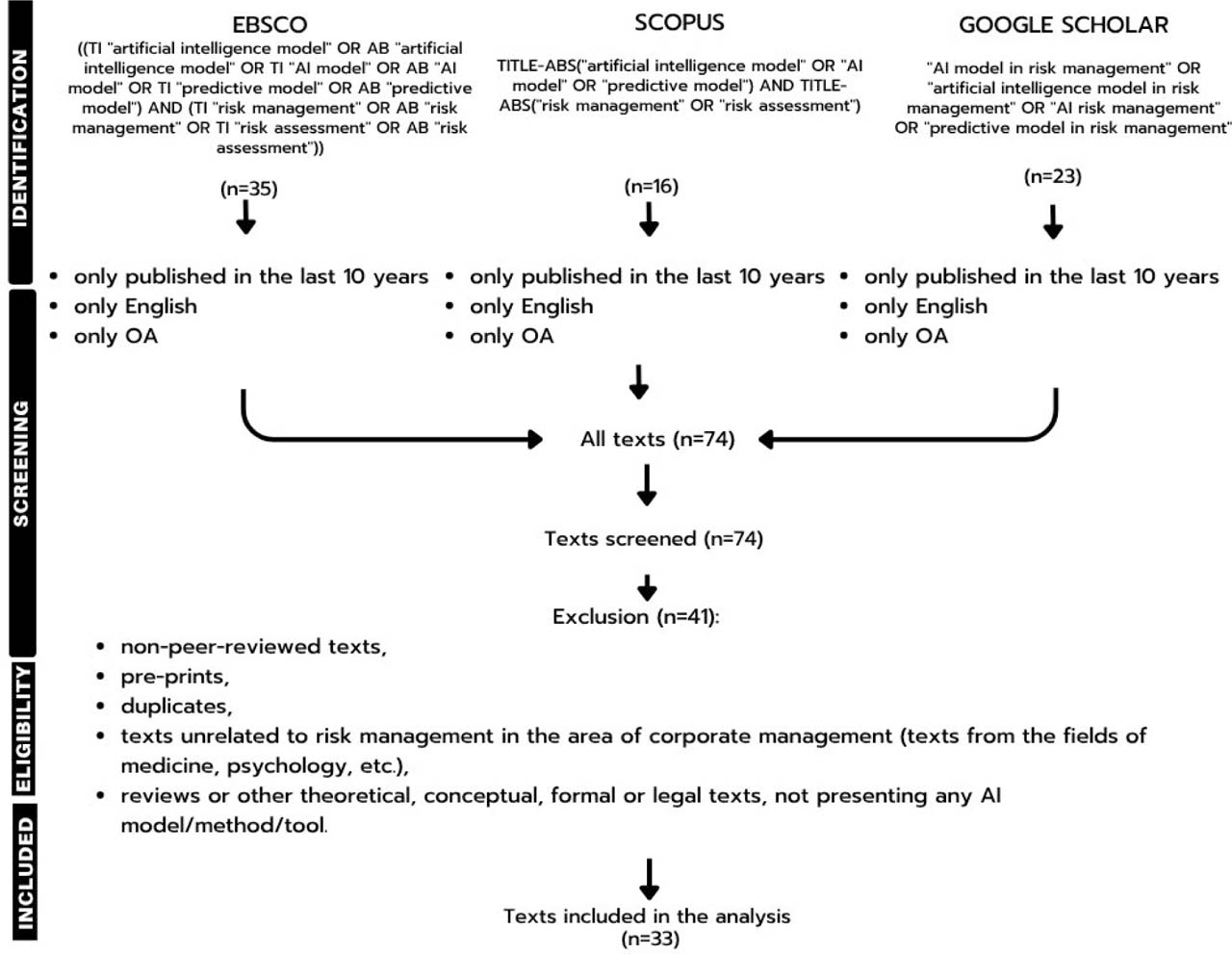
Figure 1.
Search strategy in the form of PRISMA flow chart
Source: own work
Table 5.
Comparison of AI models used in risk management
| Author | Category | Objective | Risks | Type | Methods/tools | Dedicated entities | Effect of application |
|---|---|---|---|---|---|---|---|
| Arian et al. (2020) 1 | Financial Risk Management | Risk assessment | Market risk | Decision model | Encoded Value-at-Risk based on a type of artificial neural network - variational auto-encoders | Financial entities | Reproducing market scenarios from a range of historical cross-sectional stock returns |
| Cheng et al. (2023) 2 | Financial Risk Management | Risk prevention | Systemic risk | Predictive model | Deep reinforcement learning integrated with high-order graph message-passing networks | Banks | Improved tracking and understanding of contagion and systemic risk in networked-loans |
| Cao et al. (2024) 3 | Financial Risk Management | Risk anticipation | Financial risk | Predictive model | RiskLabs based on large language models and multimodal fusion techniques | Financial entities | Forecasting both volatility and variance in financial markets |
| Fritz-Morgenthal et al. (2022) 4 | Financial Risk Management | Risk anticipation | Credit risk Insurance risk | Predictive and decision model | Simple rules-based approaches to artificial intelligence or machine learning models with a high level of sophistication | Banks | Detecting money laundering and fraud, as well as monitoring transactions |
| Alsaadi et al. (2024) 5 | Financial Risk Management | Risk anticipation | Financial risk | Predictive model | Deep learning algorithms (neural networks and convolutional neural networks) | Financial entities | Increasing capacity for collecting complicated patterns and boosting the risk prediction accuracy |
| Misheva et al. (2021) 6 | Financial Risk Management | Risk assessment | Credit risk | Explanation model | Post-hoc model agnostic explainability techniques, including local interpretable model agnostic explanations and SHapley Additive exPlanations | Financial entities | Applying based credit scoring modelling to the open-access data set offered by LendingClub (a US-based P2P lending platform) |
| Pattanayak (2023) 7 | Financial Risk Management | Risk anticipation | Credit risk | Predictive and decision model | Generative artificial intelligence, including scenario generation and stress testing processes | Banks | Improving fraud detection rates and reduction in false positives in credit risk assessments; modelling a broader range of potential economic scenarios |
| Ikudabo & Kumar (2024) 8 | Financial Risk Management | Risk anticipation | Credit risk Market risk Operational risk Regulatory risk | Predictive and decision model | Machine learning algorithms | Financial entities | Improving risk prediction accuracy, optimizing decision-making processes, enhancing risk modelling capabilities, and ensuring a proactive approach to risk management |
| Javaid (2024) 9 | Financial Risk Management | Risk anticipation | Financial risk | Predictive and decision model | Advanced machine learning algorithms and vast datasets | Financial entities | Enhancing profitability through informed investment strategies and mitigating risks by pre-emptively identifying potential threats |
| Mazumder et al. (2023) 10 | Financial Risk Management | Risk anticipation | Credit risk | Predictive model | Machine learning, reference architecture for trustworthy artificial intelligence based on three key tenets (usability, reliability, and transparency) | Financial entities | Reinforcing human centricity, societal value, and compliance with regulations being enforced by governments in business applications that are trusted from the perspective of consumers’ interests and business benefits |
| AbdElnapi et al. (2024) 11 | Financial Risk Management | Risk anticipation | Credit risk | Predictive model | Two machine learning models: logistic regression and CatBoost | Financial entities | Using a dataset with accessible data, such as accounting ratios, education level, age, income, and credit score, to assess the probability of loan default |
| Elhoseny et al. (2023) 12 | Financial Risk Management | Risk assessment | Technological risk Financial risk Operational risk Geopolitical risk | Decision model | Natural language processing techniques to perform risk analysis for the interactions of users on social media platforms | Financial entities | Enhancing the security of virtual currencies |
| Bussmann et al. (2020) 13 | Financial Risk Management | Risk anticipation | Fintech risk Credit risk | Predictive model | Shapley values; AI predictions interpreted according to the underlying explanatory variables | Financial entities | Grouping risky and non-risky borrowers according to a set of similar financial characteristics that can be employed to explain and understand their credit scores and predict their future behavior |
| Aruleba & Sun (2024) 14 | Financial Risk Management | Risk anticipation | Credit risk | Predictive and decision model | Ensemble classifiers and synthetic minority over-sampling combined with edited nearest-neighbor technique | Financial entities | Allow lenders to assess the likelihood of a borrower defaulting on a loan |
| Bao et al. (2024) 15 | Financial Risk Management | Risk assessment | Credit default risk | Decision model | Machine learning AI model with traditional credit risk measurement model, genetic algorithm optimization for a support vector machine | Financial entities | Reducing the information asymmetry in the real estate industry, enhancing the credit rating evaluation process for small and medium-sized enterprises, and furnishing references to aid commercial banks in credit and credit risk management |
| Sun et al. (2024) 16 | Financial Risk Management | Risk anticipation | Currency risk Investment risk | Predictive model | Multi-model dynamic prediction system — an AI-driven ensemble model with a multi-objective metaheuristic optimization algorithm | Financial entities | Enhancing exchange rate forecasting accuracy, prediction direction consistency, prediction robustness, enhancing investor returns, as well as mitigating investment risks |
| Locatelli et al. (2022) 17 | Financial Risk Management | Risk assessment | Credit risk | Decision model | Transactional data, together with the application of machine learning techniques in the context of the probability of default | Financial entities | Discriminating risk for borrowers with seasonal business, identifying counterparty risk during the COVID-19 crisis, and providing early warnings and advanced analytics in loan approval |
| Hu et al. (2021) 18 | Financial Risk Management | Risk assessment | Financial risk | Decision model | Fusion multiple rule-based decision-making (MRDM) approach that integrates a rule-based technique into MCDM (i.e., DEMATEL, DANP, and modified-VIKOR) | Financial entities | Helping decision makers choose the optimal model necessary for achieving aspiration-level effects in a risk control strategy |
| Freitas et al. (2023) 19 | Cybersecurity | Risk assessment | Cyber risk Operational risk | Decision model | New opportunities to apply machine learning algorithms and intrusion-tolerant systems | All entities | Augmenting intrusion tolerance capability, by learning from previous attacks and from known vulnerabilities |
| Giudici & Raffinetti (2022) 20 | Cybersecurity | Risk assessment | Cyber risk | Decision model | Machine learning models, black-box models, and Shapley values | Energy entities Financial entities Health entities | Assessing cyber risk based on certain predictions obtained the variables that mostly concur with such predictions |
| Khurana (2020) 21 | Cybersecurity | Risk anticipation | Cyber risk Financial risk | Predictive model | Machine learning models | E-commerce entities | Assuring transaction security in the face of rising challenges and fraud attempts by reducing latency in fraud detection and increasing security with minimal disturbance to real transactions |
| Biswas et al. (2024) 22 | Cybersecurity | Risk prevention | Cyber risk Insurance risk | Predictive and decision model | Hybrid framework using explainable AI techniques to assess cyber-risks generated from correlated phishing attacks | Financial entities | Optimally investing in building security into its enterprise architecture and planning for cyber-risk mitigation strategies |
| Wong et al. (2024) 23 | Supply Chain Risk Management | Risk anticipation | Supply chain risk | Predictive model | Structural model comprising AI-risk management capabilities, SC reengineering capabilities and supply chain agility, and artificial neural networks | SMEs | Dynamically reacting to volatile environments and alleviating potentially costly decision points |
| Li et al. (2024) 24 | Supply Chain Risk Management | Risk assessment | Supply chain risk | Predictive and decision model | Deep learning, survival analysis, and explainable artificial intelligence | Automotive entities | Reducing error rates for near-term and long-term predictions compared to the best-performing alternative models; deploying timely and targeted risk mitigation strategies |
| Kalogiannidis et al. (2024) 25 | Business Continuity Management | Risk anticipation | Natural disasters; Cyber risk; Economic risk | Predictive model | Natural language processing, AI-powered data analytics, AI-driven predictive maintenance, and AI integration in incident response planning | Technological entities | Improving the accuracy and speed of risk assessment procedures, greatly decreasing company interruptions and improving recovery from unforeseen events |
| Hosaka (2019) 26 | Business Continuity Management | Risk anticipation | Financial risk; bankruptcy risk | Predictive model | Convolutional neural networks | Financial entities | Predicting bankruptcy through the trained network, which has been shown to have better performance compared to methods using decision trees, linear discriminant analysis, support vector machines, multi-layer perceptron, etc. |
| Sohrabi et al. (2018) 27 | Business Continuity Management | Risk prevention | Business continuity risk | Predictive model | Scenario planning advisor | All entities | Generating scenarios that explain key risk drivers and describe alternative futures |
| Liu et al. (2025) 28 | Crisis Management | Risk anticipation | Climate risk; natural disasters | Predictive model | Integrating artificial intelligence, specifically machine learning and deep learning technologies | All entities | Enhancing the reliability of flood predictions and informing mitigation and response strategies |
| Lelis et al. (2024) 29 | Crisis Management | Risk prevention | Natural disasters | Predictive model | Novel computational system based on machine learning for wildfire risk assessment using data collected by drones | All entities | Enhancing wildfire risk estimation and enabling proactive mission planning |
| Lin (2022) 30 | Project Risk Management | Risk assessment | Project risk; economic risk | Simulation model | System-fuzzy approach model | All entities | Reflecting the flexibility and compromises involved in the process; flexible problem-solving skills |
| Nyqvist et al. (2024) 31 | Project Risk Management | Risk assessment | Project risk Human risk | Decision model | ChatGPT GPT-4 model | Construction entities | Generating comprehensive risk management plans with quantitative scores significantly surpassing the human average |
| Isah & Kim (2024) 32 | Project Risk Management | Risk assessment | Project risk | Decision model | Intelligent question-answering system based on a knowledge graph and GPT model | Construction entities | Facilitating timely and reliable decision-making to prevent safety accidents and reduce project delays and cost overruns |
| Richard et al. (2024) 33 | Operational Risk Management | Risk assessment | Operational risk Cyber risk | Decision model | State-of-the-art transformer-based machine learning models – BERT, RoBERTa, DeBERTa, and ERNIE 2.0 | Telecommunication entities | Streamlining risk management processes and providing operational benefits |
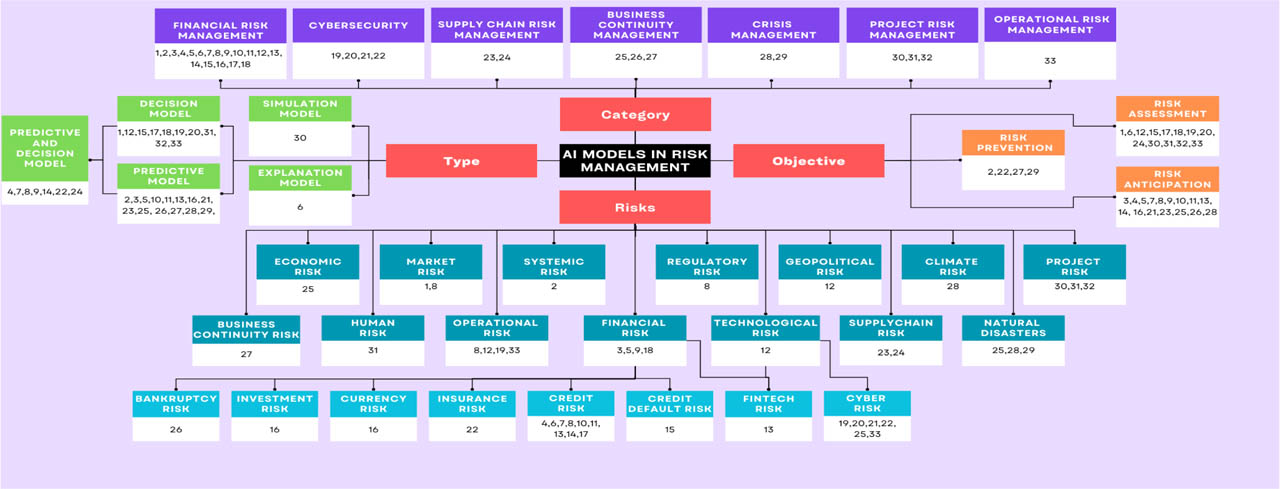
Figure 2.
Typology of AI models in risk management
Source: own work
Note: The numbers correspond to the publications listed in Table 5