
INTRODUCTION
Today's organizations operate in a dynamically changing environment, where risk has become an integral part of strategic management (Bessis, 2020). Regardless of the business sector, enterprises face economic instability, regulatory changes, cyber threats, and operational risks (Jorion, 2007). With increasing volumes of data and advances in technology, traditional risk management methods are becoming insufficient, leading organizations to turn to more intensive use of tools based on artificial intelligence (AI) (Russell & Norvig, 2020).
Artificial intelligence offers advanced analytical capabilities, allowing real-time identification, modelling and forecasting of risks (Makridakis et al., 2020). AI-based solutions can make use of machine learning (ML), neural networks, natural language processing (NLP) and other advanced analytical techniques for automatic detection of risk patterns, and decision-making support in organizations (McKinsey & Company, 2021). In risk management, artificial intelligence models apply these machine learning techniques, allowing their users to analyze large data sets and identify potential risks (Ramos-Pérez et al., 2020). Their main objective is to automate processes and increase operational efficiency, bringing about faster decision-making and cost reduction (Xu & Saleh, 2020). The introduction of AI into risk management is important because it enables better anticipation of market volatility and response to unpredictable situations, leading to greater institutional stability (Pietrasina, 2024). Predictive models allow for earlier detection of risks, which in turn reduces the likelihood of financial and reputational losses or disruption to a company's operational activities (Kalogiannidis et al., 2024).
Research indicates that the implementation of AI in risk management can contribute to improving the effectiveness of early warning systems and better prediction of adverse events (Agrawal et al., 2019). In addition, AI can improve decision-making processes, automate routine tasks and improve an organization's adaptability in the face of a rapidly changing environment (Brynjolfsson & McAfee, 2017). In particular, the application of AI in the monitoring of financial, operational and reputational risks is gaining ground, as evidenced by a number of sector-specific studies and reports (PwC, 2021).
Despite the many benefits of AI implementation, there are also challenges related to data quality, model interpretability and regulatory compliance (Goodman & Flaxman, 2017). Artificial intelligence not only supports risk management, but also generates a distinct category of threats that arise from the analytical models themselves. When a model becomes overly adjusted to training data, it exhibits overfitting, producing excellent results on past observations but failing to generalize to new situations (Goodfellow et al., 2016). Conversely, underfitting appears when model complexity is insufficient to capture essential patterns, leading to systematically inaccurate outputs (Bishop, 2006). Additional mechanisms, such as model misspecification and parameter instability, intensify uncertainty, as even minor deviations in input data may trigger large fluctuations in outcomes and distort risk signalling (Berk et al., 2021). Taken together, these mechanisms form what can be defined as the “risk of using AI”, which includes exposure to financial, operational and reputational losses despite the deployment of advanced analytical systems and large data infrastructures. AI models can also be prone to error and bias, which can lead to poor decisions and potential losses for an organization (Berk et al., 2021). For this reason, developing AI in risk management requires not only advanced analytical methods, but also appropriate oversight mechanisms and ethical rules for the use of these technologies (Jobin et al., 2019).
The purpose of this article is to develop a typology of AI models used in risk management and to characterize them, as well as to identify their differences and similarities, taking into account criteria such as category, type, objective, risk, method/tool, dedicated entity and effect of application. Taking into account the dynamics of AI development, we are aware that the typology we propose will need to be developed over time, but it has its value as a starting point for further research and findings.
THEORETICAL BACKGROUND
Current risk areas in management
Risk management has become a core component of corporate strategy, reflecting the broad spectrum of financial and non-financial threats that organizations face in a global and technologically complex environment (Aven, 2016; Hopkin, 2018; Kendrick, 2015). Table 1 summarizes current risk areas, indicating their essence; sectors where they are particularly salient; the main regulatory frameworks; and representative publications (Dionne, 2013; McKinsey & Company, 2021; World Economic Forum, 2023). Particular attention is paid to non-financial risks, such as environmental, social and governance (ESG) risks, digital transformation, cybersecurity, reputation, and geopolitical risk, which have gained strategic importance and are increasingly recognized in both academic studies and practitioner reports (Bessis, 2020; Bremmer, 2022; Coombs, 2019; Giese et al., 2019; Xu et al., 2017).
Table 1.
Main risk components in contemporary management
| Type of risk | Essence of the risk | Sectors where it is particularly salient | Key regulations / standards | Selected research |
|---|---|---|---|---|
| Cross-cutting corporate risk landscape | Overall spectrum of financial and non-financial threats associated with uncertainty in markets, technology and regulation | All sectors, especially large corporations and financial institutions | General risk management frameworks and corporate governance codes | Hopkin (2018); Aven (2016); Kendrick (2015); Dionne (2013); World Economic Forum (2023); McKinsey & Company (2021) |
| Financial risk | Volatility in capital markets, credit exposures, liquidity constraints and exchange rate fluctuations | Banking, insurance, capital markets, and asset management | Basel III; market risk and capital adequacy rules; investment services regulation | Jorion (2007); Basel Committee on Banking Supervision (BCBS, 2011); European Parliament & Council of the European Union (2014) |
| Operational risk in internal processes and services | Losses resulting from inadequate processes, human errors, system failures or weak internal controls; in financial services, these are closely linked to service operations and workflow design | Banks, payment institutions, back-office and shared service centers | Basel II/III operational risk standards; internal control and audit guidelines | BCBS (2011); Xu et al. (2017); Pinedo & Xu (2017) |
| Legal and regulatory risk | Exposure arising from non-compliance with laws, regulations and industry standards, including conduct-of-business and investor-protection rules | Highly regulated sectors such as finance, pharmaceuticals, and energy and utilities | MiFID II; sectoral regulations; data protection and consumer protection laws | Hull (2015); European Parliament & Council of the European Union (2014) |
| ESG / environmental and social risk | Climate, environmental and social issues affecting firm value and stakeholder expectations; includes climate litigation, carbon transition risk and social responsibility | Publicly listed companies, carbon-intensive industries, and consumer brands | ESG disclosure regimes, sustainable finance regulations, stewardship codes | Giese et al. (2019); Eccles & Klimenko (2019); Fatemi et al. (2018); La Torre et al. (2020) |
| Technological and digital transformation risk | Risks associated with implementing and integrating new digital technologies (e.g., AI, IoT), including failed projects, legacy constraints and loss of competitiveness | IT-intensive sectors, financial services, retail, logistics | Digitalization policies, IT governance and cybersecurity guidelines | Bharadwaj et al. (2013); Sebastian et al. (2017) |
| Cybersecurity risk | Threats related to cyber-attacks, data breaches and disruption of digital infrastructure, with severe financial and reputational consequences | Critical infrastructure, finance, healthcare, telecommunications, laboratories and public services | Data protection laws (e.g., GDPR), cybersecurity directives and sectoral security standards | Bessis (2020); Singer & Friedman (2014); Europol (2018); Sony Corporation (2011); CERT-UA (2023); UODO (2023); Von Solms & Van Niekerk (2013) |
| Reputational risk | Loss of stakeholder trust and brand value due to crises, scandals, product failures or governance problems; amplified by social media | Consumer brands, transport, manufacturing, technology and financial institutions | Indirectly shaped by disclosure rules, consumer protection and litigation frameworks | Coombs (2019); Lash & Wellington (2007); Shepardson (2025); Johnson (2024) |
| Geopolitical risk | Political instability; armed conflicts; sanctions and changes in trade policy affecting macroeconomic conditions and supply chains | Energy, manufacturing, global supply chains, high-tech and critical raw materials | Sanctions, trade agreements, export control rules | Bremmer (2022); Allison (2017); Colgan & Keohane (2017) |
In the literature, risk is typically defined as the probability of an adverse event combined with the potential severity of its consequences (Dionne, 2013). Classical systematizations distinguish several broad categories of risks that organizations face. Financial risk relates to capital markets, credit, liquidity and exchange rate fluctuations (Jorion, 2007). Operational risk results from inadequate processes, human errors or technical failures (Basel Committee on Banking Supervision [BCBS], 2011). Strategic risk is linked to poor business decisions, lack of adaptation to the environment or failed investments (Kaplan & Mikes, 2012). Legal and regulatory risk stems from non-compliance with laws, regulations and industry standards (Hull, 2015). Reputational risk is associated with the deterioration of stakeholder trust and brand image (Coombs, 2019). Technological risk results from the implementation of new technologies and their possible malfunction (Bharadwaj et al., 2013). Environmental and social risks reflect the growing importance of ESG factors, climate change and corporate social responsibility (Giese et al., 2019). Finally, geopolitical risk relates to political instability, international conflicts or trade policy changes (Bremmer, 2022).
This classical framework provides the foundation for understanding more specialized and modern approaches to risk assessment. Against this background, contemporary organizations implement advanced risk assessment models, using artificial intelligence and big data technologies to predict risks and optimize decision-making processes (McKinsey & Company, 2021). Regulations such as Basel III (BCBS, 2011) or MiFID II (European Parliament & Council of the European Union, 2014) oblige corporations to apply stricter risk management standards (Hull, 2015). Furthermore, the development of the ESG (Environmental, Social, Governance) concept means that risk management also includes environmental impact and social responsibility issues (Giese et al., 2019). Hence, risk management processes have become very comprehensive, heavily regulated and supervised.
From an operations-management perspective, Michael Pinedo's work provides a structured view of operational risk in financial services, emphasizing the role of process design, process management and human behavior in shaping risk exposure. In particular, Xu et al. (2017) propose a framework that links operational risk events to underlying operational processes, highlighting how failures in workflow design, inadequate controls and human errors translate into financial losses and reputational damage. Complementing this perspective, these authors analyze operations in financial services more broadly, showing how product design, process delivery and technology choices interact with regulatory constraints and risk drivers. Together, these contributions underline that operational risk in financial institutions cannot be understood solely through statistical loss distributions, but must be analyzed as an inherent feature of service operations that must be monitored and managed through appropriate process architectures, capacity planning and governance mechanisms (Pinedo & Xu, 2017; Xu et al., 2017).
Risk management has become a key element in organizations’ strategies. It covers a wide spectrum of financial and non-financial risks. The non-financial ones have gained in importance in recent years in parallel to the development of public awareness. From ESG issues through digital transformation to cybersecurity and reputation management, all these areas of risk can significantly impact the liquidity and efficiency of an enterprise's operational and strategic activities. Effective identification and monitoring of these risks can contribute to an organization's long-term success and the protection of its values.
Trends in the use of artificial intelligence in management and risk management
Artificial intelligence has become a key tool for optimizing decision-making processes, automating routine tasks and improving operational efficiency across organizations (Agrawal et al., 2018; Brynjolfsson & McAfee, 2017; McKinsey & Company, 2021). AI-based systems are increasingly implemented in areas such as data analytics, process optimization, human resource management and strategic decision-making, significantly enhancing productivity and performance (Chen et al., 2012; Davenport & Ronanki, 2018; Tambe et al., 2019). However, their adoption is constrained by implementation costs; shortages of specialized expertise; and ethical concerns related to transparency and bias, with particularly strong barriers observed among small and medium enterprises (SMEs) (Bąk et al., 2024; Brynjolfsson et al., 2019; Bughin et al., 2018; Mittelstadt et al., 2016). While these applications demonstrate the broad managerial potential of AI, they largely reflect a general management perspective and do not fully address the specific challenges associated with risk management, which remains an emerging and rapidly evolving area (Kaplan & Haenlein, 2019). Table 2 summarizes the applications of AI in management.
Table 2.
Use of AI in management
| Management area | Typical AI techniques | Meaning for management | Selected research |
|---|---|---|---|
| Data analytics and forecasting | Machine learning, predictive modelling, and big data analytics | Faster processing of large datasets, better market forecasts, and data-driven decision-making | Chen et al. (2012); Makridakis (2017); Russell & Norvig (2020) |
| Process optimization and automation | Robotic Process Automation (RPA) and ML-based anomaly detection | Cost reduction, fewer errors in repetitive tasks, and fraud detection in finance | Willcocks et al. (2017); Bessen (2019); Goodfellow et al. (2016) |
| Human resource management | Recommendation algorithms, ML-based profiling, and decision-support systems | Enhanced candidate selection, talent development, and personalized training | Tambe et al. (2019); Kaplan & Haenlein (2019); Jarrahi (2018) |
| Strategic decision-making and innovation | Advanced analytics, simulation models and AI-supported scenario planning | Support for strategic choices, innovation management, and long-term performance improvement | Makridakis (2017); McKinsey & Company (2021); Russell & Norvig (2020); Brynjolfsson & McAfee (2017) |
| Customer interaction and marketing | LLM-based chatbots (e.g., GPT-4, Bard), recommender systems, and natural language processing (NLP) | Automated customer service, personalized offers, and improved customer experience | Huang & Rust (2021); Buhalis & Volchek (2021); Van der Aalst et al. (2018) |
In the area of risk management, AI-based models are increasingly deployed to overcome the limitations of traditional static approaches. A prominent family of such methods is the “robust rolling” (R2) framework, including Robust Rolling Regime Detection (R2-RD), Robust Rolling PCA (R2-PCA) and Robust Rolling K-Means (R2K-Means), which adaptively retrain models on streaming data over rolling time windows in non-stationary financial environments (Hirsa et al., 2023; Hirsa et al., 2024; Holmes et al., 2024). By continuously updating inputs and parameters, these models help institutions stabilize risk estimates in turbulent markets and provide a more forward-looking basis for portfolio and operational risk management. Key AI concepts are described in more detail in Table 3.
Table 3.
Key AI concepts in risk management
| Concept | Role in risk management | Applications | Selected research |
|---|---|---|---|
| Robust rolling (R2) framework | Adaptively models non-stationary financial time series via rolling time windows | R2-RD, R2-PCA, R2K-Means for regime detection, PCA, and clustering | Hirsa et al. (2023); Hirsa et al. (2024); Holmes et al. (2024) |
| Dynamic risk modelling | Emphasizes continuous updating of inputs and parameters in the presence of market turbulence and fat-tailed risks | Scenario analysis, stress testing, and regime-switching models | Taleb (2007); Alexander (2008) |
| Modelling nonlinear shifts in risk exposure | Captures complex, time-varying and nonlinear relationships between risk factors and losses | Regularization, ensemble methods, and nonlinear regression | Hastie et al. (2009) |
| Quantitative risk management and early warning | Provides tools for measuring, aggregating and monitoring risks, including dynamic value-at-risk and multivariate dependence | Early warning systems, tail risk measures, and dependence modelling | McNeil et al. (2015) |
| Volatility and time-series risk models | Models changing volatility and serial dependence, which are crucial for portfolio risk and stress testing | GARCH-type models, volatility forecasting, and risk factor dynamics | Engle (2004); Tsay (2010) |
| Operational and anomaly-related risk | Uses AI and anomaly detection to identify irregular patterns linked to fraud, cyber incidents and process breakdowns | Fraud detection, cyber risk monitoring, transaction surveillance | Bussmann et al. (2020) |
| Data and model infrastructures for risk oversight | Highlights the importance of metadata, model infrastructures and data governance in central banks and financial institutions | Model inventories, risk data aggregation and reporting | Bholat et al. (2016) |
Various AI methodologies have been applied to concrete risk-management tasks, and each exhibits a distinct balance between accuracy, interpretability and regulatory acceptability. Linear models and tree-based or boosting methods form the backbone of many credit-scoring, fraud-detection and transaction-monitoring systems, yet they differ substantially in their ability to capture nonlinear dependencies and satisfy transparency requirements for validation and supervision (Bücker et al., 2020; Friedman, 2001; Gürtler & Zöllner, 2023). More complex neural networks and hybrid approaches further extend these capabilities to bankruptcy prediction, cyber and operational risk, but they also raise challenges related to “black-box” behavior, model risk and the design of explainable, compliant risk models (Goodfellow et al., 2016; Hosaka, 2019; Misheva et al., 2021). Those selected AI methods are shown in Table 4.
Table 4.
Key AI methods in risk management – advantages and limitations
| Method / approach | Typical risk management applications | Main advantages / limitations for risk management | Selected research |
|---|---|---|---|
| Linear models (e.g., logistic regression) | Credit scoring, probability-of-default estimation, simple stress tests | High interpretability and auditability; limited ability to model complex nonlinear relationships | Bücker et al. (2020); Gürtler & Zöllner (2023) |
| Tree-based and boosting methods (e.g., random forests, gradient boosting) | Default risk modelling, fraud detection, transaction monitoring | High predictive accuracy and robustness; reduced transparency and explainability for supervisors | Friedman (2001); Bussmann et al. (2020) |
| Neural networks and deep learning | Bankruptcy prediction, cyber risk analysis, anomaly detection in operations | Ability to model intricate nonlinear dependencies; “black-box” nature and high computational costs complicate governance | Goodfellow et al. (2016); Hosaka (2019) |
| Hybrid and explainable models | Credit, market, operational and conduct risk models requiring a balance between performance and transparency | Combine predictive, decision-making and explanatory features to satisfy regulatory and ethical requirements | Misheva et al. (2021) |
Thus, while AI plays a growing role in general management, its specific applications in risk management demonstrate both opportunities and challenges. On the one hand, AI provides enhanced early warning systems, automation of risk monitoring and improved adaptability to volatile environments (PwC, 2021). On the other hand, issues of model interpretability, data quality and ethical compliance remain critical for ensuring that AI-based risk management tools deliver sustainable value (Goodman & Flaxman, 2017).
RESEARCH METHODOLOGY
The aim of this research was to characterize and compare the AI models used in risk management that have been identified in the academic literature, as well as to propose their typology. The review of the scientific literature was performed in full compliance with the methodological rigor of the Preferred Reporting Items for Systematic Reviews and Meta-Analyses Extension for Scoping Reviews (PRISMA-ScR) Checklist (Tricco et al., 2018). We conducted the literature review in the following stages: 1) selecting databases to search, 2) defining search terms, 3) defining inclusion criteria, 4) searching databases for established search terms, taking into account the inclusion criteria, 5) defining exclusion criteria, 6) eliminating texts, taking into account the exclusion criteria, 7) establishing the final catalogue of texts included in the analysis, and 8) conducting a fundamental analysis.
The relevant models were identified through a search of three major management science databases: EBSCO, Scopus, and Google Scholar. We performed the search at the level of titles and abstracts using terms such as “artificial intelligence model,” “AI model,” “predictive model,” “risk management,” “risk assessment,” and the following inclusion criteria:
– time span – texts published in the last 10 years (2016–2025),
– language – texts published in English, and
– availability – texts available in Open Access or by using an access account in the databases.
The following search queries were used to obtain the results:
EBSCO:
((TI “artificial intelligence model” OR AB “artificial intelligence model” OR TI “AI model” OR AB “AI model” OR TI “predictive model” OR AB “predictive model”) AND (TI “risk management” OR AB “risk management” OR TI “risk assessment” OR AB “risk assessment”))
Scopus:
TITLE-ABS (“artificial intelligence model” OR “AI model” OR “predictive model”) AND TITLE-ABS (“risk management” OR “risk assessment”)
Google Scholar:
“AI model in risk management” OR “artificial intelligence model in risk management” OR “AI risk management” OR “predictive model in risk management”
The application of the above search criteria resulted in the return of 74 texts (16 from Scopus, 35 from EBSCO, 23 from Google Scholar). In the next step, they were reviewed for content at the level of their abstracts. The following exclusion criteria were applied:
– non-peer-reviewed texts,
– pre-prints,
– duplicates,
– texts unrelated to risk management in the area of corporate management (texts from the fields of medicine, psychology, etc.), and
– reviews or other theoretical, conceptual, formal or legal texts not presenting any AI model, method, or tool.
The application of the indicated criteria eliminated 41 texts (15 from EBSCO, 6 from Scopus, and 20 from Google Scholar). Eventually, 33 texts were approved for final analysis and comparison.
We present the full search strategy in Figure 1 as a PRISMA flow chart.
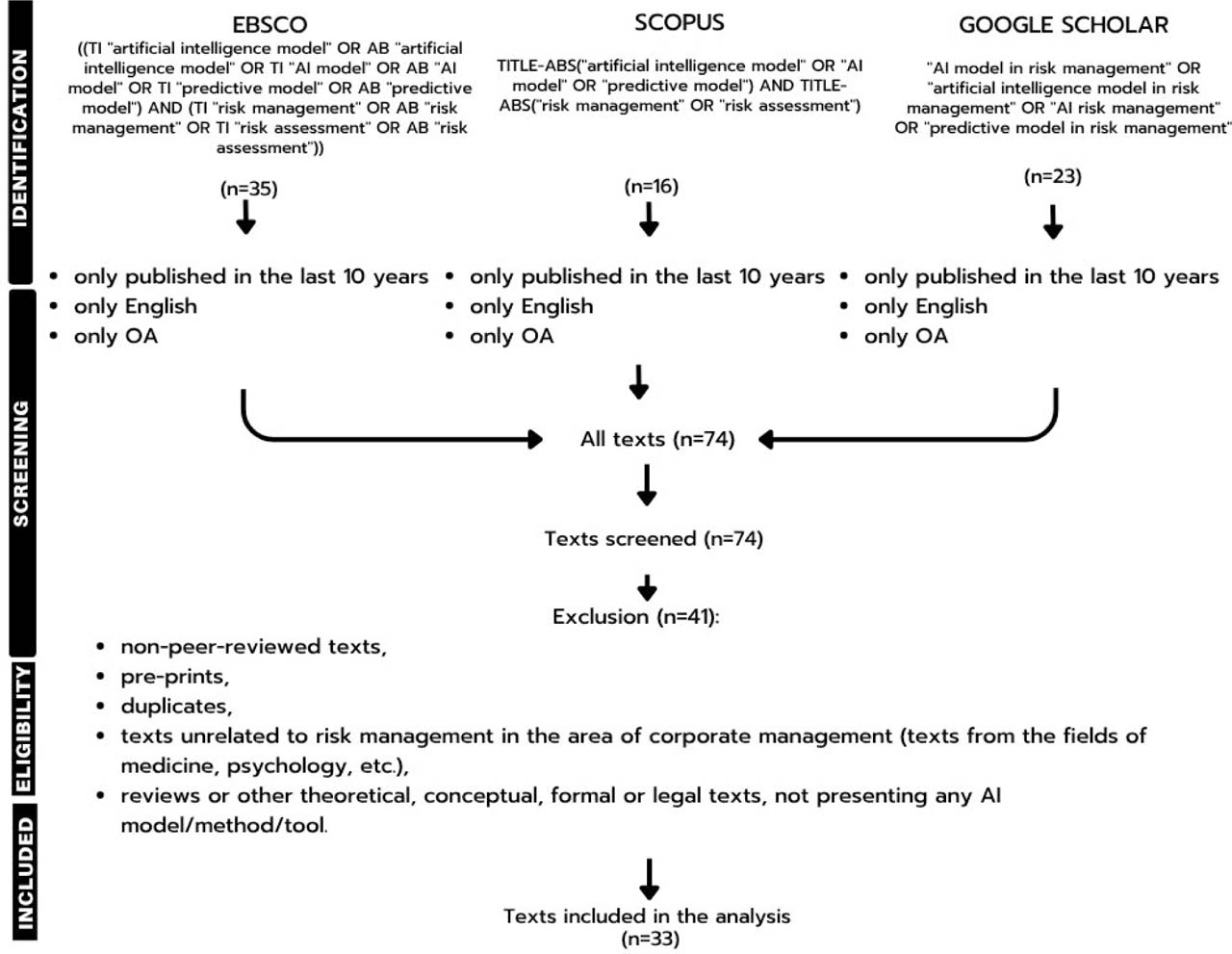
Figure 1.
Search strategy in the form of PRISMA flow chart
Source: own work
The stages described above map directly onto the four phases distinguished in the PRISMA-ScR protocol: identification covers the database searches carried out with the queries listed; screening comprises the assessment of the retrieved records at the level of titles and abstracts against the inclusion criteria; eligibility corresponds to their content-based verification against the exclusion criteria; and inclusion produces the final catalogue of texts subjected to the analysis. Figure 1 reports how many records were retained and rejected in each of these phases, which makes it possible to follow the selection path step by step and to reproduce it.
In the research process, we posed the following questions:
RQ1: In which sectors and in which functional areas of enterprises are AI models used for risk management purposes?
RQ2: What are the main features, objectives and effects of using AI models in risk management?
RQ3: What types of risks is the use of AI models in risk management ultimately intended to provide protection against?
RQ4: What AI methods/tools dominate in the presently identified AI models used in risk management?
In the process of analyzing the AI models qualified for the research, we used the comparative analysis method (Esser & Vliegenthart, 2017) in the closed comparison variant, as well as elements of the exploratory research approach (Saunders et al., 2009). At this stage, we analyzed the full content of the selected texts. The following comparison criteria were applied: 1) category, 2) objective, 3) risks, 4) type, 5) methods/tools, 6) dedicated entities, and 7) effect of application.
As a next step, we decided to develop a typology of AI models in risk management, using the method of multidimensional qualitative typology, which is a procedure that allows objects to be grouped together based on a degree of mutual similarity arbitrarily assumed by the researcher. Such a grouping is equivalent to establishing the types of objects being grouped (Rzepiński, 2016). We opted for the variant of typology dominant in the social sciences based on empirical research, which aims to introduce typological concepts, fulfilling the function of a projecting definition (Babbie, 2003). The basis for constructing a multidimensional typology was provided by the multidimensional classification we carried out as part of the comparative analysis of the models that preceded the creation of the typology.
RESULTS
Comparison of AI models used in risk management
We analyzed and compared the identified models against seven criteria (Table 5). With regard to a functional category, the largest number of identified models represented the category of financial risk management (18 models), followed by cybersecurity (4 models), business continuity management (3 models), project risk management (3 models), supply chain risk management (2 models), crisis management (2 models) and operational risk management (1 model). The dominance of models belonging to the Financial Risk Management category is justified by the need for technological improvements supporting these management processes in enterprises — especially large, international ones, which process large data sets for this purpose.
Table 5.
Comparison of AI models used in risk management
| Author | Category | Objective | Risks | Type | Methods/tools | Dedicated entities | Effect of application |
|---|---|---|---|---|---|---|---|
| Arian et al. (2020) 1 | Financial Risk Management | Risk assessment | Market risk | Decision model | Encoded Value-at-Risk based on a type of artificial neural network - variational auto-encoders | Financial entities | Reproducing market scenarios from a range of historical cross-sectional stock returns |
| Cheng et al. (2023) 2 | Financial Risk Management | Risk prevention | Systemic risk | Predictive model | Deep reinforcement learning integrated with high-order graph message-passing networks | Banks | Improved tracking and understanding of contagion and systemic risk in networked-loans |
| Cao et al. (2024) 3 | Financial Risk Management | Risk anticipation | Financial risk | Predictive model | RiskLabs based on large language models and multimodal fusion techniques | Financial entities | Forecasting both volatility and variance in financial markets |
| Fritz-Morgenthal et al. (2022) 4 | Financial Risk Management | Risk anticipation | Credit risk Insurance risk | Predictive and decision model | Simple rules-based approaches to artificial intelligence or machine learning models with a high level of sophistication | Banks | Detecting money laundering and fraud, as well as monitoring transactions |
| Alsaadi et al. (2024) 5 | Financial Risk Management | Risk anticipation | Financial risk | Predictive model | Deep learning algorithms (neural networks and convolutional neural networks) | Financial entities | Increasing capacity for collecting complicated patterns and boosting the risk prediction accuracy |
| Misheva et al. (2021) 6 | Financial Risk Management | Risk assessment | Credit risk | Explanation model | Post-hoc model agnostic explainability techniques, including local interpretable model agnostic explanations and SHapley Additive exPlanations | Financial entities | Applying based credit scoring modelling to the open-access data set offered by LendingClub (a US-based P2P lending platform) |
| Pattanayak (2023) 7 | Financial Risk Management | Risk anticipation | Credit risk | Predictive and decision model | Generative artificial intelligence, including scenario generation and stress testing processes | Banks | Improving fraud detection rates and reduction in false positives in credit risk assessments; modelling a broader range of potential economic scenarios |
| Ikudabo & Kumar (2024) 8 | Financial Risk Management | Risk anticipation | Credit risk Market risk Operational risk Regulatory risk | Predictive and decision model | Machine learning algorithms | Financial entities | Improving risk prediction accuracy, optimizing decision-making processes, enhancing risk modelling capabilities, and ensuring a proactive approach to risk management |
| Javaid (2024) 9 | Financial Risk Management | Risk anticipation | Financial risk | Predictive and decision model | Advanced machine learning algorithms and vast datasets | Financial entities | Enhancing profitability through informed investment strategies and mitigating risks by pre-emptively identifying potential threats |
| Mazumder et al. (2023) 10 | Financial Risk Management | Risk anticipation | Credit risk | Predictive model | Machine learning, reference architecture for trustworthy artificial intelligence based on three key tenets (usability, reliability, and transparency) | Financial entities | Reinforcing human centricity, societal value, and compliance with regulations being enforced by governments in business applications that are trusted from the perspective of consumers’ interests and business benefits |
| AbdElnapi et al. (2024) 11 | Financial Risk Management | Risk anticipation | Credit risk | Predictive model | Two machine learning models: logistic regression and CatBoost | Financial entities | Using a dataset with accessible data, such as accounting ratios, education level, age, income, and credit score, to assess the probability of loan default |
| Elhoseny et al. (2023) 12 | Financial Risk Management | Risk assessment | Technological risk Financial risk Operational risk Geopolitical risk | Decision model | Natural language processing techniques to perform risk analysis for the interactions of users on social media platforms | Financial entities | Enhancing the security of virtual currencies |
| Bussmann et al. (2020) 13 | Financial Risk Management | Risk anticipation | Fintech risk Credit risk | Predictive model | Shapley values; AI predictions interpreted according to the underlying explanatory variables | Financial entities | Grouping risky and non-risky borrowers according to a set of similar financial characteristics that can be employed to explain and understand their credit scores and predict their future behavior |
| Aruleba & Sun (2024) 14 | Financial Risk Management | Risk anticipation | Credit risk | Predictive and decision model | Ensemble classifiers and synthetic minority over-sampling combined with edited nearest-neighbor technique | Financial entities | Allow lenders to assess the likelihood of a borrower defaulting on a loan |
| Bao et al. (2024) 15 | Financial Risk Management | Risk assessment | Credit default risk | Decision model | Machine learning AI model with traditional credit risk measurement model, genetic algorithm optimization for a support vector machine | Financial entities | Reducing the information asymmetry in the real estate industry, enhancing the credit rating evaluation process for small and medium-sized enterprises, and furnishing references to aid commercial banks in credit and credit risk management |
| Sun et al. (2024) 16 | Financial Risk Management | Risk anticipation | Currency risk Investment risk | Predictive model | Multi-model dynamic prediction system — an AI-driven ensemble model with a multi-objective metaheuristic optimization algorithm | Financial entities | Enhancing exchange rate forecasting accuracy, prediction direction consistency, prediction robustness, enhancing investor returns, as well as mitigating investment risks |
| Locatelli et al. (2022) 17 | Financial Risk Management | Risk assessment | Credit risk | Decision model | Transactional data, together with the application of machine learning techniques in the context of the probability of default | Financial entities | Discriminating risk for borrowers with seasonal business, identifying counterparty risk during the COVID-19 crisis, and providing early warnings and advanced analytics in loan approval |
| Hu et al. (2021) 18 | Financial Risk Management | Risk assessment | Financial risk | Decision model | Fusion multiple rule-based decision-making (MRDM) approach that integrates a rule-based technique into MCDM (i.e., DEMATEL, DANP, and modified-VIKOR) | Financial entities | Helping decision makers choose the optimal model necessary for achieving aspiration-level effects in a risk control strategy |
| Freitas et al. (2023) 19 | Cybersecurity | Risk assessment | Cyber risk Operational risk | Decision model | New opportunities to apply machine learning algorithms and intrusion-tolerant systems | All entities | Augmenting intrusion tolerance capability, by learning from previous attacks and from known vulnerabilities |
| Giudici & Raffinetti (2022) 20 | Cybersecurity | Risk assessment | Cyber risk | Decision model | Machine learning models, black-box models, and Shapley values | Energy entities Financial entities Health entities | Assessing cyber risk based on certain predictions obtained the variables that mostly concur with such predictions |
| Khurana (2020) 21 | Cybersecurity | Risk anticipation | Cyber risk Financial risk | Predictive model | Machine learning models | E-commerce entities | Assuring transaction security in the face of rising challenges and fraud attempts by reducing latency in fraud detection and increasing security with minimal disturbance to real transactions |
| Biswas et al. (2024) 22 | Cybersecurity | Risk prevention | Cyber risk Insurance risk | Predictive and decision model | Hybrid framework using explainable AI techniques to assess cyber-risks generated from correlated phishing attacks | Financial entities | Optimally investing in building security into its enterprise architecture and planning for cyber-risk mitigation strategies |
| Wong et al. (2024) 23 | Supply Chain Risk Management | Risk anticipation | Supply chain risk | Predictive model | Structural model comprising AI-risk management capabilities, SC reengineering capabilities and supply chain agility, and artificial neural networks | SMEs | Dynamically reacting to volatile environments and alleviating potentially costly decision points |
| Li et al. (2024) 24 | Supply Chain Risk Management | Risk assessment | Supply chain risk | Predictive and decision model | Deep learning, survival analysis, and explainable artificial intelligence | Automotive entities | Reducing error rates for near-term and long-term predictions compared to the best-performing alternative models; deploying timely and targeted risk mitigation strategies |
| Kalogiannidis et al. (2024) 25 | Business Continuity Management | Risk anticipation | Natural disasters; Cyber risk; Economic risk | Predictive model | Natural language processing, AI-powered data analytics, AI-driven predictive maintenance, and AI integration in incident response planning | Technological entities | Improving the accuracy and speed of risk assessment procedures, greatly decreasing company interruptions and improving recovery from unforeseen events |
| Hosaka (2019) 26 | Business Continuity Management | Risk anticipation | Financial risk; bankruptcy risk | Predictive model | Convolutional neural networks | Financial entities | Predicting bankruptcy through the trained network, which has been shown to have better performance compared to methods using decision trees, linear discriminant analysis, support vector machines, multi-layer perceptron, etc. |
| Sohrabi et al. (2018) 27 | Business Continuity Management | Risk prevention | Business continuity risk | Predictive model | Scenario planning advisor | All entities | Generating scenarios that explain key risk drivers and describe alternative futures |
| Liu et al. (2025) 28 | Crisis Management | Risk anticipation | Climate risk; natural disasters | Predictive model | Integrating artificial intelligence, specifically machine learning and deep learning technologies | All entities | Enhancing the reliability of flood predictions and informing mitigation and response strategies |
| Lelis et al. (2024) 29 | Crisis Management | Risk prevention | Natural disasters | Predictive model | Novel computational system based on machine learning for wildfire risk assessment using data collected by drones | All entities | Enhancing wildfire risk estimation and enabling proactive mission planning |
| Lin (2022) 30 | Project Risk Management | Risk assessment | Project risk; economic risk | Simulation model | System-fuzzy approach model | All entities | Reflecting the flexibility and compromises involved in the process; flexible problem-solving skills |
| Nyqvist et al. (2024) 31 | Project Risk Management | Risk assessment | Project risk Human risk | Decision model | ChatGPT GPT-4 model | Construction entities | Generating comprehensive risk management plans with quantitative scores significantly surpassing the human average |
| Isah & Kim (2024) 32 | Project Risk Management | Risk assessment | Project risk | Decision model | Intelligent question-answering system based on a knowledge graph and GPT model | Construction entities | Facilitating timely and reliable decision-making to prevent safety accidents and reduce project delays and cost overruns |
| Richard et al. (2024) 33 | Operational Risk Management | Risk assessment | Operational risk Cyber risk | Decision model | State-of-the-art transformer-based machine learning models – BERT, RoBERTa, DeBERTa, and ERNIE 2.0 | Telecommunication entities | Streamlining risk management processes and providing operational benefits |
As for the purpose of using the identified models in management, the overwhelming majority are models whose purpose is risk anticipation (16 models), followed by models aiming to assess risks (13 models), and models dedicated to risk prevention (4 models). Anticipation models are currently most needed due to the need to predict threats in advance in the currently turbulent business environment and prevent the most critical risk factors.
Another criterion for comparison was the risks against which the identified models are supposed to provide protection. It appears that many of the proposed models (14) provide protection against more than one type of risk. In contrast, the risk that is repeated in the largest number of models is financial risk, and within its scope, credit risk, credit default risk, insurance risk, currency risk, bankruptcy risk, investment risk, and fintech risk. Integrated models therefore dominate, and are ultimately intended to protect enterprises against crises and provide a basis for multidimensional assessment of risk factors.
In terms of type, the catalogue of the identified models can be divided into predictive models (14), decision models (10), explanation models (1) and simulation models (1). It is also worth noting that the catalogue also includes hybrid models performing the predictive and decision functions simultaneously (7 models). These hybrid models are an excellent starting point for increasing the effectiveness of risk management systems, because in addition to forecasting changes in the risk landscape, they allow enterprises to make appropriate decisions based on simulation planning.
We also compared the models with respect to their dedicated entities. The results of the analyses showed that the largest proportion of the models is dedicated to financial entities (17 models), of which three models are dedicated to banks. Some of the models analyzed do not target any specific sector (5 models). There are also models dedicated to more than one sector (1 model). We also identified models dedicated to other individual industries: e-commerce, SMEs, automotive, technological, telecommunication (1 model each), and construction (2 models). Currently, it is financial market entities that are most sensitive to risks — especially macroeconomic ones, the materialization of which has the potential to bring the most severe and long-term negative consequences.
For each model analyzed, we also identified its leading AI tool/method and briefly characterized the expected effects of its application. As far as instrumentation is concerned, most models are based on advanced machine learning techniques and algorithms.
Typology of AI models in risk management
Having performed the analysis of the AI models used in risk management, the results of which are presented in Table 5, we proceeded to develop their typology (Figure 2). We believe that it may help those interested in implementing AI solutions to select the optimal tool to suit their needs at different stages of the risk management process. The catalogue of AI models we create on the basis of the adopted criteria can be extended with other models that will emerge in the future, which makes our typology an important contribution to the development of the sub-discipline of risk management — particularly its technological aspects resulting from digital development.
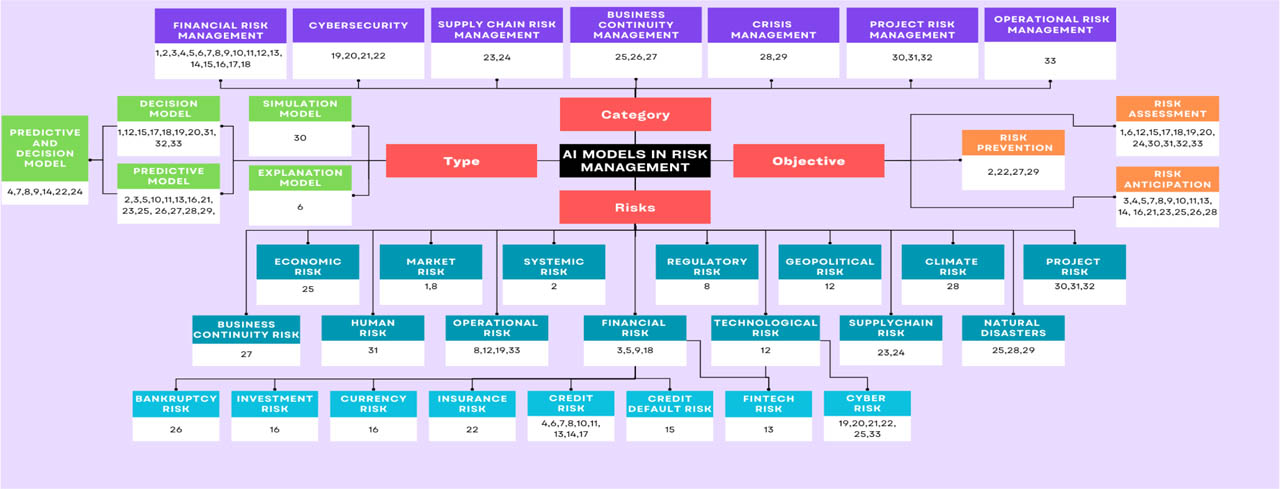
Figure 2.
Typology of AI models in risk management
Source: own work
Note: The numbers correspond to the publications listed in Table 5
The criteria taken into consideration in developing the typology of AI models used in risk management included type, category, objective and risk. Thanks to these criteria, we managed to develop: 1) four different types of identified models (predictive, explanation, decision and simulation models), 2) three types of goals guiding the creation and implementation of models (risk prevention, risk anticipation and risk assessment), 3) seven categories reflecting the risk management areas in which models are implemented (financial risk management, cybersecurity, supply chain risk management, business continuity management, crisis management, project risk management, operational risk management) and 4) 22 types of risks.
The resulting typology of AI in risk management systematizes the current state of theoretical and practical knowledge regarding the potential applications of AI-based technologies in risk management processes. This typology provides a good starting point for designing, improving, and testing new technological solutions that support the identification, analysis, estimation, and assessment of priority risk factors for enterprises in specific sectors.
The most important dimension of our typology is the creation of four types of AI models used in risk management. Predictive models are used to anticipate the risk landscape to which an enterprise is exposed, changes in the intensity of this exposure, the probability of threat occurrence, and the expected impact of individual risks on the enterprise. Simulation models, in turn, are used to test management methods and tools in simulation conditions to verify their effectiveness and, consequently, implement them within the enterprise and incorporate them into scenario planning. Decision models are directly used to facilitate the risk management decision-making process; by combining data integrated by the models (qualitative and quantitative), decision error is minimized. The final type of models are explanation models, which are considered the most advanced. They can explain the course of changes within an enterprise as a result of individual risks, and are often used in financial risk management.
DISCUSSION
The AI models used in risk management identified in our study in each case are targeted proposals. Their development is based on a classic risk taxonomy, as each tool and method used in the model is directly aimed at supporting the management of a specific type of risk. Our research has shown that these most commonly include financial risk (primarily credit risk), technological risk (primarily cyber risk), operational risk, and natural disasters. This observation is consistent with the broader risk-management literature, which distinguishes between different organizational logics of dealing with preventable, strategic, and external risks, and suggests that risk-management instruments tend to evolve around clearly delimited categories of exposure, rather than around fully universal solutions (Aven, 2016; Kaplan & Mikes, 2012; Power, 2004).
Various types of modern AI tools and solutions are definitely revolutionizing corporate risk management practices. There are a number of benefits to be derived from their use, and certainly the instrumentation of these methods will be continually expanded in the coming years (Agrawal et al., 2018; Brynjolfsson et al., 2019; Davenport & Ronanki, 2018). This broader trend is also reflected in the management literature, which emphasizes that AI usually creates organizational value when embedded in specific decision processes and supported by complementary capabilities rather than when it is implemented as an isolated technological layer (Kaplan & Haenlein, 2019; Mikalef & Gupta, 2021; Shrestha et al., 2019). However, it is also important to bear in mind the limitations of using these solutions, such as the controversies concerning suitable data management policies, transparency, and the lack of necessary skillsets within firms (Aziz & Dowling, 2019; Jarrahi, 2018; Jobin et al., 2019; Mittelstadt et al., 2016; Raisch & Krakowski, 2021). In this respect, the wider literature increasingly stresses that the effectiveness of AI-based risk management depends not only on predictive performance, but also on explainability, accountability, human oversight, and governance arrangements maintained throughout the lifecycle of the system (Jobin et al., 2019; NIST, 2023; OECD, 2019). The OECD AI Recommendation, along with NIST, explicitly frames AI risk management as a lifecycle process for organizations that design, develop, deploy, or use AI systems. Therefore, the need for additional legal and regulatory requirements regarding the rules for the use of AI models in risk management — especially in the most sensitive institutions, such as banks and other financial institutions, or in sector-specific regulations — is becoming increasingly apparent (Nowakowski & Waliszewski, 2022; OECD, 2019).
Our results also remain in dialogue with the findings of other authors. The dominance of the financial sector, and of predictive, machine-learning-based solutions that we identified, is consistent with the observations of Aziz and Dowling (2019) and with the general logic of the prediction-centred AI value creation described by Agrawal et al. (2018). Our typology goes one step further by showing that predictive models coexist with decision, explanation and simulation models within a single risk-management landscape. Our findings also confirm the argument of Shrestha et al. (2019) and Raisch and Krakowski (2021) that the organizational value of AI depends on how algorithmic and human judgement are combined, since the explanation and simulation models we identified are used precisely to support, rather than replace, managerial decisions. At the same time, our results add nuance to the conclusions of da Mata et al. (2023) regarding resilience-oriented tools; models directly addressing organizational resilience remain scarce, which suggests that the AI instrumentation of risk management is still developing asymmetrically across risk-management functions.
The limitations of using AI in risk management that we identified in the literature should also be interpreted more broadly. First, the effectiveness of the models analyzed is strictly dependent on the quality, completeness and representativeness of the input data; risk-related data are frequently incomplete, imbalanced or biased, which may lead to a systematic underestimation of rare but high-impact threats (Aziz & Dowling, 2019; Mittelstadt et al., 2016).
Second, the costs of implementation constitute a significant barrier, as they cover not only the technology itself, but also data infrastructure, integration with existing risk management systems, model validation, and the acquisition of competences, which limits the availability of the most advanced solutions to organizations with adequate resources (Bąk et al., 2024; Davenport & Ronanki, 2018).
Third, regulatory requirements are becoming an increasingly binding constraint, since supervisory expectations concerning documentation, explainability, human oversight and lifecycle governance in AI systems restrict the freedom with which such models may be deployed, particularly in regulated sectors (NIST, 2023; OECD, 2019). Taken together, these three groups of limitations mean that the decision to adopt an AI model in risk management should be treated as an organizational and compliance decision, not merely a technological one.
The results of our research presented in this text bridge an identified research gap: a lack of academic texts analyzing comparatively the currently available AI models used in risk management. By comparing 33 models of implementing AI tools used in risk management in enterprises representing different sectors, we managed to develop a typology of these models. This may be helpful for companies that are planning or are currently undergoing a digital transformation process and do not have a full understanding of the available solutions, their properties, the barriers to their implementation, and the effects of their use (Bharadwaj et al., 2013; Kaplan & Haenlein, 2019; Shrestha et al., 2019). From a broader management perspective, this is important because AI adoption in organizations is often incremental and use-case-based, which makes comparative typologies especially useful for managerial prioritization, sequencing of implementation, and the design of hybrid human-AI decision structures (Davenport & Ronanki, 2018; Raisch & Krakowski, 2021; Shrestha et al., 2019).
The results of our study provide an extensive catalogue of models that are available. For each model, it has specific details about the risk management area in which it is appropriate, what types of threats it can be used for, and what enterprise goals can be achieved with its use. Consequently, the research presented here may be useful in selecting AI instruments intended to support risk management and other procedures. This is even more true as the available AI models used in risk management are now quite numerous and are based on a variety of AI methodologies, some of which are heavily specialized and only suitable for use in entities with the necessary resources for this purpose. The literature on digital business strategy also suggests that such tools should be interpreted as part of broader digital transformation architectures, rather than as isolated technical artifacts. This further supports the usefulness of a structured typology of available models (Bharadwaj et al., 2013).
Moreover, the typology of AI models in risk management that we have created can be a base ready for expansion in situations where new models emerge, making it an important contribution to the development of the risk management subdiscipline — not only at the application level, but also at the scientific level. The wider literature suggests that typologies of this kind are valuable not only descriptively, but also analytically, because they help distinguish between different modes of AI use in organizations, especially prediction, recommendation, automation, and augmentation (Agrawal et al., 2018; Jarrahi, 2018; Raisch & Krakowski, 2021).
One of the likely development paths for AI models used in risk management is their integration with AI tools supporting corporate resilience mechanisms; however, at this moment, there is a scarcity of models directly related to resilience (cf. da Mata et al., 2023), so the road to their integration with models related to risk management is still open and evolving. This interpretation is consistent with the broader resilience literature, which conceptualizes resilience as an organizational capability related to anticipation, coping, adaptation, and renewal under conditions of disruption and uncertainty (Duchek, 2020; Hillmann & Guenther, 2021). Seen from this perspective, future AI-supported risk-management systems may develop not only toward more precise detection and prediction of threats, but also toward a stronger contribution to organizational adaptability and continuity-building capabilities.
CONCLUSIONS
In this text, we attempted to characterize and compare the available AI models used in risk management and developed a typology of these modern solutions aimed at improving the management of enterprises in different sectors. We were able to obtain satisfactory answers to all the research questions posed, so we believe that the results of our research can be a valuable source of information for enterprises on the path of technological development. The main conclusions from our study, which also answer the research questions posed, are:
RQ1: In which sectors and in which functional areas of enterprises are AI models used for risk management purposes?
– Currently, AI models in risk management are most often used in the financial sector, while in terms of functional areas of enterprises, these models appear most frequently in financial risk management, cybersecurity, business continuity management, and project risk management.
RQ2: What are the main features, objectives and effects of using AI models in risk management?
– The purposes of using AI models in risk management are risk anticipation, risk assessment, and risk prevention.
RQ3: What types of risks is the use of AI models in risk management ultimately intended to provide protection against?
– The types of AI models in risk management include predictive models, decision models, explanation models, and simulation models. Therefore, the most common effects of their use in enterprises are anticipating changes in the risk landscape; enabling or facilitating decision-making under risk conditions; explaining the circumstances of changes in the probability, intensity, and impact of risks; and verifying risk management solutions in test conditions. AI models are most often intended to provide protection against risks, including financial risk, technological risk, operational risk, and natural disasters.
RQ4: What AI methods/tools dominate in the presently identified AI models used in risk management?
– AI models in risk management are most often based on machine learning techniques and algorithms.
The results of our research demonstrate practical implications for businesses. First, our typology of AI models in risk management provides a systematic catalogue of previously developed models, which can serve as a knowledge base for other businesses that do not yet use them but intend to implement technological improvements in their risk management systems. Second, the model categorization we created can help enterprises define their primary priorities in the risk identification, analysis, and assessment processes. Therefore, enterprises can benefit from our findings when deciding whether implementing predictive, decision, explanation, or simulation models would be most appropriate for their business.
Though we searched for texts presenting AI models in risk management in as many as three databases and adopted broad inclusion criteria, we might not have been able to identify all the models currently available, which is one of the limitations of our research. Another limitation may be this study's selection of the time period of the last ten years, during which relevant texts were published. It is therefore possible that some models emerged earlier. Nevertheless, the most recent years, particularly since the COVID-19 pandemic, have been the period when businesses have been going through the digital transformation process with the most intensity, hence our assumption that it was the most fruitful in terms of the emergence of such tools. As proof of the validity of this assumption, we searched for texts starting from 2016; despite this, the first text meeting our search criteria had been published in 2018, and the vast majority of the models we analyzed were first presented in texts published in 2020 or later.
A potential direction for further research in this area is to extend the proposed typology of AI models used in risk management with new proposals. These are likely to emerge in large numbers in the years to come, given the pace of global digital transformation and the development of AI-based techniques. Any extension of the existing catalogue is likely to provide valuable information for enterprises seeking data on the solutions they plan to implement as part of their risk management systems.
It is also worth emphasizing that, in addition to the new solutions offered by AI in risk management, technologies can help improve traditional methods of managing risks of various categories, which may also be a potential next direction for research.
Future research explorations should also take into account the implications of the very rapid progress in the development of AI itself. The growing availability of generative and agentic solutions, capable of processing unstructured data and of operating with an increasing degree of autonomy, may substantially broaden the catalogue of AI models applicable to risk management, and at the same time shift the research focus from the predictive accuracy of individual models towards the reliability, controllability and auditability of entire systems.
A second promising direction is the study of the emerging frameworks governing the use of AI in risk management, including the OECD AI Recommendation, the NIST AI Risk Management Framework, and the European Union AI Act, with requirements concerning risk classification, documentation, explainability and human oversight that will directly shape the way in which enterprises design and validate such models (European Parliament & Council of the European Union, 2024; NIST, 2023; OECD, 2019). It would therefore be valuable to examine empirically how these regulatory and standardization frameworks influence the actual adoption of AI models in corporate risk-management systems, and whether they act as a barrier to implementation or, conversely, as a factor increasing organizational trust in these solutions. Longitudinal research of this kind would also make it possible to verify whether the typology proposed here remains stable, or whether the regulatory environment and technological progress will lead to the emergence of qualitatively new categories of AI models in risk management.