
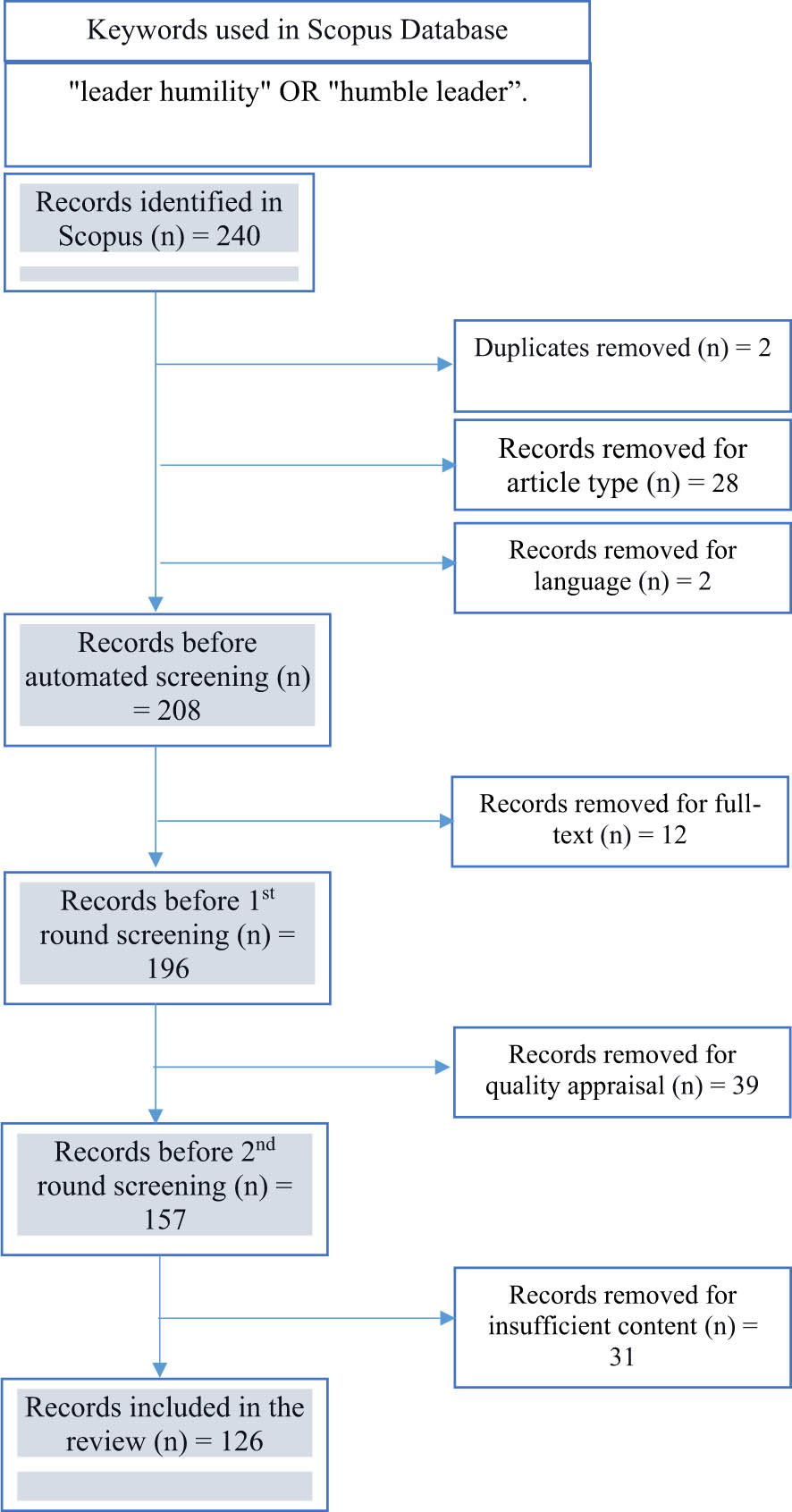
Figure 1.
PRISMA flow diagram of the article search and selection process
Table 1.
Characteristics of Included Studies (N = 126)
| Characteristic | Category | Number of Studies | Percentage (%) |
|---|---|---|---|
| Year of publication | 2012–2015 | 4 | 3.2 |
| 2016–2020 | 45 | 35.7 | |
| 2021–2025 | 76 | 60.3 | |
| 2026 (as of January 2026) | 1 | 0.8 | |
| Research design | Quantitative (survey, time-lagged, multi-source) | 113 | 89.7 |
| Qualitative (interviews, case studies) | 8 | 6.3 | |
| Mixed methods / Experimental | 5 | 4.0 | |
| Geographical context | China (including Taiwan) | 62 | 49.2 |
| United States | 19 | 15.1 | |
| Multiple countries / Cross-cultural | 13 | 10.3 | |
| Other Asia (South Korea, Singapore, Japan, Pakistan, India, Vietnam) | 25 | 19.8 | |
| Europe / Middle East / Other | 7 | 5.6 | |
| Primary theoretical framework | Social exchange theory | 25 | 20.0 |
| Social learning theory / Social cognitive theory | 21 | 16.7 | |
| Social information processing theory | 17 | 13.5 | |
| Self-determination theory | 11 | 8.7 | |
| Conservation of resources theory | 9 | 7.1 | |
| Implicit leadership theory | 7 | 5.6 | |
| Attribution theory / Expectation states theory | 6 | 4.8 | |
| Other (e.g., role identity, affective events, regulatory focus) | 29 | 23.0 |
Table 2.
Psychological mechanisms linking leader humility to outcomes
| Mechanism | Definition | Key Outcomes | Representative Studies |
|---|---|---|---|
| Psychological safety | Belief that the workplace is safe for risk-taking | Voice, creativity, learning, reduced silence | Hu et al. (2018); Qian et al. (2022); Gonçalves & Brandão (2017) |
| Psychological empowerment | Sense of meaning, competence, self-determination, and impact | Proactive behavior, job performance | Chen et al. (2018); Jeung & Yoon (2016); Noboa & Pino (2025) |
| Self-efficacy | Belief in one's capability to execute tasks | Task performance, creativity, career proactivity | Asghar et al. (2022); Mao et al. (2019); Zhong et al. (2024) |
| Work engagement | Vigor, dedication, and absorption in work | Creative performance, OCB, innovative behavior | Ansong et al. (2024); Wang et al. (2022); Yang et al. (2019) |
Table 3.
Social exchange and relational mechanisms
| Mechanism | Definition | Key Outcomes | Representative Studies |
|---|---|---|---|
| Affective trust | Emotional confidence in leader's benevolence | Knowledge sharing, OCB, reduced turnover | Nguyen et al. (2020); Liborius & Kiewitz (2022); Mertens et al. (2025) |
| Relational energy | Vitality and positive arousal from leader interactions | Bootlegging, constructive voice, task performance | Ma et al. (2020); Qu et al. (2023); Wang et al. (2018) |
| Leader-member exchange | Quality of dyadic exchange relationship | Prosocial behavior, innovative behavior | Carnevale et al. (2019); Wang et al. (2021) |
| Relational identification | Follower's self-definition based on relationship with leader | Voice (speaking up), OCB | Li et al. (2018); Zheng et al. (2023) |
Table 4.
Team-level mechanisms
| Mechanism | Definition | Key Outcomes | Representative Studies |
|---|---|---|---|
| Team learning & reflexivity | Collective reflection and adaptation | Team creativity, team innovation | Chen et al. (2021); Leblanc et al. (2022); Owens & Hekman (2016) |
| Team psychological capital (PsyCap) | Collective hope, efficacy, resilience, optimism | Team performance, task allocation | Rego et al. (2017); Rego et al. (2019) |
| Collective humility | Shared humble behaviors among team members | Team promotion focus, team performance | Owens & Hekman (2016) |
| Team job crafting | Collective redesign of tasks and relationships | Team creativity | Chen et al. (2021); Luu (2021a) |
Table 5.
Boundary conditions of leader humility effectiveness
| Moderator Category | Specific Moderator | Direction of Effect | Key Studies |
|---|---|---|---|
| Follower characteristics | Power distance orientation | Negative (stronger when low) | Hu et al. (2018); Lin et al. (2019) |
| Follower humility | Positive (congruence amplifies) | Diao et al. (2019); Zhong et al. (2023) | |
| Proactive personality | Positive (amplifies) | Asghar et al. (2022); Leblanc et al. (2022); Wu & Zhou (2023) | |
| Learning goal orientation | Positive (amplifies) | Wang et al. (2022); Wang et al. (2025) | |
| Competitiveness | Negative (weakens) | Liborius & Kiewitz (2022) | |
| Leader characteristics | Leader competence | Positive (amplifies) | Li et al. (2016); Tariq et al. (2023); Yuan et al. (2018) |
| Leader authenticity | Positive (genuine humility works; hypocrisy backfires) | Bharanitharan et al. (2021); Oc et al. (2020) | |
| Leader political skill | Positive (amplifies) | Wang et al. (2019); Zhou & Wu (2018) | |
| Leader sex | Male leaders benefit more | Noboa & Pino (2025); Swain & Korenman (2018) | |
| Team/organizational context | Task interdependence | Negative (stronger when low) | Li et al. (2022); Liu et al. (2017); Ye et al. (2020) |
| Competitive climate | Positive (amplifies) | Achmadi et al. (2022); Ye et al. (2020) | |
| Environmental uncertainty | Negative (weakens) | Xu et al. (2022); Zhou et al. (2022) | |
| Time pressure | Negative (humility seen as indecisive) | Liu et al. (2025) | |
| Bureaucratic culture | Negative (weakens) | Hadmar et al. (2022) | |
| Cultural factors | Power distance (cultural) | Negative (stronger in low PDI cultures) | Wang et al. (2023); Zou & Chen (2022) |
Table 6.
Curvilinear and dark-side effects of leader humility
| Type of Effect | Specific Finding | Key Studies |
|---|---|---|
| Curvilinear (inverted U-shaped) | Moderate humility optimal; too much reduces performance, creativity, OCB | Bin et al. (2021); Yuan et al. (2018); Chen et al. (2024) |
| Inverted U between humility and unethical pro-organizational behavior | Song et al. (2025) | |
| Dark side for followers | Humility attributed to self-serving motives increases entitlement and deviance | Qin et al. (2020) |
| Humility triggers sense of power; under Machiavellianism leads to self-interested behavior | Chen et al. (2022) | |
| Humility simultaneously reduces UPB via insider status but increases UPB via guanxi | Shaw et al. (2025) | |
| Dark side for leaders | Expressing humility depletes emotional resources → exhaustion, turnover, work-family conflict | K. Yang et al. (2019) |
| Leader humility and narcissism jointly affect project outcomes; humility can have mixed effects | Cavazotte et al. (2023) | |
| Moral licensing: humble leaders may subsequently engage in unethical behavior | Bharanitharan et al. (2019) |
Table 7.
Integrative Framework of Leader Humility
| Domain | Key Constructs | Representative Studies |
|---|---|---|
| Antecedents | Leader growth mindset, relational identity, significant-other activation, personality (Honesty-Humility, Agreeableness, Conscientiousness), feedback-seeking behavior | Wang et al. (2018); Owens & Hekman (2012); Hassan et al. (2023); Deng et al. (2019) |
| Mediators (How) | Individual-level: Psychological safety, psychological empowerment, self-efficacy, work engagement, affective trust, relational energy | Hu et al. (2018); Chen et al. (2018); Mao et al. (2019); Nguyen et al. (2020); Ma et al. (2020) |
| Team-level: Team learning/reflexivity, team PsyCap, collective humility, team job crafting | Leblanc et al. (2022); Rego et al. (2019); Owens & Hekman (2016); Chen et al. (2021) | |
| Moderators (When) | Follower: Power distance, humility, proactivity, learning orientation, competitiveness | Hu et al. (2018); Diao et al. (2019); Asghar et al. (2022); Liborius & Kiewitz (2022) |
| Leader: Competence, authenticity, political skill, sex | Li et al. (2016); Oc et al. (2020); Zhou & Wu (2018); Noboa & Pino (2025) | |
| Context: Task interdependence, competitive climate, uncertainty, time pressure, bureaucratic culture | Li et al. (2022); Ye et al. (2020); Xu et al. (2022); Liu et al. (2025); Hadmar et al. (2022) | |
| Outcomes | Individual: Creativity, voice, performance, OCB, well-being, reduced turnover | Wang et al. (2018); Lin et al. (2019); Cho et al. (2021); Ansong et al. (2024) |
| Team: Team creativity, team learning, team performance, innovation | Owens & Hekman (2016); Leblanc et al. (2022); Rego et al. (2019) | |
| Organizational: Project success, service recovery, inter-firm collaboration | Ali et al. (2021); Elhadidy et al. (2025); Zhou et al. (2022) |
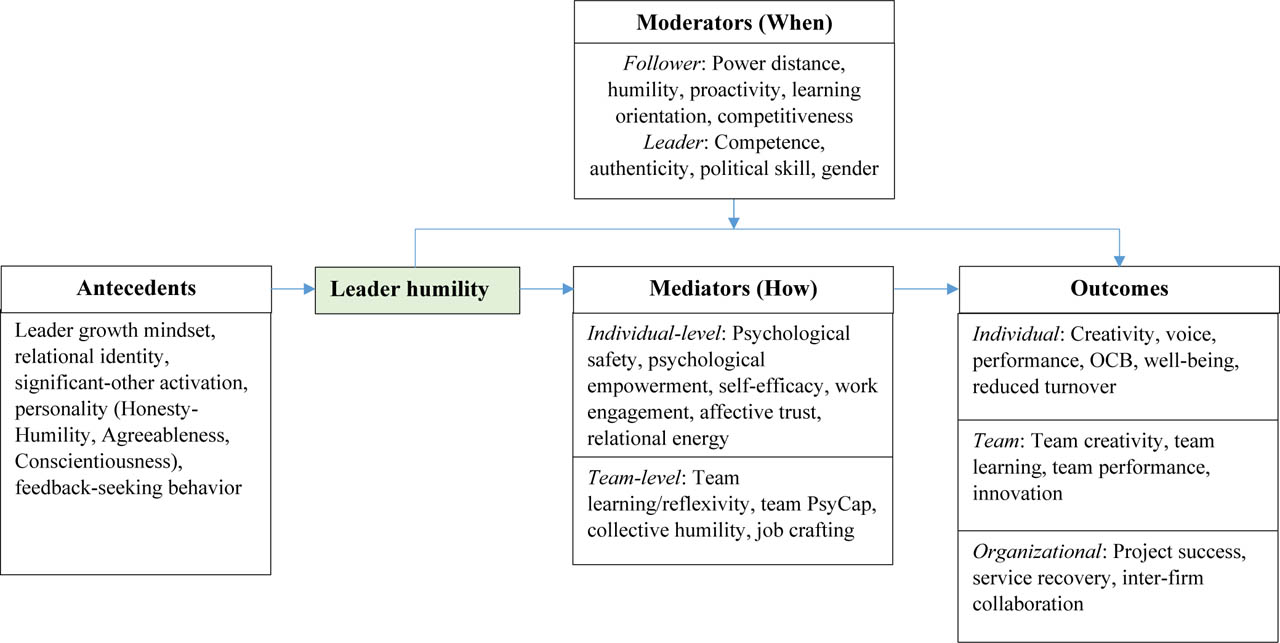
Figure 2.
Integrative framework of leader humility
| No | Authors | Title | Journal | Description |
|---|---|---|---|---|
| 1 | Lin et al. (2024) | How do humble leaders unleash followers’ leadership potential? The roles of workplace status and individualistic orientation | Journal of Organizational Behavior | Leader humility elevates followers’ workplace status and leadership potential, especially when individualism is high. |
| 2 | Ansong et al. (2024) | Leader humility and organisational citizenship behaviour: the mediating roles of job satisfaction and employee engagement | Cogent Business and Management | Leader humility positively affects OCB through job satisfaction and employee engagement (partial mediation). |
| 3 | Chen et al. (2018) | Can leader “humility” spark employee “proactivity”? The mediating role of psychological empowerment | Leadership and Organization Development Journal | Leader humility enhances proactive behavior via psychological empowerment, moderated by identification with leader. |
| 4 | Wu & Zhou (2023) | Do ‘humble’ leaders help employees to perform better? Evidence from the Chinese public sector | Australian Journal of Public Administration | Leader humility boosts performance through intrinsic motivation, stronger for proactive employees. |
| 5 | Li et al. (2022) | Leader humility and team creativity: The role of team creative efficacy and task interdependence | Journal of General Management | Leader humility promotes team creativity via team creative efficacy, especially when task interdependence is low. |
| 6 | Lin et al. (2019) | Why and When Employees Like to Speak up More Under Humble Leaders? The Roles of Personal Sense of Power and Power Distance | Journal of Business Ethics | Leader humility encourages voice via personal sense of power, stronger when power distance is low. |
| 7 | Mao et al. (2019) | Growing Followers: Exploring the Effects of Leader Humility on Follower Self-Expansion, Self-Efficacy, and Performance | Journal of Management Studies | Leader humility triggers self-expansion, enhancing self-efficacy and performance, moderated by age/gender similarity. |
| 8 | Liu et al. (2017) | Leader humility and team innovation: Investigating the substituting role of task interdependence and the mediating role of team voice climate | Frontiers in Psychology | Leader humility enhances team innovation via team voice climate; task interdependence substitutes the effect. |
| 9 | Liu et al. (2024) | Leader humility and employees’ creative performance: the role of intrinsic motivation and work engagement | Frontiers in Psychology | Leader humility boosts creative performance through intrinsic motivation and work engagement sequentially. |
| 10 | Wang et al. (2022) | An implicit leadership theory lens on leader humility and employee outcomes: Examining individual and organizational contingencies | Tourism Management | Leader humility perceived as benevolent when followers have learning orientation and informational justice, increasing commitment. |
| 11 | Zhou et al. (2022) | Leader humility and inter-firm collaboration: the moderating role of firm status and environmental uncertainty | Leadership and Organization Development Journal | CEO humility enhances inter-firm collaboration, moderated positively by firm status and negatively by uncertainty. |
| 12 | Maldonado et al. (2022) | Unpacking humility: Leader humility, leader personality, and why they matter | Business Horizons | Leader humility relates to Conscientiousness, Agreeableness, Openness; can be developed through coaching. |
| 13 | Liu et al. (2022) | Humble Leader Behavior and Its Effects on Performance at the Team and Individual Level: A Multi-Perspective Study | Group and Organization Management | Leader humility improves individual performance via self-esteem and team performance via team potency, moderated by cognitive diversity. |
| 14 | Peng et al. (2020) | Can Humble Leaders Get Results? The Indirect and Contextual Influences of Skip-Level Leaders | Journal of Leadership and Organizational Studies | Skip-level leader humility trickles down to team leaders, enhancing team performance, especially in centralized organizations. |
| 15 | Cao et al. (2023) | Team leader humility and team proactive customer service behavior: A regulatory focus perspective | International Journal of Hospitality Management | Leader humility promotes team proactive customer service via team promotion focus, moderated by CSR. |
| 16 | Davis et al. (2023) | The multilevel correlates, contributions, and consequences of leader humility in humanitarian aid work | Frontiers in Psychology | Leader humility fosters positive attributions, job satisfaction, team performance, and well-being in humanitarian aid. |
| 17 | Leblanc et al. (2022) | Leader humility and team innovation: The role of team reflexivity and team proactive personality | Journal of Organizational Behavior | Leader humility enhances team innovation via team reflexivity, stronger when team proactive personality is high. |
| 18 | Qian et al. (2022) | Leader humility as a predictor of employees’ feedback-seeking behavior: The intervening role of psychological safety and job insecurity | Current Psychology | Leader humility promotes feedback-seeking through psychological safety, stronger under high job insecurity. |
| 19 | Zhu et al. (2022) | How Does Leader Humility Influence Team Creativity? The Roles of Team Behavioral Integration and Leader Performance | Frontiers in Psychology | Leader humility boosts team creativity via team behavioral integration, moderated by leader performance. |
| 20 | Wang et al. (2020) | Antecedents and Consequences of Creativity in Teams: When and How Leader Humility Promotes Performance via Team Creativity | Journal of Creative Behavior | Leader humility promotes team creativity through team creative efficacy, moderated by leader conscientiousness. |
| 21 | Ye et al. (2020) | Leader humility, team humility and employee creative performance: The moderating roles of task dependence and competitive climate | Tourism Management | Leader humility influences employee creativity via team humility, moderated by task dependence and competitive climate. |
| 22 | Rigolizzo et al. (2022) | Leader humility, leader authenticity and informal learning: how humble team leaders model everyday workplace learning | Journal of Workplace Learning | Leader humility positively affects informal learning, partially mediated by leader authenticity. |
| 23 | Qu et al. (2023) | Does Leader Humility Foster Employee Bootlegging? Examining the Mediating Role of Relational Energy and the Moderating Role of Work Unit Structure | Journal of Business and Psychology | Leader humility fosters bootlegging via relational energy, moderated by organic work unit structure. |
| 24 | Wang et al. (2022) | Stay Humble and Fly High: The Roles of Subordinate Voice and Competitive Work Context in the Linkage Between Leader Humility and Career Success | Journal of Leadership and Organizational Studies | Humble leaders gain career success via centrality in voice networks, especially in competitive contexts. |
| 25 | Carnevale et al. (2019) | LMX-differentiation strengthens the prosocial consequences of leader humility: An identification and social exchange perspective | Journal of Business Research | Leader humility promotes helping via identification with leader, moderated positively by LMX-differentiation. |
| 26 | Howard-Baptiste & Baptiste (2013) | Echoes of a not so distant summer: Scholar-servant as humble leaders | Advances in Educational Administration | Scholar-servant as humble leaders, demystifying traditional leadership assumptions and addressing oppression. |
| 27 | Chen et al. (2021) | Leader humility, team job crafting and team creativity: The moderating role of leader–leader exchange | Human Resource Management Journal | Leader humility affects team creativity via team job crafting, moderated by leader-leader exchange (LLX). |
| 28 | Wang et al. (2017) | Understanding How Leader Humility Enhances Employee Creativity: The Roles of Perspective Taking and Cognitive Reappraisal | Journal of Applied Behavioral Science | Leader humility enhances creativity via perspective taking, moderated by cognitive reappraisal (emergency context). |
| 29 | Achmadi et al. (2022) | How can a leader's humility enhance civility climate and employee voice in a competitive environment? | Journal of Management Development | Leader humility improves civility climate and voice, moderated by competitive climate (stronger effect). |
| 30 | Mertens et al. (2025) | Leader Humility and Affective Commitment: A Cross-Sectional Study Among Hospital Nursing Teams | Journal of Advanced Nursing | Head nurse humility builds psychological safety, trust, participative communication, and nurse affective commitment. |
| 31 | Kim (2025) | Leader humility as a form of love: Building trust and cooperative culture in Japanese organizations | International Journal of Intercultural Relations | Leader humility as love promotes OCB via trust and cooperative culture in Japanese organizations. |
| 32 | Chandler et al. (2023) | A meta-analysis of humble leadership: Reviewing individual, team, and organizational outcomes of leader humility | Leadership Quarterly | Meta-analysis: humble leadership predicts follower satisfaction and participative decision-making, but not leader own performance. |
| 33 | Li et al. (2019) | Shaping the shared mental model: How leader humility helps teams to learn | Journal of Management and Organization | Leader humility enhances team learning via shared mental models, stronger with collective promotion focus. |
| 34 | Lu & Li (2024) | Do humble leaders build more flexible teams? | Social Behavior and Personality | Leader humility promotes team flexibility directly and indirectly through team reflexivity. |
| 35 | Qian et al. (2020) | Leader humility, and subordinates’ organizational citizenship behavior and withdrawal behavior: Exploring the mediating mechanisms of subordinates’ psychological capital | International Journal of Environmental Research and Public Health | Leader humility increases OCB and reduces withdrawal via psychological capital. |
| 36 | Mallén et al. (2020) | Does leader humility matter? Effects on altruism and innovation | Management Decision | Leader humility fosters firm innovativeness through altruism. |
| 37 | Chen & Liu (2023) | Stop high-flyers from flying away: Interaction effect of perceived overqualification and leader humility on turnover intention | Current Psychology | Perceived overqualification and leader humility interact to affect turnover via relative LMX. |
| 38 | Yuan et al. (2018) | When a leader is seen as too humble: A curvilinear mediation model linking leader humility to employee creative process engagement | Leadership and Organization Development Journal | Curvilinear relationship between leader humility and creativity, mediated by POS, moderated by leader competence. |
| 39 | Zhong et al. (2020) | Can leader humility enhance employee wellbeing? The mediating role of employee humility | Leadership and Organization Development Journal | Leader humility improves well-being via employee humility, moderated by perceived leader effectiveness. |
| 40 | Qin et al. (2020) | The double-edged sword of leader humility: Investigating when and why leader humility promotes versus inhibits subordinate deviance | Journal of Applied Psychology | Leader humility can increase deviance via entitlement or decrease via LMX, depending on attributions. |
| 41 | K. B et al. (2022) | A Wolf in Sheep's Clothing: Exploring the Relationship Between Leader Humility and Unethical Behavior | Journal of Management | Leader humility leads to unethical behavior via moral licensing, moderated by relational accountability. |
| 42 | Zhang & Liu (2019) | Leader Humility and Taking Charge: The Role of OBSE and Leader Prototypicality | Frontiers in Psychology | Leader humility promotes taking charge via OBSE, moderated by leader prototypicality. |
| 43 | Rego et al. (2018) | The Perceived Impact of Leaders’ Humility on Team Effectiveness: an Empirical Study | Journal of Business Ethics | Leader humility (other-reported) indirectly relates to team effectiveness via balanced processing. |
| 44 | Aarons et al. (2017) | The humble leader: Association of discrepancies in leader and follower ratings of implementation leadership with organizational climate in mental health | Psychiatric Services | Discrepancy (leader low, follower high) humility associates with positive organizational climate. |
| 45 | Zhong et al. (2023) | Antecedents and consequences of follower moqi: leader humility, follower humility, and knowledge hiding | Current Psychology | Leader humility promotes follower moqi, reducing knowledge hiding, moderated by follower humility. |
| 46 | Fu et al. (2019) | Leader humility and employee voice: the role of employees’ regulatory focus and voice-role conception | Social Behavior and Personality | Leader humility enhances voice via voice-role conception, moderated by regulatory focus. |
| 47 | Hu et al. (2018) | Leader humility and team creativity: The role of team information sharing, psychological safety, and power distance | Journal of Applied Psychology | Leader humility affects team creativity via information sharing and psychological safety, moderated by power distance. |
| 48 | Tuan et al. (2021) | Nurturing service-oriented organizational citizenship behavior among tourism employees through leader humility | Journal of Hospitality and Tourism Management | Leader humility promotes service-oriented OCB via job crafting, moderated by socially responsible HR practices. |
| 49 | Diao et al. (2019) | Being passionate to perform: The joint effect of leader humility and follower humility | Frontiers in Psychology | Leader humility enhances performance via harmonious passion, moderated by follower humility. |
| 50 | Luu (2021) | Knowledge sharing in the hospitality context: The roles of leader humility, job crafting, and promotion focus | International Journal of Hospitality Management | Leader humility activates knowledge sharing via job crafting, moderated by promotion focus. |
| 51 | Li et al. (2018) | Leader humility and constructive voice behavior in China: a dual process model | International Journal of Manpower | Leader humility promotes voice via relational and organizational identification. |
| 52 | Oc et al. (2015) | Leader humility in Singapore | Leadership Quarterly | Identifies nine dimensions of leader humility, five unique to Singapore. |
| 53 | Van Tongeren et al. (2024) | The trust signaling hypothesis of humility: how humble leaders elicit greater monetary contributions | Journal of Positive Psychology | Humble leaders elicit favorable ratings and financial contributions via trust, even when competence low. |
| 54 | Song et al. (2025) | The influence of organizational identification on the curvilinear relationship between leader humility and follower unethical pro-organizational behavior | Journal of Management and Organization | Curvilinear (inverted U) relationship between leader humility and UPB, moderated by organizational identification. |
| 55 | Chen et al. (2021) | Humble leader behavior and team creativity: the team learning perspective | Journal of Managerial Psychology | Leader humility promotes team creativity via team learning, strengthened by leader effectiveness. |
| 56 | Hadmar et al. (2022) | Leader Humility, Sense of Power, and Interpersonal Deviance Relationship Model in the Bureaucratic Culture | Frontiers in Sociology | Leader humility increases sense of power leading to deviance, moderated by bureaucratic culture. |
| 57 | Li et al. (2021) | Linking leader humility to employee creative performance: Work engagement as a mediator | Social Behavior and Personality | Leader humility enhances creative performance directly and via work engagement (partial mediation). |
| 58 | Rego et al. (2019) | Leader Humility and Team Performance: Exploring the Mediating Mechanisms of Team PsyCap and Task Allocation Effectiveness | Journal of Management | Leader humility improves team performance via team PsyCap and task allocation effectiveness (serial mediation). |
| 59 | Tariq et al. (2023) | Humility breeds creativity: the moderated mediation model of leader humility and subordinates’ creative service performance in hospitality | International Journal of Contemporary Hospitality Management | Leader humility boosts creative service performance via thriving at work, moderated by leader competency. |
| 60 | Liu et al. (2025) | Not the Time to be Humble! When and Why Leader Humility Enhances and Deteriorates Evaluations on Leader Effectiveness and Satisfaction with Leader | Journal of Management Studies | Leader humility is valued under low time pressure but seen as indecisive under high time pressure. |
| 61 | Silard et al. (2024) | Watching you descend, I help others rise: the influence of leader humility on prosocial motivation | Journal of Management and Organization | Leader humility enhances prosocial motivation through work meaningfulness, moderated by relational vitality. |
| 62 | Oc et al. (2020) | Humility breeds authenticity: How authentic leader humility shapes follower vulnerability and felt authenticity | Organizational Behavior and Human Decision Processes | Authentic leader humility reduces follower vulnerability and increases felt authenticity. |
| 63 | Swain (2018) | Effects of Leader Humility on the Performance of Virtual Groups | Journal of Leadership Studies | Leader humility increases psychological safety and liking, but not actual performance in virtual groups. |
| 64 | Zhou & Chen (2024) | Exploring the impact of leader humility on different types of voice: The role of employee other-oriented motivations | Journal of Management and Organization | Leader humility promotes prosocial and organizational concern motivations, leading to supportive and challenging voice. |
| 65 | Cheung et al. (2020) | Does being mindful make people more creative at work? The role of creative process engagement and perceived leader humility | Organizational Behavior and Human Decision Processes | Mindfulness enhances creativity via creative process engagement, strengthened by perceived leader humility. |
| 66 | Jia et al. (2024) | Leader humility and follower prosocial behaviours: Integrating three theoretical perspectives | Journal of Occupational and Organizational Psychology | Leader humility affects prosocial behaviors via self-efficacy, affective trust, and perceived insider status (social exchange strongest). |
| 67 | Bahadur & Ali (2023) | Linking leader humility with service performance: the role of service climate and customer mistreatment | Asian Business and Management | Leader humility improves service performance via service climate, moderated by customer mistreatment. |
| 68 | Upadhyay et al. (2025) | Influence of leader humility on subordinates’ knowledge-sharing: exploring the boundary conditions | Journal of Knowledge Management | Leader humility promotes knowledge sharing via psychological safety, moderated by leader competence and OSE. |
| 69 | Jeung & Yoon (2016) | Leader humility and psychological empowerment: investigating contingencies | Journal of Managerial Psychology | Leader humility predicts empowerment, moderated by power distance and hierarchical distance (three-way interaction). |
| 70 | Wang et al. (2022) | Top-down and bottom-up: Examining reciprocal relationships between leader humility and team helping behavior | Journal of Organizational Behavior | Reciprocal relationship: leader humility and team helping reinforce each other, predicting performance and lower turnover. |
| 71 | Bharanitharan et al. (2021) | Seeing is not believing: Leader humility, hypocrisy, and their impact on followers’ behaviors | Leadership Quarterly | Leader humility combined with impression management increases perceived hypocrisy, but mediation not supported. |
| 72 | Cavazotte et al. (2023) | Beyond the paradox: Understanding how project leader humility and narcissism affect project outcomes | International Journal of Project Management | Leader humility improves project outcomes via empowerment; narcissism affects outcomes differently. |
| 73 | Chiu et al. (2016) | Initiating and utilizing shared leadership in teams: The role of leader humility, team proactive personality, and team performance capability | Journal of Applied Psychology | Leader humility fosters shared leadership, moderated by team proactive personality and team competence. |
| 74 | Chan et al. (2024) | An examination of whether and how leader humility enhances leader personal career success | Human Resource Management | Humble leaders gain career success through mentoring behavior, status, and promotability. |
| 75 | Chen et al. (2022) | Leader Humility and Machiavellianism: Investigating the Effects on Followers’ Self-Interested and Prosocial Behaviors | Frontiers in Psychology | Leader humility triggers sense of power; follower Machiavellianism moderates self-interested vs prosocial behavior. |
| 76 | Upadhyay & Singh (2024) | Linking leader humility, reverse mentoring and subordinate turnover intentions: empirical evidence from the Indian information technology industry | International Journal of Organizational Analysis | Leader humility reduces turnover via reverse mentoring, moderated by leader competence. |
| 77 | Owens et al. (2015) | Leader narcissism and follower outcomes: The counterbalancing effect of leader humility | Journal of Applied Psychology | Leader narcissism can be positive when tempered by humility, affecting effectiveness and follower engagement. |
| 78 | Othman et al. (2025) | Leader's Humility: Unveiling the Mediating Effect of Decent Work on the Relation Between Humble Leadership and Nurses’ Grit | Journal of Nursing Management | Decent work mediates the relationship between humble leadership and nurses’ grit. |
| 79 | Peng et al. (2023) | How and when does leader humility promote followers’ proactive customer service performance? | International Journal of Contemporary Hospitality Management | Leader humility boosts proactive customer service via relational energy, moderated by person-supervisor fit. |
| 80 | Chen et al. (2025) | Leader humility and employee proactivity: sequential affective mediation and the moderating effect of role breadth self-efficacy | Frontiers in Psychology | Leader humility enhances proactivity via positive mood and affective commitment, moderated by role breadth self-efficacy. |
| 81 | Naseer et al. (2020) | Understanding how leaders’ humility promotes followers’ emotions and ethical behaviors: Workplace spirituality as a mediator | Journal of Positive Psychology | Leader humility predicts empathy, gratitude, ethical behavior via workplace spirituality. |
| 82 | D'Errico & Poggi (2019) | Tracking a leader's humility and its emotions from body, face and voice | Web Intelligence | Multimodal analysis of humble politicians’ nonverbal cues and expressed emotions. |
| 83 | Chiu et al. (2022) | Shaping positive and negative ties to improve team effectiveness: The roles of leader humility and team helping norms | Human Relations | Leader humility reduces hindrance ties, promotes helping norms and team effectiveness. |
| 84 | Nguyen et al. (2020) | Leader Humility and Knowledge Sharing Intention: A Serial Mediation Model | Frontiers in Psychology | Leader humility affects knowledge sharing via affective trust, work engagement, and OCB-I (serial mediation). |
| 85 | Noboa & Pino (2025) | Gender moderating role in the relationship between leader humility and employee psychological empowerment | International Journal of Management Practice | Gender moderates leader humility-empowerment relationship; strongest for male subordinates. |
| 86 | Son & Lee (2023) | When Humble Leaders Enhance Employee Job Crafting: The Role of Gender and Trust in Leaders | SAGE Open | Leader humility influences job crafting, moderated by trust and gender (three-way interaction). |
| 87 | Owens & Hekman (2012) | Modeling how to grow: An inductive examination of humble leader behaviors, contingencies, and outcomes | Academy of Management Journal | Inductive study develops model of humble leader behaviors, outcomes, and contingencies. |
| 88 | Lei et al. (2023) | Investigating the effect of leader humility on subordinates’ service creativity: a moderated dual path model | Current Psychology | Leader humility affects service creativity via role modeling and LMX, moderated by team relationship conflict. |
| 89 | Yang & Xu (2022) | The indirect effect of leader humility on employee creativity through a growth mindset for creativity | Journal of Pacific Rim Psychology | Leader humility enhances creativity via growth creative mindset, stronger in R&D teams. |
| 90 | Liborius & Kiewitz (2022) | When leader humility meets follower competitiveness: Relationships with follower affective trust, intended and voluntary turnover | Journal of Vocational Behavior | Follower competitiveness weakens leader humility's effect on trust and turnover. |
| 91 | Yang et al. (2019) | The dark side of expressed humility for non-humble leaders: A conservation of resources perspective | Frontiers in Psychology | Expressed humility depletes leaders’ resources (exhaustion) when Honesty-Humility is low. |
| 92 | Shannonhouse et al. (2019) | The Behaviors, Benefits, and Barriers of Humanitarian Aid Leader Humility | Journal of Psychology and Theology | Qualitative study on humility in faith-based humanitarian aid leadership. |
| 93 | Abbas & Wu (2019) | The moderating role of intrapreneurial personality in relation between leader humility and innovative behavior | Human Systems Management | Intrapreneurial personality moderates the relationship between leader humility and innovative behavior. |
| 94 | Mrayyan & Al-Rjoub (2024) | Does nursing leaders’ humility leadership associate with nursing team members’ psychological safety? A cross-sectional online survey | Journal of Advanced Nursing | No significant association found between nursing leader humility and team psychological safety. |
| 95 | Gonçalves & Brandão (2017) | The relation between leader's humility and team creativity: The mediating effect of psychological safety and psychological capital | International Journal of Organizational Analysis | Leader humility predicts team creativity via psychological safety and psychological capital. |
| 96 | Wang et al. (2018) | Exploring the affective impact, boundary conditions, and antecedents of leader humility | Journal of Applied Psychology | Leader humility enhances performance via relational energy and reduces exhaustion; antecedents: growth mindset, relational identity. |
| 97 | Chen et al. (2021) | Why and when do employees become more proactive under humble leaders? The roles of psychological need satisfaction and Chinese traditionality | Journal of Organizational Change Management | Leader humility promotes proactivity via psychological need satisfaction, moderated by Chinese traditionality. |
| 98 | Zhong et al. (2024) | Humble leader, successful follower: Linking leader humility with follower career outcomes via leader competence from an implicit leadership theory perspective | Journal of Vocational Behavior | Leader humility leads to career outcomes via perceived competence, moderated by follower narcissism and power distance climate. |
| 99 | Qiuyun et al. (2020) | Leader humility and employee organizational deviance: the role of sense of power and organizational identification | Leadership and Organization Development Journal | Leader humility increases deviance via sense of power, moderated by organizational identification. |
| 100 | Deng et al. (2019) | The Effects of Dynamic Work Environments on Entrepreneurs’ Humble Leader Behaviors: Based on Uncertainty Reduction Theory | Frontiers in Psychology | Dynamic work environment fosters leader humility via feedback-seeking, moderated by intolerance of uncertainty. |
| 101 | Li et al. (2016) | The effect of humble leader behavior, leader expertise, and organizational identification on employee turnover intention | Journal of Applied Business Research | Leader humility reduces turnover via organizational identification, moderated by leader expertise. |
| 102 | Zhang et al. (2025) | When leaders “stoop”: dual-path mechanisms and social connection reconstruction of humble leader behavior to dispel occupational stigma consciousness | Frontiers in Psychology | Leader humility reduces occupational stigma via social isolation and professional identification, moderated by relational identification. |
| 103 | Tu & Huang (2022) | Leader humility and employee voice behavior: The mediating effects of work engagement and cognitive emotion regulation strategies | Human Systems Management | Leader humility promotes prohibitive voice via work engagement and emotion regulation strategies. |
| 104 | Hassan et al. (2023) | Personality and Humbleness: The Role of the HEXACO Model of Personality in Development of Humble Leaders | SAGE Open | HEXACO traits predict humble leadership; humble leadership affects engagement via felt obligation. |
| 105 | Bahmannia et al. (2023) | Even Nectar is Poisonous in Excess: The Impact of Leader Humility on Pride, Entitlement, and Organizational Citizenship Behavior | Journal of Leadership and Organizational Studies | Leader humility has diminishing returns; high levels increase pride and entitlement, reducing OCB. |
| 106 | Owens & Hekman (2016) | How does leader humility influence team performance? Exploring the mechanisms of contagion and collective promotion focus | Academy of Management Journal | Leader humility spreads via contagion, creating collective humility and promotion focus, enhancing team performance. |
| 107 | Yao & Hao (2023) | Influence of Paternalistic Leadership on Employee Innovation Behavior and New Venture Performance: The Moderating Role of Leader Humility | Sustainability (Switzerland) | Paternalistic leadership dimensions affect innovation; leader humility moderates these effects positively. |
| 108 | Ali et al. (2021) | Can leaders’ humility enhance project management effectiveness? Interactive effect of top management support | Sustainability (Switzerland) | Humble leadership enhances project effectiveness via employee creativity, moderated by top management support. |
| 109 | Chen et al. (2024) | Why is leader humility related to OCBs? A psychological entitlement explanation of the curvilinear moderated relations | Leadership and Organization Development Journal | Curvilinear relationship between leader humility and OCB via psychological entitlement, moderated by perspective taking. |
| 110 | Sheikh (2022) | Leader humility and team effectiveness: a moderated mediation model of leader-member exchange and employee satisfaction | Evidence-based HRM | Leader humility affects team effectiveness via LMX, moderated by employee satisfaction. |
| 111 | Luu (2021) | Can humble leaders nurture employee well-being? The roles of job crafting and public service motivation | Personnel Review | Leader humility enhances well-being via job crafting, moderated by public service motivation. |
| 112 | Kim et al. (2025) | The relationships among leader humility, learning agility, positive psychological capital and change-oriented organizational citizenship behavior | Journal of Workplace Learning | Leader humility and learning agility influence change-oriented OCB via positive psychological capital. |
| 113 | Chiu & Hung (2022) | Impacts of Leader Humility Between Authority and Trustworthiness on Compliance: Tests of Three-Way Interaction | Psychological Reports | High humility with high trust and authority leads to highest follower compliance. |
| 114 | Asghar et al. (2022) | Eminence of Leader Humility for Follower Creativity During COVID-19: The Role of Self-Efficacy and Proactive Personality | Frontiers in Psychology | Leader humility fosters creativity via self-efficacy, moderated by proactive personality. |
| 115 | Wang et al. (2021) | Leader Sex and Employee Power Distance Orientation as Boundary Conditions of the Relationship between Leader Humility and Leader-Member Exchange | Human Performance | Leader humility-LMX relationship stronger for male leaders and low power distance employees. |
| 116 | Ma et al. (2020) | Effects of perceived overqualification on career distress and career planning: Mediating role of career identity and moderating role of leader humility | Human Resource Management | Perceived overqualification leads to career identity and planning, moderated by leader humility. |
| 117 | Ma et al. (2020) | Why and when leader humility promotes constructive voice: a crossover of energy perspective | Personnel Review | Leader humility boosts constructive voice via relational energy, moderated by apparent sincerity. |
| 118 | Liborius et al. (2025) | Up Close and Powerful: Leaders’ Personal Sense of Power and Psychological Closeness to Their Team as Antecedents of Leader Humility, Subordinate Job Engagement and Trust | Journal of Organizational Behavior | Leader's sense of power and psychological closeness predict humility, affecting follower engagement and trust. |
| 119 | Bharanitharan et al. (2019) | Is Leader Humility a Friend or Foe, or Both? An Attachment Theory Lens on Leader Humility and Its Contradictory Outcomes | Journal of Business Ethics | Leader humility can induce challenging and defensive voice via feeling trusted and self-efficacy. |
| 120 | Son & Yang (2023) | How leader humility influences team reflexivity: a team level analysis | Team Performance Management | Leader humility enhances team reflexivity via shared leadership, moderated by affect-based trust. |
| 121 | Zhang et al. (2026) | Influence of leader humility on bootlegging innovative behavior—a serial mediation model of work attention and thriving at work | Frontiers in Psychology | Leader humility promotes bootlegging via work attention and thriving at work sequentially. |
| 122 | Maan & Srivastava (2023) | Examining the role of team climate, transactive memory system, and team leader humility in teams: an empirical study of Indian generational cohorts | Benchmarking | Generational differences: GenZ higher on team climate, GenY higher on leader humility. |
| 123 | Shaw et al. (2025) | The Double-Edged Sword Effect of Leader Humility on Follower Unethical Pro-Organizational Behavior: Based on Social Identity Theory | Journal of Chinese Human Resources Management | Leader humility reduces UPB via insider status but increases via guanxi, moderated by trust. |
| 124 | Zhou & Li (2018) | The Role of Leader's Humility in Facilitating Frontline Employees’ Deep Acting and Turnover: The Moderating Role of Perceived Customer-Oriented Climate | Journal of Leadership and Organizational Studies | Leader humility facilitates deep acting and reduces turnover, moderated by customer-oriented climate. |
| 125 | Zheng et al. (2023) | Linking leader humility with follower performance: A perspective of multi-foci relational identification | Current Psychology | Leader humility promotes performance via multi-foci relational identification, moderated by leader status. |
| 126 | Rego et al. (2017) | How leader humility helps teams to be humbler, psychologically stronger, and more effective: A moderated mediation model | Leadership Quarterly | Leader humility predicts team performance via team humility and team PsyCap, moderated by strength of constructs. |