
INTRODUCTION
Over the past decade, leader humility has emerged as a distinctive and increasingly influential construct in leadership research (Owens et al., 2013; Owens & Hekman, 2012). Leader humility is a multi-dimensional leadership behavior characterized by (a) acknowledging personal limitations and mistakes, (b) recognizing followers’ strengths and contributions, and (c) demonstrating teachability and openness to feedback (Owens et al., 2013). This construct is often placed in contrast to authority-centered leadership styles (Collins, 2001). A growing body of evidence suggests that humble leaders foster positive outcomes, including enhanced follower creativity (Wang et al., 2018), proactive behavior (Chen et al., 2018), ability to voice thoughts and concerns (Achmadi et al., 2022; Lin et al., 2019), organizational citizenship behavior (Ansong et al., 2024), and team performance (Owens & Hekman, 2016). As such, this style has become one of the most extensively stufied leadership topics in the last ten years (Hadmar et al., 2022).
Despite encouraging findings, two significant gaps persist in the existing research. First, the mechanisms explaining how leader humility influences outcomes remain dispersed across multiple theoretical frameworks, including social exchange theory (Nguyen et al., 2020), social learning theory (Owens & Hekman, 2016), self-determination theory (Diao et al., 2019), and conservation of resources theory (Qu et al., 2023). This theoretical fragmentation has produced a growing, but disjointed, body of knowledge, leaving the field without a cohesive understanding of the mediating pathways through which leader humility operates.
Second, recent research has increasingly recognized that leader humility is not uniformly beneficial. Scholars have identified important boundary conditions—when leader humility becomes more or less effective—such as follower power distance orientation (Lin et al., 2019), task interdependence (Li et al., 2022), environmental uncertainty (J. Zhou et al., 2022), time pressure (Liu et al., 2025), and leader competence (Li et al., 2016). Furthermore, a growing stream of research has documented the potential “dark side” of leader humility, including curvilinear effects (Yuan et al., 2018), follower entitlement (Qin et al., 2020), and leader emotional exhaustion (Yang et al., 2019). However, these contingency factors and adverse consequences have not been systematically integrated into a coherent framework.
Given these gaps, a systematic integration of the mechanisms and boundary conditions of leader humility is urgently needed. Prior meta-analyses and comprehensive reviews (Chandler et al., 2023; Lee et al., 2020) have provided valuable quantitative syntheses of effect sizes, yet they have not fully mapped the qualitative richness of mediating pathways, nor the nuanced contextual and individual moderators that shape when leader humility is effective. Moreover, existing reviews have predominantly focused on positive outcomes, leaving the dark side and curvilinear effects largely underexplored in an integrated manner.
This systematic literature review offers three distinct contributions. First, unlike prior meta-analyses that prioritize statistical aggregation, this review provides a comprehensive qualitative synthesis of the mediating mechanisms—distinguishing between individual-level (e.g., psychological safety, empowerment, self-efficacy, engagement, trust, relational energy) and team-level (e.g., team learning, collective humility, team psychological capital) pathways. In doing so, this review offers a more nuanced understanding of how leader humility produces its effects. Second, this review systematically maps boundary conditions across four categories (follower characteristics, leader characteristics, team/organizational context, and cultural factors), providing an evidence-based contingency framework that specifies when leader humility is more or less effective, including the conditions under which it may backfire. Third, this review explicitly incorporates and synthesizes emerging evidence on curvilinear effects and dark-side consequences, challenging the prevailing consensus of uniform positivity and offering a more balanced perspective on humble leadership.
Theoretically, this review advances leadership theory by integrating fragmented mechanisms into a coherent nomological network and by identifying critical gaps—particularly the underdevelopment of antecedents, the absence of dynamic moderators, and the scarcity of macro-level outcomes, thereby charting a clear agenda for future research. Practically, this review provides actionable guidance for organizations and leaders on when to encourage or temper humble leadership, how to combine humility with competence and authenticity, and how to avoid the potential pitfalls of excessive or inauthentic humility. To achieve these objectives, this systematic literature review addresses the following research question: How and when is leader humility effective for individuals and organizations? Specifically, the review synthesizes empirical evidence on (a) the key mechanisms through which leader humility influences individual, team, and organizational outcomes; and (b) the boundary conditions—including follower characteristics, leader traits, team attributes, and contextual factors—that moderate these effects.
METHOD
Search Strategy
A systematic literature review was conducted following the PRISMA (Preferred Reporting Items for Systematic Reviews and Meta-Analyses) guidelines. The Scopus database was selected as the primary source due to its comprehensive coverage of peer-reviewed management, psychology, and organizational behavior journals. The search was performed in January 2026 using the following keyword string applied to titles, abstracts, and keywords: “leader humility” OR “humble leader.” No date restrictions were applied initially, but the search automatically covered publications from 2012 to 2026.
Inclusion and exclusion criteria
Studies were included if they met the following criteria: (1) Document type: peer-reviewed journal articles (including empirical studies, meta-analyses, and theoretical reviews with empirical data); (2) Language: English; and (3) Relevance: a substantive focus on leader humility or humble leadership as a central construct, in reporting outcomes, in mechanisms, or in boundary conditions at individual, team, or organizational levels. Studies were excluded if they were: (1) non-journal publications (e.g., conference proceedings, book chapters, dissertations, editorials); or (2) published in languages other than English.
The PRISMA flow diagram (Figure 1) summarizes the screening process. The initial database search in Scopus identified 240 records. After removing two duplicates, 238 records remained. Subsequently, 28 records were excluded based on document type (non-journal articles), and two more records were removed due to non-English language, resulting in 208 records proceeding to the full-text availability stage. At this point, 12 records were excluded because their full texts could not be accessed, leaving 196 records for the first round of screening. During this first round, a quality appraisal was conducted, leading to the exclusion of 39 records and reducing the pool to 157 records for the second round of screening. In the second round of screening, a detailed content assessment was performed; 31 records were removed due to insufficient substantive focus on leader humility or inadequate reporting of empirical findings relevant to the research question. Consequently, a total of 126 studies met all inclusion criteria and were included in the final synthesis.
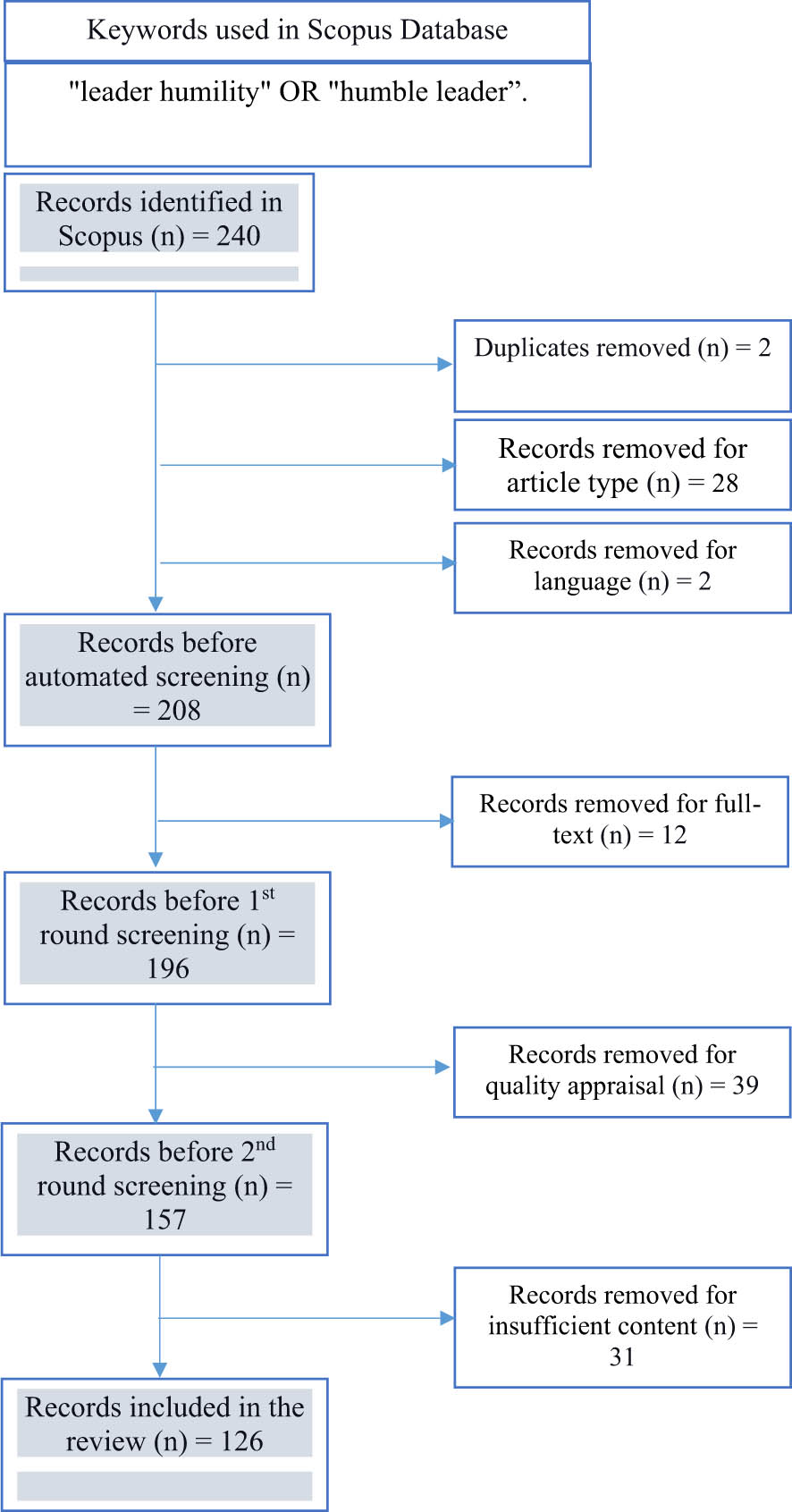
Figure 1.
PRISMA flow diagram of the article search and selection process
Data extraction and synthesis
For each included study, the following data were extracted: author(s), year, research design, sample characteristics, theoretical framework, measures of leader humility, mediators, moderators, and outcomes at individual, team, and organizational levels. A thematic synthesis approach was then applied. First, we coded mechanisms (mediators) into emergent categories (e.g., psychological safety, trust, self-efficacy, work engagement, relational energy). Second, we coded boundary conditions (moderators) into categories (e.g., follower characteristics, team attributes, leader traits, contextual factors). Third, we synthesized outcomes across levels. This iterative process allowed us to map how and when leader humility affects individuals and organizations.
RESULTS
Descriptive overview of included studies
This systematic review encompasses 126 empirical studies published from 2012 to 2026. The key characteristics of these studies are summarized in Table 1. Research focusing on leader humility has significantly increased over the last decade. Initial research began in the early 2000s (Collins, 2001; Owens & Hekman, 2012), but the data evaluated for this review only include studies that were published after 2012. An impressive 96.8% of these studies were released between 2016 and 2026, with a high concentration during 2021 to 2025, which accounted for 60.3%. Research from 2026 (as of January 2026) makes up 0.8% of the total, indicating continued increases in scholarly interest in this area. This pattern suggests that leader humility is increasingly recognized as an important and unique concept in leadership studies.
Table 1.
Characteristics of Included Studies (N = 126)
| Characteristic | Category | Number of Studies | Percentage (%) |
|---|---|---|---|
| Year of publication | 2012–2015 | 4 | 3.2 |
| 2016–2020 | 45 | 35.7 | |
| 2021–2025 | 76 | 60.3 | |
| 2026 (as of January 2026) | 1 | 0.8 | |
| Research design | Quantitative (survey, time-lagged, multi-source) | 113 | 89.7 |
| Qualitative (interviews, case studies) | 8 | 6.3 | |
| Mixed methods / Experimental | 5 | 4.0 | |
| Geographical context | China (including Taiwan) | 62 | 49.2 |
| United States | 19 | 15.1 | |
| Multiple countries / Cross-cultural | 13 | 10.3 | |
| Other Asia (South Korea, Singapore, Japan, Pakistan, India, Vietnam) | 25 | 19.8 | |
| Europe / Middle East / Other | 7 | 5.6 | |
| Primary theoretical framework | Social exchange theory | 25 | 20.0 |
| Social learning theory / Social cognitive theory | 21 | 16.7 | |
| Social information processing theory | 17 | 13.5 | |
| Self-determination theory | 11 | 8.7 | |
| Conservation of resources theory | 9 | 7.1 | |
| Implicit leadership theory | 7 | 5.6 | |
| Attribution theory / Expectation states theory | 6 | 4.8 | |
| Other (e.g., role identity, affective events, regulatory focus) | 29 | 23.0 |
Research Design
Prior research is predominantly characterized by quantitative survey-based designs, which make up 89.7% of the studies. While this allows for large-scale hypothesis testing, it has three key limitations. First, common method bias remains an issue, even with efforts to gather data from multiple sources and over time. Second, qualitative studies account for only 6.3% of the research, limiting our contextual understanding of leader humility across different settings. Third, experimental and intervention studies account for only 4.0%, limiting understanding of how leader humility develops and causally affects followers. Additionally, many of these studies utilized time-lagged and multi-source data collection methods (focusing on leader-follower dyads or triads) to reduce the impact of common method bias. Qualitative research, comprising 6.3% of the studies, includes inductive interview-based approaches (Owens & Hekman, 2012; Shannonhouse et al., 2019) that have contributed to theoretical development. Additionally, experimental and vignette-based designs, although representing a smaller fraction (4.0%), are increasingly utilized to establish causal relationships and explore boundary conditions (e.g., Oc et al., 2015; Swain, 2018).
Geographical Context
Nearly half of the research studies (49.2%) were carried out in China, including Taiwan, reflecting a cultural tendency towards humility aligned with Confucian principles (Kim, 2023; Shun, 2021). The United States accounts for 15.1%, while other Asian countries—such as South Korea, Singapore, Japan, Pakistan, India, and Vietnam—together make up 19.8%. Studies examining leader humility across various cultures or nations constitute 10.3% of the total research (e.g., Kim et al., 2023; Oc et al., 2015).
Due to research being concentrated in China and the United States, there is a bias to overlook regions such as Africa, Latin America, the Middle East, and Eastern Europe. While some cross-cultural studies (10.3%) exist, many still primarily compare China and the United States.
This geographic distribution suggests that while leader humility is a worldwide issue, the interest in the research field may be shaped by particular cultural settings. The focus on China and the United States raises concerns about the generalizability of findings across cultures with distinct power dynamics and values. For example, the relationship between Islamic work ethics and leader humility remains largely unexplored, with Suryani et al. (2023) being a rare exception.
Theoretical Foundations
The existing body of research utilizes a range of theoretical frameworks. The most prevalent are social exchange theory (20.0%) and social learning theory (16.7%), which center on mutual benefits and behavior modeling. A smaller percentage of the research uses social information processing theory (13.5%), which elucidates how followers interpret humble actions from leaders as signals of psychological safety and support. Additional frameworks, including self-determination theory (8.7%) and conservation of resources theory (7.1%), are used to investigate motivational aspects and resource dynamics. Implicit leadership theory (5.6%) and attribution theory (4.8%) are employed to examine factors that affect followers’ views on leader authenticity and competence. Notably, 23.0% of the studies incorporate multiple theories or introduce new frameworks, such as affective events theory and regulatory focus theory.
Accordingly, since 2016, research on leader humility has grown rapidly, with 96.8% of studies published in the last ten years. While this indicates that the field is developing, it also suggests that leader humility is still a relatively nascent research concept compared to established ideas like transformational or ethical leadership. There is a significant lack of long-term studies on the effects of leader humility, as most current research focuses on short-term periods.
Researchers predominantly use existing theories to examine leader humility, rather than developing new frameworks. Therefore, there is a significant need for a comprehensive, multilevel theory of humble leadership that addresses its unique features, such as the paradox of power and the evolving dynamics of leader–follower relationships.
How leader humility works: Mechanisms of effectiveness
There are three main ways in which leader humility leads to positive outcomes: through psychological mechanisms, social exchange/relational aspects, and behavioral/team-level factors.
Psychological safety mechanisms
The key psychological mechanisms are summarized in Table 2, which includes their definitions and relevant research. Psychological safety enables voice and creativity by reducing fear of risk-taking (Hu et al., 2018; Qian et al., 2022; Gonçalves & Brandão, 2017). Psychological empowerment fosters proactive behavior and job performance through enhanced meaning and self-determination (Chen et al., 2018; Jeung & Yoon, 2016; Noboa & Pino, 2025). Self-efficacy boosts task performance, creativity, and career proactivity by strengthening followers’ belief in their capabilities (Asghar et al., 2022; Mao et al., 2019; Zhong et al., 2024). Work engagement drives creative performance, organizational citizenship behavior, and innovative behavior through increased vigor and dedication (Ansong et al., 2024; Wang et al., 2022; Yang et al., 2019).
Table 2.
Psychological mechanisms linking leader humility to outcomes
| Mechanism | Definition | Key Outcomes | Representative Studies |
|---|---|---|---|
| Psychological safety | Belief that the workplace is safe for risk-taking | Voice, creativity, learning, reduced silence | Hu et al. (2018); Qian et al. (2022); Gonçalves & Brandão (2017) |
| Psychological empowerment | Sense of meaning, competence, self-determination, and impact | Proactive behavior, job performance | Chen et al. (2018); Jeung & Yoon (2016); Noboa & Pino (2025) |
| Self-efficacy | Belief in one's capability to execute tasks | Task performance, creativity, career proactivity | Asghar et al. (2022); Mao et al. (2019); Zhong et al. (2024) |
| Work engagement | Vigor, dedication, and absorption in work | Creative performance, OCB, innovative behavior | Ansong et al. (2024); Wang et al. (2022); Yang et al. (2019) |
Social exchange and relational mechanisms
Table 3 presents the relational mechanisms through which leader humility builds trust and energizes followers. Affective trust—emotional confidence in the leader's benevolence—promotes knowledge sharing, organizational citizenship behavior (OCB), and reduced turnover (Liborius & Kiewitz, 2022; Mertens et al., 2025; Nguyen et al., 2020). Relational energy, or vitality from leader interactions, drives bootlegging, constructive voice, and task performance (Ma et al., 2020; Qu et al., 2023; Wang et al., 2018). Leader–member exchange enhances prosocial and innovative behavior (Carnevale et al., 2019; Wang et al., 2021). Relational identification—defining oneself through one's relationship with a leader—encourages voice and OCB (Li et al., 2018; Zheng et al., 2023).
Table 3.
Social exchange and relational mechanisms
| Mechanism | Definition | Key Outcomes | Representative Studies |
|---|---|---|---|
| Affective trust | Emotional confidence in leader's benevolence | Knowledge sharing, OCB, reduced turnover | Nguyen et al. (2020); Liborius & Kiewitz (2022); Mertens et al. (2025) |
| Relational energy | Vitality and positive arousal from leader interactions | Bootlegging, constructive voice, task performance | Ma et al. (2020); Qu et al. (2023); Wang et al. (2018) |
| Leader-member exchange | Quality of dyadic exchange relationship | Prosocial behavior, innovative behavior | Carnevale et al. (2019); Wang et al. (2021) |
| Relational identification | Follower's self-definition based on relationship with leader | Voice (speaking up), OCB | Li et al. (2018); Zheng et al. (2023) |
Team-level mechanisms
Table 4 presents four mechanisms at the team level through which a leader's humility can enhance overall team performance. Firstly, team learning and reflexivity—encompassing collective reflection and adaptation—foster creativity and innovation among team members (Chen et al., 2021; Leblanc et al., 2022; Owens & Hekman, 2016). Secondly, team psychological capital (PsyCap), which involves a shared sense of hope, efficacy, resilience, and optimism, improves both performance and the distribution of tasks within the team (Rego et al., 2017, 2019). Thirdly, collective humility—characterized by team members demonstrating mutual humble behaviors—helps maintain a focus on the progress and success of the whole team (Owens & Hekman, 2016). Lastly, team job crafting, which refers to the collaborative restructuring of tasks and relationships, enhances the creativity of the team (Chen et al., 2021).
Table 4.
Team-level mechanisms
| Mechanism | Definition | Key Outcomes | Representative Studies |
|---|---|---|---|
| Team learning & reflexivity | Collective reflection and adaptation | Team creativity, team innovation | Chen et al. (2021); Leblanc et al. (2022); Owens & Hekman (2016) |
| Team psychological capital (PsyCap) | Collective hope, efficacy, resilience, optimism | Team performance, task allocation | Rego et al. (2017); Rego et al. (2019) |
| Collective humility | Shared humble behaviors among team members | Team promotion focus, team performance | Owens & Hekman (2016) |
| Team job crafting | Collective redesign of tasks and relationships | Team creativity | Chen et al. (2021); Luu (2021a) |
When leader humility works: Boundary conditions
Table 5 summarizes boundary conditions organized into four distinct categories. The first category is follower traits, characteristics such as a low power distance orientation, high levels of humility, a proactive attitude, and a focus on learning objectives, which are shown to improve the effectiveness of leader humility. Conversely, a competitive attitude among followers may reduce effectiveness (Diao et al., 2019; Hu et al., 2018; Liborius & Kiewitz, 2022). Second, leaders’ traits are crucial; qualities such as competence, authenticity, and political acumen lead to better outcomes. Studies show that male leaders tend to benefit more from these qualities (Bharanitharan et al., 2021; Li et al., 2016; Noboa & Pino, 2025). Third, team and organizational dynamics are vital. Settings with lower task interdependence and a competitive nature usually boost effectiveness, whereas elements such as uncertainty, time constraints, and bureaucratic cultures can hinder progress (Hadmar et al., 2022; Li et al., 2022; Liu et al., 2025). The last category is cultural factors, which are particularly influential in societies with low power distance, emphasizing the significance of cultural context in determining the effectiveness of leadership (Wang et al., 2023).
Table 5.
Boundary conditions of leader humility effectiveness
| Moderator Category | Specific Moderator | Direction of Effect | Key Studies |
|---|---|---|---|
| Follower characteristics | Power distance orientation | Negative (stronger when low) | Hu et al. (2018); Lin et al. (2019) |
| Follower humility | Positive (congruence amplifies) | Diao et al. (2019); Zhong et al. (2023) | |
| Proactive personality | Positive (amplifies) | Asghar et al. (2022); Leblanc et al. (2022); Wu & Zhou (2023) | |
| Learning goal orientation | Positive (amplifies) | Wang et al. (2022); Wang et al. (2025) | |
| Competitiveness | Negative (weakens) | Liborius & Kiewitz (2022) | |
| Leader characteristics | Leader competence | Positive (amplifies) | Li et al. (2016); Tariq et al. (2023); Yuan et al. (2018) |
| Leader authenticity | Positive (genuine humility works; hypocrisy backfires) | Bharanitharan et al. (2021); Oc et al. (2020) | |
| Leader political skill | Positive (amplifies) | Wang et al. (2019); Zhou & Wu (2018) | |
| Leader sex | Male leaders benefit more | Noboa & Pino (2025); Swain & Korenman (2018) | |
| Team/organizational context | Task interdependence | Negative (stronger when low) | Li et al. (2022); Liu et al. (2017); Ye et al. (2020) |
| Competitive climate | Positive (amplifies) | Achmadi et al. (2022); Ye et al. (2020) | |
| Environmental uncertainty | Negative (weakens) | Xu et al. (2022); Zhou et al. (2022) | |
| Time pressure | Negative (humility seen as indecisive) | Liu et al. (2025) | |
| Bureaucratic culture | Negative (weakens) | Hadmar et al. (2022) | |
| Cultural factors | Power distance (cultural) | Negative (stronger in low PDI cultures) | Wang et al. (2023); Zou & Chen (2022) |
The double-edged sword
Although leader humility is frequently regarded as advantageous, studies show that it can also negatively affect both individual and group dynamics (described in Table 6). The commonly referenced concept of curvilinear relationships is represented as an inverted U-shaped curve. This curve indicates that a moderate degree of humility in leaders is the most effective for enhancing performance. Conversely, excessive humility may lead to negative consequences, such as increased feelings of entitlement among team members (Bin et al., 2021; Yuan et al., 2018; Chen et al., 2024). Recent research suggests that leader humility might result in detrimental employee behaviors, especially if team members perceive the leader's humility as a disguise for self-serving intentions (Qin et al., 2020). Additionally, from the standpoint of leaders, possessing humility can contribute to emotional fatigue, a reduced sense of control, and moral licensing—where leaders justify unethical decisions based on their humble nature. Multiple studies underscore these negative consequences and highlight the complex role humility plays in organizational settings (Bharanitharan et al., 2019; K. Yang et al., 2019; Cavazotte et al., 2023).
Table 6.
Curvilinear and dark-side effects of leader humility
| Type of Effect | Specific Finding | Key Studies |
|---|---|---|
| Curvilinear (inverted U-shaped) | Moderate humility optimal; too much reduces performance, creativity, OCB | Bin et al. (2021); Yuan et al. (2018); Chen et al. (2024) |
| Inverted U between humility and unethical pro-organizational behavior | Song et al. (2025) | |
| Dark side for followers | Humility attributed to self-serving motives increases entitlement and deviance | Qin et al. (2020) |
| Humility triggers sense of power; under Machiavellianism leads to self-interested behavior | Chen et al. (2022) | |
| Humility simultaneously reduces UPB via insider status but increases UPB via guanxi | Shaw et al. (2025) | |
| Dark side for leaders | Expressing humility depletes emotional resources → exhaustion, turnover, work-family conflict | K. Yang et al. (2019) |
| Leader humility and narcissism jointly affect project outcomes; humility can have mixed effects | Cavazotte et al. (2023) | |
| Moral licensing: humble leaders may subsequently engage in unethical behavior | Bharanitharan et al. (2019) |
Integrative framework: antecedents, mediators, moderators, and outcomes of leader humility
Research integration has brought to light six critical factors that profoundly shape interactions within organizations. These factors include psychological safety, which refers to the belief that one will not be penalized or humiliated for speaking up; psychological empowerment, which fosters a sense of control and ownership over one's work; self-efficacy, reflecting an individual's confidence in their ability to accomplish tasks; work engagement, characterized by vigor, dedication, and absorption in one's job; affective trust, encompassing emotional bonds and confidence between team members; and relational energy, which signifies the positive energy and enthusiasm that individuals contribute to their interactions.
In addition to these influential factors, four essential dynamics within teams have been identified in the literature as significant contributors to enhanced performance and collaboration. These are team learning and reflexivity, team PsyCap, collective humility, and team job crafting.
Despite the insights provided by existing literature, three notable gaps have been identified. First, many studies tend to investigate leader humilty mechanisms in isolation, neglecting to explore how they might interact in competing or sequential ways. This signals an urgent need for future research to delve into the relative impacts and interplay of these mechanisms within organizational contexts (Liu et al., 2024; Nguyen et al., 2020). Second, while the literature often highlights the positive dimensions of these mechanisms, it frequently overlooks potential negative outcomes, such as the risk of followers being exploited, or the phenomenon of leader burnout associated with the practice of leader humility. Finally, there is often a lack of clarity between mechanisms and moderators in the existing research; for instance, psychological safety can function as both a mediator and a moderator in various contexts. This ambiguity underscores the need for more precise conceptual definitions in future investigations to better advance our understanding of these dynamics. Table 7 presents an integrative framework that outlines the interconnected aspects of leader humility, categorized into four main groups: antecedents, mediators, moderators, and outcomes.
Table 7.
Integrative Framework of Leader Humility
| Domain | Key Constructs | Representative Studies |
|---|---|---|
| Antecedents | Leader growth mindset, relational identity, significant-other activation, personality (Honesty-Humility, Agreeableness, Conscientiousness), feedback-seeking behavior | Wang et al. (2018); Owens & Hekman (2012); Hassan et al. (2023); Deng et al. (2019) |
| Mediators (How) | Individual-level: Psychological safety, psychological empowerment, self-efficacy, work engagement, affective trust, relational energy | Hu et al. (2018); Chen et al. (2018); Mao et al. (2019); Nguyen et al. (2020); Ma et al. (2020) |
| Team-level: Team learning/reflexivity, team PsyCap, collective humility, team job crafting | Leblanc et al. (2022); Rego et al. (2019); Owens & Hekman (2016); Chen et al. (2021) | |
| Moderators (When) | Follower: Power distance, humility, proactivity, learning orientation, competitiveness | Hu et al. (2018); Diao et al. (2019); Asghar et al. (2022); Liborius & Kiewitz (2022) |
| Leader: Competence, authenticity, political skill, sex | Li et al. (2016); Oc et al. (2020); Zhou & Wu (2018); Noboa & Pino (2025) | |
| Context: Task interdependence, competitive climate, uncertainty, time pressure, bureaucratic culture | Li et al. (2022); Ye et al. (2020); Xu et al. (2022); Liu et al. (2025); Hadmar et al. (2022) | |
| Outcomes | Individual: Creativity, voice, performance, OCB, well-being, reduced turnover | Wang et al. (2018); Lin et al. (2019); Cho et al. (2021); Ansong et al. (2024) |
| Team: Team creativity, team learning, team performance, innovation | Owens & Hekman (2016); Leblanc et al. (2022); Rego et al. (2019) | |
| Organizational: Project success, service recovery, inter-firm collaboration | Ali et al. (2021); Elhadidy et al. (2025); Zhou et al. (2022) |
The review highlighted four distinct categories of moderators, or boundary conditions, that influence the relationship between leader humility and various outcomes. These categories encompass follower characteristics, leader characteristics, team or organizational context, and cultural factors. Follower characteristics include aspects such as power distance, humility, and proactivity. Leader characteristics include traits such as competence and authenticity, as well as demographic factors such as sex. The context within teams or organizations includes elements such as task interdependence—how much team members rely on one another to achieve goals, uncertainty in the workplace, and time constraints. Additionally, cultural factors play a significant role in shaping leader humility dynamics.
While these categories provide a thorough overview of the moderators at play, several gaps remain. Firstly, there is a notable lack of exploration into how these various boundary conditions interact. For instance, how might a leader's competence affect the relationship between their humility and the follower's power distance? This interplay is yet to be thoroughly examined. Moreover, many of the identified moderators are static, referring to individual differences or fixed contextual features that do not change over time. However, dynamic moderators, such as a team's mood or fluctuations in daily workload, are seldom the focus of research.
Another significant gap lies in the role of technology and virtual work environments as potential boundary conditions. Despite the widespread shift towards remote and hybrid working arrangements, there is a lack of research on how leader humility is conveyed through digital communication platforms such as email, Slack, or video calls. Furthermore, it remains uncertain whether leader humility retains its effectiveness when applied in virtual teams compared to traditional settings. Lastly, the concept of dark-side moderators—specific conditions under which leader humility may become harmful—is just beginning to receive attention. Factors such as time pressure and follower competitiveness could potentially undermine the positive effects of leader humility. There remains a pressing need for research to identify scenarios where leader humility should be moderated or even avoided altogether.
Based on the synthesis, Figure 2 and Table 7 present an integrative framework summarizing the nomological network of leader humility. The framework organizes the literature into four interconnected domains. Despite extensive research on consequences, the antecedents of leader humility remain severely underdeveloped. Therefore, it is important to ask what organizational or personal factors cause leaders to become more or less humble?
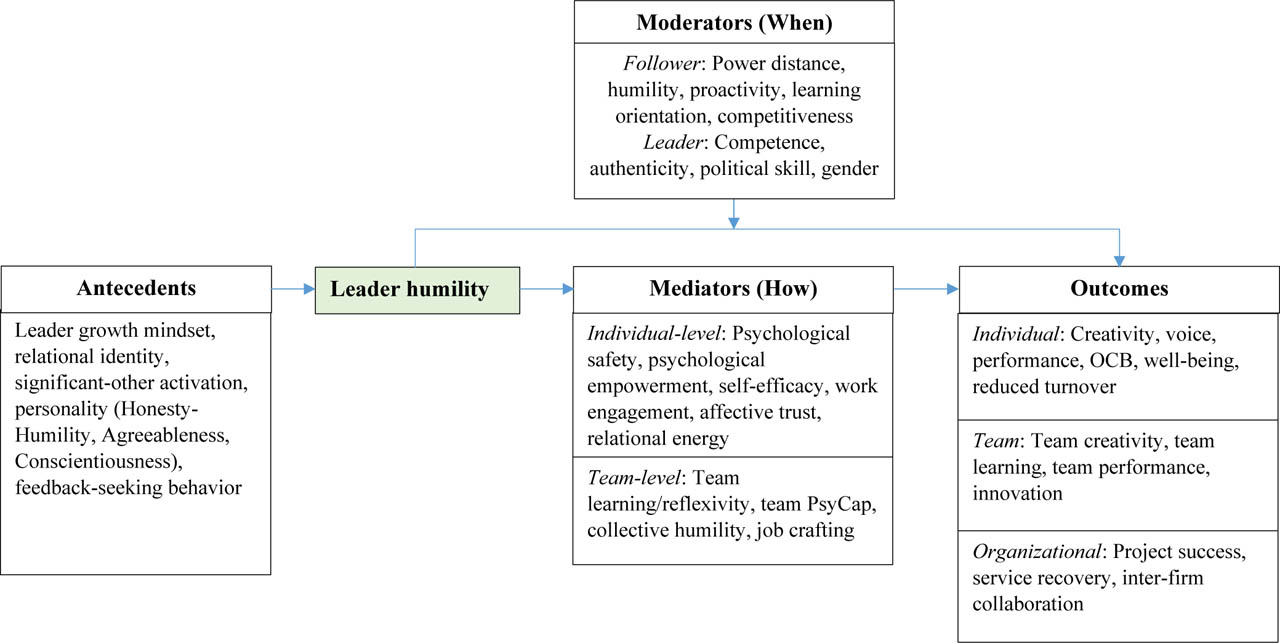
Figure 2.
Integrative framework of leader humility
Research mainly focuses on leader traits, such as honesty–humility and mindsets. However, it often overlooks how situations—such as failure experiences, feedback received, and the overall organizational culture—affect leadership. This existing view downplays the role of negative or unexpected factors, raising concerns that leader humility could sometimes lead to follower complacency or less effort. Additionally, current studies ignore changing factors, such as daily mood swings and task urgency, which could greatly influence leader–follower relationships. There is also a gap in understanding how team climate impacts individual behavior. Finally, while most research focuses on individual or team outcomes, there is little attention to organizational outcomes such as financial performance, innovative practices, and overall reputation. This lack of research leaves us unsure about the wider effects of leadership and organizational dynamics.
DISCUSSION
This systematic review illustrates that leader humility can increase effectiveness at various levels, when demonstrated authentically, in moderation, and when paired with appropriate follower traits and situational factors. However, the effectiveness of leader humility is inherently linked to how it operates—through psychological and/or relational processes—and the specific contexts in which it is exhibited (particularly within supportive boundary conditions). We synthesized 126 studies into a cohesive framework that establishes a foundation for future research to address current gaps, especially regarding antecedents, dynamic moderators, cross-cultural consistency, and macro-level outcomes.
This review provides multiple theoretical insights into the literature on leader humility. Although previous research has relied on social exchange theory, social learning theory, social information processing theory, self-determination theory, and conservation of resources theory in isolation, our results indicate that these views are complementary rather than adversarial. For example, psychological safety (from social information processing) and affective trust (from social exchange) often function concurrently to clarify voice behavior. Hence, we suggest future theoretical advancements should adopt multi-mechanism models that encompass the simultaneous cognitive, affective, and relational channels through which leader humility functions.
The review indicates that the benefits of leader humility are not consistent across all situations, and at certain levels, these effects can be curvilinear and even detrimental. This finding calls for an expansion of existing theories—most of which assume straightforward, positive relationships—to incorporate non-linear and conditional impacts. For instance, conservation of resources theory can demonstrate how excessive humility depletes leaders’ resources (Yang et al., 2019), while attribution theory can help explain how followers perceive humility and its consequences (Qin et al., 2020). Therefore, combining both attributional and resource-oriented perspectives offers a more thorough theoretical insight into when humility might negatively affect the individual or the team.
Moreover, the review points out a significant disparity in the nomological network: the precursors of leader humility are substantially less theorized and researched than its outcomes. Most studies use theories that explain consequences (such as social exchange) but overlook origins. Future theoretical research should incorporate insights from developmental psychology, personality theory, and situational strength theory to understand why some leaders exhibit more humility than others. For example, leader humility could be viewed as a dynamic state shaped by organizational feedback mechanisms, error management cultures, and significant life experiences.
The review further emphasizes cultural limitations of existing research. The review notes that leader humility is more successful in low power distance cultures than in high power distance cultures. This highlights the need to develop an indigenous theory that integrates culturally specific interpretations of humility (for example, the Confucian concept of qianxun or the Islamic idea of tawadu). In addition, future researchers need to consider cross-cultural adaptations of social exchange and social learning theories, and how cultural differences shape how humility conveys benevolence and competence.
Lastly, the review enriches leadership theory more broadly by situating leader humility as a unique construct that complements, rather than supplants, existing leadership models. Unlike transformational leadership (which focuses on idealized influence) or servant leadership (which emphasizes serving others), leader humility uniquely highlights self-awareness of limitations, respect for others, and the leader's willingness to learn. Therefore, distinctiveness indicates that humility should be integrated into broader leadership frameworks, such as the full-range leadership model, as a unique facet of effective leadership, especially in contexts that demand learning and adaptability.
Suggestions for future research
Future research should focus on several interconnected avenues. First, scholars need to explore the organizational and situational factors that either foster or hinder leader humility. This includes examining elements such as feedback systems, error management climates, leader developmental experiences, and organizational culture. Utilizing longitudinal designs that monitor leaders throughout their career transitions will provide valuable insights into these dynamics.
Second, to deepen our understanding of the functioning of leader humility, future research should directly compare the explanatory power of competing mechanisms. For example, studies could investigate the roles of psychological safety and relational energy, employing techniques such as relative weight or dominance analysis to assess their effects. Furthermore, structural models should be tested that account for serial and moderated mediation, allowing for the simultaneous integration of multiple pathways and providing a more comprehensive view of how these factors interact and influence outcomes.
Third, geographical expansion is essential for research efforts. It should encompass regions such as Africa, Latin America, the Middle East, and Eastern Europe. Moving beyond mere comparisons between China and the United States will allow for the inclusion of a variety of cultural contexts and indigenous understandings of humility. This broader focus will enrich and deepen the research findings.
Fourth, the swift transition to virtual work necessitates an examination of the expression and perception of leader humility in digital settings. It is important to explore whether humble communication through digital platforms, such as email or Slack, yields the same outcomes as in-person interactions. Additionally, understanding how virtual teams are influenced by leader humilty can provide valuable insights for effective management in a remote work environment.
The fifth point highlights the need for a deeper investigation into the complexities of leader humility. This exploration should encompass the various circumstances in which humility may be detrimental. Additionally, it is crucial to conduct cross-cultural studies to determine what constitutes optimal humility levels versus those deemed excessive, thereby providing a clearer understanding of how humility manifests across diverse cultural contexts.
Sixth, intervention and training studies should develop and test humility cultivation methods—such as feedback-seeking exercises, perspective-taking training, and significant-other activation (Wang et al., 2024)—using randomized field experiments to establish causality. Seventh, macro-level outcomes remain underexplored; future research should examine the impact of leader humility on organizational-level variables, employing multilevel modeling to link CEO humility to firm performance.
Finally, there is an urgent need for a nuanced theoretical framework that specifically addresses the complexities surrounding humility in leadership. This involves exploring the intriguing paradoxes that arise when leaders demonstrate humility while also achieving effectiveness in their roles. It is crucial to understand how power and humility can coexist in a leader's approach, and how the dynamics of humility evolve in relationships between leaders and their followers. Such a theory would provide deeper insights into the interplay of these elements, ultimately enhancing our understanding of effective leadership practices.
CONCLUSIONS
This systematic literature review of 126 empirical studies provides a comprehensive answer to the question of how and when leader humility is effective for individuals and organizations. The review yields three overarching conclusions. First, leader humility enhances positive outcomes through six individual-level mechanisms (psychological safety, psychological empowerment, self-efficacy, work engagement, affective trust, and relational energy) and four team-level mechanisms (team learning and reflexivity, team psychological capital, collective humility, and team job crafting). These mechanisms collectively explain how humble leaders foster creativity, voice, performance, organizational citizenship behavior, and well-being among followers, as well as team innovation and organizational effectiveness.
Second, the effectiveness of leader humility is highly contingent on a range of boundary conditions. Leader humility works better under the following conditions: when followers exhibit low power distance orientation, high proactive personality, and high learning goal orientation; when leaders themselves are competent and authentic; when team task interdependence is low; and when the competitive climate is high rather than uncertain. Conversely, high environmental uncertainty, time pressure, and bureaucratic cultures weaken the positive effects of leader humility.
Third, leader humility is not uniformly beneficial. Curvilinear relationships indicate that moderate levels are optimal, while excessive humility diminishes performance and increases follower entitlement. Furthermore, there is a dark side to leader humility. When followers attribute humility to self-serving motives, it can increase psychological entitlement and deviance. For leaders, expressing humility may lead to emotional exhaustion, reduced agentic perceptions, and moral licensing effects.
Limitations
This systematic review has several limitations that should be acknowledged when interpreting its findings. First, the search was limited to the Scopus database and included only peer-reviewed journal articles published in English, which may have excluded relevant studies from other databases (e.g., Web of Science, PsycINFO, Google Scholar), non-English publications, conference proceedings, book chapters, and unpublished dissertations. These exclusinos potentially introduced publication and language bias. Second, despite the use of a comprehensive search string, the keyword combination (“leader humility” OR “humble leader”) may have missed studies using related but distinct terms such as “expressed humility,” “leader expressed humility,” or “humble leadership behavior,” although efforts were made to capture these through manual screening of references.
Appendices
APPENDIX
| No | Authors | Title | Journal | Description |
|---|---|---|---|---|
| 1 | Lin et al. (2024) | How do humble leaders unleash followers’ leadership potential? The roles of workplace status and individualistic orientation | Journal of Organizational Behavior | Leader humility elevates followers’ workplace status and leadership potential, especially when individualism is high. |
| 2 | Ansong et al. (2024) | Leader humility and organisational citizenship behaviour: the mediating roles of job satisfaction and employee engagement | Cogent Business and Management | Leader humility positively affects OCB through job satisfaction and employee engagement (partial mediation). |
| 3 | Chen et al. (2018) | Can leader “humility” spark employee “proactivity”? The mediating role of psychological empowerment | Leadership and Organization Development Journal | Leader humility enhances proactive behavior via psychological empowerment, moderated by identification with leader. |
| 4 | Wu & Zhou (2023) | Do ‘humble’ leaders help employees to perform better? Evidence from the Chinese public sector | Australian Journal of Public Administration | Leader humility boosts performance through intrinsic motivation, stronger for proactive employees. |
| 5 | Li et al. (2022) | Leader humility and team creativity: The role of team creative efficacy and task interdependence | Journal of General Management | Leader humility promotes team creativity via team creative efficacy, especially when task interdependence is low. |
| 6 | Lin et al. (2019) | Why and When Employees Like to Speak up More Under Humble Leaders? The Roles of Personal Sense of Power and Power Distance | Journal of Business Ethics | Leader humility encourages voice via personal sense of power, stronger when power distance is low. |
| 7 | Mao et al. (2019) | Growing Followers: Exploring the Effects of Leader Humility on Follower Self-Expansion, Self-Efficacy, and Performance | Journal of Management Studies | Leader humility triggers self-expansion, enhancing self-efficacy and performance, moderated by age/gender similarity. |
| 8 | Liu et al. (2017) | Leader humility and team innovation: Investigating the substituting role of task interdependence and the mediating role of team voice climate | Frontiers in Psychology | Leader humility enhances team innovation via team voice climate; task interdependence substitutes the effect. |
| 9 | Liu et al. (2024) | Leader humility and employees’ creative performance: the role of intrinsic motivation and work engagement | Frontiers in Psychology | Leader humility boosts creative performance through intrinsic motivation and work engagement sequentially. |
| 10 | Wang et al. (2022) | An implicit leadership theory lens on leader humility and employee outcomes: Examining individual and organizational contingencies | Tourism Management | Leader humility perceived as benevolent when followers have learning orientation and informational justice, increasing commitment. |
| 11 | Zhou et al. (2022) | Leader humility and inter-firm collaboration: the moderating role of firm status and environmental uncertainty | Leadership and Organization Development Journal | CEO humility enhances inter-firm collaboration, moderated positively by firm status and negatively by uncertainty. |
| 12 | Maldonado et al. (2022) | Unpacking humility: Leader humility, leader personality, and why they matter | Business Horizons | Leader humility relates to Conscientiousness, Agreeableness, Openness; can be developed through coaching. |
| 13 | Liu et al. (2022) | Humble Leader Behavior and Its Effects on Performance at the Team and Individual Level: A Multi-Perspective Study | Group and Organization Management | Leader humility improves individual performance via self-esteem and team performance via team potency, moderated by cognitive diversity. |
| 14 | Peng et al. (2020) | Can Humble Leaders Get Results? The Indirect and Contextual Influences of Skip-Level Leaders | Journal of Leadership and Organizational Studies | Skip-level leader humility trickles down to team leaders, enhancing team performance, especially in centralized organizations. |
| 15 | Cao et al. (2023) | Team leader humility and team proactive customer service behavior: A regulatory focus perspective | International Journal of Hospitality Management | Leader humility promotes team proactive customer service via team promotion focus, moderated by CSR. |
| 16 | Davis et al. (2023) | The multilevel correlates, contributions, and consequences of leader humility in humanitarian aid work | Frontiers in Psychology | Leader humility fosters positive attributions, job satisfaction, team performance, and well-being in humanitarian aid. |
| 17 | Leblanc et al. (2022) | Leader humility and team innovation: The role of team reflexivity and team proactive personality | Journal of Organizational Behavior | Leader humility enhances team innovation via team reflexivity, stronger when team proactive personality is high. |
| 18 | Qian et al. (2022) | Leader humility as a predictor of employees’ feedback-seeking behavior: The intervening role of psychological safety and job insecurity | Current Psychology | Leader humility promotes feedback-seeking through psychological safety, stronger under high job insecurity. |
| 19 | Zhu et al. (2022) | How Does Leader Humility Influence Team Creativity? The Roles of Team Behavioral Integration and Leader Performance | Frontiers in Psychology | Leader humility boosts team creativity via team behavioral integration, moderated by leader performance. |
| 20 | Wang et al. (2020) | Antecedents and Consequences of Creativity in Teams: When and How Leader Humility Promotes Performance via Team Creativity | Journal of Creative Behavior | Leader humility promotes team creativity through team creative efficacy, moderated by leader conscientiousness. |
| 21 | Ye et al. (2020) | Leader humility, team humility and employee creative performance: The moderating roles of task dependence and competitive climate | Tourism Management | Leader humility influences employee creativity via team humility, moderated by task dependence and competitive climate. |
| 22 | Rigolizzo et al. (2022) | Leader humility, leader authenticity and informal learning: how humble team leaders model everyday workplace learning | Journal of Workplace Learning | Leader humility positively affects informal learning, partially mediated by leader authenticity. |
| 23 | Qu et al. (2023) | Does Leader Humility Foster Employee Bootlegging? Examining the Mediating Role of Relational Energy and the Moderating Role of Work Unit Structure | Journal of Business and Psychology | Leader humility fosters bootlegging via relational energy, moderated by organic work unit structure. |
| 24 | Wang et al. (2022) | Stay Humble and Fly High: The Roles of Subordinate Voice and Competitive Work Context in the Linkage Between Leader Humility and Career Success | Journal of Leadership and Organizational Studies | Humble leaders gain career success via centrality in voice networks, especially in competitive contexts. |
| 25 | Carnevale et al. (2019) | LMX-differentiation strengthens the prosocial consequences of leader humility: An identification and social exchange perspective | Journal of Business Research | Leader humility promotes helping via identification with leader, moderated positively by LMX-differentiation. |
| 26 | Howard-Baptiste & Baptiste (2013) | Echoes of a not so distant summer: Scholar-servant as humble leaders | Advances in Educational Administration | Scholar-servant as humble leaders, demystifying traditional leadership assumptions and addressing oppression. |
| 27 | Chen et al. (2021) | Leader humility, team job crafting and team creativity: The moderating role of leader–leader exchange | Human Resource Management Journal | Leader humility affects team creativity via team job crafting, moderated by leader-leader exchange (LLX). |
| 28 | Wang et al. (2017) | Understanding How Leader Humility Enhances Employee Creativity: The Roles of Perspective Taking and Cognitive Reappraisal | Journal of Applied Behavioral Science | Leader humility enhances creativity via perspective taking, moderated by cognitive reappraisal (emergency context). |
| 29 | Achmadi et al. (2022) | How can a leader's humility enhance civility climate and employee voice in a competitive environment? | Journal of Management Development | Leader humility improves civility climate and voice, moderated by competitive climate (stronger effect). |
| 30 | Mertens et al. (2025) | Leader Humility and Affective Commitment: A Cross-Sectional Study Among Hospital Nursing Teams | Journal of Advanced Nursing | Head nurse humility builds psychological safety, trust, participative communication, and nurse affective commitment. |
| 31 | Kim (2025) | Leader humility as a form of love: Building trust and cooperative culture in Japanese organizations | International Journal of Intercultural Relations | Leader humility as love promotes OCB via trust and cooperative culture in Japanese organizations. |
| 32 | Chandler et al. (2023) | A meta-analysis of humble leadership: Reviewing individual, team, and organizational outcomes of leader humility | Leadership Quarterly | Meta-analysis: humble leadership predicts follower satisfaction and participative decision-making, but not leader own performance. |
| 33 | Li et al. (2019) | Shaping the shared mental model: How leader humility helps teams to learn | Journal of Management and Organization | Leader humility enhances team learning via shared mental models, stronger with collective promotion focus. |
| 34 | Lu & Li (2024) | Do humble leaders build more flexible teams? | Social Behavior and Personality | Leader humility promotes team flexibility directly and indirectly through team reflexivity. |
| 35 | Qian et al. (2020) | Leader humility, and subordinates’ organizational citizenship behavior and withdrawal behavior: Exploring the mediating mechanisms of subordinates’ psychological capital | International Journal of Environmental Research and Public Health | Leader humility increases OCB and reduces withdrawal via psychological capital. |
| 36 | Mallén et al. (2020) | Does leader humility matter? Effects on altruism and innovation | Management Decision | Leader humility fosters firm innovativeness through altruism. |
| 37 | Chen & Liu (2023) | Stop high-flyers from flying away: Interaction effect of perceived overqualification and leader humility on turnover intention | Current Psychology | Perceived overqualification and leader humility interact to affect turnover via relative LMX. |
| 38 | Yuan et al. (2018) | When a leader is seen as too humble: A curvilinear mediation model linking leader humility to employee creative process engagement | Leadership and Organization Development Journal | Curvilinear relationship between leader humility and creativity, mediated by POS, moderated by leader competence. |
| 39 | Zhong et al. (2020) | Can leader humility enhance employee wellbeing? The mediating role of employee humility | Leadership and Organization Development Journal | Leader humility improves well-being via employee humility, moderated by perceived leader effectiveness. |
| 40 | Qin et al. (2020) | The double-edged sword of leader humility: Investigating when and why leader humility promotes versus inhibits subordinate deviance | Journal of Applied Psychology | Leader humility can increase deviance via entitlement or decrease via LMX, depending on attributions. |
| 41 | K. B et al. (2022) | A Wolf in Sheep's Clothing: Exploring the Relationship Between Leader Humility and Unethical Behavior | Journal of Management | Leader humility leads to unethical behavior via moral licensing, moderated by relational accountability. |
| 42 | Zhang & Liu (2019) | Leader Humility and Taking Charge: The Role of OBSE and Leader Prototypicality | Frontiers in Psychology | Leader humility promotes taking charge via OBSE, moderated by leader prototypicality. |
| 43 | Rego et al. (2018) | The Perceived Impact of Leaders’ Humility on Team Effectiveness: an Empirical Study | Journal of Business Ethics | Leader humility (other-reported) indirectly relates to team effectiveness via balanced processing. |
| 44 | Aarons et al. (2017) | The humble leader: Association of discrepancies in leader and follower ratings of implementation leadership with organizational climate in mental health | Psychiatric Services | Discrepancy (leader low, follower high) humility associates with positive organizational climate. |
| 45 | Zhong et al. (2023) | Antecedents and consequences of follower moqi: leader humility, follower humility, and knowledge hiding | Current Psychology | Leader humility promotes follower moqi, reducing knowledge hiding, moderated by follower humility. |
| 46 | Fu et al. (2019) | Leader humility and employee voice: the role of employees’ regulatory focus and voice-role conception | Social Behavior and Personality | Leader humility enhances voice via voice-role conception, moderated by regulatory focus. |
| 47 | Hu et al. (2018) | Leader humility and team creativity: The role of team information sharing, psychological safety, and power distance | Journal of Applied Psychology | Leader humility affects team creativity via information sharing and psychological safety, moderated by power distance. |
| 48 | Tuan et al. (2021) | Nurturing service-oriented organizational citizenship behavior among tourism employees through leader humility | Journal of Hospitality and Tourism Management | Leader humility promotes service-oriented OCB via job crafting, moderated by socially responsible HR practices. |
| 49 | Diao et al. (2019) | Being passionate to perform: The joint effect of leader humility and follower humility | Frontiers in Psychology | Leader humility enhances performance via harmonious passion, moderated by follower humility. |
| 50 | Luu (2021) | Knowledge sharing in the hospitality context: The roles of leader humility, job crafting, and promotion focus | International Journal of Hospitality Management | Leader humility activates knowledge sharing via job crafting, moderated by promotion focus. |
| 51 | Li et al. (2018) | Leader humility and constructive voice behavior in China: a dual process model | International Journal of Manpower | Leader humility promotes voice via relational and organizational identification. |
| 52 | Oc et al. (2015) | Leader humility in Singapore | Leadership Quarterly | Identifies nine dimensions of leader humility, five unique to Singapore. |
| 53 | Van Tongeren et al. (2024) | The trust signaling hypothesis of humility: how humble leaders elicit greater monetary contributions | Journal of Positive Psychology | Humble leaders elicit favorable ratings and financial contributions via trust, even when competence low. |
| 54 | Song et al. (2025) | The influence of organizational identification on the curvilinear relationship between leader humility and follower unethical pro-organizational behavior | Journal of Management and Organization | Curvilinear (inverted U) relationship between leader humility and UPB, moderated by organizational identification. |
| 55 | Chen et al. (2021) | Humble leader behavior and team creativity: the team learning perspective | Journal of Managerial Psychology | Leader humility promotes team creativity via team learning, strengthened by leader effectiveness. |
| 56 | Hadmar et al. (2022) | Leader Humility, Sense of Power, and Interpersonal Deviance Relationship Model in the Bureaucratic Culture | Frontiers in Sociology | Leader humility increases sense of power leading to deviance, moderated by bureaucratic culture. |
| 57 | Li et al. (2021) | Linking leader humility to employee creative performance: Work engagement as a mediator | Social Behavior and Personality | Leader humility enhances creative performance directly and via work engagement (partial mediation). |
| 58 | Rego et al. (2019) | Leader Humility and Team Performance: Exploring the Mediating Mechanisms of Team PsyCap and Task Allocation Effectiveness | Journal of Management | Leader humility improves team performance via team PsyCap and task allocation effectiveness (serial mediation). |
| 59 | Tariq et al. (2023) | Humility breeds creativity: the moderated mediation model of leader humility and subordinates’ creative service performance in hospitality | International Journal of Contemporary Hospitality Management | Leader humility boosts creative service performance via thriving at work, moderated by leader competency. |
| 60 | Liu et al. (2025) | Not the Time to be Humble! When and Why Leader Humility Enhances and Deteriorates Evaluations on Leader Effectiveness and Satisfaction with Leader | Journal of Management Studies | Leader humility is valued under low time pressure but seen as indecisive under high time pressure. |
| 61 | Silard et al. (2024) | Watching you descend, I help others rise: the influence of leader humility on prosocial motivation | Journal of Management and Organization | Leader humility enhances prosocial motivation through work meaningfulness, moderated by relational vitality. |
| 62 | Oc et al. (2020) | Humility breeds authenticity: How authentic leader humility shapes follower vulnerability and felt authenticity | Organizational Behavior and Human Decision Processes | Authentic leader humility reduces follower vulnerability and increases felt authenticity. |
| 63 | Swain (2018) | Effects of Leader Humility on the Performance of Virtual Groups | Journal of Leadership Studies | Leader humility increases psychological safety and liking, but not actual performance in virtual groups. |
| 64 | Zhou & Chen (2024) | Exploring the impact of leader humility on different types of voice: The role of employee other-oriented motivations | Journal of Management and Organization | Leader humility promotes prosocial and organizational concern motivations, leading to supportive and challenging voice. |
| 65 | Cheung et al. (2020) | Does being mindful make people more creative at work? The role of creative process engagement and perceived leader humility | Organizational Behavior and Human Decision Processes | Mindfulness enhances creativity via creative process engagement, strengthened by perceived leader humility. |
| 66 | Jia et al. (2024) | Leader humility and follower prosocial behaviours: Integrating three theoretical perspectives | Journal of Occupational and Organizational Psychology | Leader humility affects prosocial behaviors via self-efficacy, affective trust, and perceived insider status (social exchange strongest). |
| 67 | Bahadur & Ali (2023) | Linking leader humility with service performance: the role of service climate and customer mistreatment | Asian Business and Management | Leader humility improves service performance via service climate, moderated by customer mistreatment. |
| 68 | Upadhyay et al. (2025) | Influence of leader humility on subordinates’ knowledge-sharing: exploring the boundary conditions | Journal of Knowledge Management | Leader humility promotes knowledge sharing via psychological safety, moderated by leader competence and OSE. |
| 69 | Jeung & Yoon (2016) | Leader humility and psychological empowerment: investigating contingencies | Journal of Managerial Psychology | Leader humility predicts empowerment, moderated by power distance and hierarchical distance (three-way interaction). |
| 70 | Wang et al. (2022) | Top-down and bottom-up: Examining reciprocal relationships between leader humility and team helping behavior | Journal of Organizational Behavior | Reciprocal relationship: leader humility and team helping reinforce each other, predicting performance and lower turnover. |
| 71 | Bharanitharan et al. (2021) | Seeing is not believing: Leader humility, hypocrisy, and their impact on followers’ behaviors | Leadership Quarterly | Leader humility combined with impression management increases perceived hypocrisy, but mediation not supported. |
| 72 | Cavazotte et al. (2023) | Beyond the paradox: Understanding how project leader humility and narcissism affect project outcomes | International Journal of Project Management | Leader humility improves project outcomes via empowerment; narcissism affects outcomes differently. |
| 73 | Chiu et al. (2016) | Initiating and utilizing shared leadership in teams: The role of leader humility, team proactive personality, and team performance capability | Journal of Applied Psychology | Leader humility fosters shared leadership, moderated by team proactive personality and team competence. |
| 74 | Chan et al. (2024) | An examination of whether and how leader humility enhances leader personal career success | Human Resource Management | Humble leaders gain career success through mentoring behavior, status, and promotability. |
| 75 | Chen et al. (2022) | Leader Humility and Machiavellianism: Investigating the Effects on Followers’ Self-Interested and Prosocial Behaviors | Frontiers in Psychology | Leader humility triggers sense of power; follower Machiavellianism moderates self-interested vs prosocial behavior. |
| 76 | Upadhyay & Singh (2024) | Linking leader humility, reverse mentoring and subordinate turnover intentions: empirical evidence from the Indian information technology industry | International Journal of Organizational Analysis | Leader humility reduces turnover via reverse mentoring, moderated by leader competence. |
| 77 | Owens et al. (2015) | Leader narcissism and follower outcomes: The counterbalancing effect of leader humility | Journal of Applied Psychology | Leader narcissism can be positive when tempered by humility, affecting effectiveness and follower engagement. |
| 78 | Othman et al. (2025) | Leader's Humility: Unveiling the Mediating Effect of Decent Work on the Relation Between Humble Leadership and Nurses’ Grit | Journal of Nursing Management | Decent work mediates the relationship between humble leadership and nurses’ grit. |
| 79 | Peng et al. (2023) | How and when does leader humility promote followers’ proactive customer service performance? | International Journal of Contemporary Hospitality Management | Leader humility boosts proactive customer service via relational energy, moderated by person-supervisor fit. |
| 80 | Chen et al. (2025) | Leader humility and employee proactivity: sequential affective mediation and the moderating effect of role breadth self-efficacy | Frontiers in Psychology | Leader humility enhances proactivity via positive mood and affective commitment, moderated by role breadth self-efficacy. |
| 81 | Naseer et al. (2020) | Understanding how leaders’ humility promotes followers’ emotions and ethical behaviors: Workplace spirituality as a mediator | Journal of Positive Psychology | Leader humility predicts empathy, gratitude, ethical behavior via workplace spirituality. |
| 82 | D'Errico & Poggi (2019) | Tracking a leader's humility and its emotions from body, face and voice | Web Intelligence | Multimodal analysis of humble politicians’ nonverbal cues and expressed emotions. |
| 83 | Chiu et al. (2022) | Shaping positive and negative ties to improve team effectiveness: The roles of leader humility and team helping norms | Human Relations | Leader humility reduces hindrance ties, promotes helping norms and team effectiveness. |
| 84 | Nguyen et al. (2020) | Leader Humility and Knowledge Sharing Intention: A Serial Mediation Model | Frontiers in Psychology | Leader humility affects knowledge sharing via affective trust, work engagement, and OCB-I (serial mediation). |
| 85 | Noboa & Pino (2025) | Gender moderating role in the relationship between leader humility and employee psychological empowerment | International Journal of Management Practice | Gender moderates leader humility-empowerment relationship; strongest for male subordinates. |
| 86 | Son & Lee (2023) | When Humble Leaders Enhance Employee Job Crafting: The Role of Gender and Trust in Leaders | SAGE Open | Leader humility influences job crafting, moderated by trust and gender (three-way interaction). |
| 87 | Owens & Hekman (2012) | Modeling how to grow: An inductive examination of humble leader behaviors, contingencies, and outcomes | Academy of Management Journal | Inductive study develops model of humble leader behaviors, outcomes, and contingencies. |
| 88 | Lei et al. (2023) | Investigating the effect of leader humility on subordinates’ service creativity: a moderated dual path model | Current Psychology | Leader humility affects service creativity via role modeling and LMX, moderated by team relationship conflict. |
| 89 | Yang & Xu (2022) | The indirect effect of leader humility on employee creativity through a growth mindset for creativity | Journal of Pacific Rim Psychology | Leader humility enhances creativity via growth creative mindset, stronger in R&D teams. |
| 90 | Liborius & Kiewitz (2022) | When leader humility meets follower competitiveness: Relationships with follower affective trust, intended and voluntary turnover | Journal of Vocational Behavior | Follower competitiveness weakens leader humility's effect on trust and turnover. |
| 91 | Yang et al. (2019) | The dark side of expressed humility for non-humble leaders: A conservation of resources perspective | Frontiers in Psychology | Expressed humility depletes leaders’ resources (exhaustion) when Honesty-Humility is low. |
| 92 | Shannonhouse et al. (2019) | The Behaviors, Benefits, and Barriers of Humanitarian Aid Leader Humility | Journal of Psychology and Theology | Qualitative study on humility in faith-based humanitarian aid leadership. |
| 93 | Abbas & Wu (2019) | The moderating role of intrapreneurial personality in relation between leader humility and innovative behavior | Human Systems Management | Intrapreneurial personality moderates the relationship between leader humility and innovative behavior. |
| 94 | Mrayyan & Al-Rjoub (2024) | Does nursing leaders’ humility leadership associate with nursing team members’ psychological safety? A cross-sectional online survey | Journal of Advanced Nursing | No significant association found between nursing leader humility and team psychological safety. |
| 95 | Gonçalves & Brandão (2017) | The relation between leader's humility and team creativity: The mediating effect of psychological safety and psychological capital | International Journal of Organizational Analysis | Leader humility predicts team creativity via psychological safety and psychological capital. |
| 96 | Wang et al. (2018) | Exploring the affective impact, boundary conditions, and antecedents of leader humility | Journal of Applied Psychology | Leader humility enhances performance via relational energy and reduces exhaustion; antecedents: growth mindset, relational identity. |
| 97 | Chen et al. (2021) | Why and when do employees become more proactive under humble leaders? The roles of psychological need satisfaction and Chinese traditionality | Journal of Organizational Change Management | Leader humility promotes proactivity via psychological need satisfaction, moderated by Chinese traditionality. |
| 98 | Zhong et al. (2024) | Humble leader, successful follower: Linking leader humility with follower career outcomes via leader competence from an implicit leadership theory perspective | Journal of Vocational Behavior | Leader humility leads to career outcomes via perceived competence, moderated by follower narcissism and power distance climate. |
| 99 | Qiuyun et al. (2020) | Leader humility and employee organizational deviance: the role of sense of power and organizational identification | Leadership and Organization Development Journal | Leader humility increases deviance via sense of power, moderated by organizational identification. |
| 100 | Deng et al. (2019) | The Effects of Dynamic Work Environments on Entrepreneurs’ Humble Leader Behaviors: Based on Uncertainty Reduction Theory | Frontiers in Psychology | Dynamic work environment fosters leader humility via feedback-seeking, moderated by intolerance of uncertainty. |
| 101 | Li et al. (2016) | The effect of humble leader behavior, leader expertise, and organizational identification on employee turnover intention | Journal of Applied Business Research | Leader humility reduces turnover via organizational identification, moderated by leader expertise. |
| 102 | Zhang et al. (2025) | When leaders “stoop”: dual-path mechanisms and social connection reconstruction of humble leader behavior to dispel occupational stigma consciousness | Frontiers in Psychology | Leader humility reduces occupational stigma via social isolation and professional identification, moderated by relational identification. |
| 103 | Tu & Huang (2022) | Leader humility and employee voice behavior: The mediating effects of work engagement and cognitive emotion regulation strategies | Human Systems Management | Leader humility promotes prohibitive voice via work engagement and emotion regulation strategies. |
| 104 | Hassan et al. (2023) | Personality and Humbleness: The Role of the HEXACO Model of Personality in Development of Humble Leaders | SAGE Open | HEXACO traits predict humble leadership; humble leadership affects engagement via felt obligation. |
| 105 | Bahmannia et al. (2023) | Even Nectar is Poisonous in Excess: The Impact of Leader Humility on Pride, Entitlement, and Organizational Citizenship Behavior | Journal of Leadership and Organizational Studies | Leader humility has diminishing returns; high levels increase pride and entitlement, reducing OCB. |
| 106 | Owens & Hekman (2016) | How does leader humility influence team performance? Exploring the mechanisms of contagion and collective promotion focus | Academy of Management Journal | Leader humility spreads via contagion, creating collective humility and promotion focus, enhancing team performance. |
| 107 | Yao & Hao (2023) | Influence of Paternalistic Leadership on Employee Innovation Behavior and New Venture Performance: The Moderating Role of Leader Humility | Sustainability (Switzerland) | Paternalistic leadership dimensions affect innovation; leader humility moderates these effects positively. |
| 108 | Ali et al. (2021) | Can leaders’ humility enhance project management effectiveness? Interactive effect of top management support | Sustainability (Switzerland) | Humble leadership enhances project effectiveness via employee creativity, moderated by top management support. |
| 109 | Chen et al. (2024) | Why is leader humility related to OCBs? A psychological entitlement explanation of the curvilinear moderated relations | Leadership and Organization Development Journal | Curvilinear relationship between leader humility and OCB via psychological entitlement, moderated by perspective taking. |
| 110 | Sheikh (2022) | Leader humility and team effectiveness: a moderated mediation model of leader-member exchange and employee satisfaction | Evidence-based HRM | Leader humility affects team effectiveness via LMX, moderated by employee satisfaction. |
| 111 | Luu (2021) | Can humble leaders nurture employee well-being? The roles of job crafting and public service motivation | Personnel Review | Leader humility enhances well-being via job crafting, moderated by public service motivation. |
| 112 | Kim et al. (2025) | The relationships among leader humility, learning agility, positive psychological capital and change-oriented organizational citizenship behavior | Journal of Workplace Learning | Leader humility and learning agility influence change-oriented OCB via positive psychological capital. |
| 113 | Chiu & Hung (2022) | Impacts of Leader Humility Between Authority and Trustworthiness on Compliance: Tests of Three-Way Interaction | Psychological Reports | High humility with high trust and authority leads to highest follower compliance. |
| 114 | Asghar et al. (2022) | Eminence of Leader Humility for Follower Creativity During COVID-19: The Role of Self-Efficacy and Proactive Personality | Frontiers in Psychology | Leader humility fosters creativity via self-efficacy, moderated by proactive personality. |
| 115 | Wang et al. (2021) | Leader Sex and Employee Power Distance Orientation as Boundary Conditions of the Relationship between Leader Humility and Leader-Member Exchange | Human Performance | Leader humility-LMX relationship stronger for male leaders and low power distance employees. |
| 116 | Ma et al. (2020) | Effects of perceived overqualification on career distress and career planning: Mediating role of career identity and moderating role of leader humility | Human Resource Management | Perceived overqualification leads to career identity and planning, moderated by leader humility. |
| 117 | Ma et al. (2020) | Why and when leader humility promotes constructive voice: a crossover of energy perspective | Personnel Review | Leader humility boosts constructive voice via relational energy, moderated by apparent sincerity. |
| 118 | Liborius et al. (2025) | Up Close and Powerful: Leaders’ Personal Sense of Power and Psychological Closeness to Their Team as Antecedents of Leader Humility, Subordinate Job Engagement and Trust | Journal of Organizational Behavior | Leader's sense of power and psychological closeness predict humility, affecting follower engagement and trust. |
| 119 | Bharanitharan et al. (2019) | Is Leader Humility a Friend or Foe, or Both? An Attachment Theory Lens on Leader Humility and Its Contradictory Outcomes | Journal of Business Ethics | Leader humility can induce challenging and defensive voice via feeling trusted and self-efficacy. |
| 120 | Son & Yang (2023) | How leader humility influences team reflexivity: a team level analysis | Team Performance Management | Leader humility enhances team reflexivity via shared leadership, moderated by affect-based trust. |
| 121 | Zhang et al. (2026) | Influence of leader humility on bootlegging innovative behavior—a serial mediation model of work attention and thriving at work | Frontiers in Psychology | Leader humility promotes bootlegging via work attention and thriving at work sequentially. |
| 122 | Maan & Srivastava (2023) | Examining the role of team climate, transactive memory system, and team leader humility in teams: an empirical study of Indian generational cohorts | Benchmarking | Generational differences: GenZ higher on team climate, GenY higher on leader humility. |
| 123 | Shaw et al. (2025) | The Double-Edged Sword Effect of Leader Humility on Follower Unethical Pro-Organizational Behavior: Based on Social Identity Theory | Journal of Chinese Human Resources Management | Leader humility reduces UPB via insider status but increases via guanxi, moderated by trust. |
| 124 | Zhou & Li (2018) | The Role of Leader's Humility in Facilitating Frontline Employees’ Deep Acting and Turnover: The Moderating Role of Perceived Customer-Oriented Climate | Journal of Leadership and Organizational Studies | Leader humility facilitates deep acting and reduces turnover, moderated by customer-oriented climate. |
| 125 | Zheng et al. (2023) | Linking leader humility with follower performance: A perspective of multi-foci relational identification | Current Psychology | Leader humility promotes performance via multi-foci relational identification, moderated by leader status. |
| 126 | Rego et al. (2017) | How leader humility helps teams to be humbler, psychologically stronger, and more effective: A moderated mediation model | Leadership Quarterly | Leader humility predicts team performance via team humility and team PsyCap, moderated by strength of constructs. |