
INTRODUCTION
Hotels have a significant negative impact on the natural environment that emanates not only from the behaviour of guests and employees, but also from the suppliers of goods and services (Han & Hyun, 2018; Mbasera et al., 2016). Pro-environmental behaviors are important instruments for reducing negative impacts and building sustainable hotels (Puciato et al. (2023). As described by Kollmuss and Agyeman (2002), the term “pro-environmental behaviours” refers to “deliberate actions intended to minimise individuals' adverse effects on the environment.” They might “include minimizing the use of natural resources, as well as harmful and toxic substances, reducing waste production and energy consumption. These are conscious actions aimed at reducing the negative impact of people on the natural environment” (Kollmuss & Agyeman, 2002, p. 239–260). Green transport, reducing energy and water consumption, managing waste, and providing environmental education have all been identified as relevant pro-environmental behaviors for hotel stakeholders (Borys et al., 2023).
The literature distinguishes between different forms of pro-environmental behavior. There are passive or restrictive behaviors, such as waste separation or reducing resource consumption, as well as more active behaviors, including engaging in environmental education or promoting environmentally responsible practices, among many others. These behaviors may be undertaken voluntarily or result from formal organizational procedures and environmental management systems (Ones & Dilchert, 2012; Casaló et al., 2019).
This trend is progressively evident in operational practices, particularly within the criteria used for selecting hotel suppliers. Earlier studies did not indicate the importance of pro-environmental practices in the selection process of hotel suppliers. Key selection criteria at that time included efficiency and effectiveness, cost of service, reliability of the supplier, and in-house knowledge (Niamey, 2020).
However, more recent studies clearly emphasize the importance of pro-environmental practices as a selection criterion for hotel suppliers. A study conducted in Greek hotels by Vasilakakis and Sdrali (2023) recognized the importance of environmental issues in selecting hotel food and beverage suppliers, with the natural environment, raw materials, financing, services, origin of ingredients and people also playing important roles. Interestingly, environmental considerations were overlooked in decisions to switch suppliers, with priority given to service and product quality, shifts in economic policy, and the implementation of quality and food safety management systems.
Tajpour and colleagues (2024) also recognized the importance of sustainable practices in the selection of hotel suppliers. Other factors cited included competitive prices; quality, reliability and timeliness; flexibility and scalability; communication and responsiveness; after-sales service and support; technology and innovation; and compliance with business culture.
Consequently, environmental practices have become an integral part of the evaluation and selection process of hotel suppliers, with their significance likely to increase over time. Green supply chains, environmental management systems (e.g., ISO 14001), and sustainability standards provide a conceptual framework for operationalizing pro-environmental behavior among hotel suppliers. Therefore, the aim of this article is to identify the pro-environmental behavior of hotel suppliers and to assess the relationship between this behavior and selected organizational factors.
In recent years, pro-environmental behavior has become the subject of extensive research, including studies conducted within the hotel industry. Previous research has examined pro-environmental attitudes, behavioral intentions, and actual practices among hotel guests and employees, as well as organizational factors influencing environmentally responsible behavior (Baker et al., 2014; Dolnicar et al., 2017; Han & Hyun, 2018; Rezapouraghdam et al., 2018; Hsu et al., 2018; Yucedag et al., 2018; Kim et al., 2019). These studies have significantly contributed to understanding the determinants and outcomes of pro-environmental behavior in hospitality settings.
However, when considering the broader hotel supply chain, particularly the relationships between hotels and their suppliers, empirical research remains limited. Existing studies addressing suppliers in the hotel sector have focused primarily on supplier selection criteria, including environmental aspects, rather than on suppliers' actual pro-environmental behavior (Niamey, 2020; Vasilakakis & Sdrali, 2023; Tajpour et al., 2024). As a result, there is still insufficient empirical evidence regarding the types and determinants of hotel suppliers' pro-environmental behaviors.
Considering the current state of research in the hotel industry and the demonstrated publication gap, we ask the following questions regarding the main pro-environmental behaviors exhibited by suppliers:
What is the relationship between organizational factors (company size, legal form, capital origin, degree of integration, type of economic activity) and…
Pro-environmental behaviors of hotel suppliers in the transport domain?
Pro-environmental behaviors of hotel suppliers in the domain of energy and water conservation?
Pro-environmental behaviors of hotel suppliers in the domain of waste management?
Pro-environmental behaviors of hotel suppliers in the domain of pro-environmental education?
The literature review thus provides a conceptual framework for identifying the key domains and determinants of pro-environmental behaviors among the suppliers examined in this study.
THEORETICAL BACKGROUND
Hotel-Supplier Relationships in the Context of Sustainability
Selecting the right supplier is closely linked to the implementation of sustainability principles. This process can be complex due to numerous, sometimes conflicting criteria, including cost, quality, delivery time, flexibility, and suppliers' environmental requirements (Khan et al., 2018). Organizations have begun to realize that their supply chains have a significant social and environmental impact — sometimes greater than that of their core business — and that supplier sustainability management is critical to the sustainability of the entire supply chain (Patil et al., 2022). There is widespread recognition that hotels must continuously seek suppliers that are committed to reducing their environmental impact (Deraman et al., 2017).
A hotel's collaboration with its suppliers should aim to make its orders more environmentally friendly. Choosing green suppliers consequently creates new market opportunities (Astawa et al., 2020). Therefore, well-managed hotels seek the best possible methods for selecting and evaluating service providers (Hsu et al., 2014) and increasingly aim to implement various pro-environmental green purchasing programs in their relations with suppliers (Tanuwijaya et al., 2021). Collaborating with suppliers can increase a hotel's environmental performance if the processes implemented become more efficient while minimizing waste (Tarigan et al., 2020).
The literature on this topic points to a growing awareness of green practices in the service sector, particularly in the HoReCa (hotel, restaurant and café) industry. However, collaboration between hotels and suppliers requires particular care, especially in terms of supply chain management (Al-Aomar & Hussain, 2017). Our literature review indicates that one important direction for future research should be addressing behavioral aspects of this relationship, as it can help overcome the problems of implementing supplier sustainability management rules (Hiamey & Hiamey, 2020; Patil et al., 2022).
This perspective justifies our focus on empirical analysis of suppliers' pro-environmental behavior as an integral element of hotels' sustainability efforts.
Classification of Hotel Suppliers
There are two main groups of hotel suppliers. The first group includes those directly employed by the hotel. In addition to permanent employees, however, hotels also outsource employees, processes or functions by employing various people based on civil law contracts, especially during high season. In practice, legal and ethical issues arise as to the classification of people who work under our supervision — are they individual service providers or employees (Lawlor et al., 2017)? This is of limited relevance, however, from an economic-performance perspective. This is clearly illustrated by environmental management systems, implementation of which requires hotels to operate according to standardized procedures and guidelines.
According to the provisions of ISO 14001:2015, the organization should ensure that all people working under the supervision of the organization — not only contracted employees, but service providers, employees of outsourcing companies, and the like — have adequate knowledge of the system and feel responsible. It is also noteworthy that hotel guests do not know the form of employment of individual employees, so the pro- or anti-environmental behavior of the service providers implemented within facilities is relevant to their perception of the quality of hotel services and the degree of sustainability of the hotels.
The second group of suppliers, on the other hand, consists of entities that carry out contracts involving the provision of services or material products to the hotel. A feature specific to hotels, however, is that suppliers, in the broadest sense of the term, perform not only tasks related to the hotel's maintenance, but also the supply of resources needed for its operation. Hotels also seek ways to develop long-term relationships and increase their revenues by working with travel agents and contract companies (Ku et al., 2011). Travel agents are, in this case, a kind of “hotel guest provider.”
The exclusive empirical scope of this study is the second group of suppliers — external entities providing services or material resources to hotels.
Determinants of Suppliers' Pro-Environmental Behavior
According to terminology standards, a supplier is a person or organization that supplies products to a hotel — e.g., services, material objects, and processed materials (ISO 9000:2015).
The results of Bugdol and Stańczyk's (2021) study indicate that for the first group of hotel suppliers, their pro-environmental behavior is often modelled by psychosocial factors, such as professed values, intrinsic motivation, personal beliefs, faith, religion, personal relationship with nature, health consciousness, guilt, and / or internal commitment.
The second group of factors are managerial factors, which shape green competence. Research shows that awareness of consequences (Esfandiar et al., 2020) and knowledge (Casaló et al., 2019) can be important in addition to social norms. Employees with a greater level of motivation show a higher level of pro-environmental behavior through their knowledge, awareness and concern for the environment (Tariq Tariq et al., 2020). For this reason, green people-management practices can play a key role. Environmental management systems may also play a significant role in management factors. Although opinions on the impact of these systems vary and are not always favorable (Chi et al., 2022), they oblige certified hotels to conduct environmental audits, identify necessary competencies, conduct training, and manage environmental incidents. These action can effectively shape the environmental awareness of hotel employees.
Research on green practices in the hotel sector indicates that environmental awareness contributes to more responsible behavior (Keles et al., 2023). In line with ISO 14001:2015, management systems recommend defining the competencies of personnel operating under organizational supervision, especially when their activities may affect the environment. Thus, the legal form of employment does not matter, as the ways of doing things must be the same. The third group of factors are external ones related to the broader environment — e.g., changes in regulations, environmental fees, and taxes — and closer — e.g., pressure from hotel guests and local communities (Khattak et al., 2023).
In the case of the second group of suppliers (the subject of the research in this article), the hotel-supplier relationship is important, including the competitive positions of both contracting parties and market conditions, as well as the requirements of hotel chains or brands. Since the concept of a green supply chain emerged, attention has increasingly been paid to the fact that environmental aspects are shaped not only within individual organizations, but also throughout the entire network of supply relationships (Salam, 2011). A current issue in the hotel-supplier relationship is ensuring continuity of supply — which, unfortunately, is getting worse due to climate change in different parts of the world (Abdallah et al., 2021).
Pro-environmental measures taken by hotels include not only segregating and recycling waste materials, or reducing waste generation on site, but also putting pressure on suppliers to implement environmental improvement programs. Such behaviors, as highlighted in numerous studies, are important because they contribute to reducing the negative environmental impact of humans their organizations (Vasiljevic-Shikaleska et al., 2018) as well as to improving overall human health, well-being, and satisfaction (Netuveli & Watts, 2020). When writing about organizational factors, it is also important to keep in mind the procedures in place, showing in detail the ways in which processes are conducted. The impact of these procedures on the behavior of suppliers and other stakeholders is debatable. On the one hand, in hotels, procedures regulate the performance of various tasks, and activities play an educational and insurance-related role. On the other hand, despite the existence of such organizational arrangements, unethical and anti-environmental incidents still occur in supply chains (Bugdol, 2018).
Important objectives of a hotel's cooperation with suppliers include cost reduction, reduction of negative environmental impact, and creation of various innovative solutions (Kazandzhieva, 2019). Hotels that have implemented environmental management systems according to ISO 14001 standards apply comprehensive solutions for cooperation with suppliers. For many years, it has been recognized that one of the criteria for selecting a supplier should be whether they hold a green certification, such as ISO 14001 or another eco-friendly or carbon footprint label (Banaeian et al., 2015).
One of the many tasks of well-functioning environmental management systems is the reliable and objective assessment of suppliers, which entails the introduction of environmental criteria in procurement, contract specifications or the signing of long-term contacts (upon positive evaluation) (Bugdol & Puciato, 2022). Environmental management systems, through second-party audits, allow hotels to further determine which suppliers are environmentally conscious (Hsiao et al., 2014). These audits are conducted by suppliers' internal auditors. Some view these audits as a learning opportunity that can encourage environmentally friendly behaviour (Greber, 2011).
Still another factor related to environmental management systems is the process analysis performed by organizations in supply chains to identify relevant environmental issues. Various management concepts and systems contribute to performing such analyses. Some of them — e.g., lean management styles — are more oriented towards financial performance, while others — e.g., green certification — focus on achieving better environmental results (Hussain et al., 2019). In general, however, green supply-chain management can improve environmental, operational, and financial performance and increase the level and quality of products and services delivered (Alreahi et al., 2023).
Actions taken by hotels can vary depending on their size, capital forms, level of competitiveness, industry, market structure, and financial plans, well as their owners' beliefs (Göçen et al., 2017). For example, when carbon-footprint concerns go hand-in-hand with quality, hotels opt out of extensive supply chains (Milindi et al., 2022). Many hotels expect their suppliers to comply with certain environmental requirements and standards, or even require environmentally-friendly products. Some hotel chains, in cooperation with their suppliers, have implemented so-called supplier clubs, which aim to develop more environmentally-friendly products; strive for efficient use of electricity; or reduce their carbon footprint — through, for example, the use of green transport methods such as electric cars (Robin et al., 2017).
Although organizational and management solutions are important, the mutual trust between both parties in the hotel-supplier relationship remains essential for the successful implementation of sustainability practices (Espino-Rodríguez & Taha, 2022). Creating a relationship with suppliers based on trust is also important in gaining their support in the hotel's environmental efforts (Teng et al., 2015).
A literature review indicates that there are several research gaps in the issues addressed. Firstly, hotel suppliers have very rarely been the subject of empirical research so far. Secondly, there is a poor empirical understanding of the pro-environmental behavior exhibited by hotel suppliers, including a lack of knowledge as to which types of behavior are most and least common. Thirdly, the relationships between suppliers' pro-environmental behaviors and the organizational and functional factors of these companies are still not fully known. Previous studies have not considered supplier characteristics, such as the legal and organizational form and size of the company, as well as its location, its degree of integration, its capital origin, or the length of its operation. Bridging the identified research gaps is one of the main tasks of this article.
The literature review reveals a clear imbalance: While we have substantial insight into the behavior of contract-based employees, we know far less about the pro-environmental actions of suppliers. Several studies highlight the need to explore supplier selection criteria in the hotel industry (Niamey, 2020; Vasilakakisa & Sdrali, 2023), as well as the need for application of standardized supplier evaluation systems (Bugdol & Puciato, 2025). These findings underscore the novelty of the issues addressed in this article.
Based on the reviewed literature, suppliers' pro-environmental behaviors were operationalized in four domains: transport, energy and water conservation, waste management and environmental education. These domains directly correspond to the research questions formulated in this study.
METHOD
This study utilized a sequential exploratory mixed-methods approach, starting with a qualitative phase, the results of which served as the basis for conducting quantitative tests at a later stage (Almeida, 2018).
The stages of the research process are presented in simplified form in the figure below.
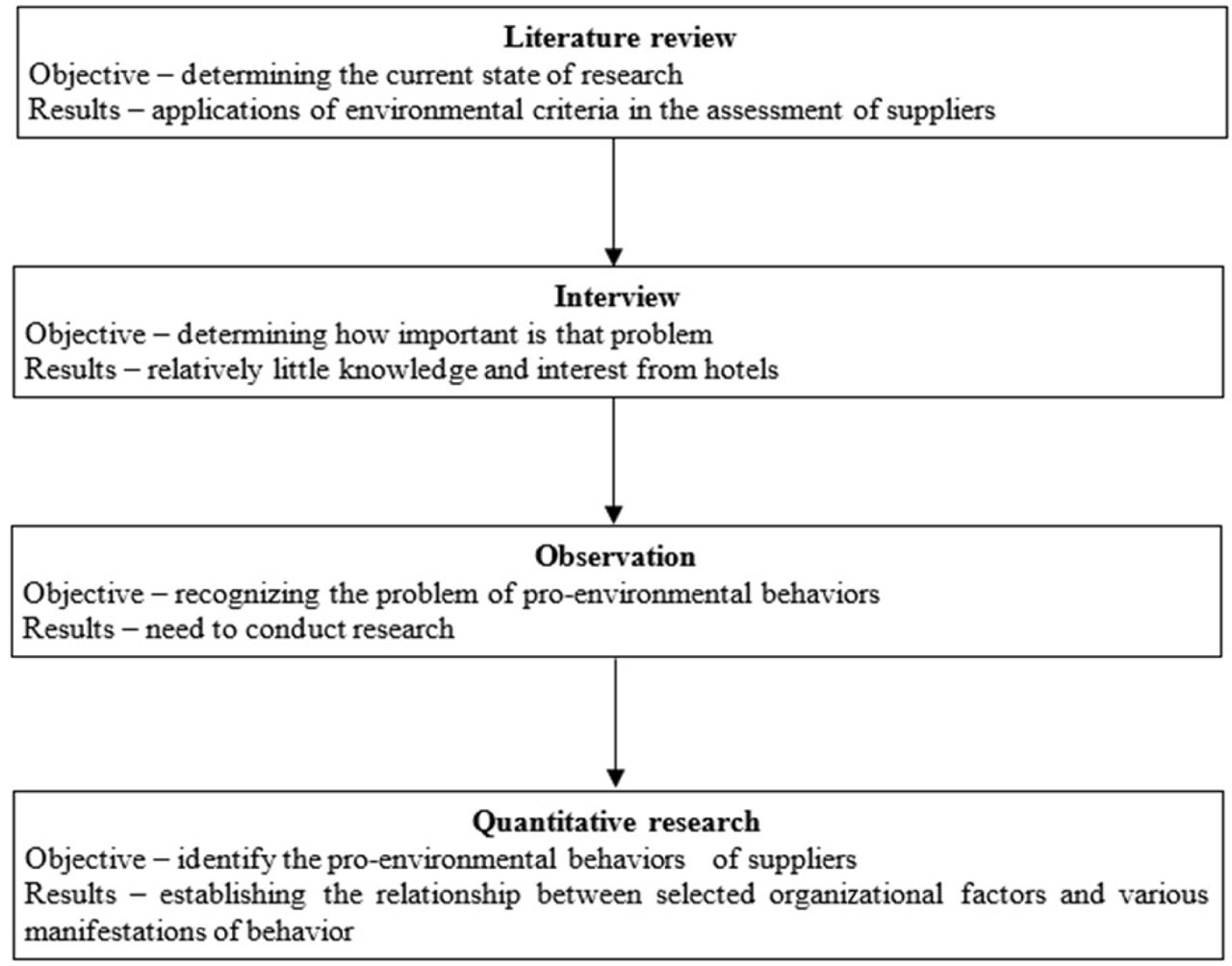
Figure 1.
The research process
Source: authors' own elaboration.
Qualitative Stage
Qualitative research was conducted using three methods and techniques: a literature review, interviews, and observations. The literature on the subject was reviewed in the course of the following stages: (1) selecting keywords, which included pro-environmental behavior, sustainable consumption, hotels, suppliers, organizational factors; (2) searching for works containing the identified keywords in the following databases: Academic Search Ultimate, including Business Source Ultimate, Education Resources Information Centre, AGRICOLA, Open Dissertations, Green FILE, Newspaper Source, and Google Scholar; (3) becoming familiar with these publications; (4) reviewing the publications; (5) preparing a map of the available literature; (6) summarizing the selected publications; and (7) arranging the collected research material.
The procedure applied here is consistent with the general methodology of conducting research and the methodology of research in management sciences (Easterby-Smith et al., 2015). In our research, an expert interview using an interview script was used. The interview was exploratory — helping to define the problem and select a research strategy, and systematized where the expert acted as a guide with knowledge not available to the researcher. Eleven hotel representatives and hotel suppliers were interviewed. A purposive sampling strategy was applied. The sample included six hotel managers who cooperated with suppliers, and five representatives of supplier organizations providing services or deliveries to hotels, all of whom agreed to participate in the study.
Topics covered the following: (1) the importance of practices, including pro-environmental behaviors, for hotels and suppliers; (2) the types of pro-environmental behaviors most commonly implemented; (3) potential ways to aggregate (classify) such pro-environmental behaviors; (4) organizational and functional factors of companies that may be relevant to pro-environmental behaviors. The interviews were analyzed through in-depth interpretation of the interview notes to identify and understand respondents' perspectives, opinions, and underlying motivations.
Participant observation was used in the process. When one of the authors of the article, who is a board member of one of the Polish hotel groups, observed hotel suppliers, he was an active participant in this relationship, establishing direct contact with suppliers and taking part in negotiations. In the process, he identified the importance of pro-environmental practices for suppliers, as well as which behaviors were most important. His research tool was an observation sheet, and the collected data were analyzed qualitatively. The data recorded in the spreadsheet were organized into thematic categories and analyzed to identify patterns and recurring behaviors.
Quantitative Stage
As a result of the qualitative research, the main research tool was developed: a survey questionnaire of suppliers' pro-environmental behavior with a metric. The questionnaire contained 17 questions on the research topic and eight metric questions. Both disjunctive and conjunctive response categories were used, as well as both single-choice and multiple-choice questions. The questions were usually closed, but sometimes semi-open. Questions concerned, among other topics, pro-environmental behaviors implemented by suppliers in their cooperation with hotels; the barriers and motivations associated with their implementation; and the use of environmental management systems, concepts, programs, and practices by suppliers. The questionnaire was subjected to pilot testing. The reliability of the measurement tool was also verified using Cronbach's alpha coefficient of internal consistency. This analysis showed a high internal consistency of Cronbach's α values, ranging from 0.72 to 0.86, among the identified subscales (groups of pro-environmental behaviors) as well as in the overall scale (α = 0.92).
Measures and Data Collection
The study included suppliers of six hotels located in the following cities in Poland: Warsaw (1), Kraków (1), Wrocław (3) and Opole (1). The criteria for selecting hotels for the study were: location in a large provincial city with more than 100,000 inhabitants; falling, on average, into the 3-star category; and consent of top management to participate in the study. Half of the facilities were in city centers, two in the vicinity of railway stations, airports or important roads, and one on the outskirts of a city. Three of the hotels were partnerships in legal organizational form, and three were corporations. Three hotels were categorized as small, one medium-sized and two as large enterprises. The hotel enterprises analyzed were financed by capital that was domestic (2), foreign (2) and mixed (2).
Two hotels operated as independent enterprises, and 4 were integrated with other businesses. Five of the facilities studied were business hotels, and 1 was a tourist hotel. The average number of accommodation units (rooms) was slightly below 100, with the smallest hotel offering 24 rooms and the largest 170 rooms. The average number of bed places ranged from ranging from 42 to 340, with the average being approximately 192. The hotels showed high variability in terms of the number of rooms and bed places, with coefficients of variation exceeding 60%.
On average, each hotel employed approximately 37 staff members, with employment ranging from 15 to 49 employees. The variability in employment levels was moderate, with a coefficient of variation of approximately 40%. All suppliers cooperating with the hotels at the time of the study who agreed to participate were included in the survey; the refusal rate was approximately 14%. Due to the limited number of hotels and the use of convenience sampling, our sample cannot be considered representative.
Data Analysis
In the first step of the statistical analyses of the collected data, the reliability of the applied questionnaire on the pro-environmental behavior of hotel suppliers were assessed in four domains: (1) transport, (2) reduction of energy and water consumption, (3) waste management, and (4) environmental education. For this purpose, Cronbach's internal consistency coefficient α was used.
In the second step, the following statistics were determined for the variables considered in the study: frequency (f) and relative frequency (rf); arithmetic mean (M); standard deviation (SD); median (Me); and quartile range (IQR). At this stage, the binomial (Z) and g-Cohen (g) test values were also calculated. The above measures were used to determine the categories of study variables that occurred most frequently, and to assess the variation in these categories among the study group of hotel suppliers.
In a third step, the values of the Mann-Whitney U test (Z) and the Rosenthal effect size coefficient (r) were calculated to assess the statistical and practical significance of the differences in the pro-environmental behaviors of hotel suppliers (DV) across selected organizational factors characterizing the business entities being analyzed (IV). The selection of statistical analysis techniques was determined by three main considerations: the characteristics of the research sample, the nature of the analyzed variables, and the objectives of the study.
Statistical inference was conducted at an α = .05 level of significance. Statistical calculations were performed using IBM SPSS Statistics software (Version 26.0).
RESULTS
Respondents' Profiles
Eighty-five businesses were included in the study, of which almost 70% were suppliers of tangible goods (e.g., food, beverages, cleaning products and cosmetics) and over 30% were suppliers of services (e.g., laundry, IT, security). The binomial test allows us to conclude that the supplier counts in these two business groups differed significantly (Z = 3.47, p = .001) in favor of firms specializing in the supply of tangible goods. The g-Cohen effect size index indicates that this difference can be considered average (g = 0.19). The numbers of suppliers also differed statistically significantly (p < .001) when broken down by size, location, degree of integration and capital origin. The g-Cohen effect sizes (g ranging from 0.31 to 0.36) indicate that these differences were medium to large. Micro and small businesses accounted for 71% and medium and large businesses for 29%; 81% of the hotel suppliers surveyed were located on the outskirts of towns and cities, while 19% were in the city center.
Nearly 86% of the businesses analyzed were independent enterprises, and 14% were capital groups. Almost 78% of the enterprises surveyed were financed by domestic capital, while 22% were financed by foreign capital. However, no statistically significant differences were found in the numbers of the surveyed entities classified according to the criteria of legal and organizational form, as well as length of operation on the market. On the subject of legal and organizational form, it was noticed that 56% of suppliers functioned as companies, while 44% were individually-owned enterprises. Considering length of functioning, it was noted that 62% of the enterprises had operated for up to 10 years, and 38% for more than 10 years.
PRO-ENVIRONMENTAL BEHAVIORS OF SUPPLIERS
Table 1 shows the basic descriptive statistics of the pro-environmental behaviors of the surveyed suppliers. On average, energy and water conservation (Me = 3.2, IQR 2.7–3.7) and waste management (Me = 3.0, IQR 2.7–4.0) were the domains where respondents most often performed pro-environmental behaviors, and the domains of transport and pro-environmental education (Me = 2.5, IQR 2.0–3.0) had the least frequent pro-environmental behaviors. When considering individual pro-environmental behaviors, respondents declared that, on average, they most often turn off lights when they do not need them; turn off heating or air conditioning when they open a window; prefer double-sided printing when possible; and segregate waste (Me = 3.0, IQR 3.0–4.0). They are least likely to use public transport when travelling to and from work; pay attention to people with bad environmental habits; and influence the environmental behaviors of others (Me = 2.0, IQR 2.0–3.0).
Table 1.
Characteristics of pro-environmental behaviors of hotel suppliers (N=85)
| Variable | M (SD) | Me (IQR) |
|---|---|---|
| Transport domain | 2.4 (0.8) | 2.5 (2.0–3.0) |
| I use public transport when travelling to/from work | 2.4 (0.8) | 2.0 (2.0–3.0) |
| When travelling to/from work, I cycle or walk | 2.5 (0.9) | 3.0 (2.0–3.0) |
| Domain of water, electricity and heat savings | 3.2 (0.6) | 3.2 (2.7–3.7) |
| I save water | 3.2 (0.7) | 3.0 (3.0–4.0) |
| Using a kettle, I boil as much water as I use | 3.0 (0.9) | 3.0 (2.0–4.0) |
| I turn off the light when I don't need it | 3.3 (0.8) | 3.0 (3.0–4.0) |
| When I open a window, I turn off the heating or air conditioning | 3.3 (0.7) | 3.0 (3.0–4.0) |
| I prefer electronic rather than paper versions of documents | 3.1 (0.8) | 3.0 (2.0–4.0) |
| I practice double-sided printing when possible | 3.2 (0.9) | 3.0 (3.0–4.0) |
| Waste management domain | 3.1 (0.7) | 3.0 (2.7–4.0) |
| I segregate waste | 3.2 (0.8) | 3.0 (3.0–4.0) |
| I minimize the use of plastic | 3.0 (0.8) | 3.0 (3.0–4.0) |
| I put away used batteries and light bulbs for disposal | 3.0 (0.9) | 3.0) (2.0–4.0) |
| Pro-environmental education domain | 2.5 (0.7) | 2.5 (2.0–3.0) |
| I point out someone's bad environmental habits | 2.5 (0.8) | 2.0 (2.0–3.0) |
| I influence the environmental behavior of others | 2.4 (0.7) | 2.0 (2.0–3.0) |
Pro-environmental Behaviors And Selected Organizational Factors of Suppliers
Tables 2–5 present analyses of the findings that show the variation in suppliers' pro-environmental behaviors in relation to selected organizational factors. The Mann-Whitney U test showed that the pro-environmental behaviors of hotel suppliers in the transport domain did not differ significantly by type of business (p = .394), specific location of the business (p = .446) and degree of integration (p = .069). The magnitude of the difference, as assessed by the Rosenthal correlation coefficient, for these organizational factors ranged from r = 0.08–0.20. In contrast, the pro-environmental behaviors of hotel suppliers differed significantly across organizational and legal forms (p < .001); size (p = .005); capital origin (p = .001); and the length of time the company has been in operation (p = .001). Effect size was in the range of r = 0.08–0.44. Transport-related pro-environmental behaviors were more common among suppliers that had company status; were medium or large enterprises; were financed by foreign or mixed capital; and that had operated in the market for more than 10 years (Table 2).
Table 2.
Pro-environmental behaviors of hotel suppliers in the transport domain vs. selected organizational factors (N = 85)
| Variable | Category | Me (IQR) | MR |
|---|---|---|---|
| Type of economic activity | Shopping | 2.5 (2.0–3.0) | 44.5 |
| Third-party services | 2.5 (1.5–3.0) | 39.7 | |
| Z (n1 = 59, n2 = 26) = −0.85, p = .394, r = 0.09 | |||
| Organizational and legal form | Company | 3.0 (2.1–3.0) | 52.1 |
| Individual ownership company | 2.0 (1.5–2.5) | 31.1 | |
| Z (n1 = 48, n2 = 37) = −4.02, p < .001, r = 0.44 | |||
| Company size | Micro and small enterprise | 2.3 (2.0–3.0) | 38.3 |
| Medium and large enterprise | 3.0 (2.5–3.0) | 54.3 | |
| Z (n1 = 60, n2 = 25) = −2.83, p = .005, r = 0.31 | |||
| Detailed location | Outskirts of the city | 2.5 (2.0–3.0) | 42.1 |
| City center | 2.8 (2.0–3.0) | 47.1 | |
| Z (n1 = 69, n2 = 16) = −0.76, p = .446, r = 0.08 | |||
| Degree of integration of the company | Independent enterprise | 2.5 (2.0–3.0) | 41.1 |
| Capital group | 3.0 (2.0–3.9) | 54.6 | |
| Z (n1 = 73, n2 = 12) = −1.82, p = .069, r = 0.20 | |||
| Capital origin | Domestic | 2.3 (2.0–3.0) | 38.5 |
| Foreign and mixed | 3.0 (2.5–3.5) | 58.6 | |
| Z (n1 = 66, n2 = 19) = −3.23, p = .001, r = 0.35 | |||
| Length of operation of the company | Up to 10 years | 2.0 (2.0–3.0) | 36.1 |
| Over 10 years | 3.0 (3.0–3.0) | 54.4 | |
| Z (n1 = 53, n2 = 32) = −3.43, p = .001, r = 0.37 |
[ii] Me – median; IQR – quartile range; MR – mean ranks; Z – Mann-Whitney U test value (standardized); p – test probability level for U; and r – effect size measure, where r < 0.20 is a very small effect, 0.20 ≤ r < 0.40 is a small effect, 0.40 ≤ r < 0.60 is a medium effect, 0.60 ≤ r < 0.80 is a large effect, r ≥ 0.80 is a very large effect.
Table 3.
Pro-environmental behaviors of hotel suppliers in the domain of energy and water conservation vs. selected organizational factors (N = 85)
| Variable | Category | Me (IQR) | MR |
|---|---|---|---|
| Type of economic activity | Shopping | 3.3 (2.7– 3.7) | 45.0 |
| Third-party services | 3.0 (2.6–3.8) | 38.4 | |
| Z (n1 = 59, n2 = 26) = −1.16, p = .248, r = 0.13 | |||
| Organizational and legal form | Company | 3.5 (3.0–3.8) | 53.5 |
| Individual-ownership company | 2.8 (2.4–3.2) | 29.4 | |
| Z (n1 = 48, n2 = 37) = −4.50, p < .001, r = 0.49 | |||
| Company size | Micro- and small enterprise | 3.0 (2.7–3.5) | 37.9 |
| Medium and large enterprise | 3.7 (3.0–4.0) | 55.1 | |
| Z (n1 = 60, n2 = 25) = −2.94, p = .003, r = 0.32 | |||
| Detailed location | Outskirts of the city | 3.2 (2.7–3.8) | 42.4 |
| City center | 3.3 (2.9–3.7) | 45.6 | |
| Z (n1 = 69, n2 = 16) = −0.46, p = .643, r = 0.05 | |||
| Degree of integration of the company | Independent enterprise | 3.2 (2.7–3.7) | 42.9 |
| Capital group | 3.1 (2.8–3.8) | 43.4 | |
| Z (n1 = 73, n2 = 12) = −0.06, p = .949, r = 0.01 | |||
| Capital origin | Domestic | 3.2 (2.7–3.7) | 41.2 |
| Foreign and mixed | 3.3 (3.0–3.8) | 49.3 | |
| Z (n1 = 66, n2 = 19) = −1.28, p = .201, r = 0.14 | |||
| Length of operation of the company | Up to 10 years | 3.0 (2.7–3.3) | 34.7 |
| Over 10 years | 3.8 (3.0–4.0) | 56.8 | |
| Z (n1 = 53, n2 = 32) = −4.03, p < .001, r = 0.44 |
[ii] Me – median; IQR – quartile range; MR – mean ranks; Z – Mann-Whitney U test value (standardized); p – test probability level for U; and r – effect size measure, where: r < 0.20 is a very small effect, 0.20 ≤ r < 0.40 is a small effect, 0.40 ≤ r < 0.60 is a medium effect, 0.60 ≤ r < 0.80 is a large effect, and r ≥ 0.80 is a very large effect.
Table 4.
Pro-environmental behaviors of hotel suppliers in the domain of waste management – selected organizational factors (N = 85)
| Variable | Category | Me (IQR) | MR |
|---|---|---|---|
| Type of economic activity | Shopping | 3.0 (2.7–4.0) | 44.3 |
| Third-party services | 2.7 (2.7–4.0) | 40.1 | |
| Z (n1 = 59, n2 = 26) = −0.73, p = .463, r = 0.08 | |||
| Organizational and legal form | Company | 3.7 (3.0–4.0) | 54.3 |
| Individual-ownership company | 2.7 (2.2–3.0) | 28.3 | |
| Z (n1 = 48, n2 = 37) = −4.90, p < .001, r = 0.53 | |||
| Company size | Micro- and small enterprise | 3.0 (2.7–3.7) | 37.8 |
| Medium and large enterprise | 3.7 (3.0–4.0) | 55.6 | |
| Z (n1 = 60, n2 = 25) = −3.09, p = .002, r = 0.34 | |||
| Detailed location | Outskirts of the city | 3.0 (2.7–4.0) | 43.4 |
| City center | 2.8 (2.7–3.8) | 41.2 | |
| Z (n1 = 69, n2 = 16) = −0.33, p = .744, r = 0.04 | |||
| Degree of integration of the company | Independent enterprise | 3.0 (2.7–4.0) | 43.4 |
| Capital group | 2.7 (2.7–3.8) | 40.5 | |
| Z (n1 = 73, n2 = 12) = −0.39, p = .695, r = 0.04 | |||
| Capital origin | Domestic | 3.0 (2.7–4.0) | 40.8 |
| Foreign and mixed | 3.7 (2.7–4.0) | 50.6 | |
| Z (n1 = 66, n2 = 19) = −1.55, p = .122, r = 0.17 | |||
| Length of operation of the company | Up to 10 years | 2.7 (2.7–3.3) | 34.7 |
| Over 10 years | 4.0 (3.1–4.0) | 56.7 | |
| Z (n1 = 53, n2 = 32) = −4.05, p < .001, r = 0.44 |
[ii] Me – median; IQR – quartile range; MR – mean ranks; Z – Mann-Whitney U test value (standardized); p – test probability level for U; and r – effect size measure, where r < 0.20 is a very small effect, 0.20 ≤ r < 0.40 is a small effect, 0.40 ≤ r < 0.60 is a medium effect, 0.60 ≤ r < 0.80 is a large effect, and r ≥ 0.80 is a very large effect.
Table 5.
Pro-environmental behaviors of hotel suppliers in the domain of pro-environmental education vs. selected organizational factors (N = 85)
| Variable | Category | Me (IQR) | MR |
|---|---|---|---|
| Type of economic activity | Shopping | 2.5 (2.0–3.0) | 43.7 |
| Third-party services | 2.0 (2.0–3.0) | 41.4 | |
| Z (n1 = 59, n2 = 26) = −0.42, p = .674, r = 0.05 | |||
| Organizational and legal form | Company | 3.0 (2.0–3.0) | 52.3 |
| Individual ownership company | 2.0 (2.0–2.5) | 30.9 | |
| Z (n1 = 48, n2 = 37) = −4.16, p < .001, r = 0.45 | |||
| Company size | Micro and small enterprise | 2.0 (2.0–3.0) | 39.4 |
| Medium and large enterprise | 2.5 (2.0–3.0) | 51.6 | |
| Z (n1 = 60, n2 = 25) = −2.17, p = .030, r = 0.24 | |||
| Detailed location | Outskirts of the city | 2.0 (2.0–3.0) | 39.8 |
| City center | 3.0 (2.1–3.0) | 56.8 | |
| Z (n1 = 69, n2 = 16) = −2.61, p = .009, r = 0.28 | |||
| Degree of integration of the company | Independent enterprise | 2.0 (2.0–3.0) | 41.7 |
| Capital Group | 2.8 (2.0–3.0) | 51.2 | |
| Z (n1 = 73, n2 = 12) = −1.30, p = .194, r = 0.14 | |||
| Capital origin | Domestic | 2.0 (2.0–3.0) | 39.9 |
| Foreign and mixed | 3.0 (2.0–3.5) | 53.8 | |
| Z (n1 = 66, n2 = 19) = −2.27, p = .023, r = 0.25 | |||
| Length of operation of the company | Up to 10 years | 2.0 (2.0–3.0) | 39.2 |
| Over 10 years | 2.8 (2.0–3.0) | 49.3 | |
| Z (n1 = 53, n2 = 32) = −1.92, p = .055, r = 0.21 |
[ii] Me – median; IQR – quartile range; MR – mean ranks; Z – Mann-Whitney U test value (standardized); p – test probability level for U; and r – effect size measure, where r < 0.20 is a very small effect, 0.20 ≤ r < 0.40 is a small effect, 0.40 ≤ r < 0.60 is a medium effect, 0.60 ≤ r < 0.80 is a large effect, and r ≥ 0.80 is a very large effect.
The pro-environmental behaviors of the surveyed hotel suppliers in the domain of energy and water conservation did not differ significantly by the type of business (p = .248); its detailed location (p = .643); its degree of integration (p = .949) or its capital origin (p = .201). The magnitude of the difference assessed by the Rosenthal correlation coefficient for these enterprise organizational factors ranged from r = 0.01 to 0.14.
In contrast, the pro-environmental behaviors of hotel suppliers differed significantly by organizational and legal form (p < .001), size (p = .003), and length of company operation (p < .001), with effect sizes r = 0.32 to 0.49. Pro-environmental behavior regarding energy and water savings was more common among suppliers that had company status, were medium or large enterprises, and that had operated in the market for more than 10 years (Table 3).
The pro-environmental behaviors of the surveyed hotel suppliers in the domain of waste management did not differ significantly by type of business (p = .463), detailed location (p = .744), degree of integration (p = .695) or capital origin (p = .122). The magnitude of the difference assessed by the Rosenthal correlation coefficient for these organizational factors ranged from r = 0.04–0.17. In contrast, the pro-environmental behaviors of hotel suppliers differed significantly by organizational and legal form (p < .001), size (p = .002) and the length of the company's time of operation (p < .001), with effect sizes r ranging from 0.34 to 0.53. Pro-environmental behaviors regarding waste management were more frequent among suppliers with company status that were medium or large enterprises operating in the market for more than 10 years (Table 4).
The pro-environmental behaviors of the surveyed hotel suppliers in the domain of pro-environmental education did not differ significantly by type of business (p = .674), degree of integration (p = .194) or length of operation in the market (p = .055). The magnitude of the difference, as assessed by the Rosenthal correlation coefficient for these business organizational factors, ranged from r = 0.05 to 0.25. In contrast, the pro-environmental behaviors of hotel suppliers differed significantly according to organizational and legal form (p < .001), size (p = .030), detailed location (p = .009) and capital origin (p = .023), with effect sizes (r) ranging from 0.24 to 0.45. Pro-environmental education behaviors were more likely to be undertaken by suppliers with corporate status that were medium or large company located in a city centers, and financed by foreign or mixed capital (Table 5).
CONCLUSIONS
The most frequently implemented pro-environmental behaviors by the surveyed suppliers were those related to energy and water conservation, as well as waste management. The least frequent behaviors were those related to transport and pro-environmental education. Particularly disconcerting is the relative infrequency of behaviors related to education, as these are active behaviors that are crucial to the sustainability of the organization. Furthermore, it was shown that passive pro-environmental behaviors related to energy and water saving, waste management and transport were most often undertaken by suppliers that operated as a medium or large enterprise, in the form of a company, for more than 10 years. Transport behaviors were most common in suppliers whose capital came from abroad or was of mixed nature (domestic and foreign). Active pro-environmental behaviors, on the other hand, were most often undertaken by suppliers who were medium or large enterprises, with company form; that were financed with foreign or mixed capital; and whose headquarters were in city centers.
The most common pro-environmental behaviors implemented by the surveyed suppliers were those related to saving energy, as well as water and waste management. Pro-environmental behaviors related to transport and pro-environmental education were indicated least often by the surveyed suppliers. Pro-environmental active behaviors related to ecological education were most often undertaken by suppliers that were medium or large enterprises; in the form of a company; and that were financed with foreign or mixed capital. This means that the size of the organization and the extent to which it is part of a capital group has an impact on its pro-environmental behaviors. It can therefore be assumed that pro-environmental (passive) behaviors are influenced by economic factors, which force water and energy conservation. However, it is very clear that pro-environmental actions (including active ones) are also undertaken by larger organizations.
Discussion and Further Research
When interpreting the results, it should be emphasized that both psychosocial and systemic factors may explain the observed patterns. On the one hand, psychosocial conditions, including managers' values and attitudes, may influence the implementation of pro-environmental behaviors. On the other hand, systemic factors, such as organizational procedures and management practices, may also play an important role. These findings are consistent with previous studies (Segarra-Oña et al., 2012; Chen et al., 2021).
Environmental management systems that oblige hotels to shape pro-environmental awareness, to improve their processes and monitoring, and to study environmental aspects work better in large organizations in some cases. However, the implementation of environmental management systems is also influenced by appropriate government policy (Segarra-Oña et al., 2012). Pro-environmental behavior in supplier-hotel relationships should be considered in the broader context of sustainable development policy. We must bear in mind that governments and hotel customers play a key role in greening traditional hotel supply chains (Chen et al., 2021). Green supply-chain management is key, and, at the same time, is a very complicated process due to the complexity of the managing relationships with stakeholders (Alreahi et al., 2023). That is why studying the needs and expectations of stakeholders, as prompted by normative conditions, is so important (cf. ISO14001, point 4.2).
It can therefore be assumed that the pro-environmental behavior of suppliers is influenced not only by hotels' criteria for assessing suppliers, but also by various green practices undertaken by the suppliers themselves. Supplier-recipient relationships and evaluation criteria are just one element in a complex chain of relationships. The way recipients behave may also be influenced to a small extent by the actions taken by hotels.
Taking into account the research findings, several directions for future research can be identified. First, the spatial scope of the study could be extended to cover the whole of Poland or other countries in Central Europe, and more advanced research methods, such as experiments or in-depth interviews, could be applied.
An important area for future research is the identification of predictors and determinants shaping the pro-environmental behavior of hotel suppliers (Končar et al., 2021). It would also be valuable to examine the strength and direction of interactions between hotels and suppliers in the context of implementing pro-environmental practices, as well as develop methods for assessing the environmental effectiveness of hotel-supplier relationships.
Previous studies conducted among hotel guests suggest that determinants of pro-environmental behavior may vary across different groups (Wang et al., 2023). Therefore, future research on suppliers should consider not only organizational factors, but also individual and decision-related factors, such as owners' personal characteristics, or the economic interests of decision-makers responsible for supply processes.
Practical Recommendations
The findings of the study lead to several practical recommendations for hotel managers and other stakeholders involved in hotel supply chains.
First, active pro-environmental behaviors should be actively promoted among suppliers and other hotel stakeholders. Such behaviors are particularly important in terms of environmental education, promoting sustainability-oriented practices, and improving both environmental and economic performance.
Second, the prevalence of pro-environmental behaviors among suppliers can be strengthened through contractual relationships between hotels and suppliers. One practical solution is the implementation of supplier audits that assess not only the quality of goods and services, but also suppliers' level of environmental commitment. When selecting suppliers, hotels should consider criteria like environmental training of staff, environmental planning (e.g., emission reduction programs), green research and development activities, the use of environmentally friendly materials, and the application of environmentally-friendly technologies (Banaeian et al., 2015).
Third, the supplier evaluation process should be improved to reduce problems related to information asymmetry. Hotels often lack reliable information about suppliers' environmental performance, and the format in which such information is presented may significantly influence decision-making (Pichert & Katsikopoulos, 2008). Improving transparency and standardizing environmental reporting could facilitate more informed supplier selection.
Fourth, supplier evaluation criteria should be progressive, meaning that environmental requirements should be gradually strengthened over time. This approach would encourage continuous improvement and reduce the environmental impact of subsequent deliveries.
Fifth, hotel organizations, particularly hotel chains, could develop benchmarking databases for suppliers. Such benchmarking systems would enable suppliers to compare their environmental performance with that of other entities and support organizational learning by promoting best practices.
Sixth, given the importance of financial incentives, hotels may consider introducing financial mechanisms to encourage pro-environmental behavior among suppliers, such as preferential contract terms, financial rewards, or special recognition programs for environmentally responsible suppliers.
Finally, public policy should provide support for smaller and more capital-constrained suppliers, particularly small enterprises operating as individually owned businesses financed by domestic capital. These entities may face greater barriers to implementing pro-environmental practices, and therefore require additional institutional and financial support.
Limitations
This study has several limitations that should be acknowledged. First, the spatial scope of the research was limited, as it included suppliers cooperating with only six hotels. Therefore, the findings cannot be generalized to the entire hotel market, but apply only to the cases that were analyzed.
Second, the use of a diagnostic survey method constitutes a limitation. The study relied on self-reported data regarding suppliers' pro-environmental behaviors. As with all self-reported measures, there is a possibility of response bias, including social desirability bias, misunderstanding of questions, or situational factors affecting respondents' answers. Consequently, respondents' declared behaviors may not fully reflect their actual practices.
Third, this study focused on direct interactions between hotels and their suppliers and did not analyze the broader structure and dynamics of supply chains. The organization and governance of supply chains may significantly influence suppliers' pro-environmental behavior.
Finally, suppliers' behavior may also be influenced by additional factors not included in this study, such as operational constraints, regulatory requirements, or market conditions. Future research should consider these factors to provide a more comprehensive understanding of the determinants of pro-environmental behaviors in hotel supply chains.