
INTRODUCTION
The rising awareness among consumers regarding Sustainable Development Goals (SDGs) (Bacari et al., 2021) and changing demands and desires for environmentally and socially responsible behaviors are increasingly noticeable nowadays (White et al., 2019). As a result, incorporating sustainability has become an imperative requirement in the service enterprise domain, including focusing on hotels (Olya et al., 2021). A recent increase in emphasis on accelerating the shift of the hotel industry to sustainability has been noticed (Moyeen & Mehjabeen, 2024). This evolution involves minimizing the environmental impact of the hotel industry (Legrand et al., 2022) and increasing social impact (Suárez-Cebador et al., 2018). Hotels that introduce CSR (corporate social responsibility) into their everyday business operations can potentially achieve increased customer loyalty (CL), financial benefits, and improved business performance (Akbari et al., 2021; Babajee et al., 2022; Goffi et al., 2022; Islam et al., 2023; Latif et al., 2020). Thus, CSR is essential in safeguarding a hotel’s long-lasting success (Achmad & Yulianah, 2022). Importantly, sustainable tourism has gained importance after the pandemic due to the change in travelers’ priorities and the growing demand for sustainable experiences (Accenture, 2021). It is also evident that businesses and stakeholders can shape hotels’ CSR strategies in contributing to greater sustainability (Moyeen & Mehjabeen, 2024). In addition, CSR engagement is important for developing relationships with different stakeholders (Madanaguli et al., 2022).
Although research on ethics has expanded substantially (Polat & Köseoglu, 2024) and the literature on CSR in the hotel industry is well established (Madanaguli et al., 2022), many CSR areas remain underexplored (Fatima & Elbanna, 2023). For instance, studies investigating the correlations among CSR, customer value (CV), and customer loyalty (CL) have recently appeared in the literature, yet research on these variables in the hotel industry remains very limited. In addition, prior studies indicate that future research should examine CSR components and customers’ perceived value (Servera-Francés & Piqueras-Tomás, 2019). Considering that customer value is acknowledged as an important factor in building customer satisfaction (CS) and CL (El-Adly, 2019), and given the close connection between CSR and CL (Latif et al., 2020), it becomes imperative to gain an understanding of the effect of CV in the link between CSR and CL. Mohammed and Al-Swidi (2019) explored the relationships between CSR, CV, social media engagement and CL in a single study. A direct effect of CSR related to the environment on CV was found, but the direct effect of CSR related to society on CV was not indicated. In addition, only partial mediation has been confirmed in the link between environmental CSR, CV, and CL, while social CSR has not been found to influence CL via CV in the hotel context (Mohammed & Al-Swidi, 2019). Thus, the effect of social CSR on CV and CL warrants further investigation. Moreover, the effects of CSR on CV and CL have not yet been examined in cross-country comparisons within the hotel context; this also justifies the research we undertake.
Hence, this study focuses on the relationships among environmental and social CSR, CV, and CL in the hotel industry across countries. Specifically, our study compares customers’ perceptions across two countries, Poland and China, selected for their distinct levels of economic development and cultural differences. This study aims to assess the effects of CSR on CV and CL and to evaluate differences in customers’ perceptions across the two countries. The study examines three key research questions:
RQ1) Does CSR have a positive effect on CV?
RQ2) Does CSR have a positive effect on CL through CV mediation?
RQ3) To what extent do these effects indicate variation between Poland and China?
To address the following questions, this study examines links among such constructs as CSR (encompassing both environmental and social dimensions), CV (encompassing quality, price, emotional, social, and reputation dimensions), and CL. Furthermore, this study is also the first to discuss the links between CSR, CV, and CL in a cross-country setting, providing insights from the European and Asian perspectives, namely from Poland and China. In addition, the study highlights implications for hotel managers that will help develop a CSR strategy from a customer value perspective.
THEORETICAL BACKGROUND AND HYPOTHESES FORMULATION
Social Exchange Theory
Social exchange theory (SET) is one of the most important conceptual frameworks in the social sciences to examine interpersonal relationships (Ahmad et al., 2023). Social exchange theory is based on the assumption that social life involves a series of continuous transactions between at least two persons (Mitchell et al., 2012) and suggests that social behavior is a consequence of cost and benefit analysis, where individuals seek to maximize rewards and minimize costs in relationships (Stafford & Kuiper, 2021). Foundations of social exchange theory are based on several principles, i.e., social exchange behavior leads to mutual benefits to the exchange partners; social exchange lasts as long as it is beneficial for the exchange partners; beneficial outcomes eventually strengthen trust in the exchange partner; ongoing beneficial interactions bring about mutually agreed norms for exchange (Lambe et al., 2001). Social exchanges involve interactions with family members, friends, and other relatives, as well as with other relationships (Cropanzano et al., 2017). Social exchange theory provides a framework to study professional relationships to understand workplace behavior (Cropanzano & Mitchell, 2005) and has been applied in consumer research to understand consumer behavior (Mishra & Mund, 2024).
Mishra and Mund (2024) distinguished several areas in consumer research, drawing on social exchange theory as the theoretical background, including relationship marketing, collaborative consumption, gifting behavior, brand experience, and tourism and hospitality. Social exchange between entities is based on value, and the mutual flow of value sustains the relationship. Understanding how customers judge value is essential for attaining competitive advantage and company success (Graf & Maas, 2008). Customer perceived value refers to the benefits that are received from a product compared to the total cost paid by customers, including time, energy, and money (Yan, 2019). Yet, new value dimensions, like environmental value, and their relationships with core value dimensions offer new research opportunities (Zeithaml et al., 2020). In addition, customer trust, commitment, engagement, and loyalty are considered as important outcomes of social exchange (Mishra & Mund, 2024). Thus, we are convinced that social exchange theory provides a strong theoretical foundation for our study, which focuses on the relationships among CSR, CV, and CL.
Hypotheses formulation
CSR has been studied across various contexts within the hotel industry, including consumer perspectives. Numerous studies have focused on the effects of CSR on consumers’ attitudinal and behavioral responses (e.g., Ahn & Dias Soeiro, 2022; Karim & Rabiul, 2022; Khalil et al., 2023; Lin et al., 2023; Liu et al., 2020; Latif et al., 2020; Johann at al., 2025; Martínez & Del Bosque, 2013; Martínez et al., 2014; Su et al., 2017). In prior research, the emphasis has been put on linkages between CSR, corporate image, corporate reputation, CS, and CL. For example, Martínez and Del Bosque (2013) examined the direct and indirect effects among CSR, trust, customer identification with the company, CS, and CL, as well as the mediating role of trust, identification, and satisfaction. Martínez et al. (2014) researched the impact of CSR on brand image and CL. Su et al. (2017) investigated the linkages between CSR, CS, corporate reputation, and customers’ behavioral intentions, and the moderating role of income. Latif et al. (2020) explored the direct and mediating effects of CSR on CL through service quality, CS, corporate image, and corporate reputation. Karim and Rabiul (2022) examined the roles of corporate image and customer satisfaction in the relationship between sustainability and CL. These studies, conducted in various countries, have provided evidence of a positive influence of CSR on corporate image, reputation, trust, identification, service quality, CS, and CL.
However, there is not much evidence of the effects of CSR on CV and CL in the hotel context, although it is known that customer-perceived value affects CS (Saut & Bie, 2024), and is acknowledged as an important factor in building CL (Joviando & Kurniawati, 2022; Paulose & Shakeel, 2022; Ru & Jantan, 2023). In addition, CV is crucial in developing connections with customers, which is critical for hotel performance (Ibrahim & Rasheed, 2024). Moreover, CL is vital to gaining a sustainable competitive advantage (Basrowi et al., 2023). Customer value (CV) is a subjective construct made up of numerous value constituents (Huber et al., 2001). Due to the complex and multifaceted nature of this phenomenon, researchers have used different approaches to measure CV, and various scales have been developed to measure customer value (Holbrook, 1999; Nasution & Mavondo, 2008; Sweeney & Soutar, 2001). It is also evident that CV perceptions change over time (Flint et al., 2002). Thus, it is essential to conduct research regarding value perception regularly and consistently.
Mohammed and Al-Swidi (2019) examined CSR effects on CV, social media engagement, and CL in the hotel industry. While the direct effect of CSR related to the environment on CV was found, the direct effect of CSR related to society on CV was not evident. In addition, only partial mediation has been confirmed in the link between CSR related to the environment and CV, and between CSR related to social issues and CV; no mediating effect has been found in the link between CSR related to the environment and CL, or between CSR related to social issues and CL (Mohammed & Al-Swidi, 2019). Thus, there is insufficient evidence about the CSR effect on CV and CL, and limited research on social sustainability (Changha et al., 2025) in the hotel context. Moreover, none of the previous studies regarding the relationships between CSR, CV, and CL have taken a cross-country perspective.
Thus, in our research, we analyze the effects of social and environmental CSR on CV and CL. We conceptualize CV within five constructs, including items representing quality, price, emotional, social, and reputation dimensions, which, in our opinion, reflect specific attributes of hotel services. We also take a cross-country perspective of two culturally contrasting countries in different stages of economic development, such as Poland and China, which have not yet been the subjects of a comparative analysis in the hotel context. Based on previous results, we suggest the following hypotheses:
H1: CSR positively influences CV for Polish and Chinese hotel guests.
H2: CSR positively influences CL for Polish and Chinese hotel guests.
H3: CV positively influences CL for Polish and Chinese hotel guests.
H4: CSR positively influences CL, with CV mediating this effect among Polish and Chinese hotel guests.
Based on the specified hypotheses, we propose a theoretical model presented in Figure 1.
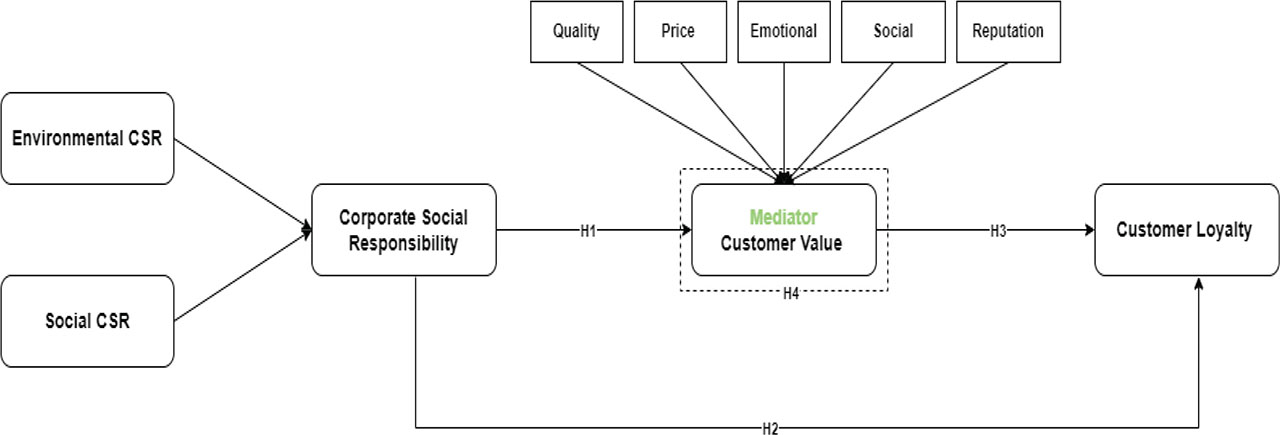
Figure 1.
The theoretical model
RESEARCH METHODS
Survey design
A questionnaire in English was created and subsequently translated into Polish and Mandarin. The data was gathered online to mitigate potential sample mistakes and biases, and leverage the efficiency of this approach for conducting descriptive research (Bethlehem, 2010; Karunarathna et al., 2024). The questionnaire was divided into three components: demographics, classification questions, and study themes, along with a concise introduction.
Measurement
Every measurement item employed in this study was adopted from previous studies, i.e., five items of environmental CSR (Ahn & Kwon, 2020; Lo, 2020; Marquina Feldman & Vasquez-Parraga, 2013), five items of social CSR (Kim & Kim, 2016; Lo, 2020; Marquina Feldman & Vasquez-Parraga, 2013), four items of quality customer value (Petrick, 2002), four items of price customer value (Sweeney & Soutar, 2001), five items of emotional customer value (Petrick, 2002), four items of social customer value (Sweeney & Soutar, 2001), five items of customer reputation value (Petrick, 2002), and five items of CL (Latif et al., 2020). ECSR encompasses activities related to environmental protection and the minimization of hazardous emissions, whereas SCSR focuses on working conditions and community welfare. The data were measured with a 7-point Likert scale. Demographic factors were used as control variables.
Data collection
The Polish-translated version of the questionnaire was circulated online via a research agency through a research panel in Poland. The Chinese version of the questionnaire was shared through social media platforms in China, such as Weibo, Baidu, and WeChat, using a snowball sampling method. This method ensures a fair opportunity for participation among the respondents, allowing for minimizing potential bias (Batara et al., 2017). Respondents were required to meet several criteria for inclusion in the survey, including having spent at least one week in hotels that implemented CSR practices in 2023. Those who spent less than one week in hotels, stayed in hotels before the given year, or travelled for business were excluded from the survey. In addition, participants who spent holidays in hotels that had not implemented CSR practices were excluded from the survey. The classification questions enabled a specified selection of survey participants. The online survey was voluntary, and anonymity was ensured for the participants throughout the process. Before the primary data collection, a pilot study was carried out to evaluate the research instrument (Khanal & Chhetri, 2024). Data were collected from 40 respondents in both countries. The pilot study verified the face and content validity of the scales, although minor rewording was needed. Subsequently, the study was conducted in both countries. The respondents’ characteristics are displayed in Table 1.
Table 1.
Respondents’ characteristics
| Poland | China | |||
|---|---|---|---|---|
| Variables | Frequency | % | Frequency | % |
| Total number of respondents | 560 | 100 | 560 | 100 |
| Gender | ||||
| Male | 334 | 59.6 | 289 | 51.6 |
| Female | 226 | 40.4 | 271 | 48.4 |
| Age group | ||||
| 18 – 24 | 56 | 10.0 | 203 | 36.2 |
| 25 – 34 | 189 | 33.7 | 117 | 20.8 |
| 35 – 44 | 166 | 29.6 | 108 | 19.2 |
| 45 – 54 | 89 | 15.8 | 73 | 13.0 |
| 55 – 64 | 41 | 7.2 | 59 | 10.5 |
| 65 or above | 19 | 3.3 | 0 | 0 |
| Educational level | ||||
| High school graduate or below | 6 | 1.0 | 0 | 0 |
| Technical/vocational school graduate | 138 | 24.6 | 81 | 14.4 |
| BA degree | 111 | 19.8 | 292 | 52.2 |
| MA degree or higher | 251 | 44.8 | 187 | 33.4 |
| Monthly household income | ||||
| Less than 2,500 | 18 | 3.2 | 0 | 0 |
| 2,501–5,000 | 123 | 21.9 | 159 | 28.3 |
| 5,001–7,500 | 165 | 29.4 | 216 | 38.6 |
| 7,501–10,000 | 158 | 28.2 | 134 | 23.9 |
| Above 10,000 | 96 | 17.1 | 51 | 9.1 |
Methodological structure
PLS-SEM was applied, employing SmartPLS4 (Sarstedt et al., 2022), which is especially suitable for complex models featuring latent variables and non-normal data distributions (Ali et al., 2018). The reason this method was chosen is that it allows the simultaneous evaluation of measurement and structural models, making it suitable for theoretical development and testing in the social sciences (Dash & Paul, 2021). Moreover, PLS-SEM is particularly effective for small to medium sample sizes, ensuring statistical power and model precision (Sarstedt et al., 2022).
RESULTS
All the procedures of PLS-SEM have been conducted according to the recommendations from Sarstedt et al. (2022). The measurement models for the Polish and Chinese samples are shown in the same tables, whereas the structural models are shown in different tables.
Measurement model
Reliability was established, as all factor loadings, Cronbach’s alpha, and composite reliability values exceeded the cutoff value of 0.70. Convergent validity was established using average variance extracted (AVE) values, all of which exceeded the minimum of 0.50 (Sarstedt et al., 2022). Discriminant validity was confirmed by utilizing the Heterotrait-Monotrait (HTMT) standard, and all ratios fell below the 0.85 threshold (Roemer et al., 2021). In addition, the Variance Inflation Factor (VIF) scores were all below 5, indicating that multicollinearity and common method bias were absent (Sarstedt et al., 2017). To improve model parsimony, a higher-order reflective-formative construct was employed for CSR and CV, integrating numerous dimensions into a singular measure (Van Riel et al., 2017). (Tables 2, 3, and 4)
Table 2.
Reliabilities, validities, and variance inflation factors of the studies
| Constructs | FL | α | rho_A | CR | AVE | VIF | ||||||
|---|---|---|---|---|---|---|---|---|---|---|---|---|
| Country | PL | CN | PL | CN | PL | CN | PL | CN | PL | CN | PL | CN |
| CSR | ||||||||||||
| Environmental CSR (ECSR) | 0.91 | 0.84 | 0.92 | 0.84 | 0.93 | 0.89 | 0.75 | 0.62 | ||||
| ECSR1 | 0.83 | 0.81 | 3.90 | 2.99 | ||||||||
| ECSR2 | 0.86 | 0.73 | 3.80 | 2.52 | ||||||||
| ECSR3 | 0.83 | 0.82 | 3.93 | 2.19 | ||||||||
| ECSR4 | 0.71 | 0.74 | 1.58 | 1.57 | ||||||||
| ECSR5 | 0.82 | 0.80 | 3.12 | 1.94 | ||||||||
| Social CSR (SCSR) | 0.78 | 0.87 | 0.79 | 0.88 | 0.85 | 0.90 | 0.54 | 0.66 | ||||
| SCSR 1 | 0.78 | 0.90 | 1.76 | 4.36 | ||||||||
| SCSR 2 | 0.71 | 0.88 | 1.58 | 4.25 | ||||||||
| SCSR 3 | 0.76 | 0.75 | 1.66 | 1.97 | ||||||||
| SCSR 4 | 0.79 | 0.72 | 1.65 | 2.11 | ||||||||
| SCSR 5 | 0.61 | 0.79 | 1.34 | 1.90 | ||||||||
| Customer Value (CV) | ||||||||||||
| Quality (CVQ) | 0.73 | 0.88 | 0.75 | 0.88 | 0.83 | 0.91 | 0.56 | 0.73 | ||||
| CVQ1 | 0.77 | 0.85 | 1.71 | 3.45 | ||||||||
| CVQ2 | 0.60 | 0.81 | 1.30 | 2.50 | ||||||||
| CVQ3 | 0.70 | 0.90 | 2.12 | 4.22 | ||||||||
| CVQ4 | 0.76 | 0.86 | 2.02 | 3.16 | ||||||||
| Price (CVP) | 0.83 | 0.82 | 0.87 | 0.83 | 0.88 | 0.88 | 0.66 | 0.66 | ||||
| CVP1 | 0.77 | 0.77 | 2.88 | 1.78 | ||||||||
| CVP2 | 0.87 | 0.87 | 2.52 | 2.39 | ||||||||
| CVP3 | 0.86 | 0.79 | 2.47 | 1.84 | ||||||||
| CVP4 | 0.74 | 0.80 | 2.77 | 1.77 | ||||||||
| Emotional (CVE) | 0.94 | 0.89 | 0.94 | 0.90 | 0.95 | 0.92 | 0.81 | 0.69 | ||||
| CVE1 | 0.81 | 0.82 | 3.31 | 2.20 | ||||||||
| CVE2 | 0.74 | 0.84 | 2.61 | 2.43 | ||||||||
| CVE3 | 0.82 | 0.79 | 4.31 | 1.89 | ||||||||
| CVE4 | 0.80 | 0.85 | 3.50 | 2.58 | ||||||||
| CVE5 | 0.81 | 0.85 | 4.52 | 2.24 | ||||||||
| Social (CVS) | 0.85 | 0.83 | 0.85 | 0.84 | 0.91 | 0.91 | 0.71 | 0.66 | ||||
| CVS1 | 0.86 | 0.86 | 2.97 | 2.76 | ||||||||
| CVS2 | 0.89 | 0.78 | 3.86 | 1.82 | ||||||||
| CVS3 | 0.70 | 0.84 | 1.25 | 2.62 | ||||||||
| CVS4 | 0.88 | 0.76 | 3.63 | 1.84 | ||||||||
| Reputation (CVR) | 0.92 | 0.92 | 0.92 | 0.93 | 0.90 | 0.94 | 0.76 | 0.77 | ||||
| CVR1 | 0.89 | 0.88 | 3.13 | 2.87 | ||||||||
| CVR2 | 0.86 | 0.88 | 2.62 | 3.20 | ||||||||
| CVR3 | 0.85 | 0.86 | 2.51 | 2.69 | ||||||||
| CVR4 | 0.89 | 0.89 | 3.21 | 3.44 | ||||||||
| CVR5 | 0.86 | 0.86 | 2.77 | 2.91 | ||||||||
| Customer Loyalty (CL) | 0.90 | 0.84 | 0.90 | 0.85 | 0.92 | 0.85 | 0.72 | 0.60 | ||||
| CL1 | 0.88 | 0.82 | 3.42 | 2.05 | ||||||||
| CL2 | 0.86 | 0.79 | 3.09 | 1.88 | ||||||||
| CL3 | 0.85 | 0.78 | 2.97 | 1.99 | ||||||||
| CL4 | 0.77 | 0.79 | 1.79 | 1.73 | ||||||||
| CL5 | 0.86 | 0.69 | 3.04 | 1.61 | ||||||||
Table 3.
Discriminant validity of the studies (HTMT method)
| Poland | China | |||||||||||||||
|---|---|---|---|---|---|---|---|---|---|---|---|---|---|---|---|---|
| Constructs | 1 | 2 | 3 | 4 | 5 | 6 | 7 | 8 | 1 | 2 | 3 | 4 | 5 | 6 | 7 | 8 |
| 1. CL | ||||||||||||||||
| 2. CVE | 0.784 | 0.203 | ||||||||||||||
| 3. CVP | 0.628 | 0.558 | 0.314 | 0.659 | ||||||||||||
| 4. CVQ | 0.798 | 0.810 | 0.711 | 0.368 | 0.143 | 0.298 | ||||||||||
| 5. CVR | 0.759 | 0.784 | 0.532 | 0.808 | 0.703 | 0.106 | 0.322 | 0.225 | ||||||||
| 6. CVS | 0.636 | 0.666 | 0.578 | 0.745 | 0.717 | 0.684 | 0.195 | 0.409 | 0.302 | 0.654 | ||||||
| 7. ECSR | 0.606 | 0.603 | 0.579 | 0.722 | 0.608 | 0.704 | 0.441 | 0.157 | 0.128 | 0.604 | 0.297 | 0.375 | ||||
| 8. SCSR | 0.728 | 0.687 | 0.688 | 0.778 | 0.730 | 0.800 | 0.773 | 0.415 | 0.160 | 0.142 | 0.440 | 0.231 | 0.368 | 0.645 | ||
Table 4.
Formative construct evaluation of the studies
| Poland | China | |||||
|---|---|---|---|---|---|---|
| Latent Variables | Outer Weight | T Statistics | P Value | Outer Weight | T Statistics | P Value |
| Customer Value | ||||||
| CVE -> CV | 0.324 | 43.144 | 0.000 | 0.213 | 5.319 | 0.000 |
| CVP -> CV | 0.179 | 22.264 | 0.000 | 0.262 | 19.345 | 0.000 |
| CVQ-> CV | 0.176 | 26.861 | 0.000 | 0.248 | 11.764 | 0.000 |
| CVR -> CV | 0.302 | 39.945 | 0.000 | 0.445 | 20.784 | 0.000 |
| CVS-> CV | 0.207 | 25.798 | 0.000 | 0.326 | 20.072 | 0.000 |
| CSR | ||||||
| ECSR-> CSR | 0.630 | 49.223 | 0.000 | 0.546 | 48.713 | 0.000 |
| SCSR-> CSR | 0.467 | 45.943 | 0.000 | 0.585 | 41.692 | 0.000 |
Structural model for the Polish sample
The structural model involves causal links between endogenous and exogenous constructs (Hair et al., 2017). We calculated path coefficients (ß values), the coefficient of determination (R2), and predictive relevance (Q2). The R2 values for CV and CL are 0.60 and 0.619, respectively, indicating the model’s predictive power (Hair et al., 2017). The blindfolding procedures resulted in Q2 values of CV and CL of 0.592 and 0.604, respectively. All obtained values in Q2 are positive and above zero. It shows that our study model has a high prediction power for endogenous variables. Furthermore, we also assessed the model fit through the GoF formula = √ (AVE × R2). Our estimated GoF is 0.64, indicating a good model fit and supporting the measurability of the model’s robustness. Against the threshold standards, 0.10 (small), 0.25 (medium), and 0.36 (large), the obtained value surpasses the large-fit threshold, thereby affirming the overall quality of the model (Wetzels et al., 2009).
The structural model incorporated an analysis of the statistical significance and importance of the path coefficient values, utilizing the methodology described (Hair et al., 2019). As stated in Table 5, CSR has significant effects on CV and CL, confirming hypotheses H1 and H2 (β = 0.774; β = 0.089). In addition, the study shows that CV has a strong and statistically significant effect on CL, confirming hypothesis H3 (β = 0.715). Furthermore, evidence indicates that CV has a mediating effect on the relationship between CSR and CL, supporting hypothesis H4 (β = 0.554).
Structural model for the Polish sample
The R2 values for CV and CL are 0.142 and 0.483, respectively. The blindfolding processes yielded Q2 values of 0.141 for CV and 0.479 for CL. Furthermore, the computed GoF value is 0.458. Table 6 shows significant effects of CSR on CV and CL, supporting hypotheses H1 and H2 (β = 0.377; β = 0.221). The investigation demonstrates that CV significantly influences CL, supporting hypothesis H3 (β = 0.581). Moreover, CV has a positive and significant mediating effect on the relationship between CSR and CL, providing robust evidence for hypothesis H4 (β = 0.219).
DISCUSSION, IMPLICATIONS, AND CONCLUSION
Discussion
CSR strategy, which focuses on companies’ social and environmental responsibilities, is crucial for enhancing business performance and long-term growth in the hotel industry (Achmad & Yulianah, 2022; Najam-mu-Sahar & Dar, 2024; Pereira-Moliner et al., 2021). It is also vital for sustainable development (Moyeen & Mehjabeen, 2024). CSR strategy enhances relationships with stakeholders and positively affects customer responses (Ahn & Dias Soeiro, 2022; Karim & Rabiul, 2022; Khalil et al., 2023; Latif et al., 2020). Furthermore, the rising demand for sustainable travel experiences (Accenture, 2021), strengthens sustainable orientation in the tourism and hospitality sector. However, some concepts related to business social responsibility seem to be insufficiently explored (Fatima & Elbanna, 2023), including the link between CSR and perceived value. Taking into account the importance of CV and its positive impact on CS and CL (El-Adly, 2019; Paulose & Shakeel, 2022), as well as limited research in this area in the hotel industry (Mohammed & Al-Swidi, 2019), the relationship between CSR, CV, and CL requires more attention. Additionally, given the global trend toward sustainability, comparing customers’ perceptions across culturally distinct countries at different stages of economic development is worthwhile.
In our study, we assumed that CSR (social and environmental dimensions) should have a positive effect on CV (quality, price, emotional, social, and reputation dimensions) for Polish and Chinese hotel guests. Hypothesis H1 is supported in both countries. Moreover, all dimensions of CV are significant in this link. Our results are in line with Mohammed and Al-Swidi’ (2019) finding who proved a positive effect of environmental CSR on CV, and contrary to his finding that social CSR has no positive effect on CV. In the context of other industries, the positive effect of CSR on perceived value was indicated in the retail industry (Servera-Francés & Piqueras-Tomás, 2019). Yet the social and environmental CSR dimensions have not been distinguished as separate constructs in this study. Conversely, the effect of environmental and social CSR on emotional and social value was not evidenced in the banking industry, while CV was considered as a construct including functional, social, and emotional value (Abbass et al., 2023). Thus, our findings bring new information concerning customers’ perceptions of CSR, specifically in the hotel industry, as well as new information on the links between CSR and CV.
We also expected that CSR would have a positive effect on CL for Polish and Chinese hotel guests. The hypothesis H2 is accepted for Poland and China. This finding confirms prior studies’ results concerning the links between CSR and CL in the hotel setting (Karim & Rabiul, 2022; Khalil et al., 2023; Latif et al., 2020; Su et al., 2017). However, Mohammed and Al-Swidi (2019) showed the positive effect of CSR related to the environment on CL, while the effect of CSR related to society on CL was not evident in their study. Specifically, Su et al. (2017) analyzed data from customers of three high-end hotels in China; however, their findings are limited to the guests’ perceptions of three selected hotels. Yet, Latif et al. (2020) reported a positive effect of CSR on CL for the overall sample, whereas this relationship was insignificant for the samples from Pakistan and Italy and partially significant for the sample from China. Thus, our finding gives new information, particularly for Poland and China.
In addition, we expected that CV would have a positive influence on CL for Polish and Chinese hotel guests. Hypothesis H3 is also supported for these two countries. Our results are in line with Paulose and Shakeel’ (2022) finding that CL is positively influenced by value perception and the service experience. However, in El-Adly’s (2019) Four components of perceived value were positively associated with CL, whereas three were not in the hotel context. Thus, our finding gives new information, particularly for Poland and China.
Moreover, we presumed that CSR has a positive effect on CL through a mediating role of CV for Polish and Chinese hotel guests. Hypothesis H4 is accepted for the specified countries. This finding is especially important, since there is no confirmation of the mediating role of CV in the link between CSR and CL in the hotel context. Our finding is different from Mohammed and Al-Swidi’ (2019) Results found partial mediation in the link between CSR related to the environment, CV, and CL, and no mediating effect in the linkage between CSR related to social issues, CV, and CL. Interestingly, we find that the effect of CSR on CV is stronger for the Polish hotel guests than for the Chinese hotel guests. Conversely, the effect of CV on CL is stronger for the Chinese hotel guests than for the Polish hotel guests. Our findings give new insights into the hotel industry and contribute to the general knowledge about the CSR effect on CL via CV.
When evaluating the theoretical framework among Polish and Chinese hotel guests, positive effects of CSR on CV and CL are observed in both samples. This indicates that customer views consistently exhibit similarities in responses to CSR practices. The study results differ from previous findings, suggesting that CSR influence on customers’ responses varies across countries and cultures (Latif et al., 2020). The findings indicate that CSR influences CV and CL across cultures, and also that customers in different countries are developing similar concepts of CSR, which can be linked to the evolution of sustainability as a global trend. The results also suggest that ethical values may become consistent across diverse cultures as globalization progresses.
Implications
Motivated by social exchange theory, this research tests the links between CSR, CV, and CL in the hotel industries in Poland and China. The theoretical model contributes to the scientific literature on CSR and enriches social exchange theory by demonstrating how CSR affects CL through CV. The novelty of the model lies in several points. First, our model shows CSR as a two-dimensional construct reflecting the environmental and social aspects of the concept, each described by several items, which extends prior models presenting CSR as a one-dimensional construct with a few items describing CSR (Latif et al., 2020; Martínez & Del Bosque, 2013; Martínez et al., 2014). Second, in the proposed model, CV is composed of five dimensions, which is a more detailed approach and an extension of previous models displaying CV in the hotel industry (Mohammed & Al-Swidi, 2019; Nasution & Mavondo, 2008). Third, CL is described by several elements in the model, referring to revisit and recommendation intention, which also extends the previous model depicting the links between CSR, CV, and CL in the hotel context (Mohammed & Al-Swidi, 2019). Fourth, it shows a mediating effect of CSR on CL via CV, which extends the previous model, which had only displayed the partial mediation of environmental CSR on CL via CV, and no mediating effect of social CSR in this relationship (Mohammed & Al-Swidi, 2019).
The study results are also important for policymakers and hotel owners and managers in Poland and China; however, they may be applicable to other countries given the growing importance of socially responsible activities and their recognized benefits, and the broader trend toward sustainability. CSR programs, including social and environmental practices, should be supported and promoted by state, regional, and local authorities, given their impact on CV and CL, which in turn are linked to business performance and, ultimately, to regional development. Thus, sustainable tourism development requires cooperation between tourism policymakers and hotel entrepreneurs in sustainable management.
Hotel managers have an opportunity to include CSR practices in their operations. In that way, hotels would meet their social obligations and build more profound relationships with customers. It is also crucial to develop services that deliver the indicated value dimensions in our study. In addition, hotel managers could enhance the CV by incorporating social and environmental practices into hotel business operations that align with the values of target consumers. Moreover, it is possible to boost influence on customers’ perceptions and loyalty by conveying hotels’ CSR initiatives on many platforms, for instance, social media, websites, and on-site signs, and associate them with CV dimensions. By focusing on the impact of their CSR practices on increasing guests’ meaningful experiences, hotels could build a sense of connection and CL.
Furthermore, it is essential to regularly monitor and measure the effectiveness of hotels’ CSR initiatives in providing benefits to customers. Through the collection of feedback from customers via surveys and other evaluations, hotel managers could get valuable data concerning CSR activities that are most relevant for their customers. Consistent customer feedback would enable hotels to improve and tailor their CSR strategies to evolving guest preferences. It would also enhance the connection between CSR, CV, and CL as time progresses.
CONCLUSION
The study results show that CSR has a positive effect on customer value and customer loyalty for Polish and Chinese hotel guests. In addition, a mediating effect of customer value between CSR and customer loyalty is observed for both samples. Interestingly, the CSR effect on customer value is greater for the Polish hotel guests than for the Chinese hotel guests, while the effect of customer value on loyalty is greater for the Chinese hotel guests than for the Polish hotel guests. Thus, our findings show somewhat similar perceptions of CSR activities and their effects on customer value and loyalty; however interestingly, some dissimilarities are also observed that require further investigation. The study brings important implications, yet it is not free from limitations. The sample was purposively selected, which limits the generalizability of the findings; however, it was essential to select survey participants who met the specified criteria. In addition, the sample is dominated by individuals aged 25–44, which may underestimate the results from other age groups. Thus, further analysis is required to address these research limitations.
In our study, we focused on hotel guests from two countries with different levels of economic development: Poland and China. Therefore, we suggest that future research focus on customers’ responses to hotels’ CSR practices in other unexplored regions, particularly through cross-country comparisons. Among other potential research directions related to the CSR effects on customers’ attitudinal and behavioral responses, it would be worth investigating demographic variables as potential moderators in the links between CSR and customers’ responses. Research in this area could have important implications for developing segmentation strategies and targeting specific consumer groups more precisely. Developing sustainable experiences for customers and involving them in sustainable value co-creation may also be a promising research direction.