
INTRODUCTION
Currently, tourism is one of the largest sectors in the world economy (Cembruch-Nowakowski, 2019; Rabadán-Martín, Aguado-Correa, and Padilla-Garrido, 2019). According to data from the World Economic Forum (WEF) report, in 2023 tourism accounted for 9.1% of global GDP (World Economic Forum and University of Surrey, 2024). In 2019, tourism accounted for 10.8% of global GDP (WTTC, 2020); however, a significant loss was recorded as a result of the pandemic. Nevertheless, tourism will not only return to pre-pandemic levels, but growth is actually forecast to reach 11.4% of global GDP in 2034. Tourism is also responsible for job creation. It is estimated that 12% of jobs in 2034 will be in the tourism sector (World Economic Forum and University of Surrey, 2024). In 2019, it provided 330 million jobs (WTTC, 2020). The WEF report also emphasizes that sustainable development will be one of the most important challenges for this sector, as tourism emissions began returning to pre-pandemic levels as early as 2024.
The pandemic period, which steered society towards living in a digital world, contributed to the creation of filter bubbles (Daume, Galaz, and Bjersér, 2023) and the emergence of the so-called Post-Truth Era (Kotler, Kartajaya, and Setiawan, 2021). The Internet was flooded with false information and climate denialism, suggesting that the climate problem is exaggerated. The development of AI, however, has accelerated the spread of these messages (Daume et al., 2023). Moreover, people have become accustomed to companies engaging in corporate social responsibility (CSR) and sustainable development initiatives, paying them less attention and assuming that environmental and social responsibility lies solely with businesses. Kotler (2024) emphasizes that consumers need to begin understanding their role in driving negative climate change. To this end, it is necessary to understand how to communicate with consumers so that they choose offerings from companies pursuing sustainable development goals and how to actively involve them in implementing actions aligned with those goals.
Communication is crucial in business management, including sustainable development management, by enabling an organization to engage in stakeholder dialogue. Companies can develop new, more sustainable products through this exchange, ultimately reducing their negative environmental and societal impact. At the same time, a company that aims to strengthen its market position and enhance competitiveness through sustainable practices must effectively communicate the value of its new products and the company’s core values to its stakeholders (Kowalska, 2020). Without communication, the transition towards sustainable development, both for businesses and society as a whole, is not possible (Hartmann and Apaolaza Ibáñez, 2006; Kowalska, 2020; Martin and Schouten, 2014). As a strategic management process, communication aids in handling interactions with key groups that influence the mission, goals, and targets of the organization (Etter, 2014). If a company does not share information about its values with stakeholders, it will not know that such values are recognized and incorporated into its products. The way business communication is conducted, in turn, reflects how the company wants to present itself (Font, Elgammal, and Lamond, 2017) and how it wishes to be perceived by its stakeholders.
Despite the growing importance of sustainable development issues in the tourism sector and the need to convince consumers that they also impact society and the environment, the number of studies on sustainable development communication in tourism remains small. Between 1996 and 2017, only 97 studies were identified that addressed sustainable development communication in tourism (Tölkes, 2018). Research concerning sustainable development in tourism has intensified since 2017, but still, just a few of them focus on how to communicate about sustainable development. There is a significant lack of research investigating how to effectively communicate about sustainable development so that consumers believe the message and consequently make responsible purchasing decisions. In particular, there is a significant research gap concerning the effective reception and acceptance of sustainable communication, and an empirical model explaining the mechanism of acceptance of sustainable communication by consumers in the tourism sector is lacking.
This research applies a fresh perspective focusing on the acceptance of sustainability communication conducted by tourism enterprises, elucidating audience perceptions and determinants of message reception, which constitute an identified gap. Insights into these processes are crucial for optimizing corporate communication and marketing strategies. This study aims to advance this understanding of audience perceptions and determinants of message reception. To this end, we introduce a theoretical model that delineates the factors fostering positive engagement with sustainability messages and the adoption of sustainable offerings, and we validate the model’s assumptions using structural equation modelling with partial least squares (SEM-PLS). The survey study was conducted between December 2024 and January 2025 throughout Poland. A total of 402 adult respondents participated in the study. The foundation for the study’s design was the Technology Acceptance Model (Davis, 1986) and the Theory of Green Purchase Behaviour (Han, 2020).
The structure of this paper is as follows: Section 2, Theoretical Background, consists of an introduction aimed at outlining the motivation for the research and the issues addressed. Then, in subsections, the existing theoretical findings related to each construct are presented. Section 3, Research Methodology, presents the hypotheses and the assumptions of the method used, which is structural equation modelling using the partial least squares method (SEM-PLS). Section 4, Results, contains the presentation of the modelling results. Section 5, Discussion, highlights the identified consistencies or discrepancies with previous studies. Finally, Section 6, Conclusion, provides a brief summary of the findings, limitations, directions for future research, and practical implications.
LITERATURE REVIEW
Marketing activities that encourage consumerism are being questioned in the face of environmental decline, visible natural resource deficits, and global struggles with poverty, hunger, or poor social welfare (Kotler, 2005, 2024). Marketing is often perceived as conflicting with the idea of sustainable development (Font and McCabe, 2017; Kowalska, 2020) because its primary goal is the sale of goods and services, while the main objective of sustainable development is to reduce consumption. Therefore, it has become necessary to find a new approach to marketing that would address contemporary challenges and reconcile seemingly conflicting values: corporate profit, customer needs, and social interest (Kotler, 2005), especially in times when society is polarized and social inequalities are very extreme (Kotler et al., 2021). The concept that responds to these needs is sustainable marketing (Kowalska, 2020; Melovic et al., 2018), a type of social marketing created to encourage the realization of sustainable development principles (Font and McCabe, 2017; Santos et al., 2019; Tölkes, 2020). Sustainable marketing is used as a tool for shaping consumer culture and fostering a sustainability-oriented mindset among stakeholders (Kuzior and Lobanova, 2020; Santos et al., 2019; Tölkes, 2020). In the context of tourism, its main goal is to raise consumer awareness that sustainable tourism products are available and meet travellers’ needs.
Additionally, the goal of sustainable tourism marketing is to enhance the transparency of tourism businesses regarding their sustainability initiatives (Pato and Duque, 2021). Tourism enterprises often fail to recognize the benefits of communicating their sustainability efforts, frequently choosing to remain silent about their engagement (Carlos and Lewis, 2018; Ettinger et al., 2021; Font and McCabe, 2017; Ginder, Kwon, and Byun, 2021; Tiago et al., 2021). Such hesitation might arise from worries about accusations of greenwashing or from not fully grasping sustainability terminology and what consumers expect. The phenomenon of insufficient communication about a company’s sustainability practices, despite active engagement, is less frequently discussed in the literature and is referred to as “greenhushing” (Carlos and Lewis, 2018; Ettinger et al., 2021). It is most often characterized within the hospitality sector. It is because the hotels fear that sustainability and CSR communication might deter guests who associate vacations with luxury, freedom, and indulgence—experiences they may not afford or engage in during their everyday lives (Ettinger et al., 2021; Malone et al., 2014). Font et al. (2017) found that tourism companies communicate only 30% of all sustainability initiatives they undertake.
This raises a fundamental question, which constitutes the research problem of this study: what influences the acceptance of digital communication of the sustainable development of hotel enterprises? Finding the answer to this question can help tourism enterprises formulate messages that will be received positively, thereby increasing the tourism sector’s engagement in sustainable development.
Attitude (ATT)
The Theory of Planned Behaviour (TPB), built upon the Theory of Reasoned Action (TRA) extension, was broadly used for consumer behaviour and technology acceptance prediction and explanation. These theories provide insight into self-interest motivations (Han, 2020) and help understand how individuals make decisions. The Theory of Reasoned Action suggests that individuals act rationally, taking into account the potential impacts of their actions related to their objectives and needs. The theory asserts that a person’s intention, determined by the attitude of this person towards the action as well as societal expectations, drives behaviour. Attitudes are, in turn, influenced by one’s beliefs about the likely results of their activities. Hence, if consumers regard a service or technology favourably and perceive its adoption as useful, they have a greater tendency to develop a positive disposition towards its utilization (Tsai, Chen, and Chien, 2012). Attitude is also a primary predictor of intention, representing an individual’s evaluation of potential outcomes. Therefore, depending on a person’s attitude towards sustainable services, they will perceive the message about the company’s sustainable development activities differently.
H1. Attitude has a significant impact on the form of message.
Offer (OFE)
As proven, key attributes, such as price, cleanliness, and comfort, are crucial while making a decision on a vacation destination (Cembruch-Nowakowski, 2019; Font et al., 2018). Also the friendliness and politeness of the staff, the quality of food, brand awareness, and the natural surroundings of the hotel, which enhance the aesthetic experience of their stay (Verma and Chandra, 2018), are considered important.
H2. Offer has a significant impact on the Intention to use the service. H12
Vacations are primarily hedonistic; therefore, sustainability should be communicated as a form of benefit, while not choosing a sustainable product should be framed as a loss or missed opportunity (Cembruch-Nowakowski, 2019; Font et al., 2018; Tiago et al., 2021). Sustainable development should be introduced into the mainstream market as something normal through peripheral persuasion (Font et al., 2018), and sustainable attributes should be intertwined with the typical features of this type of product (Font et al., 2018). Achieving this state is possible through widely acceptable messaging (Tölkes, 2018). Adopting the strategy proposed by Font et al. (2018), which suggests that sustainability initiatives should be communicated alongside other service attributes as a beneficial requires careful consideration.
H3. Offer has a significant impact on the Form of message. H11
Sense of Moral Obligation (SMO)
The Theory of Green Purchase Behaviour (TGPB) proposes two main categories of motivation that influence an individual’s environmentally responsible purchasing behaviour: self-interest motives and pro-social motives. On the one hand, it draws from TRA and TPB, as well as theories related to pro-social motives (Han, 2020), including Schwartz’s Norm Activation Theory and the Value-Belief-Norm (VBN) Theory. Pro-social motives are linked to an intrinsic motivation to act, which stems from internalized norms and beliefs. They are also associated with how consumers want to be perceived (Gołębiowska, 2020). The Value-Belief-Norm (VBN) Theory states that a person’s willingness to perform environmentally friendly behaviours is driven by their sense of moral obligation (Han, 2020), which is also emphasized by Schwartz’s Norm Activation Theory, primarily derived from being conscious of the outcomes of one’s decisions (e.g., the environmental harm caused by a purchasing choice) and a sense of personal responsibility (Han, 2020). When individuals recognize that their actions may have negative consequences and feel responsible for their behaviour, this can be considered altruistic (Gołębiowska, 2020). Becoming aware of the consequences of behaviour can influence attitude (Han, 2020).
H4. Sense of moral obligation has a significant impact on Attitude.
The sense of moral obligation is particularly significant in the context of pro-environmental behaviour, as such actions often involve higher personal costs (Harland, Staats, and Wilke, 2007). Consumers may need to spend more money to choose environmentally friendly products. Additionally, adopting sustainable behaviours may require sacrificing convenience and investing more time and effort in seeking sustainable options (Han, 2020).
H5. Sense of moral obligation has a significant impact on the form of message.
Service Quality (QLS)
Quality of service is one of the most commonly explored subjects in tourism research. This factor is regarded as a crucial driver of competitive advantage for hospitality companies. Perceived service quality is defined as a consumer’s judgement regarding the excellence of a service (P.J. et al., 2023). However, it can also be defined as compliance with requirements or specifications, suitability for use, fulfilment of expectations, or the presence of desired features (Zeqiraj and Nimani, 2022).
H6. Service quality has a significant impact on Attitude.
There are various approaches to service quality. From a consumer-centred perspective, service quality depends on subjective opinion and perception. In this view, the optimal service or good is the one that best satisfies the customer’s requirements and expectations. Within this understanding, it is often equated with customer satisfaction (Zeqiraj and Nimani, 2022). Much research has examined how service quality affects the performance of tourism businesses. They showed that superior service quality results in greater customer satisfaction and strengthens their loyalty (Han et al., 2021; P.J. et al., 2023).
H7. Service quality has a significant impact on Satisfaction.
This is relevant in the context of sustainable development practices, as consumers may perceive such initiatives as a reduction in service quality or an attempt by hotels to cut costs under the guise of eco-friendly actions (Choudhary and Gokarn, 2013; E. A. Clark et al., 2021).
H8. Service quality has a significant impact on the Form of message.
Trust (TRU)
Since tourism services are intangible and cannot be tested or returned, trust in the brand and the information it provides is crucial (Bilgihan, 2016; Cheunkamon, Jomnonkwao, and Ratanavaraha, 2022). In the digital era, travellers can verify the authenticity of accommodation providers’ sustainability claims by reading reviews from past guests (Miranda and Briley, 2021; Prendergast, Ko, and Yuen, 2015). However, there is a risk that these reviews reflect subjective assessments, or guests may overlook sustainability-related attributes in their evaluations. Trust can also predict tourist behaviour, influencing their intention to choose a particular offer and their level of engagement (Han et al., 2021). Cheunkamon (2022) notes that a company can build consumer trust through honesty, which is extremely important in the tourism industry because tourism offerings are intangible, and as a result, consumers are particularly vulnerable to information asymmetry. Moreover, monitoring customer satisfaction and implementing corrective measures to improve service quality as part of a tourism enterprise’s sustainable development strategy aligns with the Global Sustainable Tourism Criteria (GTSC, 2020).
Trust represents the level of openness stakeholders have to being affected by others’ behaviours (Curşeu and Schruijer, 2010). It can be directed towards company’s sustainability strategy and the reliability of its associated communication. Trust is also perceived as a mental state where consumers as well as businesses share assurance and hopeful outlooks (Asante Boadi et al., 2019). In the case of tourism services, it is linked to concerns that implementing sustainability initiatives may compromise service quality.
H9. Trust has a significant impact on Service quality.
Satisfaction (SAT)
In the Expectation-Disconfirmation Theory (EDT) (Oliver, 1977, 1980), satisfaction can be characterized as the emotional response a person experiences after service or product usage. It indicates how well a product or a service matches the expectations of consumers formed from using it. The EDT defines satisfaction as the degree to which a person’s view of a service or product matches their expectations. People experience satisfaction when their expectations are met by the product or service. Moreover, satisfaction is also affected by the importance a person gives to particular features. If someone values a specific characteristic, they are more pleased when that characteristic is part of the product or works as intended. Service quality, information quality, and trust influence consumer satisfaction (Geebren, Jabbar, and Luo, 2021; Sharma and Sharma, 2019).
For some consumers, choosing tourism services from companies that communicate their sustainability efforts is associated with sacrificing certain pleasures during their trip. This perception can negatively impact their overall experience (Font et al., 2018), may be seen as a reduction in service quality (Santos et al., 2019) or even as an attempt by hotels to cut costs under the guise of eco-friendly initiatives (Choudhary and Gokarn, 2013; M. Clark, Kang, and Calhoun, 2021), and consequently, can impact intention to use the service. For this reason, some hotels downplay their sustainability efforts to avoid alienating guests who equate vacations with luxury and indulgence absent from their everyday lives.
H10. Satisfaction has a significant impact on the Intention to use the service.
Form of message (FOM)
Kronrod et al. (2012) analysed which types of messages most effectively encourage consumers to choose more sustainable products and services. They observed that a significant number of sustainability messages use imperative language, employing strong, commanding phrases that leave no room for refusal. However, their research, supported by numerous examples from the literature, demonstrated that audiences respond more positively to softer, more suggestive messages. Communications that enable individuals to make independent choices could be more effective in motivating environmentally friendly actions. Zhang et al. (2011) argue that customers are more likely to engage in sustainable actions when this stems from their voluntary choice. Similarly, Goldstein et al. (2008) found that people are most inclined to participate in actions that are consistent with their objectives. Cornelissen et al. (2006) highlight that audiences may respond better to messages presenting common responsible behaviours as social norms. Research confirms that audiences do not react negatively to sustainability messages per se but rather when they perceive such communication as manipulative (Camilleri, 2017) or when they identify a lack of logical connection between a company’s engagement in a particular social or environmental issue and its core business activities (Camilleri, 2017). For this reason, organizations should clearly explain this connection.
H11. The Form of message has a significant impact on the Intention to use the service.
Environmental Awareness (EAW)
The number of tourists choosing sustainable tourism services remains limited, although an increase has been observed (Font and McCabe, 2017; Santos et al., 2019). Many consumers lack a clear understanding of sustainability and its significance, and as a result, they do not seek information about hotels’ sustainable practices (Fernández Robin et al., 2016). Lack of knowledge (Tiago et al., 2016; Tölkes, 2018) and difficulty in perceiving the benefits of choosing sustainable tourism services make communication about sustainability more challenging and likely hinder the decision to select sustainable tourism offerings (Bordian and Gil-Saura, 2021; Font and McCabe, 2017; Tölkes, 2018).
Some consumers purchase sustainable products and services to justify other behaviours that do not align with sustainability principles (Font and McCabe, 2017). Additionally, sustainable tourism products are often perceived as philanthropic, which is typically associated with exclusivity and higher prices (Font and McCabe, 2017). Studies show that over 30% hotel guests are ready to pay additional costs for stays in environmentally responsible hotels (M. Clark et al., 2021; Fernández Robin et al., 2016).
H12. Environmental awareness has a significant impact on the Sense of moral obligation.
Environmental awareness has been incorporated as an additional construct in the Technology Acceptance Model in a study on consumers’ willingness to adopt ride-sharing services (Y. Wang et al., 2020). It is characterized by an understanding of, and sensitivity to, the impacts of people’s behaviour on the environment, and acts as an important driver for adopting sustainable practices (Schuitema et al., 2013; Y. Wang et al., 2020). Consumer awareness is key to effective sustainability communication (M. Clark et al., 2021), and also influences their attitude (Schuitema et al., 2013; Y. Wang et al., 2020).
H13. Environmental awareness has a significant impact on Attitude.
Empathy (EMP)
The way the staff and the owner of an accommodation provider present themselves is a significant element in building communication credibility in tourism. Tourists should not be treated merely as customers but as guests integrated into shared sustainability efforts (Font, English, and Gkritzali, 2018). It is important to present guests with the company’s traditions and values, as represented by the owner (host). Engaging guests in shared activities and co-creating value makes it easier to involve them in practices that might otherwise be perceived as disrupting their comfort, such as reusing towels or conserving energy (Bordian and Gil-Saura, 2021; Hartmann and Apaolaza Ibáñez, 2006). According to Bordian and Gil-Saura (2021), involving guests in co-creating value enhances customer loyalty and satisfaction, but communication should additionally focus on education to raise consciousness of ecological and societal challenges.
H14. Empathy has a significant impact on Trust.
Lehto et al. (2020) note that most research on host-guest relations in sustainability frames hosts and tourists as opposing groups. Lehto et al. (2020) suggest that shifting tourism towards a model emphasizing reciprocity and mutual well-being is beneficial. This fosters friendly and lasting relationships, enabling both parties to contribute to shared value creation and collective action for the common good.
H15. Empathy has a significant impact on Attitude.
RESEARCH METHODOLOGY
In structural equation modelling using the partial least squares method (PLS-SEM), the correct determination of sample size is vital to maintain the validity and robustness of the outcomes. In studies employing PLS-SEM, the number of observations depends on multiple criteria, like model complexity, the total number of latent variables and associated indicators, the expected effect size, and the targeted degree of statistical power (Hair, Ringle, and Sarstedt, 2013). Some researchers suggest that there should be a minimum sample-to-indicator ratio of 5:1 or 10:1, while others suggest that the sample should include at least 100–200 observations (Kock, 2018; Strzelecki, 2023). In this study, a 10:1 sample size to indicator ratio was applied. In this case, the required sample size is 400 observations, as the model includes 40 indicators.
The conceptual model was constructed employing nine constructs taken from well-known theoretical approaches to technology acceptance and green product purchase intentions, which were discussed above.
The survey was distributed between December 2024 and January 2025 (45 days of collecting data) among users registered in the Polish company SW Research panel. The study utilized a 7-point Likert scale. The survey form was distributed using the research panel’s dedicated application, and closed after the last of 432 responses had been collected. After removing records deemed unreliable, 402 questionnaires were incorporated into the analytical sample.
The majority of respondents were women, 59.7%, for 244. Men, 36.9%, made up 151 respondents. Additionally, nine people (2.2%) declared themselves non-binary, and 5 (1.2%) chose not to specify their gender. The majority age category among respondents was between 36–45 years old (26.7%), followed by 26–35 years old (21%) and 46–55 years old (20%). No respondents under the age of 18 were surveyed. Most survey participants had secondary education (55.3%) or higher (40.6%). The fewest participants had primary education (4.2%). Among the survey participants, the largest group was residents of large cities (35%), followed by villages (28.9%) and medium-sized cities (25.2%). The fewest respondents lived in small towns (11%).
RESULTS
SmartPLS4 version 4.1.0.9, software utilizing PLS-SEM algorithms (Sarstedt et al., 2017), was employed to develop the SEM model. Default settings were applied for the analysis. The first phase of assessing the reflective measurement model involved analysing indicator loadings and computing indicator reliability. The reliability of an indicator is obtained by taking the square of its loading, signifying the bivariate correlation between the indicator and the construct it measures (Hair et al., 2022). When an indicator loading exceeds 0.70, it signifies indicating that the construct explains more than half of the indicator’s variance, thereby confirming a satisfactory reliability level (Sarstedt, Ringle, and Hair, 2017).
Initially, the indicator FOM1 (Form of Message) was removed due to its loading of 0.30, which did not meet the minimum threshold of 0.40. This indicator was eliminated as it did not contribute sufficiently to the explained variance of the construct. Following its removal, the Average Variance Extracted (AVE) for the construct Form of Message exceeded the recommended threshold of 0.50, indicating satisfactory convergent validity. For the construct Trust, the AVE remained below 0.50, necessitating the removal of indicators with the lowest loadings. TRU2 was the first to be removed, as it exhibited a loading of 0.417, which fell below the acceptable level. However, the AVE for Trust was still insufficient, prompting the removal of TRU1, which had the next lowest loading (0.539). By sequentially discarding items, the measurement model’s internal consistency and convergent validity were strengthened.
After ensuring indicator reliability, the internal consistency reliability of the constructs was evaluated using composite reliability (ρc), Cronbach’s alpha (α), and the reliability coefficient (ρA). In PLS-SEM, composite reliability (ρc) is a widely used metric, with higher values indicating greater reliability. In exploratory research, values between 0.60 and 0.70 are considered acceptable, while values ranging from 0.70 to 0.95 are regarded as good.
Cronbach’s alpha (α) was also examined, as it provides a traditional measure of internal consistency reliability. While α follows a similar threshold as ρc, it typically yields lower values due to its assumption of equal indicator loadings. In contrast, composite reliability (ρc) generally provides a more accurate estimate of construct reliability in the context of PLS-SEM. In addition, the reliability coefficient (ρA) was determined, which, as expected, exhibited values between those of Cronbach’s alpha and composite reliability, further supporting the reliability assessment of the constructs (Hair et al., 2013).
Furthermore, convergent validity was assessed as part of the reflective measurement model evaluation. Convergent validity evaluates how well a construct’s indicators capture the same underlying concept by accounting for variance in the observed variables. The Average Variance Extracted was used for this purpose and is determined by averaging the squared loadings of all indicators tied to a construct (Hair et al., 2022).
For the construct Trust, Cronbach’s alpha was below the expected threshold. However, since the construct achieved a satisfactory AVE score and met the remaining validity criteria, it was retained in the model to ensure that at least three indicators remained for the construct (Sarstedt, Ringle, and Hair, 2021). This decision was made to maintain the structural integrity and robustness of the model. Table 1 displays the reliability analysis outcomes for each construct.
Table 1.
Assessment of measurement models using PLS-SEM
| Variable | Indicators | Convergent validity | Internal consistency reliability | ||||
|---|---|---|---|---|---|---|---|
| Loading | Indicator reliability | Cronbach’s alpha | ρA (rho_A) | Composite reliability ρc | AVE | ||
| >.70 | >.50 | .70–.95 | >.70 | >.70 | >.50 | ||
| Attitude | ATT1 | .925 | .856 | .902 | .903 | 0.939 | .836 |
| ATT2 | .912 | .832 | |||||
| ATT3 | .906 | .821 | |||||
| Environmental awareness | EAW1 | .838 | .702 | .887 | .889 | 0.922 | .746 |
| EAW2 | .891 | .794 | |||||
| EAW3 | .866 | .750 | |||||
| EAW4 | .859 | .738 | |||||
| Empathy | EMP1 | .895 | .801 | .908 | .909 | 0.936 | .785 |
| EMP2 | .887 | .787 | |||||
| EMP3 | .910 | .828 | |||||
| EMP4 | .850 | .723 | |||||
| Form of message | FOM2 | .821 | .674 | .791 | .849 | 0.852 | .546 |
| FOM3 | .855 | .731 | |||||
| FOM4 | .859 | .738 | |||||
| FOM5 | .535 | .286 | |||||
| FOM6 | .546 | .298 | |||||
| Intention to use | ITU1 | .924 | .854 | .816 | .853 | 0.891 | .734 |
| ITU2 | .901 | .812 | |||||
| ITU3 | .733 | .537 | |||||
| Offer | OFE1 | .680 | .462 | .833 | .858 | 0.889 | .668 |
| OFE2 | .871 | .759 | |||||
| OFE3 | .872 | .760 | |||||
| OFE4 | .832 | .692 | |||||
| Service quality | QLS1 | .624 | .389 | .913 | .914 | 0.945 | .852 |
| QLS2 | .799 | .638 | |||||
| QLS3 | .864 | .746 | |||||
| QLS4 | .850 | .723 | |||||
| Satisfaction | SAT1 | .906 | .821 | .917 | .919 | 0.941 | .801 |
| SAT2 | .934 | .872 | |||||
| SAT3 | .929 | .863 | |||||
| Sense of moral obligation | SMO1 | .873 | .762 | .797 | .830 | 0.868 | .624 |
| SMO2 | .892 | .796 | |||||
| SMO3 | .908 | .824 | |||||
| SMO4 | .907 | .823 | |||||
| Trust | TRU3 | .696 | .484 | .663 | .701 | 0.810 | .588 |
| TRU4 | .776 | .602 | |||||
| TRU5 | .823 | .677 | |||||
In PLS-SEM, the heterotrait–monotrait ratio of correlations (HTMT) is the preferred method for assessing discriminant validity (Henseler, Ringle, and Sarstedt, 2015). A threshold of 0.90 is recommended to confirm discriminant validity, especially when constructs share conceptual similarities, whereas a more stringent threshold of 0.85 is advised for distinctly different constructs. As shown in Table 2, all values—except for one (ITU - EMP)—fall below the 0.90 threshold, indicating an acceptable level of discriminant validity.
Table 2.
Heterotrait–monotrait ratio (HTMT) values
| ATT | EAW | EMP | FOM | ITU | OFE | SAT | SMD | QLS | TRU | |
|---|---|---|---|---|---|---|---|---|---|---|
| Attitude (ATT) | ||||||||||
| Environmental awareness (EAW) | 0,683 | |||||||||
| Empathy (EMP) | 0,790 | 0,887 | ||||||||
| Form of message (FOM) | 0,569 | 0,691 | 0,719 | |||||||
| Intention to use (ITU) | 0,786 | 0,883 | 0,936 | 0,665 | ||||||
| Offer (OFE) | 0,442 | 0,480 | 0,448 | 0,581 | 0,404 | |||||
| Satisfaction (SAT) | 0,824 | 0,779 | 0,826 | 0,679 | 0,871 | 0,461 | ||||
| Sense of moral obligation (SMO) | 0,892 | 0,758 | 0,827 | 0,603 | 0,851 | 0,437 | 0,838 | |||
| Service quality (QLS) | 0,766 | 0,718 | 0,763 | 0,701 | 0,769 | 0,605 | 0,848 | 0,803 |
As indicated in Table 3, the findings for the path coefficients demonstrate that 12 hypotheses tested reached statistical significance at the 5% error margin. However, the f2 values for H2, H8, and H12 do not exceed the 0.15 threshold, suggesting a relatively low effect size. Among the tested relationships, the paths corresponding to H13, H1, H7, H14, and H6 exhibit the highest significance, with path coefficient values exceeding 0.6. Figure 2 presents the results of the final structural model.
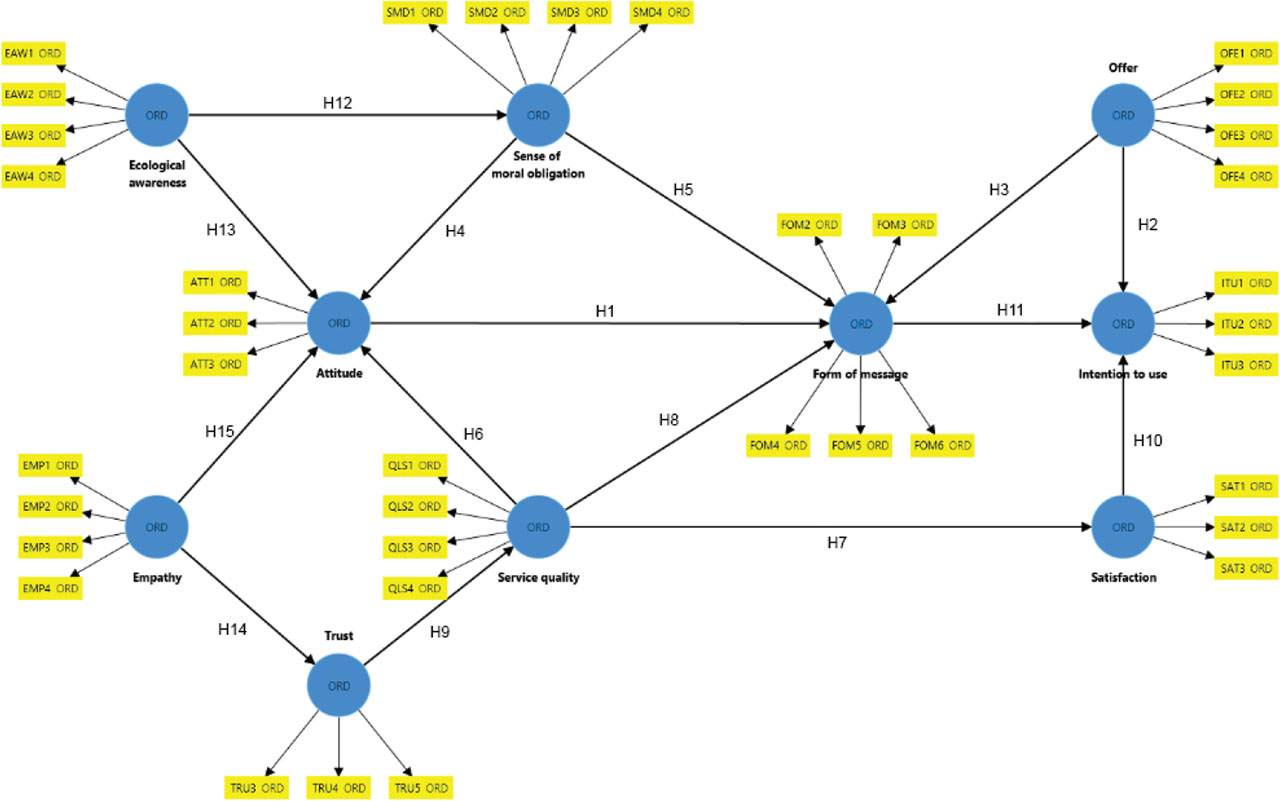
Figure 1.
A conceptual acceptance model for sustainability communication
Table 3.
Results of the significance tests and the path coefficient of the structural model
| Hypothesis | Path | Coefficient | Effect size (f2) | Significant (p <0.05)? |
|---|---|---|---|---|
| H1 | Attitude (ATT) → Form of message (FOM) | .074 | .047 | No (0,305) |
| H2 | Offer (OFE) → Intention to use (ITU) | −.033 | .002 | No (0,405) |
| H3 | Offer (OFE) → Form of message (FOM) | .265 | .095 | Yes (0,000) |
| H4 | Sense of moral obligation (SMO) → Attitude (ATT) | .578 | .377 | Yes (0,000) |
| H5 | Sense of moral obligation (SMO) → Form of message (FOM) | .216 | .024 | Yes (0,009) |
| H6 | Service quality (QLS) → Attitude (ATT) | .143 | .030 | Yes (0,008) |
| H7 | Service quality (QLS) → Satisfaction (SAT) | .740 | 1.209 | Yes (0,000) |
| H8 | Service quality (QLS) → Form of message (FOM) | .249 | .003 | Yes (0,001) |
| H9 | Trust (TRU) → Service quality (QLS) | .677 | .847 | Yes (0,000) |
| H10 | Satisfaction (SAT) → Intention to use (ITU) | .648 | .660 | Yes (0,000) |
| H11 | Form of message (FOM) → Intention to use (ITU) | .209 | .062 | Yes (0,000) |
| H12 | Environmental awareness (EAW) → Sense of moral obligation (SMO) | .686 | .891 | Yes (0,000) |
| H13 | Environmental awareness (EAW) → Attitude (ATT) | −.053 | .003 | No (0,379) |
| H14 | Empathy (EMP) → Trust (TRU) | .630 | .658 | Yes (0,000) |
| H15 | Empathy (EMP) → Attitude (ATT) | .225 | .046 | Yes (0,001) |
Figure 2 presents the results of the PLS-SEM analysis, illustrating the standardized regression coefficients that define the relationships between the variables. R2 values, representing the Explained Variance of the structural model, are displayed within the circles of the endogenous constructs. Loadings are displayed on the lines connecting the constructs to their indicators (also presented in Table 1). The Loadings, along with AVE (Average Variance Extracted) in Table 1, are metrics used exclusively to assess the Measurement Model’s convergent validity and internal consistency. Values on the lines connecting the constructs are the Standardized Path Coefficients, which represent the estimated strength and direction of the structural relationships. These values are consistent with the Coefficient column in Table 3, and their significance is also reported there.
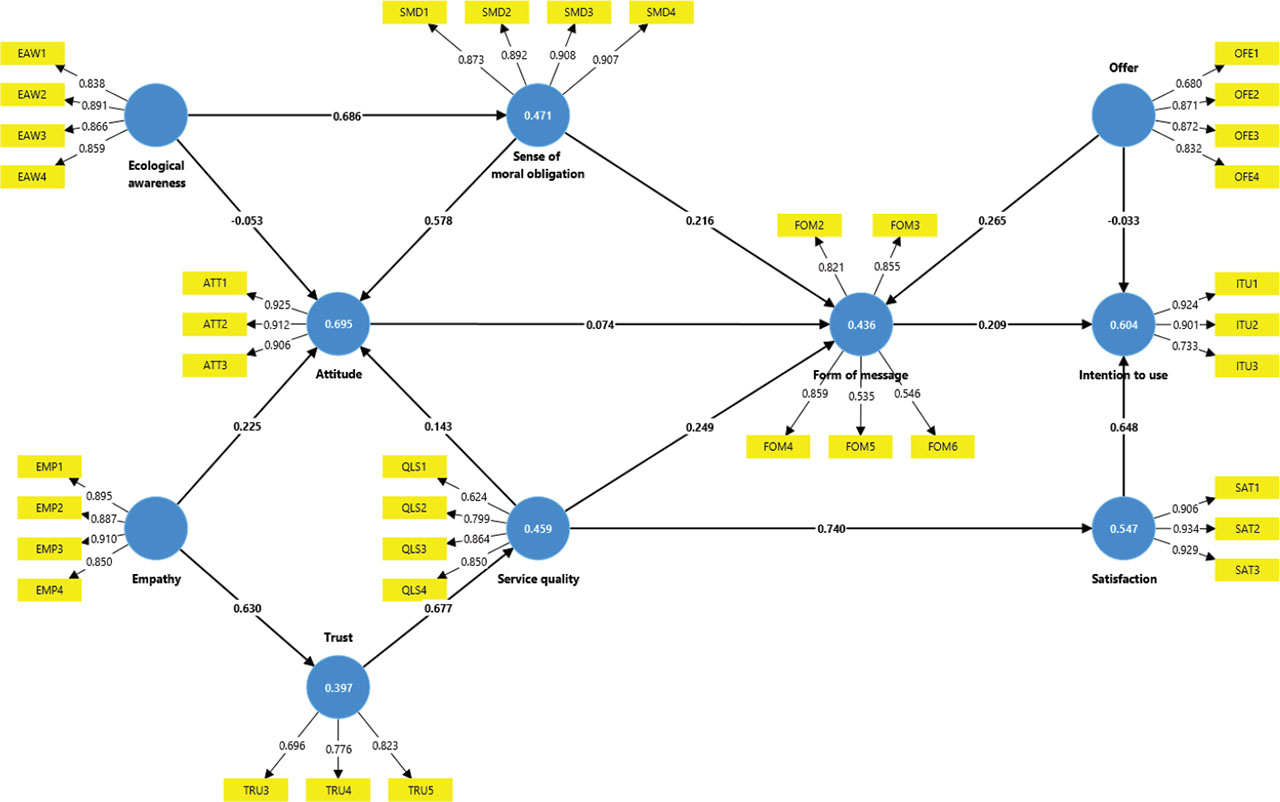
Figure 2.
A conceptual acceptance model for sustainability communication—final results.
Based on the Significant (p < 0.05) values, it was found that Hypotheses H1 (Attitude → Form of message), H2 (Offer → Intention to use), and H13 (Environmental awareness → Attitude) were not supported.
DISCUSSION
This paper proposed and validated a conceptual acceptance model for sustainability communication. A literature review was undertaken to highlight key factors potentially shaping the acceptance of sustainability communication among clients when deciding on tourism facilities. Out of the 15 stated hypotheses, 12 were confirmed. Service quality emerged as the most significant factor, having a substantial impact on Satisfaction (H7) and influencing the form of message (H8) and Attitude (H6). Satisfaction was also significantly impacting Intention to use (H10). Additionally, Trust strongly influences service quality (H9), while Environmental awareness significantly affects the Sense of moral obligation (H12).
The findings of this investigation correspond with previous research demonstrating a notable positive influence of service quality on customer satisfaction (Cong, 2021; Han et al., 2021; Melián-Alzola and Martín-Santana, 2020; P.J et al., 2023). However, service quality has a relatively low effect on consumers’ perception of sustainability messages.
Based on the literature, a Sense of moral obligation is recognized as a determinant of environmentally friendly behaviour (Han, 2020). However, research shows that its effect on consumers’ perception of sustainability messages appears relatively weak. Nevertheless, it was confirmed that Environmental awareness significantly influences the Sense of moral obligation, suggesting that fostering ecological consciousness may be a key factor in strengthening individuals’ commitment to sustainable choices (Gołębiowska, 2020). The hypothesis that consumer’s Environmental awareness influences their Attitude, confirmed by Schuitema (2013) and Wang (2020), was not confirmed in this study.
The results did not confirm a direct influence of attributes such as price, cleanliness, comfort, and location on the decision-making, despite previous studies highlighting their significant role (Cembruch-Nowakowski, 2019; Font et al., 2018). However, a slight positive impact of Offer elements on the communication of sustainability-related messages was observed. As Font (2018) suggests, sustainable attributes should be linked to key product features, integrally to the perceived benefits. Our study indirectly confirms these findings, but it needs to be more precisely investigated.
Findings indicate that Trust is pivotal in forming views on service quality, supporting prior research (Bilgihan, 2016; Cheunkamon et al., 2022; Miranda and Briley, 2021; Prendergast et al., 2015). Conducted study also demonstrates that Empathy has a significant positive impact on Trust, supporting previous findings that engaging guests in shared activities and co-creating value facilitates their participation in sustainable practices (Bordian and Gil-Saura, 2021; Hartmann and Apaolaza Ibáñez, 2006). Empathy also influences Attitude, though its effect is not particularly strong. In contrast, the Sense of moral obligation has a considerably more significant impact on Attitude.
CONCLUSIONS
The study finds that satisfaction is central to vacation destination choice, with service quality and trust significantly shaping satisfaction and quality perceptions. Naturally involving guests in sustainability activities enhances their view of service quality, while greater empathy fosters trust in hosts and their proposed solutions. Furthermore, environmental awareness strongly influences moral obligation, indicating that sustainability education can shift perceptions of environmental and social issues from burdensome requirements to moral imperatives. This heightened sense of obligation, in turn, positively affects attitudes towards sustainable behaviours (Mou and Lin, 2015). Preferences for sustainability communication are shaped by moral obligation, attitudes, offer characteristics, and the quality of service, yet communication directly affects the intention to use an offer only to a limited extent.
This study offers an innovative viewpoint by applying elements of the Technology Acceptance Model to sustainability communication, an area not yet thoroughly explored in the literature. The primary theoretical implications of this research lie in the development and empirical validation of an integrated structural model that extends the utility of established behavioural theories (such as TAM) to the specific context of consumer acceptance of sustainable communication in the tourism sector. It proposes a new conceptual model that investigates the factors influencing the acceptance of tourism enterprises’ communication about sustainable development, which constitutes its main theoretical contribution. Additionally, the study questions the extent to which offer components are crucial factors influencing decision-making, as previously believed, highlighting the need for further research in this area.
This research also provides practical recommendations for marketing professionals in the tourism industry by identifying key elements that affect the intention to use sustainable hotel offerings. It further suggests that high customer satisfaction with services may be an important factor influencing the acceptance of sustainability-related communications conducted by hotels.
A primary limitation of this study is its narrow scope, covering only one country. It is necessary to expand the research with a larger sample of respondents (the current sample was sufficient but minimal) and to replicate the study in other countries. Furthermore, it would be valuable to introduce the variable Form of Message as a moderating factor in the model, considering different forms of communication, as the current results do not provide clear conclusions regarding the preferred message format.
Future research should explore how different forms of communication moderate the intention to use sustainable offers, aiming to identify the key factors influencing message reception and destination choice. It is also essential to replicate these studies with a larger and more diverse respondent group.