
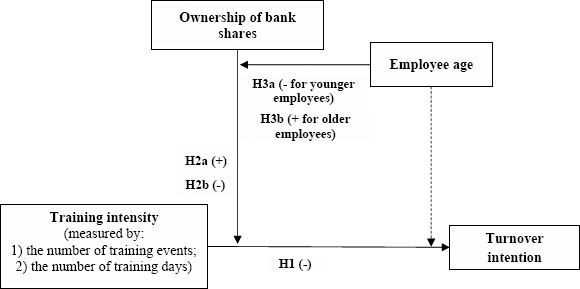
Figure 1.
The relationships between the study variables and the research hypotheses. The solid lines represent the relationships described in the research hypotheses. The dashed lines indicate relationships not directly addressed by the hypotheses (the interaction of training intensity and employee age) that were also analysed.
Table 1.
Means, standard deviations and correlations among the study variables.
| M | SD | 1. | 2. | 3. | 4. | 5. | 6. | 7. | 8. | |
|---|---|---|---|---|---|---|---|---|---|---|
| 1. Gender | 0.793 | 0.405 | - | - | - | - | - | - | - | - |
| 2. Position | 0.239 | 0.427 | -0.177** | - | - | - | - | - | - | - |
| 3. Education | 0.835 | 0.372 | -0.108** | 0.108** | - | - | - | - | - | - |
| 4. Company size | 0.617 | 0.486 | -0.016 | -0.031 | 0.078** | - | - | - | - | - |
| 5. Ownership of bank shares | 0.590 | 0.492 | 0.005 | 0.152** | -0.118** | 0.132** | - | - | - | - |
| 6. Age | 0.434 | 0.496 | 0.010 | 0.216** | -0.390** | 0.020 | 0.227** | - | - | - |
| 7. Training (events) | 1.837 | 1.484 | -0.022 | 0.276** | 0.008 | -0.047 | 0.209** | 0.110** | - | - |
| 8. Training (days) | 2.206 | 1.690 | -0.027 | 0.260** | 0.021 | -0.025 | 0.208** | 0.110** | 0.890** | - |
| 9. Turnover intention | 2.552 | 1.069 | -0.110** | -0.087** | 0.186** | 0.176** | -0.039 | -0.144** | -0.112** | -0.125** |
1 N = 1560, ** p < 0.01, * p < 0.05.M, mean; SD, standard deviation.
Dummy-coded: Gender, 0 = man, 1 = woman; Position, 0 = non-managerial, 1 = managerial; Education, 0 = lower than higher education, 1 = higher education; Company size, 0 = less than 100 employees, 1 = 100 or more employees; Ownership of bank shares, 0 = no, 1 = yes; Age, 0 = less than 40 years old, 1 = 40 years or more.
Category-coded: Training (events), 0 = no training, 1 = one training event, 2 = two training events, 3 = three training events, 4 = more than three training events; Training (days), 0 = no training, 1 = less than 1 day, 2 = 1–2 days, 3 = 3–4 days, 4 = 5–6 days, 5 = more than 6 days. Continuous: Turnover intention.
Table 2.
MLM results for the number of training events (random slope models)
| Variable | 1. | 2. | 3. | 4. | 5. |
|---|---|---|---|---|---|
| Gender | -0.317 | -0.303 | -0.295 | -0.301 | -0.298 |
| - | (0.000) | (0.000) | (0.000) | (0.000) | (0.000) |
| Position | -0.298 | -0.256 | -0.233 | -0.225 | -0.211 |
| - | (0.000) | (0.000) | (0.000) | (0.001) | (0.001) |
| Education | 0.425 | 0.424 | 0.424 | 0.392 | 0.399 |
| - | (0.000) | (0.000) | (0.000) | (0.000) | (0.000) |
| Company size | 0.330 | 0.346 | 0.346 | 0.359 | 0.357 |
| - | (0.008) | (0.004) | (0.004) | (0.003) | (0.003) |
| Training (events) | - | -0.060 | -0.018 | -0.034 | -0.035 |
| - | - | (0.015) | (0.590) | (0.241) | (0.351) |
| Ownership of bank shares | - | - | -0.009 | - | -0.003 |
| - | - | - | (0.880) | - | (0.967) |
| Training (events)*Ownership of bank shares | - | - | -0.083 | - | -0.012 |
| - | - | (0.037) | - | (0.820) | |
| Age | - | - | - | -0.089 | -0.105 |
| - | - | - | (0.125) | (0.242) | |
| Training (events)*Age | - | - | - | -0.053 | 0.072 |
| - | - | - | (0.167) | (0.280) | |
| Ownership of bank shares*Age | - | - | - | - | 0.044 |
| - | - | - | - | (0.691) | |
| Training (events)*Ownership of bank shares*Age | - | - | - | - | -0.165 |
| - | - | - | - | (0.045) | |
| Intercept | 2.363 | 2.347 | 2.351 | 2.397 | 2.391 |
| (0.000) | (0.000) | (0.000) | (0.000) | (0.000) | |
| Slope variance | 0.007 | 0.008 | 0.006 | 0.007 | |
| Intercept variance | 0.111 | 0.118 | 0.116 | 0.123 | 0.122 |
| Covariance between random intercepts and slopes | - | -0.018 | -0.018 | -0.019 | -0.020 |
| Within-company between-employee variance | 0.957 | 0.947 | 0.942 | 0.945 | 0.938 |
| Number of observations | 1653 | 1577 | 1571 | 1568 | 1562 |
| Log likelihood | -2340.056 | -2231.579 | -2219.648 | -2216.900 | -2203.586 |
| Likelihood-ratio test statistic (comparison with random intercept model) | 6.29 (0.043) | 7.10 (0.029) | 5.82 (0.055) | 7.00 (0.030) |
1 Number of organisations in each model: 42.
Descriptions of the variables are provided with Table 1, p-value in parentheses.
Table 3.
MLM results for the number of training days (random slope models)
| Variable | 1. | 2. | 3. | 4. |
|---|---|---|---|---|
| Gender | -0.304 | -0.296 | -0.301 | -0.299 |
| (0.000) | (0.000) | (0.000) | (0.000) | |
| Position | -0.246 | -0.224 | -0.218 | -0.201 |
| (0.000) | (0.000) | (0.001) | (0.002) | |
| Education | 0.440 | 0.443 | 0.408 | 0.422 |
| (0.000) | (0.000) | (0.000) | (0.000) | |
| Company size | 0.351 | 0.349 | 0.361 | 0.362 |
| (0.004) | (0.004) | (0.003) | (0.003) | |
| Training (days) | -0.066 | -0.035 | -0.048 | -0.059 |
| (0.003) | (0.239) | (0.065) | (0.074) | |
| Ownership of bank shares | - | -0.001 | - | 0.005 |
| - | (0.989) | - | (0.942) | |
| Training (days) *Ownership of bank shares | - | -0.065 | - | 0.010 |
| - | (0.063) | (0.818) | ||
| Age | - | - | -0.088 | -0.105 |
| - | - | (0.129) | (0.240) | |
| Training (days)*Age | - | - | -0.034 | 0.093 |
| - | - | (0.309) | (0.103) | |
| Ownership of bank shares*Age | - | - | - | 0.048 |
| - | - | - | (0.661) | |
| Training (days)*Ownership of bank | - | - | - | -0.178 |
| shares*Age | - | - | - | (0.013) |
| Intercept | 2.325 | 2.322 | 2.375 | 2.356 |
| (0.000) | (0.000) | (0.000) | (0.000) | |
| Slope variance | 0.006 | 0.007 | 0.006 | 0.007 |
| Intercept variance | 0.119 | 0.117 | 0.123 | 0.122 |
| Covariance between random intercepts and slopes | -0.016 | -0.016 | -0.017 | -0.018 |
| Within-company between-employee variance | 0.937 | 0.933 | 0.935 | 0.927 |
| Number of observations | 1,576 | 1,570 | 1,567 | 1,561 |
| Log likelihood | -2,223.244 | -2,211.652 | -2,209.014 | -2,194.731 |
| Likelihood-ratio test statistic (the comparison with random intercept model) | 8.27 (0.016) | 9.58 (0.008) | 8.23 (0.016) | 9.37 (0.009) |
1 Number of organisations in each model – 42.
Descriptions of the variables are provided with Table 1, p-value in parentheses.
Table S1.
MLM results for number of training events (random intercept models)
| Variable | 1. | 2. | 3. | 4. |
|---|---|---|---|---|
| Gender | -0.309 | -0.301 | -0.306 | -0.303 |
| (0.000) | (0.000) | (0.000) | (0.000) | |
| Position | -0.262 | -0.239 | -0.225 | -0.213 |
| (0.000) | (0.000) | (0.001) | (0.001) | |
| Education | 0.430 | 0.429 | 0.392 | 0.400 |
| (0.000) | (0.000) | (0.000) | (0.000) | |
| Company size | 0.329 | 0.323 | 0.334 | 0.332 |
| (0.010) | (0.012) | (0.010) | (0.011) | |
| Training (events) | -0.046 | -0.001 | -0.020 | -0.017 |
| (0.015) | (0.970) | (0.417) | (0.624) | |
| Ownership of bank shares | -0.010 | -0.006 | ||
| (0.869) | (0.936) | |||
| Training (events)*Ownership of bank shares | -0.082 | -0.013 | ||
| (0.032) | (0.788) | |||
| Age | -0.103 | -0.123 | ||
| (0.077) | (0.170) | |||
| Training (events)*Age | -0.052 | 0.065 | ||
| (0.169) | (0.327) | |||
| Ownership of bank shares*Age | 0.053 | |||
| (0.630) | ||||
| Training (events)*Ownership of bank shares *Age | -0.157 | |||
| (0.057) | ||||
| Intercept | 2.353 | 2.361 | 2.415 | 2.409 |
| (0.000) | (0.000) | (0.000) | (0.000) | |
| Intercept variance | 0.115 | 0.115 | 0.119 | 0.119 |
| Within-company between-employee variance | 0.958 | 0.954 | 0.955 | 0.949 |
| Number of observations | 1577 | 1571 | 1568 | 1562 |
| log likelihood | -2234.724 | -2223.197 | -2219.809 | -2207.083 |
1 Number of organisations in each model – 42
Descriptions of the variables are provided with Table 1, p-value in parentheses
Table S2.
MLM results for number of training days (random intercept models)
| Variable | 1. | 2. | 3. | 4. |
|---|---|---|---|---|
| Gender | -0.313 (0.000) | -0.306 (0.000) | -0.311 (0.000) | -0.309 (0.000) |
| Position | -0.249 (0.000) | -0.230 (0.000) | -0.217 (0.001) | -0.202 (0.002) |
| Education | 0.447 (0.000) | 0.449 (0.000) | 0.409 (0.000) | 0.424 (0.000) |
| Company size | 0.333 (0.010) | 0.328 (0.010) | 0.340 (0.009) | 0.342 (0.009) |
| Training (days) | -0.055 (0.001) | -0.025 (0.318) | -0.039 (0.069) | -0.049 (0.096) |
| Ownership of bank shares | 0.003 (0.963) | 0.006 (0.939) | ||
| Training (days)*Ownership of bank shares | -0.058 (0.082) | 0.014 (0.752) | ||
| Age | -0.102 (0.080) | -0.127 (0.156) | ||
| Training (days)*Age | -0.029 (0.372) | 0.094 (0.101) | ||
| Ownership of bank shares*Age | 0.062 (0.577) | |||
| Training (days)*Ownership of bank shares*Age | -0.175 (0.015) | |||
| Intercept | 2.334 (0.000) | 2.331 (0.000) | 2.396 (0.000) | 2.375 (0.000) |
| Intercept variance | 0.116 | 0.115 | 0.120 | 0.120 |
| Within-company between-employee variance | 0.951 | 0.948 | 0.948 | 0.942 |
| Number of observations | 1576 | 1570 | 1567 | 1561 |
| Log likelihood | -2227.378 | -2216.443 | -2213.129 | -2199.417 |
1 Number of organisations in each model – 42
Descriptions of the variables are provided with Table 1, p-value in parentheses
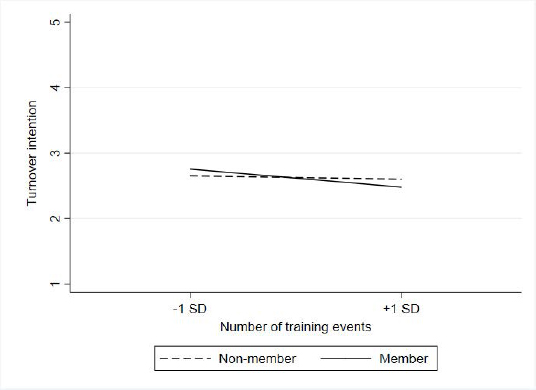
Figure 2.
Two-way interaction between number of training events and ownership of bank shares. Figure presents the interaction effect of number of training events and ownership of bank shares on turnover intention (see Model 3 from Table 2). The solid line shows a statistically significant change. -1 SD/+1 SD: one standard deviation below/above the mean.
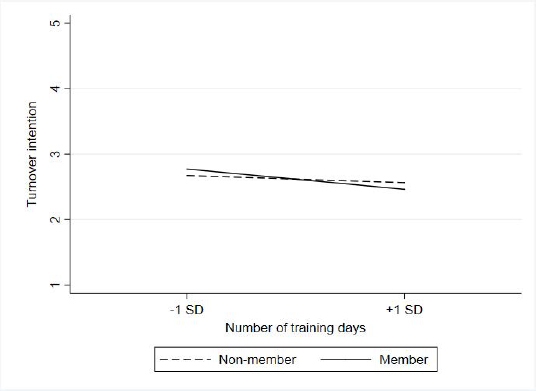
Figure 3.
Two-way interaction between number of training days and ownership of bank shares. Figure presents the interaction effect of number of training days and ownership of bank shares on turnover intention (see Model 2 from Table 3). The solid line shows a statistically significant change. -1 SD/+1 SD: one standard deviation below/above the mean.
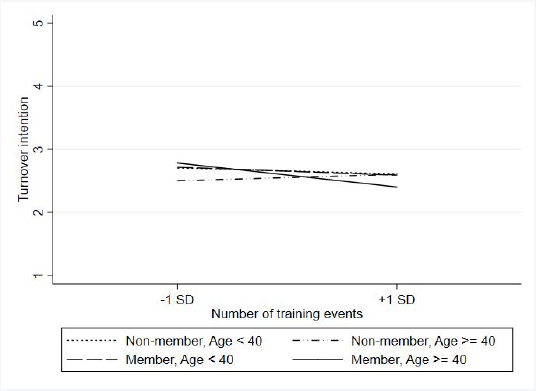
Figure 4.
Three-way interaction between number of training events, ownership of bank shares and employee age. Figure presents the interaction effect of number of training events, ownership of bank shares and employee age on turnover intention (see Model 5 from Table 2). The solid line shows a statistically significant change. -1 SD/+1 SD: one standard deviation below/above the mean.
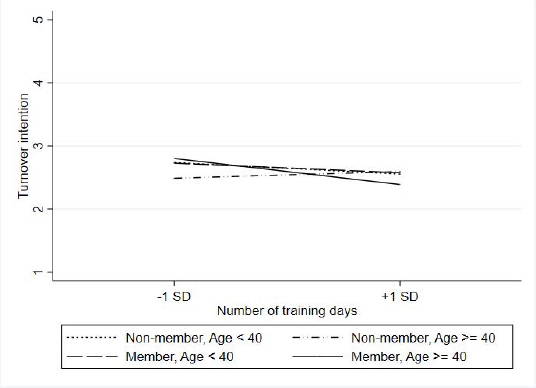
Figure 5.
Three-way interaction between number of training days, ownership of bank shares and employee age. Figure presents the interaction effect of number of training days, ownership of bank shares and employee age on turnover intention (see Model 4 from Table 3). The solid line shows a statistically significant change. -1 SD/+1 SD: one standard deviation below/above the mean.