
Table 1
Principles of cooperation between franchisee and franchisor
| Franchisor | Franchicsee |
|---|---|
| He/she checked the business concept in his/her own pilot unit and indicated its profitability. He/she passes on know-how to the franchisee on how to conduct business. He/she is the owner of the trademark and the brand of franchising chain. He/she passes on the instructions and solutions on how to conduct business in accordance with the concept, which is passed on in the form of an operations manual. | He/she conducts business trading under the logo of the system provider as an independent entity, while his/her profit is gained from his/her business activities. He/she finances the greater part of the investment in terms of launching the facility, its equipment and purchasing of goods from his/her own resources. He/she regulates payments for maintaining the licence and the monthly fee for accessing of know-how (which is charged directly or compensated by retrospective payments from suppliers). He/she defines the price of goods in his/her premises with the exception of promotional actions organized by the chain. He/she has the majority of influence on the type and variety of goods in his/her premises with the exception of agreements entered with the producers on the part of the chain. |
[i] Source: Self-analysis on the basis of Słodkowski (2008).
Table 2
Operations manual as a tool of franchising cooperation
| Element of manual | Content |
|---|---|
| Introduction |
|
| Operational instructions |
|
| Set of standard forms |
|
| Guidebook for franchisees |
|
[i] Source: Self-analysis on the basis of Mendelson and Acheson (1992).
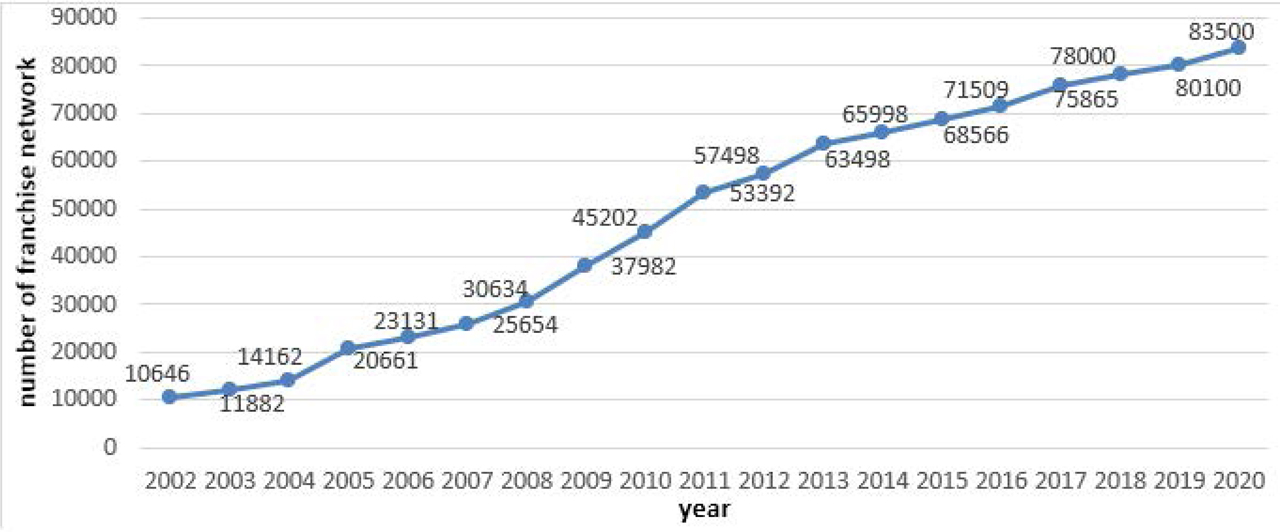
Chart 1
Development of franchising chain in sector of FMCG in Poland in the years 2002 – 2020.
Source: https://franchising.pl/abc-franczyzy/24/franczyza-polsce-rozwoj-1989-2020-roku/ [access 2021-12-10]
Table 3
Division of franchising chains in Poland according to format of shop
| Format of shop | Characteristic features of particular format | Name of franchising chain |
|---|---|---|
| Convenience/local type shops |
|
|
| Supermarkets |
|
|
| Delicatessen shops |
|
|
[i] Source: Self-analysis on the basis of Reformat, 2015.
[ii] https://handelextra.pl/artykuly/209007,tylko-u-nas-top-30-sieci-franczyzowych [access 10.11.2021]
Table 4
Regulations of Civil Code relating to franchising
| Legislative basis | Reference to franchising activities |
|---|---|
| Art. 43.1-Art. 43.10 | Indicating an entrepreneur as a physical or legislative entity, who conducts business or professional activity on his/her own behalf. This individual operates as a firm that is entered into the appropriate register. The notion of a firm in the case of a physical entity is perceived as the individual's name and surname, whereas in the case of a legislative entity, it is perceived as the name of the firm. |
| Art. 56 – Art. 116 | Regulations stipulated in the first book under the fourth title relate to the legislative activities. They regulate the activities of parties associated with entering agreement. They treat the declaration of the will to enter agreement as an offer. This offer becomes transformed into an agreement, if the parties express such a wish. This will, as indicated by the act, should be presented in a written form. Similarly, all appendices and modifications to the agreement should be prepared in a written form. Simultaneously, the act assumes that the declaration of the will of unauthorized people, or those in a state that excludes the conscious or free will to make decisions is deemed null and void. |
| Art. 353.1 – Art. 396 | In accordance with the resolutions of the Civil Code, the parties entering agreement may arrange the legal relationship according to their own discretion, yet must respect the legal regulations, as well as the principles of community life. Both the debtor and the creditor should execute the obligations in accordance with the stipulated content and in a manner that is appropriate to the principles of community life, as well as the binding customs. The obligations of the parties may be of a nature of solidarity obligations. Likewise, they may also be divisible obligations, or indivisible obligations. |
| Art. 451 | The Civil Code defines the manner of executing obligations. By way of example, it assumes that the debtor, who has several debts to the same creditor, may indicate which debt he/she wishes to pay off. |
| Art. 471 | The Civil Code defines the effects of the failure to execute the obligations. In accordance with its stipulations, it is assumed that the debtor is obliged to repair the damage which arises from the failure to execute, or the inappropriate execution of the obligations. |
| Art. 487 | The resolutions of the Civil Code refer to the execution and effects of the failure to execute the obligations arising from the mutual agreements. Mutual agreements are treated as contracts, in which both parties are obliged by the declaration of one of the parties that should be the equivalent of the declaration of the second party. |
[i] Source: Self-analysis on the basis of Civil Code (2020).
Table 5
Diagnosis of differences in hard systems and soft franchises
| Provision of agreement | “Hard” franchising suste | “Soft” franchising system |
|---|---|---|
| Preamble | The system provider establishes the trading conditions for the system receiver with suppliers and manufacturers and also obliges the system receivers to make purchases and sell goods from the suppliers and manufacturers indicated. | The system provider has a concept of the system of the sales of goods at his/her disposal, which creates the possibility of an effective form of business activity and business cooperation in the sphere of sales and promotion of goods for the network participants and independent firms. |
| Obligations of franchisee |
|
|
| Participation in marketing and advertising actions | The participant of the trading network has the obligation of participation in all marketing, advertising and promotional actions organized by the network, including advertising the trading premises according to the principles stipulated in the regulations for the particular action, | The network participant has the right to participate in all marketing, advertising, and promotional actions organized by the network, including advertising the trading premises according to the principles stipulated in the regulations for the particular action. |
| Recommended suppliers |
|
|
| Operational activities | The network participant has a trade coordinator assigned to him/her by the franchise provider, whose cyclical visits amount to one visit per week, | The network participant has a trade coordinator assigned to him/her by the franchise provider, whose cyclical visits amount to one visit per month, |
| Additional programs and services | The trading network participant has the obligation to udr the programs and services prepared by the network (loyalty program for consumers, loyalty program for franchisees, competitions by means of text messaging, trade fairs), | The trading network participant has the right to use the programs and services prepared by the network (loyalty program for consumers, loyalty program for franchisees, competitions by means of text messaging, trade fairs). |
| Training | The trading network participant and the workers employed in the trading premises have the obligation to participate in training prepared by the network. | The trading network participant and the workers employed in the trading premises have the right to participate in training prepared by the network, |
| Purchase of advertising materials and consumables | The obligation to purchase materials in cycles - 1 purchase monthly. | Authorization to purchase materials. |
| Period of duration of agreement | The agreement is entered for an indefinite time period with a 6-month period of notice that comes into effect at the end of the calendar year. | The agreement is entered for an indefinite period of time with a month's period of notice of termination. |
| Grace period | Following the termination of the agreement, the network participant may not conduct business activities in competitive trading networks for a period of 6 months. | There is no grace period, |
| Contractual penalties |
| There are no contractual penalties in the case of a failure to adhere to the stipulations of the agreement that are binding within the regulations of the Civil Code, |
| Franchising fees |
| The quarterly licence fee amounts to between 1 PLN and 30 PLN, |
| Security of payments due | The franchisee has the obligation to issue a blank bill of exchange, and also a blank bill of exchange agreement with the aim of securing all payments that are payable to the franchisor. |
|
| Level of retrospective discounts and bonuses with suppliers and manufacturers indicated by the organizer of the system |
|
|
[i] Source: Self-analysis of the franchising agreements of the analysed chains.
Table 6
Similarities in hard agreements and soft franchises
| Elelment of agreement | Provisions of agreement |
|---|---|
| Parties entering agreement | Representative of management of network, franchisee. |
| Definitions of notions | A franchising agreement, network, network participant, system, brandname, trademark, supplier, sales outlet (trading premises). |
| Obligations of the franchisor |
|
| Operational activities |
|
| Liability | `The franchisor does not bear any liability for the financial performance of the network participant, nor for any of the participant's activities and obligations with regard to third parties. |
| Confidentiality |
|
| Trading system |
|
| Settlement of remuneration from suppliers and manufacturers |
|
[i] Source: Self-analysis of the franchising agreements of the analysed chains.