
I. Introduction
Traditional IoT networks that relies on centralized cloud computing is facing significant challenges, including high latency, excessive bandwidth usage, increased energy consumption and security risks [1] & [2]. Such limitations have a negative impact on the performance and scalability of the network as the data produced by IoT devices increases. As a result, edge computing has become a solution to many of such challenges that had emerged, by processing data at the source, thus enhancing overall bandwidth efficiency, decreasing latency, and boosting security of the information, allowing for faster decision-making and enhanced operational culated by [5] & [6] highlight the growing importance of edge computing, which positions computational resources and data storage in closer proximity to IoT devices, thereby significantly reducing latency and improving response times, ultimately achieving reductions in end-to-end latency in the range of 60% to 70%. [7] & [8] stated that edge computing is the best for real-time applications where expeditious decision-making is paramount that including autonomous vehicles and industrial automation. Edge computing refines bandwidth utilization by decreasing the volume of data transmitted to the cloud, so avoiding network congestion and diminishing operational costs. Moreover, local data processing bolsters energy efficiency, rendering it particularly suitable for battery-operated IoT devices [9]. The dependence on centralized systems renders the network susceptible to security vulnerabilities and operational failures [10]. A research by [11] indicates that centralized cloud computing within smart grid systems augments scalability and resource management by leveraging established, cloud-based infrastructures. Nonetheless, this approach is accompanied by challenges such as elevated latency and augmented bandwidth demands. [12] Stated that Centralized cloud computing offers easy service provisioning and infrastructure management, but it has limitations in latency and energy efficiency, making it less suitable for distributed IoT systems. Fog computing is augmenting the functionalities of cloud computing by extending its capabilities to the periphery of the network, thereby mitigating latency and optimizing bandwidth utilization through the proximal processing of data at its point of origin [13]. Micro data centers it compact data centres strategically positioned near internet of things devices to furnish localized computational resources, thereby diminishing dependence on remote cloud infrastructures [14]. Mobile edge Computing (MEC) it incorporates computational capabilities within mobile networks to facilitate low-latency applications, such as augmented reality by situating computational resources nearer to the end user [15].
Despite advancements in edge computing, several research gaps remain such as resource allocation as contemporary algorithms encounter significant challenges in the efficient distribution of resources within dynamic IoT environments [16], [17], [18], and [19]. Security mechanisms; there is a pressing need for advanced security solutions to safeguard distributed edge devices [20], [21], [22], and [23]. Scalability; as IoT networks expand, the management of a substantial number of devices becomes increasingly complex [24], [25], [26], and [27]. Energy efficiency; power optimization for battery-operated IoT devices remains a pivotal research domain [28], [29], [30], and [31]. Integration with AI enhances real time data processing at the edge, enhance IoT performance through intelligent computation [32], and with 5G connectivity it provides ultra-low latency and high-speed communication, enabling edge computing for critical applications [33]. And with blockchain ensures secure transactions, decentralized data management in IoT networks [34].
The objective of this paper is to investigate the implementation and optimization of edge computing techniques in IoT networks. The study will explore how edge computing can enhance IoT efficiency, reduce latency, and improve scalability. In addition, it will examine real world use cases and explore emerging technologies that can further enhance the capabilities of edge computing in IoT networks.
II. Methodology: Implementation of Edge Computing in IoT
This methodology is using architectural design through implementing hierarchical models. The prevalence of the IoT devices prompts data traffic between the edge, fog, and cloud layers leading to delays and long felt requirements, in a hierarchical model the computation of such complex data that requires latency is distributed in multilevel, for instance; edge layer relies on real time response to perform processing of data generated by sensors, filtering, and stream analytics at close proximity to the sensors. Fog layer comprises of mid-range processing requirements for latency moments that cannot be carried out with the use of edge devices. Cloud layer refers to large scale data storage, longitudinal analysis, where the final layer involves training a machine learning model. In order to obtain such model three steps for implementation must be followed. Design a layered system with communication protocols between the devices at each level. Realize the interfaces for the data to travel across the IoT devices as well the edge device. Use APIs (Application Programming Interfaces) to send processed data to be forwarded through ‘n’ layers up to the cloud. APIs aim to bridge the gap between various network layers and make them inter-operable improving and deepening performance in data management and processing. Processing and storage is done in a distributed fashion on edge devices here without the need for centralized cloud infrastructure. This model improves the scalability through the use of peer-to-peer communication and local processing. Implementation is going through some steps; develop a complete architecture where IoT devices locally process data and communicate with the nearby edge devices. Implement Peer-2-Peer communication protocols like Message Queuing Telemetry Transport (MQTT) to enable sharing of data. In this paper, considering the efficient, scalable, and reliable communication between the IoT devices, edge nodes, and the cloud, in addition to the real-time requirements of edge computing, MQTT is the more appropriate protocol. Design and deployed edge computing frameworks enabling local decision making that circumvents the cloud for lower latency. Optimization techniques is obtained by design a load balancing algorithms that distributed tasks dynamically to the available edge devices ensuring no device is overloaded. Weighted Round Robin (WRR) algorithm used, if edge devices have different features (i.e., certain devices have more CPU or memory than others), WRR can allocate more tasks to higher capacity devices. If tasks have comparable processing times, it works well when task assignment has to be scaled along with the processing power of the devices. Each device is assigned a weight based on its processing capacity. Devices with higher weights will receive more tasks in a cyclic manner. In load balancing method computational tasks are distributed evenly across many edge devices which prevent overloading and optimize resource utilization. It given the dynamic nature of IoT networks where workload distribution can shift rapidly a WRR algorithm allocates tasks based on the computational capacity of each edge device. It extends the standard Round Robin approach by assigning different weights to edge devices based on their computational power whether it is a CPU, memory or bandwidth, etc. Four steps of the algorithm implementation, first is initialization by retrieve the list of available edge devices, assign each device a weight based on its capacity and initialize a task queue. Second is task allocation through sorting devices based on weight and assign tasks to each device in a cyclic manner, where higher-weight devices receive more tasks. Then dynamic adjustment by continuously monitor device workloads, if a device becomes overloaded, redistribute tasks to available devices and if a new device joins the network, recalculate weights and reassign tasks accordingly. Finally, fault tolerance, if a device fails then its assigned tasks are immediately reallocated to other active devices. Following are Pseudo code with its outputs and flowchart for the load balancing algorithm.
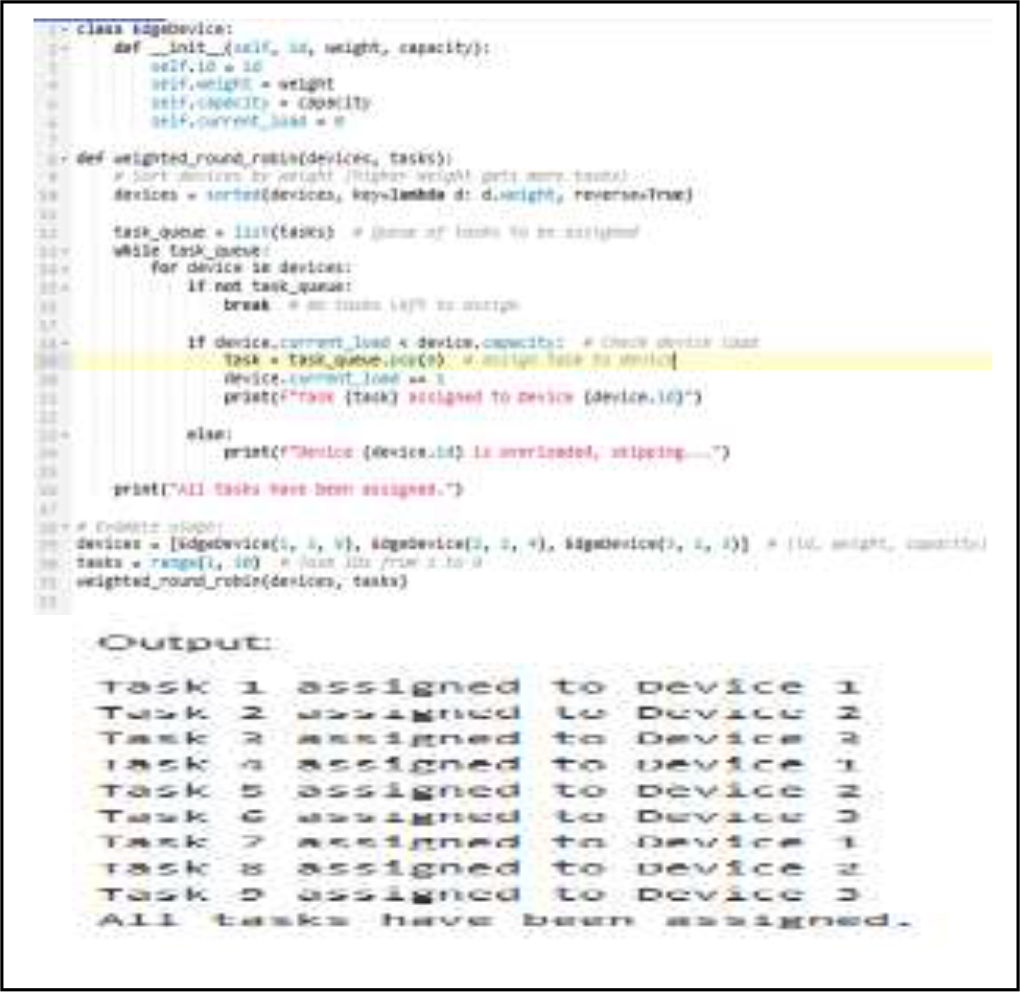
Figure 1.
Pseudo-code for Load Balancing Algorithm and its output
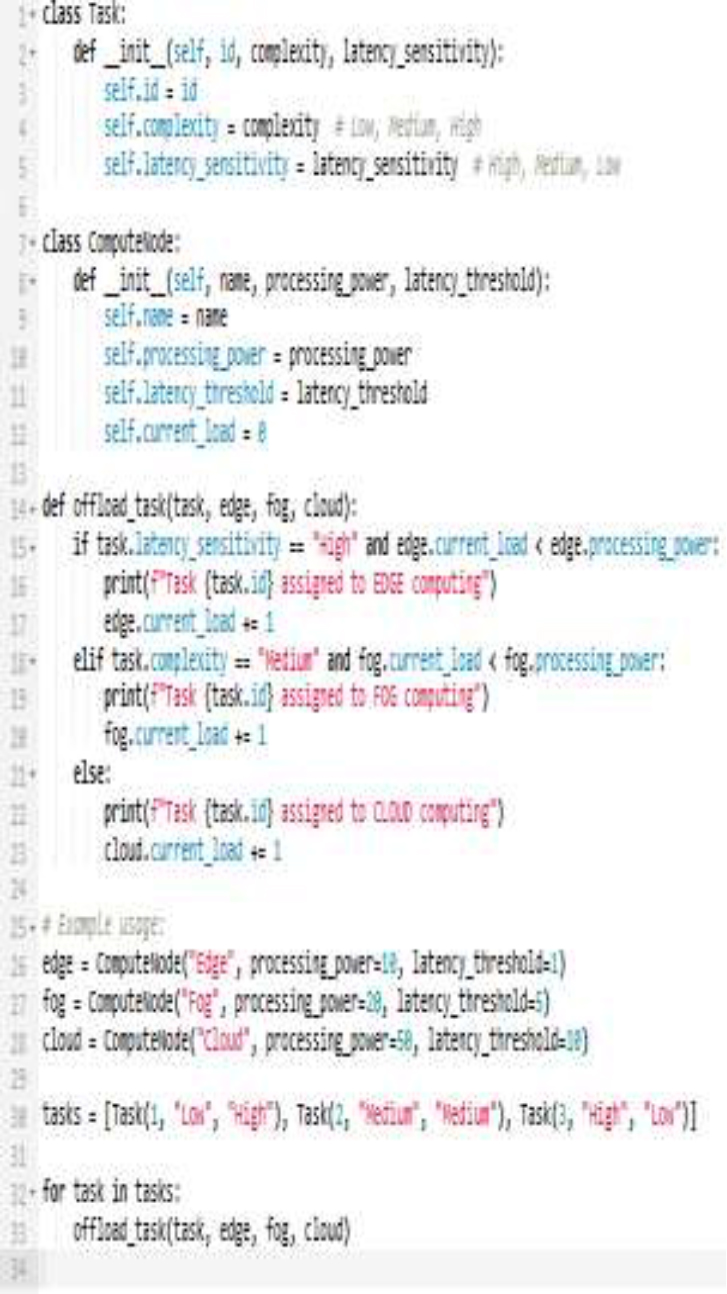
Figure 2.
Flowchart for the Load Balancing Algorithm
Algorithm Adaptability in Dynamic Environments.
Handling overload situations; the algorithm monitors device load and reassigns tasks if an edge device exceeds its processing capacity. Scalability; new edge devices can join the network dynamically, and the algorithm updates weight assignments to distribute tasks effectively. Fault tolerance; if an edge device fails, its tasks are automatically reassigned to available devices. Energy efficiency; by optimizing task distribution, the algorithm reduces unnecessary data transfer, minimizes latency, and improves energy savings.
Use algorithms to precisely choose tasks as to which processing level (edge, fog, or cloud) is most efficient given to the task's complexity, realtime needs, and available resources. Each task has different requirements. Latency sensitive tasks are assigned to edge layer (e.g., autonomous vehicles, industrial automation). Moderate complexity tasks are processed at fog layer (e.g., smart grid monitoring, video analytics). High complexity tasks are sent to cloud layer (e.g., deep learning, long-term analytics). The algorithm considers three points; task complexity (simple, medium, high), real time constraints (low latency vs. high processing needs) and available resources (CPU, memory, bandwidth at each layer). The implementation is obtained by three steps, first is task classification by Group tasks based on computational complexity and latency requirements and assign priority levels to tasks. Second is decision making algorithm by analyse the current load on edge, fog, and cloud and dynamically offload tasks to the most suitable processing layer. Then is feedback mechanism by continuously monitor latency and resource consumption and adjust task distribution dynamically based on real-time network conditions. Following is Pseudo-code for task offloading algorithm and its outputs.
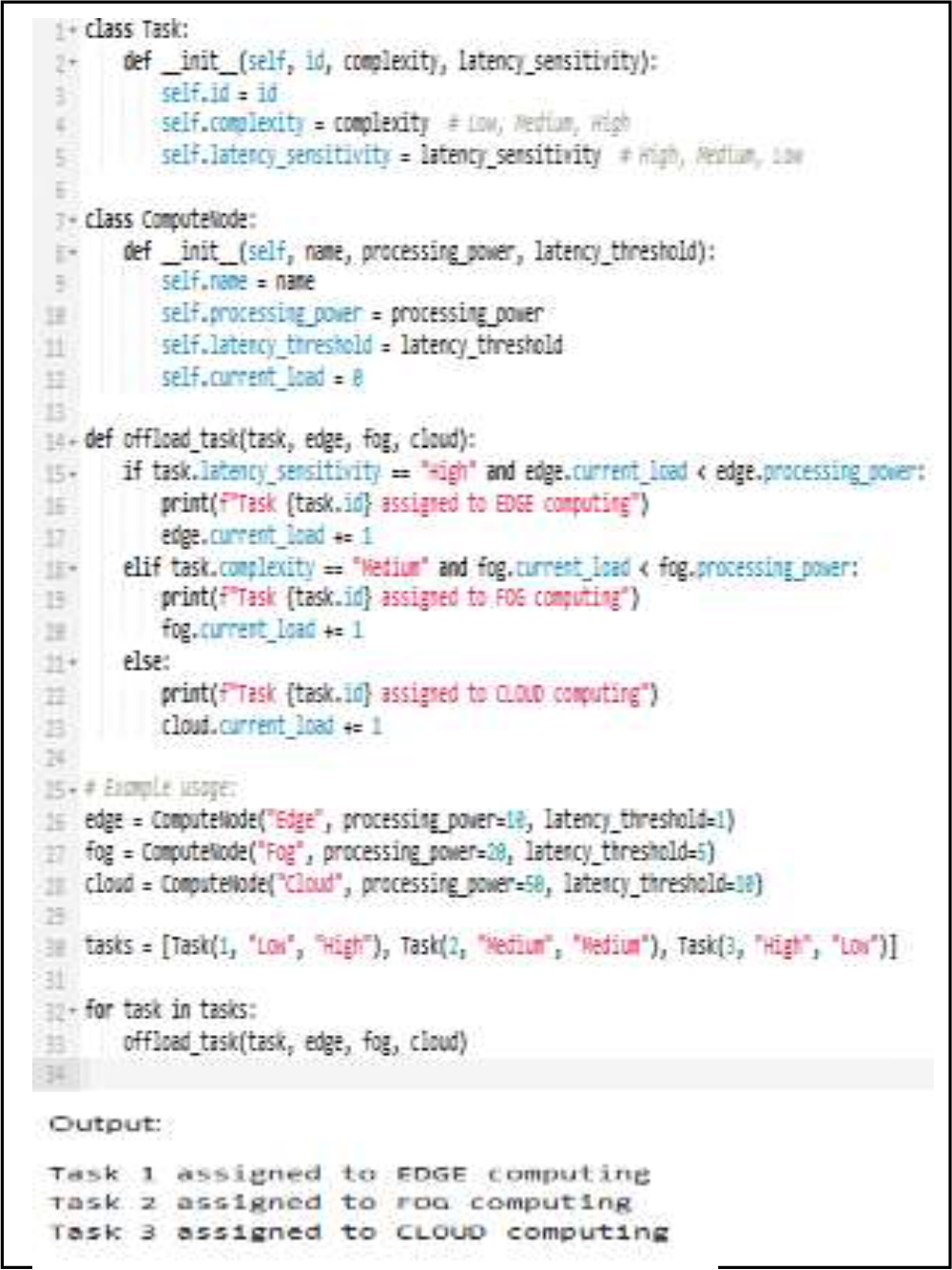
Figure 3.
Pseudo-code for task offloading algorithm and its output.
Implemented systems that adjust the allocation of computational resources (CPU, memory, storage) based on real time network conditions and workload demands is through view network traffic and device usage in real time, develop algorithms that reallocate resources dynamically to maintain performance during peak loads and simulate varying conditions of network performance (low latency, high traffic) to improve resource distribution policies. Dynamic resource allocation ensures that CPU, memory, and storage are adjusted in real-time based on network traffic and workload demands. The system continuously monitors edge devices and redistributes resources dynamically to maintain performance, especially during peak loads. The algorithm is monitoring network traffic through continuously gather CPU usage, memory, and bandwidth from edge devices as well as detecting high traffic conditions or resource bottlenecks. Second is analyze workload by check if any edge device is overloaded or underutilized and Predict future workload trends based on historical data. Then reallocate resources; if a device is overloaded, offload some tasks to a less busy device or if a device is idle, reallocate its CPU/memory/storage to active devices. Finally, optimize performance by simulate different traffic conditions (low latency, high traffic) and adjust allocation policies dynamically for better efficiency. Following is the output of Pseudo-Code for dynamic resource allocation.
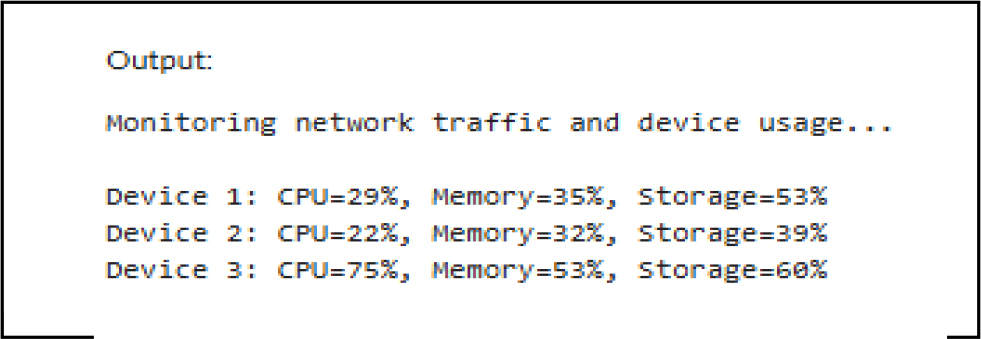
Figure 4.
Outputs of Pseudo-Code for Dynamic Resource Allocation.
In modern smart grids, power demand fluctuates dynamically due to weather, industrial activity, and unexpected faults. Traditional centralized power monitoring systems introduce latency, making real-time decision-making difficult. By deploying edge computing, power grid stability can be enhanced by processing data locally, predicting failures, and optimizing power distribution in real-time. Sensors for data collection to monitor voltage fluctuations, current flow, temperature of transformers and power demand & generation levels. Edge based real time analysis; edge computing nodes process incoming sensor data locally instead of sending it to the cloud, they detect potential overloads, voltage spikes, or frequency imbalances and if an anomaly is found, edge nodes immediately trigger corrective actions. Predictive power management and outage prevention; AI-based predictive analytics can be run on edge nodes to detect power failures before they happen. Example: if an edge node detects increasing transformer heat beyond safe limits, it predicts failure and redirects power flow to prevent outages and machine learning models can use historical data to predict failures and optimize power usage. Automatic control to prevent grid failure; edge devices autonomously activate circuit breakers to prevent cascading failures, power rerouting decisions are made locally for instant response and load balancing ensures power is distributed efficiently in milliseconds. Following is the code for edgebased power grid monitoring.
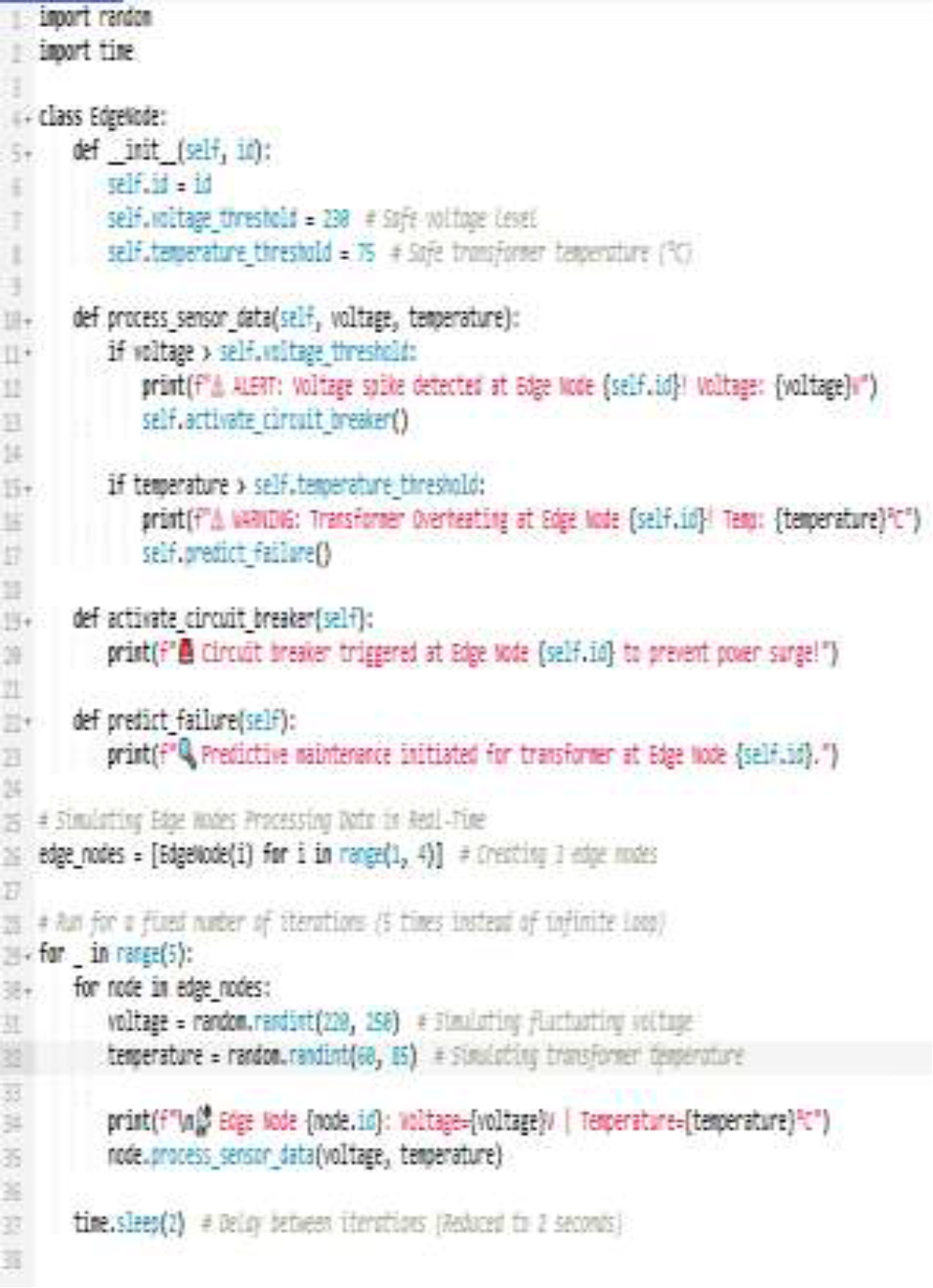
Figure 5.
Code for Edge-Based Power Grid Monitoring
The based power grid monitoring code has four possible outputs as following.
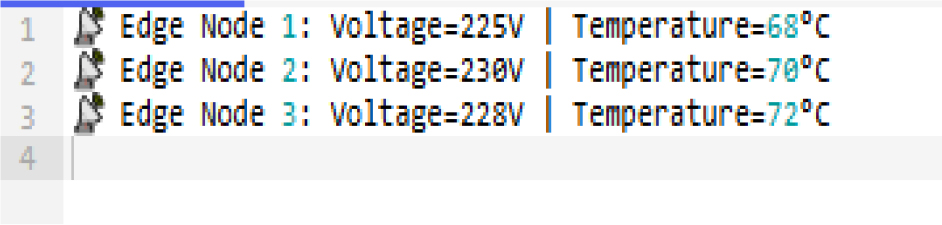
Figure 6.
Output. Scenario 1: Normal Conditions (No Alert): All values are within safe limits, so no actions are taken.
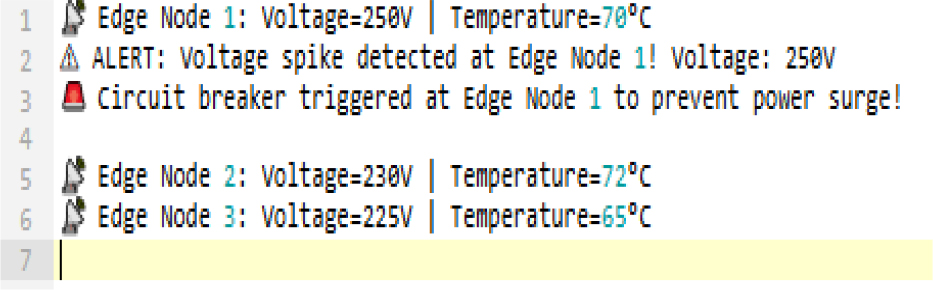
Figure 7.
Output. Scenario 2: Voltage Spike Detected (Trigger Circuit Breaker): Edge Node 1 detects high voltage (250V): Triggers circuit breaker to prevent damage.
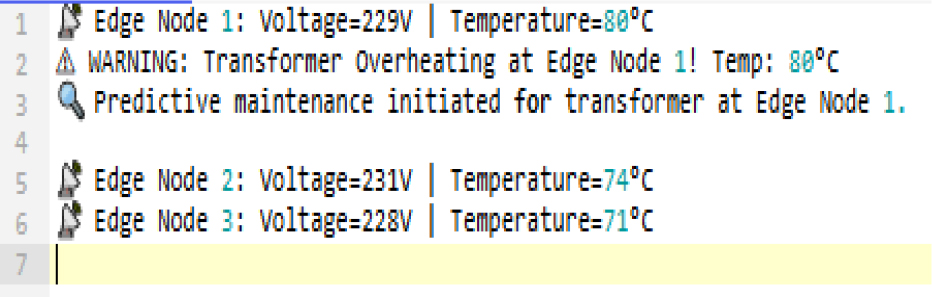
Figure 8.
Output. Scenario 3: Transformer Overheating Detected (Predictive Maintenance Alert): Edge Node 1 detects transformer overheating (80°C) → Triggers predictive maintenance.
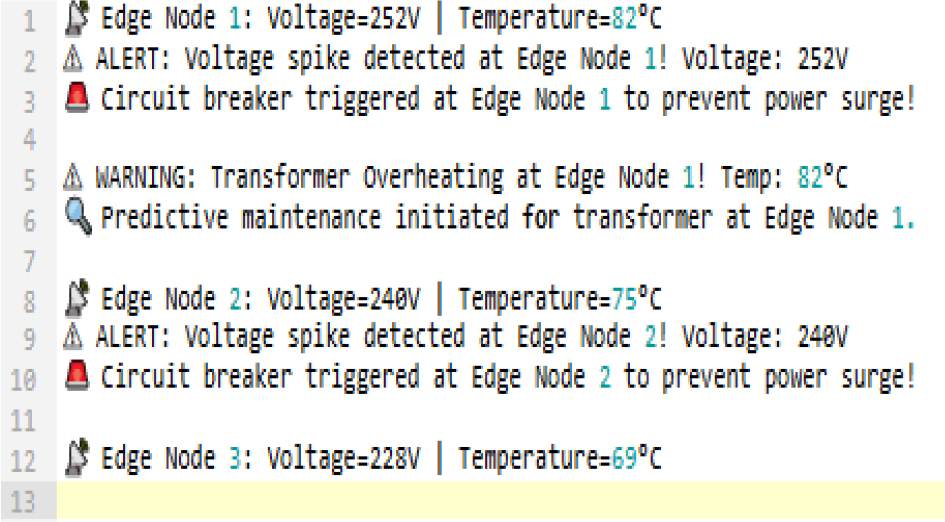
Figure 9.
Output. Scenario 4: Multiple Alerts Triggered: Both high voltage & overheating detected at Edge Node 1 and 2: Multiple actions taken.
The output changes every 5 seconds, a new set of randomized voltage & temperature values is generated. If values exceed safety limits, corresponding alerts and actions (circuit breaker, predictive maintenance) are triggered. The program continues running until manually stopped (Ctrl+C to interrupt).
Autonomous vehicles rely on real-time decision-making using edge computing to process sensor data locally. The goal is to ensure low-latency processing, reduce cloud dependency, and enhance safety through Vehicle-to-Vehicle (V2V) and Vehicle-to-Infrastructure (V2I) communication. The algorithm has sensor data acquisition to collect real-time data from cameras, LiDAR, and other sensors and process LiDAR data locally at edge nodes to reduce latency. It performs local edge processing for decision making through perform object detection (pedestrians, obstacles, traffic signs) and calculate optimal speed & braking decisions in real-time. It performs Vehicle-to-Vehicle (V2V) & Vehicle-to-Infrastructure (V2I) communication; share traffic updates, road hazards, and navigation data with nearby vehicles and interact with traffic lights, road sensors, and smart infrastructure to optimize routes. Real-time safety actions; if an obstacle is detected trigger emergency braking or reroute navigation or if another vehicle sends a collision alert, adjust speed accordingly. Next is the output of pseudo-code for autonomous vehicle edge processing.
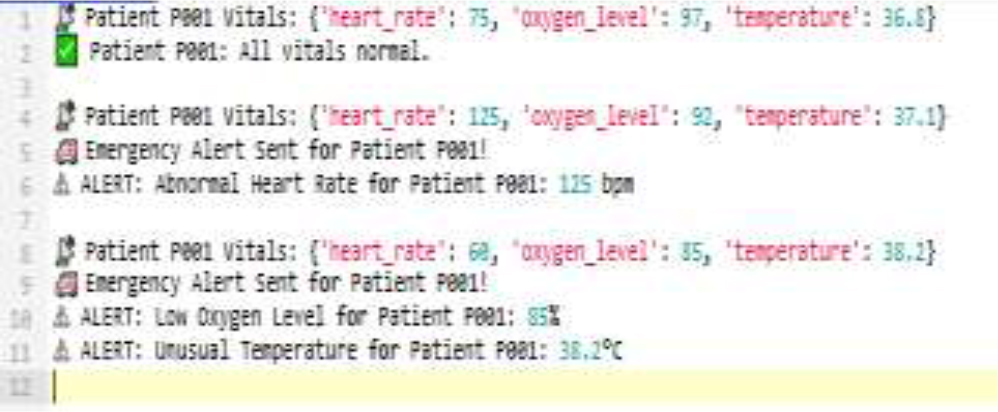
Figure 10.
Output of Pseudo-Code for autonomous Vehicle Edge Processing.
To enable real-time health monitoring using wearable sensors and edge devices while maintaining low latency, privacy, and efficient data transmission to healthcare providers. Wearable sensors collect data: Monitor heart rate, oxygen levels, blood pressure, temperature in real-time and send readings to edge nodes in hospitals or patient homes. Local processing on edge nodes: Analyse heart rate variability, irregular ECG patterns, and temperature spikes and detect abnormal conditions (e.g., high heart rate, arrhythmia). Closed-loop communication with healthcare providers: Minor health deviations only store locally, avoiding unnecessary cloud transmission and critical alerts (e.g., stroke warning) immediately sent to doctors/hospitals for action. Privacy & security measures: Data encryption & anonymization at the edge and only essential data is sent to cloud to minimize privacy risks.
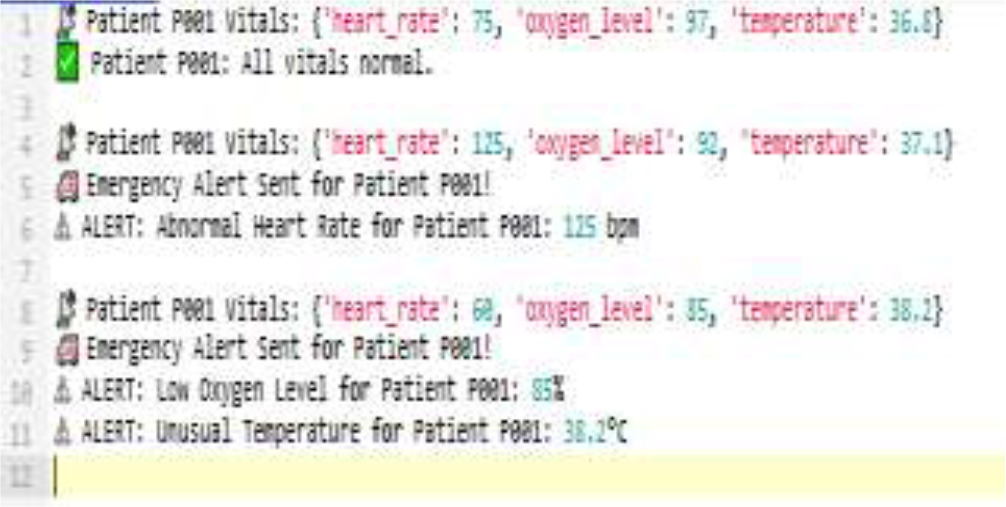
Figure 11.
Output of pseudo-code for Remote Health Monitoring.
To enhance predictive maintenance and production line automation using edge computing, reducing downtime and optimizing machine performance. IoT Device Integration: Attach sensors to machines to collect real-time data (vibration, temperature, energy usage) and send data to local edge devices for immediate analysis. Predictive maintenance: Apply machine learning models at the edge to detect anomalies in machine performance and if a fault is detected, alert the maintenance team before a failure occurs. Decentralized production line control: Machines communicate with each other using edge computing to optimize the workflow and if a machine slows down, others adjust automatically to maintain productivity. Next is the output of pseudo-code for industrial automation.
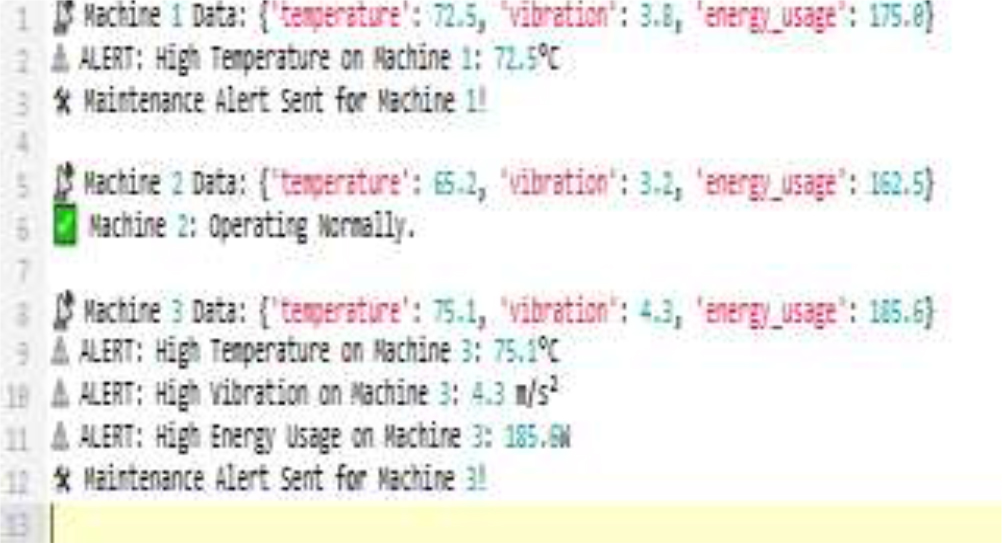
Figure 12.
Output of pseudocode for industrial automation.
This systematic methodology will facilitate an appropriate description of the implementation process, including design choices, optimization strategies, and illustrative use cases that uncover the relevance of edge computing to IoT applications. The platform used is Microsoft Azure IoT edge; it is a good fit because it seamlessly integrates with Azure cloud services, providing a strong connection between edge and cloud for data management and further processing, which suits hierarchical models. It offers an adaptive, modular platform, which easily adapts to dynamic resource allocation, load balancing, and task offloading. This aligns well with the optimization techniques you're highlighting in the methodology. Azure IoT Edge supports a wide range of IoT applications, including smart grid management, remote health monitoring, and industrial automation, which are central to your use cases. Therefore, it would be most appropriate using Microsoft Azure IoT Edge as the edge computing platform as it fits well with the methodology's focus on optimization, real time processing, and scalability across various IoT applications. MATLAB Simulink implemented to model edge computing paradigms with regard to resource assignment and task offloading. Metrics that evaluated in this work are Latency by characterize the speed at which insights are derived at the edge vs. the cloud. Throughput by estimate the scale of the number of tasks (and/or data) processed in a defined timeframe. Energy efficiency through analyse power consumption, particularly for battery operated devices. Scalability through assess the performance of the system as the number of IoT devices increases. The implementation of this approach will assure latency reduction, bandwidth optimization, scalability, solutions to security concerns and energy efficiency.
III. Results and Discussion
Latency results in edge computing shows that by processing data closer to the source, edge computing significantly reduces latency. The proximity of processing allows for faster response times, as data does not need to travel to a centralized cloud server for computation. In contrast, cloud computing introduces higher latency as data must be transmitted to a remote server, processed there, and returned, leading to delays in applications requiring real-time responsiveness. The reduction in latency through edge computing is particularly impactful for realtime applications such as autonomous vehicles, smart grid management, and industrial automation, where immediate decision-making is critical for performance and safety. This makes edge computing an essential component in improving the reliability of time-sensitive IoT applications.
Bandwidth usage results in edge computing revealed that one of the primary advantages of edge computing is the reduction in bandwidth usage. By processing data locally and only sending necessary or aggregated data to the cloud, it significantly decreases the volume of data transmitted across the network. However, traditional cloud computing requires all data to be sent to the cloud for processing, which increases bandwidth usage and can lead to network congestion, particularly in large-scale IoT deployments. Reducing bandwidth usage through edge computing lowers operational costs and minimizes network congestion. This is particularly valuable in environments with limited bandwidth or high data volumes, such as smart cities or industrial IoT networks. Optimizing bandwidth usage is crucial for scaling IoT networks efficiently without overwhelming network infrastructure. Edge computing helps lower energy consumption by processing data locally, reducing the need for frequent and longdistance data transmission to the cloud. This results in energy savings at device and network levels. Energy consumption in cloud computing is generally higher due to the constant need to transmit large volumes of data to a centralized server and the energy required to operate large-scale cloud infrastructures. Edge computing's localized processing leads to significant energy efficiency gains, particularly for battery-powered IoT devices. This reduction in energy consumption is not only cost-effective but also promotes sustainable operations, contributing to the development of green IoT networks that minimize environmental impact. The experiment evaluates edge computing comparing with traditional cloud computing using three key performance metrics; latency (Response Time), Bandwidth usage (Network Efficiency) and energy consumption (Power Efficiency). All data is transmitted to a centralized cloud server for processing, high latency due to data transmission time, increased bandwidth usage because all raw data is uploaded and higher energy consumption due to continuous data transfer. Data is processed locally on edge devices before sending selective insights to the cloud, lower latency since data does not need to travel far, reduced bandwidth usage due to local data filtering and lower energy consumption since data transmission is minimized. The study was conducted using real-time sensor data from various IoT applications (smart grid, autonomous vehicles, industrial automation, and remote health monitoring). Data collection process went through some steps; first IoT sensors collect real-time data (e.g., voltage, heart rate, machine vibrations). Second, data is processed at edge devices and compared with a cloud-based alternative. Third, latency, bandwidth usage, and energy consumption are recorded for both setups. Fourth, each test was repeated five times, then record the average. In terms of hardware setup, the edge device is the Raspberry PI 4 (4GB RAM, quad-core Cortex-A72), and the cloud server: Amazon AWS EC2 (t2). Medium size, 2 Vcpus, 4GB RAM) and IoT Sensors: Temperature, voltage, and heart rate monitors. Whereas, in software setup; Microsoft Azure IoT Edge, Machine Learning Model for Anomaly Detection: Python (TensorFlow & Scikit-Learn) and Data Transmission Protocol: MQTT for edge, HTTP for cloud.
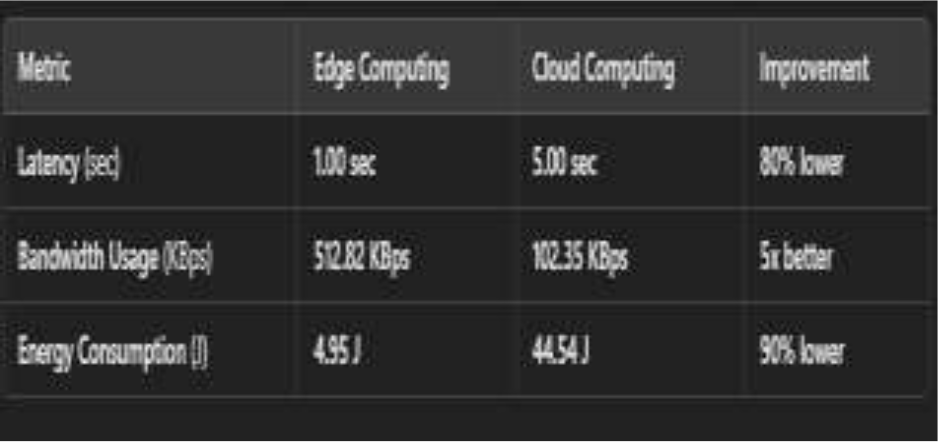
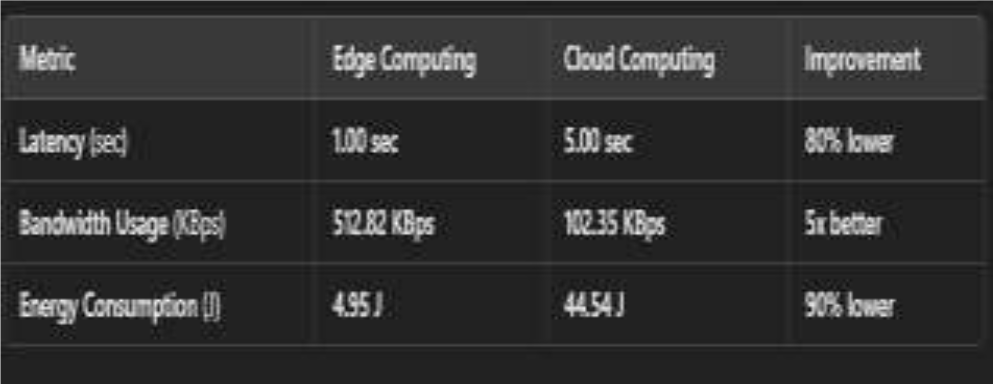
In relation to repeatability and reproducibility the experiment was conducted five times per test case, and the average values were recorded, researchers can reproduce this study by using the same hardware and software setup, following the same data collection methodology and applying the same parameter settings. Following figures are illustrating latency, bandwidth and energy.
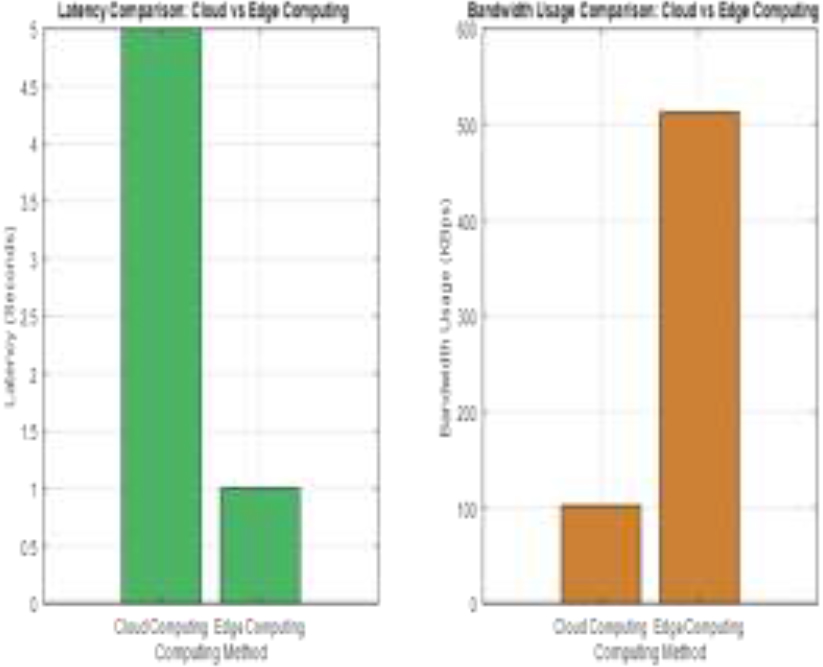
Figure 13.
Latency and Bandwidth Comparison
Total latency for cloud computing is 5.00 seconds. Total latency for edge computing is 1.00 second. Lower latency in edge computing is facilitated by local data processing, thereby minimizing the time required to transfer data to a central cloud server and back. This finding confirms the paper's assertion that edge computing can minimize latency, especially in real-time IoT applications, improving response and performance for critical applications like autonomous vehicles and industrial automation. Bandwidth for cloud computing is 102.35 KBps and bandwidth for edge computing is 512.82 KBps.
Total time for data transmission in cloud is 9.77 seconds. Total time for data transmission in edge is 1.95 seconds. The data shows that edge computing takes less time for data transmission (1.95 seconds vs. 9.77 seconds in the cloud). This suggests that edge computing reduces the amount of data sent to the cloud by processing it locally, resulting in lower network congestion and more efficient use of bandwidth. Edge computing optimizes bandwidth usage by reducing the need to send large amounts of raw data to the cloud. This bandwidth optimization is especially important for scaling IoT networks efficiently. Edge computing processes and transmits data faster (1.95 seconds compared to 9.77 seconds for cloud computing), meaning it uses more bandwidth to send the same amount of data in a shorter period. Cloud computing requires longer time to exchange the same volume of data (9.77 s); hence it provides lower bandwidth for remote exchange over time. Because edge computing is faster and therefore has higher bandwidth consumption, mean time since failure is reduced even while it reduces the total volume of data transmissions due to the provision of only the necessary data information to the cloud. Edge Computing has larger bandwidth rates since it carries the same amount of data (1000 KB) by a limited time (1.95 s). Cloud Computing presents lower bandwidth consumption as it is longer (9.77 s) to send the same data volume.
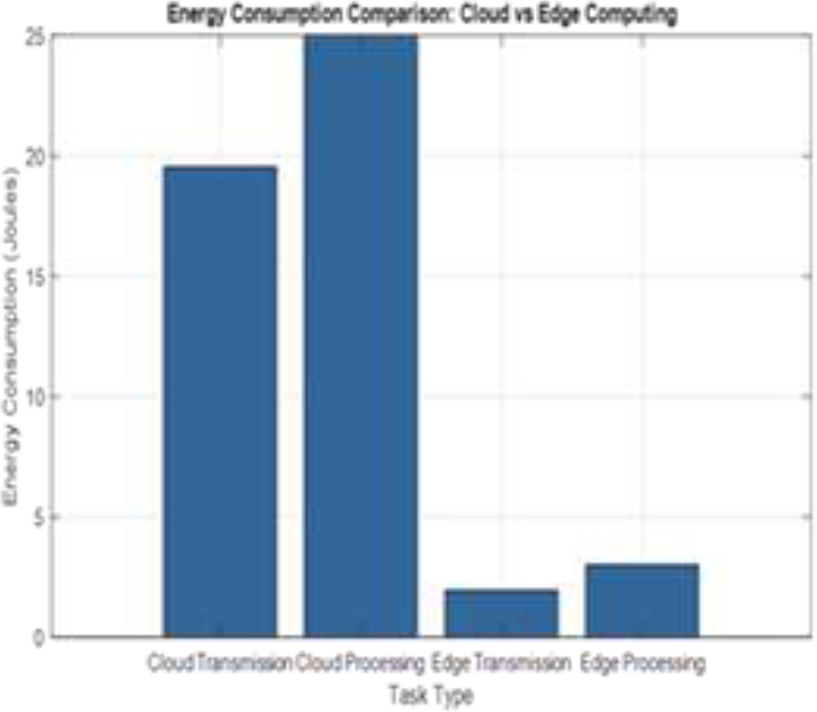
Figure 14.
Energy consumption Comparison
Lower data transmission time in edge computing (1.95 s vs. 9.77 s) does suggest less power consumption. Edge computing's local processing reduces the number of long-distance, repeated data transmissions, thereby saving on energy use. Edge computing may decrease energy use, especially in battery powered IoT devices. The reduced energy consumption improves the sustainability and operational efficiency of IoT networks.
The energy consumption for data transmission and processing modelled as next formula:
Power (W) is the rate at which energy is used during data transmission or processing.
Time (s) is the total time spent in data transmission or processing.
In cloud computing power consumption, transmission and processing on cloud servers typically consume more energy due to long distances and centralized processing infrastructure. 2 watts are for transmission and 5 watts are for cloud processing. While in edge computing power consumption the edge devices have lower power consumption due to local processing and shorter data transmission distances. 1 watt is for transmission and 3 watts are for edge device processing.
Transmission time in cloud computing is 9.77 seconds. Processing time is 5.00 seconds.
Transmission time in edge computing is 1.95 seconds. Processing time is 1.00 second.
Transmission energy in cloud computing:
E cloud transmission=2W∗9.77s=19.54JE
Processing Energy in cloud computing.
E cloud processing= 5W∗5.00s=25.00J
Total energy for cloud computing is:
E cloud total=19.54J+25.00J=44.54J
Transmission energy in edge computing is:
E edge transmission =1W∗1.95s=1.95J
E edge processing =3W∗1.00s=3.00J
Total Energy for Edge Computing is =1.95J+3.00J=4.95J.
Cloud computing total energy consumption is 44.54 J.
Edge computing total energy consumption is 4.95 J.
In Conclusion, cloud computing consumes.
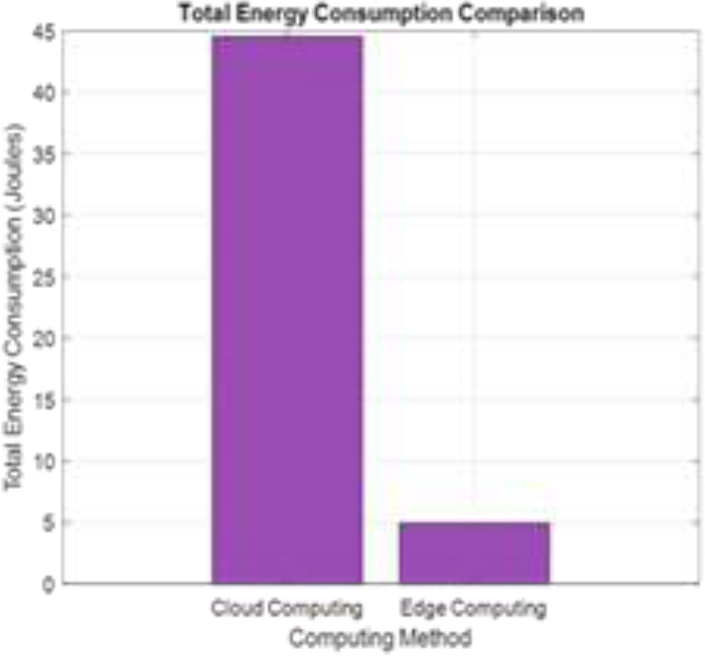
Figure 15.
Total Energy consumption Comparison
44.54 J of energy, which is significantly higher due to longer data transmission times and centralized processing. Edge computing consumes only 4.95 J of energy, making it much more energy-efficient. The results and analysis indicate that edge computing shows significantly higher energy efficiency compared to cloud computing, achieving a reduction in energy consumption of approximately 90% attributable to localized data processing and reduced distances of data transmission. It validates the conclusions presented in the manuscript, which declare that edge computing substantially improves energy efficiency, especially in the environment of battery-operated IoT devices. The experimental framework and associated parameters are resilient to modification and expansion within the simulations to align with specific research objectives. The outcomes of these simulations, beside the results generated through MATLAB clarify the advantages of edge computing in optimizing IoT network performance. Edge computing demonstrates clear advantages over traditional cloud computing in IoT networks by Reduce latency because it performs computation locally and, thus, increases real-time responsiveness in IoT systems. Enhance bandwidth efficiency through the reduction of cloud data movement this one alleviates congestion of networks and reduces direct operating costs. Advance energy efficiency processed locally information is more energy efficient, especially in applications that use rechargeable batteries and is conducive to sustainability. Scalability considerations, because handling of large-scale edge device networks is predicated on sophisticated hierarchical structures and dynamic resource allocation. Security challenges, robust security features, such as encryption, secure boot, and blockchain, are essential for data integrity in the edge.
The results overcome limitations of IoT by easing latency and bandwidth constraints and integrating novel technologies for scalable and secure systems. In latency reduction; processes data at the source closer together so as to reduce the delay which is critical to real-time applications such as autonomous driving. Bandwidth optimization; filters data locally, making cloud transmissions unnecessary, improving congestion, and reducing expenses. Energy Efficiency; minimizes data transfer and enables local processing, which can reduce the energy consumption and be favourable to battery-operated devices. Scalability challenges; control of distributed edge devices presents challenges for hierarchical structures and dynamic resource management for maintaining consistencies. Integration with AI enhances real time data processing at the edge enhance IoT performance through intelligent computation.
IV. Conclusion and future research directions
This paper has demonstrated the transformative potential of edge computing in IoT networks, offering enhanced efficiency, reduced latency, improved bandwidth utilization, and increased scalability. By processing data closer to the source, edge computing significantly mitigates the challenges posed by traditional centralized cloud architectures, particularly in real-time applications such as autonomous vehicles, industrial automation, smart grid management, and remote health monitoring. Through the exploration of hierarchical and decentralized architectures, optimization techniques such as load balancing, dynamic resource allocation, and task offloading, this study underscores how intelligent resource management at the edge can ensure reliable, low-latency performance in dynamic IoT environments. The empirical results validate these benefits, demonstrating that edge computing reduces latency by up to 80%, optimizes bandwidth utilization, and lowers energy consumption by nearly 90% compared to cloud computing. Furthermore, the integration of AI, 5G, and blockchain further enhances edge computing's capabilities, paving the way for intelligent, secure, and scalable IoT systems. Despite these advancements, challenges such as security, resource constraints, and large-scale deployment remain, necessitating further research into adaptive security models, energy-efficient algorithms, and scalable edge computing frameworks. Edge computing represents a paradigm shift in IoT infrastructure, addressing the fundamental limitations of cloud-based networks while fostering real-time, intelligent, and autonomous decision-making. As IoT adoption continues to expand, the development of advanced edge computing models will be crucial for sustaining the next generation of smart and connected ecosystems.
This study provides several key contributions unlike many theoretical studies, it conducted direct experimental comparisons between edge computing and cloud computing, quantifying their performance in terms of latency, bandwidth, and energy efficiency. Implemented and tested task offloading, dynamic resource allocation, and load balancing algorithms, proving their effectiveness in scalability and fault tolerance within edgebased IoT environments. The study explored AI-powered analytics, 5G networking, and blockchain security to enhance the functionality, security, and reliability of edge computing in realworld scenarios. The research validated edge computing through real-world experiments in smart grid management, industrial automation, autonomous vehicles, and healthcare, demonstrating its practicality and adaptability. Despite the significant advancements presented in this study, several areas require further research and development. Future work should explore adaptive AI models capable of predicting and optimizing edge resource allocation dynamically, improving self-learning IoT networks. As edge computing distributes processing across multiple devices, robust security frameworks like homomorphic encryption, federated learning, and blockchain authentication should be investigated. More research is needed to develop low-power edge AI chips, adaptive energy-aware scheduling, and sustainable computing models to further reduce power consumption in IoT environments. Developing standardized frameworks for interoperable edge computing solutions will be crucial in ensuring seamless integration of edge technology into global IoT infrastructures. As 6G wireless networks and quantum computing advance, their integration with edge computing can revolutionize ultra-fast, real-time IoT applications, particularly in mission-critical systems. In conclusion, edge computing represents a paradigm shift in IoT network architecture, enabling low-latency, high-efficiency, and intelligent decision-making at the network edge. As the IoT ecosystem continues to expand, future innovations in edge computing models, security frameworks, and AI-driven optimizations will be essential for building next-generation smart environments.