
1. Introduction
Science education is crucial for the development of any country. According to the National Curriculum Framework for School Education (NCFSE) (2023), deep knowledge, capacities, values, and awareness should be created related to environmental education (EE) for sustainable living. According to Sprague et al. (2021), EE serves as a comprehensive conservation approach, integrating various disciplines to foster learning rooted in local environments and a deep appreciation for nature. Its aim is to cultivate upcoming environmental advocates, scientists, policymakers, and engaged members of society through experiential and contextually relevant educational experiences. As the population increases, environmental challenges also increase, such as pollution, solid waste management, biodiversity loss, resource depletion, and water scarcity (Dowlath et al., 2020).
Nowadays, plastic is ubiquitous in many aspects of daily life, easily available in a wide range of settings, and affects many aspects of human activity. The widespread usage of plastic materials highlights their wide-ranging influence and ease of use in contemporary life. According to Statista (2024), plastic production globally is 400.3 million metric tons in 2022, which is an increase of 1.6% from the previous year. China is the largest producer of plastic. India uses about 6% of all the plastics used worldwide, ranking third after China and the United States in plastic consumption. According to The Times of India (2019), Gujarat tops in plastic export.
Plastic is made of carbon, hydrogen, silicon, chloride, and oxygen. They are made of long chain called a polymer (Seyyedi et al., 2023). As they are light in weight, strong, and easily shaped, they are used widely. Burning of plastic should be avoided because it releases harmful toxins such as furans, CO2, mercury, and halogens, which cause air pollution and also lead to global warming (Abid et al., 2020; Alhazmi et al., 2021).
The plastic needs lots of energy to produce (UNEP, 2023). The plastic causes pollution, which contaminates water and land, it threatens marine life and ecosystems. Their improper disposal also damages the land and makes it infertile (Vanella group, 2022). Plastic degrades into microplastic, and this microplastic harms human health through air, water, and oral intake. Microplastics cause damage to the DNA, reproductive organs, and also affect the development of human beings and marine life. It is also a threat to aquatic animals such as turtles, dolphins, and endangered species (Kumar et al., 2021; Ocean Plastic Pollution, 2012).
The improper plastic waste, such as open burning and incineration, and the production of plastic emits greenhouse gas that leads to climate change, which is Sustainable Development Goal 13 (Kumar et al., 2021). As climate change needs to be solved, the reuse, recycle, or zero waste management strategies should be used. The mismanagement of plastic waste not only leads to SDG 13 but also SDG 14 (Life Below Water) and SDG 15 (Life on Land) by harming marine and terrestrial life, and also gets incorporated into the food, which eventually harms the health of living things.
Habit formation plays a crucial role in the development of sustainable behaviour. In the development of the pro-environmental habit, the intervention should be designed so that habit formation happens positively (Linder et al., 2021; White et al., 2019). The habit formation is well established in the population and then becomes part of the social practice (Verplanken & Whitmarsh, 2021). In the study, it was found that both adolescents and their parents influence each other’s pro-environmental intentions and behaviours, and the adolescents also contribute to their families and society (Žukauskienė et al., 2020).
The aim of this study is to develop the Plastic Waste Management Programme to raise awareness among the students of Vadodara city. By reviewing the literature, the researchers found gap in most of the studies conducted on the household’s behaviour, university students, and pre-primary students. But the researcher was not able to find the study on class VIII students.
2. Research questions
How to ameliorate the challenge related to plastic waste pollution?
What should students do to reduce plastic waste pollution in cities?
2.1. Objective of the studies
To develop the plastic waste management awareness programme for VIII standard students.
To implement a plastic waste management awareness programme in VIII standard students.
To find the effectiveness of the plastic waste management awareness programme through the achievement test of VIII standard students.
To study the effectiveness of the programme in terms of the reaction of students towards it.
2.2. Operational definition of terms
2.2.1. Effectiveness of the programme
It will be judged based on the significant difference in the mean achievement scores of the experimental group and control group in the post-test.
2.3. Plastic waste management programme and its components
During the development of the programme, the topic selection is done through literature review and current topic, and also by reviewing the textbook of science and social science of GSEB English medium, and after that, the components like plastic, plastic pollution, microplastic, plastic waste management and types of bins were selected.
Then, the Herbartian lesson plan was designed based on the components, and then the relevant videos and pictures were selected, and after that, the PowerPoint presentation was made so that the students would easily understand the topics.
The videos were selected carefully so that the students would be able to understand the language, and it was 2–5 min of length so that the students would get a clear idea, and the pictures were also easy to understand. According to the components of the programme, the videos and pictures were used. The lesson plan and PowerPoint were validated by the guide and as per the guide’s advice, the changes were made.
2.4. Validation of the tool
The tool got validated by the five experts in the field of teacher education with biology as their subject. One expert gave suggestions related to the formatting of the tool, a second expert suggested the addition of the question, while a third expert suggested the duplication of the questions and some same answers, and a fourth expert suggested the logical sequence of the questions. In the reaction scale, some suggestions related to the framing of the question were given. After validation of the tools, the researcher incorporated the suggestions as per the guide’s decision.
2.5. Variables of the study
2.5.1. Independent variable
Plastic waste management awareness programme is considered as independent variable for this study.
2.5.2. Dependent variable
Achievement score of the students’ pretest and post-test is considered as the dependent variable of this study.
2.6. Hypothesis
2.6.1. Null hypothesis
There will be no significant difference between the mean score achievement of the control group and the experimental group at the 0.05 level of significance.
2.6.2. Alternate hypothesis
The difference, if any, in the calculated value of the t-test can be attributed to the effectiveness of the intervention programme.
3. Research method
The present study is experimental. A quasi-experimental research design is used by the researcher because no randomization will be done in the selection of the sample. Pretest- post-test equivalent group design is used. The design of the proposed study is as follows.
| Groups | Pre-test | Treatment | Post-test |
|---|---|---|---|
| Experimental group | O1 | X | O2 |
| Control group | O3 | C | O4 |
where O1 and O3 are Pretest. O2 and O4 are Post-test. X stands for Treatment. C stands for Control.
3.1. Population of the study
All the students studying in the VIII standard of GSEB of the academic year 2024–2025 in Vadodara city are considered as the population for this study.
3.2. Sample and sampling techniques
A sample of the study was students of class VIII studying in any primary school. The random sampling technique was used in choosing the school. In the selected schools, there were two divisions of class VIII. With the help of a chit, VIII A was selected as a control group, and VIII B was chosen as the experimental group for the academic year 2024–2025. The school follows co-education system. The students belong to middle-class background, and have diverse mother tongue.
3.3. Tools for data collection
i) Achievement test: The achievement test consists of 40 multiple choice questions, and each contains 1 mark. In this test, topics like plastic, plastic pollution, microplastic, policies related to plastic and plastic waste management, and its techniques are included.
ii) Reaction scale: The reaction scale was prepared to know the reaction of the students regarding the program. The researcher constructed the scale in which students have to tick the appropriate box ranging from strongly agree to strongly disagree. The reaction scale was validated by the expert and changes were done by discussing with guide. The reaction scale consists of 12 questions.
3.4. Data analysis
The programme was analysed by using mean, standard deviation, and t-test and for the reaction scale percentage analysis was done.
4. Result
This study showed that the plastic waste management programme is effective for enhancing waste management strategies. The research data clearly showed that the control group and experimental group had the same level of awareness at the beginning. The plastic waste management programme brought a significant difference in the level of awareness in the experimental group compared to the control group, which showed that the programme was effective. This outcome is strongly shown by the significant differences observed in the post-test scores of both groups. The calculated t-test score (3.66) is higher than the critical t-test (2.68), which shows that the null hypothesis is rejected at the 5% level of significance. Therefore, it can be said that the programme was effective.
The feedback obtained from the students through the reaction scale showed positive results for the programme. They reported that the programme is valuable and impactful, and also raises their awareness related to plastic waste management. The programme also significantly improved the understanding of various topics, including recycling, alternatives to used instead of plastic, microplastics, the harmful effects of plastic waste, etc.
In conclusion, the programme related to plastic waste management had a positive effect on students’ learning, and their feedback also showed that they became aware of plastic waste and how to manage it. Students in the experimental group scored higher in the post-test compared to the control group, showing that the programme helped to improve their understanding. Overall, the programme was effective in increasing both knowledge and awareness about plastic waste management among the students (Table 1, Figure 1).
Table 1
Mean, standard deviation, and t-test value of post test score.
| Sr. No. | No. of Students | Post-test | Mean | Standard deviation | t-value |
|---|---|---|---|---|---|
| 1 | 24 | Control group | 18.09 | 1.27 | 3.66 |
| 2 | 24 | Experimental group | 25.02 | 7.47 |
(t critical value is 2.68 at 23 degree of freedom).
Source: Author’s contribution.
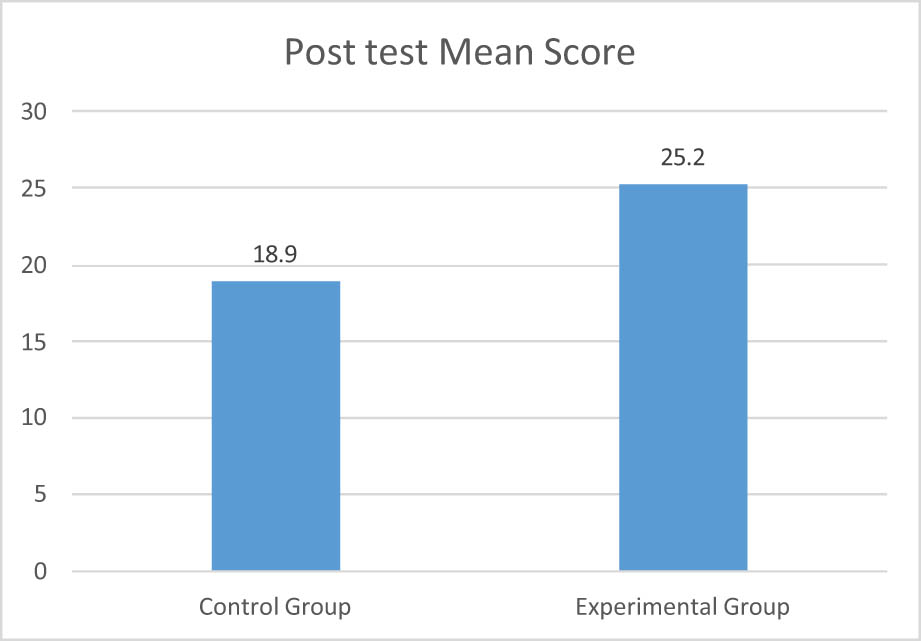
Figure 1
Graphical presentation of post-test mean scores.
Source: Author’s contribution.
5. Discussion
Plastic is significantly increased nowadays, and its management is also necessary. The study was conducted on the VIII standard students studying in the English medium school of Vadodara city. The study aimed to develop awareness in the students regarding plastic waste management with the help of the programme. Through the data analysis, it was found that the null hypothesis was rejected, which shows that the result is significant. However the difference was not much. Probable reasons could be related to this, such as the control group and experiment group were from the same school, sports event in the school, annual day practice was going on ,and perhaps the students might have interacted among themselves during the sports or annual day practice, the programme implementation was bit rushed due to event in the school. The analysis of the reaction scale showed that the students showed a favourable response towards the programme, and they developed a positive environmental attitude. The study conducted by Cheang et al. (2019) on the primary school students found that after the intervention of the plastic waste recycle bin programme, there was a mild increase in the students’ knowledge, attitude, and behaviour, which was also similar to this study.
5.1. Suggestion for further study
The present study was conducted in Vadodara city. Future research could be carried out in different geographical regions to examine whether similar results are observed in diverse cultural and environmental contexts.
As this study did not include a pilot phase, future researchers are encouraged to conduct a pilot study before full-scale implementation. This would help in refining the content, methods, and tools used in the programme.
This study was limited to students of Standard VIII. Future studies can be extended to include learners from lower primary, secondary, higher secondary, and even college Levels. The programme could also be adapted for community-based awareness initiatives.
Further research can explore the use of constructivist teaching approaches, allowing students to actively build knowledge through experience, discussion, and reflection.
The duration of the programme should ideally be extended to 15–21 days, based on the understanding that forming new habits typically requires consistent effort over at least 21 days.
Future programmes may benefit from incorporating experiential learning strategies, which allow students to engage in hands-on activities and real-life problem-solving to deepen their understanding and commitment to plastic waste reduction.
6. Conclusion
The plastic waste management programme proved to be effective in raising awareness and improving knowledge among VIII standard students regarding plastic waste and its management. The programme led to a significant improvement in the post-test scores of the experimental group as compared to the control group, indicating its success. The students showed a positive response to the programme through the reaction scale, suggesting an increased environmental awareness and understanding of crucial topics such as recycling, microplastics, and the harmful effects of plastic. This aligns with the goals of science education, which plays a critical role in shaping informed, responsible, and environmentally conscious citizens. As emphasized in the National Curriculum Framework for School Education (2023), science education must foster deep knowledge, values, and awareness for sustainable living. Through programmes like this, science education can empower students to adopt pro- environmental behaviours and contribute meaningfully to the sustainable development of society.
Funding information
Authors state no funding involved.
Author contributions
Both authors have read and approved the final manuscript and are equally responsible for its content.
Conflict of interest statement
Authors state no conflict of interest.