
1. Introduction
The way in which students are evaluated and the manner in which this assessment is carried out significantly influences the educational experience of students and, implicitly, the way they learn. Students perceive assessment as the most stressful aspect of school life.
Because assessment is a process that tells students what they have learned and how this assessment was conducted by the teacher, most students feel fear and anxiety when they are told that they will be assessed. This feeling of anxiety is present since elementary school, intensifying with age (Crișan & Copaci, 2014). In the preparatory class, assessment is perceived more as a play activity, but, as student progress through primary school, anxiety levels increase.
Academic assessment is a fundamental part of the educational process, providing information about students’ progress and skills. However, for students with disabilities, these assessments can be significant sources of stress and anxiety. Evaluation anxiety is a complex problem that can affect students’ academic performance and well-being, requiring special attention from teachers, psychologists, and education specialists.
Students with disabilities often face multiple barriers in the education system, from the lack of adequate adaptations to negative attitudes from peers and teachers. Anxiety about evaluation can aggravate these difficulties, leading to poor academic performance and affecting their self-esteem.
2. Theoretical framework
Evaluation is a complex intellectual skill that is based on a subjective approach, allowing a person to differentiate between important and unimportant aspects, as well as between good and evil. The concept of evaluation is closely related to values, implying belonging, discovering, criticizing, confirming, or refuting them (Skutil et al., 2018).
The processes involved in evaluation are cognitive and affective in nature. Evaluation inevitably involves relationships, preferences for certain values of evaluators and those evaluated, as well as experiences and attitudes toward various aspects of life.
Evaluation is “a means of training and self-training for educational partners, both actors being significantly influenced by the results obtained. The evaluator reformulates his entire activity according to the results of the evaluation, and the evaluated integrates the appraisals and efficiently develops his own skills and attitudes” (Bonchis et al., 2021).
The literature offers a variety of assessment strategies, including paper-and-pencil tests, portfolios, projects, oral presentations, observations, learning diaries, learning contracts, interviews, and others (Berry, 2010). Paper-and-pencil tests are considered standardized and allow teachers to objectively compare student performance. These tests can include multiple-choice, true, or false items, short questions, essays, or other types of questions that stimulate students’ cognitive thinking. However, many learning skills and outcomes cannot be measured by such tests, which are typically used in summative assessment and tend to focus on memorizing information (Berry, 2010).
Quality education assumes that the learning process is an active construction of knowledge by the learner, an interactive and organic process of reorganization and restructuring (Berry, 2010). The way students are assessed has a major impact on the learning process, and if done correctly, it can stimulate students’ active learning.
Anxiety is a complex and multifactorial psychological phenomenon that can be defined and understood from multiple perspectives, ranging from normal and adaptive to pathological and debilitating (Stein & Sareen, 2015). According to the American Psychological Association (APA), anxiety is described as an emotion characterized by feelings of tension, worrying thoughts, and physical changes, such as increased blood pressure (APA, 2023).
The dimensions of anxiety include somatic, cognitive, emotional, and behavioral aspects. The somatic dimension involves physical symptoms such as muscle tension and sweating, while the cognitive dimension encompasses negative thoughts and excessive worries. Emotionally, anxiety manifests itself through feelings of fear and anxiety, and behaviorally, it can lead to avoidance of anxious situations (Clark & Beck, 2010).
Academic anxiety is a specific form of anxiety related to educational situations and school performance, which can negatively affect pupils and students. This manifests itself in an intense and persistent fear of academic failure, evaluation, and performance below expectations, often leading to the avoidance of these situations and the decrease in academic performance (Zeidner, 1998).
In the case of students with certain special educational needs, psychopedagogical assistance contributes to the educational instructional process, by providing specialized (qualified) support and guidance that takes into account the psychoindividual particularities of the students. Within the psychopedagogical assistance approach, an essential role is played by psychopedagogical counseling, which is based on the relationship between the teacher and the student as a psychopedagogical partnership relationship (Mândrea, 2021, in Orțan, 2021).
Students with disabilities may have intense negative thoughts about their academic abilities, constantly fearing that they will not be able to meet school requirements or that they will be criticized for their performance. They may have difficulty concentrating on tasks and processing information, thus aggravating academic anxiety (Wiener, 2004).
3. Research methodology
The main objective of this article is to identify the level of test anxiety reported by students with disabilities in special and mainstream education. Thus, the research part of this article focuses on highlighting any differences between students depending on the gender of the subject and type of education (special/mass).
These objectives were formulated taking into account the results obtained in the literature, according to which female students feel a higher level of test anxiety compared to male students. In addition, we assume that students in mainstream education will feel a higher level of anxiety toward evaluation, being in a group with students without TSI (specific learning disorders), compared to those in special education, where all students have various disabilities in different forms.
3.1. Research hypotheses
H1. The perceived support from teachers is negatively correlated with evaluation anxiety.
H2. Girls will report higher levels of evaluation anxiety compared to boys.
H3. Students in special education will report different levels of evaluation anxiety compared to students in mainstream education.
3.2. Participants
The group of participants consists of 56 students with disabilities from mainstream and special education in the city of Târgu Neamț and the surrounding areas. Of all the students, 25 have mild intellectual disability and 31 have moderate intellectual disability. In terms of gender, 25 participants are boys and 31 are girls. The students are part of a single-parent family (24 students) and two-parent families (32 students). All the students are from the primary cycle: 28 students with SEN integrated in the mainstream schools from rural area and 28 students from the School Center for Inclusive Education Târgu Neamț.
3.3. Questionnaires
The Evaluation Anxiety Scale is a questionnaire that was completed by the students, with the help of teachers. The scale was developed by Douglas and Benson (2004) and adapted to the Romanian population by Bonchis et al. (2021). The tool consists of 25 items grouped into three dimensions: 11 questions related to the thoughts and concerns dimension (e.g., I think I will get a poor grade), 7 items related to the distracted behavior dimension (e.g., I move my feet under the bench), and 7 items related to the automatic reactions dimension (my hands tremble). For this scale, an alpha Cronbach internal consistency coefficient of α = 0.954 is obtained.
The scale on teachers’ perceived support contains eight items taken from the Learning Climate Questionnaire (LCQ, Williams & Deci, 1996). The scale was validated on the Romanian population (Mihăileasa, 2017). The questionnaire analyzes the learning climate in relation to the support offered to students by teachers/instructors. Thus, students are asked to think about the teachers they come into contact with in the classroom and to choose how they perceive them, through a seven-step Lickert scale. The internal consistency coefficient of α = 0.830 is obtained.
Considering the carrying out of activities with students and teachers from mainstream education, through educational and extracurricular partnerships, there was an opportunity to carry out the research having in the target group students with SEN integrated in mainstream schools from rural area and students with disabilities from the School Center for Inclusive Education Târgu Neamț. For each participant, a set of two questionnaires was completed (one to measure the level of anxiety toward the evaluation and one to measure the perceived support from the teachers), after obtaining the consent of the parents or legal representatives. Given that the students have SEN or with different disabilities, the questions were read by the teachers, and the students mentioned the extent to which each statement represents them.
3.4. Data analysis
The statistical operations used in the practical part of the research were performed through the IBM SPSS Statistics program, version 20. In a first stage, we considered verifying the condition that the study variables are normally distributed to be able to perform the necessary statistical analyses. Thus, this condition was verified by the Skewness method according to which the Skewness and Kurtosis coefficients should fall between the values −3 and +3, for the variable to be normally distributed. The variable anxiety toward evaluation is normally distributed, with the Skewness coefficient having a value of −0.723 (S.E. = 0.319), and the Kurtosis coefficient having a value of −0.458 (S.E. = 0.628). The condition is also respected for the variable perceived support from teachers, which is normally distributed, the Skewness coefficient having the value 0.487 (S.E. = 0.319), and the Kurtosis coefficient having the value −1.600 (S.E. = 0.628). The data are normally distributed, and the hypotheses of the study are verified in the following.
3.5. Results
To test hypothesis 1, Pearson correlation analysis was performed to examine the relationship between perceived teacher support and test anxiety. Results revealed a strong and statistically significant negative correlation between perceived teacher support and overall test anxiety, r = −0.84, p < 0.001. Higher levels of perceived support were associated with lower levels of test anxiety (Table 1).
Table 1
Pearson correlations between test anxiety dimensions and perceived teacher support.
| Variable | 1 | 2 | 3 | 4 |
|---|---|---|---|---|
| 1. Teacher support | — | |||
| 2. Thoughts/concerns | −0.86** | — | ||
| 3. Distracted behavior | −0.79** | −0.81** | — | |
| 4. Automatic reactions | −0.76** | −0.84** | −0.83** | — |
Note. N = 56. **p** < 0.01.
Source: Author’s contribution.
By deeply analyzing the relationship between the dimensions of the variable test anxiety and the variable perceived support from teachers, significant negative correlations were also observed between perceived teacher support and all three dimensions of test anxiety: concerns, distracted behavior, and automatic reactions (all p < 0.001).
Hypothesis 2 was analyzed using independent sample t-Test for independent samples, to compare the means of the two groups of boys and girls obtained at the variable Test anxiety, as well as its three dimensions.
The results of the t-test for independent samples indicate that there is a statistically significant difference in levels of test anxiety between girls and boys: t(54) = −3.090, p = 0.003. According to the data, girls report higher levels of anxiety (M = 91.74) compared to boys (M = 81.96). This confirms the hypothesis that girls experience more anxiety about evaluation than boys.
By analyzing in detail the differences between students (girls and boys) regarding the dimensions of the variable anxiety towards evaluation, the results indicate statistically significant differences in this case as well: thoughts and concerns: t(54) = −2.972, p = 0.004; distracted behavior: t(54) = −2.659, p = 0.010; automatic reactions: t(54) = −3.269, p = 0.002 (Table 2).
Table 2
Independent samples t-test comparing girls and boys on test anxiety dimensions.
| Variable | t | df | p | Mean difference | 95% CI lower | 95% CI upper |
|---|---|---|---|---|---|---|
| Thoughts/concerns | −2.972 | 54 | 0.004 | −3.96 | −6.63 | −1.29 |
| Distracted behavior | −2.659 | 54 | 0.010 | −2.54 | −4.46 | −0.63 |
| Automatic reactions | −3.269 | 54 | 0.002 | −3.29 | −5.30 | −1.27 |
Source: Author’s contribution.
According to the data, girls report higher levels of thoughts and concerns (M = 40.52) compared to boys (M = 36.56) when it comes to evaluation situations. The same happens in the case of behavioral manifestations associated with anxiety, which are more frequent in girls (M = 25.58) than in boys (M = 23.04). Automatic reactions are more common in girls (M = 25.65) compared to boys (M = 22.36) (Figure 1).
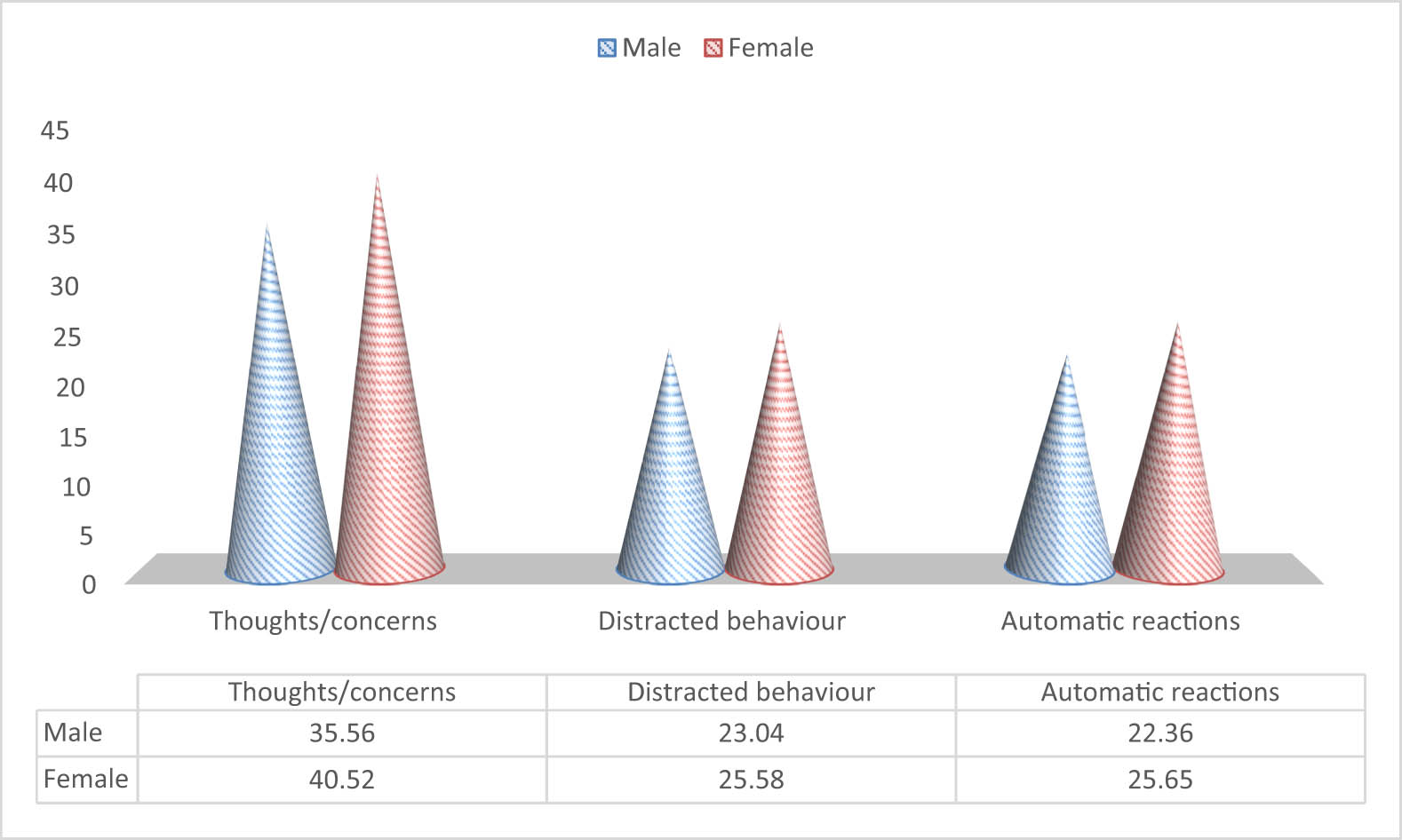
Figure 1
The averages of the two groups of students (girls/boys) at test anxiety dimensions.
Source: Author’s contribution.
To test Hypothesis 3, independent samples t-tests were conducted to compare the averages of the two groups of students (from special education and from mainstream education) obtained at the variable test anxiety, as well as at its three dimensions.
Findings showed a statistically significant difference in overall test anxiety between the two groups, t(31.37) = 11.70, p < 0.001. According to the data, students in mainstream education report higher levels of anxiety (M = 98.00) compared to students in special education (M = 76.75), and this difference is significant (p = 0.000). This supports the hypothesis that students in mainstream education experience more anxiety about evaluation than students in special education.
By analyzing the differences between students (in special and mainstream education) in the dimensions of the variable test anxiety, the results indicate statistically significant differences in this case as well, thoughts and concerns: t(33.05) = 10.967, p = 0.000; distracted behavior: t(32.50) = 9.586, p = 0.000; automatic reactions: t(54) = 10.792, p = 0.000 (Table 3).
Table 3
Independent samples t-test comparing special and mainstream education students.
| Variable | t | df | p | Mean difference | 95% CI lower | 95% CI upper |
|---|---|---|---|---|---|---|
| Thoughts/concerns | 10.967 | 54 | <0.001 | 8.71 | 7.12 | 10.31 |
| Distracted behavior | 9.586 | 54 | <0.001 | 5.89 | 4.66 | 7.13 |
| Automatic reactions | 10.792 | 54 | <0.001 | 6.64 | 5.41 | 7.88 |
Source: Author’s contribution.
According to the data, students in mainstream education report higher levels of thoughts and concerns (M = 43.11) compared to students in special education (M = 34.39) when it comes to assessment situations. The same happens in the case of behavioral manifestations associated with anxiety, which are more frequent in students in mainstream education (M = 27.39) than in students in special education (M = 21.5). Automatic reactions are also more common in mainstream education students (M = 27.5) compared to special education students (M = 20.86) (Figure 2).
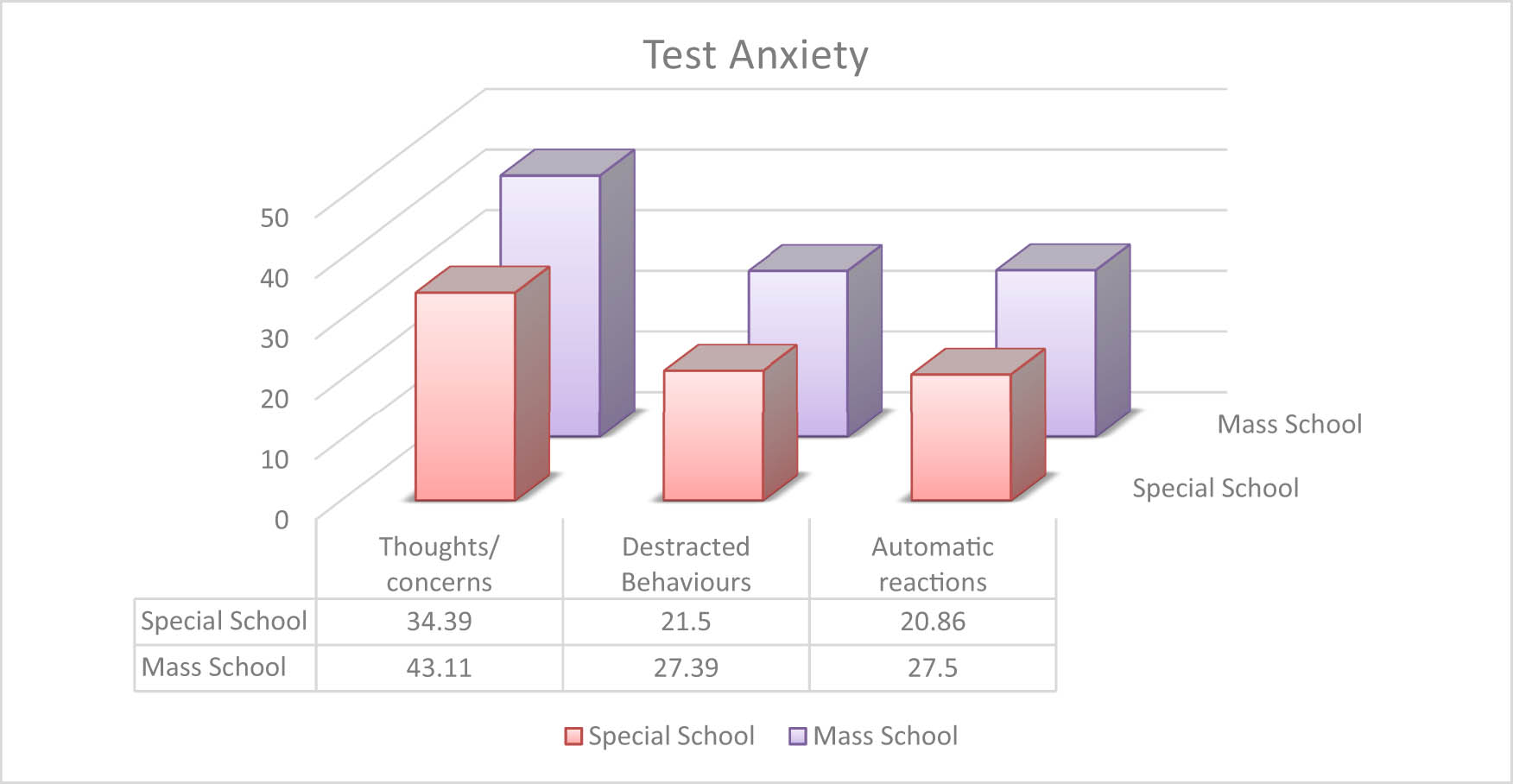
Figure 2
The averages of the two groups of students (from special and mainstream education) at Test Anxiety dimensions.
Source: Author’s contribution.
The hypothesis is confirmed. Test Anxiety about assessment can vary significantly between students with disabilities in special education and students with SEN in mainstream education. These differences are influenced by the educational context, the level of support available, and the specific nature of the disabilities.
4. Discussion
The present study examined test anxiety among students with disabilities, focusing on the role of perceived teacher support, gender differences, and educational context. The findings provide strong support for the proposed hypotheses and contribute to the growing literature on emotional experience in inclusive and special education settings.
Consistent with Hypothesis 1, perceived teacher support was strongly and negatively associated with test anxiety (as well as its dimensions: thoughts and concerns, distracted behavior, and automatic reactions). Students who perceived higher levels of support from their teachers reported fewer anxious thoughts, reduced behavioral distraction, and fewer automatic physiological reactions. These findings underscore the protective role of supportive teacher–student relationships and align with the previous research emphasizing the importance of autonomy-supportive and emotionally responsive teaching practices in reducing academic anxiety.
In line with Hypothesis 2, girls reported significantly higher levels of test anxiety than boys across all measured dimensions. This pattern has been consistently reported in the prior research and may reflect gender-related socialization processes, increased self-evaluative concerns, and heightened academic performance pressure experienced by female students. Studies show that girls tend to report higher levels of evaluation anxiety compared to boys (Chapell et al., 2005). This may be related to cultural and social factors that encourage girls to be more aware of academic performance and feel greater pressure to excel. Girls may have a greater tendency to critically self-evaluate and compare their performance with others, which can amplify anxiety (Zeidner, 1998). Teachers may have different expectations depending on gender and may provide more emotional support to girls, recognizing their tendency to be more anxious. Girls often benefit from stronger social support in the educational setting, which can alleviate anxiety. Teachers’ interactions with boys may be more focused on disciplinary issues and less on emotional support, which can affect how boys manage anxiety about evaluation (Swann & Graddol, 1988).
Regarding Hypothesis 3, students enrolled in mainstream education reported significantly higher levels of test anxiety compared to those in special education. This finding may be explained by differences in instructional pacing, evaluative demands, and perceived social comparison within inclusive classrooms. Students with disabilities in mainstream settings may experience increased pressure to perform at the level of their typically developing peers, thereby intensifying anxiety during evaluative situations.
Special education students benefit from an adapted environment and a more accessible student–teacher relationship, which allows for more personalized attention and specific anxiety reduction strategies. Curriculum and assessment methods are often modified to meet students’ specific needs, reducing pressure and anxiety related to performance. Students with SEN in mainstream education are integrated into regular classrooms, where support may vary depending on the resources available and the level of preparation of teachers to manage special needs. These students may feel greater pressure to perform at the level of their typical peers, which can increase test anxiety (Lindsay, 2007).
5. Conclusions, limits, further research directions
Following the investigative approach, most of the hypotheses were confirmed. Statistical analyses have shown significant and strong correlations between the different dimensions of assessment anxiety: anxious thoughts and concerns, distraction behaviors and automatic reactions, and perceived support from teachers. The main conclusion related to this hypothesis is that perceived support from teachers plays a complex role in reducing anxiety about evaluation. The data showed that students who feel they receive more support and understanding from their teachers experience lower levels of anxiety in assessment situations. It emphasizes the importance of a positive teacher–student relationship and inclusive pedagogical methods that not only support students academically but also help them manage the negative emotions associated with assessments.
Statistical differences by gender showed that girls have a higher level of anxiety about testing compared to boys. Data analysis confirmed this hypothesis, highlighting that girls report, on average, higher levels of anxiety about evaluation compared to boys. This difference can be attributed to sociocultural and psychological factors, such as greater social pressures on girls to perform well academically, as well as differences in coping strategies and expressing emotions.
The research revealed significant differences between the levels of anxiety about evaluation reported by students in special education and those in mainstream education. Special education students reported higher levels of anxiety, which can be attributed to factors such as a sense of stigma, lack of adequate adaptations in assessments, and negative experiences. These results indicate the need to adopt specialized support strategies to reduce the anxiety of these students.
This article highlights the importance of teacher support, gender-specific interventions, and educational adaptations in reducing assessment anxiety in students with disabilities. The results indicate the need for personalized educational strategies, which take into account not only disability but also the gender and experiences of students.
Although this work brings benefits, the research has certain limitations. The group of subjects is small and does not allow the generalization of the results. The exclusive use of Likert-type scales can induce responses influenced by respondents’ desire to provide answers in line with social expectations. The lack of experimental manipulation is another limitation, and future research should include experimental manipulation to explore differences in evaluation anxiety.
Funding information
Author states no funding involved.
Author contributions
The author contributed to the conception and design of the study, data collection, analysis and interpretation, drafting and revising the manuscript, and approved the final version for publication.
Conflict of interest statement
Author states no conflict of interest.